PRESENTED BY:
DEVIKA SHAJI
ESHA NIZAR
LEKSMI B NAIR
NIKHITHA RAMESH
RAHNA V RAJ
DEFINITION
Bladder cancer occur when cells in the bladder
start to grow without control. The bladder is a
hollow ,balloon shaped organ in the lower part
of the abdomen that stores urine.
TYPES
 Urothelial carcinoma
 Adenocarcinoma
 Squamous cell carcinoma
 Small cell carcinoma
EPIDEMIOLOGY
• Globally,bladder cancer is the tenth most common
cancer type in terms of absolute number of cells
with approximately 5,75000 new diagnosis in
2020,more than three quarters occurring in
men.In Indian, bladder cancer is rare malignancy
.The average age of people whom they are
diagnosed is 73.
ANATOMY AND PHYSIOLOGY
ANATOMY
Urinary bladder is a hollow muscular organ which
function as the reservoir for the urine received from the
kidney and to discharge it out periodically.
SHAPE:The empty bladder resembles a four sided
pyramid.It has 4 angles, apex,neck,2lateral angles.
POSITION:When empty situated within the true
pelvis.
PHYSIOLOGY
The bladder has two main functions which are the storage
and emptying of urine.The bladder maintains continence,
by delaying and controlling urination.
HISTOPATHOLOGY
• SITE: Most urothelial tumor arise from the
lateral or posterior wall of the bladder base.
RISK FACTORS
• Cigarette smoking
• Exposure to dye used in the rubber and other
industries.
• Chronic renal calculi
• Chronic lower UTI
• Analgesics
• Radiation
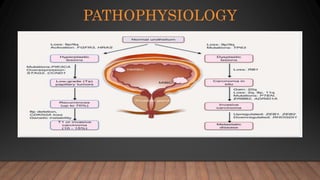
PATHOPHYSIOLOGY
CLINICAL FEATURES
• Hematuria
• Pelvic pain
• Back pain
• Change in urinary habit
• Frequent UTI
• Painful urination
• Burning sensation during urinating
DIAGNOSTIC TEST
• CT Scan
• Ultrasound
• MRI Scan
• Cytoscopy
• Biopsy
• X-Ray
• Intravenous pyelogram
TREATMENT
• Biological therapy
• Surgical management
• Chemotherapy
• Immunotherapy
• Gene therapy
• Radiation therapy
• Surgery-TURBT
COMPLICATIONS
• EARLY: Infection
Bleeding
Bladder perforation
• LATE: Urethral stenosis
Eletrolyte abnormalities
Cystitis
Constipation
NURSING DIAGNOSIS
• Acute pain related to justative voiding symptoms and catheter related
discomfort.
• Impaired urinary elimination related to hematuria and transurethral
surgery.
• Anxiety related to disease condition.
• Deficient knowledge related to progress of disease and future treatment.
BLADDER CANCER copy.pptx

BLADDER CANCER copy.pptx

  • 1.
    PRESENTED BY: DEVIKA SHAJI ESHANIZAR LEKSMI B NAIR NIKHITHA RAMESH RAHNA V RAJ
  • 2.
    DEFINITION Bladder cancer occurwhen cells in the bladder start to grow without control. The bladder is a hollow ,balloon shaped organ in the lower part of the abdomen that stores urine.
  • 4.
    TYPES  Urothelial carcinoma Adenocarcinoma  Squamous cell carcinoma  Small cell carcinoma
  • 5.
    EPIDEMIOLOGY • Globally,bladder canceris the tenth most common cancer type in terms of absolute number of cells with approximately 5,75000 new diagnosis in 2020,more than three quarters occurring in men.In Indian, bladder cancer is rare malignancy .The average age of people whom they are diagnosed is 73.
  • 6.
    ANATOMY AND PHYSIOLOGY ANATOMY Urinarybladder is a hollow muscular organ which function as the reservoir for the urine received from the kidney and to discharge it out periodically. SHAPE:The empty bladder resembles a four sided pyramid.It has 4 angles, apex,neck,2lateral angles. POSITION:When empty situated within the true pelvis.
  • 7.
    PHYSIOLOGY The bladder hastwo main functions which are the storage and emptying of urine.The bladder maintains continence, by delaying and controlling urination.
  • 8.
    HISTOPATHOLOGY • SITE: Mosturothelial tumor arise from the lateral or posterior wall of the bladder base.
  • 9.
    RISK FACTORS • Cigarettesmoking • Exposure to dye used in the rubber and other industries. • Chronic renal calculi • Chronic lower UTI • Analgesics • Radiation
  • 10.
  • 11.
    CLINICAL FEATURES • Hematuria •Pelvic pain • Back pain • Change in urinary habit • Frequent UTI • Painful urination • Burning sensation during urinating
  • 12.
    DIAGNOSTIC TEST • CTScan • Ultrasound • MRI Scan • Cytoscopy • Biopsy • X-Ray • Intravenous pyelogram
  • 13.
    TREATMENT • Biological therapy •Surgical management • Chemotherapy • Immunotherapy • Gene therapy • Radiation therapy • Surgery-TURBT
  • 14.
    COMPLICATIONS • EARLY: Infection Bleeding Bladderperforation • LATE: Urethral stenosis Eletrolyte abnormalities Cystitis Constipation
  • 15.
    NURSING DIAGNOSIS • Acutepain related to justative voiding symptoms and catheter related discomfort. • Impaired urinary elimination related to hematuria and transurethral surgery. • Anxiety related to disease condition. • Deficient knowledge related to progress of disease and future treatment.