Types of Welding Techniques
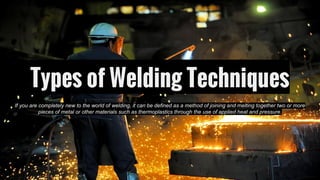
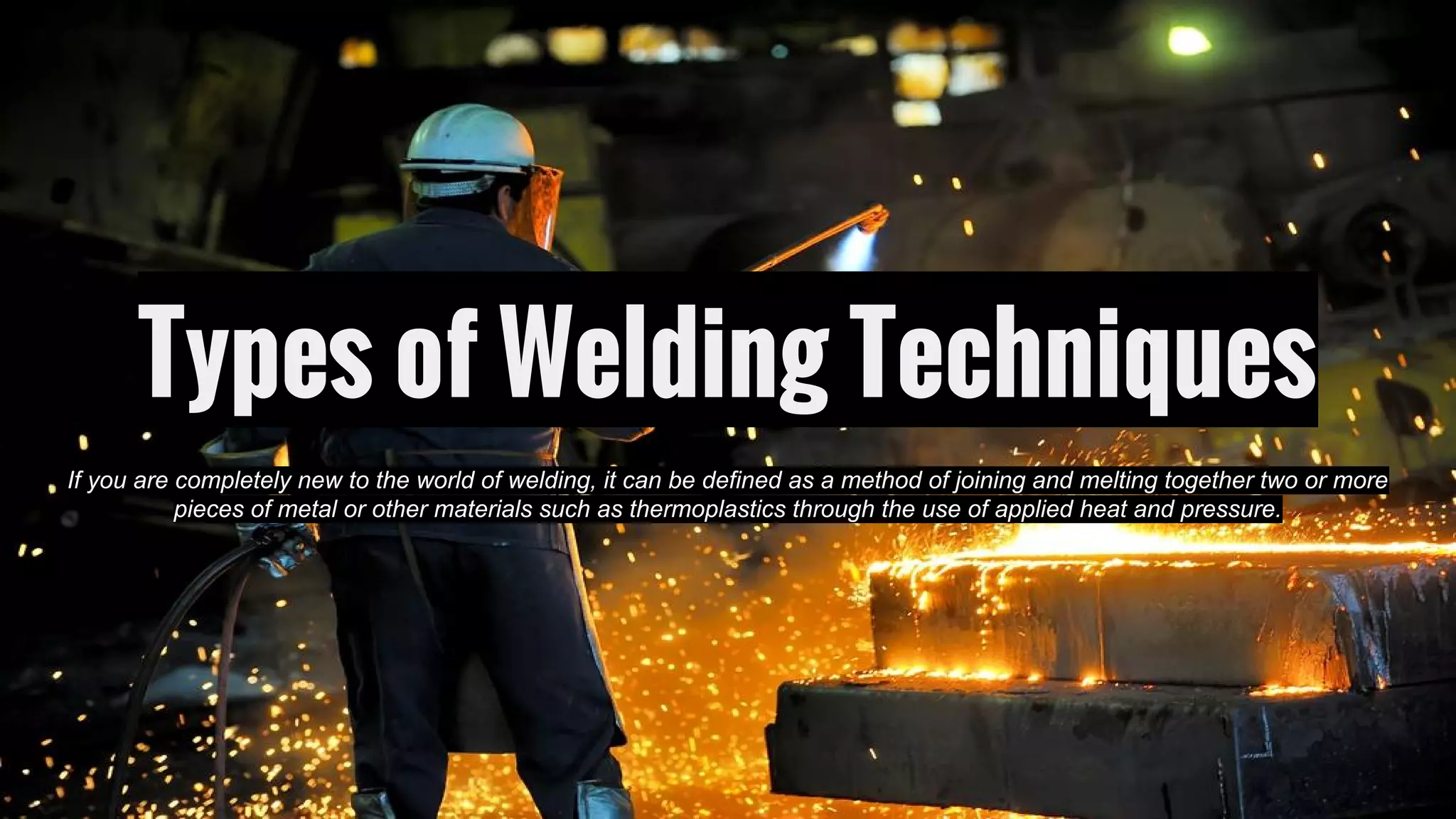
If you are completely new to the world of welding, it can be defined as a method of joining and melting together two or more
pieces of metal or other materials such as thermoplastics through the use of applied heat and pressure.
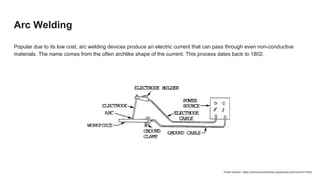
Arc Welding
Popular due to its low cost, arc welding devices produce an electric current that can pass through even non-conductive
materials. The name comes from the often archlike shape of the current. This process dates back to 1802.
Public Domain, https://commons.wikimedia.org/w/index.php?curid=511642
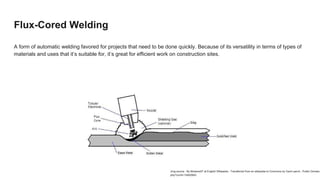
Flux-Cored Welding
A form of automatic welding favored for projects that need to be done quickly. Because of its versatility in terms of types of
materials and uses that it’s suitable for, it’s great for efficient work on construction sites.
(img source : By Mowens57 at English Wikipedia - Transferred from en.wikipedia to Commons by Gavin.perch., Public Domain,
php?curid=13462064)
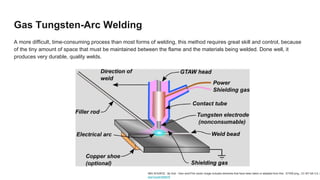
Gas Tungsten-Arc Welding
A more difficult, time-consuming process than most forms of welding, this method requires great skill and control, because
of the tiny amount of space that must be maintained between the flame and the materials being welded. Done well, it
produces very durable, quality welds.
IMG SOURCE : By Duk - Own workThis vector image includes elements that have been taken or adapted from this: GTAW.png., CC BY-SA 3.0, h
php?curid=455575
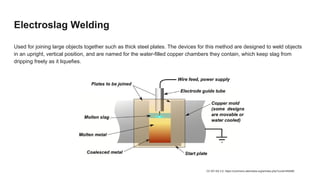
Electroslag Welding
Used for joining large objects together such as thick steel plates. The devices for this method are designed to weld objects
in an upright, vertical position, and are named for the water-filled copper chambers they contain, which keep slag from
dripping freely as it liquefies.
CC BY-SA 3.0, https://commons.wikimedia.org/w/index.php?curid=450485
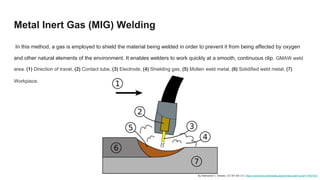
Metal Inert Gas (MIG) Welding
In this method, a gas is employed to shield the material being welded in order to prevent it from being affected by oxygen
and other natural elements of the environment. It enables welders to work quickly at a smooth, continuous clip. GMAW weld
area. (1) Direction of travel, (2) Contact tube, (3) Electrode, (4) Shielding gas, (5) Molten weld metal, (6) Solidified weld metal, (7)
Workpiece.
By Nathaniel C. Sheetz, CC BY-SA 3.0, https://commons.wikimedia.org/w/index.php?curid=17907341
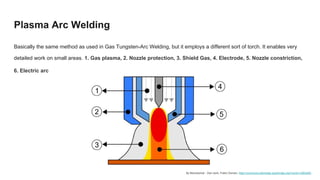
Plasma Arc Welding
Basically the same method as used in Gas Tungsten-Arc Welding, but it employs a different sort of torch. It enables very
detailed work on small areas. 1. Gas plasma, 2. Nozzle protection, 3. Shield Gas, 4. Electrode, 5. Nozzle constriction,
6. Electric arc
By Marcelochal - Own work, Public Domain, https://commons.wikimedia.org/w/index.php?curid=12602493
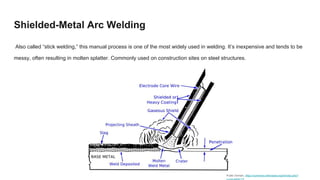
Shielded-Metal Arc Welding
Also called “stick welding,” this manual process is one of the most widely used in welding. It’s inexpensive and tends to be
messy, often resulting in molten splatter. Commonly used on construction sites on steel structures.
Public Domain, https://commons.wikimedia.org/w/index.php?
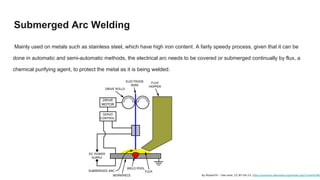
Submerged Arc Welding
Mainly used on metals such as stainless steel, which have high iron content. A fairly speedy process, given that it can be
done in automatic and semi-automatic methods, the electrical arc needs to be covered or submerged continually by flux, a
chemical purifying agent, to protect the metal as it is being welded.
By Wizard191 - Own work, CC BY-SA 3.0, https://commons.wikimedia.org/w/index.php?curid=87945
For More info check out cemetalfabrication.com

Different types of welding techniques

  • 1.
    Types of WeldingTechniques If you are completely new to the world of welding, it can be defined as a method of joining and melting together two or more pieces of metal or other materials such as thermoplastics through the use of applied heat and pressure.
  • 2.
    Arc Welding Popular dueto its low cost, arc welding devices produce an electric current that can pass through even non-conductive materials. The name comes from the often archlike shape of the current. This process dates back to 1802. Public Domain, https://commons.wikimedia.org/w/index.php?curid=511642
  • 3.
    Flux-Cored Welding A formof automatic welding favored for projects that need to be done quickly. Because of its versatility in terms of types of materials and uses that it’s suitable for, it’s great for efficient work on construction sites. (img source : By Mowens57 at English Wikipedia - Transferred from en.wikipedia to Commons by Gavin.perch., Public Domain, php?curid=13462064)
  • 4.
    Gas Tungsten-Arc Welding Amore difficult, time-consuming process than most forms of welding, this method requires great skill and control, because of the tiny amount of space that must be maintained between the flame and the materials being welded. Done well, it produces very durable, quality welds. IMG SOURCE : By Duk - Own workThis vector image includes elements that have been taken or adapted from this: GTAW.png., CC BY-SA 3.0, h php?curid=455575
  • 5.
    Electroslag Welding Used forjoining large objects together such as thick steel plates. The devices for this method are designed to weld objects in an upright, vertical position, and are named for the water-filled copper chambers they contain, which keep slag from dripping freely as it liquefies. CC BY-SA 3.0, https://commons.wikimedia.org/w/index.php?curid=450485
  • 6.
    Metal Inert Gas(MIG) Welding In this method, a gas is employed to shield the material being welded in order to prevent it from being affected by oxygen and other natural elements of the environment. It enables welders to work quickly at a smooth, continuous clip. GMAW weld area. (1) Direction of travel, (2) Contact tube, (3) Electrode, (4) Shielding gas, (5) Molten weld metal, (6) Solidified weld metal, (7) Workpiece. By Nathaniel C. Sheetz, CC BY-SA 3.0, https://commons.wikimedia.org/w/index.php?curid=17907341
  • 7.
    Plasma Arc Welding Basicallythe same method as used in Gas Tungsten-Arc Welding, but it employs a different sort of torch. It enables very detailed work on small areas. 1. Gas plasma, 2. Nozzle protection, 3. Shield Gas, 4. Electrode, 5. Nozzle constriction, 6. Electric arc By Marcelochal - Own work, Public Domain, https://commons.wikimedia.org/w/index.php?curid=12602493
  • 8.
    Shielded-Metal Arc Welding Alsocalled “stick welding,” this manual process is one of the most widely used in welding. It’s inexpensive and tends to be messy, often resulting in molten splatter. Commonly used on construction sites on steel structures. Public Domain, https://commons.wikimedia.org/w/index.php?
  • 9.
    Submerged Arc Welding Mainlyused on metals such as stainless steel, which have high iron content. A fairly speedy process, given that it can be done in automatic and semi-automatic methods, the electrical arc needs to be covered or submerged continually by flux, a chemical purifying agent, to protect the metal as it is being welded. By Wizard191 - Own work, CC BY-SA 3.0, https://commons.wikimedia.org/w/index.php?curid=87945
  • 10.
    For More infocheck out cemetalfabrication.com