TIG Welding Introduction


       by Daniel Min
Outline
► Background
► Advantages    and Disadvantages
► Safety
► Preparation for TIG Welding
► Techniques for Basic Weld Joints
► TIG Shielding Gases
► Welding Parameters
► Tungsten Electrode Selection
► Conclusion

                         ENBE 499    2
Background
► What    is TIG?
   Tungsten Inert Gas
► Also   referred to as GTAW
   Gas Shielded Tungsten Welding
► InTIG welding, a tungsten electrode heats
 the metal you are welding and gas (most
 typically Argon) protects the weld from
 airborne contaminants
                         ENBE 499             3
Background
► TIG   welding uses a non-consumable
  tungsten
► Filler metal, when required, is added by
  hand
► Shielding gas protects the weld and
  tungsten


                     ENBE 499                4
Advantages
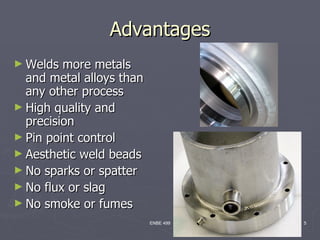
► Welds  more metals
  and metal alloys than
  any other process
► High quality and
  precision
► Pin point control
► Aesthetic weld beads
► No sparks or spatter
► No flux or slag
► No smoke or fumes
                          ENBE 499   5
Disadvantages
           ►    Lower filler metal
                deposition rates
           ►    Good hand-eye
                coordination a required
                skill
           ►    Brighter UV rays than
                other processes
           ►    Slower travel speeds than
                other processes
           ►    Equipment costs tend to
                be higher than other
                processes
     ENBE 499                               6
Safety
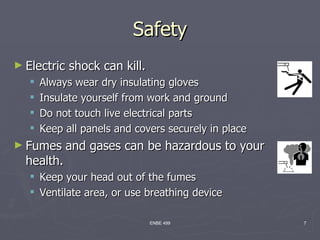
► Electric   shock can kill.
      Always wear dry insulating gloves
      Insulate yourself from work and ground
      Do not touch live electrical parts
      Keep all panels and covers securely in place
► Fumes     and gases can be hazardous to your
  health.

    Keep your head out of the fumes
    Ventilate area, or use breathing device

                               ENBE 499               7
Safety
► Welding    can cause fire or explosion.
     Do not weld near flammable material
     Watch for fire; keep extinguisher nearby
     Do not locate unit over combustible surfaces
     Do not weld on closed containers
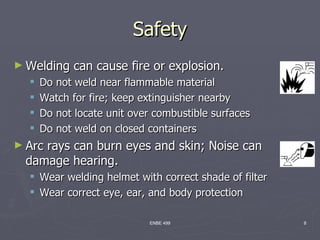
► Arc
    rays can burn eyes and skin; Noise can
 damage hearing.
   Wear welding helmet with correct shade of filter
   Wear correct eye, ear, and body protection

                            ENBE 499                   8
Safety
► Hot   parts can cause injury.
   Allow cooling period before touching welded
    metal
   Wear protective gloves and clothing
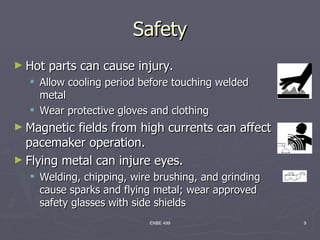
► Magnetic fields from high currents can affect
  pacemaker operation.
► Flying metal can injure eyes.
   Welding, chipping, wire brushing, and grinding
    cause sparks and flying metal; wear approved
    safety glasses with side shields
                          ENBE 499                   9
Safety
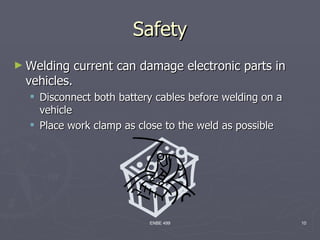
► Welding    current can damage electronic parts in
 vehicles.
   Disconnect both battery cables before welding on a
    vehicle
   Place work clamp as close to the weld as possible


                          ENBE 499                       10
Preparation for TIG Welding
► Basic preparations should be made
  before establishing an arc, including
  base metal prep, set up of the
  machine and its controls
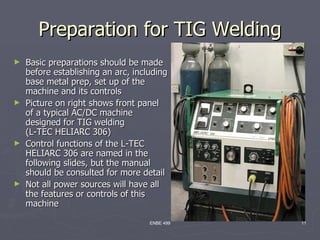
► Picture on right shows front panel
  of a typical AC/DC machine
  designed for TIG welding
  (L-TEC HELIARC 306)
► Control functions of the L-TEC
  HELIARC 306 are named in the
  following slides, but the manual
  should be consulted for more detail
► Not all power sources will have all
  the features or controls of this
  machine

                                  ENBE 499   11
Preparation for TIG Welding
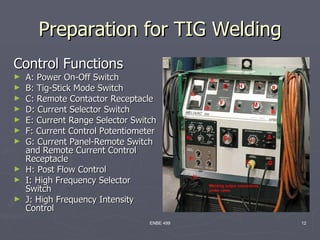
Control Functions
►   A: Power On-Off Switch
►   B: Tig-Stick Mode Switch
►   C: Remote Contactor Receptacle
►   D: Current Selector Switch
►   E: Current Range Selector Switch
►   F: Current Control Potentiometer
►   G: Current Panel-Remote Switch
    and Remote Current Control
    Receptacle
►   H: Post Flow Control
►   I: High Frequency Selector
    Switch
►   J: High Frequency Intensity
    Control
                                  ENBE 499   12
Preparation for TIG Welding
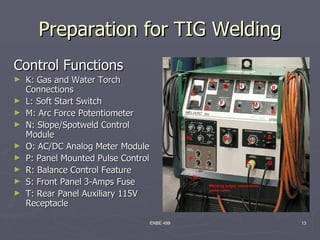
Control Functions
►   K: Gas and Water Torch
    Connections
►   L: Soft Start Switch
►   M: Arc Force Potentiometer
►   N: Slope/Spotweld Control
    Module
►   O: AC/DC Analog Meter Module
►   P: Panel Mounted Pulse Control
►   R: Balance Control Feature
►   S: Front Panel 3-Amps Fuse
►   T: Rear Panel Auxiliary 115V
    Receptacle

                                 ENBE 499   13
Preparation for TIG Welding
Preparing the Weld Joint
► Many  problems are a direct result of using
  improper methods to prepare the weld joint
► One of the most common is the improper use of
  grinding wheels
► Soft materials like aluminum may get embedded
  with abrasive particles resulting in excessive
  porosity
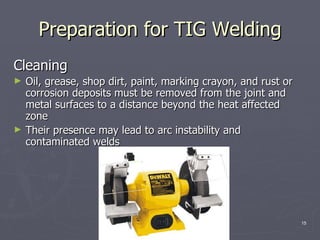
► Grinding wheels should be cleaned and dedicated
  only to the material being welded
                       ENBE 499                     14
Preparation for TIG Welding
Cleaning
►   Oil, grease, shop dirt, paint, marking crayon, and rust or
    corrosion deposits must be removed from the joint and
    metal surfaces to a distance beyond the heat affected
    zone
►   Their presence may lead to arc instability and
    contaminated welds


                              ENBE 499                           15
Preparation for TIG Welding
Preparing Aluminum for Welding
► Very  susceptible to contaminants
► Surface oxide must be removed
► Special abrasive wheels are available for
  aluminum
► Stainless steel wire brushes recommended
► Both sides of the joint should be cleaned if
  it contains foreign material
                      ENBE 499                   16
Preparation for TIG Welding
Preparing Stainless Steel for Welding
► Should  be thoroughly cleaned
► Foreign material may cause porosity in
  welds and carburetion of the surface which
  decreases the corrosion resistance
► Stainless steel wire brushes recommended


                     ENBE 499                  17
Preparation for TIG Welding
Preparing Titanium for Welding
► Essential  that weld area and filler metal be cleaned
► Mill scale, oil, grease, dirt, grinding dust, and any
  other contamination must be removed
► If titanium is scale free, only degreasing required
► Joint should be brushed with stainless steel wire
  brush and degreased with acetone
► Be cautious of fine titanium dust particles as they
  are flammable

                         ENBE 499                     18
Preparation for TIG Welding
Preparing Mild Steel for Welding
► Should  be mechanically cleaned
► Scale, rust, paint, oil, grease, or any surface
  contaminants should be removed


                      ENBE 499                  19
Techniques for Basic Weld Joints
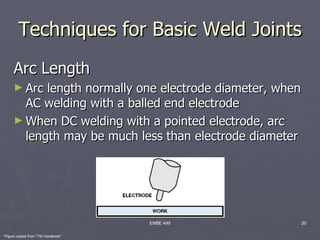
      Arc Length
      ► Arc length normally one electrode diameter, when
        AC welding with a balled end electrode
      ► When DC welding with a pointed electrode, arc
        length may be much less than electrode diameter


                                     ENBE 499              20

*Figure copied from “TIG Handbook”
Techniques for Basic Weld Joints
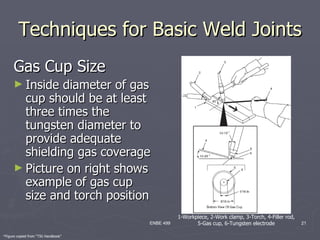
      Gas Cup Size
      ► Inside diameter of gas
        cup should be at least
        three times the
        tungsten diameter to
        provide adequate
        shielding gas coverage
      ► Picture on right shows
        example of gas cup
        size and torch position
                                                1-Workpiece, 2-Work clamp, 3-Torch, 4-Filler rod,
                                     ENBE 499          5-Gas cup, 6-Tungsten electrode              21

*Figure copied from “TIG Handbook”
Techniques for Basic Weld Joints
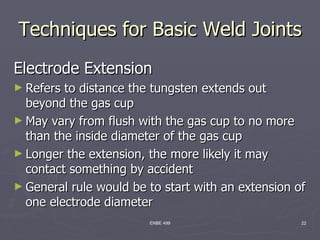
Electrode Extension
► Refers to distance the tungsten extends out
  beyond the gas cup
► May vary from flush with the gas cup to no more
  than the inside diameter of the gas cup
► Longer the extension, the more likely it may
  contact something by accident
► General rule would be to start with an extension of
  one electrode diameter
                        ENBE 499                    22
Techniques for Basic Weld Joints
                                     Arc Starting with High
                                      Frequency
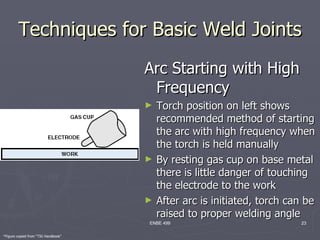
                                     ►   Torch position on left shows
                                         recommended method of starting
                                         the arc with high frequency when
                                         the torch is held manually
                                     ►   By resting gas cup on base metal
                                         there is little danger of touching
                                         the electrode to the work
                                     ►   After arc is initiated, torch can be
                                         raised to proper welding angle
                                     ENBE 499                            23

*Figure copied from “TIG Handbook”
Techniques for Basic Weld Joints
      Manual Torch Movement


                                     ENBE 499   24

*Figure copied from “TIG Handbook”
Techniques for Basic Weld Joints
Manual Torch Movement
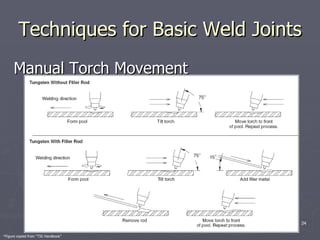
► Torch  and filler rod must be moved progressively
  and smoothly so the weld pool, the hot filler rod
  end, and the solidifying weld are not exposed to
  air that will contaminate the weld metal area or
  heat affected zone
► When arc is turned off, postflow of shielding gas
  should shield the weld pool, electrode, and hot
  end of the filler rod
                        ENBE 499                      25
Techniques for Basic Weld Joints
      Butt Weld and
       Stringer Bead
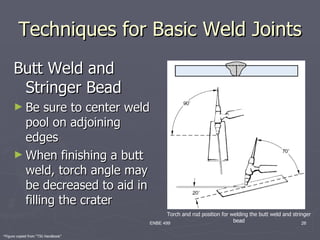
      ► Be   sure to center weld
        pool on adjoining
        edges
      ► When finishing a butt
        weld, torch angle may
        be decreased to aid in
        filling the crater
                                            Torch and rod position for welding the butt weld and stringer
                                     ENBE 499                           bead                         26

*Figure copied from “TIG Handbook”
Techniques for Basic Weld Joints
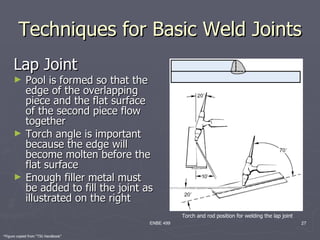
      Lap Joint
      ►      Pool is formed so that the
             edge of the overlapping
             piece and the flat surface
             of the second piece flow
             together
      ►      Torch angle is important
             because the edge will
             become molten before the
             flat surface
      ►      Enough filler metal must
             be added to fill the joint as
             illustrated on the right
                                                    Torch and rod position for welding the lap joint
                                         ENBE 499                                                      27

*Figure copied from “TIG Handbook”
Techniques for Basic Weld Joints
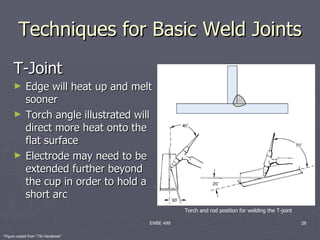
      T-Joint
      ►      Edge will heat up and melt
             sooner
      ►      Torch angle illustrated will
             direct more heat onto the
             flat surface
      ►      Electrode may need to be
             extended further beyond
             the cup in order to hold a
             short arc
                                                   Torch and rod position for welding the T-joint

                                        ENBE 499                                                    28

*Figure copied from “TIG Handbook”
Techniques for Basic Weld Joints
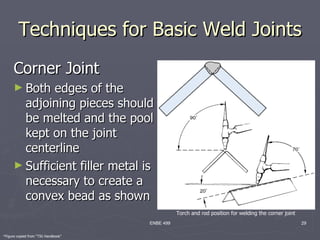
      Corner Joint
      ► Both  edges of the
        adjoining pieces should
        be melted and the pool
        kept on the joint
        centerline
      ► Sufficient filler metal is
        necessary to create a
        convex bead as shown
                                                Torch and rod position for welding the corner joint
                                     ENBE 499                                                         29

*Figure copied from “TIG Handbook”
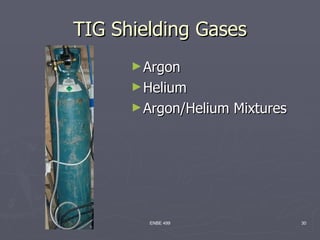
TIG Shielding Gases
      ► Argon
      ► Helium
      ► Argon/Helium   Mixtures


        ENBE 499                  30
TIG Shielding Gases
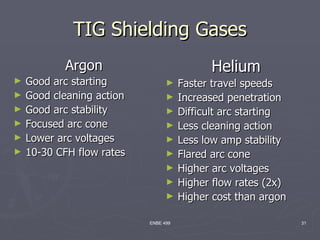
           Argon                            Helium
►   Good arc starting            ►    Faster travel speeds
►   Good cleaning action         ►    Increased penetration
►   Good arc stability           ►    Difficult arc starting
►   Focused arc cone             ►    Less cleaning action
►   Lower arc voltages           ►    Less low amp stability
►   10-30 CFH flow rates         ►    Flared arc cone
                                 ►    Higher arc voltages
                                 ►    Higher flow rates (2x)
                                 ►    Higher cost than argon

                           ENBE 499                            31
TIG Shielding Gases
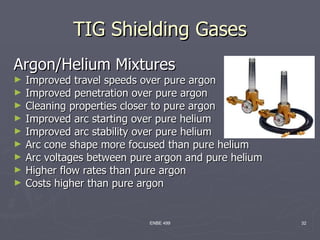
Argon/Helium Mixtures
►   Improved travel speeds over pure argon
►   Improved penetration over pure argon
►   Cleaning properties closer to pure argon
►   Improved arc starting over pure helium
►   Improved arc stability over pure helium
►   Arc cone shape more focused than pure helium
►   Arc voltages between pure argon and pure helium
►   Higher flow rates than pure argon
►   Costs higher than pure argon


                            ENBE 499                  32
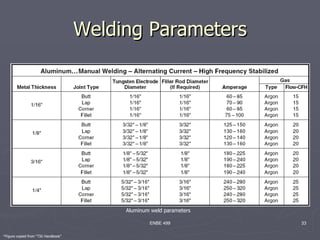
Welding Parameters


                                          Aluminum weld parameters

                                                  ENBE 499           33

*Figure copied from “TIG Handbook”
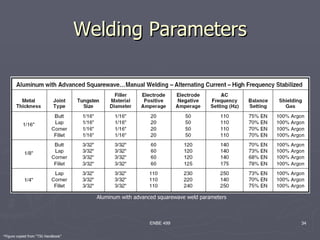
Welding Parameters


                                       Aluminum with advanced squarewave weld parameters


                                                           ENBE 499                        34

*Figure copied from “TIG Handbook”
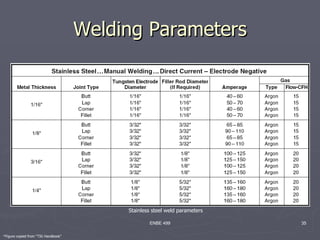
Welding Parameters


                                          Stainless steel weld parameters

                                                  ENBE 499                  35

*Figure copied from “TIG Handbook”
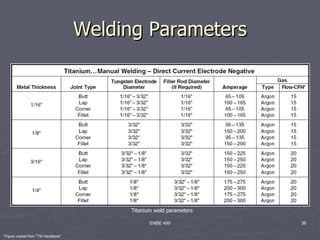
Welding Parameters


                                          Titanium weld parameters

                                                 ENBE 499            36

*Figure copied from “TIG Handbook”
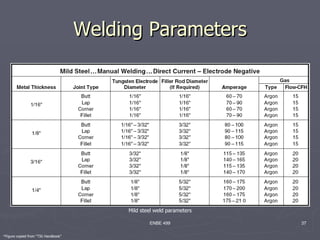
Welding Parameters


                                          Mild steel weld parameters

                                                  ENBE 499             37

*Figure copied from “TIG Handbook”
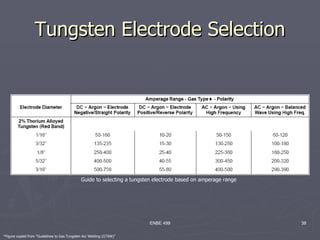
Tungsten Electrode Selection


                                              Guide to selecting a tungsten electrode based on amperage range


                                                                         ENBE 499                               38

*Figure copied from “Guidelines to Gas Tungsten Arc Welding (GTAW)”
Conclusion
►   TIG welding is an exciting skill that proves itself useful in
    countless applications
►   Because it welds more metal and metal alloys than any
    other process, TIG welding should be regarded as an
    important tool where experience is the teacher
►   Welding parameters and tungsten electrode selection
    tables are recommended values and should be used as a
    guideline
►   Information presented here is only the tip of the iceberg,
    and further research and hands-on involvement should be
    pursued to be comprehensive


                               ENBE 499                             39
References
►   “Gas tungsten arc welding.” Wikipedia.
    http://en.wikipedia.org/wiki/Gas_tungsten_arc_welding. 19 February
    2008.
►   “Guidelines to Gas Tungsten Arc Welding (GTAW).” Miller Electric Mfg
    Co. July 2003.
►   “Installation and Operating Instructions for HELIARC 306 Welding
    Power Supply.” L-TEC Welding and Cutting Systems. January 1988.
►   “TIG Handbook.” Miller Electric Mfg Co. July 2003.
►   “TIG Welding.” American Metallurgical Consultants.
    http://www.weldingengineer.com/1tig.htm. 18 October 2007.
►   “TIG Welding Tips.” Miller Electric Mfg Co.
    http://www.millerwelds.com/education/tech_tips/TIG_tips. 29 January
    2008.

                                  ENBE 499                            40

Gtaw 03

  • 1.
  • 2.
    Outline ► Background ► Advantages and Disadvantages ► Safety ► Preparation for TIG Welding ► Techniques for Basic Weld Joints ► TIG Shielding Gases ► Welding Parameters ► Tungsten Electrode Selection ► Conclusion ENBE 499 2
  • 3.
    Background ► What is TIG?  Tungsten Inert Gas ► Also referred to as GTAW  Gas Shielded Tungsten Welding ► InTIG welding, a tungsten electrode heats the metal you are welding and gas (most typically Argon) protects the weld from airborne contaminants ENBE 499 3
  • 4.
    Background ► TIG welding uses a non-consumable tungsten ► Filler metal, when required, is added by hand ► Shielding gas protects the weld and tungsten ENBE 499 4
  • 5.
    Advantages ► Welds more metals and metal alloys than any other process ► High quality and precision ► Pin point control ► Aesthetic weld beads ► No sparks or spatter ► No flux or slag ► No smoke or fumes ENBE 499 5
  • 6.
    Disadvantages ► Lower filler metal deposition rates ► Good hand-eye coordination a required skill ► Brighter UV rays than other processes ► Slower travel speeds than other processes ► Equipment costs tend to be higher than other processes ENBE 499 6
  • 7.
    Safety ► Electric shock can kill.  Always wear dry insulating gloves  Insulate yourself from work and ground  Do not touch live electrical parts  Keep all panels and covers securely in place ► Fumes and gases can be hazardous to your health.  Keep your head out of the fumes  Ventilate area, or use breathing device ENBE 499 7
  • 8.
    Safety ► Welding can cause fire or explosion.  Do not weld near flammable material  Watch for fire; keep extinguisher nearby  Do not locate unit over combustible surfaces  Do not weld on closed containers ► Arc rays can burn eyes and skin; Noise can damage hearing.  Wear welding helmet with correct shade of filter  Wear correct eye, ear, and body protection ENBE 499 8
  • 9.
    Safety ► Hot parts can cause injury.  Allow cooling period before touching welded metal  Wear protective gloves and clothing ► Magnetic fields from high currents can affect pacemaker operation. ► Flying metal can injure eyes.  Welding, chipping, wire brushing, and grinding cause sparks and flying metal; wear approved safety glasses with side shields ENBE 499 9
  • 10.
    Safety ► Welding current can damage electronic parts in vehicles.  Disconnect both battery cables before welding on a vehicle  Place work clamp as close to the weld as possible ENBE 499 10
  • 11.
    Preparation for TIGWelding ► Basic preparations should be made before establishing an arc, including base metal prep, set up of the machine and its controls ► Picture on right shows front panel of a typical AC/DC machine designed for TIG welding (L-TEC HELIARC 306) ► Control functions of the L-TEC HELIARC 306 are named in the following slides, but the manual should be consulted for more detail ► Not all power sources will have all the features or controls of this machine ENBE 499 11
  • 12.
    Preparation for TIGWelding Control Functions ► A: Power On-Off Switch ► B: Tig-Stick Mode Switch ► C: Remote Contactor Receptacle ► D: Current Selector Switch ► E: Current Range Selector Switch ► F: Current Control Potentiometer ► G: Current Panel-Remote Switch and Remote Current Control Receptacle ► H: Post Flow Control ► I: High Frequency Selector Switch ► J: High Frequency Intensity Control ENBE 499 12
  • 13.
    Preparation for TIGWelding Control Functions ► K: Gas and Water Torch Connections ► L: Soft Start Switch ► M: Arc Force Potentiometer ► N: Slope/Spotweld Control Module ► O: AC/DC Analog Meter Module ► P: Panel Mounted Pulse Control ► R: Balance Control Feature ► S: Front Panel 3-Amps Fuse ► T: Rear Panel Auxiliary 115V Receptacle ENBE 499 13
  • 14.
    Preparation for TIGWelding Preparing the Weld Joint ► Many problems are a direct result of using improper methods to prepare the weld joint ► One of the most common is the improper use of grinding wheels ► Soft materials like aluminum may get embedded with abrasive particles resulting in excessive porosity ► Grinding wheels should be cleaned and dedicated only to the material being welded ENBE 499 14
  • 15.
    Preparation for TIGWelding Cleaning ► Oil, grease, shop dirt, paint, marking crayon, and rust or corrosion deposits must be removed from the joint and metal surfaces to a distance beyond the heat affected zone ► Their presence may lead to arc instability and contaminated welds ENBE 499 15
  • 16.
    Preparation for TIGWelding Preparing Aluminum for Welding ► Very susceptible to contaminants ► Surface oxide must be removed ► Special abrasive wheels are available for aluminum ► Stainless steel wire brushes recommended ► Both sides of the joint should be cleaned if it contains foreign material ENBE 499 16
  • 17.
    Preparation for TIGWelding Preparing Stainless Steel for Welding ► Should be thoroughly cleaned ► Foreign material may cause porosity in welds and carburetion of the surface which decreases the corrosion resistance ► Stainless steel wire brushes recommended ENBE 499 17
  • 18.
    Preparation for TIGWelding Preparing Titanium for Welding ► Essential that weld area and filler metal be cleaned ► Mill scale, oil, grease, dirt, grinding dust, and any other contamination must be removed ► If titanium is scale free, only degreasing required ► Joint should be brushed with stainless steel wire brush and degreased with acetone ► Be cautious of fine titanium dust particles as they are flammable ENBE 499 18
  • 19.
    Preparation for TIGWelding Preparing Mild Steel for Welding ► Should be mechanically cleaned ► Scale, rust, paint, oil, grease, or any surface contaminants should be removed ENBE 499 19
  • 20.
    Techniques for BasicWeld Joints Arc Length ► Arc length normally one electrode diameter, when AC welding with a balled end electrode ► When DC welding with a pointed electrode, arc length may be much less than electrode diameter ENBE 499 20 *Figure copied from “TIG Handbook”
  • 21.
    Techniques for BasicWeld Joints Gas Cup Size ► Inside diameter of gas cup should be at least three times the tungsten diameter to provide adequate shielding gas coverage ► Picture on right shows example of gas cup size and torch position 1-Workpiece, 2-Work clamp, 3-Torch, 4-Filler rod, ENBE 499 5-Gas cup, 6-Tungsten electrode 21 *Figure copied from “TIG Handbook”
  • 22.
    Techniques for BasicWeld Joints Electrode Extension ► Refers to distance the tungsten extends out beyond the gas cup ► May vary from flush with the gas cup to no more than the inside diameter of the gas cup ► Longer the extension, the more likely it may contact something by accident ► General rule would be to start with an extension of one electrode diameter ENBE 499 22
  • 23.
    Techniques for BasicWeld Joints Arc Starting with High Frequency ► Torch position on left shows recommended method of starting the arc with high frequency when the torch is held manually ► By resting gas cup on base metal there is little danger of touching the electrode to the work ► After arc is initiated, torch can be raised to proper welding angle ENBE 499 23 *Figure copied from “TIG Handbook”
  • 24.
    Techniques for BasicWeld Joints Manual Torch Movement ENBE 499 24 *Figure copied from “TIG Handbook”
  • 25.
    Techniques for BasicWeld Joints Manual Torch Movement ► Torch and filler rod must be moved progressively and smoothly so the weld pool, the hot filler rod end, and the solidifying weld are not exposed to air that will contaminate the weld metal area or heat affected zone ► When arc is turned off, postflow of shielding gas should shield the weld pool, electrode, and hot end of the filler rod ENBE 499 25
  • 26.
    Techniques for BasicWeld Joints Butt Weld and Stringer Bead ► Be sure to center weld pool on adjoining edges ► When finishing a butt weld, torch angle may be decreased to aid in filling the crater Torch and rod position for welding the butt weld and stringer ENBE 499 bead 26 *Figure copied from “TIG Handbook”
  • 27.
    Techniques for BasicWeld Joints Lap Joint ► Pool is formed so that the edge of the overlapping piece and the flat surface of the second piece flow together ► Torch angle is important because the edge will become molten before the flat surface ► Enough filler metal must be added to fill the joint as illustrated on the right Torch and rod position for welding the lap joint ENBE 499 27 *Figure copied from “TIG Handbook”
  • 28.
    Techniques for BasicWeld Joints T-Joint ► Edge will heat up and melt sooner ► Torch angle illustrated will direct more heat onto the flat surface ► Electrode may need to be extended further beyond the cup in order to hold a short arc Torch and rod position for welding the T-joint ENBE 499 28 *Figure copied from “TIG Handbook”
  • 29.
    Techniques for BasicWeld Joints Corner Joint ► Both edges of the adjoining pieces should be melted and the pool kept on the joint centerline ► Sufficient filler metal is necessary to create a convex bead as shown Torch and rod position for welding the corner joint ENBE 499 29 *Figure copied from “TIG Handbook”
  • 30.
    TIG Shielding Gases ► Argon ► Helium ► Argon/Helium Mixtures ENBE 499 30
  • 31.
    TIG Shielding Gases Argon Helium ► Good arc starting ► Faster travel speeds ► Good cleaning action ► Increased penetration ► Good arc stability ► Difficult arc starting ► Focused arc cone ► Less cleaning action ► Lower arc voltages ► Less low amp stability ► 10-30 CFH flow rates ► Flared arc cone ► Higher arc voltages ► Higher flow rates (2x) ► Higher cost than argon ENBE 499 31
  • 32.
    TIG Shielding Gases Argon/HeliumMixtures ► Improved travel speeds over pure argon ► Improved penetration over pure argon ► Cleaning properties closer to pure argon ► Improved arc starting over pure helium ► Improved arc stability over pure helium ► Arc cone shape more focused than pure helium ► Arc voltages between pure argon and pure helium ► Higher flow rates than pure argon ► Costs higher than pure argon ENBE 499 32
  • 33.
    Welding Parameters Aluminum weld parameters ENBE 499 33 *Figure copied from “TIG Handbook”
  • 34.
    Welding Parameters Aluminum with advanced squarewave weld parameters ENBE 499 34 *Figure copied from “TIG Handbook”
  • 35.
    Welding Parameters Stainless steel weld parameters ENBE 499 35 *Figure copied from “TIG Handbook”
  • 36.
    Welding Parameters Titanium weld parameters ENBE 499 36 *Figure copied from “TIG Handbook”
  • 37.
    Welding Parameters Mild steel weld parameters ENBE 499 37 *Figure copied from “TIG Handbook”
  • 38.
    Tungsten Electrode Selection Guide to selecting a tungsten electrode based on amperage range ENBE 499 38 *Figure copied from “Guidelines to Gas Tungsten Arc Welding (GTAW)”
  • 39.
    Conclusion ► TIG welding is an exciting skill that proves itself useful in countless applications ► Because it welds more metal and metal alloys than any other process, TIG welding should be regarded as an important tool where experience is the teacher ► Welding parameters and tungsten electrode selection tables are recommended values and should be used as a guideline ► Information presented here is only the tip of the iceberg, and further research and hands-on involvement should be pursued to be comprehensive ENBE 499 39
  • 40.
    References ► “Gas tungsten arc welding.” Wikipedia. http://en.wikipedia.org/wiki/Gas_tungsten_arc_welding. 19 February 2008. ► “Guidelines to Gas Tungsten Arc Welding (GTAW).” Miller Electric Mfg Co. July 2003. ► “Installation and Operating Instructions for HELIARC 306 Welding Power Supply.” L-TEC Welding and Cutting Systems. January 1988. ► “TIG Handbook.” Miller Electric Mfg Co. July 2003. ► “TIG Welding.” American Metallurgical Consultants. http://www.weldingengineer.com/1tig.htm. 18 October 2007. ► “TIG Welding Tips.” Miller Electric Mfg Co. http://www.millerwelds.com/education/tech_tips/TIG_tips. 29 January 2008. ENBE 499 40