TYPES OF TEST ITEMS
Presented by: Surekha V S
Assistant Professor in Commerce Education
Sree Vivekananda Teacher Education Centre, Akkikkavu.
TYPES OF TEST ITEMS
 Free response
 Fixed response
 Objective type test items
 Short answer type test items
 Essay type test items
Objective type test items
• Responses are fixed and objective.
• Number of questions.
• Short duration for answering.
• Scoring is quite objective.
• Easily scored
• Easy to administer & control
• More valid & reliable
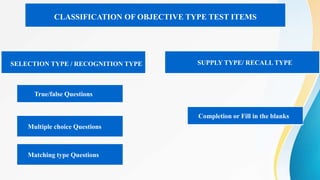
CLASSIFICATION OF OBJECTIVE TYPE TEST ITEMS
SELECTION TYPE / RECOGNITION TYPE SUPPLY TYPE/ RECALL TYPE
True/false Questions
Multiple choice Questions
Completion or Fill in the blanks
Matching type Questions
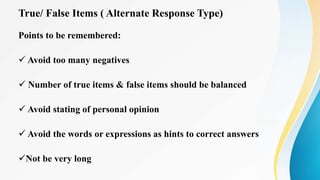
True/ False Items ( Alternate Response Type)
Points to be remembered:
 Avoid too many negatives
 Number of true items & false items should be balanced
 Avoid stating of personal opinion
 Avoid the words or expressions as hints to correct answers
Not be very long
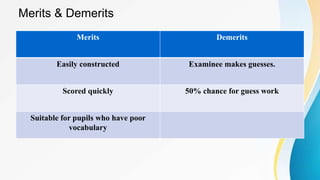
Merits & Demerits
Merits Demerits
Easily constructed Examinee makes guesses.
Scored quickly 50% chance for guess work
Suitable for pupils who have poor
vocabulary
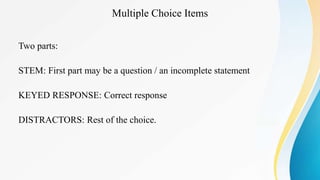
Multiple Choice Items
Two parts:
STEM: First part may be a question / an incomplete statement
KEYED RESPONSE: Correct response
DISTRACTORS: Rest of the choice.
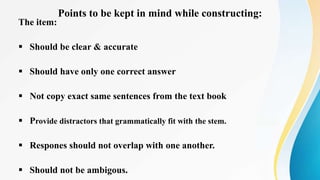
Points to be kept in mind while constructing:
The item:
 Should be clear & accurate
 Should have only one correct answer
 Not copy exact same sentences from the text book
 Provide distractors that grammatically fit with the stem.
 Respones should not overlap with one another.
 Should not be ambigous.
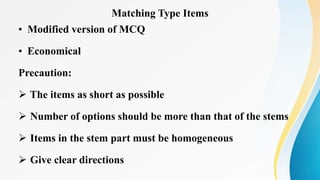
Matching Type Items
• Modified version of MCQ
• Economical
Precaution:
 The items as short as possible
 Number of options should be more than that of the stems
 Items in the stem part must be homogeneous
 Give clear directions
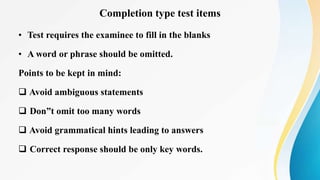
Completion type test items
• Test requires the examinee to fill in the blanks
• A word or phrase should be omitted.
Points to be kept in mind:
 Avoid ambiguous statements
 Don”t omit too many words
 Avoid grammatical hints leading to answers
 Correct response should be only key words.
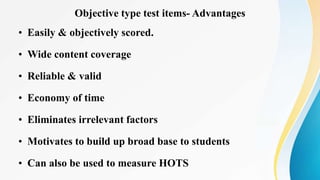
Objective type test items- Advantages
• Easily & objectively scored.
• Wide content coverage
• Reliable & valid
• Economy of time
• Eliminates irrelevant factors
• Motivates to build up broad base to students
• Can also be used to measure HOTS
Limitations
• Possibility of guessing
• Difficulty to prepare good items
• Problem of cheating
• Takes more time to construct
• High printing cost
• Inefficient in testing complicated skills
• Content validity cannot be tested
Short Answer type test items
• Question having 3 value points at the most
• Can be answered by a word or a few sentences
• Uses direct question
• Lies between objective & essay type test items
• Value points- points to be credit in the correct answer
• Expected length of the answer should be very short
• Can be answered in few seconds
• Covering wide content area
Advantages
• Wide area should be covered
• Easy to construct
• Little opportunity for guessing
• Helpful in interpreting of charts, diagrams etc.
Disadvantages
• More subjective
• Develop poor study habits
• Mechanical scoring can not be possible
Essay type test items
• Traditional
• Free response
Advantages
• Easy to construct
• Simple administration
• Used to measure complex skills
• Examinee can get the opportunity to respond freely
• Promote originality & creativity
• Reduce the chance for spot copying
Disadvantages
• Subjective
• Content coverage is not possible
• Develop poor study habits
• Not valid & reliable
• Develops unhealthy competition
• Leads to selective study

Types of test items

  • 1.
    TYPES OF TESTITEMS Presented by: Surekha V S Assistant Professor in Commerce Education Sree Vivekananda Teacher Education Centre, Akkikkavu.
  • 2.
    TYPES OF TESTITEMS  Free response  Fixed response  Objective type test items  Short answer type test items  Essay type test items
  • 3.
    Objective type testitems • Responses are fixed and objective. • Number of questions. • Short duration for answering. • Scoring is quite objective. • Easily scored • Easy to administer & control • More valid & reliable
  • 4.
    CLASSIFICATION OF OBJECTIVETYPE TEST ITEMS SELECTION TYPE / RECOGNITION TYPE SUPPLY TYPE/ RECALL TYPE True/false Questions Multiple choice Questions Completion or Fill in the blanks Matching type Questions
  • 5.
    True/ False Items( Alternate Response Type) Points to be remembered:  Avoid too many negatives  Number of true items & false items should be balanced  Avoid stating of personal opinion  Avoid the words or expressions as hints to correct answers Not be very long
  • 6.
    Merits & Demerits MeritsDemerits Easily constructed Examinee makes guesses. Scored quickly 50% chance for guess work Suitable for pupils who have poor vocabulary
  • 7.
    Multiple Choice Items Twoparts: STEM: First part may be a question / an incomplete statement KEYED RESPONSE: Correct response DISTRACTORS: Rest of the choice.
  • 8.
    Points to bekept in mind while constructing: The item:  Should be clear & accurate  Should have only one correct answer  Not copy exact same sentences from the text book  Provide distractors that grammatically fit with the stem.  Respones should not overlap with one another.  Should not be ambigous.
  • 9.
    Matching Type Items •Modified version of MCQ • Economical Precaution:  The items as short as possible  Number of options should be more than that of the stems  Items in the stem part must be homogeneous  Give clear directions
  • 10.
    Completion type testitems • Test requires the examinee to fill in the blanks • A word or phrase should be omitted. Points to be kept in mind:  Avoid ambiguous statements  Don”t omit too many words  Avoid grammatical hints leading to answers  Correct response should be only key words.
  • 11.
    Objective type testitems- Advantages • Easily & objectively scored. • Wide content coverage • Reliable & valid • Economy of time • Eliminates irrelevant factors • Motivates to build up broad base to students • Can also be used to measure HOTS
  • 12.
    Limitations • Possibility ofguessing • Difficulty to prepare good items • Problem of cheating • Takes more time to construct • High printing cost • Inefficient in testing complicated skills • Content validity cannot be tested
  • 13.
    Short Answer typetest items • Question having 3 value points at the most • Can be answered by a word or a few sentences • Uses direct question • Lies between objective & essay type test items • Value points- points to be credit in the correct answer • Expected length of the answer should be very short • Can be answered in few seconds • Covering wide content area
  • 14.
    Advantages • Wide areashould be covered • Easy to construct • Little opportunity for guessing • Helpful in interpreting of charts, diagrams etc.
  • 15.
    Disadvantages • More subjective •Develop poor study habits • Mechanical scoring can not be possible
  • 16.
    Essay type testitems • Traditional • Free response
  • 17.
    Advantages • Easy toconstruct • Simple administration • Used to measure complex skills • Examinee can get the opportunity to respond freely • Promote originality & creativity • Reduce the chance for spot copying
  • 18.
    Disadvantages • Subjective • Contentcoverage is not possible • Develop poor study habits • Not valid & reliable • Develops unhealthy competition • Leads to selective study