MATERIAL SCIENCE AND ENGINEERING
Classification
Of
S
te
e
ls
R
E
F
E
R
E
N
C
E
S
 Materials Science and Engineering, V
.Raghavan,
Fifth Edition, Prentice Hall of India Pvt. Ltd., New
Delhi, 2004.
 Materials Science and Engineering: An Introduction,
William D. Callister
John Wiley & Sons, 2010.
ONLINE - Nptel
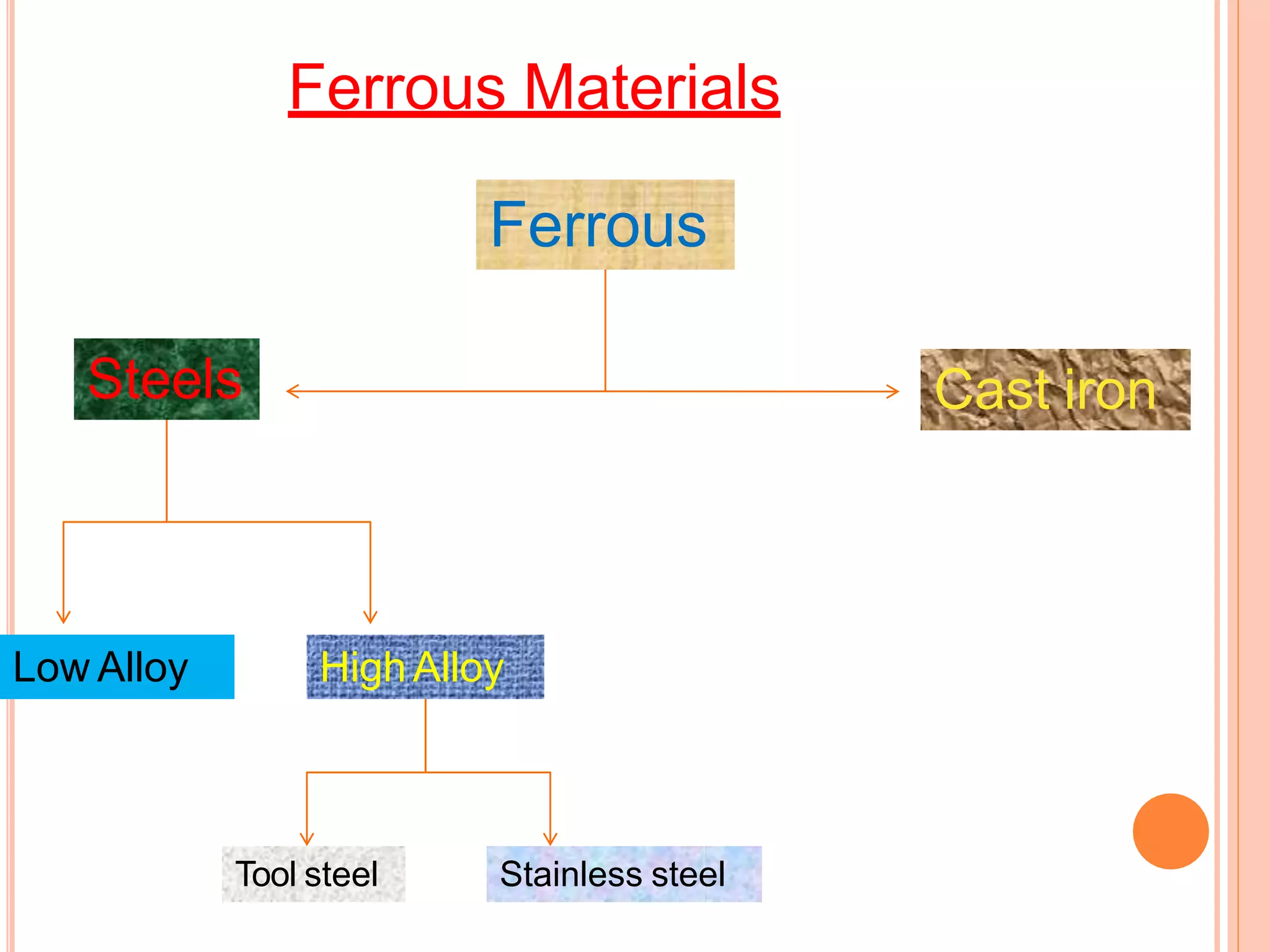
Ferrous Materials
Ferrous
Steels Cast iron
Low Alloy HighAlloy
Tool steel Stainless steel
CLASSIFICATION OF STEELS
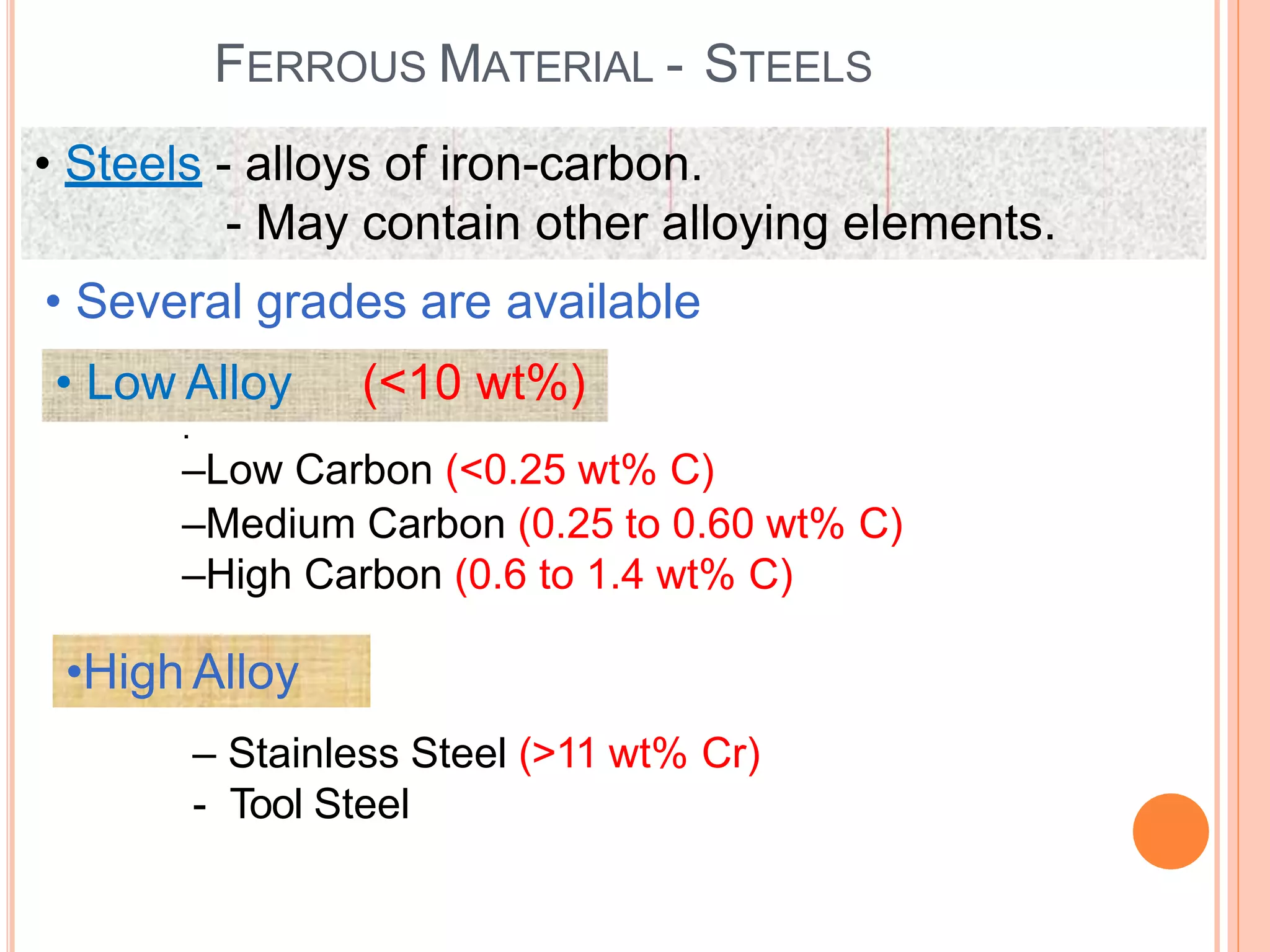
FERROUS MATERIAL - STEELS
• Steels - alloys of iron-carbon.
- May contain other alloying elements.
• Several grades are available
• Low Alloy (<10 wt%)
.
–Low Carbon (<0.25 wt% C)
–Medium Carbon (0.25 to 0.60 wt% C)
–High Carbon (0.6 to 1.4 wt% C)
•High Alloy
– Stainless Steel (>11 wt% Cr)
- Tool Steel
EFFECT OF CARBON ON PROPERTIES OF STEELS
Low Carbon Steel
- Also known as Mild Steel
- Tensile strength of 555 N/mm
- Hardness of 140 BHN
- Bright fibrous structure
-Tough , malleable , ductile and more elastic than
wrought iron
- Melting point 1410
Low Carbon Steel
Plain carbon steels - very low content of alloying elements
and small amounts of Mn.
Most abundant grade of steel is low carbon steel –
greatest quantity produced; least expensive.
Not responsive to heat treatment; cold working needed to
improve the strength.
Good Weldability and machinability
High Strength, Low Alloy (HSLA) steels - alloying elements
(like Cu, V, Ni and Mo) up to 10 wt %; have higher strengths
and may be heat treated.
LOW CARBON STEEL
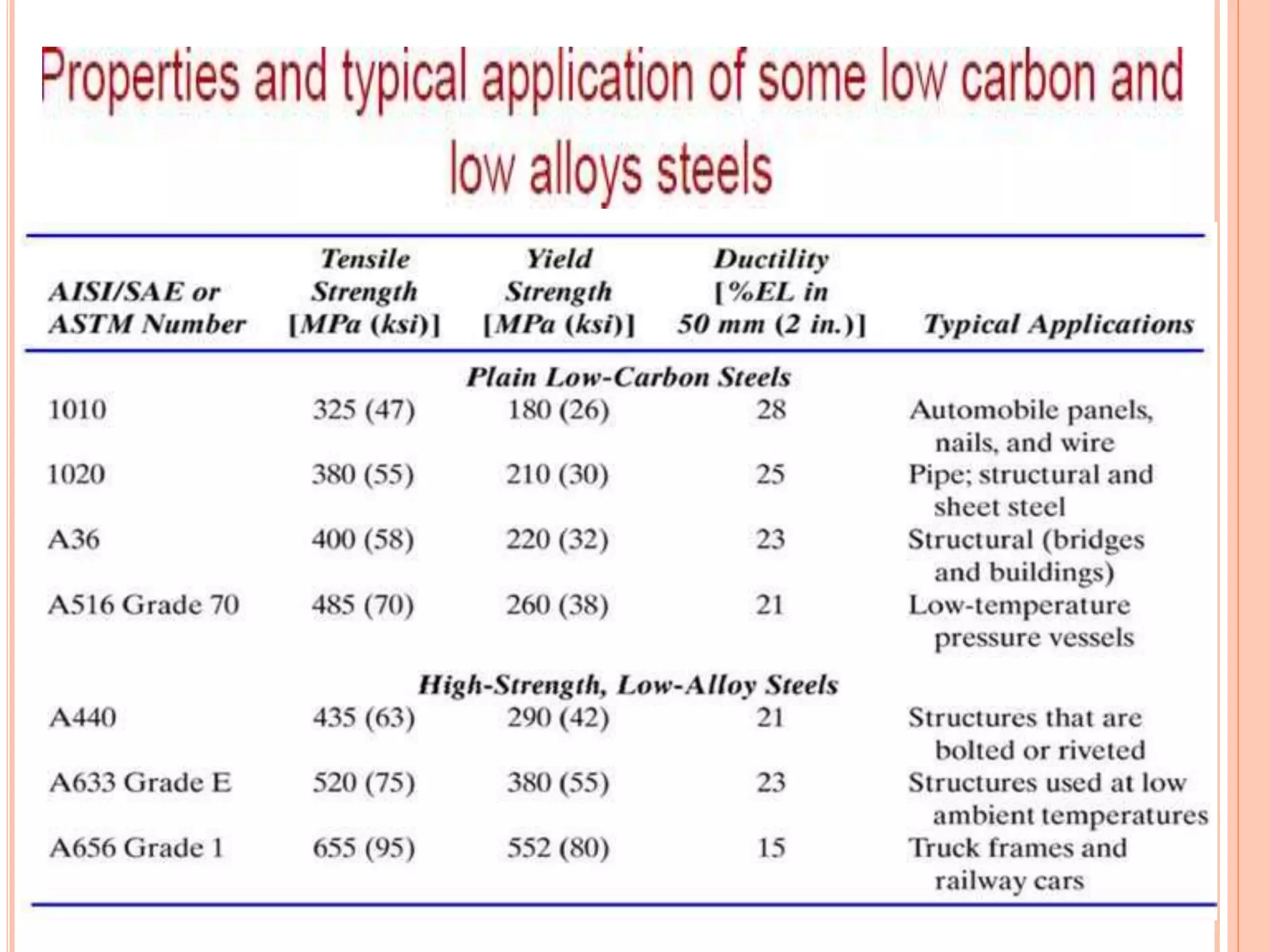
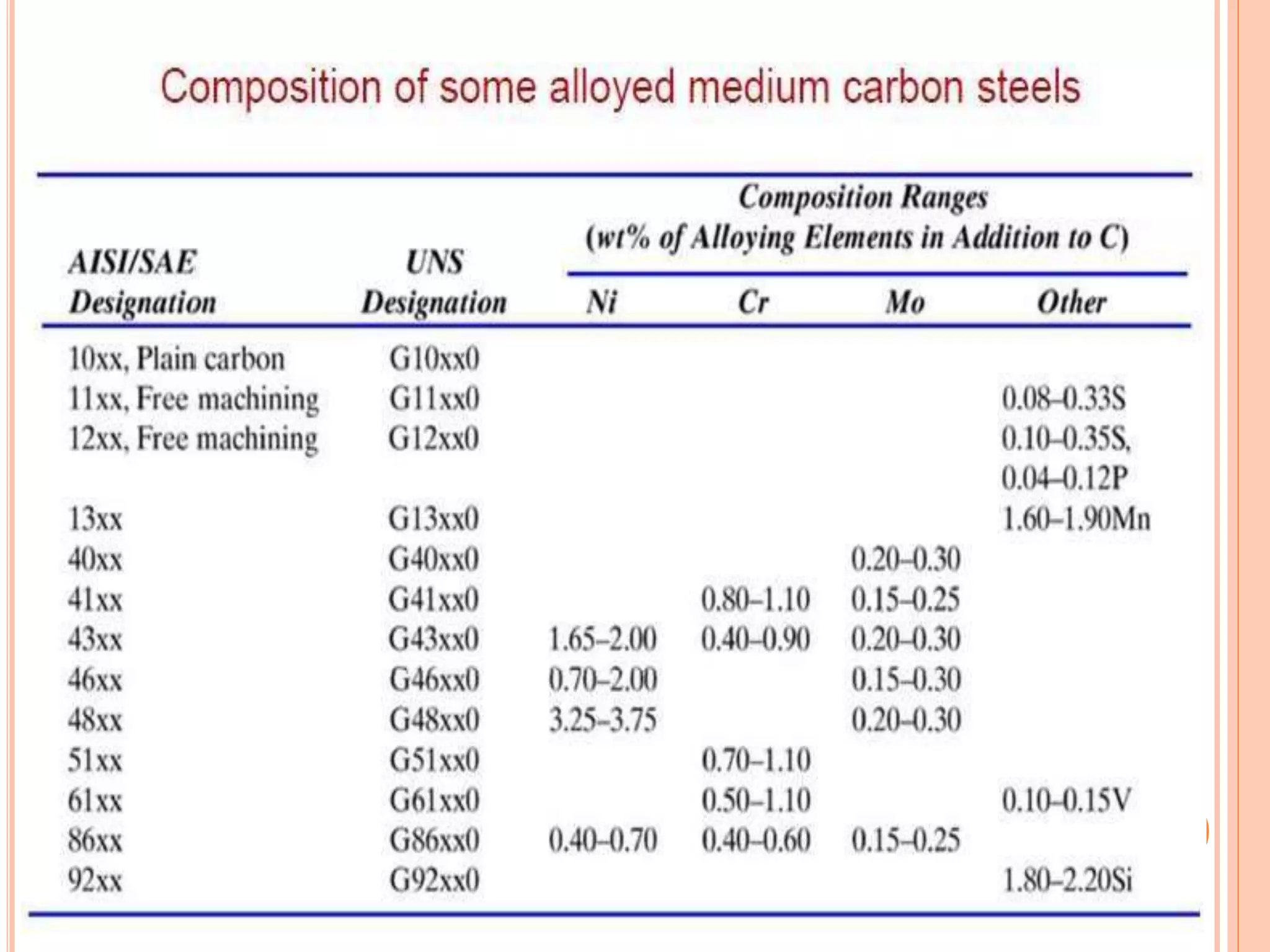
Compositions of some low carbon and low alloy steels
AISI - SAE CLASSIFICATION SYSTEM
AISI XXXX
American Iron and Steel Institute (AISI)
 classifies alloys by chemistry
 4 digit number
1st number is the major alloyingelement
2nd number designates the subgroup alloying
element OR the relative percent of primary
alloying element.
last two numbers approximate amount of
carbon (expresses in 0.01%)
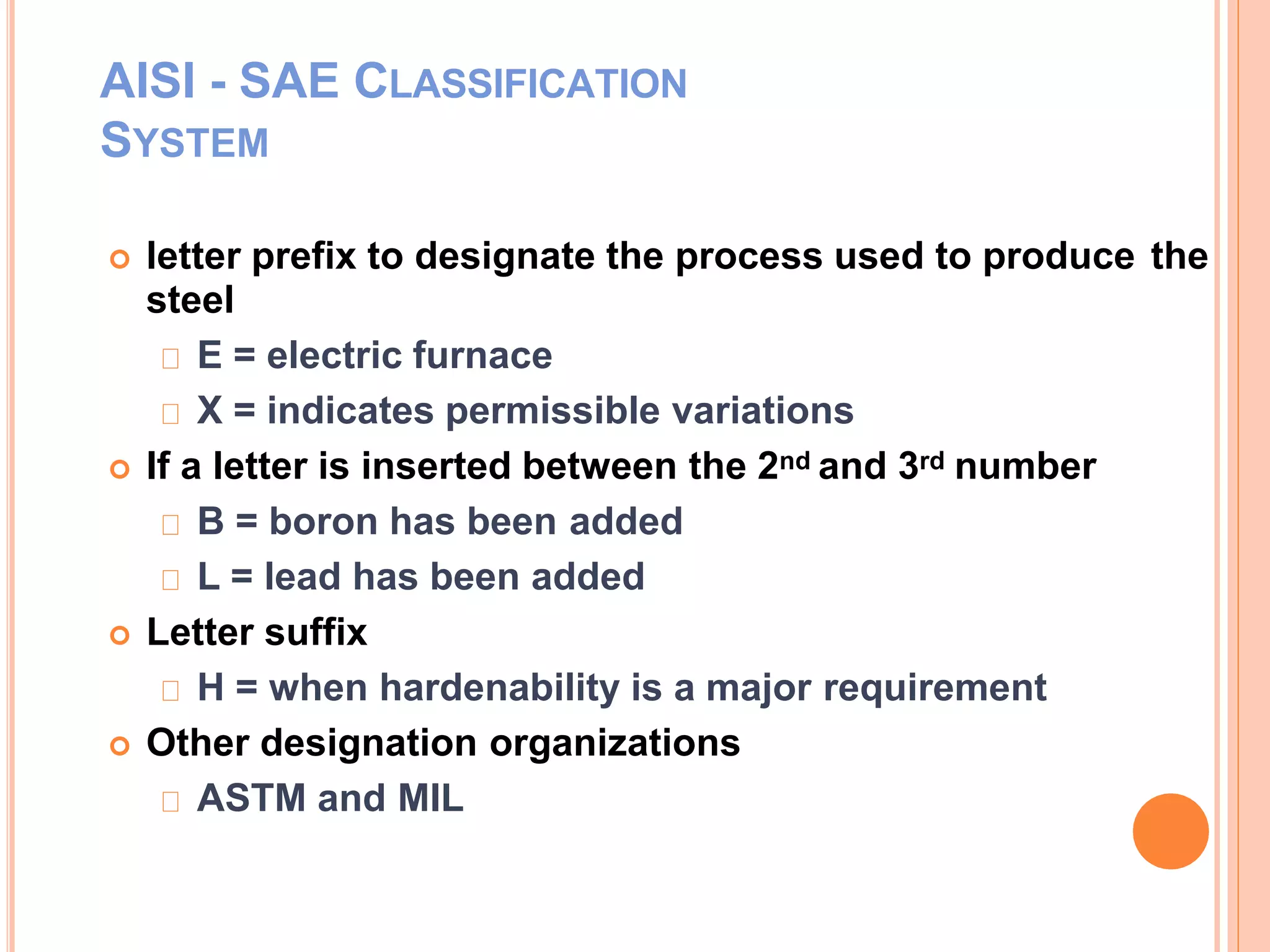
AISI - SAE CLASSIFICATION
SYSTEM
 letter prefix to designate the process used to produce the
steel
E = electric furnace
X = indicates permissible variations
 If a letter is inserted between the 2nd and 3rd number
B = boron has been added
L = lead has been added
 Letter suffix
H = when hardenability is a major requirement
 Other designation organizations
ASTM and MIL
MEDIUM CARBON STEEL
Carbon content in the range of 0.3 – 0.6%.
Can be heat treated - austenitizing, quenching and then
tempering.
Most often used in tempered condition – tempered
martensite
Medium carbon steels have low hardenability
Addition of Cr, Ni, Mo improves the heat treating capacity
Heat treated alloys are stronger but have lower ductility
Typical applications – Railway wheels and tracks, gears,
crankshafts.
MEDIUM CARBON STEEL
- Bright fibrous structure when fractured
- Tough and more elastic in comparison to wrought iron
- Eaisly forged , welded , elongated due to ductility
- Good malleability
- Its tensile strength is better than cast iron and wrought iron
- Compressive strength is better than wrought iron but lesser
than cast iron
HIGH CARBON STEEL
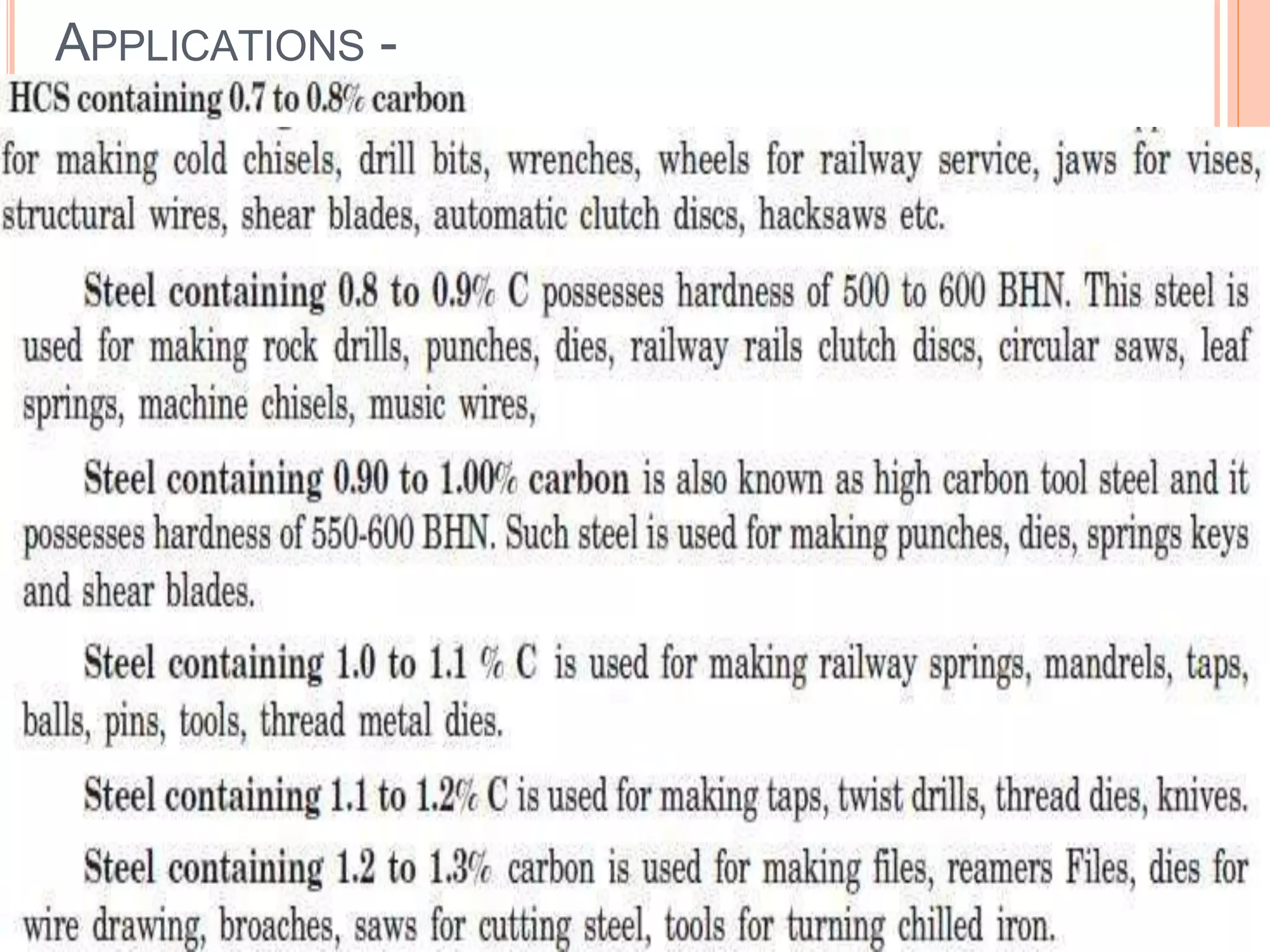
APPLICATIONS -
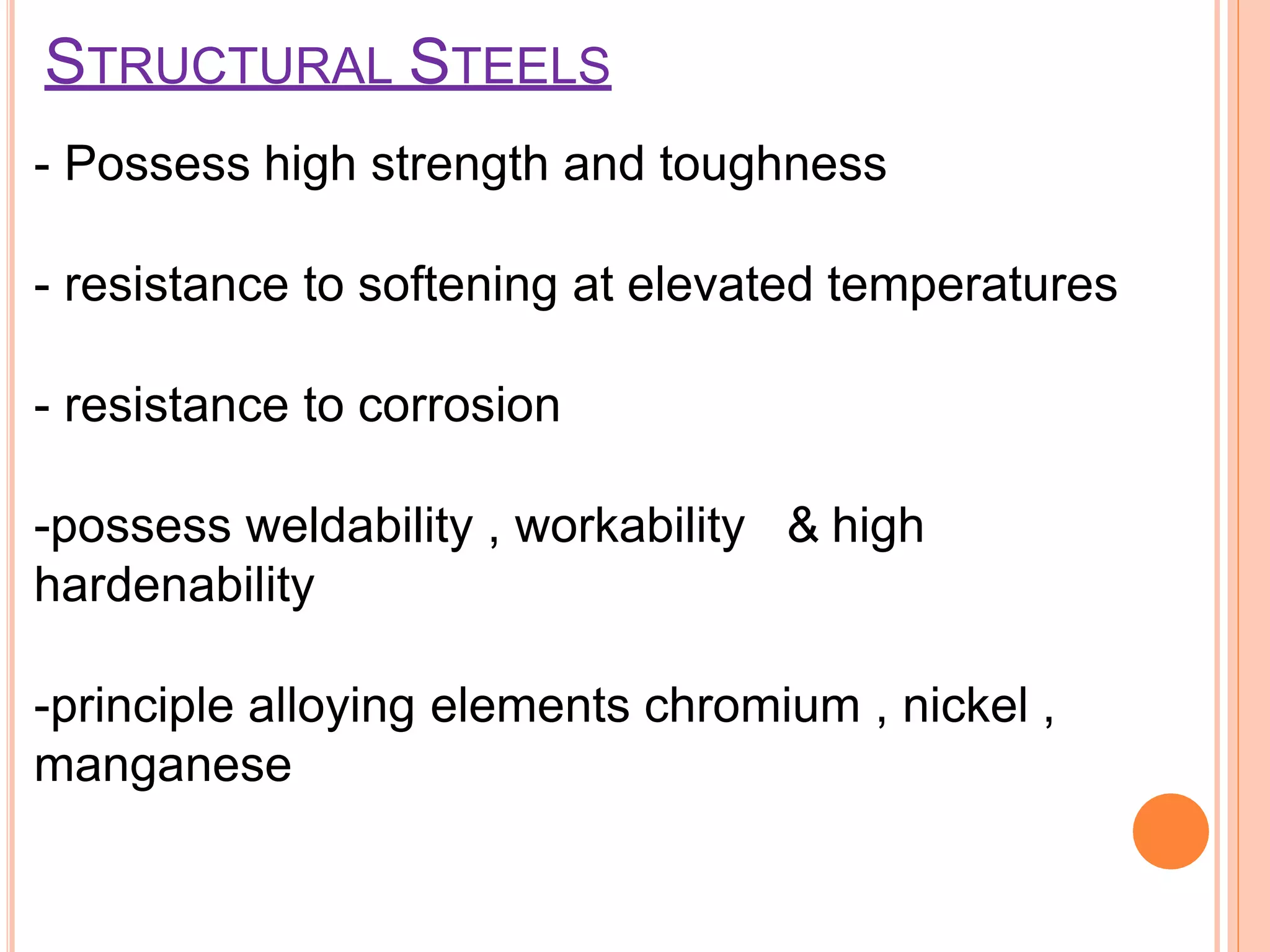
STRUCTURAL STEELS
- Possess high strength and toughness
- resistance to softening at elevated temperatures
- resistance to corrosion
-possess weldability , workability & high
hardenability
-principle alloying elements chromium , nickel ,
manganese
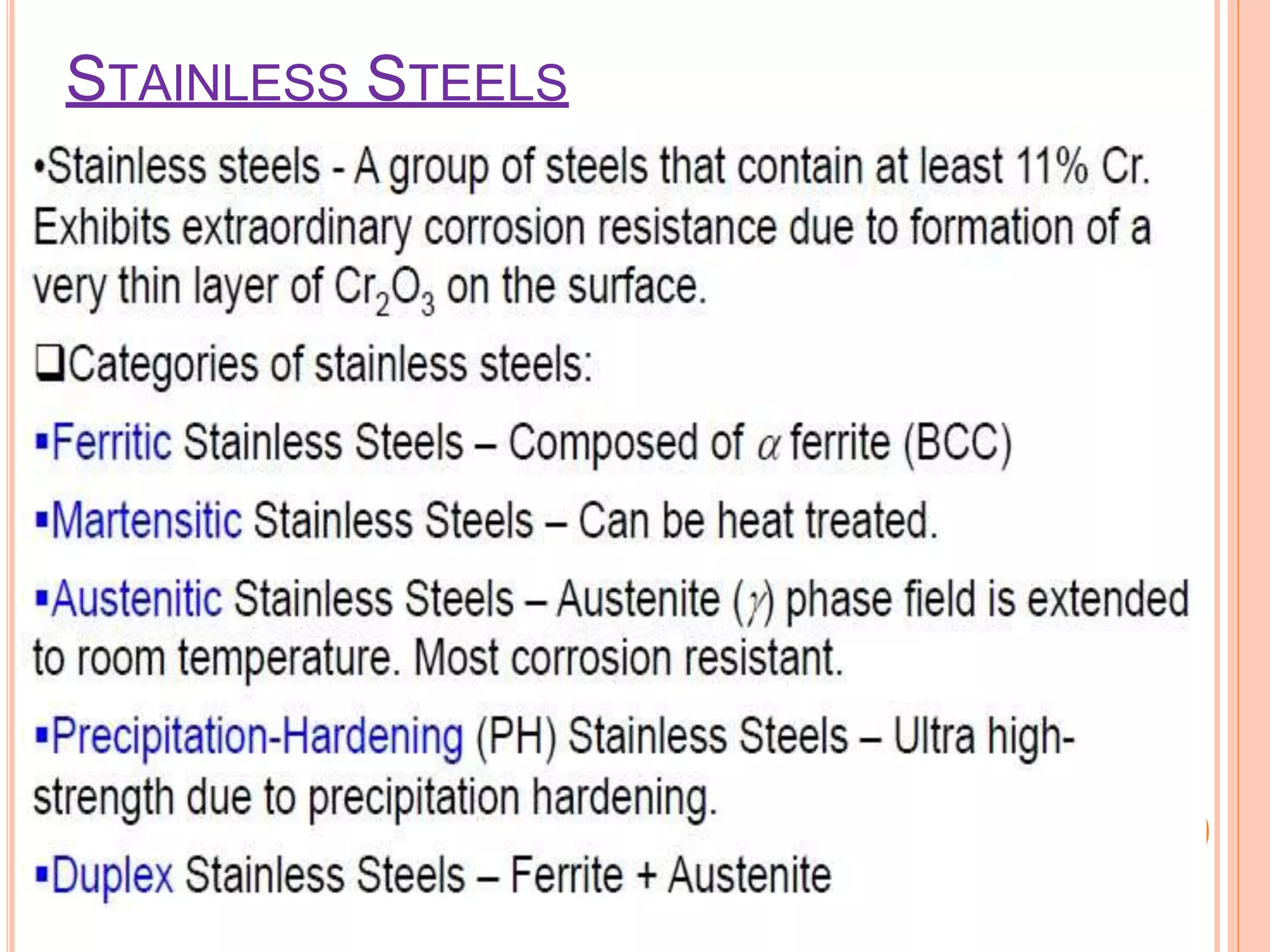
STAINLESS STEELS
EFFECTS OF ALLOYING ELEMENTS ON STEEL
 Manganese contributes to strength and hardness; dependent upon the carbon
content. Increasing the manganese content decreases ductility and weldability.
Manganese has a significant effect on the hardenability of steel.
 Phosphorus increases strength and hardness and decreases ductility and notch
impact toughness of steel. The adverse effects on ductility and toughness are
greater in quenched and tempered higher-carbon steels.
 Sulfur decreases ductility and notch impact toughness especially in the transverse
direction. Weldability decreases with increasing sulfur content. Sulfur is found
primarily in the form of sulfide inclusions.
 Silicon is one of the principal deoxidizers used in steelmaking. Silicon is less
effective than manganese in increasing as-rolled strength and hardness. In low-
carbon steels, silicon is generally detrimental to surface quality.
 Copper in significant amounts is detrimental to hot-working steels. Copper can be
detrimental to surface quality. Copper is beneficial to atmospheric corrosion
resistance when present in amounts exceeding 0.20%.
 Nickel is a ferrite strengthener. Nickel does not form carbides in steel. It remains
in solution in ferrite, strengthening and toughening the ferrite phase. Nickel
increases the hardenability and impact strength of steels.
 Molybdenum increases the hardenability of steel. It enhances the creep strength
of low-alloy steels at elevated temperatures.
classification of steels.pptx

classification of steels.pptx

  • 1.
    MATERIAL SCIENCE ANDENGINEERING Classification Of S te e ls
  • 2.
    R E F E R E N C E S  Materials Scienceand Engineering, V .Raghavan, Fifth Edition, Prentice Hall of India Pvt. Ltd., New Delhi, 2004.  Materials Science and Engineering: An Introduction, William D. Callister John Wiley & Sons, 2010. ONLINE - Nptel
  • 3.
    Ferrous Materials Ferrous Steels Castiron Low Alloy HighAlloy Tool steel Stainless steel
  • 4.
  • 5.
    FERROUS MATERIAL -STEELS • Steels - alloys of iron-carbon. - May contain other alloying elements. • Several grades are available • Low Alloy (<10 wt%) . –Low Carbon (<0.25 wt% C) –Medium Carbon (0.25 to 0.60 wt% C) –High Carbon (0.6 to 1.4 wt% C) •High Alloy – Stainless Steel (>11 wt% Cr) - Tool Steel
  • 6.
    EFFECT OF CARBONON PROPERTIES OF STEELS
  • 7.
    Low Carbon Steel -Also known as Mild Steel - Tensile strength of 555 N/mm - Hardness of 140 BHN - Bright fibrous structure -Tough , malleable , ductile and more elastic than wrought iron - Melting point 1410
  • 8.
    Low Carbon Steel Plaincarbon steels - very low content of alloying elements and small amounts of Mn. Most abundant grade of steel is low carbon steel – greatest quantity produced; least expensive. Not responsive to heat treatment; cold working needed to improve the strength. Good Weldability and machinability High Strength, Low Alloy (HSLA) steels - alloying elements (like Cu, V, Ni and Mo) up to 10 wt %; have higher strengths and may be heat treated.
  • 9.
    LOW CARBON STEEL Compositionsof some low carbon and low alloy steels
  • 10.
    AISI - SAECLASSIFICATION SYSTEM AISI XXXX American Iron and Steel Institute (AISI)  classifies alloys by chemistry  4 digit number 1st number is the major alloyingelement 2nd number designates the subgroup alloying element OR the relative percent of primary alloying element. last two numbers approximate amount of carbon (expresses in 0.01%)
  • 11.
    AISI - SAECLASSIFICATION SYSTEM  letter prefix to designate the process used to produce the steel E = electric furnace X = indicates permissible variations  If a letter is inserted between the 2nd and 3rd number B = boron has been added L = lead has been added  Letter suffix H = when hardenability is a major requirement  Other designation organizations ASTM and MIL
  • 14.
    MEDIUM CARBON STEEL Carboncontent in the range of 0.3 – 0.6%. Can be heat treated - austenitizing, quenching and then tempering. Most often used in tempered condition – tempered martensite Medium carbon steels have low hardenability Addition of Cr, Ni, Mo improves the heat treating capacity Heat treated alloys are stronger but have lower ductility Typical applications – Railway wheels and tracks, gears, crankshafts.
  • 15.
    MEDIUM CARBON STEEL -Bright fibrous structure when fractured - Tough and more elastic in comparison to wrought iron - Eaisly forged , welded , elongated due to ductility - Good malleability - Its tensile strength is better than cast iron and wrought iron - Compressive strength is better than wrought iron but lesser than cast iron
  • 18.
  • 19.
  • 21.
    STRUCTURAL STEELS - Possesshigh strength and toughness - resistance to softening at elevated temperatures - resistance to corrosion -possess weldability , workability & high hardenability -principle alloying elements chromium , nickel , manganese
  • 23.
  • 26.
    EFFECTS OF ALLOYINGELEMENTS ON STEEL  Manganese contributes to strength and hardness; dependent upon the carbon content. Increasing the manganese content decreases ductility and weldability. Manganese has a significant effect on the hardenability of steel.  Phosphorus increases strength and hardness and decreases ductility and notch impact toughness of steel. The adverse effects on ductility and toughness are greater in quenched and tempered higher-carbon steels.  Sulfur decreases ductility and notch impact toughness especially in the transverse direction. Weldability decreases with increasing sulfur content. Sulfur is found primarily in the form of sulfide inclusions.  Silicon is one of the principal deoxidizers used in steelmaking. Silicon is less effective than manganese in increasing as-rolled strength and hardness. In low- carbon steels, silicon is generally detrimental to surface quality.  Copper in significant amounts is detrimental to hot-working steels. Copper can be detrimental to surface quality. Copper is beneficial to atmospheric corrosion resistance when present in amounts exceeding 0.20%.  Nickel is a ferrite strengthener. Nickel does not form carbides in steel. It remains in solution in ferrite, strengthening and toughening the ferrite phase. Nickel increases the hardenability and impact strength of steels.  Molybdenum increases the hardenability of steel. It enhances the creep strength of low-alloy steels at elevated temperatures.