Module 4
ENGINEERING
MATERIALS
Steels - classification
• Steels – Alloys containing up to 2% C
• Cast Iron – 2 to 4.3% C
• Plain Carbon Steels: C is the main alloying
element
• Alloy steels: in addition to C, one or more
other metallic elements also present
• Low C steels: 0.1 to 0.3%
• Medium C steels: 0.3 to 0.6%
• High C steels: 0.6 to 1.2%
Alloy steels
• Alloy steels: Carbon steels to which 1 or
more elements are added to obtain some
positive effects
• Mn, Ni, W, Cu, B, Si, Al, Cr, Mo, V
• Leads to improvements in properties of C
steels
• Have higher hardness, strength, toughness,
corrosion and oxidation resistance
Effects of Alloying elements on
Dislocation movement
• Introduction of impurity atoms creates a pinning
point for dislocations
• An alloying element is by nature a point defect
• It creates a stress field (due to size) when
placed in to another crystallographic position
• The alloying atom may have a different elastic
modulus
• Reduce dislocation mobility; increase strength
and hardness
Effects of Alloying elements on
Polymorphic transformation
temperature
• α-γ transformation at A3 (912˚C) and γ-δ
transformation at A4 (1394˚C)
• δ –ferrite, γ-austenite, α-ferrite exist in
distinct regions of phase diagram
• Mo, Cr, W, Si, V, Ti raise the A3 temp and
lower the A4 temp…….
• Contract γ region and enlarge ferrite region
• Ni, Mn, Cu, Co has the opposite effect
• Cr, Mo, and W form very stable carbides
and favour precipitation of carbides
• In second case carbon tends to remain in
solid solution in the austenite
Effects of Alloying elements on
Strengthening of Ferrite
• Most of the alloying elements form solid
solutions with ferrite
• Increase the hardness and strength
• Ni, Al, Si, Cu have better solubility in ferrite
• The effectiveness of strengthening is low
Effects of Alloying elements on
Formation and stability of Carbides
• Alloying elements may combine with C to form Carbides
• These are hard and brittle, hence provide better hardness
and wear resistance
• Carbides of Cr and V have very high hardness and wear
resistance
• Also act to reduce grain growth
• Ni, Al, Si don’t form carbides in the presence of iron and
causes instability of iron carbide
• Ti and Niobium have very strong crbide forming
tendencies
• Cr, Mo, W, V, Mn also form carbides
• When more than one is added Complex carbides formed
Effects of Alloying elements on
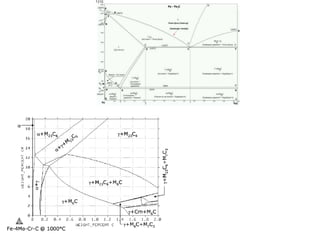
Displacement of the eutectoid point
• Affects equilibrium conditions
• Change position of eutectoid point and the
positions of α and δ phase fields
• Most of the alloying elements shift
Eutectoid compositionto lower C content
values
• Presence of Ni and Mn lowers the
Eutectoid temperature
Effects of Alloying elements on
Retardation of transformation temp:
• Austenite transformation temp is shifted up
or down by alloying elements
• Ni and Mn content lower Austenite
transformation temp – postpone
transformation of Austenite on slow
cooling
• Austenite stabilizers
Effects of Alloying elements on
Lowering of critical cooling rate
• Due to alloying elements TTT curve is displaced to
right side
• ie, CCR required for transformation of Martensite
is decreased and leads to better hardenability
• Makes possible to obtain a hard Martensitic
structure throughout
• Cr, Mo, Mn, Ni are more effective
• One of the most useful feature of Alloying
Effects of Alloying elements on
Improvement in
corrosion resistance
• Thin oxide layers and protection against
corrosion
• Al, Si, Cr
• Cr only when a min: 13% is added
Effects of Alloying elements on
Grain growth
• Accelerate grain growth and increase
brittleness
• Cr is the most important
• Ni, V retard grain growth
• Grain refiners
Functions of alloying elements
• Mn
• Present in all steels and functions as a deoxidiser
• It forms MnS and takes care of the negative
effects of residual S content
• 0.5-2% to increase hardness and strength
• Also improves hardenability
• Mo
• Relatively expensive
• Found in high strength structural steels
• Also added to Cr-Ni steels to improve resistance
to corrosion
• Improves hardenability and eliminates
brittleness
• 0.1-0.4%
• Forms carbides having high red hardness and
wear resistance
• Ni
• First alloy steels to be used in large engg
structures
• Increases strength and toughness of steels;
least effect on hardness
• Increase impact resistance at low temperatures
• 1-5%
• In SS above 8% is added – improve corrosion
resistance
• Cr
• Less expensive and most common
• 0.5-4%
• Forms carbides having high hardness and wear
resistance
• Increases hardenability, strength and wear resistance
• Added to tool steels, structural steels and SS
• In SS 12% or more is added
• High temp proprties and corrosion resistance are greatly
improved when added in excess of 5%
• Vanadium
• A powerful deoxidiser, strong carbide
former and prevents grain growth
• Expensive
• Increase hardenability, elastic limit, fatigue
and wear resistance
• 0.1-0.3%
• Tungsten
• Forms hard and stable carbides
• Excellent wear resistance and hardness
• 2-3% to tool steels and heat resisting
steels
• Cobalt
– Increases heat and wear resistance
– High cobalt alloy steels, known for excellent
corrosion resistance over a wide range of
temperatures
– Also increases cutting efficiency and red
hardness of tool steels
Silicon
- Added up to 0.3% as deoxidizer
- Forms SiO2 and eliminates the presence of
oxygen
- 1.5 to 2.5 %to improve strength and toughness
- Also increases magnetic permeability of steels
used for transformers and motors
• Cu
• 0.15-0.25% is normally added to improve
corrosion resistance
• Also promotes precipitation hardening thereby
higher strength and hardness
• Lead
• Up to 0.35%
• Improve machinability
• Doesn’t affect other properties like ductility,
toughness etc
• Ti
• Strongest carbide former
• Added up to 1%
• Strength and corrosion resistance improves
• Sulphur
• Up to 0.33% to increase machinability
• Higher amounts is undesirable
• Can be overcome by adding Mn
• Phosphorus
• Present as a residue
• Upto 0.12% - increase strength, hardness, corrosion
resistance and machinablity
• Higher phosphorous content may lead to cold shortness
• Al
• Most active deoxidizer
• 0.01-0.06%
• Controls grain growth – fine grained steels
• Boron
• 0.001-0.005%
• Increase hardenability
• Increases depth of hardening during
quenching
Nickel-Steels
• Most fundamental alloying element in steel
• Highly soluble in γ and ferrite phases
• Contributes to strength and toughness
• Lowers critical temperature
• Retards transformation of austenite; doesn’t form
any carbides
• Shifts the position of eutectoid point – lowers C
content of Eutectoid alloy
• Pearlite is formed at lower temp
• Have better toughness, plasticity and fatigue
resistance
• Mild effect on hardenability
Chromium steels
• Less expensive alloying element
• Forms carbides having high hardness and
wear resistance
• Cr is soluble up to 13% in γ-iron and
unlimited solubility in α-ferrite
• More than 5% - high temp properties and
corrosion resistance improved
• Plain Chromium steels – 0.7 to 1.15% Cr
and 0.15-0.65% C
• Steel containing 1%C and 2-4% Cr –
excellent magnetic properties
Nickel-Chromium steels
• Contains both Ni and Cr – with 5:2
• Increased toughness, ductility,
hardenability and wear resistance
• Combined effect on hardenability is better
Molybdenum steels
• Relatively costlier element
• Limited solubility in γ and α irons and is a
strong carbide former
• Has a good effect on hardenability and
increases high temperature hardness and
strength of steel
• Used along with Cr, Ni or both
• Ni-Cr-Mo steels have the advantages Ni-
Cr steels along with high hardenability due
to Molybdenum
• Aircraft industry
High Speed Steels
• Steels which maintain high hardness at
temperature up to 550˚C
• Can be used as cutting tools at high speeds at
which high temperatures are developed
• Presence of wear resistant carbides makes HSS
suitable
• Possesses high wear resistance, excellent red
hardness, good shock resistance, machinability
W based and Molybdenum based HSS
• Tungsten HSS – W is the principal alloying
element with additions of Cr, V, and Co
• Molybdenum HSS – in addition Mo is also
present
• Formation of alloy carbides: retain hardness at
high temperatures
• 18% W, 4% Cr, 1% V with 0.6-0.7% C
• 18W4Cr1V or 18:4:1 HSS
• 6W6Mo4Cr1V
• Cobalt is added to HSS to improve red
hardness
• V improves hardness and abrasion
resistance
• Cr ( 0.5-12%) increases hardness
• W & Mo provides resistance to softening
at high temperatures
• Mn (0.6-2%) improves hardenability
• Si in low amounts increases toughness
Free cutting steels
• Used where free machining is the primary
requirement
• Components provide good surface finish
even at high temperatures
• 2 types:
- High sulphur steels (0.33%S,0.12%P)
- Leaded steels (0.35%Pb)
• Improves machinability
Rail steels
• Steels used for railway tracks
• Good combination of strength and ductility
along with high impact and fatigue resistance
• Mn and Cr up to 1% improves these
properties
Spring steels
• Used for springs subjected to
compression, tension & torsion
• Should possess high elastic limit, good
elongation, high fatigue resistance
• Mn and Si
• Si is replaced by a combination of Cr, Ni, V
Tool steels
• Used for machining and shaping metals
• To make tools: chisels, hammers, punches,
cutting tools
• Tool steels: high hardness, wear resistance,
toughness etc (also at high temps:)
• Attained by the addition of Cr, W, Mo, V, Mn, Si,
Co to high C steels
• Grouping: cold work tool steels
Hot work tool steels
High speed tool steels
special purpose tool steels
HSLA Steels
• Improvement in strength is achieved
through addition of small quantities of
alloying elements
• Possess high strength to weight ratio
• Attractive balance of toughness, fatigue
resistance and formability
• C content 0.07-0.13%
• Ti, V, Al – less than 0.5%
• Known as micro alloyed steels
TMT Steels
• Thermo Mechanically Treated (TMT) steel
• TMT steel bars widely used as structural
material
• 0.17-0.24% C, 0.05% S, 0.045% P
• TM Treatment………….
Stainless Steels
• Used where corrosion and oxidation
resistance is important
• Also have good creep strength
• Cr – main alloying element – it forms a
protective film
a. Ferritic stainless steels
b. Martensitic stainless steels
c. Austenitic stainless steels
Ferritic stainless steels
• Contain 16-25% Cr, 0.12-0.2% C
• The steel is in the ferritic state
• Strength is increased by cold working followed
by grain refinement through annealing
• High Cr content – excellent corrosion and
oxidation resistance
• For house hold appliances, transportation
industry
• Martensitic SS : 12-14% Cr, up to 0.15% C
• Respond to heat treatment
• Low C – Martensite formed isn’t brittle
• Cutlery items, surgical instruments, ball bearings
Austenitic SS
• Austinite is stable at even room temp.
So not heat treatable
• Very good formability
• 18% Cr, 8% Ni, 0.08%C
• Addition of 2% Mo gives better resistance
to pitting corrosions
• 18/8 steels have excellent formability
• House hold articles, sanitary fittings,
vessels in chemical industry
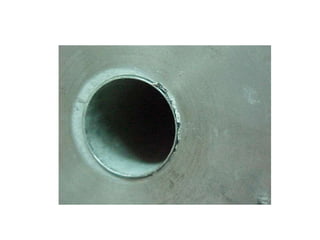
Duplex stainless steels
• Have a 2 phase mic: consisting of grains of ferritic
and austenitic structure – Duplex
• When melted it solidifies to a completely ferritic
structure
• As cooled to room temp: about half of the ferritic
grains transform to austenitic grains
• Have twice the strength of Austenitic SS
• Resistance to pitting corrosion, crevice corrosion,
and stress corrosion cracking
• Better toughness and ductility
• N addition – improved strength, corrosion resistnce
Sensitization in SS
• Is the precipitation of Cr Carbide along the
grain boundaries of SS leading to
intergranular corrosion.
• Phenomenon which happens in SS heated
between 400 to 850ºC
• To prevent this SS is heated to 1060 to
1120ºC And water quenched (Solution
annealing/quench annealing/solution
quenching)
• C content is <0.03% insufficient for
carbide formation and sesitization is
Cast Irons
• Most of the CI contains 3-4.5% C
• Fe-C alloys in this range becomes
completely liquid b/w 1150-1300˚C aprox:
• Thus they are easily melted and cast
• Most CIs are brittle; hence casting is
convenient
Characteristics of Cast Irons
• Low melting temperatures with good fluidity
• Low cost material (low cost raw material & tech.)
• Higher compressive strength, damping capacity,
wear resistance, rigidity, machinability
• Variety of mic: can be developed
• Alloy CIs - high corrosion and heat resistance
• Not ductile to be rolled, drawn, or mechanically
worked
CI classification
• Factors that control the structure & appearance
• 1) C content:
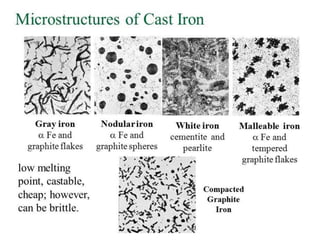
- C is present either as Fe3C or as free C (Graphite)
- when alloyed, alloy carbides are formed
- free C can exist as flakes, irregular shaped
globules (rosette) or as round nodules
• 2) presence of other elements:
– Some present as impurities
– Some form carbides
- some, stabilize carbide, and keep C in the
combined form
- others have a graphitizing effect
• 3) cooling rate:
higher- help formation of carbides
slow- help C to be in free form
• 4) Heat treatments:
- Helps either the formation of carbides
or decomposition of Fe3C into free C
- when C decomposed, it causes
changes in shape, size & distribution of
graphite particles
Gray Cast Iron
• Contains 2.5-3.5% C, 1-2.8% Si
• Mn, S, Phosphorous may also be present
• C exists in the form of graphite flakes in a matrix
of α-ferrite or Pearlite
• Moderate cooling – Pearlite matrix
• Slow cooling – Ferrite matrix
• Due to presence of graphite flakes, a fractured
surface appears gray in color
• Low strength and brittle in tension
• Under compressive loads, strength and ductility
higher
• Low melting point, good fluidity, castability,
machinability, damping capacity, impact strength
• Lowest production cost – widely used CI
• AUTOMOBILE PARTS: cylinder block, cylinder
head, underground pipes, c/f pump parts, m/c
tool beds, house hold appliances etc.
Ductile (Nodular) CI
• When Mg or Cerium added to Gray iron before
casting leads to different mic:
• C exists as Graphite, in the form of nodules or
speroids instead of flakes – Nodular CI or SG iron
• Depending on the cooling rate matrix phase is
either Pearlite or Ferrite
• 3-4.3% C, 1-3.5% Si, 0.3-0.8% Mn, 0.03% S,
0.08%Phosphorous
• Stronger and much ductile than gray iron
• Comparable properties with steel
• Automobile parts, farm machinery, earth moving
machinery, rolls, gears, valves
White Cast Iron
• CIs containing lower Si content, on rapid cooling
results in a mic: in which C exists as Fe3C
• Fracture surface of this alloy has a white
appearance
• 2-3.5% C, 0.5-1.3%Si, 0.2-0.8%Mn, 0.18%S,
0.1%P
• Due to large amounts of Fe3C, this CI is very
hard and brittle
• Also good wear resistance, high comp: strength
• Difficult to machine
• Pump liners, rollers, for production of malleable
iron
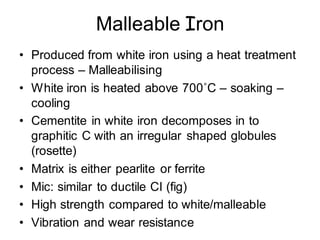
Malleable Iron
• Produced from white iron using a heat treatment
process – Malleabilising
• White iron is heated above 700˚C – soaking –
cooling
• Cementite in white iron decomposes in to
graphitic C with an irregular shaped globules
(rosette)
• Matrix is either pearlite or ferrite
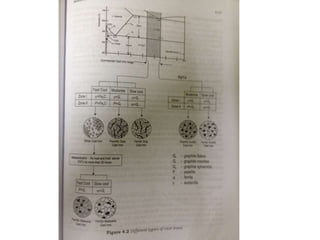
• Mic: similar to ductile CI (fig)
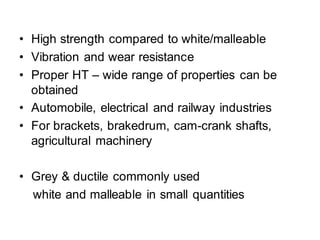
• High strength compared to white/malleable
• Vibration and wear resistance
• High strength compared to white/malleable
• Vibration and wear resistance
• Proper HT – wide range of properties can be
obtained
• Automobile, electrical and railway industries
• For brackets, brakedrum, cam-crank shafts,
agricultural machinery
• Grey & ductile commonly used
white and malleable in small quantities
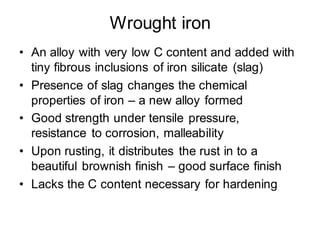
Wrought iron
• An alloy with very low C content and added with
tiny fibrous inclusions of iron silicate (slag)
• Presence of slag changes the chemical
properties of iron – a new alloy formed
• Good strength under tensile pressure,
resistance to corrosion, malleability
• Upon rusting, it distributes the rust in to a
beautiful brownish finish – good surface finish
• Lacks the C content necessary for hardening
Non Ferrous Alloys
Copper
• Most extensively used
• Two most important properties: electrical
conductivity and corrosion resistance
• Second place among engg materials
• Can be easily machined, welded, brazed,
soldered
• Lacks strength
Uses
• Electrical conductors, heat conductors
• Over 50% is used for electrical purposes – wires,
switches…
• Applications which require higher thermal conductivity –
radiators, water heaters, refrigerators, heat exchangers
• Excellent corrosion resistance – used in corrrossive
environments
• Cu Strengthening methods – strain hardening, solid
solution strengthening, precipitation hardening…
• Alloying with Zn, Tin, Al…
• Solid solutions are Brasses, Bronzes…
Brasses
• Alloy of Cu and Zn – 5 to 54% Zn
• Also Pb, Tin, Al
• Wide variety of Brasses are used today
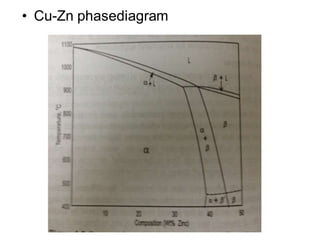
• Cu-Zn phase diagram
• Cu-Zn phasediagram
• Cu and α solid solution – FCC and β – BCC
• In β, Cu and Zn atoms randomly dispersed
at lattice points
• An ordered structure β’ – Cu at corners and
Zn at body centers of BCC
• Based on solid solution formed:
α-brsses
Duplex Brasses
• α Brasses
• Cu can dissolve up to 38% Zn to form FCC structure
called α phase
• Brasses containing only α phase – α Brasses
• Highly ductile at room temperature – easily deformed by
cold working, corrosion resistance
• Types
• Yellow α brass: lower Cu content (20-36%)
• Yellow color
• Good corrosion resistance
• Cartridge Brass: used for cartridge and shell cases of
rifles
• 70% Cu 30% Zn
• High strength, ductility
• Admiralty Brass: Tin in small% added to improve
resistance to certain types of corrosion
• Suitable for marine applications
• 71% Cu, 28% Zn, 1% Sn
• Tubes for condensers, heat exchangers…
• Aluminium Brass: 76% Cu, 22% Zn, 2% Al
• Better corrosion resistance
• Marine applications
• Red α Brass: Zn content in the range 5 to 20% only
• Higher Cu content – red appearance
• Good corrosion resistance, workability
• Variants of this category…
• Gilding metal: α Brass with highest Cu
content (95% Cu, 5% Zn)
• Closely matches gold in color
• Softest type of brass
• High ductility, corrosion resistance
• Coins, medals, jewellary…
• Leaded red brass: Pb, Sn, Zn in 5% each to Cu
• Also called three fives
• Pressure valves, pipe fittings, pump castings…
• Good strength, machinability
Duplex or (α+β) Brasses
• Zn content beyond 38% results in (α+β) brass
• At lower temperatures β changes to β’ phase
making the alloy harder and brittle
• At high temp: changes back to β phase
• Good strength, suitable for hot working
• Types:
• Muntz metal: 60% Cu, 40% Zn
• Springs, chains
• Also as a brazing alloy for steel
• Naval Brass: 1%Sn with 60% Cu, 39% Zn
• Tin improves corrosion resistance – used in
contact with sea water
• Propeller shafts, valves, impellers…
• Forging Brass: 60% Cu, 38% Zn, 2% Pb
• Best hot working properties
• For hardware and plumbing parts
Bronzes
• Alloys of Cu with elements other than Zn
• Simplest bronze – 88% Cu with 12% Sn
• Pb, Ni, P, Al, Si also added
• Zn may also be present in very small%
• Softer and weaker than steel
• Better heat and electric conductivity
• Costlier than steel
• Good castability, anti-friction properties
• Bearings, springs, bells, statues
• Tin Bronze: 88-98%Cu, 1-11% Sn, 0.1-0.5% P
• Tin improves wear and corrosion resistance
• P acts as deoxidiser, also contributes to hardness
• Also called phosphor Bronze
• Gun metal: Zn replaces P in tin bronze
• 88% Cu, 10% Sn, 2%Zn
• Marine components
• Aluminium Bronze: alloys of Cu and Al (4-11%)
• Other elements: Fe, Ni, Mn, Si also added
• Better strength and corrosion resistance
• called imitation gold
• Silicon Bronze: Cu-Si alloys (1-4% Si)
• Small amounts of Mn, Zn, Fe
• Si improves strength
• Rivets, bolts, nuts…
• Beryllium Bronze: Cu-Be alloy (0.6-3% Be)
• Attains high strength upon precipitation hardening
• Expensive
• Also called Beryllium Copper
• High elasticity, fatigue resistance
• Used for springs
Aluminium
• 3rd place among engg materials
• Low density, low melting point, high electrical
and thermal conductivities
• Low strength and hardness
• High ductility and malleability
• AlO2 formed prevents further oxidation and
corrosion
• Good machinability, formability
• Non magnetic, non toxic, easily available
Al alloys
• Strengthened by strain hardening, solid solution
hardening, age hardening, fiber reinforcement
• Alloying elements: Cu, Mn, Mg, Si increase the
strength of Al upto 4 times
• Due to increased strength Al alloys widely used in
commercial applications
• Duralumin and Y alloy
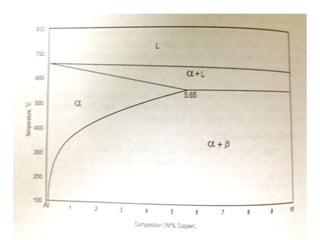
•Phase dgm
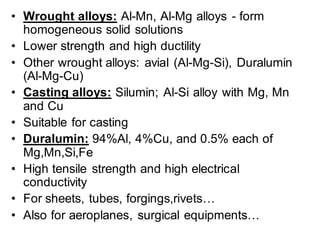
• Wrought alloys: Al-Mn, Al-Mg alloys - form
homogeneous solid solutions
• Lower strength and high ductility
• Other wrought alloys: avial (Al-Mg-Si), Duralumin
(Al-Mg-Cu)
• Casting alloys: Silumin; Al-Si alloy with Mg, Mn
and Cu
• Suitable for casting
• Duralumin: 94%Al, 4%Cu, and 0.5% each of
Mg,Mn,Si,Fe
• High tensile strength and high electrical
conductivity
• For sheets, tubes, forgings,rivets…
• Also for aeroplanes, surgical equipments…
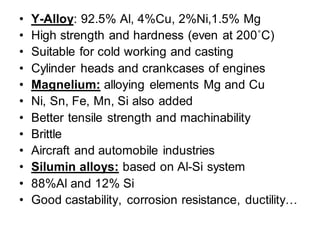
• Y-Alloy: 92.5% Al, 4%Cu, 2%Ni,1.5% Mg
• High strength and hardness (even at 200˚C)
• Suitable for cold working and casting
• Cylinder heads and crankcases of engines
• Magnelium: alloying elements Mg and Cu
• Ni, Sn, Fe, Mn, Si also added
• Better tensile strength and machinability
• Brittle
• Aircraft and automobile industries
• Silumin alloys: based on Al-Si system
• 88%Al and 12% Si
• Good castability, corrosion resistance, ductility…
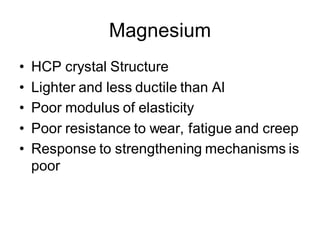
Magnesium
• HCP crystal Structure
• Lighter and less ductile than Al
• Poor modulus of elasticity
• Poor resistance to wear, fatigue and creep
• Response to strengthening mechanisms is
poor
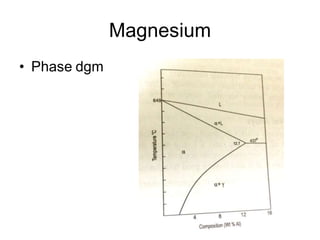
Magnesium
• Phase dgm
Magnesium Alloys
• Addition of Al to Mg increases strength,
hardness, castability
• Zn and Mn also added
• Mn increases corrosion resistance, but little
effect on mech: properties
• Mg-Al-Zn alloys have higher mech: properties
• Zirconium has grain refining effect
• Mg alloys – aerospace, high speed machinery,
transportation equipments
• Mg-Mn alloys used for sheet forming processes
• Mg-Al-Zn alloys are suitable for sand and
die casting, extrusion and forging
processes
• Mg alloys have poor ductility and
formability but poor fatigue and stress
corrosion resistance
Nickel
• A metal having good corrosion resistance
• Strengthened by strain hardening, age
hardening, dispersion hardening
• Common alloying elements: Cu, Fe, Cr, Mo,
Mn, Al
• Ni based alloys constitute 40-50% of total
weight of an aircraft engine (combustor and
turbine sections
• Extensively used at elevated temperatures
Cu-Ni Alloys
• Cu is completely soluble in Ni
• Monel – when Ni and Cu alloyed in 2:1 ratio
• High corrosion resistance, better mech: properties
than Bronzes, brasses
• Also good toughness, fatigue strength
• When S is added to Monel, machinability
improves – R monel
• K-monel; contains 3% Al (age hardenable)
• H-monel; 3% Si (improved strength and corrosion
resistance)
• S-monel; 4% Si (improved strength and corrosion
resistance)
• Cu-Ni alloys (cupro-nickels) suitable for service at elevated
temperatures
• cupro-nickels with 30 % nickel – condenser tubes in naval
applications
• Constantan – alloy containing 40% Ni and 1.5% Mn
• It has high electrical resistivity unaffected with change in
temperature
• Used in rheostats, thermocouples and in heating devices
• Nickel Silvers or German silvers- ternary alloys of copper
containing 5-45% Zn & 5-30% Ni.
• Good strength and plasticity, low thermal conductivity
• plumbing hardware and tableware which are silver plated
Titanium
• Has two allotropic forms
• Upto 880˚C; α titanium (hexagonal)
• At higher temperatures β titanium (BCC)
• Pure titanium – strong, ductile and light
• High corrosion resistance and high strength at
elevated temperatures – used as structural
material
• Suitable for hot and cold working
• Good weldability but Poor machinability
Titanium Alloys
• Elements: Al, Cr, Mn, V, Fe, Mo, Sn
• Fe, Cr, Al – highest strengthening effect
• Ti alloys – creep resistance, fatigue strength,
corrosion resistance
• High specific strength
• Ti-6Al-4V is the most widely used alloy
• Used for aircraft structures, air craft turbines
• Construction of leaching and purification plants
for cobalt production
• Various chemical processing equipments,
valves, tanks…
• Babbit Metal: also called white metal
• A set of tin or lead based alloys
• 90%Sn, 10%Cu
• 89%Sn,7% Antimony, 4%Cu
• 80% Pb, 15% Antimony, 5% Sn
• Structure is made up of small hard crystals
dispersed in a matrix of softer alloy
• Low friction lining for bearing shells
Thank you

Module 4.pdf

  • 1.
  • 2.
    Steels - classification •Steels – Alloys containing up to 2% C • Cast Iron – 2 to 4.3% C • Plain Carbon Steels: C is the main alloying element • Alloy steels: in addition to C, one or more other metallic elements also present • Low C steels: 0.1 to 0.3% • Medium C steels: 0.3 to 0.6% • High C steels: 0.6 to 1.2%
  • 3.
    Alloy steels • Alloysteels: Carbon steels to which 1 or more elements are added to obtain some positive effects • Mn, Ni, W, Cu, B, Si, Al, Cr, Mo, V • Leads to improvements in properties of C steels • Have higher hardness, strength, toughness, corrosion and oxidation resistance
  • 4.
    Effects of Alloyingelements on Dislocation movement • Introduction of impurity atoms creates a pinning point for dislocations • An alloying element is by nature a point defect • It creates a stress field (due to size) when placed in to another crystallographic position • The alloying atom may have a different elastic modulus • Reduce dislocation mobility; increase strength and hardness
  • 5.
    Effects of Alloyingelements on Polymorphic transformation temperature • α-γ transformation at A3 (912˚C) and γ-δ transformation at A4 (1394˚C) • δ –ferrite, γ-austenite, α-ferrite exist in distinct regions of phase diagram • Mo, Cr, W, Si, V, Ti raise the A3 temp and lower the A4 temp……. • Contract γ region and enlarge ferrite region • Ni, Mn, Cu, Co has the opposite effect
  • 6.
    • Cr, Mo,and W form very stable carbides and favour precipitation of carbides • In second case carbon tends to remain in solid solution in the austenite
  • 7.
    Effects of Alloyingelements on Strengthening of Ferrite • Most of the alloying elements form solid solutions with ferrite • Increase the hardness and strength • Ni, Al, Si, Cu have better solubility in ferrite • The effectiveness of strengthening is low
  • 8.
    Effects of Alloyingelements on Formation and stability of Carbides • Alloying elements may combine with C to form Carbides • These are hard and brittle, hence provide better hardness and wear resistance • Carbides of Cr and V have very high hardness and wear resistance • Also act to reduce grain growth • Ni, Al, Si don’t form carbides in the presence of iron and causes instability of iron carbide • Ti and Niobium have very strong crbide forming tendencies • Cr, Mo, W, V, Mn also form carbides • When more than one is added Complex carbides formed
  • 9.
    Effects of Alloyingelements on Displacement of the eutectoid point • Affects equilibrium conditions • Change position of eutectoid point and the positions of α and δ phase fields • Most of the alloying elements shift Eutectoid compositionto lower C content values • Presence of Ni and Mn lowers the Eutectoid temperature
  • 10.
    Effects of Alloyingelements on Retardation of transformation temp: • Austenite transformation temp is shifted up or down by alloying elements • Ni and Mn content lower Austenite transformation temp – postpone transformation of Austenite on slow cooling • Austenite stabilizers
  • 12.
    Effects of Alloyingelements on Lowering of critical cooling rate • Due to alloying elements TTT curve is displaced to right side • ie, CCR required for transformation of Martensite is decreased and leads to better hardenability • Makes possible to obtain a hard Martensitic structure throughout • Cr, Mo, Mn, Ni are more effective • One of the most useful feature of Alloying
  • 13.
    Effects of Alloyingelements on Improvement in corrosion resistance • Thin oxide layers and protection against corrosion • Al, Si, Cr • Cr only when a min: 13% is added
  • 14.
    Effects of Alloyingelements on Grain growth • Accelerate grain growth and increase brittleness • Cr is the most important • Ni, V retard grain growth • Grain refiners
  • 15.
    Functions of alloyingelements • Mn • Present in all steels and functions as a deoxidiser • It forms MnS and takes care of the negative effects of residual S content • 0.5-2% to increase hardness and strength • Also improves hardenability
  • 16.
    • Mo • Relativelyexpensive • Found in high strength structural steels • Also added to Cr-Ni steels to improve resistance to corrosion • Improves hardenability and eliminates brittleness • 0.1-0.4% • Forms carbides having high red hardness and wear resistance
  • 17.
    • Ni • Firstalloy steels to be used in large engg structures • Increases strength and toughness of steels; least effect on hardness • Increase impact resistance at low temperatures • 1-5% • In SS above 8% is added – improve corrosion resistance
  • 18.
    • Cr • Lessexpensive and most common • 0.5-4% • Forms carbides having high hardness and wear resistance • Increases hardenability, strength and wear resistance • Added to tool steels, structural steels and SS • In SS 12% or more is added • High temp proprties and corrosion resistance are greatly improved when added in excess of 5%
  • 19.
    • Vanadium • Apowerful deoxidiser, strong carbide former and prevents grain growth • Expensive • Increase hardenability, elastic limit, fatigue and wear resistance • 0.1-0.3%
  • 20.
    • Tungsten • Formshard and stable carbides • Excellent wear resistance and hardness • 2-3% to tool steels and heat resisting steels
  • 21.
    • Cobalt – Increasesheat and wear resistance – High cobalt alloy steels, known for excellent corrosion resistance over a wide range of temperatures – Also increases cutting efficiency and red hardness of tool steels Silicon - Added up to 0.3% as deoxidizer - Forms SiO2 and eliminates the presence of oxygen - 1.5 to 2.5 %to improve strength and toughness - Also increases magnetic permeability of steels used for transformers and motors
  • 22.
    • Cu • 0.15-0.25%is normally added to improve corrosion resistance • Also promotes precipitation hardening thereby higher strength and hardness • Lead • Up to 0.35% • Improve machinability • Doesn’t affect other properties like ductility, toughness etc
  • 23.
    • Ti • Strongestcarbide former • Added up to 1% • Strength and corrosion resistance improves • Sulphur • Up to 0.33% to increase machinability • Higher amounts is undesirable • Can be overcome by adding Mn • Phosphorus • Present as a residue • Upto 0.12% - increase strength, hardness, corrosion resistance and machinablity • Higher phosphorous content may lead to cold shortness
  • 24.
    • Al • Mostactive deoxidizer • 0.01-0.06% • Controls grain growth – fine grained steels • Boron • 0.001-0.005% • Increase hardenability • Increases depth of hardening during quenching
  • 25.
    Nickel-Steels • Most fundamentalalloying element in steel • Highly soluble in γ and ferrite phases • Contributes to strength and toughness • Lowers critical temperature • Retards transformation of austenite; doesn’t form any carbides • Shifts the position of eutectoid point – lowers C content of Eutectoid alloy • Pearlite is formed at lower temp • Have better toughness, plasticity and fatigue resistance • Mild effect on hardenability
  • 26.
    Chromium steels • Lessexpensive alloying element • Forms carbides having high hardness and wear resistance • Cr is soluble up to 13% in γ-iron and unlimited solubility in α-ferrite • More than 5% - high temp properties and corrosion resistance improved • Plain Chromium steels – 0.7 to 1.15% Cr and 0.15-0.65% C • Steel containing 1%C and 2-4% Cr – excellent magnetic properties
  • 27.
    Nickel-Chromium steels • Containsboth Ni and Cr – with 5:2 • Increased toughness, ductility, hardenability and wear resistance • Combined effect on hardenability is better
  • 28.
    Molybdenum steels • Relativelycostlier element • Limited solubility in γ and α irons and is a strong carbide former • Has a good effect on hardenability and increases high temperature hardness and strength of steel • Used along with Cr, Ni or both • Ni-Cr-Mo steels have the advantages Ni- Cr steels along with high hardenability due to Molybdenum • Aircraft industry
  • 29.
    High Speed Steels •Steels which maintain high hardness at temperature up to 550˚C • Can be used as cutting tools at high speeds at which high temperatures are developed • Presence of wear resistant carbides makes HSS suitable • Possesses high wear resistance, excellent red hardness, good shock resistance, machinability
  • 30.
    W based andMolybdenum based HSS • Tungsten HSS – W is the principal alloying element with additions of Cr, V, and Co • Molybdenum HSS – in addition Mo is also present • Formation of alloy carbides: retain hardness at high temperatures • 18% W, 4% Cr, 1% V with 0.6-0.7% C • 18W4Cr1V or 18:4:1 HSS • 6W6Mo4Cr1V
  • 31.
    • Cobalt isadded to HSS to improve red hardness • V improves hardness and abrasion resistance • Cr ( 0.5-12%) increases hardness • W & Mo provides resistance to softening at high temperatures • Mn (0.6-2%) improves hardenability • Si in low amounts increases toughness
  • 32.
    Free cutting steels •Used where free machining is the primary requirement • Components provide good surface finish even at high temperatures • 2 types: - High sulphur steels (0.33%S,0.12%P) - Leaded steels (0.35%Pb) • Improves machinability
  • 33.
    Rail steels • Steelsused for railway tracks • Good combination of strength and ductility along with high impact and fatigue resistance • Mn and Cr up to 1% improves these properties
  • 34.
    Spring steels • Usedfor springs subjected to compression, tension & torsion • Should possess high elastic limit, good elongation, high fatigue resistance • Mn and Si • Si is replaced by a combination of Cr, Ni, V
  • 35.
    Tool steels • Usedfor machining and shaping metals • To make tools: chisels, hammers, punches, cutting tools • Tool steels: high hardness, wear resistance, toughness etc (also at high temps:) • Attained by the addition of Cr, W, Mo, V, Mn, Si, Co to high C steels • Grouping: cold work tool steels Hot work tool steels High speed tool steels special purpose tool steels
  • 36.
    HSLA Steels • Improvementin strength is achieved through addition of small quantities of alloying elements • Possess high strength to weight ratio • Attractive balance of toughness, fatigue resistance and formability • C content 0.07-0.13% • Ti, V, Al – less than 0.5% • Known as micro alloyed steels
  • 37.
    TMT Steels • ThermoMechanically Treated (TMT) steel • TMT steel bars widely used as structural material • 0.17-0.24% C, 0.05% S, 0.045% P • TM Treatment………….
  • 38.
    Stainless Steels • Usedwhere corrosion and oxidation resistance is important • Also have good creep strength • Cr – main alloying element – it forms a protective film a. Ferritic stainless steels b. Martensitic stainless steels c. Austenitic stainless steels
  • 39.
    Ferritic stainless steels •Contain 16-25% Cr, 0.12-0.2% C • The steel is in the ferritic state • Strength is increased by cold working followed by grain refinement through annealing • High Cr content – excellent corrosion and oxidation resistance • For house hold appliances, transportation industry • Martensitic SS : 12-14% Cr, up to 0.15% C • Respond to heat treatment • Low C – Martensite formed isn’t brittle • Cutlery items, surgical instruments, ball bearings
  • 40.
    Austenitic SS • Austiniteis stable at even room temp. So not heat treatable • Very good formability • 18% Cr, 8% Ni, 0.08%C • Addition of 2% Mo gives better resistance to pitting corrosions • 18/8 steels have excellent formability • House hold articles, sanitary fittings, vessels in chemical industry
  • 41.
    Duplex stainless steels •Have a 2 phase mic: consisting of grains of ferritic and austenitic structure – Duplex • When melted it solidifies to a completely ferritic structure • As cooled to room temp: about half of the ferritic grains transform to austenitic grains • Have twice the strength of Austenitic SS • Resistance to pitting corrosion, crevice corrosion, and stress corrosion cracking • Better toughness and ductility • N addition – improved strength, corrosion resistnce
  • 43.
    Sensitization in SS •Is the precipitation of Cr Carbide along the grain boundaries of SS leading to intergranular corrosion. • Phenomenon which happens in SS heated between 400 to 850ºC • To prevent this SS is heated to 1060 to 1120ºC And water quenched (Solution annealing/quench annealing/solution quenching) • C content is <0.03% insufficient for carbide formation and sesitization is
  • 44.
    Cast Irons • Mostof the CI contains 3-4.5% C • Fe-C alloys in this range becomes completely liquid b/w 1150-1300˚C aprox: • Thus they are easily melted and cast • Most CIs are brittle; hence casting is convenient
  • 46.
    Characteristics of CastIrons • Low melting temperatures with good fluidity • Low cost material (low cost raw material & tech.) • Higher compressive strength, damping capacity, wear resistance, rigidity, machinability • Variety of mic: can be developed • Alloy CIs - high corrosion and heat resistance • Not ductile to be rolled, drawn, or mechanically worked
  • 47.
    CI classification • Factorsthat control the structure & appearance • 1) C content: - C is present either as Fe3C or as free C (Graphite) - when alloyed, alloy carbides are formed - free C can exist as flakes, irregular shaped globules (rosette) or as round nodules • 2) presence of other elements: – Some present as impurities – Some form carbides - some, stabilize carbide, and keep C in the combined form - others have a graphitizing effect
  • 48.
    • 3) coolingrate: higher- help formation of carbides slow- help C to be in free form • 4) Heat treatments: - Helps either the formation of carbides or decomposition of Fe3C into free C - when C decomposed, it causes changes in shape, size & distribution of graphite particles
  • 49.
    Gray Cast Iron •Contains 2.5-3.5% C, 1-2.8% Si • Mn, S, Phosphorous may also be present • C exists in the form of graphite flakes in a matrix of α-ferrite or Pearlite • Moderate cooling – Pearlite matrix • Slow cooling – Ferrite matrix • Due to presence of graphite flakes, a fractured surface appears gray in color
  • 50.
    • Low strengthand brittle in tension • Under compressive loads, strength and ductility higher • Low melting point, good fluidity, castability, machinability, damping capacity, impact strength • Lowest production cost – widely used CI • AUTOMOBILE PARTS: cylinder block, cylinder head, underground pipes, c/f pump parts, m/c tool beds, house hold appliances etc.
  • 51.
    Ductile (Nodular) CI •When Mg or Cerium added to Gray iron before casting leads to different mic: • C exists as Graphite, in the form of nodules or speroids instead of flakes – Nodular CI or SG iron • Depending on the cooling rate matrix phase is either Pearlite or Ferrite • 3-4.3% C, 1-3.5% Si, 0.3-0.8% Mn, 0.03% S, 0.08%Phosphorous • Stronger and much ductile than gray iron • Comparable properties with steel • Automobile parts, farm machinery, earth moving machinery, rolls, gears, valves
  • 52.
    White Cast Iron •CIs containing lower Si content, on rapid cooling results in a mic: in which C exists as Fe3C • Fracture surface of this alloy has a white appearance • 2-3.5% C, 0.5-1.3%Si, 0.2-0.8%Mn, 0.18%S, 0.1%P • Due to large amounts of Fe3C, this CI is very hard and brittle • Also good wear resistance, high comp: strength • Difficult to machine • Pump liners, rollers, for production of malleable iron
  • 53.
    Malleable Iron • Producedfrom white iron using a heat treatment process – Malleabilising • White iron is heated above 700˚C – soaking – cooling • Cementite in white iron decomposes in to graphitic C with an irregular shaped globules (rosette) • Matrix is either pearlite or ferrite • Mic: similar to ductile CI (fig) • High strength compared to white/malleable • Vibration and wear resistance
  • 54.
    • High strengthcompared to white/malleable • Vibration and wear resistance • Proper HT – wide range of properties can be obtained • Automobile, electrical and railway industries • For brackets, brakedrum, cam-crank shafts, agricultural machinery • Grey & ductile commonly used white and malleable in small quantities
  • 55.
    Wrought iron • Analloy with very low C content and added with tiny fibrous inclusions of iron silicate (slag) • Presence of slag changes the chemical properties of iron – a new alloy formed • Good strength under tensile pressure, resistance to corrosion, malleability • Upon rusting, it distributes the rust in to a beautiful brownish finish – good surface finish • Lacks the C content necessary for hardening
  • 57.
  • 58.
    Copper • Most extensivelyused • Two most important properties: electrical conductivity and corrosion resistance • Second place among engg materials • Can be easily machined, welded, brazed, soldered • Lacks strength
  • 59.
    Uses • Electrical conductors,heat conductors • Over 50% is used for electrical purposes – wires, switches… • Applications which require higher thermal conductivity – radiators, water heaters, refrigerators, heat exchangers • Excellent corrosion resistance – used in corrrossive environments • Cu Strengthening methods – strain hardening, solid solution strengthening, precipitation hardening… • Alloying with Zn, Tin, Al… • Solid solutions are Brasses, Bronzes…
  • 60.
    Brasses • Alloy ofCu and Zn – 5 to 54% Zn • Also Pb, Tin, Al • Wide variety of Brasses are used today • Cu-Zn phase diagram
  • 61.
  • 62.
    • Cu andα solid solution – FCC and β – BCC • In β, Cu and Zn atoms randomly dispersed at lattice points • An ordered structure β’ – Cu at corners and Zn at body centers of BCC • Based on solid solution formed: α-brsses Duplex Brasses
  • 63.
    • α Brasses •Cu can dissolve up to 38% Zn to form FCC structure called α phase • Brasses containing only α phase – α Brasses • Highly ductile at room temperature – easily deformed by cold working, corrosion resistance • Types • Yellow α brass: lower Cu content (20-36%) • Yellow color • Good corrosion resistance • Cartridge Brass: used for cartridge and shell cases of rifles • 70% Cu 30% Zn • High strength, ductility
  • 64.
    • Admiralty Brass:Tin in small% added to improve resistance to certain types of corrosion • Suitable for marine applications • 71% Cu, 28% Zn, 1% Sn • Tubes for condensers, heat exchangers… • Aluminium Brass: 76% Cu, 22% Zn, 2% Al • Better corrosion resistance • Marine applications • Red α Brass: Zn content in the range 5 to 20% only • Higher Cu content – red appearance • Good corrosion resistance, workability • Variants of this category…
  • 65.
    • Gilding metal:α Brass with highest Cu content (95% Cu, 5% Zn) • Closely matches gold in color • Softest type of brass • High ductility, corrosion resistance • Coins, medals, jewellary… • Leaded red brass: Pb, Sn, Zn in 5% each to Cu • Also called three fives • Pressure valves, pipe fittings, pump castings… • Good strength, machinability
  • 66.
    Duplex or (α+β)Brasses • Zn content beyond 38% results in (α+β) brass • At lower temperatures β changes to β’ phase making the alloy harder and brittle • At high temp: changes back to β phase • Good strength, suitable for hot working • Types: • Muntz metal: 60% Cu, 40% Zn • Springs, chains • Also as a brazing alloy for steel
  • 67.
    • Naval Brass:1%Sn with 60% Cu, 39% Zn • Tin improves corrosion resistance – used in contact with sea water • Propeller shafts, valves, impellers… • Forging Brass: 60% Cu, 38% Zn, 2% Pb • Best hot working properties • For hardware and plumbing parts
  • 68.
    Bronzes • Alloys ofCu with elements other than Zn • Simplest bronze – 88% Cu with 12% Sn • Pb, Ni, P, Al, Si also added • Zn may also be present in very small% • Softer and weaker than steel • Better heat and electric conductivity • Costlier than steel • Good castability, anti-friction properties • Bearings, springs, bells, statues
  • 69.
    • Tin Bronze:88-98%Cu, 1-11% Sn, 0.1-0.5% P • Tin improves wear and corrosion resistance • P acts as deoxidiser, also contributes to hardness • Also called phosphor Bronze • Gun metal: Zn replaces P in tin bronze • 88% Cu, 10% Sn, 2%Zn • Marine components • Aluminium Bronze: alloys of Cu and Al (4-11%) • Other elements: Fe, Ni, Mn, Si also added • Better strength and corrosion resistance • called imitation gold
  • 70.
    • Silicon Bronze:Cu-Si alloys (1-4% Si) • Small amounts of Mn, Zn, Fe • Si improves strength • Rivets, bolts, nuts… • Beryllium Bronze: Cu-Be alloy (0.6-3% Be) • Attains high strength upon precipitation hardening • Expensive • Also called Beryllium Copper • High elasticity, fatigue resistance • Used for springs
  • 71.
    Aluminium • 3rd placeamong engg materials • Low density, low melting point, high electrical and thermal conductivities • Low strength and hardness • High ductility and malleability • AlO2 formed prevents further oxidation and corrosion • Good machinability, formability • Non magnetic, non toxic, easily available
  • 72.
    Al alloys • Strengthenedby strain hardening, solid solution hardening, age hardening, fiber reinforcement • Alloying elements: Cu, Mn, Mg, Si increase the strength of Al upto 4 times • Due to increased strength Al alloys widely used in commercial applications • Duralumin and Y alloy
  • 73.
  • 74.
    • Wrought alloys:Al-Mn, Al-Mg alloys - form homogeneous solid solutions • Lower strength and high ductility • Other wrought alloys: avial (Al-Mg-Si), Duralumin (Al-Mg-Cu) • Casting alloys: Silumin; Al-Si alloy with Mg, Mn and Cu • Suitable for casting • Duralumin: 94%Al, 4%Cu, and 0.5% each of Mg,Mn,Si,Fe • High tensile strength and high electrical conductivity • For sheets, tubes, forgings,rivets… • Also for aeroplanes, surgical equipments…
  • 75.
    • Y-Alloy: 92.5%Al, 4%Cu, 2%Ni,1.5% Mg • High strength and hardness (even at 200˚C) • Suitable for cold working and casting • Cylinder heads and crankcases of engines • Magnelium: alloying elements Mg and Cu • Ni, Sn, Fe, Mn, Si also added • Better tensile strength and machinability • Brittle • Aircraft and automobile industries • Silumin alloys: based on Al-Si system • 88%Al and 12% Si • Good castability, corrosion resistance, ductility…
  • 76.
    Magnesium • HCP crystalStructure • Lighter and less ductile than Al • Poor modulus of elasticity • Poor resistance to wear, fatigue and creep • Response to strengthening mechanisms is poor
  • 77.
  • 78.
    Magnesium Alloys • Additionof Al to Mg increases strength, hardness, castability • Zn and Mn also added • Mn increases corrosion resistance, but little effect on mech: properties • Mg-Al-Zn alloys have higher mech: properties • Zirconium has grain refining effect • Mg alloys – aerospace, high speed machinery, transportation equipments • Mg-Mn alloys used for sheet forming processes
  • 79.
    • Mg-Al-Zn alloysare suitable for sand and die casting, extrusion and forging processes • Mg alloys have poor ductility and formability but poor fatigue and stress corrosion resistance
  • 80.
    Nickel • A metalhaving good corrosion resistance • Strengthened by strain hardening, age hardening, dispersion hardening • Common alloying elements: Cu, Fe, Cr, Mo, Mn, Al • Ni based alloys constitute 40-50% of total weight of an aircraft engine (combustor and turbine sections • Extensively used at elevated temperatures
  • 81.
    Cu-Ni Alloys • Cuis completely soluble in Ni • Monel – when Ni and Cu alloyed in 2:1 ratio • High corrosion resistance, better mech: properties than Bronzes, brasses • Also good toughness, fatigue strength • When S is added to Monel, machinability improves – R monel • K-monel; contains 3% Al (age hardenable) • H-monel; 3% Si (improved strength and corrosion resistance) • S-monel; 4% Si (improved strength and corrosion resistance)
  • 82.
    • Cu-Ni alloys(cupro-nickels) suitable for service at elevated temperatures • cupro-nickels with 30 % nickel – condenser tubes in naval applications • Constantan – alloy containing 40% Ni and 1.5% Mn • It has high electrical resistivity unaffected with change in temperature • Used in rheostats, thermocouples and in heating devices • Nickel Silvers or German silvers- ternary alloys of copper containing 5-45% Zn & 5-30% Ni. • Good strength and plasticity, low thermal conductivity • plumbing hardware and tableware which are silver plated
  • 83.
    Titanium • Has twoallotropic forms • Upto 880˚C; α titanium (hexagonal) • At higher temperatures β titanium (BCC) • Pure titanium – strong, ductile and light • High corrosion resistance and high strength at elevated temperatures – used as structural material • Suitable for hot and cold working • Good weldability but Poor machinability
  • 84.
    Titanium Alloys • Elements:Al, Cr, Mn, V, Fe, Mo, Sn • Fe, Cr, Al – highest strengthening effect • Ti alloys – creep resistance, fatigue strength, corrosion resistance • High specific strength • Ti-6Al-4V is the most widely used alloy • Used for aircraft structures, air craft turbines • Construction of leaching and purification plants for cobalt production • Various chemical processing equipments, valves, tanks…
  • 85.
    • Babbit Metal:also called white metal • A set of tin or lead based alloys • 90%Sn, 10%Cu • 89%Sn,7% Antimony, 4%Cu • 80% Pb, 15% Antimony, 5% Sn • Structure is made up of small hard crystals dispersed in a matrix of softer alloy • Low friction lining for bearing shells
  • 86.