1
 In non-functional linguistics, a sentence
is a textual unit consisting of one or
more words that are grammatically
linked. In functional linguistics, a
sentence is a unit of written texts
delimited by graphological features such
as upper case letters and markers such
as periods, question marks, and
exclamation marks.
2
 A sentence is the largest unit of any language. In
English, it begins with a capital letter and ends with
a full-stop, or a question mark, or an exclamation
mark.
 Example:
 Do it. (In this sentence, a subject ‘you’ is hidden but
verb ‘do’ is visible)
 “[A sentence is] a group of words,
usually containing a verb, that expresses a
thought in the form of
a statement, question, instruction, or
exclamation and starts with a capital letter when
written.” - (Cambridge Advanced Learner’s
Dictionary & Thesaurus © Cambridge University
Press.)

3
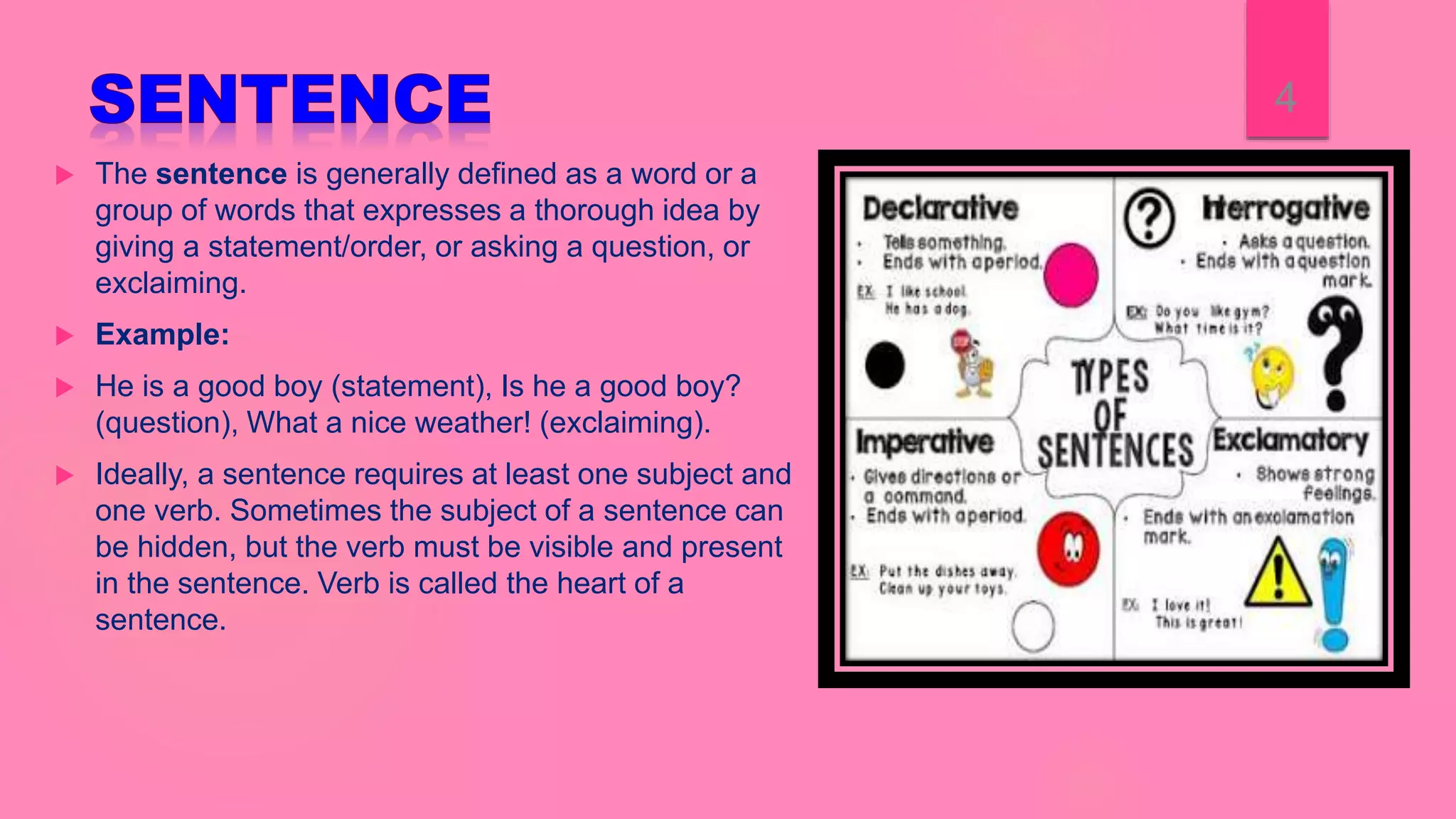
 The sentence is generally defined as a word or a
group of words that expresses a thorough idea by
giving a statement/order, or asking a question, or
exclaiming.
 Example:
 He is a good boy (statement), Is he a good boy?
(question), What a nice weather! (exclaiming).
 Ideally, a sentence requires at least one subject and
one verb. Sometimes the subject of a sentence can
be hidden, but the verb must be visible and present
in the sentence. Verb is called the heart of a
sentence.
4
 Types of Sentences
 Structurally, sentences are of four types:
 Simple sentence
 Compound sentence
 Complex sentence, and
 Compound-complex sentence.
5
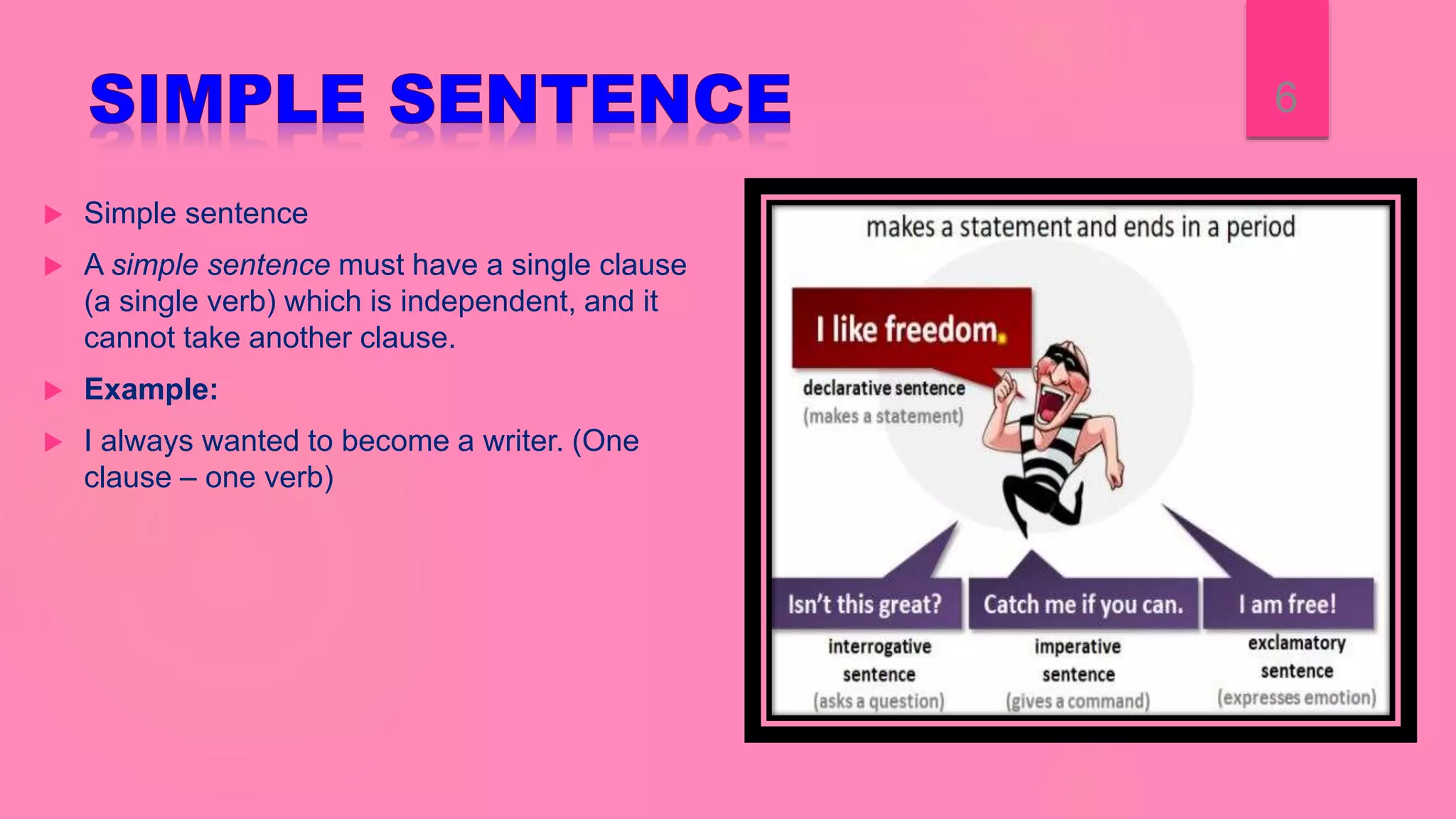
 Simple sentence
 A simple sentence must have a single clause
(a single verb) which is independent, and it
cannot take another clause.
 Example:
 I always wanted to become a writer. (One
clause – one verb)
6
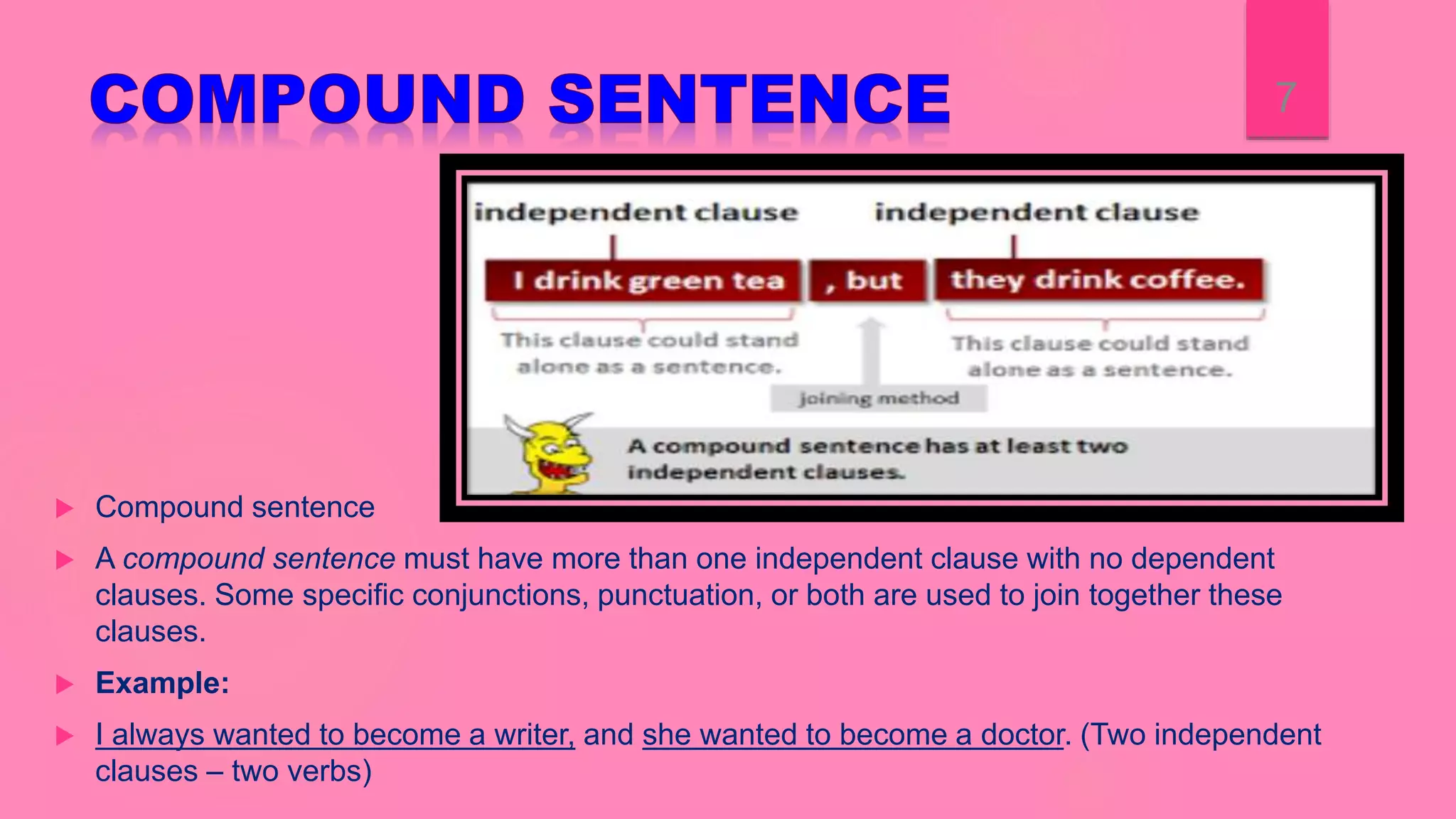
 Compound sentence
 A compound sentence must have more than one independent clause with no dependent
clauses. Some specific conjunctions, punctuation, or both are used to join together these
clauses.
 Example:
 I always wanted to become a writer, and she wanted to become a doctor. (Two independent
clauses – two verbs)
7
8
 Complex sentence
 A complex sentence also has more than one clause but of one them must be an independent
clause and the other/others must be (a) dependent clause(es). There are also some particular
connectors for the clauses of a complex sentence to be connected.
 Example:
 I know that you always wanted to be a writer. (Here, a dependent clause is followed by a
connector and an independent clause. The other way around is also possible.)
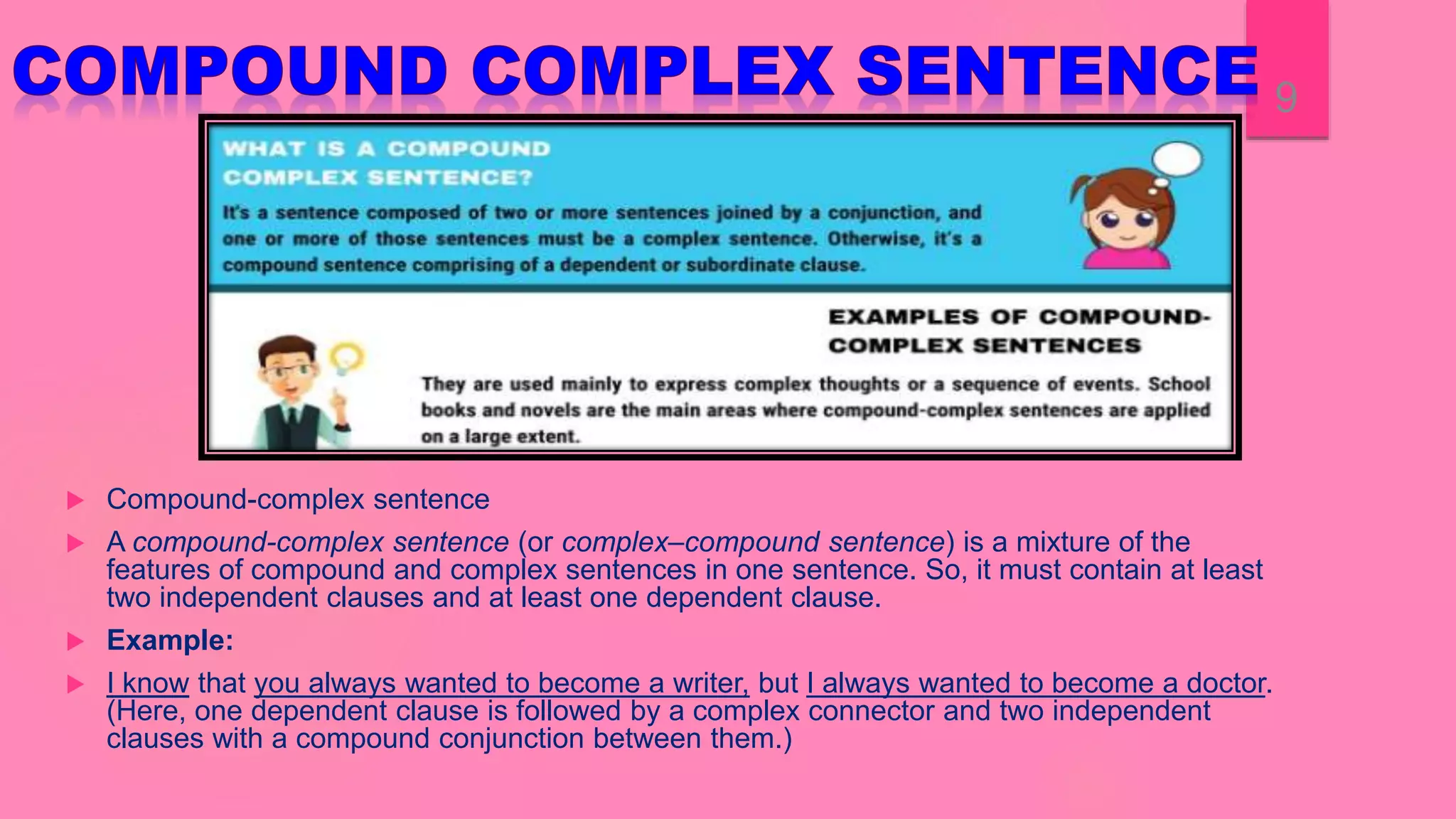
 Compound-complex sentence
 A compound-complex sentence (or complex–compound sentence) is a mixture of the
features of compound and complex sentences in one sentence. So, it must contain at least
two independent clauses and at least one dependent clause.
 Example:
 I know that you always wanted to become a writer, but I always wanted to become a doctor.
(Here, one dependent clause is followed by a complex connector and two independent
clauses with a compound conjunction between them.)
9
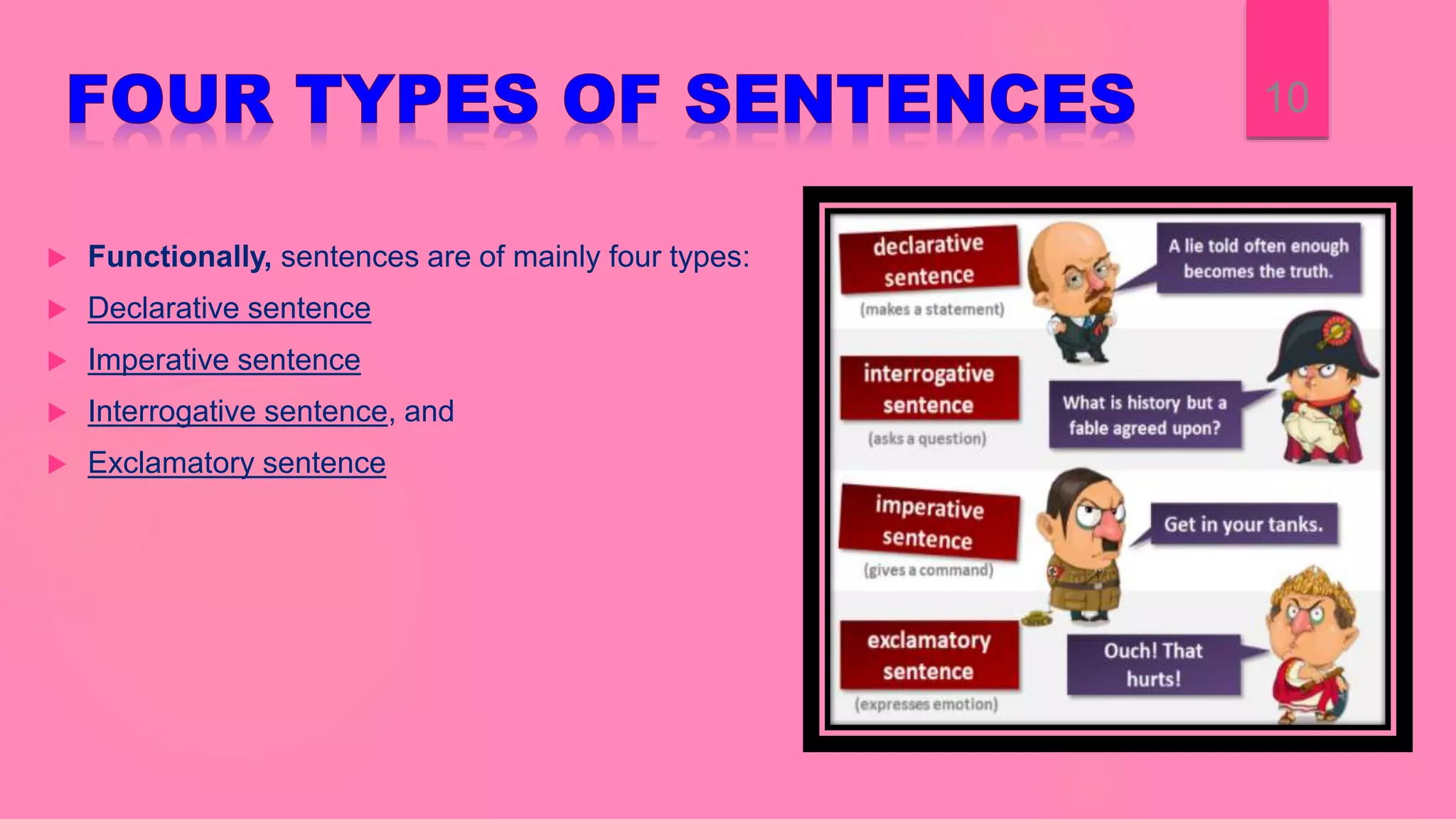
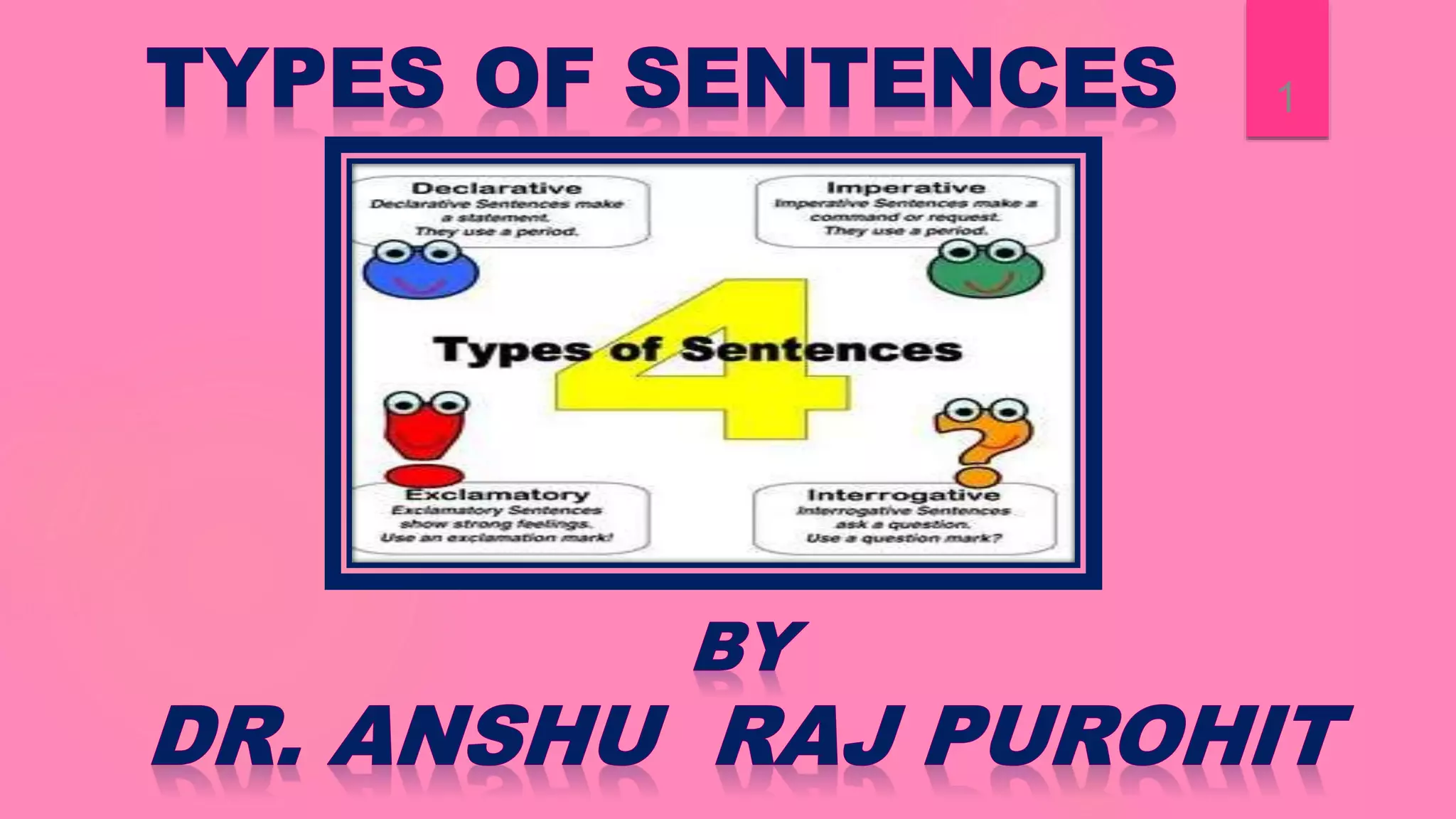
 Functionally, sentences are of mainly four types:
 Declarative sentence
 Imperative sentence
 Interrogative sentence, and
 Exclamatory sentence
10
 Declarative sentence:
 An assertive sentence (declarative sentence) simply expresses an opinion/feeling, or
makes a statement, or describes things. In other words, it declares something. This type
of sentence ends with a period (i.e., a full-stop).
 Examples:
 I want to be a good cricketer. (a statement)
 I am very happy today. (a feeling)
11
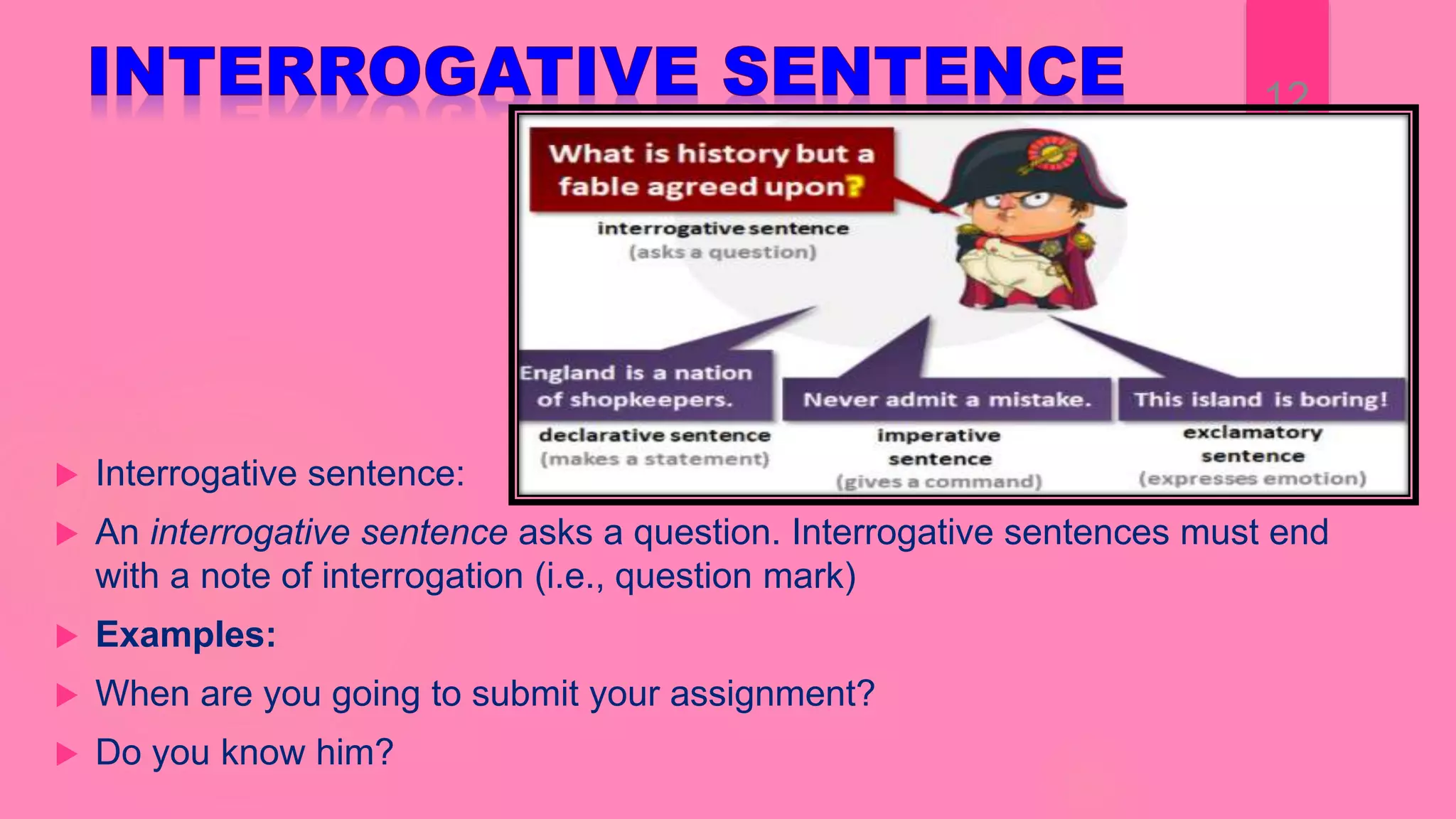
 Interrogative sentence:
 An interrogative sentence asks a question. Interrogative sentences must end
with a note of interrogation (i.e., question mark)
 Examples:
 When are you going to submit your assignment?
 Do you know him?
12
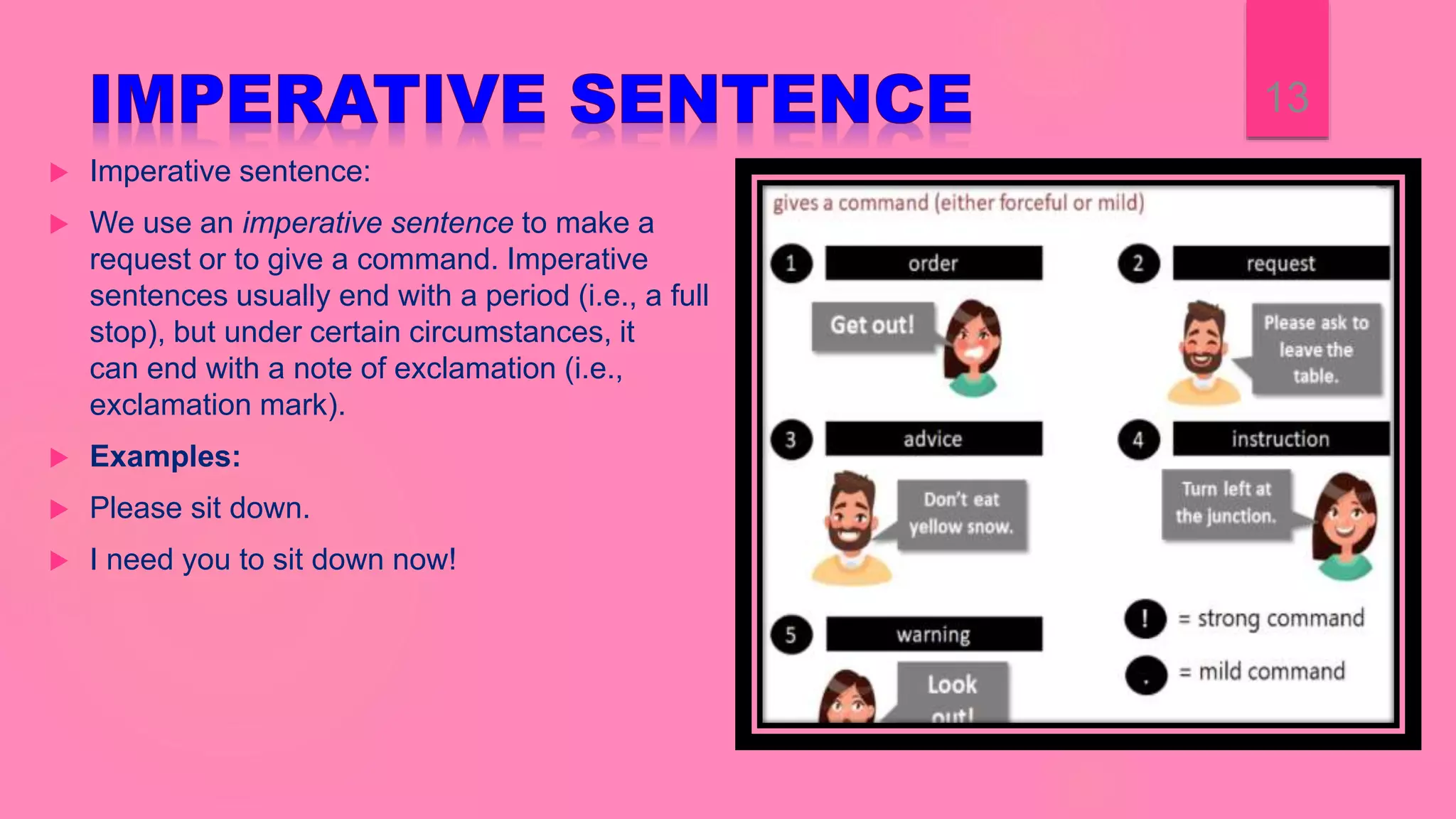
 Imperative sentence:
 We use an imperative sentence to make a
request or to give a command. Imperative
sentences usually end with a period (i.e., a full
stop), but under certain circumstances, it
can end with a note of exclamation (i.e.,
exclamation mark).
 Examples:
 Please sit down.
 I need you to sit down now!
13
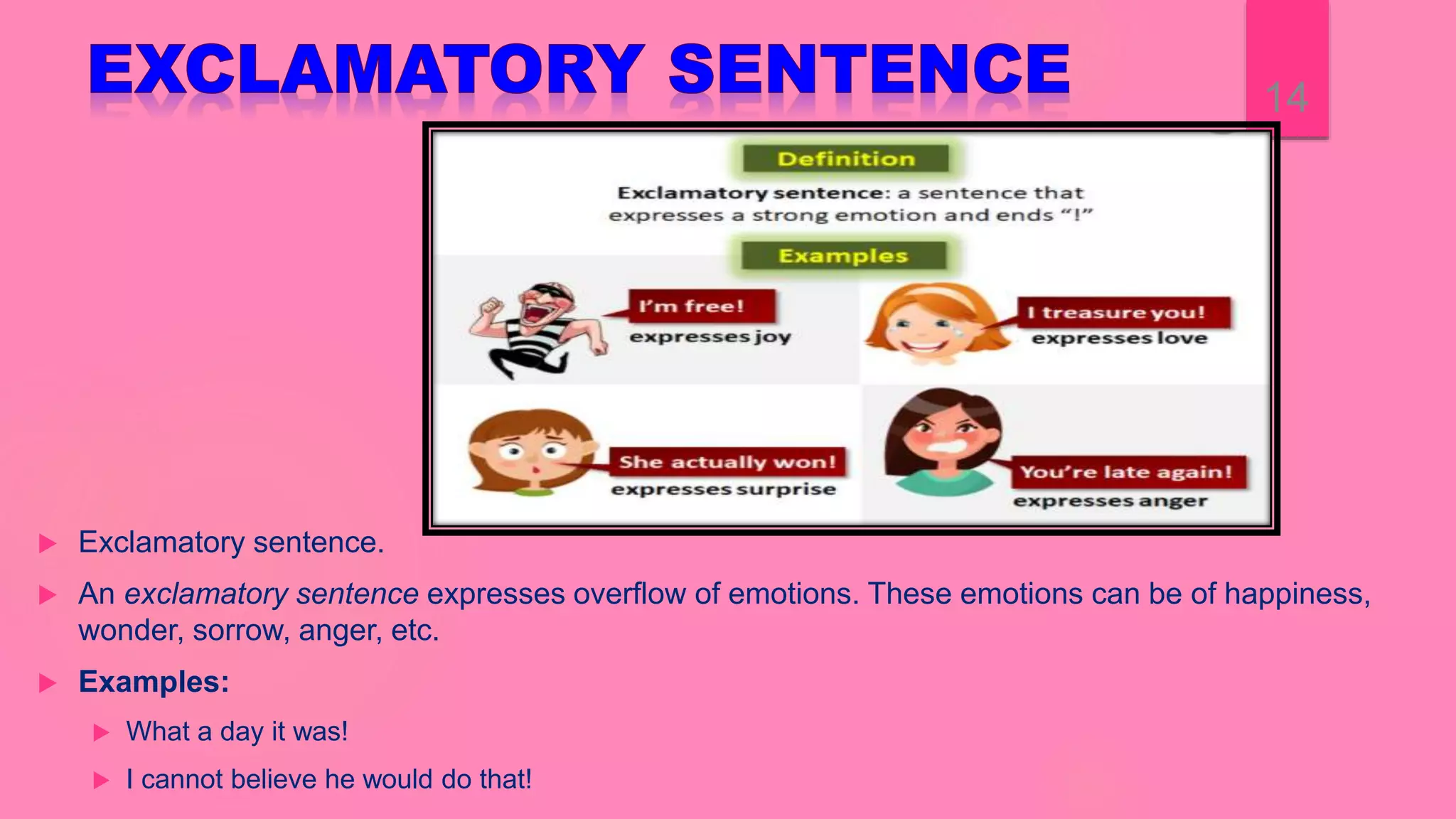
 Exclamatory sentence.
 An exclamatory sentence expresses overflow of emotions. These emotions can be of happiness,
wonder, sorrow, anger, etc.
 Examples:
 What a day it was!
 I cannot believe he would do that!
14
15
16

Types of sentences

  • 1.
  • 2.
     In non-functionallinguistics, a sentence is a textual unit consisting of one or more words that are grammatically linked. In functional linguistics, a sentence is a unit of written texts delimited by graphological features such as upper case letters and markers such as periods, question marks, and exclamation marks. 2
  • 3.
     A sentenceis the largest unit of any language. In English, it begins with a capital letter and ends with a full-stop, or a question mark, or an exclamation mark.  Example:  Do it. (In this sentence, a subject ‘you’ is hidden but verb ‘do’ is visible)  “[A sentence is] a group of words, usually containing a verb, that expresses a thought in the form of a statement, question, instruction, or exclamation and starts with a capital letter when written.” - (Cambridge Advanced Learner’s Dictionary & Thesaurus © Cambridge University Press.)  3
  • 4.
     The sentenceis generally defined as a word or a group of words that expresses a thorough idea by giving a statement/order, or asking a question, or exclaiming.  Example:  He is a good boy (statement), Is he a good boy? (question), What a nice weather! (exclaiming).  Ideally, a sentence requires at least one subject and one verb. Sometimes the subject of a sentence can be hidden, but the verb must be visible and present in the sentence. Verb is called the heart of a sentence. 4
  • 5.
     Types ofSentences  Structurally, sentences are of four types:  Simple sentence  Compound sentence  Complex sentence, and  Compound-complex sentence. 5
  • 6.
     Simple sentence A simple sentence must have a single clause (a single verb) which is independent, and it cannot take another clause.  Example:  I always wanted to become a writer. (One clause – one verb) 6
  • 7.
     Compound sentence A compound sentence must have more than one independent clause with no dependent clauses. Some specific conjunctions, punctuation, or both are used to join together these clauses.  Example:  I always wanted to become a writer, and she wanted to become a doctor. (Two independent clauses – two verbs) 7
  • 8.
    8  Complex sentence A complex sentence also has more than one clause but of one them must be an independent clause and the other/others must be (a) dependent clause(es). There are also some particular connectors for the clauses of a complex sentence to be connected.  Example:  I know that you always wanted to be a writer. (Here, a dependent clause is followed by a connector and an independent clause. The other way around is also possible.)
  • 9.
     Compound-complex sentence A compound-complex sentence (or complex–compound sentence) is a mixture of the features of compound and complex sentences in one sentence. So, it must contain at least two independent clauses and at least one dependent clause.  Example:  I know that you always wanted to become a writer, but I always wanted to become a doctor. (Here, one dependent clause is followed by a complex connector and two independent clauses with a compound conjunction between them.) 9
  • 10.
     Functionally, sentencesare of mainly four types:  Declarative sentence  Imperative sentence  Interrogative sentence, and  Exclamatory sentence 10
  • 11.
     Declarative sentence: An assertive sentence (declarative sentence) simply expresses an opinion/feeling, or makes a statement, or describes things. In other words, it declares something. This type of sentence ends with a period (i.e., a full-stop).  Examples:  I want to be a good cricketer. (a statement)  I am very happy today. (a feeling) 11
  • 12.
     Interrogative sentence: An interrogative sentence asks a question. Interrogative sentences must end with a note of interrogation (i.e., question mark)  Examples:  When are you going to submit your assignment?  Do you know him? 12
  • 13.
     Imperative sentence: We use an imperative sentence to make a request or to give a command. Imperative sentences usually end with a period (i.e., a full stop), but under certain circumstances, it can end with a note of exclamation (i.e., exclamation mark).  Examples:  Please sit down.  I need you to sit down now! 13
  • 14.
     Exclamatory sentence. An exclamatory sentence expresses overflow of emotions. These emotions can be of happiness, wonder, sorrow, anger, etc.  Examples:  What a day it was!  I cannot believe he would do that! 14
  • 15.
  • 16.