Eng7-Q3 Lesson 2: Part
3 - Sentence Structure
and Function
Prepared by: Mr. Sandy N. Navergas
Learning Competency : 1. 2. EN7INF-III-2 Examine linguistic features as tools to
achieve organizational efficiency in informational texts:
-diction and style
-transition devices
-sentence structure and function
Objectives
By the end of the lesson, students will be able to:
a. Distinguish types of sentences based on structure
(simple, compound, complex, compound-complex).
b. Analyze how varied sentence structures contribute to
text effectiveness.
Types of Sentence
Structure
Sentence Structure refers to the
way a sentence is organized, including
the arrangement of words, phrases,
and clauses. It affects the clarity,
rhythm, and emphasis of a sentence.
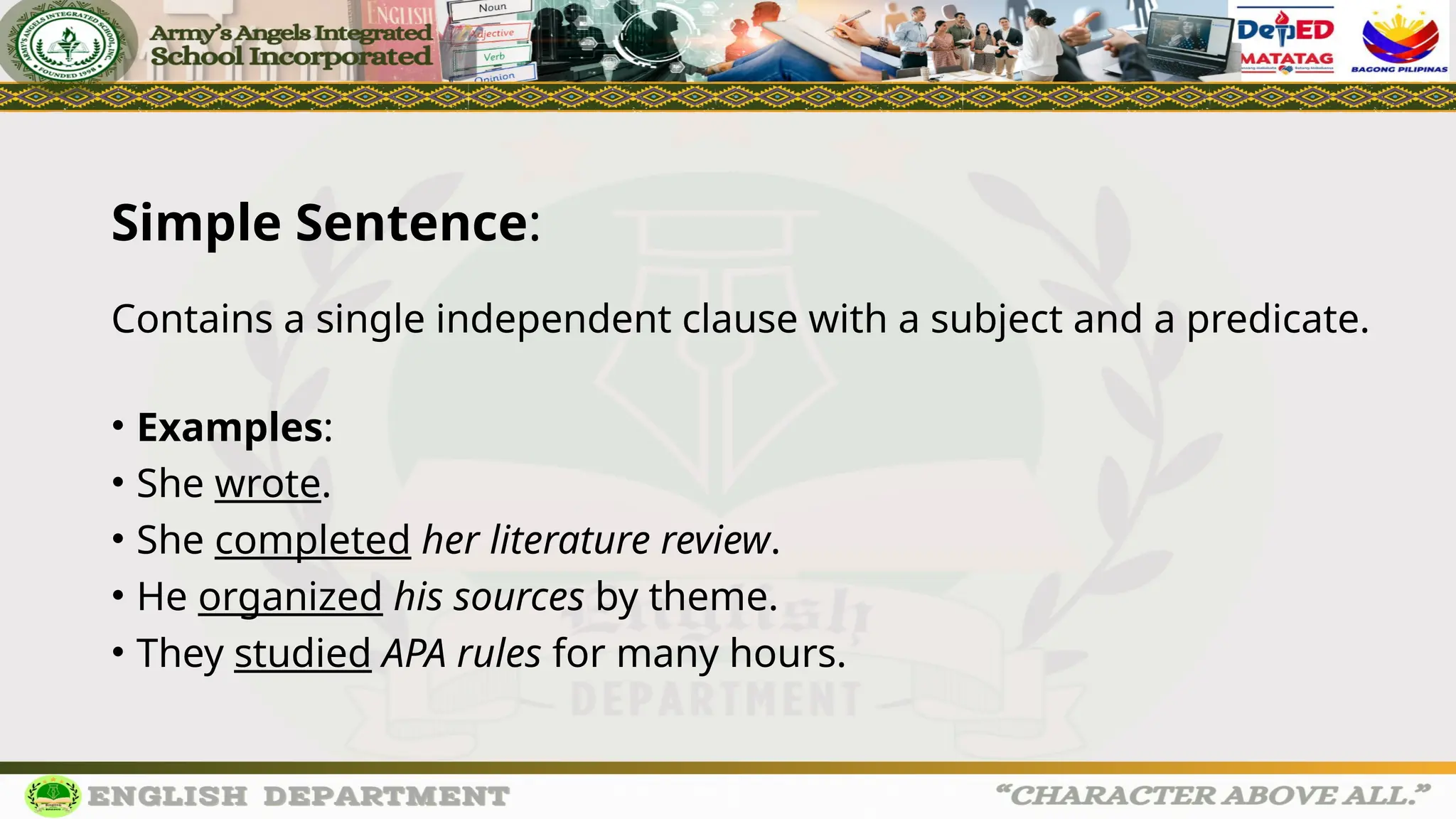
Simple Sentence:
Contains a single independent clause with a subject and a predicate.
• Examples:
• She wrote.
• She completed her literature review.
• He organized his sources by theme.
• They studied APA rules for many hours.
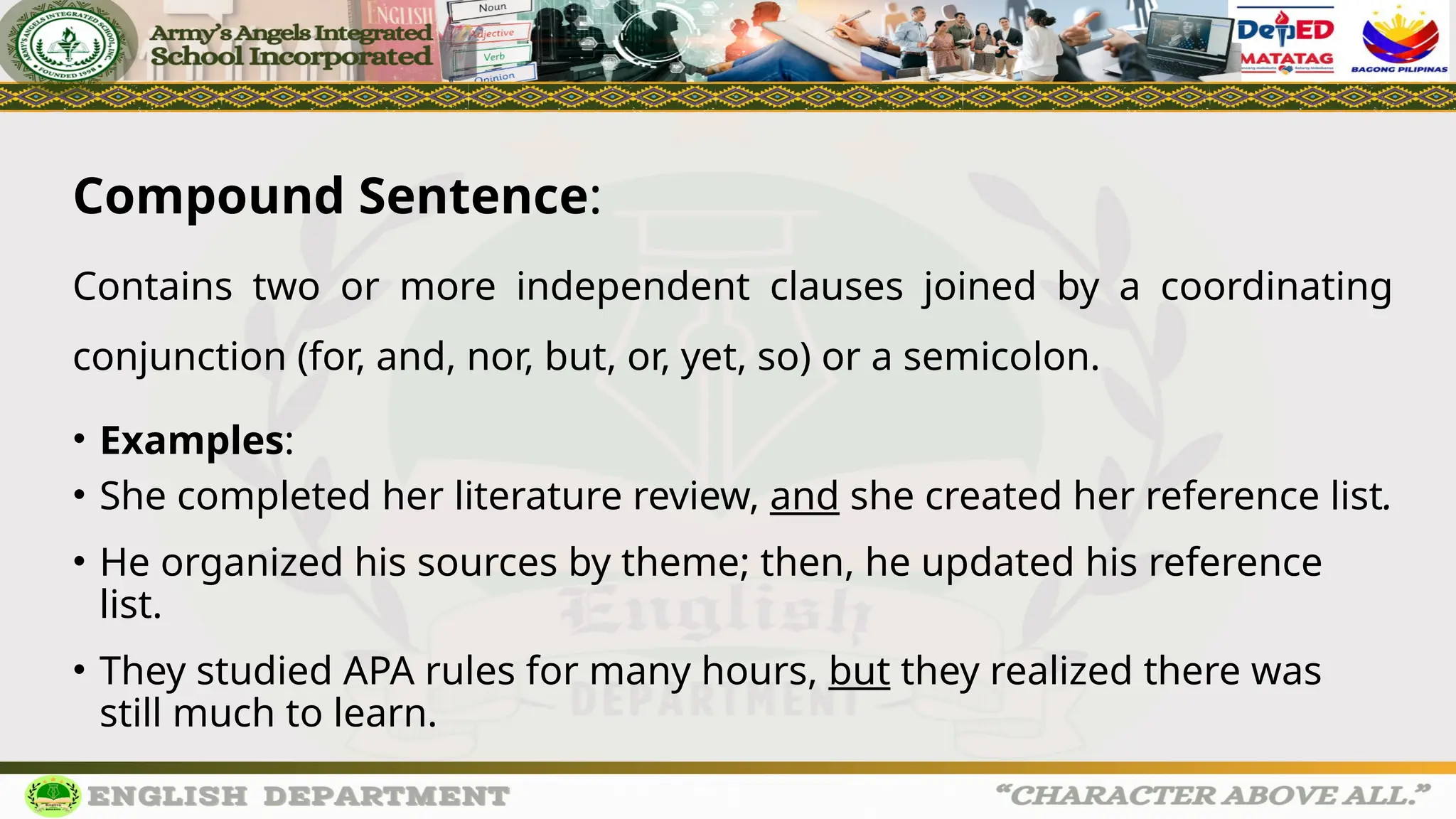
Compound Sentence:
Contains two or more independent clauses joined by a coordinating
conjunction (for, and, nor, but, or, yet, so) or a semicolon.
• Examples:
• She completed her literature review, and she created her reference list.
• He organized his sources by theme; then, he updated his reference
list.
• They studied APA rules for many hours, but they realized there was
still much to learn.
Complex Sentence:
Contains one independent clause and at least one dependent (subordinate) clause,
which cannot stand alone.
Examples:
• Although she completed her literature review, she still needed to work on her
methods section.
• Note the comma in this sentence because it begins with a dependent clause.
• Because he organized his sources by theme, it was easier for his readers to follow.
• Note the comma in this sentence because it begins with a dependent clause.
• They studied APA rules for many hours as they were so interesting.
• Note that there is no comma in this sentence because it begins with an independent clause.
• Using some complex sentences in writing allows for more sentence variety.
Compound-Complex Sentence:
• Contains two or more independent clauses and at least one dependent
clause.
• Examples:
• She completed her literature review, but she still needs to work on her
methods section even though she finished her methods course last semester.
• Although he organized his sources by theme, he decided to arrange them
chronologically, and he carefully followed the MEAL plan for
organization.
• They studied APA rules for many hours, and they decided that writing in
APA made sense because it was clear, concise, and objective.
Types of Sentence Function
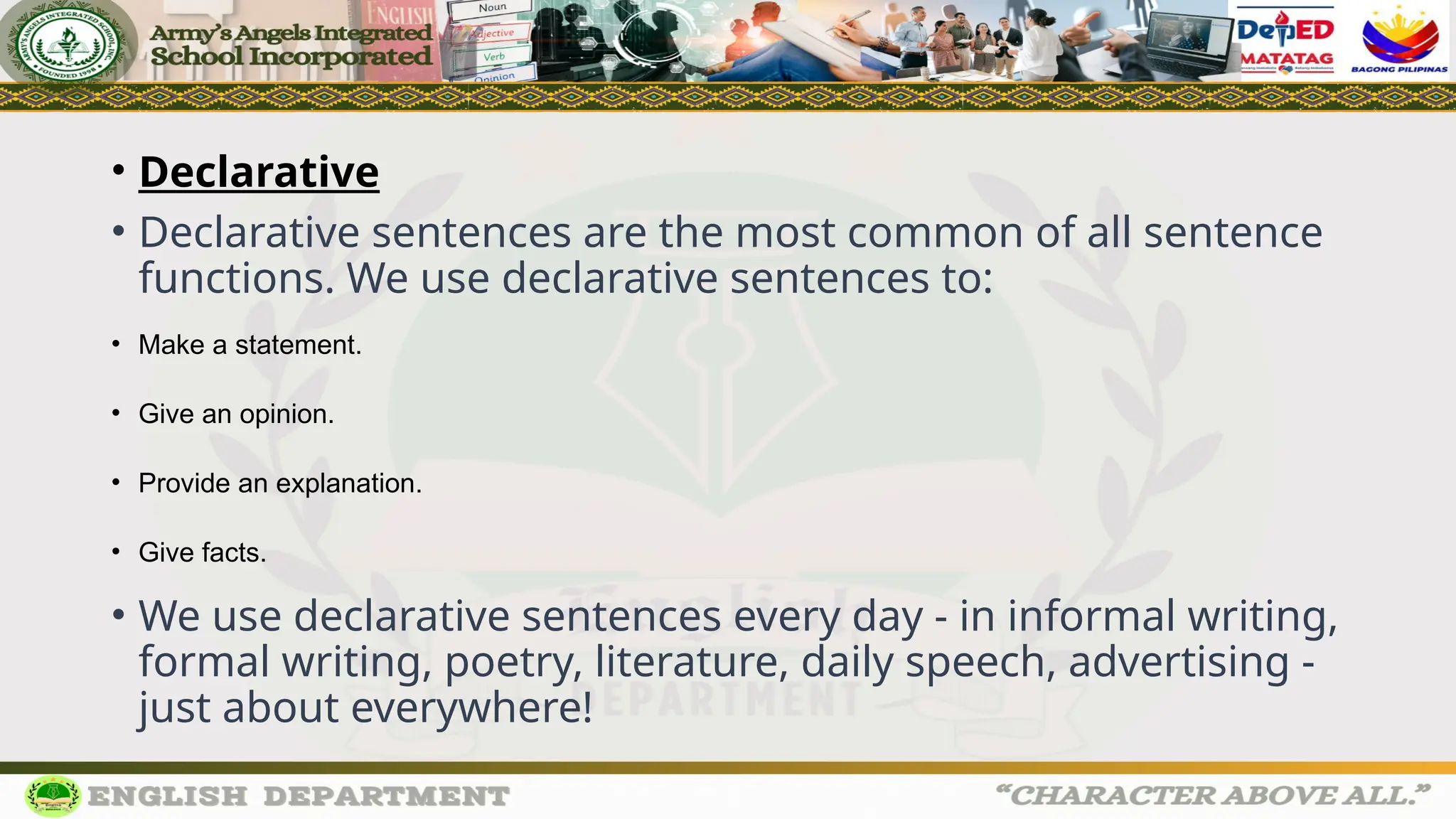
• Declarative
• Declarative sentences are the most common of all sentence
functions. We use declarative sentences to:
• Make a statement.
• Give an opinion.
• Provide an explanation.
• Give facts.
• We use declarative sentences every day - in informal writing,
formal writing, poetry, literature, daily speech, advertising -
just about everywhere!
Let's take a look at some examples of declarative
sentences.
•I like singing.
•I don't like singing.
•It's cold because he forgot to put the heating on.
•The capital of India is New Delhi.
• Interrogative
• Interrogative sentences are used to ask questions and typically require
an answer. There are a few different types of interrogative sentences:
• Yes/No interrogatives.
• Alternative interrogatives.
• WH interrogatives.
• Negative interrogatives.
• Tag questions.
• Interrogative sentences usually begin with a WH question word (who,
what, where, when, why, and how) or an auxiliary verb (are, do, can,
may, etc.), and always end with a question mark (?).
Let's take a look at some examples of interrogative
sentences.
• Where is the bathroom?
• Have you seen the latest episode of The Crown?
• You don't eat meat, do you?
• Do you prefer tea or coffee?
Imperative
• Imperative sentences are mainly used to give a command or make
a demand and can be presented in several ways.
• Giving instructions.
• Offering advice.
• Making a wish on behalf of someone else.
• Extending an invitation.
• Giving a command.
• There is often no subject present when forming imperative sentences
because the subject is assumed to be you, the reader, or the
listener. Imperative sentences can end in either a full stop (.) or an
exclamation mark (!), depending on the urgency of the command.
Here are some examples of imperative sentences:
• Sit down!
• Set the oven to 180 degrees.
• Try the other door.
• Have a nice day.
• Please, take a seat.
• Exclamatory
• Exclamative sentences are used to express strong feelings and
opinions, such as surprise, excitement, and anger. Exclamative
sentences must contain the words What or How and usually end
with an exclamation mark (!).
• Here are some examples of exclamative sentences:
• 'Lord, what fools these mortals be!' (William Shakespeare, A
Midsummer Night's Dream, 1605)
• What a nice surprise!
• Oh, how lovely!
• Combining Sentence Structure and Function:
• A simple sentence can be used to make a declarative statement:
"The sun sets."
• A compound sentence can ask a question and make a statement:
"Do you want coffee, or should we go out for tea?"
• A complex sentence can give a command with additional information:
"Close the door when you leave."
• A compound-complex sentence can express excitement while
providing details:
"I can’t believe it! We won the game, and now we’re celebrating!"
• By understanding both sentence structure and function, writers can
create varied and effective sentences that fulfill specific communication
needs.

Eng7-Q3-Lesson 2 Part 3_Sentence Structure and Function.pptx

  • 1.
    Eng7-Q3 Lesson 2:Part 3 - Sentence Structure and Function Prepared by: Mr. Sandy N. Navergas Learning Competency : 1. 2. EN7INF-III-2 Examine linguistic features as tools to achieve organizational efficiency in informational texts: -diction and style -transition devices -sentence structure and function
  • 2.
    Objectives By the endof the lesson, students will be able to: a. Distinguish types of sentences based on structure (simple, compound, complex, compound-complex). b. Analyze how varied sentence structures contribute to text effectiveness.
  • 3.
  • 4.
    Sentence Structure refersto the way a sentence is organized, including the arrangement of words, phrases, and clauses. It affects the clarity, rhythm, and emphasis of a sentence.
  • 5.
    Simple Sentence: Contains asingle independent clause with a subject and a predicate. • Examples: • She wrote. • She completed her literature review. • He organized his sources by theme. • They studied APA rules for many hours.
  • 6.
    Compound Sentence: Contains twoor more independent clauses joined by a coordinating conjunction (for, and, nor, but, or, yet, so) or a semicolon. • Examples: • She completed her literature review, and she created her reference list. • He organized his sources by theme; then, he updated his reference list. • They studied APA rules for many hours, but they realized there was still much to learn.
  • 7.
    Complex Sentence: Contains oneindependent clause and at least one dependent (subordinate) clause, which cannot stand alone. Examples: • Although she completed her literature review, she still needed to work on her methods section. • Note the comma in this sentence because it begins with a dependent clause. • Because he organized his sources by theme, it was easier for his readers to follow. • Note the comma in this sentence because it begins with a dependent clause. • They studied APA rules for many hours as they were so interesting. • Note that there is no comma in this sentence because it begins with an independent clause. • Using some complex sentences in writing allows for more sentence variety.
  • 8.
    Compound-Complex Sentence: • Containstwo or more independent clauses and at least one dependent clause. • Examples: • She completed her literature review, but she still needs to work on her methods section even though she finished her methods course last semester. • Although he organized his sources by theme, he decided to arrange them chronologically, and he carefully followed the MEAL plan for organization. • They studied APA rules for many hours, and they decided that writing in APA made sense because it was clear, concise, and objective.
  • 9.
  • 10.
    • Declarative • Declarativesentences are the most common of all sentence functions. We use declarative sentences to: • Make a statement. • Give an opinion. • Provide an explanation. • Give facts. • We use declarative sentences every day - in informal writing, formal writing, poetry, literature, daily speech, advertising - just about everywhere!
  • 11.
    Let's take alook at some examples of declarative sentences. •I like singing. •I don't like singing. •It's cold because he forgot to put the heating on. •The capital of India is New Delhi.
  • 12.
    • Interrogative • Interrogativesentences are used to ask questions and typically require an answer. There are a few different types of interrogative sentences: • Yes/No interrogatives. • Alternative interrogatives. • WH interrogatives. • Negative interrogatives. • Tag questions. • Interrogative sentences usually begin with a WH question word (who, what, where, when, why, and how) or an auxiliary verb (are, do, can, may, etc.), and always end with a question mark (?).
  • 13.
    Let's take alook at some examples of interrogative sentences. • Where is the bathroom? • Have you seen the latest episode of The Crown? • You don't eat meat, do you? • Do you prefer tea or coffee?
  • 14.
    Imperative • Imperative sentencesare mainly used to give a command or make a demand and can be presented in several ways. • Giving instructions. • Offering advice. • Making a wish on behalf of someone else. • Extending an invitation. • Giving a command. • There is often no subject present when forming imperative sentences because the subject is assumed to be you, the reader, or the listener. Imperative sentences can end in either a full stop (.) or an exclamation mark (!), depending on the urgency of the command.
  • 15.
    Here are someexamples of imperative sentences: • Sit down! • Set the oven to 180 degrees. • Try the other door. • Have a nice day. • Please, take a seat.
  • 16.
    • Exclamatory • Exclamativesentences are used to express strong feelings and opinions, such as surprise, excitement, and anger. Exclamative sentences must contain the words What or How and usually end with an exclamation mark (!). • Here are some examples of exclamative sentences: • 'Lord, what fools these mortals be!' (William Shakespeare, A Midsummer Night's Dream, 1605) • What a nice surprise! • Oh, how lovely!
  • 17.
    • Combining SentenceStructure and Function: • A simple sentence can be used to make a declarative statement: "The sun sets." • A compound sentence can ask a question and make a statement: "Do you want coffee, or should we go out for tea?" • A complex sentence can give a command with additional information: "Close the door when you leave." • A compound-complex sentence can express excitement while providing details: "I can’t believe it! We won the game, and now we’re celebrating!" • By understanding both sentence structure and function, writers can create varied and effective sentences that fulfill specific communication needs.