By
ANITA ANWER ALI
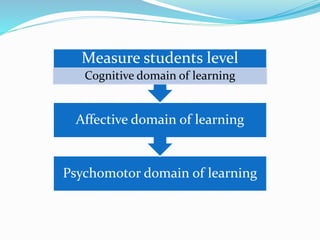
Psychomotor domain of learning
Affective domain of learning
Measure students level
Cognitive domain of learning
•To report the progress made by pupils.
•To place children in ability groups.
•To see whether pupils have mastered a
particular unit or skill .
•To match pupils materials with pupils
abilities.
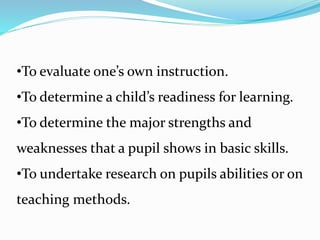
•To evaluate one’s own instruction.
•To determine a child’s readiness for learning.
•To determine the major strengths and
weaknesses that a pupil shows in basic skills.
•To undertake research on pupils abilities or on
teaching methods.
Testing:
Test is an instrument or device, or procedure that
proposes a sequence of tasks to which a student is to
respond. The results are then used as measures to define
relative value of the trait to which the test relates.
“Testing is a systematic process to measure the
sample behaviour”.
Testing is a device or systematic procedure where an
individual’s performance is assessed by assigning different
tools. E.g. Questions or different tasks.
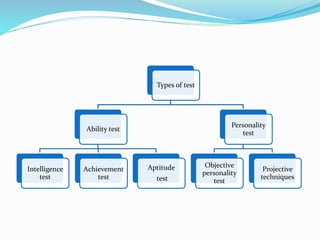
Types of test
Ability test
Intelligence
test
Achievement
test
Aptitude
test
Personality
test
Objective
personality
test
Projective
techniques
Measurement
James M. Bardfield suggest “Measurement is the
process of assigning number to an individual by
describing quality and quantity by using different
tools or scales according to a set of rules”.
“The process of obtaining a numerical
description of the degree to which an individual
possess a particular characteristic”(Linn & Gronlund,
2000).
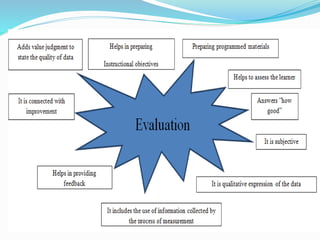
Evaluation
“Evaluation is the systematic process of
collecting and analyzing data in order to make
decision.”
“Evaluation is a systematic process of
collecting and analyzing data in order to
determine whether, and to what degree objectives
have been achieved” (Linn & Gronlund, 2000).
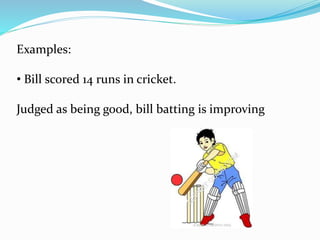
Examples:
• Bill scored 14 runs in cricket.
Judged as being good, bill batting is improving
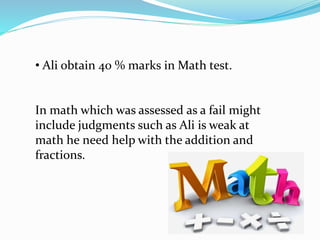
• Ali obtain 40 % marks in Math test.
In math which was assessed as a fail might
include judgments such as Ali is weak at
math he need help with the addition and
fractions.
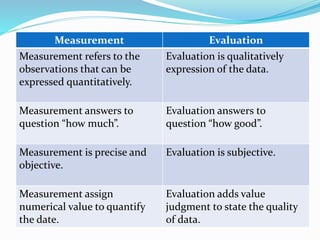
Measurement Evaluation
Measurement refers to the
observations that can be
expressed quantitatively.
Evaluation is qualitatively
expression of the data.
Measurement answers to
question “how much”.
Evaluation answers to
question “how good”.
Measurement is precise and
objective.
Evaluation is subjective.
Measurement assign
numerical value to quantify
the date.
Evaluation adds value
judgment to state the quality
of data.
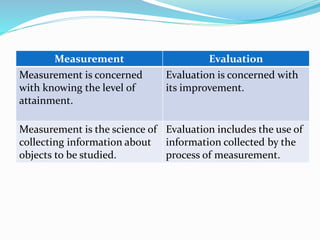
Measurement Evaluation
Measurement is concerned
with knowing the level of
attainment.
Evaluation is concerned with
its improvement.
Measurement is the science of
collecting information about
objects to be studied.
Evaluation includes the use of
information collected by the
process of measurement.
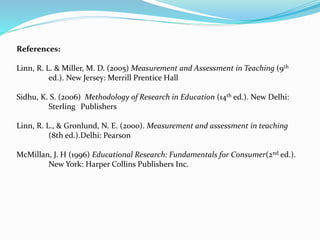
References:
Linn, R. L. & Miller, M. D. (2005) Measurement and Assessment in Teaching (9th
ed.). New Jersey: Merrill Prentice Hall
Sidhu, K. S. (2006) Methodology of Research in Education (14th ed.). New Delhi:
Sterling Publishers
Linn, R. L., & Gronlund, N. E. (2000). Measurement and assessment in teaching
(8th ed.).Delhi: Pearson
McMillan, J. H (1996) Educational Research: Fundamentals for Consumer(2nd ed.).
New York: Harper Collins Publishers Inc.

Testing, Measurement and Evaluation

  • 1.
  • 2.
    Psychomotor domain oflearning Affective domain of learning Measure students level Cognitive domain of learning
  • 4.
    •To report theprogress made by pupils. •To place children in ability groups. •To see whether pupils have mastered a particular unit or skill . •To match pupils materials with pupils abilities.
  • 5.
    •To evaluate one’sown instruction. •To determine a child’s readiness for learning. •To determine the major strengths and weaknesses that a pupil shows in basic skills. •To undertake research on pupils abilities or on teaching methods.
  • 6.
    Testing: Test is aninstrument or device, or procedure that proposes a sequence of tasks to which a student is to respond. The results are then used as measures to define relative value of the trait to which the test relates. “Testing is a systematic process to measure the sample behaviour”. Testing is a device or systematic procedure where an individual’s performance is assessed by assigning different tools. E.g. Questions or different tasks.
  • 7.
    Types of test Abilitytest Intelligence test Achievement test Aptitude test Personality test Objective personality test Projective techniques
  • 8.
    Measurement James M. Bardfieldsuggest “Measurement is the process of assigning number to an individual by describing quality and quantity by using different tools or scales according to a set of rules”. “The process of obtaining a numerical description of the degree to which an individual possess a particular characteristic”(Linn & Gronlund, 2000).
  • 9.
    Evaluation “Evaluation is thesystematic process of collecting and analyzing data in order to make decision.” “Evaluation is a systematic process of collecting and analyzing data in order to determine whether, and to what degree objectives have been achieved” (Linn & Gronlund, 2000).
  • 11.
    Examples: • Bill scored14 runs in cricket. Judged as being good, bill batting is improving
  • 12.
    • Ali obtain40 % marks in Math test. In math which was assessed as a fail might include judgments such as Ali is weak at math he need help with the addition and fractions.
  • 13.
    Measurement Evaluation Measurement refersto the observations that can be expressed quantitatively. Evaluation is qualitatively expression of the data. Measurement answers to question “how much”. Evaluation answers to question “how good”. Measurement is precise and objective. Evaluation is subjective. Measurement assign numerical value to quantify the date. Evaluation adds value judgment to state the quality of data.
  • 14.
    Measurement Evaluation Measurement isconcerned with knowing the level of attainment. Evaluation is concerned with its improvement. Measurement is the science of collecting information about objects to be studied. Evaluation includes the use of information collected by the process of measurement.
  • 15.
    References: Linn, R. L.& Miller, M. D. (2005) Measurement and Assessment in Teaching (9th ed.). New Jersey: Merrill Prentice Hall Sidhu, K. S. (2006) Methodology of Research in Education (14th ed.). New Delhi: Sterling Publishers Linn, R. L., & Gronlund, N. E. (2000). Measurement and assessment in teaching (8th ed.).Delhi: Pearson McMillan, J. H (1996) Educational Research: Fundamentals for Consumer(2nd ed.). New York: Harper Collins Publishers Inc.