TYNDALL EFFECT 15251510-010(AROOJ)
15251510-002(KASHIFA)
CONTENTS
History
Difference between solution, suspension and colloidal solution
Video about this
Explanation of tyndall effect
Conditions
Applications
Why sky appear blue?
Why sky appear red at sunset and sunrise?
TYNDALL EFFECT
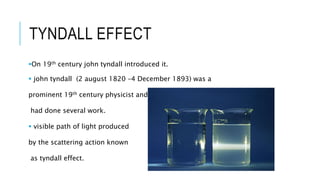
On 19th century john tyndall introduced it.
 john tyndall (2 august 1820 –4 December 1893) was a
prominent 19th century physicist and
had done several work.
 visible path of light produced
by the scattering action known
as tyndall effect.
DIFFERENCE BETWEEN SOLUTION,
SUSPENSION, COLLOIDS.
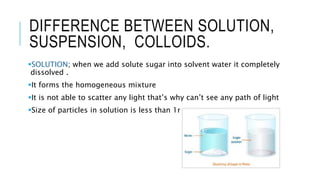
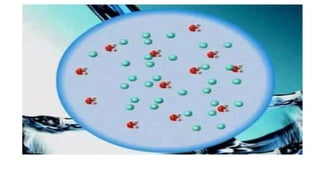
SOLUTION; when we add solute sugar into solvent water it completely
dissolved .
It forms the homogeneous mixture
It is not able to scatter any light that’s why can’t see any path of light
Size of particles in solution is less than 1nm
SUSPENSION
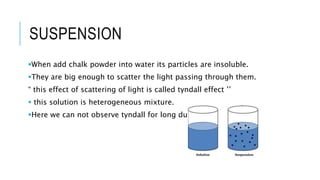
When add chalk powder into water its particles are insoluble.
They are big enough to scatter the light passing through them.
“ this effect of scattering of light is called tyndall effect ’’
 this solution is heterogeneous mixture.
Here we can not observe tyndall for long duration
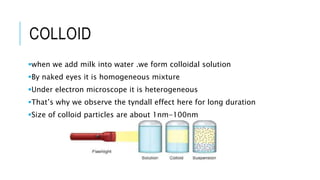
COLLOID
when we add milk into water .we form colloidal solution
By naked eyes it is homogeneous mixture
Under electron microscope it is heterogeneous
That’s why we observe the tyndall effect here for long duration
Size of colloid particles are about 1nm-100nm
CONDITIONS
1. Diameter of dispersed particles should be smaller than the
wavelength of light used
2. Refractive index of dispersion medium and dispersed phase must
be differ greatly in magnitude.
TYNDALL EFFECT
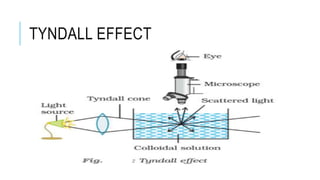
When the light fall from any medium to any colloidal particles and
getting interact with it.
Consider the light ray falling in colloidal particle through tyndall cone
Size of particles around 10nm -100nm
After interacting with light reflected in all around
And perfectly scattered
Colloidal particle seen under the electron microscope
TYNDALL EFFECT
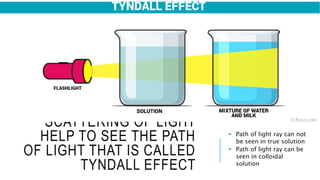
SCATTERING OF LIGHT
HELP TO SEE THE PATH
OF LIGHT THAT IS CALLED
TYNDALL EFFECT
 Path of light ray can not
be seen in true solution
 Path of light ray can be
seen in colloidal
solution
APPLICATIONS
Blue color of sky and sea
Twinkling of star
Visibility of tail of comets
Light comes from projection
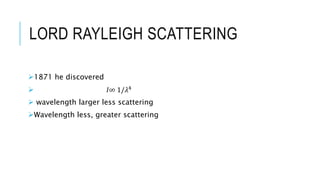
LORD RAYLEIGH SCATTERING
1871 he discovered
 𝐼∞ 1/𝜆4
 wavelength larger less scattering
Wavelength less, greater scattering
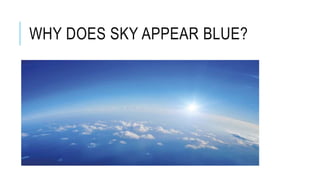
WHY DOES SKY APPEAR BLUE?
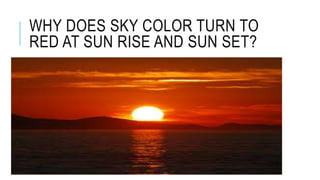
WHY DOES SKY COLOR TURN TO
RED AT SUN RISE AND SUN SET?

Tyndall effect

  • 1.
  • 2.
    CONTENTS History Difference between solution,suspension and colloidal solution Video about this Explanation of tyndall effect Conditions Applications Why sky appear blue? Why sky appear red at sunset and sunrise?
  • 3.
    TYNDALL EFFECT On 19thcentury john tyndall introduced it.  john tyndall (2 august 1820 –4 December 1893) was a prominent 19th century physicist and had done several work.  visible path of light produced by the scattering action known as tyndall effect.
  • 4.
    DIFFERENCE BETWEEN SOLUTION, SUSPENSION,COLLOIDS. SOLUTION; when we add solute sugar into solvent water it completely dissolved . It forms the homogeneous mixture It is not able to scatter any light that’s why can’t see any path of light Size of particles in solution is less than 1nm
  • 5.
    SUSPENSION When add chalkpowder into water its particles are insoluble. They are big enough to scatter the light passing through them. “ this effect of scattering of light is called tyndall effect ’’  this solution is heterogeneous mixture. Here we can not observe tyndall for long duration
  • 6.
    COLLOID when we addmilk into water .we form colloidal solution By naked eyes it is homogeneous mixture Under electron microscope it is heterogeneous That’s why we observe the tyndall effect here for long duration Size of colloid particles are about 1nm-100nm
  • 8.
    CONDITIONS 1. Diameter ofdispersed particles should be smaller than the wavelength of light used 2. Refractive index of dispersion medium and dispersed phase must be differ greatly in magnitude.
  • 9.
    TYNDALL EFFECT When thelight fall from any medium to any colloidal particles and getting interact with it. Consider the light ray falling in colloidal particle through tyndall cone Size of particles around 10nm -100nm After interacting with light reflected in all around And perfectly scattered Colloidal particle seen under the electron microscope
  • 10.
  • 12.
    SCATTERING OF LIGHT HELPTO SEE THE PATH OF LIGHT THAT IS CALLED TYNDALL EFFECT  Path of light ray can not be seen in true solution  Path of light ray can be seen in colloidal solution
  • 13.
    APPLICATIONS Blue color ofsky and sea Twinkling of star Visibility of tail of comets Light comes from projection
  • 14.
    LORD RAYLEIGH SCATTERING 1871he discovered  𝐼∞ 1/𝜆4  wavelength larger less scattering Wavelength less, greater scattering
  • 15.
    WHY DOES SKYAPPEAR BLUE?
  • 16.
    WHY DOES SKYCOLOR TURN TO RED AT SUN RISE AND SUN SET?