Personal Branding 2.0 With Social Media & Digital PR Specialist/Strategist
What Is Personal Branding? This has become increasingly important as our current, future & potential employers, clients and colleagues have more and more access to information that may or may not pertain to us, and naturally start to form opinions based on that information. Personal Branding is how we present ourselves to others.
What Is Personal Branding? “ Personal Branding” first showed up in 1987 when Tom Peters wrote “The Brand Called You” for  Fast Company  magazine. Since the onslaught of Web 2.0 and Social Media, Personal Branding has become an industry of its own, spawning hundreds of books and websites on the topic.
Why Brand YOU? “ Brand is everything and perceptions  are 90 percent of a brand.”*  — Paul Kedrosky, CNBC Television * As appears in  Me 2.0  by Dan Schawbel
Why Brand YOU? A first impression, or  perception , is usually made in less than 30 seconds; however, studies have shown it can take 21 new interactions to change that first impression.
Why Brand YOU? In this quickly evolving digital age, where sometimes we’re not even present when someone gets their first impression of us, Personal Branding is the key to making sure the REAL YOU gets seen the way YOU want to be seen.
What do you think when  you see the following? Martha Stewart Richard Branson Kanye West
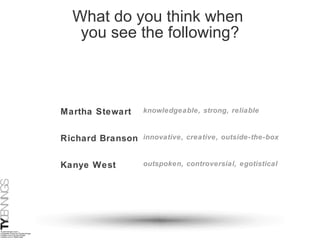
What do you think when  you see the following? Martha Stewart Richard Branson Kanye West outspoken, controversial, egotistical innovative, creative, outside-the-box knowledgeable, strong, reliable
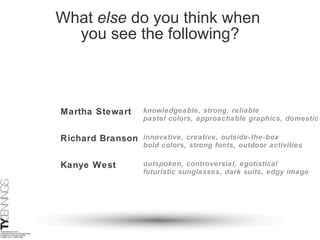
What  else  do you think when  you see the following? Martha Stewart Richard Branson Kanye West outspoken, controversial, egotistical innovative, creative, outside-the-box knowledgeable, strong, reliable pastel colors, approachable graphics, domestic bold colors, strong fonts, outdoor activities futuristic sunglasses, dark suits, edgy image
What do you think when  you see your name? ?
What do other people think  when they see your name? What would you like others to think of when they see your name?
With Social Media sites such as LinkedIn, Twitter, YouTube and others allowing us, the general public, to not only control, but participate in, the content we see, it is up to us to set ourselves apart from our competitors and colleagues…
… especially given that the average college student today will have upwards of 14 jobs by the time they’re 38! That’s a lot of applying & interviewing, which is happening more and more through Social Media. As companies realize they can no longer hope for long-term employees, they’re looking for higher-quality employees that they can get the most out of while they have them. Personal Branding gets that message across.
“ Until roughly five years ago, finding great talent was like finding a needle in a haystack. Today it’s like finding a needle in a stack of needles. Monster contains 44 million resumes. CareerBuilder has 17 million resumes. HotJobs has 5 million. And that’s just the tip of the iceberg. Facebook, LinkedIn, Spoke, and numerous other online networks add to the clutter. The amount of noise in the employment marketplace is unbelievable.”* — Harry Joiner, executive recruiter MarketingHeadHunter.com *As appears in Me 2.0 by Dan Schawbel
When is Personal Branding appropriate? IT’S ALWAYS APPROPRIATE! People are always looking at our work, our reputation and us, and they’re forming opinions; Personal Branding can help shape those opinions beyond our direct control. By leaving behind a consistent image/message about oneself, you are building brand ambassadors for your own brand, which can really come in handy when faced with, or involved in, a crisis or when you might be up for new opportunities.
What is my brand? First, identify your brand: Who are YOU? Where have YOU come from? Where do YOU want to be?
What is my brand? Then, do a SWOT analysis of yourself: Strengths Weaknesses Opportunities Threats
What is my brand? After successfully identifying your traits, you can more accurately and honestly define and describe who you are to the public mind and what you bring to a situation.
How do I brand myself? By employing similar presentation tools whenever possible: Same name/spelling/nicknames/logins across all platforms Same image on all public platforms Same or similar description Whenever possible, use the same font on your name, thereby  developing a “brand logo” and have it appear whenever  possible: resumes,office & personal stationery, professional photographs, cards, websites and more Most importantly: Be authentic and honest. Always…
What do I need to brand myself? … And a nickname, 15 characters or less Maybe a backup nickname, as close to your name and nickname as possible Be consistent: Whenever possible, try to use the same name on all sites  I.e., TyJennings vs. Tyler Jennings vs. Tyler A. Jennings A Name.
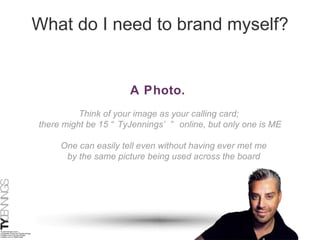
What do I need to brand myself? A Photo.   Think of your image as your calling card;  there might be 15 “TyJennings’” online, but only one is ME One can easily tell even without having ever met me  by the same picture being used across the board
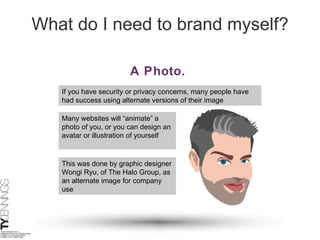
What do I need to brand myself? A Photo.   If you have security or privacy concerns, many people have had success using alternate versions of their image Many websites will “animate” a photo of you, or you can design an avatar or illustration of yourself This was done by graphic designer Wongi Ryu, of The Halo Group, as an alternate image for company use
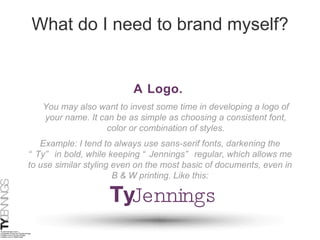
What do I need to brand myself? A Logo.   You may also want to invest some time in developing a logo of your name. It can be as simple as choosing a consistent font, color or combination of styles. Example: I tend to always use sans-serif fonts, darkening the “Ty” in bold, while keeping “Jennings” regular, which allows me to use similar styling even on the most basic of documents, even in B & W printing. Like this:
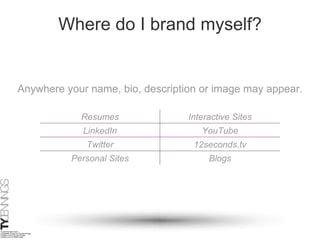
Where do I brand myself? Anywhere your name, bio, description or image may appear. Resumes Interactive Sites LinkedIn YouTube Twitter 12seconds.tv Personal Sites Blogs
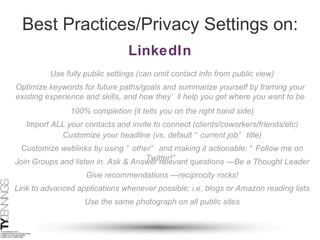
Best Practices/Privacy Settings on: LinkedIn Use fully public settings (can omit contact info from public view) 100% completion (it tells you on the right hand side) Customize your headline (vs. default “current job” title) Give recommendations — reciprocity rocks! Link to advanced applications whenever possible; i.e. blogs or Amazon reading lists Use the same photograph on all public sites Join Groups and listen in. Ask & Answer relevant questions — Be a Thought Leader Import ALL your contacts and invite to connect (clients/coworkers/friends/etc) Customize links by using “other” and making it actionable: “Follow me on Twitter!” Optimize keywords for future paths/goals and summarize yourself by framing your existing experience and skills, and how they’ll help you get where you want to be
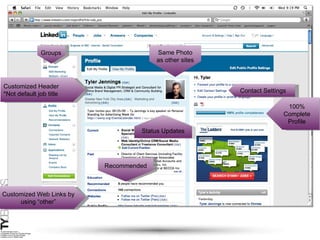
LinkedIn.com Customized Web Links by using “other” Customized Header *Not default job title Same Photo as other sites Recommended Status Updates Groups Contact Settings 100% Complete Profile
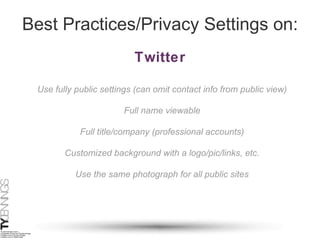
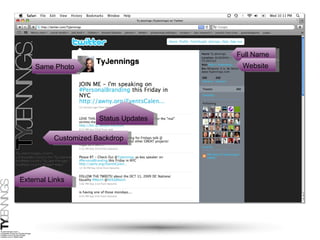
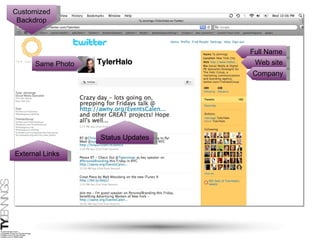
Best Practices/Privacy Settings on: Twitter Use fully public settings (can omit contact info from public view) Full title/company (professional accounts) Customized background with a logo/pic/links, etc. Use the same photograph for all public sites Full name viewable
Same Photo Full Name Customized Backdrop Status Updates Website External Links
Same Photo Customized Backdrop Status Updates Full Name Web site Company  External Links
Best Practices/Privacy Settings on: Facebook  |  Myspace  |  Flickr This is really about your personal preference. My professional advice is to keep these sites private, with  public access and security turned high, unless appropriate for your industry, job or public persona
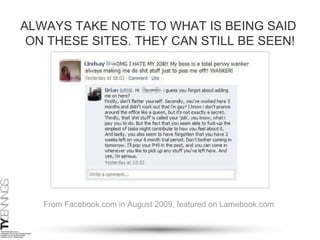
ALWAYS TAKE NOTE TO WHAT IS BEING SAID  ON THESE SITES. THEY CAN STILL BE SEEN! From Facebook.com in August 2009, featured on Lamebook.com
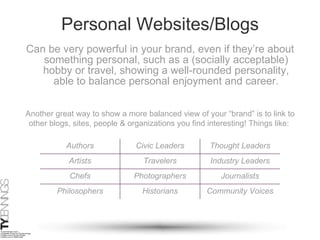
Personal Websites/Blogs Can be very powerful in your brand, even if they’re about something personal, such as a (socially acceptable) hobby or travel, showing a well-rounded personality, able to balance personal enjoyment and career. Another great way to show a more balanced view of your “brand” is to link to other blogs, sites, people & organizations you find interesting! Things like:  Authors Civic Leaders Thought Leaders Artists Travelers Industry Leaders Chefs Photographers Journalists Philosophers Historians Community Voices
Once you’re set up, it’s time to engage! Start conversations by asking and answering questions and be an active part of your community by contributing regular status updates!
Status Updates? HUH?
Status Updates Status Updates are the technical term for the message you’re writing on Twitter, Facebook, MySpace, LinkedIn & more — usually a short message describing what you’re up to at that moment, or what’s on your mind, or news you want to share. Some tips: The more interesting your message is, the more people will read and resend. The more followers and forwarders you get, the more you will be looked at as a Thought/Opinion Leader  A general rule: like with most things, Quality is superior to Quantity!
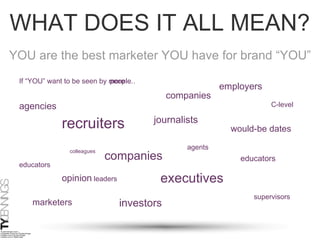
YOU are the best marketer YOU have for brand “YOU” If “YOU” want to be seen by more people educators employers recruiters journalists colleagues agencies companies would-be dates investors marketers companies agents supervisors opinion  leaders educators executives C-level … WHAT DOES IT ALL MEAN?
GO BRAND YOURSELF!
.:: Personal Branding 2.0 ::. Concept, copy & original design by:  Ty Jennings Connect  ::  LinkedIn.com/in/TyJennings Follow  ::  Twitter.com/TylerHalo Follow  ::  Twitter.com/TyJennings Personal Branding 2.0 With Social Media & Digital PR Specialist/Strategist

Personal Branding 2.0 by Social Media & Digital PR Strategist Ty Jennings

  • 1.
    Personal Branding 2.0With Social Media & Digital PR Specialist/Strategist
  • 2.
    What Is PersonalBranding? This has become increasingly important as our current, future & potential employers, clients and colleagues have more and more access to information that may or may not pertain to us, and naturally start to form opinions based on that information. Personal Branding is how we present ourselves to others.
  • 3.
    What Is PersonalBranding? “ Personal Branding” first showed up in 1987 when Tom Peters wrote “The Brand Called You” for Fast Company magazine. Since the onslaught of Web 2.0 and Social Media, Personal Branding has become an industry of its own, spawning hundreds of books and websites on the topic.
  • 4.
    Why Brand YOU?“ Brand is everything and perceptions are 90 percent of a brand.”* — Paul Kedrosky, CNBC Television * As appears in Me 2.0 by Dan Schawbel
  • 5.
    Why Brand YOU?A first impression, or perception , is usually made in less than 30 seconds; however, studies have shown it can take 21 new interactions to change that first impression.
  • 6.
    Why Brand YOU?In this quickly evolving digital age, where sometimes we’re not even present when someone gets their first impression of us, Personal Branding is the key to making sure the REAL YOU gets seen the way YOU want to be seen.
  • 7.
    What do youthink when you see the following? Martha Stewart Richard Branson Kanye West
  • 8.
    What do youthink when you see the following? Martha Stewart Richard Branson Kanye West outspoken, controversial, egotistical innovative, creative, outside-the-box knowledgeable, strong, reliable
  • 9.
    What else do you think when you see the following? Martha Stewart Richard Branson Kanye West outspoken, controversial, egotistical innovative, creative, outside-the-box knowledgeable, strong, reliable pastel colors, approachable graphics, domestic bold colors, strong fonts, outdoor activities futuristic sunglasses, dark suits, edgy image
  • 10.
    What do youthink when you see your name? ?
  • 11.
    What do otherpeople think when they see your name? What would you like others to think of when they see your name?
  • 12.
    With Social Mediasites such as LinkedIn, Twitter, YouTube and others allowing us, the general public, to not only control, but participate in, the content we see, it is up to us to set ourselves apart from our competitors and colleagues…
  • 13.
    … especially giventhat the average college student today will have upwards of 14 jobs by the time they’re 38! That’s a lot of applying & interviewing, which is happening more and more through Social Media. As companies realize they can no longer hope for long-term employees, they’re looking for higher-quality employees that they can get the most out of while they have them. Personal Branding gets that message across.
  • 14.
    “ Until roughlyfive years ago, finding great talent was like finding a needle in a haystack. Today it’s like finding a needle in a stack of needles. Monster contains 44 million resumes. CareerBuilder has 17 million resumes. HotJobs has 5 million. And that’s just the tip of the iceberg. Facebook, LinkedIn, Spoke, and numerous other online networks add to the clutter. The amount of noise in the employment marketplace is unbelievable.”* — Harry Joiner, executive recruiter MarketingHeadHunter.com *As appears in Me 2.0 by Dan Schawbel
  • 15.
    When is PersonalBranding appropriate? IT’S ALWAYS APPROPRIATE! People are always looking at our work, our reputation and us, and they’re forming opinions; Personal Branding can help shape those opinions beyond our direct control. By leaving behind a consistent image/message about oneself, you are building brand ambassadors for your own brand, which can really come in handy when faced with, or involved in, a crisis or when you might be up for new opportunities.
  • 16.
    What is mybrand? First, identify your brand: Who are YOU? Where have YOU come from? Where do YOU want to be?
  • 17.
    What is mybrand? Then, do a SWOT analysis of yourself: Strengths Weaknesses Opportunities Threats
  • 18.
    What is mybrand? After successfully identifying your traits, you can more accurately and honestly define and describe who you are to the public mind and what you bring to a situation.
  • 19.
    How do Ibrand myself? By employing similar presentation tools whenever possible: Same name/spelling/nicknames/logins across all platforms Same image on all public platforms Same or similar description Whenever possible, use the same font on your name, thereby developing a “brand logo” and have it appear whenever possible: resumes,office & personal stationery, professional photographs, cards, websites and more Most importantly: Be authentic and honest. Always…
  • 20.
    What do Ineed to brand myself? … And a nickname, 15 characters or less Maybe a backup nickname, as close to your name and nickname as possible Be consistent: Whenever possible, try to use the same name on all sites I.e., TyJennings vs. Tyler Jennings vs. Tyler A. Jennings A Name.
  • 21.
    What do Ineed to brand myself? A Photo. Think of your image as your calling card; there might be 15 “TyJennings’” online, but only one is ME One can easily tell even without having ever met me by the same picture being used across the board
  • 22.
    What do Ineed to brand myself? A Photo. If you have security or privacy concerns, many people have had success using alternate versions of their image Many websites will “animate” a photo of you, or you can design an avatar or illustration of yourself This was done by graphic designer Wongi Ryu, of The Halo Group, as an alternate image for company use
  • 23.
    What do Ineed to brand myself? A Logo. You may also want to invest some time in developing a logo of your name. It can be as simple as choosing a consistent font, color or combination of styles. Example: I tend to always use sans-serif fonts, darkening the “Ty” in bold, while keeping “Jennings” regular, which allows me to use similar styling even on the most basic of documents, even in B & W printing. Like this:
  • 24.
    Where do Ibrand myself? Anywhere your name, bio, description or image may appear. Resumes Interactive Sites LinkedIn YouTube Twitter 12seconds.tv Personal Sites Blogs
  • 25.
    Best Practices/Privacy Settingson: LinkedIn Use fully public settings (can omit contact info from public view) 100% completion (it tells you on the right hand side) Customize your headline (vs. default “current job” title) Give recommendations — reciprocity rocks! Link to advanced applications whenever possible; i.e. blogs or Amazon reading lists Use the same photograph on all public sites Join Groups and listen in. Ask & Answer relevant questions — Be a Thought Leader Import ALL your contacts and invite to connect (clients/coworkers/friends/etc) Customize links by using “other” and making it actionable: “Follow me on Twitter!” Optimize keywords for future paths/goals and summarize yourself by framing your existing experience and skills, and how they’ll help you get where you want to be
  • 26.
    LinkedIn.com Customized WebLinks by using “other” Customized Header *Not default job title Same Photo as other sites Recommended Status Updates Groups Contact Settings 100% Complete Profile
  • 27.
    Best Practices/Privacy Settingson: Twitter Use fully public settings (can omit contact info from public view) Full title/company (professional accounts) Customized background with a logo/pic/links, etc. Use the same photograph for all public sites Full name viewable
  • 28.
    Same Photo FullName Customized Backdrop Status Updates Website External Links
  • 29.
    Same Photo CustomizedBackdrop Status Updates Full Name Web site Company External Links
  • 30.
    Best Practices/Privacy Settingson: Facebook | Myspace | Flickr This is really about your personal preference. My professional advice is to keep these sites private, with public access and security turned high, unless appropriate for your industry, job or public persona
  • 31.
    ALWAYS TAKE NOTETO WHAT IS BEING SAID ON THESE SITES. THEY CAN STILL BE SEEN! From Facebook.com in August 2009, featured on Lamebook.com
  • 32.
    Personal Websites/Blogs Canbe very powerful in your brand, even if they’re about something personal, such as a (socially acceptable) hobby or travel, showing a well-rounded personality, able to balance personal enjoyment and career. Another great way to show a more balanced view of your “brand” is to link to other blogs, sites, people & organizations you find interesting! Things like: Authors Civic Leaders Thought Leaders Artists Travelers Industry Leaders Chefs Photographers Journalists Philosophers Historians Community Voices
  • 33.
    Once you’re setup, it’s time to engage! Start conversations by asking and answering questions and be an active part of your community by contributing regular status updates!
  • 34.
  • 35.
    Status Updates StatusUpdates are the technical term for the message you’re writing on Twitter, Facebook, MySpace, LinkedIn & more — usually a short message describing what you’re up to at that moment, or what’s on your mind, or news you want to share. Some tips: The more interesting your message is, the more people will read and resend. The more followers and forwarders you get, the more you will be looked at as a Thought/Opinion Leader A general rule: like with most things, Quality is superior to Quantity!
  • 36.
    YOU are thebest marketer YOU have for brand “YOU” If “YOU” want to be seen by more people educators employers recruiters journalists colleagues agencies companies would-be dates investors marketers companies agents supervisors opinion leaders educators executives C-level … WHAT DOES IT ALL MEAN?
  • 37.
  • 38.
    .:: Personal Branding2.0 ::. Concept, copy & original design by: Ty Jennings Connect :: LinkedIn.com/in/TyJennings Follow :: Twitter.com/TylerHalo Follow :: Twitter.com/TyJennings Personal Branding 2.0 With Social Media & Digital PR Specialist/Strategist