




















Two-Dimensional Shape and Texture
Quantification
Medical Image Processing-BM4300
120405P
Shashika Chamod Munasingha
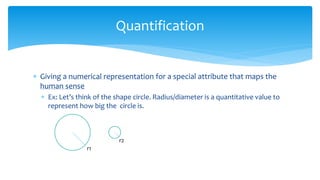
 Giving a numerical representation for a special attribute that maps the
human sense
 Ex: Let’s think of the shape circle. Radius/diameter is a quantitative value to
represent how big the circle is.
Quantification
r1
r2
 Methods
1.1 Compactness
1.2 Spatial Moments
1.3 Radial Distance Measures
1.4 Chain Codes
1.5 Fourier Descriptors
1.6 Thinning
1. Shape Quantification
 Computed using the perimeter (P) and the area (A) of the segmented region
 𝑪 = 𝑷 𝟐/𝑨
 Quantifies how close a shape is to the smoothest shape; circle
 When the C is getting larger for a particular shape, it moves away from the shape
circle.
 Perfect circle has the smallest value for C
 More details: ‘State of the Art of Compactness and Circularity Measures’ by Raul S. Montero
and Ernesto Bribiesca, 2009
1.1 Compactness (C)
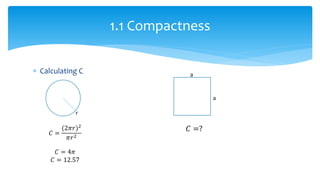
 Calculating C
1.1 Compactness
𝐶 =
(2𝜋𝑟)2
𝜋𝑟2
𝐶 = 4𝜋
𝐶 = 12.57
r
a
a
𝐶 =?
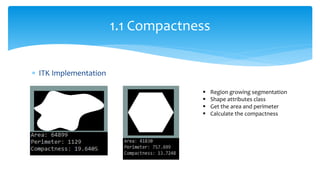
 ITK Implementation
1.1 Compactness
 Region growing segmentation
 Shape attributes class
 Get the area and perimeter
 Calculate the compactness
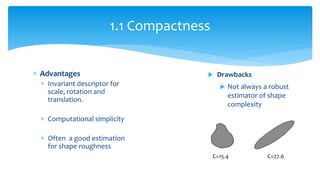
 Advantages
 Invariant descriptor for
scale, rotation and
translation.
 Computational simplicity
 Often a good estimation
for shape roughness
1.1 Compactness
 Drawbacks
 Not always a robust
estimator of shape
complexity
C=15.4 C=27.6
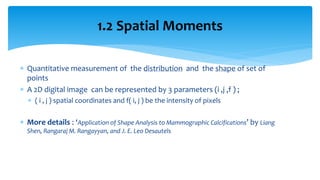
 Quantitative measurement of the distribution and the shape of set of
points
 A 2D digital image can be represented by 3 parameters (i ,j ,f ) ;
 ( i , j ) spatial coordinates and f( i, j ) be the intensity of pixels
 More details : ‘Application of Shape Analysis to Mammographic Calcifications’ by Liang
Shen, Rangaraj M. Rangayyan, and J. E. Leo Desautels
1.2 Spatial Moments
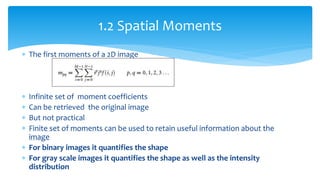
 The first moments of a 2D image
 Infinite set of moment coefficients
 Can be retrieved the original image
 But not practical
 Finite set of moments can be used to retain useful information about the
image
 For binary images it quantifies the shape
 For gray scale images it quantifies the shape as well as the intensity
distribution
1.2 Spatial Moments
 Central moments
 Translation invariant
 Think of an image scaled by a factor of s (>1), the central moment will be
 How could we have a scale invariant descriptor?
 Scale down the image axes by a factor of µ00
( µ00
=area of the
object),then calculate the central moments or
 Direct calculation
1.2 Spatial Moments
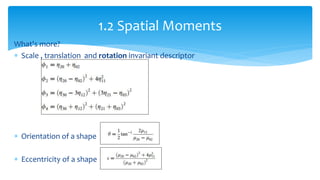
What's more?
 Scale , translation and rotation invariant descriptor
 Orientation of a shape
 Eccentricity of a shape
1.2 Spatial Moments
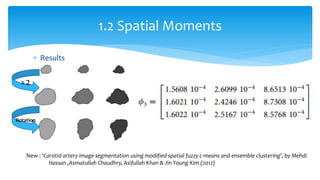
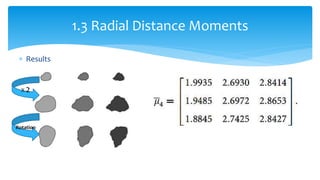
 Results
1.2 Spatial Moments
X 2
Rotation
New : ‘Carotid artery image segmentation using modified spatial fuzzy c-means and ensemble clustering’, by Mehdi
Hassan ,Asmatullah Chaudhry, Asifullah Khan & Jin Young Kim (2012)
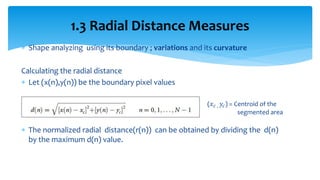
 Shape analyzing using its boundary ; variations and its curvature
Calculating the radial distance
 Let (x(n),y(n)) be the boundary pixel values
 (𝑥 𝑐 , 𝑦𝑐) = Centroid of the
segmented area
 The normalized radial distance(r(n)) can be obtained by dividing the d(n)
by the maximum d(n) value.
1.3 Radial Distance Measures
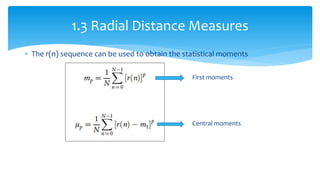
 The r(n) sequence can be used to obtain the statistical moments
First moments
Central moments
1.3 Radial Distance Measures
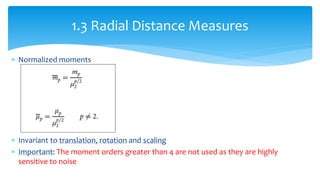
 Normalized moments
 Invariant to translation, rotation and scaling
 Important: The moment orders greater than 4 are not used as they are highly
sensitive to noise
1.3 Radial Distance Measures
 Results
1.3 Radial Distance Moments
X 2
Rotation
More..
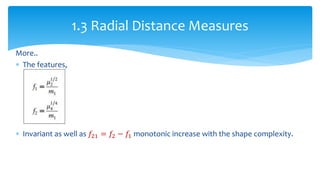
 The features,
 Invariant as well as 𝑓21 = 𝑓2 − 𝑓1 monotonic increase with the shape complexity.
1.3 Radial Distance Measures
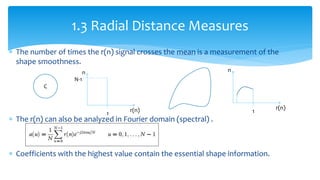
 The number of times the r(n) signal crosses the mean is a measurement of the
shape smoothness.
 The r(n) can also be analyzed in Fourier domain (spectral) .
 Coefficients with the highest value contain the essential shape information.
1.3 Radial Distance Measures
C
r(n)
1
N-1
n
r(n)
1
n
 Also a shape boundary measurement
 A shape can be quantified by the relative position of consecutive points in its
boundary
Method
 Each point in the boundary is assigned a label according to the relative position
from the previous point
 Clockwise or counter clockwise walking can be chosen
 4- connectivity or 8-connectivity base can be used
1.4 Chain Codes
3 2 1
4 P 0
5 6 7
1
2 P 0
3
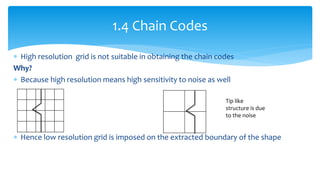
 High resolution grid is not suitable in obtaining the chain codes
Why?
 Because high resolution means high sensitivity to noise as well
 Hence low resolution grid is imposed on the extracted boundary of the shape
1.4 Chain Codes
Tip like
structure is due
to the noise
 Example : 8-connected chain code in counter clockwise direction
What about the starting point (s) of the chain code?
When S changes the chain code will also be changed
Hence the chain code which gives the minimum value for the sum is considered to be chain code of that
shape .
1.4 Chain Codes
4 3
4 6 2
6 0 2 0
s 0
0 -> 2 ->0 ->2 ->3 ->4 ->6 ->4 ->6 ->0
 A rotation invariant code can be obtained using the first difference of the chain
code.
 Counter clockwise direction – Positive
 Clockwise direction – Negative
 Different for different boundaries, hence it can be used to distinguish different shapes.
 But cannot be used to compare the scale
1.4 Chain Codes
2, -2, 2, 1, 1, 2, -2, 2, -6
Is that all?
 If the differential chain code shows very small values (0,1) over a local section of
a boundary that section tends to be smoother.
 If the shape is symmetric or nearly symmetric, the differential chain code will
also have symmetric parts too.
 Concave and Convex regions can also be identified using differential chain code
 Continuous positive differences – Convex region
 Continuous negative differences – Concave region
New:
 ‘A measure of tortuosity based on chain coding’ by E Bribiesca - Pattern Recognition, 2013 – Elsevier
 ‘An automated lung segmentation approach using bidirectional chain codes to improve nodule detection
accuracy’ by S Shen, AAT Bui, J Cong, W Hsu - Computers in biology and medicine, 2015 - Elsevier
1.4 Chain Codes
 Each pixel on a selected contour can be represented by a complex number.
 The DFT
 Inverse DFT
 Except the first coefficient d(0) in DFT (centroid), all other coefficients are translation
invariant
 Important information is on lower order coefficients of d(u)
1.5 Fourier Descriptors
 d(u) is dependent upon the starting point of pixel array
𝑑 𝑠=coefficients after moving the starting point by 𝑛 𝑠 pixels
 FT properties can be effectively used in obtaining invariant descriptors
 The rotation of the object by angle 𝜃, shift of the starting point and scale by a factor
of a yields the DFT series
1.5 Fourier Descriptors
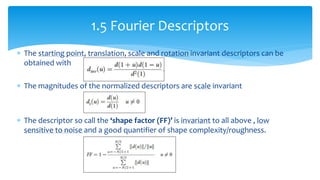
 The starting point, translation, scale and rotation invariant descriptors can be
obtained with
 The magnitudes of the normalized descriptors are scale invariant
 The descriptor so call the ‘shape factor (FF)’ is invariant to all above , low
sensitive to noise and a good quantifier of shape complexity/roughness.
1.5 Fourier Descriptors
We have talked a lot about Fourier Descriptors. But,
 All the results are based on the assumption; equidistance between pixel values of the
contour
 Can be achieved by 4-connected pixels
 Then the diagonal orientations are over estimated.
 If the region is large enough equidistance points can be selected along the contour, not
necessarily be the adjacent pixels
New: ‘Thermography based breast cancer analysis using statistical features and fuzzy classification’ by
Gerald Schaefer
1.5 Fourier Descriptors
 The essential shape information can be represented by reducing the shape to a
graph(skeleton)
 Skeleton is made of the medial lines along the main shape
 Medial lines are obtained via the medial axis transformation (MAT).
 The computational complexity is high for the MAT algorithm.
 Some iterative algorithms are introduced to reduce the computational
complexity
 Algorithm by Zhang and Suen is the widely used one among them
1.6 Thinning/Skeleton
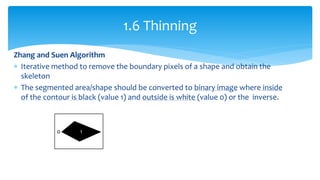
Zhang and Suen Algorithm
 Iterative method to remove the boundary pixels of a shape and obtain the
skeleton
 The segmented area/shape should be converted to binary image where inside
of the contour is black (value 1) and outside is white (value 0) or the inverse.
1.6 Thinning
0 1
Z & S algorithm conti..
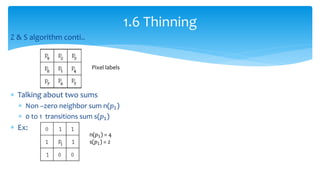
 Talking about two sums
 Non –zero neighbor sum n(𝑝1)
 0 to 1 transitions sum s(𝑝1)
 Ex:
1.6 Thinning
n(𝑝1) = 4
s(𝑝1) = 2
Pixel labels
Z & S algorithm conti..
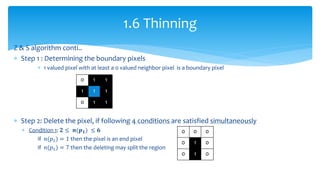
 Step 1 : Determining the boundary pixels
 1 valued pixel with at least a 0 valued neighbor pixel is a boundary pixel
 Step 2: Delete the pixel, if following 4 conditions are satisfied simultaneously
 Condition 1: 𝟐 ≤ 𝒏(𝒑 𝟏) ≤ 𝟔
if 𝑛(𝑝1) = 1 then the pixel is an end pixel
if 𝑛(𝑝1) = 7 then the deleting may split the region
1.6 Thinning
0 1 1
1 1 1
0 1 1
0 0 0
0 1 0
0 1 0
Z & S algorithm conti..
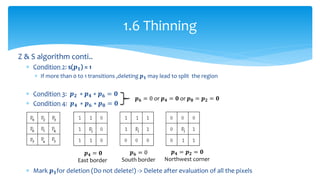
 Condition 2: s(𝒑 𝟏) = 1
 If more than 0 to 1 transitions ,deleting 𝒑 𝟏 may lead to split the region
 Condition 3: 𝒑 𝟐 ∗ 𝒑 𝟒 ∗ 𝒑 𝟔 = 𝟎
 Condition 4: 𝒑 𝟒 ∗ 𝒑 𝟔 ∗ 𝒑 𝟖 = 𝟎
 Mark 𝒑 𝟏for deletion (Do not delete!) -> Delete after evaluation of all the pixels
1.6 Thinning
𝒑 𝟔 = 0 or 𝒑 𝟒 = 𝟎 or 𝒑 𝟖 = 𝒑 𝟐 = 𝟎
𝒑 𝟒 = 𝟎
East border
𝒑 𝟔 = 0
South border
𝒑 𝟒 = 𝒑 𝟐 = 𝟎
Northwest corner
 Step 3 :Apply the step2, first two conditions along with the new two conditions to the
result of the step2
 Condition 3: 𝒑 𝟐 ∗ 𝒑 𝟒 ∗ 𝒑 𝟖 = 𝟎
 Condition 4: 𝒑 𝟐 ∗ 𝒑 𝟔 ∗ 𝒑 𝟖 = 𝟎
 These two conditions yield the north, west borders and the southeast corner in the similar
manner
 Mark for deletion
 Delete the marked after running the step 3 to all the boundary pixels
 Iteratively apply the step 2 to the results of step 3
 Iteration stops when no pixel is marked in both step 2 and step 3
1.6 Thinning
𝒑 𝟐 = 0 or 𝒑 𝟖 = 𝟎 or 𝒑 𝟒 = 𝒑 𝟔 = 𝟎
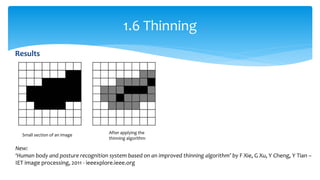
Results
1.6 Thinning
Small section of an image After applying the
thinning algorithm
New:
‘Human body and posture recognition system based on an improved thinning algorithm’ by F Xie, G Xu, Y Cheng, Y Tian –
IET image processing, 2011 - ieeexplore.ieee.org
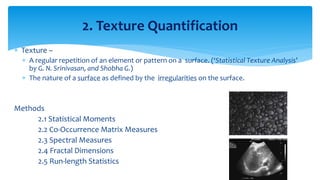
 Texture –
 A regular repetition of an element or pattern on a surface. (‘Statistical Texture Analysis’
by G. N. Srinivasan, and Shobha G.)
 The nature of a surface as defined by the irregularities on the surface.
Methods
2.1 Statistical Moments
2.2 Co-Occurrence Matrix Measures
2.3 Spectral Measures
2.4 Fractal Dimensions
2.5 Run-length Statistics
2. Texture Quantification
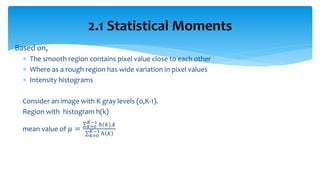
Based on,
 The smooth region contains pixel value close to each other
 Where as a rough region has wide variation in pixel values
 Intensity histograms
Consider an image with K gray levels (0,K-1).
Region with histogram h(k)
mean value of 𝜇 =
ℎ 𝑘 .𝑘𝐾−1
𝑘=0
ℎ 𝑘𝐾−1
𝑘=0
2.1 Statistical Moments
 The nth moment about the mean is defined as
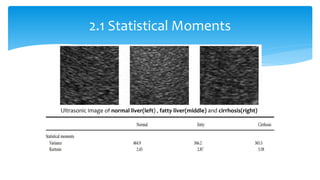
 The second moment 𝒎 𝟐 (variance) is an important texture measurement.
 It correlates with the visual roughness perception.
 But,
 The third and fourth moments, skewness (symmetric nature) and kurtosis (Peakedness)
respectively cannot be used as texture measurements.
 Because they do not always correlate with texture
 In special cases where their potential value is pre quantified we can use them as well.
2.1 Statistical Moments
Ultrasonic image of normal liver(left) , fatty liver(middle) and cirrhosis(right)
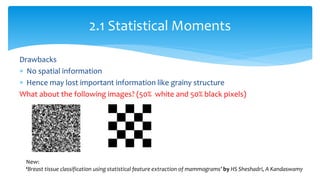
Drawbacks
 No spatial information
 Hence may lost important information like grainy structure
What about the following images? (50% white and 50% black pixels)
2.1 Statistical Moments
New:
‘Breast tissue classification using statistical feature extraction of mammograms’ by HS Sheshadri, A Kandaswamy
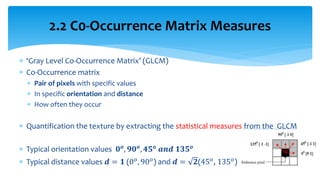
 ‘Gray Level Co-Occurrence Matrix’ (GLCM)
 Co-Occurrence matrix
 Pair of pixels with specific values
 In specific orientation and distance
 How often they occur
 Quantification the texture by extracting the statistical measures from the GLCM
 Typical orientation values 𝟎 𝒐
, 𝟗𝟎 𝒐
, 𝟒𝟓 𝒐
𝒂𝒏𝒅 𝟏𝟑𝟓 𝒐
 Typical distance values 𝒅 = 𝟏 (0 𝑜, 90 𝑜) and 𝒅 = 𝟐(45 𝑜, 135 𝑜)
2.2 C0-Occurrence Matrix Measures
Ex: Consider an image of 6x6=36 pixels (P) and 4 gray levels(K) (0,1,2 and 3)
 The matrix of 4x4 (based on gray levels) which contains count for specific d and 𝜽 H(d, 𝜽)
H( 𝟐, 𝟒𝟓 𝒐
)
2.2 C0-Occurrence Matrix Measures
This is not the GLCM𝒉𝒊𝒋
2.2 Co-Occurrence Matrix Measures
Number of pixel pairs in H(d, 𝜽) < Number of pixels in the picture
P’ < P
(3+3+2+2+1+9+1+4 = 25) < 36
WHY?
The edge pixels do not contribute in creating pairs.
When d is getting larger and larger the lesser the # pairs
(large number of rows and columns will be omitted)
For M x N image,
 Co-occurrence matrix (C(d, 𝜽) )
 𝒄𝒊𝒋 = 𝒉𝒊𝒋/𝑷′ Showing the probability
 Size of Co-occurrence matrix depends on number of gray levels
 Very large number of gray levels  Computational time increases ? ? ?
 Solution
 Mapping into new smaller gray scale, but
 Larger steps at insignificant gray levels and smaller steps at critical gray levels
2.2 Co-Occurrence Matrix Measures
What is derived by Co-Occurrence Matrix ? ?
 Angular second moment (Energy) (Homogeneity)
 Inertia (Contrast)
 Entropy (Randomness)
2.2 Co-Occurrence Matrix Measures
Inhomogeneous (many intensity transformations) lesser value for 𝑡1
Homogeneous  lesser value for 𝑡2
Structured (less random)  less value for 𝑡4
 Co-Occurrence Matrix Marginal distributions Other texture matrices
 Marginal distributions
 Sum of probabilities of intensity sums and differences
2.2 Co-Occurrence Matrix Measures
Means and variances
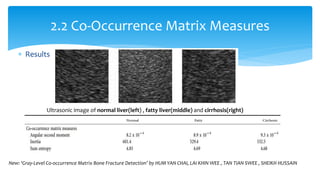
 Results
2.2 Co-Occurrence Matrix Measures
Ultrasonic image of normal liver(left) , fatty liver(middle) and cirrhosis(right)
New: ‘Gray-Level Co-occurrence Matrix Bone Fracture Detection’ by HUM YAN CHAI, LAI KHIN WEE , TAN TIAN SWEE , SHEIKH HUSSAIN
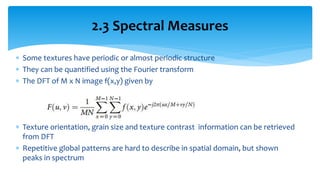
 Some textures have periodic or almost periodic structure
 They can be quantified using the Fourier transform
 The DFT of M x N image f(x,y) given by
 Texture orientation, grain size and texture contrast information can be retrieved
from DFT
 Repetitive global patterns are hard to describe in spatial domain, but shown
peaks in spectrum
2.3 Spectral Measures
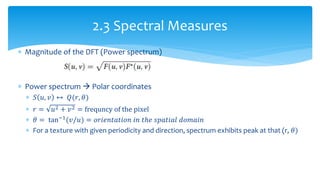
 Magnitude of the DFT (Power spectrum)
 Power spectrum  Polar coordinates
 𝑆 𝑢, 𝑣 ↔ 𝑄(𝑟, 𝜃)
 𝑟 = 𝑢2 + 𝑣2 = frequncy of the pixel
 𝜃 = tan−1(𝑣/𝑢) = 𝑜𝑟𝑖𝑒𝑛𝑡𝑎𝑡𝑖𝑜𝑛 𝑖𝑛 𝑡ℎ𝑒 𝑠𝑝𝑎𝑡𝑖𝑎𝑙 𝑑𝑜𝑚𝑎𝑖𝑛
 For a texture with given periodicity and direction, spectrum exhibits peak at that (r, 𝜃)
2.3 Spectral Measures
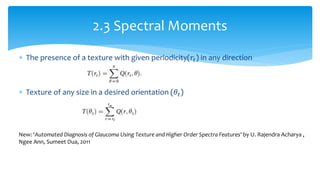
 The presence of a texture with given periodicity(𝑟𝑡) in any direction
 Texture of any size in a desired orientation (𝜃𝑡)
New: ‘Automated Diagnosis of Glaucoma Using Texture and Higher Order Spectra Features’ by U. Rajendra Acharya ,
Ngee Ann, Sumeet Dua, 2011
2.3 Spectral Moments
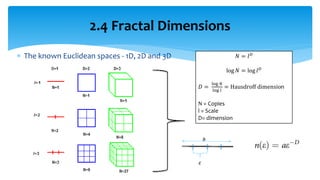
 The known Euclidean spaces - 1D, 2D and 3D
2.4 Fractal Dimensions
𝑁 = 𝑙 𝐷
log 𝑁 = log 𝑙 𝐷
𝐷 =
log 𝑁
log 𝑙
= Hausdroff dimension
N = Copies
l = Scale
D= dimension
a
𝜀
2.4 Fractal Dimensions
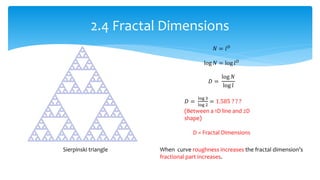
Sierpinski triangle
𝑁 = 𝑙 𝐷
log 𝑁 = log 𝑙 𝐷
𝐷 =
log 𝑁
log 𝑙
𝐷 =
log 3
log 2
= 1.585 ? ? ?
(Between a 1D line and 2D
shape)
D = Fractal Dimensions
When curve roughness increases the fractal dimension’s
fractional part increases.
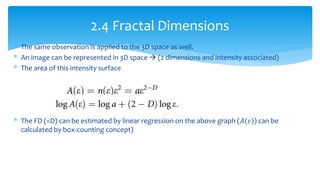
* The same observation is applied to the 3D space as well.
* An image can be represented in 3D space  (2 dimensions and intensity associated)
* The area of this intensity surface
* The FD (=D) can be estimated by linear regression on the above graph (𝐴(𝜀)) can be
calculated by box-counting concept)
2.4 Fractal Dimensions
Another method to calculate FD
 Fractional Brownian Motion model
 Distance between two pixels
 Absolute difference of intensity values
 Above two values are related with
 FD
 Imp: 𝐻 𝑖𝑠 𝑐𝑎𝑙𝑐𝑢𝑙𝑎𝑡𝑒𝑑 𝑏𝑦 𝑎𝑝𝑝𝑙𝑦𝑖𝑛𝑔 𝑙𝑖𝑛𝑒𝑎𝑟 𝑟𝑒𝑔𝑟𝑒𝑠𝑠𝑖𝑜𝑛 𝑡𝑜
 Rough textures  large values for D
2.4 Fractal Dimensions
E= Expectation Operator
b= proportionality constant
H= Hurst coefficient
2.4 Fractal Dimensions
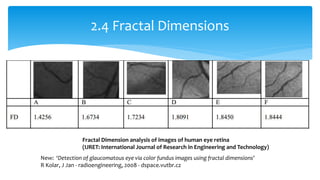
Fractal Dimension analysis of images of human eye retina
(IJRET: International Journal of Research in Engineering and Technology)
New: ‘Detection of glaucomatous eye via color fundus images using fractal dimensions’
R Kolar, J Jan - radioengineering, 2008 - dspace.vutbr.cz
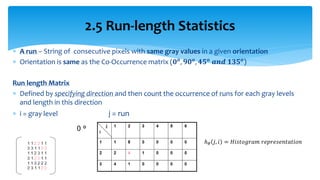
 A run – String of consecutive pixels with same gray values in a given orientation
 Orientation is same as the Co-Occurrence matrix (𝟎 𝒐, 𝟗𝟎 𝒐, 𝟒𝟓 𝒐 𝒂𝒏𝒅 𝟏𝟑𝟓 𝒐)
Run length Matrix
 Defined by specifying direction and then count the occurrence of runs for each gray levels
and length in this direction
 i = gray level j = run
2.5 Run-length Statistics
ℎ 𝜃 𝑗, 𝑖 = 𝐻𝑖𝑠𝑡𝑜𝑔𝑟𝑎𝑚 𝑟𝑒𝑝𝑟𝑒𝑠𝑒𝑛𝑡𝑎𝑡𝑖𝑜𝑛
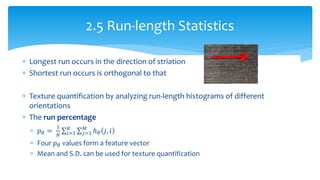
 Longest run occurs in the direction of striation
 Shortest run occurs is orthogonal to that
 Texture quantification by analyzing run-length histograms of different
orientations
 The run percentage
 𝑝 𝜃 =
1
𝑁
ℎ 𝜃 𝑗, 𝑖𝑀
𝑗=1
𝐾
𝑖=1
 Four 𝑝 𝜃 values form a feature vector
 Mean and S.D. can be used for texture quantification
2.5 Run-length Statistics
Thank you!

Two Dimensional Shape and Texture Quantification - Medical Image Processing

  • 1.
    Two-Dimensional Shape andTexture Quantification Medical Image Processing-BM4300 120405P Shashika Chamod Munasingha
  • 2.
     Giving anumerical representation for a special attribute that maps the human sense  Ex: Let’s think of the shape circle. Radius/diameter is a quantitative value to represent how big the circle is. Quantification r1 r2
  • 3.
     Methods 1.1 Compactness 1.2Spatial Moments 1.3 Radial Distance Measures 1.4 Chain Codes 1.5 Fourier Descriptors 1.6 Thinning 1. Shape Quantification
  • 4.
     Computed usingthe perimeter (P) and the area (A) of the segmented region  𝑪 = 𝑷 𝟐/𝑨  Quantifies how close a shape is to the smoothest shape; circle  When the C is getting larger for a particular shape, it moves away from the shape circle.  Perfect circle has the smallest value for C  More details: ‘State of the Art of Compactness and Circularity Measures’ by Raul S. Montero and Ernesto Bribiesca, 2009 1.1 Compactness (C)
  • 5.
     Calculating C 1.1Compactness 𝐶 = (2𝜋𝑟)2 𝜋𝑟2 𝐶 = 4𝜋 𝐶 = 12.57 r a a 𝐶 =?
  • 6.
     ITK Implementation 1.1Compactness  Region growing segmentation  Shape attributes class  Get the area and perimeter  Calculate the compactness
  • 7.
     Advantages  Invariantdescriptor for scale, rotation and translation.  Computational simplicity  Often a good estimation for shape roughness 1.1 Compactness  Drawbacks  Not always a robust estimator of shape complexity C=15.4 C=27.6
  • 8.
     Quantitative measurementof the distribution and the shape of set of points  A 2D digital image can be represented by 3 parameters (i ,j ,f ) ;  ( i , j ) spatial coordinates and f( i, j ) be the intensity of pixels  More details : ‘Application of Shape Analysis to Mammographic Calcifications’ by Liang Shen, Rangaraj M. Rangayyan, and J. E. Leo Desautels 1.2 Spatial Moments
  • 9.
     The firstmoments of a 2D image  Infinite set of moment coefficients  Can be retrieved the original image  But not practical  Finite set of moments can be used to retain useful information about the image  For binary images it quantifies the shape  For gray scale images it quantifies the shape as well as the intensity distribution 1.2 Spatial Moments
  • 10.
     Central moments Translation invariant  Think of an image scaled by a factor of s (>1), the central moment will be  How could we have a scale invariant descriptor?  Scale down the image axes by a factor of µ00 ( µ00 =area of the object),then calculate the central moments or  Direct calculation 1.2 Spatial Moments
  • 11.
    What's more?  Scale, translation and rotation invariant descriptor  Orientation of a shape  Eccentricity of a shape 1.2 Spatial Moments
  • 12.
     Results 1.2 SpatialMoments X 2 Rotation New : ‘Carotid artery image segmentation using modified spatial fuzzy c-means and ensemble clustering’, by Mehdi Hassan ,Asmatullah Chaudhry, Asifullah Khan & Jin Young Kim (2012)
  • 13.
     Shape analyzingusing its boundary ; variations and its curvature Calculating the radial distance  Let (x(n),y(n)) be the boundary pixel values  (𝑥 𝑐 , 𝑦𝑐) = Centroid of the segmented area  The normalized radial distance(r(n)) can be obtained by dividing the d(n) by the maximum d(n) value. 1.3 Radial Distance Measures
  • 14.
     The r(n)sequence can be used to obtain the statistical moments First moments Central moments 1.3 Radial Distance Measures
  • 15.
     Normalized moments Invariant to translation, rotation and scaling  Important: The moment orders greater than 4 are not used as they are highly sensitive to noise 1.3 Radial Distance Measures
  • 16.
     Results 1.3 RadialDistance Moments X 2 Rotation
  • 17.
    More..  The features, Invariant as well as 𝑓21 = 𝑓2 − 𝑓1 monotonic increase with the shape complexity. 1.3 Radial Distance Measures
  • 18.
     The numberof times the r(n) signal crosses the mean is a measurement of the shape smoothness.  The r(n) can also be analyzed in Fourier domain (spectral) .  Coefficients with the highest value contain the essential shape information. 1.3 Radial Distance Measures C r(n) 1 N-1 n r(n) 1 n
  • 19.
     Also ashape boundary measurement  A shape can be quantified by the relative position of consecutive points in its boundary Method  Each point in the boundary is assigned a label according to the relative position from the previous point  Clockwise or counter clockwise walking can be chosen  4- connectivity or 8-connectivity base can be used 1.4 Chain Codes 3 2 1 4 P 0 5 6 7 1 2 P 0 3
  • 20.
     High resolutiongrid is not suitable in obtaining the chain codes Why?  Because high resolution means high sensitivity to noise as well  Hence low resolution grid is imposed on the extracted boundary of the shape 1.4 Chain Codes Tip like structure is due to the noise
  • 21.
     Example :8-connected chain code in counter clockwise direction What about the starting point (s) of the chain code? When S changes the chain code will also be changed Hence the chain code which gives the minimum value for the sum is considered to be chain code of that shape . 1.4 Chain Codes 4 3 4 6 2 6 0 2 0 s 0 0 -> 2 ->0 ->2 ->3 ->4 ->6 ->4 ->6 ->0
  • 22.
     A rotationinvariant code can be obtained using the first difference of the chain code.  Counter clockwise direction – Positive  Clockwise direction – Negative  Different for different boundaries, hence it can be used to distinguish different shapes.  But cannot be used to compare the scale 1.4 Chain Codes 2, -2, 2, 1, 1, 2, -2, 2, -6
  • 23.
    Is that all? If the differential chain code shows very small values (0,1) over a local section of a boundary that section tends to be smoother.  If the shape is symmetric or nearly symmetric, the differential chain code will also have symmetric parts too.  Concave and Convex regions can also be identified using differential chain code  Continuous positive differences – Convex region  Continuous negative differences – Concave region New:  ‘A measure of tortuosity based on chain coding’ by E Bribiesca - Pattern Recognition, 2013 – Elsevier  ‘An automated lung segmentation approach using bidirectional chain codes to improve nodule detection accuracy’ by S Shen, AAT Bui, J Cong, W Hsu - Computers in biology and medicine, 2015 - Elsevier 1.4 Chain Codes
  • 24.
     Each pixelon a selected contour can be represented by a complex number.  The DFT  Inverse DFT  Except the first coefficient d(0) in DFT (centroid), all other coefficients are translation invariant  Important information is on lower order coefficients of d(u) 1.5 Fourier Descriptors
  • 25.
     d(u) isdependent upon the starting point of pixel array 𝑑 𝑠=coefficients after moving the starting point by 𝑛 𝑠 pixels  FT properties can be effectively used in obtaining invariant descriptors  The rotation of the object by angle 𝜃, shift of the starting point and scale by a factor of a yields the DFT series 1.5 Fourier Descriptors
  • 26.
     The startingpoint, translation, scale and rotation invariant descriptors can be obtained with  The magnitudes of the normalized descriptors are scale invariant  The descriptor so call the ‘shape factor (FF)’ is invariant to all above , low sensitive to noise and a good quantifier of shape complexity/roughness. 1.5 Fourier Descriptors
  • 27.
    We have talkeda lot about Fourier Descriptors. But,  All the results are based on the assumption; equidistance between pixel values of the contour  Can be achieved by 4-connected pixels  Then the diagonal orientations are over estimated.  If the region is large enough equidistance points can be selected along the contour, not necessarily be the adjacent pixels New: ‘Thermography based breast cancer analysis using statistical features and fuzzy classification’ by Gerald Schaefer 1.5 Fourier Descriptors
  • 28.
     The essentialshape information can be represented by reducing the shape to a graph(skeleton)  Skeleton is made of the medial lines along the main shape  Medial lines are obtained via the medial axis transformation (MAT).  The computational complexity is high for the MAT algorithm.  Some iterative algorithms are introduced to reduce the computational complexity  Algorithm by Zhang and Suen is the widely used one among them 1.6 Thinning/Skeleton
  • 29.
    Zhang and SuenAlgorithm  Iterative method to remove the boundary pixels of a shape and obtain the skeleton  The segmented area/shape should be converted to binary image where inside of the contour is black (value 1) and outside is white (value 0) or the inverse. 1.6 Thinning 0 1
  • 30.
    Z & Salgorithm conti..  Talking about two sums  Non –zero neighbor sum n(𝑝1)  0 to 1 transitions sum s(𝑝1)  Ex: 1.6 Thinning n(𝑝1) = 4 s(𝑝1) = 2 Pixel labels
  • 31.
    Z & Salgorithm conti..  Step 1 : Determining the boundary pixels  1 valued pixel with at least a 0 valued neighbor pixel is a boundary pixel  Step 2: Delete the pixel, if following 4 conditions are satisfied simultaneously  Condition 1: 𝟐 ≤ 𝒏(𝒑 𝟏) ≤ 𝟔 if 𝑛(𝑝1) = 1 then the pixel is an end pixel if 𝑛(𝑝1) = 7 then the deleting may split the region 1.6 Thinning 0 1 1 1 1 1 0 1 1 0 0 0 0 1 0 0 1 0
  • 32.
    Z & Salgorithm conti..  Condition 2: s(𝒑 𝟏) = 1  If more than 0 to 1 transitions ,deleting 𝒑 𝟏 may lead to split the region  Condition 3: 𝒑 𝟐 ∗ 𝒑 𝟒 ∗ 𝒑 𝟔 = 𝟎  Condition 4: 𝒑 𝟒 ∗ 𝒑 𝟔 ∗ 𝒑 𝟖 = 𝟎  Mark 𝒑 𝟏for deletion (Do not delete!) -> Delete after evaluation of all the pixels 1.6 Thinning 𝒑 𝟔 = 0 or 𝒑 𝟒 = 𝟎 or 𝒑 𝟖 = 𝒑 𝟐 = 𝟎 𝒑 𝟒 = 𝟎 East border 𝒑 𝟔 = 0 South border 𝒑 𝟒 = 𝒑 𝟐 = 𝟎 Northwest corner
  • 33.
     Step 3:Apply the step2, first two conditions along with the new two conditions to the result of the step2  Condition 3: 𝒑 𝟐 ∗ 𝒑 𝟒 ∗ 𝒑 𝟖 = 𝟎  Condition 4: 𝒑 𝟐 ∗ 𝒑 𝟔 ∗ 𝒑 𝟖 = 𝟎  These two conditions yield the north, west borders and the southeast corner in the similar manner  Mark for deletion  Delete the marked after running the step 3 to all the boundary pixels  Iteratively apply the step 2 to the results of step 3  Iteration stops when no pixel is marked in both step 2 and step 3 1.6 Thinning 𝒑 𝟐 = 0 or 𝒑 𝟖 = 𝟎 or 𝒑 𝟒 = 𝒑 𝟔 = 𝟎
  • 34.
    Results 1.6 Thinning Small sectionof an image After applying the thinning algorithm New: ‘Human body and posture recognition system based on an improved thinning algorithm’ by F Xie, G Xu, Y Cheng, Y Tian – IET image processing, 2011 - ieeexplore.ieee.org
  • 35.
     Texture – A regular repetition of an element or pattern on a surface. (‘Statistical Texture Analysis’ by G. N. Srinivasan, and Shobha G.)  The nature of a surface as defined by the irregularities on the surface. Methods 2.1 Statistical Moments 2.2 Co-Occurrence Matrix Measures 2.3 Spectral Measures 2.4 Fractal Dimensions 2.5 Run-length Statistics 2. Texture Quantification
  • 36.
    Based on,  Thesmooth region contains pixel value close to each other  Where as a rough region has wide variation in pixel values  Intensity histograms Consider an image with K gray levels (0,K-1). Region with histogram h(k) mean value of 𝜇 = ℎ 𝑘 .𝑘𝐾−1 𝑘=0 ℎ 𝑘𝐾−1 𝑘=0 2.1 Statistical Moments
  • 37.
     The nthmoment about the mean is defined as  The second moment 𝒎 𝟐 (variance) is an important texture measurement.  It correlates with the visual roughness perception.  But,  The third and fourth moments, skewness (symmetric nature) and kurtosis (Peakedness) respectively cannot be used as texture measurements.  Because they do not always correlate with texture  In special cases where their potential value is pre quantified we can use them as well. 2.1 Statistical Moments
  • 38.
    2.1 Statistical Moments Ultrasonicimage of normal liver(left) , fatty liver(middle) and cirrhosis(right)
  • 39.
    Drawbacks  No spatialinformation  Hence may lost important information like grainy structure What about the following images? (50% white and 50% black pixels) 2.1 Statistical Moments New: ‘Breast tissue classification using statistical feature extraction of mammograms’ by HS Sheshadri, A Kandaswamy
  • 40.
     ‘Gray LevelCo-Occurrence Matrix’ (GLCM)  Co-Occurrence matrix  Pair of pixels with specific values  In specific orientation and distance  How often they occur  Quantification the texture by extracting the statistical measures from the GLCM  Typical orientation values 𝟎 𝒐 , 𝟗𝟎 𝒐 , 𝟒𝟓 𝒐 𝒂𝒏𝒅 𝟏𝟑𝟓 𝒐  Typical distance values 𝒅 = 𝟏 (0 𝑜, 90 𝑜) and 𝒅 = 𝟐(45 𝑜, 135 𝑜) 2.2 C0-Occurrence Matrix Measures
  • 41.
    Ex: Consider animage of 6x6=36 pixels (P) and 4 gray levels(K) (0,1,2 and 3)  The matrix of 4x4 (based on gray levels) which contains count for specific d and 𝜽 H(d, 𝜽) H( 𝟐, 𝟒𝟓 𝒐 ) 2.2 C0-Occurrence Matrix Measures This is not the GLCM𝒉𝒊𝒋
  • 42.
    2.2 Co-Occurrence MatrixMeasures Number of pixel pairs in H(d, 𝜽) < Number of pixels in the picture P’ < P (3+3+2+2+1+9+1+4 = 25) < 36 WHY? The edge pixels do not contribute in creating pairs. When d is getting larger and larger the lesser the # pairs (large number of rows and columns will be omitted) For M x N image,
  • 43.
     Co-occurrence matrix(C(d, 𝜽) )  𝒄𝒊𝒋 = 𝒉𝒊𝒋/𝑷′ Showing the probability  Size of Co-occurrence matrix depends on number of gray levels  Very large number of gray levels  Computational time increases ? ? ?  Solution  Mapping into new smaller gray scale, but  Larger steps at insignificant gray levels and smaller steps at critical gray levels 2.2 Co-Occurrence Matrix Measures
  • 44.
    What is derivedby Co-Occurrence Matrix ? ?  Angular second moment (Energy) (Homogeneity)  Inertia (Contrast)  Entropy (Randomness) 2.2 Co-Occurrence Matrix Measures Inhomogeneous (many intensity transformations) lesser value for 𝑡1 Homogeneous  lesser value for 𝑡2 Structured (less random)  less value for 𝑡4
  • 45.
     Co-Occurrence MatrixMarginal distributions Other texture matrices  Marginal distributions  Sum of probabilities of intensity sums and differences 2.2 Co-Occurrence Matrix Measures Means and variances
  • 46.
     Results 2.2 Co-OccurrenceMatrix Measures Ultrasonic image of normal liver(left) , fatty liver(middle) and cirrhosis(right) New: ‘Gray-Level Co-occurrence Matrix Bone Fracture Detection’ by HUM YAN CHAI, LAI KHIN WEE , TAN TIAN SWEE , SHEIKH HUSSAIN
  • 47.
     Some textureshave periodic or almost periodic structure  They can be quantified using the Fourier transform  The DFT of M x N image f(x,y) given by  Texture orientation, grain size and texture contrast information can be retrieved from DFT  Repetitive global patterns are hard to describe in spatial domain, but shown peaks in spectrum 2.3 Spectral Measures
  • 48.
     Magnitude ofthe DFT (Power spectrum)  Power spectrum  Polar coordinates  𝑆 𝑢, 𝑣 ↔ 𝑄(𝑟, 𝜃)  𝑟 = 𝑢2 + 𝑣2 = frequncy of the pixel  𝜃 = tan−1(𝑣/𝑢) = 𝑜𝑟𝑖𝑒𝑛𝑡𝑎𝑡𝑖𝑜𝑛 𝑖𝑛 𝑡ℎ𝑒 𝑠𝑝𝑎𝑡𝑖𝑎𝑙 𝑑𝑜𝑚𝑎𝑖𝑛  For a texture with given periodicity and direction, spectrum exhibits peak at that (r, 𝜃) 2.3 Spectral Measures
  • 49.
     The presenceof a texture with given periodicity(𝑟𝑡) in any direction  Texture of any size in a desired orientation (𝜃𝑡) New: ‘Automated Diagnosis of Glaucoma Using Texture and Higher Order Spectra Features’ by U. Rajendra Acharya , Ngee Ann, Sumeet Dua, 2011 2.3 Spectral Moments
  • 50.
     The knownEuclidean spaces - 1D, 2D and 3D 2.4 Fractal Dimensions 𝑁 = 𝑙 𝐷 log 𝑁 = log 𝑙 𝐷 𝐷 = log 𝑁 log 𝑙 = Hausdroff dimension N = Copies l = Scale D= dimension a 𝜀
  • 51.
    2.4 Fractal Dimensions Sierpinskitriangle 𝑁 = 𝑙 𝐷 log 𝑁 = log 𝑙 𝐷 𝐷 = log 𝑁 log 𝑙 𝐷 = log 3 log 2 = 1.585 ? ? ? (Between a 1D line and 2D shape) D = Fractal Dimensions When curve roughness increases the fractal dimension’s fractional part increases.
  • 52.
    * The sameobservation is applied to the 3D space as well. * An image can be represented in 3D space  (2 dimensions and intensity associated) * The area of this intensity surface * The FD (=D) can be estimated by linear regression on the above graph (𝐴(𝜀)) can be calculated by box-counting concept) 2.4 Fractal Dimensions
  • 53.
    Another method tocalculate FD  Fractional Brownian Motion model  Distance between two pixels  Absolute difference of intensity values  Above two values are related with  FD  Imp: 𝐻 𝑖𝑠 𝑐𝑎𝑙𝑐𝑢𝑙𝑎𝑡𝑒𝑑 𝑏𝑦 𝑎𝑝𝑝𝑙𝑦𝑖𝑛𝑔 𝑙𝑖𝑛𝑒𝑎𝑟 𝑟𝑒𝑔𝑟𝑒𝑠𝑠𝑖𝑜𝑛 𝑡𝑜  Rough textures  large values for D 2.4 Fractal Dimensions E= Expectation Operator b= proportionality constant H= Hurst coefficient
  • 54.
    2.4 Fractal Dimensions FractalDimension analysis of images of human eye retina (IJRET: International Journal of Research in Engineering and Technology) New: ‘Detection of glaucomatous eye via color fundus images using fractal dimensions’ R Kolar, J Jan - radioengineering, 2008 - dspace.vutbr.cz
  • 55.
     A run– String of consecutive pixels with same gray values in a given orientation  Orientation is same as the Co-Occurrence matrix (𝟎 𝒐, 𝟗𝟎 𝒐, 𝟒𝟓 𝒐 𝒂𝒏𝒅 𝟏𝟑𝟓 𝒐) Run length Matrix  Defined by specifying direction and then count the occurrence of runs for each gray levels and length in this direction  i = gray level j = run 2.5 Run-length Statistics ℎ 𝜃 𝑗, 𝑖 = 𝐻𝑖𝑠𝑡𝑜𝑔𝑟𝑎𝑚 𝑟𝑒𝑝𝑟𝑒𝑠𝑒𝑛𝑡𝑎𝑡𝑖𝑜𝑛
  • 56.
     Longest runoccurs in the direction of striation  Shortest run occurs is orthogonal to that  Texture quantification by analyzing run-length histograms of different orientations  The run percentage  𝑝 𝜃 = 1 𝑁 ℎ 𝜃 𝑗, 𝑖𝑀 𝑗=1 𝐾 𝑖=1  Four 𝑝 𝜃 values form a feature vector  Mean and S.D. can be used for texture quantification 2.5 Run-length Statistics
  • 57.