Basic Level English Course
October 23rd
, 2010 (Part I)
Introduction to Modal Verbs: Ability
and Future
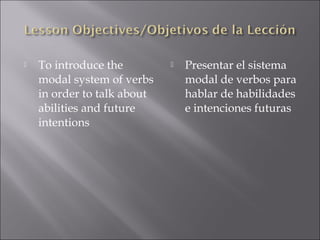
 To introduce the
modal system of verbs
in order to talk about
abilities and future
intentions
 Presentar el sistema
modal de verbos para
hablar de habilidades
e intenciones futuras
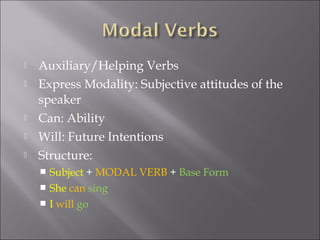
 Auxiliary/Helping Verbs
 Express Modality: Subjective attitudes of the
speaker
 Can: Ability
 Will: Future Intentions
 Structure:
 Subject + MODAL VERB + Base Form
 She can sing
 I will go
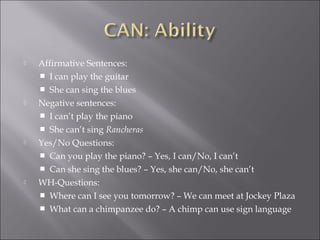
 Affirmative Sentences:
 I can play the guitar
 She can sing the blues
 Negative sentences:
 I can’t play the piano
 She can’t sing Rancheras
 Yes/No Questions:
 Can you play the piano? – Yes, I can/No, I can’t
 Can she sing the blues? – Yes, she can/No, she can’t
 WH-Questions:
 Where can I see you tomorrow? – We can meet at Jockey Plaza
 What can a chimpanzee do? – A chimp can use sign language
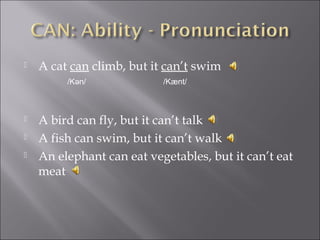
 A cat can climb, but it can’t swim
 A bird can fly, but it can’t talk
 A fish can swim, but it can’t walk
 An elephant can eat vegetables, but it can’t eat
meat
/K n/ǝ /Kænt/
I. Expresses the voluntary nature of the subject’s
(future) actions:
 The teacher will talk to his mother
 I will send you the information
I. Expresses a promise:
 Megan will be here tonight
 Nugkui won’t/will not miss class again
I. Expresses a future action decided at the
moment of speaking:
 I’ll call you later
 I will see you tonight
IV. Expressions often used with
“will”(Contracted form = ‘ll) are: “I guess” =
You creo, “I think” = Yo pienso,
“Maybe/Perhaps” = Talvez.
 I guess, I’ll go to the party with you
 I think, I’ll study for my exam
 Maybe, I’ll see you tonight
 Affirmative Sentences:
 I will talk to him later
 She’ll send me the information
 Negative sentences (Won’t = Will not):
 I won’t talk to her
 She won’t come to class today
 Yes/No Questions:
 Will you be here for class? – Yes, I will/No, I won’t
 Will she do the homework? – Yes, she will/No, she won’t
 WH-Questions:
 What will you do tonight? – I have no idea
 Who will watch the dog? – I guess, Brett will watch it
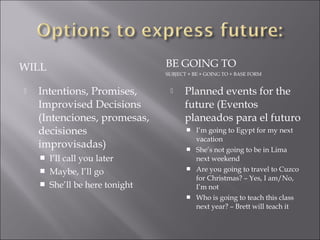
WILL BE GOING TO
SUBJECT + BE + GOING TO + BASE FORM
 Intentions, Promises,
Improvised Decisions
(Intenciones, promesas,
decisiones
improvisadas)
 I’ll call you later
 Maybe, I’ll go
 She’ll be here tonight
 Planned events for the
future (Eventos
planeados para el futuro
 I’m going to Egypt for my next
vacation
 She’s not going to be in Lima
next weekend
 Are you going to travel to Cuzco
for Christmas? – Yes, I am/No,
I’m not
 Who is going to teach this class
next year? – Brett will teach it
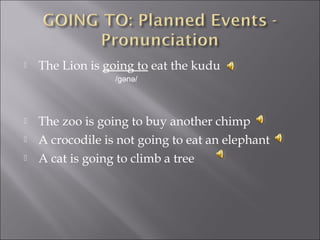
 The Lion is going to eat the kudu
 The zoo is going to buy another chimp
 A crocodile is not going to eat an elephant
 A cat is going to climb a tree
/g n /ǝ ǝ
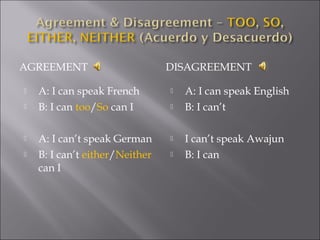
AGREEMENT DISAGREEMENT
 A: I can speak French
 B: I can too/So can I
 A: I can’t speak German
 B: I can’t either/Neither
can I
 A: I can speak English
 B: I can’t
 I can’t speak Awajun
 B: I can
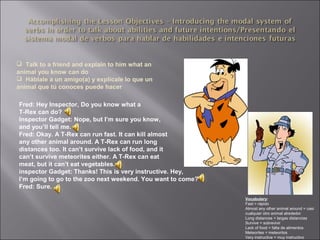
 Talk to a friend and explain to him what an
animal you know can do
 Háblale a un amigo(a) y explícale lo que un
animal que tú conoces puede hacer
Fred: Hey Inspector, Do you know what a
T-Rex can do?
Inspector Gadget: Nope, but I’m sure you know,
and you’ll tell me.
Fred: Okay. A T-Rex can run fast. It can kill almost
any other animal around. A T-Rex can run long
distances too. It can’t survive lack of food, and it
can’t survive meteorites either. A T-Rex can eat
meat, but it can’t eat vegetables.
inspector Gadget: Thanks! This is very instructive. Hey,
I’m going to go to the zoo next weekend. You want to come?
Fred: Sure.
Vocabulary:
Fast = rápido
Almost any other animal around = casi
cualquier otro animal alrededor
Long distances = largas distancias
Survive = sobrevivir
Lack of food = falta de alimentos
Meteorites = meteoritos
Very instructive = muy instructivo
 Discuss what an animal you know can do:/
 Conversen sobre lo que un animal que
conoces puede hacer:
You: Hey, Do you know what a dog can do?
Your friend: Not really, tell me…
You: Ok. A dog can…

Twelfth Class - Part I - Introduction to Modals: Ability & Future

  • 1.
    Basic Level EnglishCourse October 23rd , 2010 (Part I) Introduction to Modal Verbs: Ability and Future
  • 2.
     To introducethe modal system of verbs in order to talk about abilities and future intentions  Presentar el sistema modal de verbos para hablar de habilidades e intenciones futuras
  • 3.
     Auxiliary/Helping Verbs Express Modality: Subjective attitudes of the speaker  Can: Ability  Will: Future Intentions  Structure:  Subject + MODAL VERB + Base Form  She can sing  I will go
  • 4.
     Affirmative Sentences: I can play the guitar  She can sing the blues  Negative sentences:  I can’t play the piano  She can’t sing Rancheras  Yes/No Questions:  Can you play the piano? – Yes, I can/No, I can’t  Can she sing the blues? – Yes, she can/No, she can’t  WH-Questions:  Where can I see you tomorrow? – We can meet at Jockey Plaza  What can a chimpanzee do? – A chimp can use sign language
  • 5.
     A catcan climb, but it can’t swim  A bird can fly, but it can’t talk  A fish can swim, but it can’t walk  An elephant can eat vegetables, but it can’t eat meat /K n/ǝ /Kænt/
  • 6.
    I. Expresses thevoluntary nature of the subject’s (future) actions:  The teacher will talk to his mother  I will send you the information I. Expresses a promise:  Megan will be here tonight  Nugkui won’t/will not miss class again I. Expresses a future action decided at the moment of speaking:  I’ll call you later  I will see you tonight
  • 7.
    IV. Expressions oftenused with “will”(Contracted form = ‘ll) are: “I guess” = You creo, “I think” = Yo pienso, “Maybe/Perhaps” = Talvez.  I guess, I’ll go to the party with you  I think, I’ll study for my exam  Maybe, I’ll see you tonight
  • 8.
     Affirmative Sentences: I will talk to him later  She’ll send me the information  Negative sentences (Won’t = Will not):  I won’t talk to her  She won’t come to class today  Yes/No Questions:  Will you be here for class? – Yes, I will/No, I won’t  Will she do the homework? – Yes, she will/No, she won’t  WH-Questions:  What will you do tonight? – I have no idea  Who will watch the dog? – I guess, Brett will watch it
  • 9.
    WILL BE GOINGTO SUBJECT + BE + GOING TO + BASE FORM  Intentions, Promises, Improvised Decisions (Intenciones, promesas, decisiones improvisadas)  I’ll call you later  Maybe, I’ll go  She’ll be here tonight  Planned events for the future (Eventos planeados para el futuro  I’m going to Egypt for my next vacation  She’s not going to be in Lima next weekend  Are you going to travel to Cuzco for Christmas? – Yes, I am/No, I’m not  Who is going to teach this class next year? – Brett will teach it
  • 10.
     The Lionis going to eat the kudu  The zoo is going to buy another chimp  A crocodile is not going to eat an elephant  A cat is going to climb a tree /g n /ǝ ǝ
  • 11.
    AGREEMENT DISAGREEMENT  A:I can speak French  B: I can too/So can I  A: I can’t speak German  B: I can’t either/Neither can I  A: I can speak English  B: I can’t  I can’t speak Awajun  B: I can
  • 12.
     Talk toa friend and explain to him what an animal you know can do  Háblale a un amigo(a) y explícale lo que un animal que tú conoces puede hacer Fred: Hey Inspector, Do you know what a T-Rex can do? Inspector Gadget: Nope, but I’m sure you know, and you’ll tell me. Fred: Okay. A T-Rex can run fast. It can kill almost any other animal around. A T-Rex can run long distances too. It can’t survive lack of food, and it can’t survive meteorites either. A T-Rex can eat meat, but it can’t eat vegetables. inspector Gadget: Thanks! This is very instructive. Hey, I’m going to go to the zoo next weekend. You want to come? Fred: Sure. Vocabulary: Fast = rápido Almost any other animal around = casi cualquier otro animal alrededor Long distances = largas distancias Survive = sobrevivir Lack of food = falta de alimentos Meteorites = meteoritos Very instructive = muy instructivo
  • 13.
     Discuss whatan animal you know can do:/  Conversen sobre lo que un animal que conoces puede hacer: You: Hey, Do you know what a dog can do? Your friend: Not really, tell me… You: Ok. A dog can…