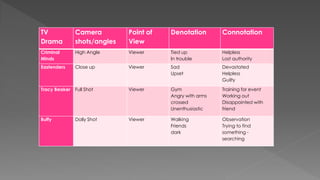
TV
Drama
Camera
shots/angles
Point of
View
Denotation Connotation
Criminal
Minds
High Angle Viewer Tied up
In trouble
Helpless
Lost authority
Eastenders Close up Viewer Sad
Upset
Devastated
Helpless
Guilty
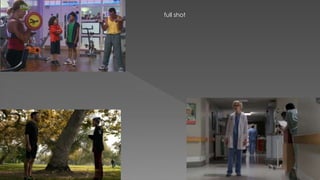
Tracy Beaker Full Shot Viewer Gym
Angry with arms
crossed
Unenthusiastic
Training for event
Working out
Disappointed with
friend
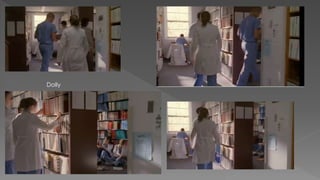
Buffy Dolly Shot Viewer Walking
Friends
dark
Observation
Trying to find
something -
searching
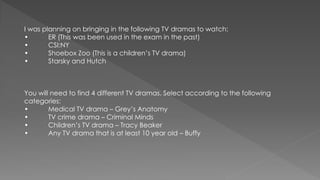
I was planning on bringing in the following TV dramas to watch:
• ER (This was been used in the exam in the past)
• CSI:NY
• Shoebox Zoo (This is a children’s TV drama)
• Starsky and Hutch
You will need to find 4 different TV dramas. Select according to the following
categories:
• Medical TV drama – Grey’s Anatomy
• TV crime drama – Criminal Minds
• Children’s TV drama – Tracy Beaker
• Any TV drama that is at least 10 year old – Buffy
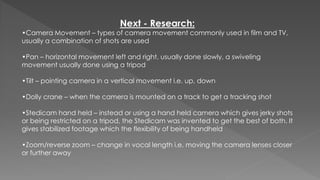
Next - Research:
•Camera Movement – types of camera movement commonly used in film and TV,
usually a combination of shots are used
•Pan – horizontal movement left and right, usually done slowly, a swiveling
movement usually done using a tripod
•Tilt – pointing camera in a vertical movement i.e. up, down
•Dolly crane – when the camera is mounted on a track to get a tracking shot
•Stedicam hand held – instead or using a hand held camera which gives jerky shots
or being restricted on a tripod, the Stedicam was invented to get the best of both. It
gives stabilized footage which the flexibility of being handheld
•Zoom/reverse zoom – change in vocal length i.e. moving the camera lenses closer
or further away
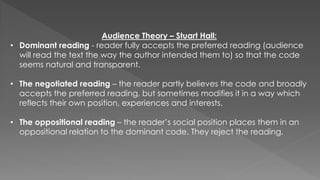
Audience Theory – Stuart Hall:
• Dominant reading - reader fully accepts the preferred reading (audience
will read the text the way the author intended them to) so that the code
seems natural and transparent.
• The negotiated reading – the reader partly believes the code and broadly
accepts the preferred reading, but sometimes modifies it in a way which
reflects their own position, experiences and interests.
• The oppositional reading – the reader’s social position places them in an
oppositional relation to the dominant code. They reject the reading.
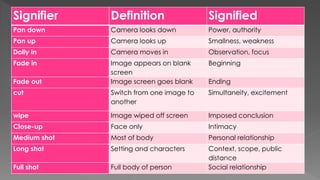
Signifier Definition Signified
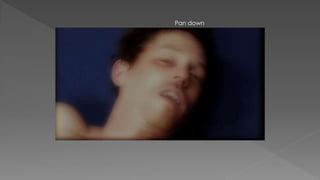
Pan down Camera looks down Power, authority
Pan up Camera looks up Smallness, weakness
Dolly in Camera moves in Observation, focus
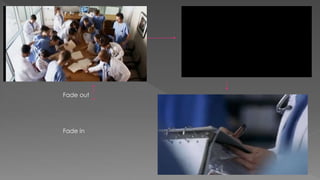
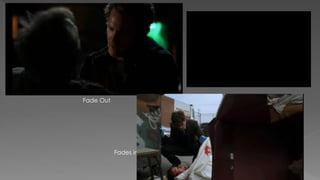
Fade in Image appears on blank
screen
Beginning
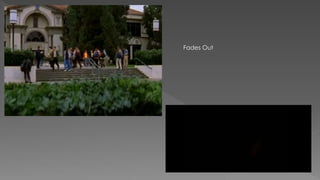
Fade out Image screen goes blank Ending
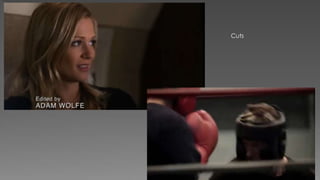
cut Switch from one image to
another
Simultaneity, excitement
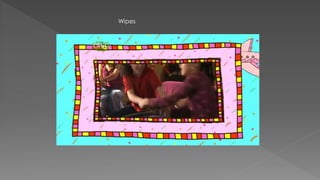
wipe Image wiped off screen Imposed conclusion
Close-up Face only Intimacy
Medium shot Most of body Personal relationship
Long shot Setting and characters Context, scope, public
distance
Full shot Full body of person Social relationship
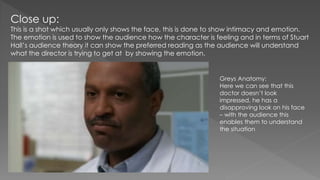
Close up:
This is a shot which usually only shows the face, this is done to show intimacy and emotion.
The emotion is used to show the audience how the character is feeling and in terms of Stuart
Hall’s audience theory it can show the preferred reading as the audience will understand
what the director is trying to get at by showing the emotion.
Greys Anatomy:
Here we can see that this
doctor doesn’t look
impressed, he has a
disapproving look on his face
– with the audience this
enables them to understand
the situation
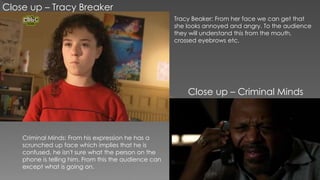
Close up – Tracy Breaker
Close up – Criminal Minds
Tracy Beaker: From her face we can get that
she looks annoyed and angry. To the audience
they will understand this from the mouth,
crossed eyebrows etc.
Criminal Minds: From his expression he has a
scrunched up face which implies that he is
confused, he isn't sure what the person on the
phone is telling him. From this the audience can
except what is going on.
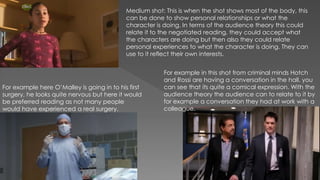
Medium shot: This is when the shot shows most of the body, this
can be done to show personal relationships or what the
character is doing. In terms of the audience theory this could
relate it to the negotiated reading, they could accept what
the characters are doing but then also they could relate
personal experiences to what the character is doing. They can
use to it reflect their own interests.
For example in this shot from criminal minds Hotch
and Rossi are having a conversation in the hall, you
can see that its quite a comical expression. With the
audience theory the audience can to relate to it by
for example a conversation they had at work with a
colleague.
For example here O’Malley is going in to his first
surgery, he looks quite nervous but here it would
be preferred reading as not many people
would have experienced a real surgery.
Long shot:
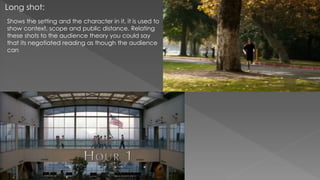
Shows the setting and the character in it, it is used to
show context, scope and public distance. Relating
these shots to the audience theory you could say
that its negotiated reading as though the audience
can
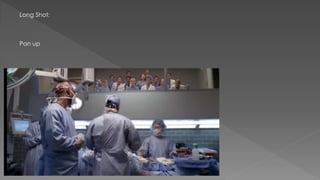
Long Shot:
Pan up
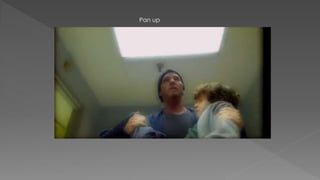
Pan up
full shot
Fade out
Fade in
Fades Out
Fade Out
Fades in
Dolly
Dolly
Pan down
Cuts
Wipes

Tv drama - shot types

  • 2.
    TV Drama Camera shots/angles Point of View Denotation Connotation Criminal Minds HighAngle Viewer Tied up In trouble Helpless Lost authority Eastenders Close up Viewer Sad Upset Devastated Helpless Guilty Tracy Beaker Full Shot Viewer Gym Angry with arms crossed Unenthusiastic Training for event Working out Disappointed with friend Buffy Dolly Shot Viewer Walking Friends dark Observation Trying to find something - searching
  • 3.
    I was planningon bringing in the following TV dramas to watch: • ER (This was been used in the exam in the past) • CSI:NY • Shoebox Zoo (This is a children’s TV drama) • Starsky and Hutch You will need to find 4 different TV dramas. Select according to the following categories: • Medical TV drama – Grey’s Anatomy • TV crime drama – Criminal Minds • Children’s TV drama – Tracy Beaker • Any TV drama that is at least 10 year old – Buffy
  • 4.
    Next - Research: •CameraMovement – types of camera movement commonly used in film and TV, usually a combination of shots are used •Pan – horizontal movement left and right, usually done slowly, a swiveling movement usually done using a tripod •Tilt – pointing camera in a vertical movement i.e. up, down •Dolly crane – when the camera is mounted on a track to get a tracking shot •Stedicam hand held – instead or using a hand held camera which gives jerky shots or being restricted on a tripod, the Stedicam was invented to get the best of both. It gives stabilized footage which the flexibility of being handheld •Zoom/reverse zoom – change in vocal length i.e. moving the camera lenses closer or further away
  • 5.
    Audience Theory –Stuart Hall: • Dominant reading - reader fully accepts the preferred reading (audience will read the text the way the author intended them to) so that the code seems natural and transparent. • The negotiated reading – the reader partly believes the code and broadly accepts the preferred reading, but sometimes modifies it in a way which reflects their own position, experiences and interests. • The oppositional reading – the reader’s social position places them in an oppositional relation to the dominant code. They reject the reading.
  • 6.
    Signifier Definition Signified Pandown Camera looks down Power, authority Pan up Camera looks up Smallness, weakness Dolly in Camera moves in Observation, focus Fade in Image appears on blank screen Beginning Fade out Image screen goes blank Ending cut Switch from one image to another Simultaneity, excitement wipe Image wiped off screen Imposed conclusion Close-up Face only Intimacy Medium shot Most of body Personal relationship Long shot Setting and characters Context, scope, public distance Full shot Full body of person Social relationship
  • 7.
    Close up: This isa shot which usually only shows the face, this is done to show intimacy and emotion. The emotion is used to show the audience how the character is feeling and in terms of Stuart Hall’s audience theory it can show the preferred reading as the audience will understand what the director is trying to get at by showing the emotion. Greys Anatomy: Here we can see that this doctor doesn’t look impressed, he has a disapproving look on his face – with the audience this enables them to understand the situation
  • 8.
    Close up –Tracy Breaker Close up – Criminal Minds Tracy Beaker: From her face we can get that she looks annoyed and angry. To the audience they will understand this from the mouth, crossed eyebrows etc. Criminal Minds: From his expression he has a scrunched up face which implies that he is confused, he isn't sure what the person on the phone is telling him. From this the audience can except what is going on.
  • 9.
    Medium shot: Thisis when the shot shows most of the body, this can be done to show personal relationships or what the character is doing. In terms of the audience theory this could relate it to the negotiated reading, they could accept what the characters are doing but then also they could relate personal experiences to what the character is doing. They can use to it reflect their own interests. For example in this shot from criminal minds Hotch and Rossi are having a conversation in the hall, you can see that its quite a comical expression. With the audience theory the audience can to relate to it by for example a conversation they had at work with a colleague. For example here O’Malley is going in to his first surgery, he looks quite nervous but here it would be preferred reading as not many people would have experienced a real surgery.
  • 10.
    Long shot: Shows thesetting and the character in it, it is used to show context, scope and public distance. Relating these shots to the audience theory you could say that its negotiated reading as though the audience can
  • 11.
  • 12.
  • 13.
  • 14.
  • 15.
  • 16.
  • 17.
  • 18.
  • 19.
  • 20.
  • 21.