Camera shots and angle
shotsBy: Cheldy Sgaco Elumba-Pableo, MPA; LlB
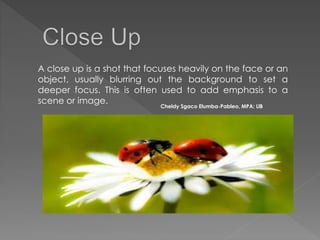
A close up is a shot that focuses heavily on the face or an
object, usually blurring out the background to set a
deeper focus. This is often used to add emphasis to a
scene or image.
Cheldy Sgaco Elumba-Pableo, MPA; LlB
Close
up
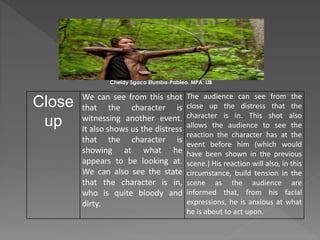
We can see from this shot
that the character is
witnessing another event.
It also shows us the distress
that the character is
showing at what he
appears to be looking at.
We can also see the state
that the character is in,
who is quite bloody and
dirty.
The audience can see from the
close up the distress that the
character is in. This shot also
allows the audience to see the
reaction the character has at the
event before him (which would
have been shown in the previous
scene.) His reaction will also, in this
circumstance, build tension in the
scene as the audience are
informed that, from his facial
expressions, he is anxious at what
he is about to act upon.
Cheldy Sgaco Elumba-Pableo, MPA; LlB
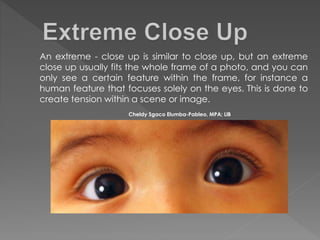
An extreme - close up is similar to close up, but an extreme
close up usually fits the whole frame of a photo, and you can
only see a certain feature within the frame, for instance a
human feature that focuses solely on the eyes. This is done to
create tension within a scene or image.
Cheldy Sgaco Elumba-Pableo, MPA; LlB
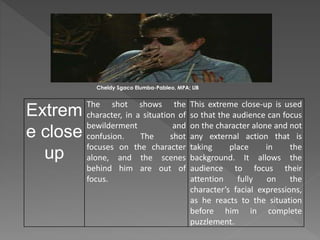
Extrem
e close
up
The shot shows the
character, in a situation of
bewilderment and
confusion. The shot
focuses on the character
alone, and the scenes
behind him are out of
focus.
This extreme close-up is used
so that the audience can focus
on the character alone and not
any external action that is
taking place in the
background. It allows the
audience to focus their
attention fully on the
character’s facial expressions,
as he reacts to the situation
before him in complete
puzzlement.
Cheldy Sgaco Elumba-Pableo, MPA; LlB
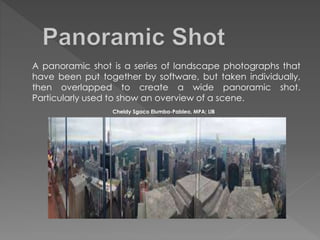
A panoramic shot is a series of landscape photographs that
have been put together by software, but taken individually,
then overlapped to create a wide panoramic shot.
Particularly used to show an overview of a scene.
Cheldy Sgaco Elumba-Pableo, MPA; LlB
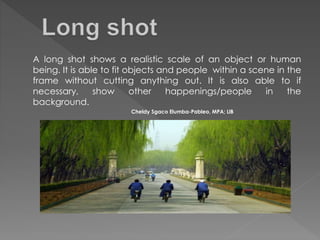
A long shot shows a realistic scale of an object or human
being. It is able to fit objects and people within a scene in the
frame without cutting anything out. It is also able to if
necessary, show other happenings/people in the
background.
Cheldy Sgaco Elumba-Pableo, MPA; LlB
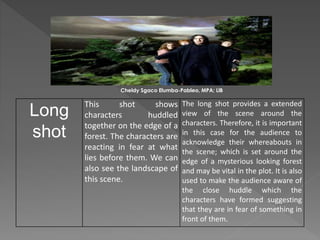
Long
shot
This shot shows
characters huddled
together on the edge of a
forest. The characters are
reacting in fear at what
lies before them. We can
also see the landscape of
this scene.
The long shot provides a extended
view of the scene around the
characters. Therefore, it is important
in this case for the audience to
acknowledge their whereabouts in
the scene; which is set around the
edge of a mysterious looking forest
and may be vital in the plot. It is also
used to make the audience aware of
the close huddle which the
characters have formed suggesting
that they are in fear of something in
front of them.
Cheldy Sgaco Elumba-Pableo, MPA; LlB
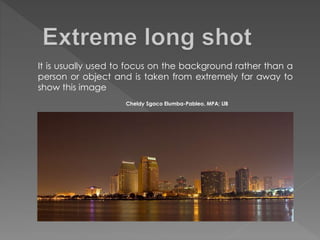
It is usually used to focus on the background rather than a
person or object and is taken from extremely far away to
show this image
Cheldy Sgaco Elumba-Pableo, MPA; LlB
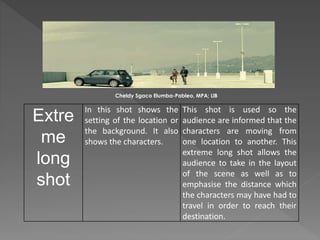
Extre
me
long
shot
In this shot shows the
setting of the location or
the background. It also
shows the characters.
This shot is used so the
audience are informed that the
characters are moving from
one location to another. This
extreme long shot allows the
audience to take in the layout
of the scene as well as to
emphasise the distance which
the characters may have had to
travel in order to reach their
destination.
Cheldy Sgaco Elumba-Pableo, MPA; LlB
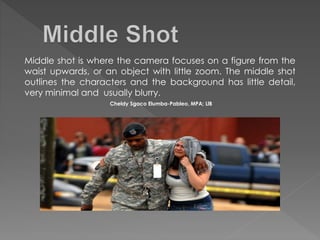
Middle shot is where the camera focuses on a figure from the
waist upwards, or an object with little zoom. The middle shot
outlines the characters and the background has little detail,
very minimal and usually blurry.
Cheldy Sgaco Elumba-Pableo, MPA; LlB
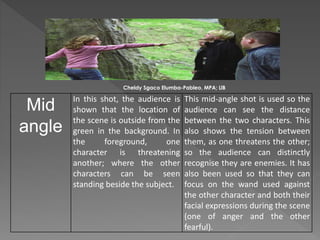
Mid
angle
In this shot, the audience is
shown that the location of
the scene is outside from the
green in the background. In
the foreground, one
character is threatening
another; where the other
characters can be seen
standing beside the subject.
This mid-angle shot is used so the
audience can see the distance
between the two characters. This
also shows the tension between
them, as one threatens the other;
so the audience can distinctly
recognise they are enemies. It has
also been used so that they can
focus on the wand used against
the other character and both their
facial expressions during the scene
(one of anger and the other
fearful).
Cheldy Sgaco Elumba-Pableo, MPA; LlB
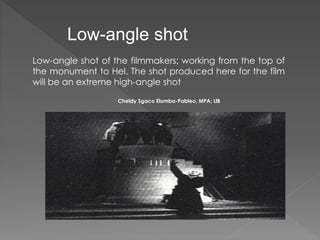
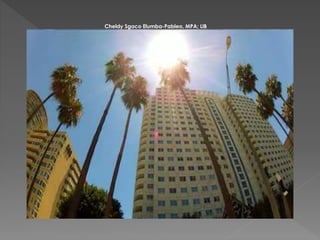
Low-angle shot of the filmmakers; working from the top of
the monument to Hel. The shot produced here for the film
will be an extreme high-angle shot
Cheldy Sgaco Elumba-Pableo, MPA; LlB
Low-angle shot
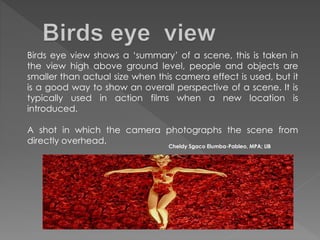
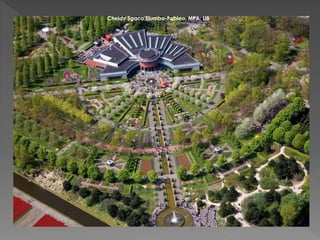
Birds eye view shows a ‘summary’ of a scene, this is taken in
the view high above ground level, people and objects are
smaller than actual size when this camera effect is used, but it
is a good way to show an overall perspective of a scene. It is
typically used in action films when a new location is
introduced.
A shot in which the camera photographs the scene from
directly overhead.
Cheldy Sgaco Elumba-Pableo, MPA; LlB
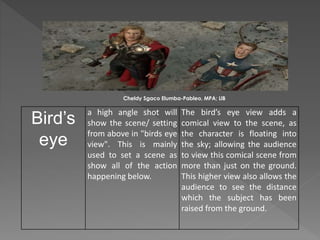
Bird’s
eye
a high angle shot will
show the scene/ setting
from above in "birds eye
view". This is mainly
used to set a scene as
show all of the action
happening below.
The bird’s eye view adds a
comical view to the scene, as
the character is floating into
the sky; allowing the audience
to view this comical scene from
more than just on the ground.
This higher view also allows the
audience to see the distance
which the subject has been
raised from the ground.
Cheldy Sgaco Elumba-Pableo, MPA; LlB
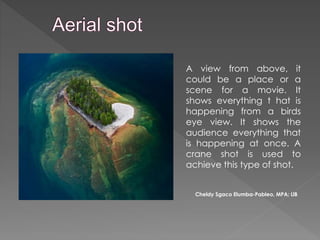
A view from above, it
could be a place or a
scene for a movie. It
shows everything t hat is
happening from a birds
eye view. It shows the
audience everything that
is happening at once. A
crane shot is used to
achieve this type of shot.
Cheldy Sgaco Elumba-Pableo, MPA; LlB
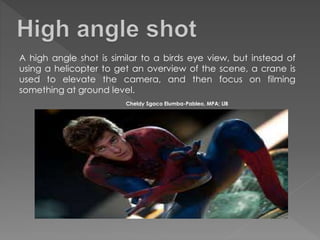
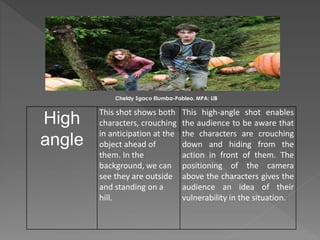
A high angle shot is similar to a birds eye view, but instead of
using a helicopter to get an overview of the scene, a crane is
used to elevate the camera, and then focus on filming
something at ground level.
Cheldy Sgaco Elumba-Pableo, MPA; LlB
High
angle
This shot shows both
characters, crouching
in anticipation at the
object ahead of
them. In the
background, we can
see they are outside
and standing on a
hill.
This high-angle shot enables
the audience to be aware that
the characters are crouching
down and hiding from the
action in front of them. The
positioning of the camera
above the characters gives the
audience an idea of their
vulnerability in the situation.
Cheldy Sgaco Elumba-Pableo, MPA; LlB
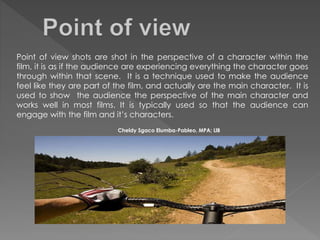
Point of view shots are shot in the perspective of a character within the
film, it is as if the audience are experiencing everything the character goes
through within that scene. It is a technique used to make the audience
feel like they are part of the film, and actually are the main character. It is
used to show the audience the perspective of the main character and
works well in most films. It is typically used so that the audience can
engage with the film and it’s characters.
Cheldy Sgaco Elumba-Pableo, MPA; LlB
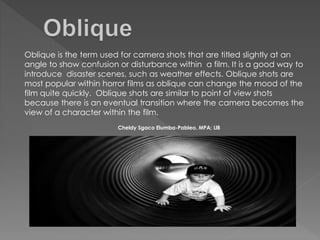
Oblique is the term used for camera shots that are titled slightly at an
angle to show confusion or disturbance within a film. It is a good way to
introduce disaster scenes, such as weather effects. Oblique shots are
most popular within horror films as oblique can change the mood of the
film quite quickly. Oblique shots are similar to point of view shots
because there is an eventual transition where the camera becomes the
view of a character within the film.
Cheldy Sgaco Elumba-Pableo, MPA; LlB
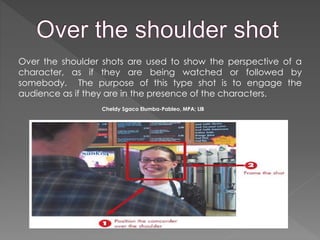
Over the shoulder shots are used to show the perspective of a
character, as if they are being watched or followed by
somebody. The purpose of this type shot is to engage the
audience as if they are in the presence of the characters.
Cheldy Sgaco Elumba-Pableo, MPA; LlB
Over
the
should
er shot
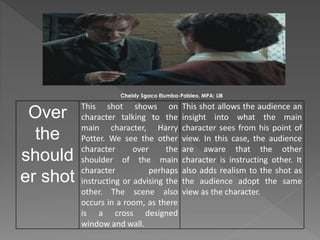
This shot shows on
character talking to the
main character, Harry
Potter. We see the other
character over the
shoulder of the main
character perhaps
instructing or advising the
other. The scene also
occurs in a room, as there
is a cross designed
window and wall.
This shot allows the audience an
insight into what the main
character sees from his point of
view. In this case, the audience
are aware that the other
character is instructing other. It
also adds realism to the shot as
the audience adopt the same
view as the character.
Cheldy Sgaco Elumba-Pableo, MPA; LlB
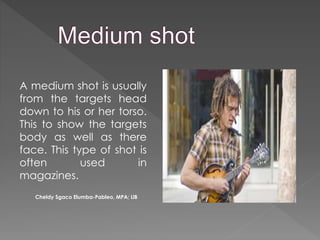
A medium shot is usually
from the targets head
down to his or her torso.
This to show the targets
body as well as there
face. This type of shot is
often used in
magazines.
Cheldy Sgaco Elumba-Pableo, MPA; LlB
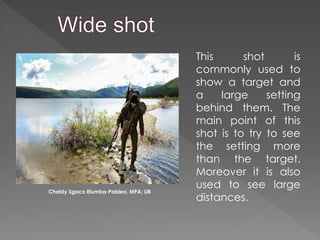
This shot is
commonly used to
show a target and
a large setting
behind them. The
main point of this
shot is to try to see
the setting more
than the target.
Moreover it is also
used to see large
distances.
Cheldy Sgaco Elumba-Pableo, MPA; LlB
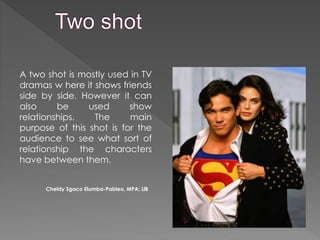
A two shot is mostly used in TV
dramas w here it shows friends
side by side. However it can
also be used show
relationships. The main
purpose of this shot is for the
audience to see what sort of
relationship the characters
have between them.
Cheldy Sgaco Elumba-Pableo, MPA; LlB
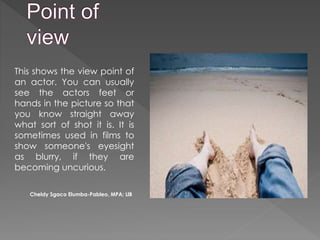
This shows the view point of
an actor. You can usually
see the actors feet or
hands in the picture so that
you know straight away
what sort of shot it is. It is
sometimes used in films to
show someone's eyesight
as blurry, if they are
becoming uncurious.
Cheldy Sgaco Elumba-Pableo, MPA; LlB
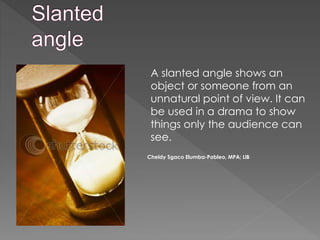
A slanted angle shows an
object or someone from an
unnatural point of view. It can
be used in a drama to show
things only the audience can
see.
Cheldy Sgaco Elumba-Pableo, MPA; LlB
Thank you for reading
cheldhaye

Camera & angle shots

  • 1.
    Camera shots andangle shotsBy: Cheldy Sgaco Elumba-Pableo, MPA; LlB
  • 2.
    A close upis a shot that focuses heavily on the face or an object, usually blurring out the background to set a deeper focus. This is often used to add emphasis to a scene or image. Cheldy Sgaco Elumba-Pableo, MPA; LlB
  • 3.
    Close up We can seefrom this shot that the character is witnessing another event. It also shows us the distress that the character is showing at what he appears to be looking at. We can also see the state that the character is in, who is quite bloody and dirty. The audience can see from the close up the distress that the character is in. This shot also allows the audience to see the reaction the character has at the event before him (which would have been shown in the previous scene.) His reaction will also, in this circumstance, build tension in the scene as the audience are informed that, from his facial expressions, he is anxious at what he is about to act upon. Cheldy Sgaco Elumba-Pableo, MPA; LlB
  • 4.
    An extreme -close up is similar to close up, but an extreme close up usually fits the whole frame of a photo, and you can only see a certain feature within the frame, for instance a human feature that focuses solely on the eyes. This is done to create tension within a scene or image. Cheldy Sgaco Elumba-Pableo, MPA; LlB
  • 5.
    Extrem e close up The shotshows the character, in a situation of bewilderment and confusion. The shot focuses on the character alone, and the scenes behind him are out of focus. This extreme close-up is used so that the audience can focus on the character alone and not any external action that is taking place in the background. It allows the audience to focus their attention fully on the character’s facial expressions, as he reacts to the situation before him in complete puzzlement. Cheldy Sgaco Elumba-Pableo, MPA; LlB
  • 6.
    A panoramic shotis a series of landscape photographs that have been put together by software, but taken individually, then overlapped to create a wide panoramic shot. Particularly used to show an overview of a scene. Cheldy Sgaco Elumba-Pableo, MPA; LlB
  • 7.
  • 8.
    A long shotshows a realistic scale of an object or human being. It is able to fit objects and people within a scene in the frame without cutting anything out. It is also able to if necessary, show other happenings/people in the background. Cheldy Sgaco Elumba-Pableo, MPA; LlB
  • 9.
    Long shot This shot shows charactershuddled together on the edge of a forest. The characters are reacting in fear at what lies before them. We can also see the landscape of this scene. The long shot provides a extended view of the scene around the characters. Therefore, it is important in this case for the audience to acknowledge their whereabouts in the scene; which is set around the edge of a mysterious looking forest and may be vital in the plot. It is also used to make the audience aware of the close huddle which the characters have formed suggesting that they are in fear of something in front of them. Cheldy Sgaco Elumba-Pableo, MPA; LlB
  • 10.
    It is usuallyused to focus on the background rather than a person or object and is taken from extremely far away to show this image Cheldy Sgaco Elumba-Pableo, MPA; LlB
  • 11.
    Extre me long shot In this shotshows the setting of the location or the background. It also shows the characters. This shot is used so the audience are informed that the characters are moving from one location to another. This extreme long shot allows the audience to take in the layout of the scene as well as to emphasise the distance which the characters may have had to travel in order to reach their destination. Cheldy Sgaco Elumba-Pableo, MPA; LlB
  • 12.
    Middle shot iswhere the camera focuses on a figure from the waist upwards, or an object with little zoom. The middle shot outlines the characters and the background has little detail, very minimal and usually blurry. Cheldy Sgaco Elumba-Pableo, MPA; LlB
  • 13.
    Mid angle In this shot,the audience is shown that the location of the scene is outside from the green in the background. In the foreground, one character is threatening another; where the other characters can be seen standing beside the subject. This mid-angle shot is used so the audience can see the distance between the two characters. This also shows the tension between them, as one threatens the other; so the audience can distinctly recognise they are enemies. It has also been used so that they can focus on the wand used against the other character and both their facial expressions during the scene (one of anger and the other fearful). Cheldy Sgaco Elumba-Pableo, MPA; LlB
  • 14.
    Low-angle shot ofthe filmmakers; working from the top of the monument to Hel. The shot produced here for the film will be an extreme high-angle shot Cheldy Sgaco Elumba-Pableo, MPA; LlB Low-angle shot
  • 15.
    Birds eye viewshows a ‘summary’ of a scene, this is taken in the view high above ground level, people and objects are smaller than actual size when this camera effect is used, but it is a good way to show an overall perspective of a scene. It is typically used in action films when a new location is introduced. A shot in which the camera photographs the scene from directly overhead. Cheldy Sgaco Elumba-Pableo, MPA; LlB
  • 16.
    Bird’s eye a high angleshot will show the scene/ setting from above in "birds eye view". This is mainly used to set a scene as show all of the action happening below. The bird’s eye view adds a comical view to the scene, as the character is floating into the sky; allowing the audience to view this comical scene from more than just on the ground. This higher view also allows the audience to see the distance which the subject has been raised from the ground. Cheldy Sgaco Elumba-Pableo, MPA; LlB
  • 17.
    A view fromabove, it could be a place or a scene for a movie. It shows everything t hat is happening from a birds eye view. It shows the audience everything that is happening at once. A crane shot is used to achieve this type of shot. Cheldy Sgaco Elumba-Pableo, MPA; LlB
  • 18.
  • 19.
    A high angleshot is similar to a birds eye view, but instead of using a helicopter to get an overview of the scene, a crane is used to elevate the camera, and then focus on filming something at ground level. Cheldy Sgaco Elumba-Pableo, MPA; LlB
  • 20.
    High angle This shot showsboth characters, crouching in anticipation at the object ahead of them. In the background, we can see they are outside and standing on a hill. This high-angle shot enables the audience to be aware that the characters are crouching down and hiding from the action in front of them. The positioning of the camera above the characters gives the audience an idea of their vulnerability in the situation. Cheldy Sgaco Elumba-Pableo, MPA; LlB
  • 21.
  • 22.
    Point of viewshots are shot in the perspective of a character within the film, it is as if the audience are experiencing everything the character goes through within that scene. It is a technique used to make the audience feel like they are part of the film, and actually are the main character. It is used to show the audience the perspective of the main character and works well in most films. It is typically used so that the audience can engage with the film and it’s characters. Cheldy Sgaco Elumba-Pableo, MPA; LlB
  • 23.
    Oblique is theterm used for camera shots that are titled slightly at an angle to show confusion or disturbance within a film. It is a good way to introduce disaster scenes, such as weather effects. Oblique shots are most popular within horror films as oblique can change the mood of the film quite quickly. Oblique shots are similar to point of view shots because there is an eventual transition where the camera becomes the view of a character within the film. Cheldy Sgaco Elumba-Pableo, MPA; LlB
  • 24.
    Over the shouldershots are used to show the perspective of a character, as if they are being watched or followed by somebody. The purpose of this type shot is to engage the audience as if they are in the presence of the characters. Cheldy Sgaco Elumba-Pableo, MPA; LlB
  • 25.
    Over the should er shot This shotshows on character talking to the main character, Harry Potter. We see the other character over the shoulder of the main character perhaps instructing or advising the other. The scene also occurs in a room, as there is a cross designed window and wall. This shot allows the audience an insight into what the main character sees from his point of view. In this case, the audience are aware that the other character is instructing other. It also adds realism to the shot as the audience adopt the same view as the character. Cheldy Sgaco Elumba-Pableo, MPA; LlB
  • 26.
    A medium shotis usually from the targets head down to his or her torso. This to show the targets body as well as there face. This type of shot is often used in magazines. Cheldy Sgaco Elumba-Pableo, MPA; LlB
  • 27.
    This shot is commonlyused to show a target and a large setting behind them. The main point of this shot is to try to see the setting more than the target. Moreover it is also used to see large distances. Cheldy Sgaco Elumba-Pableo, MPA; LlB
  • 28.
    A two shotis mostly used in TV dramas w here it shows friends side by side. However it can also be used show relationships. The main purpose of this shot is for the audience to see what sort of relationship the characters have between them. Cheldy Sgaco Elumba-Pableo, MPA; LlB
  • 29.
    This shows theview point of an actor. You can usually see the actors feet or hands in the picture so that you know straight away what sort of shot it is. It is sometimes used in films to show someone's eyesight as blurry, if they are becoming uncurious. Cheldy Sgaco Elumba-Pableo, MPA; LlB
  • 30.
    A slanted angleshows an object or someone from an unnatural point of view. It can be used in a drama to show things only the audience can see. Cheldy Sgaco Elumba-Pableo, MPA; LlB
  • 31.
    Thank you forreading cheldhaye