TV Dramas
• What is a TV Drama?
• Discuss your ideas with a partner and try to
create a shared definition
Connect
G322 Media Exam
• Textual Analysis and Representation:
– Camera shots
– Camera Angle
– Movement and Composition
– Editing
– Sound
– Mise-en-Scene
Discover
G322 Media Exam
• The purpose of these units is first to assess
candidates’ media textual analysis skills and
their understanding of the concept of
representation using a short unseen moving
image extract
Discover
Section A
• An ‘unseen’ moving image extract with one
compulsory question dealing with textual
analysis of various technical aspects of the
languages and conventions of moving image
media. Candidates will be asked to link this
analysis with a discussion of some aspect of
representation within the sequence.
Discover
Section A
• An ‘unseen’ moving image extract with one
compulsory question dealing with textual
analysis of various technical aspects of the
languages and conventions of moving image
media. Candidates will be asked to link this
analysis with a discussion of some aspect of
representation within the sequence.
Discover
Section A
• The focus of study for Section A is the use of
technical aspects of the moving image
medium to create meaning for an audience,
focussing on the creation of representations
of specific social types, groups, events or
places within the extract.
Discover
Section A
TV Drama
• The sequence will be taken from a
contemporary one-off drama or series or
serial drama programme scheduled on British
television stations including some sourced
from other countries.
Discover
Exam Structure
Watching the unseen moving image extract
• You will be allowed two minutes to read the question for Section A before the extract is screened.
• The extract will be screened four times.
– First screening: watch the extract; no notes are to be made this time.
– Second screening: watch the extract and make notes. • There will be a brief break for note-making.
– Third and fourth screening: watch the extract and make notes
• There will be a brief break for note-making after the third and fourth screenings.
• Your notes for Section A are to be written in the answer booklet provided and must be handed in at
the end of the examination.
• Rule a diagonal line through your notes afterwards.
Discover
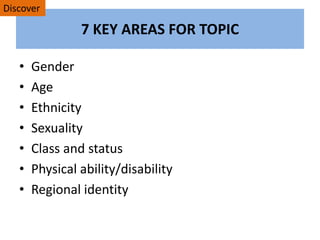
7 KEY AREAS FOR TOPIC
• Gender
• Age
• Ethnicity
• Sexuality
• Class and status
• Physical ability/disability
• Regional identity
Discover
TV Dramas
• A story that is presented in a dramatic way
and explores a range of genres, from soap
opera to science-fiction to costume drama.
• A piece of film that engages with the issues of
the day in an accessible fashion, i.e. through
believable characters, through fantastic
locations or plots.
MACRO and MICRO elements of
film language
• MACRO -
• GENRE
• NARRATIVE
• (REPRESENTATION)
• MICRO –
• CINEMATOGRAPHY
• SOUND
• EDITING
• MISE EN SCENE
• SPECIAL EFFECTS
CONVENTIONS OF TV DRAMA
• What are the CONVENTIONS of a TV Drama?
BONUS: Which do you think are the most
important?
Develop
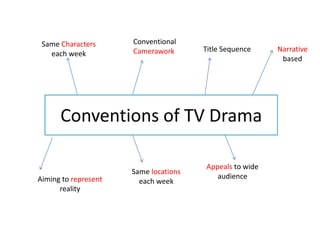
Conventions of TV Drama
Same Characters
each week
Conventional
Camerawork Title Sequence
Aiming to represent
reality
Same locations
each week
Appeals to wide
audience
Narrative
based
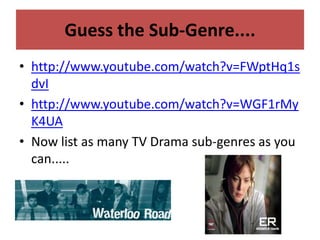
Guess the Sub-Genre....
• http://www.youtube.com/watch?v=FWptHq1s
dvI
• http://www.youtube.com/watch?v=WGF1rMy
K4UA
• Now list as many TV Drama sub-genres as you
can.....
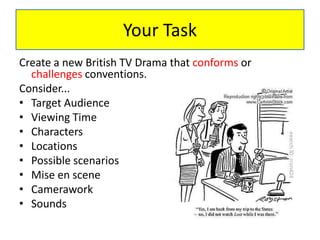
Your Task
Create a new British TV Drama that conforms or
challenges conventions.
Consider...
• Target Audience
• Viewing Time
• Characters
• Locations
• Possible scenarios
• Mise en scene
• Camerawork
• Sounds
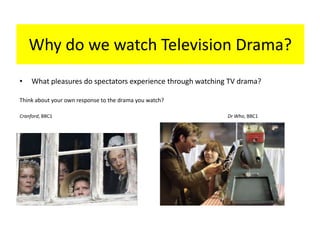
Why do we watch Television Drama?
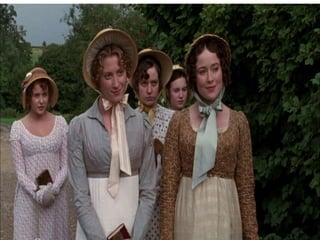
• What pleasures do spectators experience through watching TV drama?
Think about your own response to the drama you watch?
Cranford, BBC1 Dr Who, BBC1
DENOTATION AND CONNOTATION
Words and images in media texts can work on
more than one level.
You will come across the terms denotation and
connotation throughout your course. They are
important terms for you to understand.
DENOTATION is the straight forward or common-
sense meaning of a sign. Literally what is actually
shown in an image.
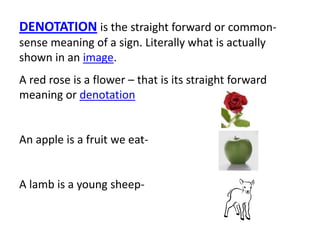
A red rose is a flower – that is its straight forward
meaning or denotation
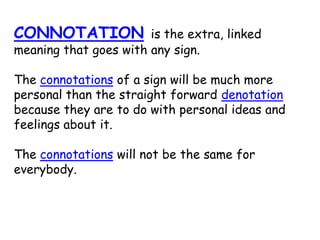
An apple is a fruit we eat-
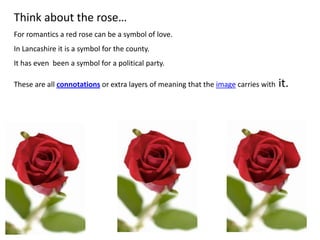
A lamb is a young sheep-
CONNOTATION is the extra, linked
meaning that goes with any sign.
The connotations of a sign will be much more
personal than the straight forward denotation
because they are to do with personal ideas and
feelings about it.
The connotations will not be the same for
everybody.
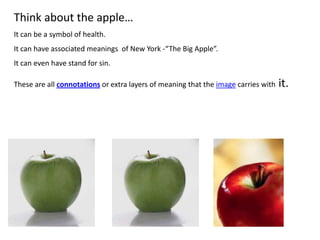
Think about the rose…
For romantics a red rose can be a symbol of love.
In Lancashire it is a symbol for the county.
It has even been a symbol for a political party.
These are all connotations or extra layers of meaning that the image carries with it.
Think about the apple…
It can be a symbol of health.
It can have associated meanings of New York -“The Big Apple”.
It can even have stand for sin.
These are all connotations or extra layers of meaning that the image carries with it.
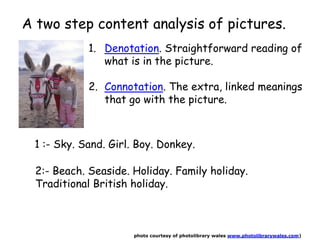
A two step content analysis of pictures.
1. Denotation. Straightforward reading of
what is in the picture.
2. Connotation. The extra, linked meanings
that go with the picture.
1 :- Sky. Sand. Girl. Boy. Donkey.
2:- Beach. Seaside. Holiday. Family holiday.
Traditional British holiday.
photo courtesy of photolibrary wales www.photolibrarywales.com)
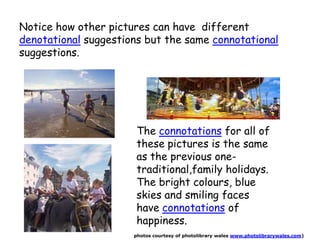
Notice how other pictures can have different
denotational suggestions but the same connotational
suggestions.
The connotations for all of
these pictures is the same
as the previous one-
traditional,family holidays.
The bright colours, blue
skies and smiling faces
have connotations of
happiness.
photos courtesy of photolibrary wales www.photolibrarywales.com)
Creating Realism
• Why is it important for a TV Drama to create
‘REALISM’?
• How is Realism Created?
Discover
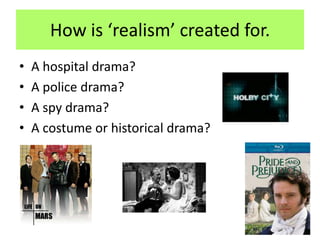
How is ‘realism’ created for.
• A hospital drama?
• A police drama?
• A spy drama?
• A costume or historical drama?
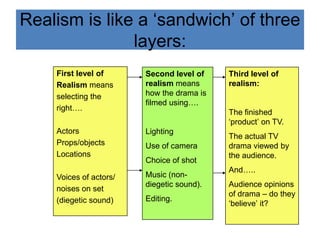
Realism is like a ‘sandwich’ of three
layers:
First level of
Realism means
selecting the
right….
Actors
Props/objects
Locations
Voices of actors/
noises on set
(diegetic sound)
Second level of
realism means
how the drama is
filmed using….
Lighting
Use of camera
Choice of shot
Music (non-
diegetic sound).
Editing.
Third level of
realism:
The finished
‘product’ on TV.
The actual TV
drama viewed by
the audience.
And…..
Audience opinions
of drama – do they
‘believe’ it?
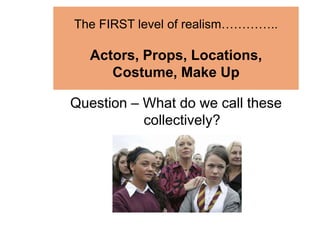
The FIRST level of realism…………..
Actors, Props, Locations,
Costume, Make Up
Question – What do we call these
collectively?
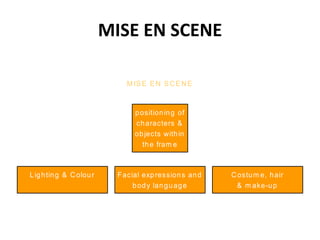
MISE EN SCENE
MISE EN SCENE
Lighting & Colour Facial expressions and
body language
Costum e, hair
& m ake-up
positioning of
characters &
objects within
the fram e
THE CORE
Mise En Scene
• There are 6 Areas of MIS EN SCENE:
• Lighting
• Location
• Props
• Costume
• Make Up & Hair
• Proxemics
Verisimilitude
The ‘truth’ of the Scene and its
‘reality’
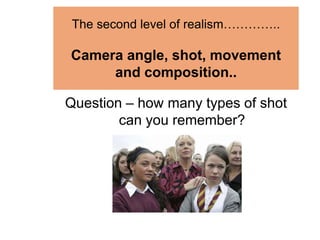
The second level of realism…………..
Camera angle, shot, movement
and composition..
Question – how many types of shot
can you remember?
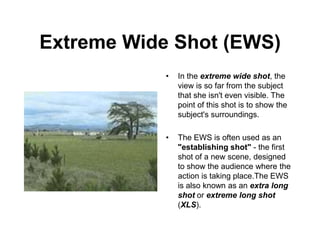
Extreme Wide Shot (EWS)
• In the extreme wide shot, the
view is so far from the subject
that she isn't even visible. The
point of this shot is to show the
subject's surroundings.
• The EWS is often used as an
"establishing shot" - the first
shot of a new scene, designed
to show the audience where the
action is taking place.The EWS
is also known as an extra long
shot or extreme long shot
(XLS).
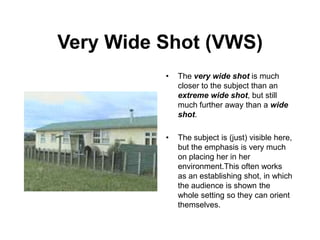
Very Wide Shot (VWS)
• The very wide shot is much
closer to the subject than an
extreme wide shot, but still
much further away than a wide
shot.
• The subject is (just) visible here,
but the emphasis is very much
on placing her in her
environment.This often works
as an establishing shot, in which
the audience is shown the
whole setting so they can orient
themselves.
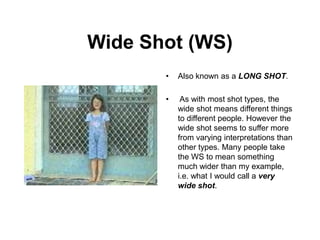
Wide Shot (WS)
• Also known as a LONG SHOT.
• As with most shot types, the
wide shot means different things
to different people. However the
wide shot seems to suffer more
from varying interpretations than
other types. Many people take
the WS to mean something
much wider than my example,
i.e. what I would call a very
wide shot.
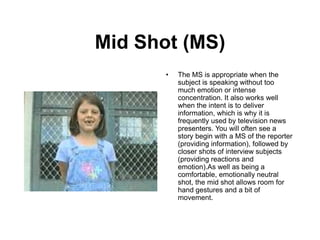
Mid Shot (MS)
• The MS is appropriate when the
subject is speaking without too
much emotion or intense
concentration. It also works well
when the intent is to deliver
information, which is why it is
frequently used by television news
presenters. You will often see a
story begin with a MS of the reporter
(providing information), followed by
closer shots of interview subjects
(providing reactions and
emotion).As well as being a
comfortable, emotionally neutral
shot, the mid shot allows room for
hand gestures and a bit of
movement.
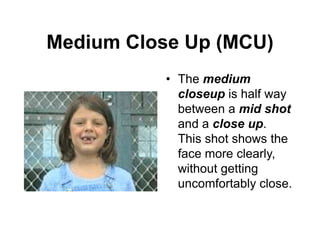
Medium Close Up (MCU)
• The medium
closeup is half way
between a mid shot
and a close up.
This shot shows the
face more clearly,
without getting
uncomfortably close.
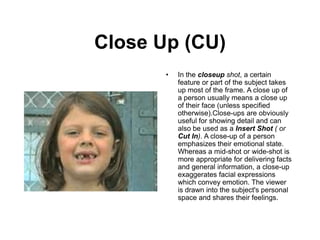
Close Up (CU)
• In the closeup shot, a certain
feature or part of the subject takes
up most of the frame. A close up of
a person usually means a close up
of their face (unless specified
otherwise).Close-ups are obviously
useful for showing detail and can
also be used as a Insert Shot ( or
Cut In). A close-up of a person
emphasizes their emotional state.
Whereas a mid-shot or wide-shot is
more appropriate for delivering facts
and general information, a close-up
exaggerates facial expressions
which convey emotion. The viewer
is drawn into the subject's personal
space and shares their feelings.
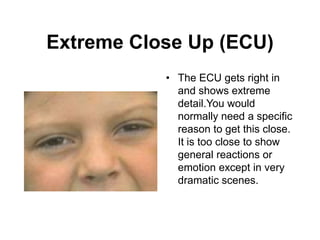
Extreme Close Up (ECU)
• The ECU gets right in
and shows extreme
detail.You would
normally need a specific
reason to get this close.
It is too close to show
general reactions or
emotion except in very
dramatic scenes.
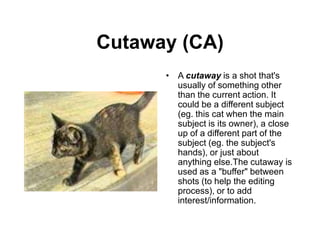
Cutaway (CA)
• A cutaway is a shot that's
usually of something other
than the current action. It
could be a different subject
(eg. this cat when the main
subject is its owner), a close
up of a different part of the
subject (eg. the subject's
hands), or just about
anything else.The cutaway is
used as a "buffer" between
shots (to help the editing
process), or to add
interest/information.
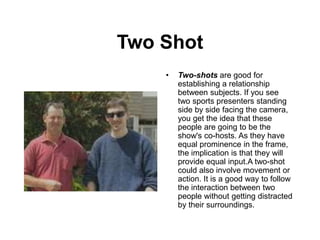
Two Shot
• Two-shots are good for
establishing a relationship
between subjects. If you see
two sports presenters standing
side by side facing the camera,
you get the idea that these
people are going to be the
show's co-hosts. As they have
equal prominence in the frame,
the implication is that they will
provide equal input.A two-shot
could also involve movement or
action. It is a good way to follow
the interaction between two
people without getting distracted
by their surroundings.
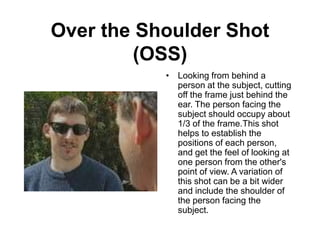
Over the Shoulder Shot
(OSS)
• Looking from behind a
person at the subject, cutting
off the frame just behind the
ear. The person facing the
subject should occupy about
1/3 of the frame.This shot
helps to establish the
positions of each person,
and get the feel of looking at
one person from the other's
point of view. A variation of
this shot can be a bit wider
and include the shoulder of
the person facing the
subject.
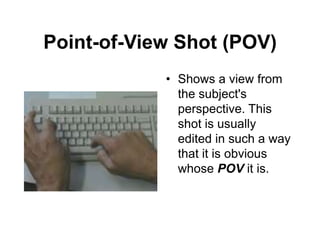
Point-of-View Shot (POV)
• Shows a view from
the subject's
perspective. This
shot is usually
edited in such a way
that it is obvious
whose POV it is.
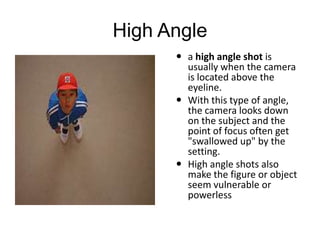
High Angle
 a high angle shot is
usually when the camera
is located above the
eyeline.
 With this type of angle,
the camera looks down
on the subject and the
point of focus often get
"swallowed up" by the
setting.
 High angle shots also
make the figure or object
seem vulnerable or
powerless
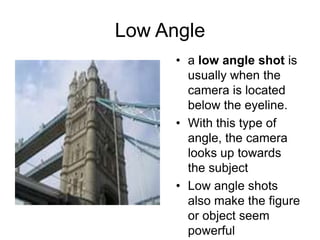
Low Angle
• a low angle shot is
usually when the
camera is located
below the eyeline.
• With this type of
angle, the camera
looks up towards
the subject
• Low angle shots
also make the figure
or object seem
powerful
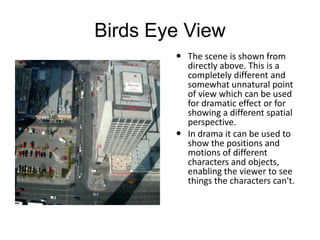
Birds Eye View
 The scene is shown from
directly above. This is a
completely different and
somewhat unnatural point
of view which can be used
for dramatic effect or for
showing a different spatial
perspective.
 In drama it can be used to
show the positions and
motions of different
characters and objects,
enabling the viewer to see
things the characters can't.
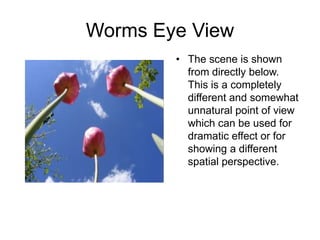
Worms Eye View
• The scene is shown
from directly below.
This is a completely
different and somewhat
unnatural point of view
which can be used for
dramatic effect or for
showing a different
spatial perspective.
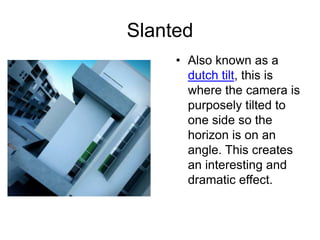
Slanted
• Also known as a
dutch tilt, this is
where the camera is
purposely tilted to
one side so the
horizon is on an
angle. This creates
an interesting and
dramatic effect.
Zoom
• An adjustment to the focal length of the
camera making the it seem that we are
getting closer to the subject
• Zoom
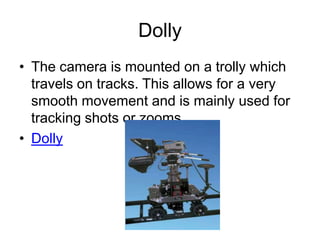
Dolly
• The camera is mounted on a trolly which
travels on tracks. This allows for a very
smooth movement and is mainly used for
tracking shots or zooms
• Dolly
Pan
• A horizontal movement of the camera,
either left of right
• Pan
Tilt
• Pointing the camera up and down (not
moving the camera up and down)
• Tilt
Pedestal
• The camera moves up and down but
remains level, making it different to a tilt
• Pedestal
Tracking
• Movement that stays a constant distance
from the subject – can be used on a crane
as well
• Tracking
Composition
 Composition is how we create the shot we
want in the frame
 There are 5 key rules to composing a great
shot:
• Simplicity
• Rule of Thirds
• Framing
• Leading Lines
• Balance
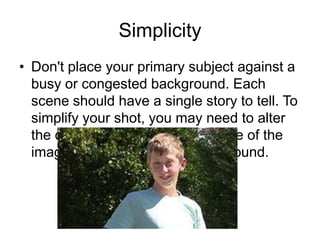
Simplicity
• Don't place your primary subject against a
busy or congested background. Each
scene should have a single story to tell. To
simplify your shot, you may need to alter
the camera position, alter the size of the
image, or select the right background.
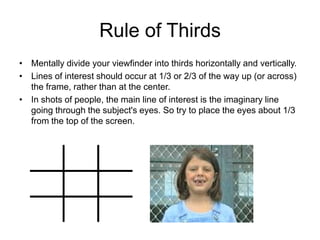
Rule of Thirds
• Mentally divide your viewfinder into thirds horizontally and vertically.
• Lines of interest should occur at 1/3 or 2/3 of the way up (or across)
the frame, rather than at the center.
• In shots of people, the main line of interest is the imaginary line
going through the subject's eyes. So try to place the eyes about 1/3
from the top of the screen.
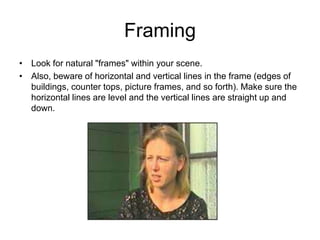
Framing
• Look for natural "frames" within your scene.
• Also, beware of horizontal and vertical lines in the frame (edges of
buildings, counter tops, picture frames, and so forth). Make sure the
horizontal lines are level and the vertical lines are straight up and
down.
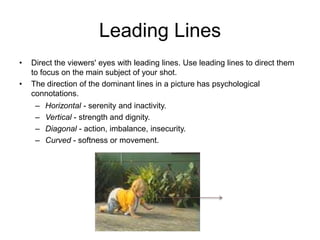
Leading Lines
• Direct the viewers' eyes with leading lines. Use leading lines to direct them
to focus on the main subject of your shot.
• The direction of the dominant lines in a picture has psychological
connotations.
– Horizontal - serenity and inactivity.
– Vertical - strength and dignity.
– Diagonal - action, imbalance, insecurity.
– Curved - softness or movement.
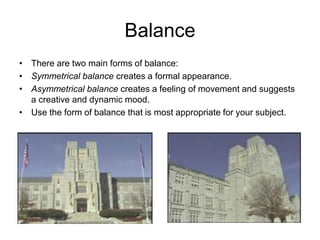
Balance
• There are two main forms of balance:
• Symmetrical balance creates a formal appearance.
• Asymmetrical balance creates a feeling of movement and suggests
a creative and dynamic mood.
• Use the form of balance that is most appropriate for your subject.
Cinematography Analysis
• Watch the following sequence and analyse
the cinematography of the scene. Pay
close attention to the shot type, the
camera angle, the camera movement and
what the shot makes us feel
How do we Analyse a TV Drama
– Mise-en-Scene
– Camera shots / Camera Angle / Movement and
Composition
– Editing
– Sound
Discover
Editing Techniques
• Editing is how individual shots are combined
in sequence to convey certain meanings. The
relationships between shots themselves
convey certain meanings
• Editing also serves to portray lived time in
terms of film-time so that actual events that
would take longer to occur in real time are
truncated or reduced to fit into the film time of
the typical two-hour film
Editing Techniques
• Key Terminology:
– Shot Duration – How long each shot lasts
– Continuity Editing - In continuity editing everything is filmed so that
the viewer thinks they are seeing continuous action. You will need to
ensure that characters’ appearance, the set and the lighting (colour
and direction) remain consistent from shot to shot.
– Transitions - Fades and dissolves (or ‘cross-fades’) can add to the
meaning of a sequence.
– Montage - Not all editing is continuity editing. Title sequences often
use ‘montage’, where the combination of contrasting images builds
up meaning.
Transitions
• Dissolves can be used to provide a slow, relaxed way of
linking shots - eg in a ‘montage’ of different shots within
an opening sequence. They can also be used in
continuity editing to show that we have moved forward in
time and/or space.
• Fades to black and back are usually used to show that a
more significant period of time has elapsed between two
sequences.
• Wipes and other unusual transitions are best avoided!
Editing Techniques
• Match on Action – A technique used in
continuity editing to convey a sense of
continuity between shots
• Match Cut – objects or images on the
screen are matched to another similar
object to show a connection between both
objects
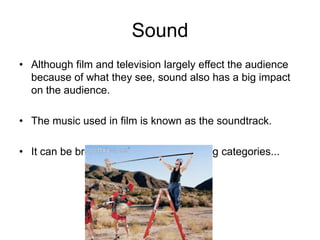
Sound
• Although film and television largely effect the audience
because of what they see, sound also has a big impact
on the audience.
• The music used in film is known as the soundtrack.
• It can be broken down into the following categories...
The soundtrack of a film is a very complex mix of:
• dialogue recorded on location.
• dialogue recorded after filming, and dubbed in sync with the lip
movement of the actors – virtually all the dialogue on major movies is
post- synched in a dubbing studio to get a very clean high definition
sound.
• sound effects (FX) - these may be recorded on location and added
later or they may be created for a scene such as a gun shot, the sound
of a man being punched, cars crashing etc. Hollywood does these
extra sound FX in a Foley studio.
The two key words you need to know when analysing film are written
below.
Copy their definitions:
Diagetic Sound:
Sound or music that is recorded on set as it happens. This will
include dialogue and sounds which take place within the film e.g. a
door closing, gun being fired, police siren.
Non-Diagetic Sound:
Music or sound which is added to the film during the editing process.
Most often, non-diagetic sound is music, which is used to create
atmosphere or emotion.
EXTENSION:
What sort of instrument(s) do you think would be used to create a ‘sad’
atmosphere in film and television?
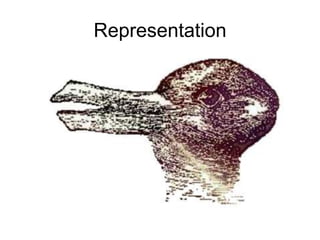
Representation
Representation
An image+ a point of view =
representation
In exploring representation you need
to establish....
• What view of people or issues is being
conveyed to audiences?
• How far is that view conveyed?
• How far are audiences positioned to take up a
preferred view?
• How far do the representations challenge or
conform to dominant representations and
ideologies?
Representation
• Representation refers to the construction
in any medium of aspects of ‘reality’ such
as people, places, objects, events, cultural
identities and other abstract concepts.
Such representations may be in speech or
writing as well as still or moving pictures.
• A key aspect in the study of representation
concern is with the way in which
representations are made to seem
‘natural’.
Representation
• Media is all about taking reality (real life) and
re-presenting it to an audience in a different
way. This might be a re-presentation of real
life e.g. BBC news, a manipulation of real life
e.g. The Only Way is Essex or Made in
Chelsea, or a fictional account e.g.
Eastenders or Coronation Street.
• All Media has a base in reality and the way
we see different events or characters can
have a real impact on the way we feel about
a group of people or a major issue.
Representation
• Representation plays a major role in our
enjoyment of a Media text. The audience
reads and decodes information in a number
of ways, and this helps them to understand
who a character is or what they might be
feeling.
• The audience is also influenced by what they
see represented on screen
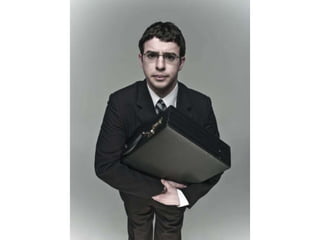
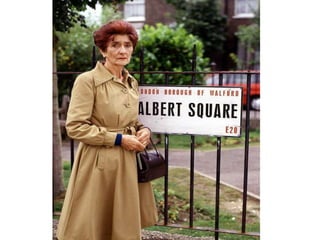
• Look at the following TV characters – how do
they make you feel about them?
Stereotypes
• The easiest way for the audience to relate
to a character or characters is to use
Stereotypes
• Stereotypes are when a character is
created using a common set of ideas
about a group of people. These ideas can
be both positive and negative and can
influence the way we view groups of
people
Stereotypes
• Whenever we look at a character on screen
we need to work out who they are
representing. The easiest way to do this to
use the letters C.A.G.E. This stands for:
• Class
• Age
• Gender
• Ethnicity

As level tv drama 1

  • 1.
    TV Dramas • Whatis a TV Drama? • Discuss your ideas with a partner and try to create a shared definition Connect
  • 2.
    G322 Media Exam •Textual Analysis and Representation: – Camera shots – Camera Angle – Movement and Composition – Editing – Sound – Mise-en-Scene Discover
  • 3.
    G322 Media Exam •The purpose of these units is first to assess candidates’ media textual analysis skills and their understanding of the concept of representation using a short unseen moving image extract Discover
  • 4.
    Section A • An‘unseen’ moving image extract with one compulsory question dealing with textual analysis of various technical aspects of the languages and conventions of moving image media. Candidates will be asked to link this analysis with a discussion of some aspect of representation within the sequence. Discover
  • 5.
    Section A • An‘unseen’ moving image extract with one compulsory question dealing with textual analysis of various technical aspects of the languages and conventions of moving image media. Candidates will be asked to link this analysis with a discussion of some aspect of representation within the sequence. Discover
  • 6.
    Section A • Thefocus of study for Section A is the use of technical aspects of the moving image medium to create meaning for an audience, focussing on the creation of representations of specific social types, groups, events or places within the extract. Discover
  • 7.
    Section A TV Drama •The sequence will be taken from a contemporary one-off drama or series or serial drama programme scheduled on British television stations including some sourced from other countries. Discover
  • 8.
    Exam Structure Watching theunseen moving image extract • You will be allowed two minutes to read the question for Section A before the extract is screened. • The extract will be screened four times. – First screening: watch the extract; no notes are to be made this time. – Second screening: watch the extract and make notes. • There will be a brief break for note-making. – Third and fourth screening: watch the extract and make notes • There will be a brief break for note-making after the third and fourth screenings. • Your notes for Section A are to be written in the answer booklet provided and must be handed in at the end of the examination. • Rule a diagonal line through your notes afterwards. Discover
  • 9.
    7 KEY AREASFOR TOPIC • Gender • Age • Ethnicity • Sexuality • Class and status • Physical ability/disability • Regional identity Discover
  • 10.
    TV Dramas • Astory that is presented in a dramatic way and explores a range of genres, from soap opera to science-fiction to costume drama. • A piece of film that engages with the issues of the day in an accessible fashion, i.e. through believable characters, through fantastic locations or plots.
  • 11.
    MACRO and MICROelements of film language • MACRO - • GENRE • NARRATIVE • (REPRESENTATION) • MICRO – • CINEMATOGRAPHY • SOUND • EDITING • MISE EN SCENE • SPECIAL EFFECTS
  • 12.
    CONVENTIONS OF TVDRAMA • What are the CONVENTIONS of a TV Drama? BONUS: Which do you think are the most important? Develop
  • 13.
    Conventions of TVDrama Same Characters each week Conventional Camerawork Title Sequence Aiming to represent reality Same locations each week Appeals to wide audience Narrative based
  • 14.
    Guess the Sub-Genre.... •http://www.youtube.com/watch?v=FWptHq1s dvI • http://www.youtube.com/watch?v=WGF1rMy K4UA • Now list as many TV Drama sub-genres as you can.....
  • 15.
    Your Task Create anew British TV Drama that conforms or challenges conventions. Consider... • Target Audience • Viewing Time • Characters • Locations • Possible scenarios • Mise en scene • Camerawork • Sounds
  • 16.
    Why do wewatch Television Drama? • What pleasures do spectators experience through watching TV drama? Think about your own response to the drama you watch? Cranford, BBC1 Dr Who, BBC1
  • 17.
    DENOTATION AND CONNOTATION Wordsand images in media texts can work on more than one level. You will come across the terms denotation and connotation throughout your course. They are important terms for you to understand.
  • 18.
    DENOTATION is thestraight forward or common- sense meaning of a sign. Literally what is actually shown in an image. A red rose is a flower – that is its straight forward meaning or denotation An apple is a fruit we eat- A lamb is a young sheep-
  • 19.
    CONNOTATION is theextra, linked meaning that goes with any sign. The connotations of a sign will be much more personal than the straight forward denotation because they are to do with personal ideas and feelings about it. The connotations will not be the same for everybody.
  • 20.
    Think about therose… For romantics a red rose can be a symbol of love. In Lancashire it is a symbol for the county. It has even been a symbol for a political party. These are all connotations or extra layers of meaning that the image carries with it.
  • 21.
    Think about theapple… It can be a symbol of health. It can have associated meanings of New York -“The Big Apple”. It can even have stand for sin. These are all connotations or extra layers of meaning that the image carries with it.
  • 22.
    A two stepcontent analysis of pictures. 1. Denotation. Straightforward reading of what is in the picture. 2. Connotation. The extra, linked meanings that go with the picture. 1 :- Sky. Sand. Girl. Boy. Donkey. 2:- Beach. Seaside. Holiday. Family holiday. Traditional British holiday. photo courtesy of photolibrary wales www.photolibrarywales.com)
  • 23.
    Notice how otherpictures can have different denotational suggestions but the same connotational suggestions. The connotations for all of these pictures is the same as the previous one- traditional,family holidays. The bright colours, blue skies and smiling faces have connotations of happiness. photos courtesy of photolibrary wales www.photolibrarywales.com)
  • 24.
    Creating Realism • Whyis it important for a TV Drama to create ‘REALISM’? • How is Realism Created? Discover
  • 25.
    How is ‘realism’created for. • A hospital drama? • A police drama? • A spy drama? • A costume or historical drama?
  • 26.
    Realism is likea ‘sandwich’ of three layers: First level of Realism means selecting the right…. Actors Props/objects Locations Voices of actors/ noises on set (diegetic sound) Second level of realism means how the drama is filmed using…. Lighting Use of camera Choice of shot Music (non- diegetic sound). Editing. Third level of realism: The finished ‘product’ on TV. The actual TV drama viewed by the audience. And….. Audience opinions of drama – do they ‘believe’ it?
  • 27.
    The FIRST levelof realism………….. Actors, Props, Locations, Costume, Make Up Question – What do we call these collectively?
  • 28.
    MISE EN SCENE MISEEN SCENE Lighting & Colour Facial expressions and body language Costum e, hair & m ake-up positioning of characters & objects within the fram e
  • 29.
  • 30.
    Mise En Scene •There are 6 Areas of MIS EN SCENE: • Lighting • Location • Props • Costume • Make Up & Hair • Proxemics
  • 31.
    Verisimilitude The ‘truth’ ofthe Scene and its ‘reality’
  • 34.
    The second levelof realism………….. Camera angle, shot, movement and composition.. Question – how many types of shot can you remember?
  • 35.
    Extreme Wide Shot(EWS) • In the extreme wide shot, the view is so far from the subject that she isn't even visible. The point of this shot is to show the subject's surroundings. • The EWS is often used as an "establishing shot" - the first shot of a new scene, designed to show the audience where the action is taking place.The EWS is also known as an extra long shot or extreme long shot (XLS).
  • 36.
    Very Wide Shot(VWS) • The very wide shot is much closer to the subject than an extreme wide shot, but still much further away than a wide shot. • The subject is (just) visible here, but the emphasis is very much on placing her in her environment.This often works as an establishing shot, in which the audience is shown the whole setting so they can orient themselves.
  • 37.
    Wide Shot (WS) •Also known as a LONG SHOT. • As with most shot types, the wide shot means different things to different people. However the wide shot seems to suffer more from varying interpretations than other types. Many people take the WS to mean something much wider than my example, i.e. what I would call a very wide shot.
  • 38.
    Mid Shot (MS) •The MS is appropriate when the subject is speaking without too much emotion or intense concentration. It also works well when the intent is to deliver information, which is why it is frequently used by television news presenters. You will often see a story begin with a MS of the reporter (providing information), followed by closer shots of interview subjects (providing reactions and emotion).As well as being a comfortable, emotionally neutral shot, the mid shot allows room for hand gestures and a bit of movement.
  • 39.
    Medium Close Up(MCU) • The medium closeup is half way between a mid shot and a close up. This shot shows the face more clearly, without getting uncomfortably close.
  • 40.
    Close Up (CU) •In the closeup shot, a certain feature or part of the subject takes up most of the frame. A close up of a person usually means a close up of their face (unless specified otherwise).Close-ups are obviously useful for showing detail and can also be used as a Insert Shot ( or Cut In). A close-up of a person emphasizes their emotional state. Whereas a mid-shot or wide-shot is more appropriate for delivering facts and general information, a close-up exaggerates facial expressions which convey emotion. The viewer is drawn into the subject's personal space and shares their feelings.
  • 41.
    Extreme Close Up(ECU) • The ECU gets right in and shows extreme detail.You would normally need a specific reason to get this close. It is too close to show general reactions or emotion except in very dramatic scenes.
  • 42.
    Cutaway (CA) • Acutaway is a shot that's usually of something other than the current action. It could be a different subject (eg. this cat when the main subject is its owner), a close up of a different part of the subject (eg. the subject's hands), or just about anything else.The cutaway is used as a "buffer" between shots (to help the editing process), or to add interest/information.
  • 43.
    Two Shot • Two-shotsare good for establishing a relationship between subjects. If you see two sports presenters standing side by side facing the camera, you get the idea that these people are going to be the show's co-hosts. As they have equal prominence in the frame, the implication is that they will provide equal input.A two-shot could also involve movement or action. It is a good way to follow the interaction between two people without getting distracted by their surroundings.
  • 44.
    Over the ShoulderShot (OSS) • Looking from behind a person at the subject, cutting off the frame just behind the ear. The person facing the subject should occupy about 1/3 of the frame.This shot helps to establish the positions of each person, and get the feel of looking at one person from the other's point of view. A variation of this shot can be a bit wider and include the shoulder of the person facing the subject.
  • 45.
    Point-of-View Shot (POV) •Shows a view from the subject's perspective. This shot is usually edited in such a way that it is obvious whose POV it is.
  • 46.
    High Angle  ahigh angle shot is usually when the camera is located above the eyeline.  With this type of angle, the camera looks down on the subject and the point of focus often get "swallowed up" by the setting.  High angle shots also make the figure or object seem vulnerable or powerless
  • 47.
    Low Angle • alow angle shot is usually when the camera is located below the eyeline. • With this type of angle, the camera looks up towards the subject • Low angle shots also make the figure or object seem powerful
  • 48.
    Birds Eye View The scene is shown from directly above. This is a completely different and somewhat unnatural point of view which can be used for dramatic effect or for showing a different spatial perspective.  In drama it can be used to show the positions and motions of different characters and objects, enabling the viewer to see things the characters can't.
  • 49.
    Worms Eye View •The scene is shown from directly below. This is a completely different and somewhat unnatural point of view which can be used for dramatic effect or for showing a different spatial perspective.
  • 50.
    Slanted • Also knownas a dutch tilt, this is where the camera is purposely tilted to one side so the horizon is on an angle. This creates an interesting and dramatic effect.
  • 51.
    Zoom • An adjustmentto the focal length of the camera making the it seem that we are getting closer to the subject • Zoom
  • 52.
    Dolly • The camerais mounted on a trolly which travels on tracks. This allows for a very smooth movement and is mainly used for tracking shots or zooms • Dolly
  • 53.
    Pan • A horizontalmovement of the camera, either left of right • Pan
  • 54.
    Tilt • Pointing thecamera up and down (not moving the camera up and down) • Tilt
  • 55.
    Pedestal • The cameramoves up and down but remains level, making it different to a tilt • Pedestal
  • 56.
    Tracking • Movement thatstays a constant distance from the subject – can be used on a crane as well • Tracking
  • 57.
    Composition  Composition ishow we create the shot we want in the frame  There are 5 key rules to composing a great shot: • Simplicity • Rule of Thirds • Framing • Leading Lines • Balance
  • 58.
    Simplicity • Don't placeyour primary subject against a busy or congested background. Each scene should have a single story to tell. To simplify your shot, you may need to alter the camera position, alter the size of the image, or select the right background.
  • 59.
    Rule of Thirds •Mentally divide your viewfinder into thirds horizontally and vertically. • Lines of interest should occur at 1/3 or 2/3 of the way up (or across) the frame, rather than at the center. • In shots of people, the main line of interest is the imaginary line going through the subject's eyes. So try to place the eyes about 1/3 from the top of the screen.
  • 60.
    Framing • Look fornatural "frames" within your scene. • Also, beware of horizontal and vertical lines in the frame (edges of buildings, counter tops, picture frames, and so forth). Make sure the horizontal lines are level and the vertical lines are straight up and down.
  • 61.
    Leading Lines • Directthe viewers' eyes with leading lines. Use leading lines to direct them to focus on the main subject of your shot. • The direction of the dominant lines in a picture has psychological connotations. – Horizontal - serenity and inactivity. – Vertical - strength and dignity. – Diagonal - action, imbalance, insecurity. – Curved - softness or movement.
  • 62.
    Balance • There aretwo main forms of balance: • Symmetrical balance creates a formal appearance. • Asymmetrical balance creates a feeling of movement and suggests a creative and dynamic mood. • Use the form of balance that is most appropriate for your subject.
  • 63.
    Cinematography Analysis • Watchthe following sequence and analyse the cinematography of the scene. Pay close attention to the shot type, the camera angle, the camera movement and what the shot makes us feel
  • 64.
    How do weAnalyse a TV Drama – Mise-en-Scene – Camera shots / Camera Angle / Movement and Composition – Editing – Sound Discover
  • 65.
    Editing Techniques • Editingis how individual shots are combined in sequence to convey certain meanings. The relationships between shots themselves convey certain meanings • Editing also serves to portray lived time in terms of film-time so that actual events that would take longer to occur in real time are truncated or reduced to fit into the film time of the typical two-hour film
  • 66.
    Editing Techniques • KeyTerminology: – Shot Duration – How long each shot lasts – Continuity Editing - In continuity editing everything is filmed so that the viewer thinks they are seeing continuous action. You will need to ensure that characters’ appearance, the set and the lighting (colour and direction) remain consistent from shot to shot. – Transitions - Fades and dissolves (or ‘cross-fades’) can add to the meaning of a sequence. – Montage - Not all editing is continuity editing. Title sequences often use ‘montage’, where the combination of contrasting images builds up meaning.
  • 67.
    Transitions • Dissolves canbe used to provide a slow, relaxed way of linking shots - eg in a ‘montage’ of different shots within an opening sequence. They can also be used in continuity editing to show that we have moved forward in time and/or space. • Fades to black and back are usually used to show that a more significant period of time has elapsed between two sequences. • Wipes and other unusual transitions are best avoided!
  • 68.
    Editing Techniques • Matchon Action – A technique used in continuity editing to convey a sense of continuity between shots • Match Cut – objects or images on the screen are matched to another similar object to show a connection between both objects
  • 69.
    Sound • Although filmand television largely effect the audience because of what they see, sound also has a big impact on the audience. • The music used in film is known as the soundtrack. • It can be broken down into the following categories...
  • 70.
    The soundtrack ofa film is a very complex mix of: • dialogue recorded on location. • dialogue recorded after filming, and dubbed in sync with the lip movement of the actors – virtually all the dialogue on major movies is post- synched in a dubbing studio to get a very clean high definition sound. • sound effects (FX) - these may be recorded on location and added later or they may be created for a scene such as a gun shot, the sound of a man being punched, cars crashing etc. Hollywood does these extra sound FX in a Foley studio.
  • 71.
    The two keywords you need to know when analysing film are written below. Copy their definitions: Diagetic Sound: Sound or music that is recorded on set as it happens. This will include dialogue and sounds which take place within the film e.g. a door closing, gun being fired, police siren. Non-Diagetic Sound: Music or sound which is added to the film during the editing process. Most often, non-diagetic sound is music, which is used to create atmosphere or emotion. EXTENSION: What sort of instrument(s) do you think would be used to create a ‘sad’ atmosphere in film and television?
  • 72.
  • 73.
    Representation An image+ apoint of view = representation
  • 74.
    In exploring representationyou need to establish.... • What view of people or issues is being conveyed to audiences? • How far is that view conveyed? • How far are audiences positioned to take up a preferred view? • How far do the representations challenge or conform to dominant representations and ideologies?
  • 75.
    Representation • Representation refersto the construction in any medium of aspects of ‘reality’ such as people, places, objects, events, cultural identities and other abstract concepts. Such representations may be in speech or writing as well as still or moving pictures. • A key aspect in the study of representation concern is with the way in which representations are made to seem ‘natural’.
  • 76.
    Representation • Media isall about taking reality (real life) and re-presenting it to an audience in a different way. This might be a re-presentation of real life e.g. BBC news, a manipulation of real life e.g. The Only Way is Essex or Made in Chelsea, or a fictional account e.g. Eastenders or Coronation Street. • All Media has a base in reality and the way we see different events or characters can have a real impact on the way we feel about a group of people or a major issue.
  • 77.
    Representation • Representation playsa major role in our enjoyment of a Media text. The audience reads and decodes information in a number of ways, and this helps them to understand who a character is or what they might be feeling. • The audience is also influenced by what they see represented on screen • Look at the following TV characters – how do they make you feel about them?
  • 81.
    Stereotypes • The easiestway for the audience to relate to a character or characters is to use Stereotypes • Stereotypes are when a character is created using a common set of ideas about a group of people. These ideas can be both positive and negative and can influence the way we view groups of people
  • 82.
    Stereotypes • Whenever welook at a character on screen we need to work out who they are representing. The easiest way to do this to use the letters C.A.G.E. This stands for: • Class • Age • Gender • Ethnicity

Editor's Notes

  • #26 Spy drama - spooks
  • #27 Do we need to believe all TV dramas?Music – why do we need it?