AS Media Studies: TV Drama

     Sound: Micro Elements
Sound in TV Drama
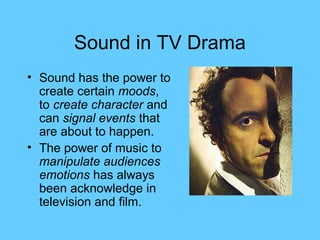
• Sound has the power to
  create certain moods,
  to create character and
  can signal events that
  are about to happen.
• The power of music to
  manipulate audiences
  emotions has always
  been acknowledge in
  television and film.
Sound in TV Drama
The entire sound track is comprised of three essential ingredients:

•   the human voice /dialogue
•   sound effects
•   music

•   In TV drama these create a balance between the realism of the
     world of the text/programme and drama that is created by the
                             use of sound

(in the real world dialogue is less polished and music/ soundtracks
                              don’t appear!)
Types of Sound
     The world of the TV programme we see on screen is called the
                               DIEGESIS.

•     There are two main types of sound in TV drama…

1)    DIEGETIC sound

1)    NON-DIEGETIC sound

Both are used in TV drama to create VERISIMILITUDE – realism.


     VERISIMILITUDE = the believable logic of the texts
     world (which appears real)
Diegetic Sound
• DIEGETIC SOUND is any sound or music
  that happens inside the world of the story

  This sound is part of the programme’s
  world (diegesis) and can be
  dialogue/speech, footsteps and sound
  effects with a source.

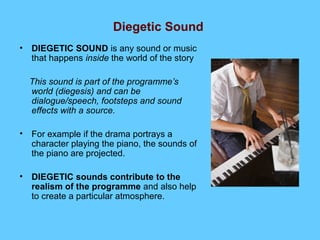
• For example if the drama portrays a
  character playing the piano, the sounds of
  the piano are projected.

• DIEGETIC sounds contribute to the
  realism of the programme and also help
  to create a particular atmosphere.
Diegetic Sound
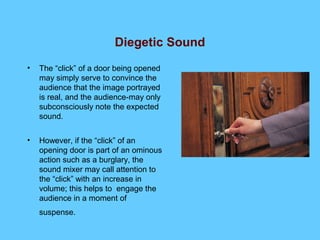
•   The “click” of a door being opened
    may simply serve to convince the
    audience that the image portrayed
    is real, and the audience-may only
    subconsciously note the expected
    sound.

•   However, if the “click” of an
    opening door is part of an ominous
    action such as a burglary, the
    sound mixer may call attention to
    the “click” with an increase in
    volume; this helps to engage the
    audience in a moment of
    suspense.
Non-Diegetic Sound

•   Non-diegetic sound is sound that which takes place outside
    the world of the story.
•   It is usually placed on later in the post-production process e.g.
    music and soundtrack.
•   Such sounds are included so as to provide an appropriate
    emotion or mood and they may also add to the realism of the
    drama.
•   Foley is the reproduction of everyday sounds for use in filmmaking.
    These reproduced sounds can be anything from the swishing of
    clothing and footsteps to squeaky doors and breaking glass. The best
    Foley art is so well integrated into a film that it goes unnoticed by the
    audience. It helps to create a sense of reality within a scene. Without
    these crucial background noise, movies feel unnaturally quiet and
    uncomfortable. - http://www.youtube.com/watch?v=D5CK0HH6xBk
Diegetic and Non- Diegetic sounds


 Task: In groups, watch the opening sequence of
 Life on Mars (episode 5) and identify as many
 examples of diegetic sound and non-diegetic
 sound as you can.
• http://www.youtube.com/watch?
  v=2Pwbw5grXVk
Dialogue - modes of address
                   Voice Over
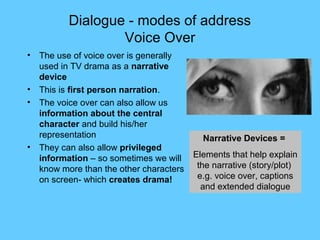
•   The use of voice over is generally
    used in TV drama as a narrative
    device
•   This is first person narration.
•   The voice over can also allow us
    information about the central
    character and build his/her
    representation                          Narrative Devices =
•   They can also allow privileged
    information – so sometimes we will    Elements that help explain
    know more than the other characters    the narrative (story/plot)
    on screen- which creates drama!        e.g. voice over, captions
                                            and extended dialogue
Dialogue/Speech: Modes of Address
                     Direct Address
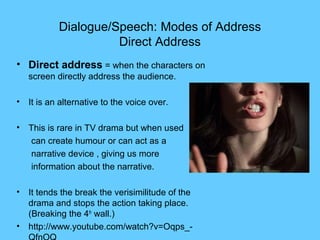
• Direct address = when the characters on
   screen directly address the audience.

• It is an alternative to the voice over.

• This is rare in TV drama but when used
   can create humour or can act as a
   narrative device , giving us more
   information about the narrative.

• It tends the break the verisimilitude of the
  drama and stops the action taking place.
  (Breaking the 4th wall.)
• http://www.youtube.com/watch?v=Oqps_-
Dialogue/Speech: Modes of
             Address
• Can also refer to how the audience speak to
  one another
• Are they speaking to them in a fatherly
  figure way, are they having to refer to them
  as ‘My lord..’, reflecting age/status…are
  they being sexist…
• You can actually quote dialogue to support
  your points
The Importance of Music in
          TV Drama
• The soundtrack/score in TV drama is often used to
  tell the audience how we should be feeling, whether
  this is sad, happy, scared or amused.

• This use of music is a convention of TV drama.

 Task: Watch the sequence from Jaws – what
  emotions do you feel in this sequence and how
  do the programme makers achieve it through the
  use of music?
http://www.youtube.com/watch?v=f2K-YedETiI
Incidental music
•   This Incidental music is used to add emotion and rhythm to a
    drama. Usually not meant to be noticeable.

•   it often provides a tone or an emotional attitude toward the
    story and/or the characters depicted.

•   In addition, background music often foreshadows a change
    in mood. For example, dissonant music may be used in film to
    indicate an approaching (but not yet visible) menace or disaster.

•   Incidental music may aid viewer understanding by linking
    scenes. For example, a particular musical theme or sound
    motif associated with an individual character or situation may
    be repeated at various points in a text in order to remind the
    audience of ideas (think the Bond theme in Bond films or
    Indiana Jones films.)
• sound is comprised of conventions and
  innovations.

• We have come to expect an acceleration of
  music during car chases and creaky doors in
  horror dramas.

• Yet, it is important to note as well that sound
  is often brilliantly conceived. The effects of
  sound are often largely subtle and often are
  noted by only our subconscious minds
Parallel and Contrapuntal Sound
•    Sound can be used in one of two ways…

1)   Parallel sound = when we watch a TV drama the
     sound we hear usually compliments and follows
     what we see on screen. For example fast paced,
     loud music in chase scenes or action sequences.

2) Contrapuntal sound = is sound that does not fit the
   images we see on screen. Usually done to create
   an effect e.g. classical music over violent scenes
   etc…
Stings
• A Sting = either a brief crescendo stab of music used to
  enhance the drama of the current situation just before a
  change of scene (called a "dramatic sting" when used this way)

• or a brief comical stab on music to enhance a punch line at the
  end of a scene (most famously, the so-called "rimshot" -- ba-
  dum-bum-ching).

• "Sting 'em and sling 'em" is a phrase used to describe this kind
  of break.

• When used for a cheap shock, the sting becomes a scare
  chord.

E.g the end of an episode of Eastenders
http://www.youtube.com/watch?v=F6YU1Bs35Tc
Ambient Sound
• Ambient sound, also known as natural
  sound = The sound occurring in the
  area where they shoot the drama. It is
  often used or created in dramas to
  create verisimilitude (realism)
Revision Test
• Next lesson on terms covered in todays
  class

TV Drama - Sound

  • 1.
    AS Media Studies:TV Drama Sound: Micro Elements
  • 2.
    Sound in TVDrama • Sound has the power to create certain moods, to create character and can signal events that are about to happen. • The power of music to manipulate audiences emotions has always been acknowledge in television and film.
  • 3.
    Sound in TVDrama The entire sound track is comprised of three essential ingredients: • the human voice /dialogue • sound effects • music • In TV drama these create a balance between the realism of the world of the text/programme and drama that is created by the use of sound (in the real world dialogue is less polished and music/ soundtracks don’t appear!)
  • 4.
    Types of Sound The world of the TV programme we see on screen is called the DIEGESIS. • There are two main types of sound in TV drama… 1) DIEGETIC sound 1) NON-DIEGETIC sound Both are used in TV drama to create VERISIMILITUDE – realism. VERISIMILITUDE = the believable logic of the texts world (which appears real)
  • 5.
    Diegetic Sound • DIEGETICSOUND is any sound or music that happens inside the world of the story This sound is part of the programme’s world (diegesis) and can be dialogue/speech, footsteps and sound effects with a source. • For example if the drama portrays a character playing the piano, the sounds of the piano are projected. • DIEGETIC sounds contribute to the realism of the programme and also help to create a particular atmosphere.
  • 6.
    Diegetic Sound • The “click” of a door being opened may simply serve to convince the audience that the image portrayed is real, and the audience-may only subconsciously note the expected sound. • However, if the “click” of an opening door is part of an ominous action such as a burglary, the sound mixer may call attention to the “click” with an increase in volume; this helps to engage the audience in a moment of suspense.
  • 7.
    Non-Diegetic Sound • Non-diegetic sound is sound that which takes place outside the world of the story. • It is usually placed on later in the post-production process e.g. music and soundtrack. • Such sounds are included so as to provide an appropriate emotion or mood and they may also add to the realism of the drama. • Foley is the reproduction of everyday sounds for use in filmmaking. These reproduced sounds can be anything from the swishing of clothing and footsteps to squeaky doors and breaking glass. The best Foley art is so well integrated into a film that it goes unnoticed by the audience. It helps to create a sense of reality within a scene. Without these crucial background noise, movies feel unnaturally quiet and uncomfortable. - http://www.youtube.com/watch?v=D5CK0HH6xBk
  • 8.
    Diegetic and Non-Diegetic sounds Task: In groups, watch the opening sequence of Life on Mars (episode 5) and identify as many examples of diegetic sound and non-diegetic sound as you can. • http://www.youtube.com/watch? v=2Pwbw5grXVk
  • 9.
    Dialogue - modesof address Voice Over • The use of voice over is generally used in TV drama as a narrative device • This is first person narration. • The voice over can also allow us information about the central character and build his/her representation Narrative Devices = • They can also allow privileged information – so sometimes we will Elements that help explain know more than the other characters the narrative (story/plot) on screen- which creates drama! e.g. voice over, captions and extended dialogue
  • 10.
    Dialogue/Speech: Modes ofAddress Direct Address • Direct address = when the characters on screen directly address the audience. • It is an alternative to the voice over. • This is rare in TV drama but when used can create humour or can act as a narrative device , giving us more information about the narrative. • It tends the break the verisimilitude of the drama and stops the action taking place. (Breaking the 4th wall.) • http://www.youtube.com/watch?v=Oqps_-
  • 11.
    Dialogue/Speech: Modes of Address • Can also refer to how the audience speak to one another • Are they speaking to them in a fatherly figure way, are they having to refer to them as ‘My lord..’, reflecting age/status…are they being sexist… • You can actually quote dialogue to support your points
  • 12.
    The Importance ofMusic in TV Drama • The soundtrack/score in TV drama is often used to tell the audience how we should be feeling, whether this is sad, happy, scared or amused. • This use of music is a convention of TV drama. Task: Watch the sequence from Jaws – what emotions do you feel in this sequence and how do the programme makers achieve it through the use of music? http://www.youtube.com/watch?v=f2K-YedETiI
  • 13.
    Incidental music • This Incidental music is used to add emotion and rhythm to a drama. Usually not meant to be noticeable. • it often provides a tone or an emotional attitude toward the story and/or the characters depicted. • In addition, background music often foreshadows a change in mood. For example, dissonant music may be used in film to indicate an approaching (but not yet visible) menace or disaster. • Incidental music may aid viewer understanding by linking scenes. For example, a particular musical theme or sound motif associated with an individual character or situation may be repeated at various points in a text in order to remind the audience of ideas (think the Bond theme in Bond films or Indiana Jones films.)
  • 14.
    • sound iscomprised of conventions and innovations. • We have come to expect an acceleration of music during car chases and creaky doors in horror dramas. • Yet, it is important to note as well that sound is often brilliantly conceived. The effects of sound are often largely subtle and often are noted by only our subconscious minds
  • 15.
    Parallel and ContrapuntalSound • Sound can be used in one of two ways… 1) Parallel sound = when we watch a TV drama the sound we hear usually compliments and follows what we see on screen. For example fast paced, loud music in chase scenes or action sequences. 2) Contrapuntal sound = is sound that does not fit the images we see on screen. Usually done to create an effect e.g. classical music over violent scenes etc…
  • 16.
    Stings • A Sting= either a brief crescendo stab of music used to enhance the drama of the current situation just before a change of scene (called a "dramatic sting" when used this way) • or a brief comical stab on music to enhance a punch line at the end of a scene (most famously, the so-called "rimshot" -- ba- dum-bum-ching). • "Sting 'em and sling 'em" is a phrase used to describe this kind of break. • When used for a cheap shock, the sting becomes a scare chord. E.g the end of an episode of Eastenders http://www.youtube.com/watch?v=F6YU1Bs35Tc
  • 17.
    Ambient Sound • Ambientsound, also known as natural sound = The sound occurring in the area where they shoot the drama. It is often used or created in dramas to create verisimilitude (realism)
  • 18.
    Revision Test • Nextlesson on terms covered in todays class