Practising camera angles, shot size and movement
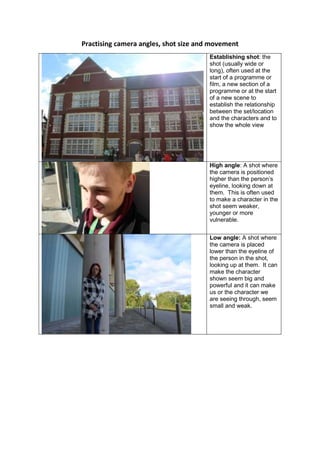
Establishing shot: the
shot (usually wide or
long), often used at the
start of a programme or
film, a new section of a
programme or at the start
of a new scene to
establish the relationship
between the set/location
and the characters and to
show the whole view
High angle: A shot where
the camera is positioned
higher than the person’s
eyeline, looking down at
them. This is often used
to make a character in the
shot seem weaker,
younger or more
vulnerable.
Low angle: A shot where
the camera is placed
lower than the eyeline of
the person in the shot,
looking up at them. It can
make the character
shown seem big and
powerful and it can make
us or the character we
are seeing through, seem
small and weak.
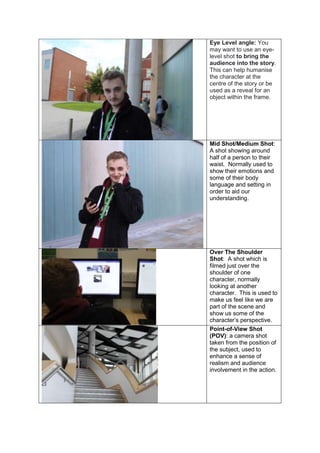
Eye Level angle: You
may want to use an eye-
level shot to bring the
audience into the story.
This can help humanise
the character at the
centre of the story or be
used as a reveal for an
object within the frame.
Mid Shot/Medium Shot:
A shot showing around
half of a person to their
waist. Normally used to
show their emotions and
some of their body
language and setting in
order to aid our
understanding.
Over The Shoulder
Shot: A shot which is
filmed just over the
shoulder of one
character, normally
looking at another
character. This is used to
make us feel like we are
part of the scene and
show us some of the
character’s perspective.
Point-of-View Shot
(POV): a camera shot
taken from the position of
the subject, used to
enhance a sense of
realism and audience
involvement in the action.
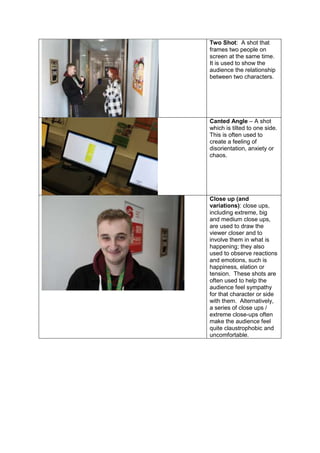
Two Shot: A shot that
frames two people on
screen at the same time.
It is used to show the
audience the relationship
between two characters.
Canted Angle – A shot
which is tilted to one side.
This is often used to
create a feeling of
disorientation, anxiety or
chaos.
Close up (and
variations): close ups,
including extreme, big
and medium close ups,
are used to draw the
viewer closer and to
involve them in what is
happening; they also
used to observe reactions
and emotions, such is
happiness, elation or
tension. These shots are
often used to help the
audience feel sympathy
for that character or side
with them. Alternatively,
a series of close ups /
extreme close-ups often
make the audience feel
quite claustrophobic and
uncomfortable.
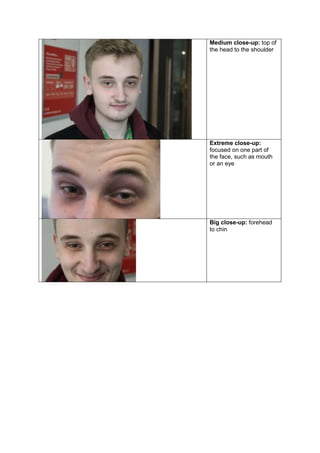
Medium close-up: top of
the head to the shoulder
Extreme close-up:
focused on one part of
the face, such as mouth
or an eye
Big close-up: forehead
to chin

Cinematography (2).docx

  • 1.
    Practising camera angles,shot size and movement Establishing shot: the shot (usually wide or long), often used at the start of a programme or film, a new section of a programme or at the start of a new scene to establish the relationship between the set/location and the characters and to show the whole view High angle: A shot where the camera is positioned higher than the person’s eyeline, looking down at them. This is often used to make a character in the shot seem weaker, younger or more vulnerable. Low angle: A shot where the camera is placed lower than the eyeline of the person in the shot, looking up at them. It can make the character shown seem big and powerful and it can make us or the character we are seeing through, seem small and weak.
  • 2.
    Eye Level angle:You may want to use an eye- level shot to bring the audience into the story. This can help humanise the character at the centre of the story or be used as a reveal for an object within the frame. Mid Shot/Medium Shot: A shot showing around half of a person to their waist. Normally used to show their emotions and some of their body language and setting in order to aid our understanding. Over The Shoulder Shot: A shot which is filmed just over the shoulder of one character, normally looking at another character. This is used to make us feel like we are part of the scene and show us some of the character’s perspective. Point-of-View Shot (POV): a camera shot taken from the position of the subject, used to enhance a sense of realism and audience involvement in the action.
  • 3.
    Two Shot: Ashot that frames two people on screen at the same time. It is used to show the audience the relationship between two characters. Canted Angle – A shot which is tilted to one side. This is often used to create a feeling of disorientation, anxiety or chaos. Close up (and variations): close ups, including extreme, big and medium close ups, are used to draw the viewer closer and to involve them in what is happening; they also used to observe reactions and emotions, such is happiness, elation or tension. These shots are often used to help the audience feel sympathy for that character or side with them. Alternatively, a series of close ups / extreme close-ups often make the audience feel quite claustrophobic and uncomfortable.
  • 4.
    Medium close-up: topof the head to the shoulder Extreme close-up: focused on one part of the face, such as mouth or an eye Big close-up: forehead to chin