Submitted by:
Rajani Manjunath Bhat
UHS20PGD399
1st Ph.D. PSMAC
COH, Bengaluru
Scientific name: Myristica fragrance Stout
Family: Myristicaceae
Chromosome number: 2n=42
Tree spice crop
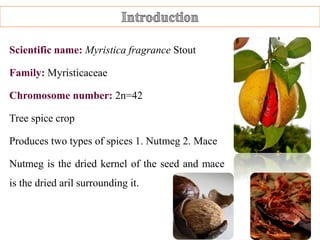
Produces two types of spices 1. Nutmeg 2. Mace
Nutmeg is the dried kernel of the seed and mace
is the dried aril surrounding it.
Uses:
 These spices are used as spice, in confectioneries, culinary and
pharmaceutical industries.
 Nutmeg yield 7-16% of oil
 Aril yield 4-15% of oil
 Used for flavouring food products and liquors, cosmetics,
pharmaceuticals.
 Value added products
Nutmeg butter 25-40%, oleoresin 10-13%, essential oil
Pericarp is used for making jam, jellies and pickles
Origin and distribution:
 Nutmeg is indigenous to Moluccas island (Indonesia).
 This spices of genus Myristica are distributed from India and South East
Asia to north Australia and the specific island. Nearly 120 species are
identified out of which 72 species are distributed in these areas.
 Major nutmeg growing countries are Indonesia (>60% of world
production) and Grenada (west indies). Small scale in Sri Lanka, India,
China, Malaysia, western Sumatra, Zangiber, Mauritius and Salomon
islands.
 In India, nutmeg is mainly cultivated in Kerala, parts of Kanyakumari
and Tirunelveli district of T.N and in Uttara Kannada, Dakshin Kannada,
Chikkamagalur and Shivamogga district of Karnataka.
Botany and flowering:
 Nutmeg is spreading
evergreen tree, 4-10 m
height, sometimes 20 m.
 Flowers are dioecious but
sometimes male and female
flowers are formed on the
same tree.
 Occasionally hermaphrodite
flowers are seen.
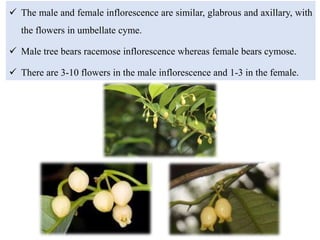
 The male and female inflorescence are similar, glabrous and axillary, with
the flowers in umbellate cyme.
 Male tree bears racemose inflorescence whereas female bears cymose.
 There are 3-10 flowers in the male inflorescence and 1-3 in the female.
 The calyx is bell-shaped with 3 reflexed triangular lobes and
petals are absent.
 8-12 stamens, anther adnate.
 Females are sessile, one celled ovary, two lipped stigma.
 Male flowers take 80 days flower bud to anthesis, where in
female flowers takes 148 days.
Fruit - fleshy drupe.
Institute working on crop improvement
1. IISR, Kozhikode
2. Dr. Bala Saheb Sawant Konkan Krishi Vidyapeeth, Dapoli
3. Regional Fruit Research Station, Vengurla
 Nutmeg is an obligatory cross-pollinated crop. The variation
observed in the crop is considerable especially in fruit number
and weight, seed + mace weight, seed weight and mace weight
beside morphological charecters.
 Good tree yields about 2000 fruits annually, is having the
potential yield of 10000 fruits/tree
 Identification of sex in the initial stage is difficult, however it
can be distinguished based on the shape of the calcium oxalate
crystals in the lower epidermal cells of leaves at 2 year age of
the plant.
 Male plant has single large prismatic crystal shape whereas in
case of female plants large clusters of small crystals.
Germplasm collection
 Myristica frangrance tree do not occur in the wild form.
However wide variability is noticed among the cultivated
types due to its breeding behaviour.
 Germplasm collection survey have been made in nutmeg
growing areas of Kerala, Tamil Nadu and Karnataka.
 IISR maintained 421 germplasm
 357- Indigenous from Karnataka, T.N, Kerala
 9- Related taxa and wild
 357 accession have been collected and maintained
 One seed/fruit and the multi seeded types 2-4 seeded/fruit
 Survey in Western Ghats and Andaman island for related
species of nutmeg. Some of them are M. malabarica,
Gymnacranthera canarica (related genera)
 Wild and related species of Myristica occurring in India and
obtained 12 wild from Nagercoil, Andaman, Western Ghats,
Sri Lanka, Khasia mountains, Assam, Sikkim etc.
1. Varieties yielding more than 2000 fruits per tree or up to 10000 fruits per tree.
High yield >1000 fruit/tree, Medium yield – 500-1000 fruits/tree, Low yield <500
fruits/tree at 15th year.
2. Regular yielding and dwarf stature for easy harvesting and intercultural
operations
3. Suitable to multiple environment/ agroclimatic conditions.
4. It should be more of gynoceous types and less segregation, more of female trees
5. Bold fruit with higher nut and mace weight.
6. High dry recovery of mace and nut
7. Resistance to biotic and abiotic stresses like thread blight, fruit rot, die back, shot
hole borer, drought and suitable for open condition, water logged conditions
 It is reported that the ratio of seed weight and mace weight, showed higher
heritability and genetic advance.
Breeding objectives:
Breeding methods
1. Introduction and selection
2. Clonal selection
3. Hybridization
Breeding methods:
• Introduction, selection and multiply vegetatively.
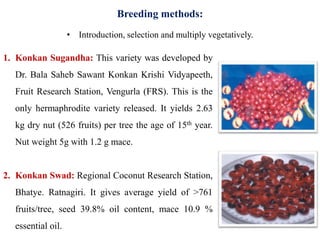
1. Konkan Sugandha: This variety was developed by
Dr. Bala Saheb Sawant Konkan Krishi Vidyapeeth,
Fruit Research Station, Vengurla (FRS). This is the
only hermaphrodite variety released. It yields 2.63
kg dry nut (526 fruits) per tree the age of 15th year.
Nut weight 5g with 1.2 g mace.
2. Konkan Swad: Regional Coconut Research Station,
Bhatye. Ratnagiri. It gives average yield of >761
fruits/tree, seed 39.8% oil content, mace 10.9 %
essential oil.
Essential oil Oleoresin Butter Yield/ ha
Nut 7.25 2.5 30.90 3122
Mace 7.1 13.8 - 480
 High yielding, high quality variety.
 Bushy and compact plant type.
Selection from IISR, Kozhikode.
 Average yield 3122 kg/ha (dry) and
480 kg mace (dry) per ha
 Nut -7.25% oil, 2.5% oleoresin,
butter 30.9%,
 mace- 7.1% oil, 13.8% oleoresin.
 Relatively free from diseases and
low incidence of fruit rot caused by
Diploduia spp.
 One male graft to be planted for
every 10-female graft. 360
plants/ha- 4.5 m X 4.5 m
IISR Viswashree:
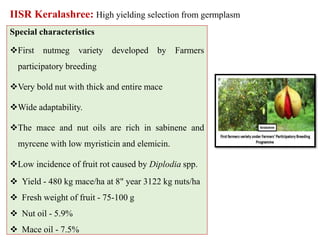
IISR Keralashree: High yielding selection from germplasm
Special characteristics
First nutmeg variety developed by Farmers
participatory breeding
Very bold nut with thick and entire mace
Wide adaptability.
The mace and nut oils are rich in sabinene and
myrcene with low myristicin and elemicin.
Low incidence of fruit rot caused by Diplodia spp.
 Yield - 480 kg mace/ha at 8" year 3122 kg nuts/ha
 Fresh weight of fruit - 75-100 g
 Nut oil - 5.9%
 Mace oil - 7.5%
Konkan shrimanti…
Single plant selection; developed at Dr. BSKKV, Dapoli, 2005.
Bold nuts, thick mace and high yield
Plant Characters Value
Length of fruit (cm) 7.4
Breadth of fruit (cm) 5.2
Weight of fruit (g) 71.40
Fresh nut weight (g) 14
Dry nut weight (g) 10.20
Fresh mace weight (g) 5.0
Dry mace weight(g) 2.10
Nut oil % 39.85
Ma oil % 26.70
Average no. of fruit/Tree/year 900
Plant type (sex Form) Female
Canopy volume (m3) 117.71
No of fruits / cu.m volume 7.64
Yield kg/plant nut 9.18
Description of Variety Distinguishing Character
Plant type (Sex form) Monoecious
Days required for fruit maturity 270 days
Harvesting period June November
Average yield 500 nuts/ Plant
Length of fruit 6.7 cm.
Breadth of fruit 5.2 cm
Weight of fruit 75.70 g
Length of nut 3.8 cm
Fresh nut weight 14.22 g.
Dry nut weight 9.20 g.
Fresh mace weight 3.90 g.
Dry mace weight 1.07 g
Nut oil 27%
Mace oil 17.75%
Nut yield/plant 4.60 kg
Konkan sanyukta
 Ten nutmeg accessions viz., A11/29, A11/70, A9/20, A9/22, A9/25,
A9/79, A9/86, A4/12, A4/22 and A4/52 accessions with high fruit
set were identified as promising types from IISR Calicut
germplasm conservatory.
 Four seeds per fruit in one of the valuable accession of the
germplasm. This germplasm can be used in future breeding
programmes to increase the yield of the nuts. Among 100
accessions studied for sex segregation, a ratio of 40:45:5 was
observed for male, female and bisexual types respectively.
 Analysis of genetic variability in nutmeg progeny population,
derived from 16 mother trees collected from Kerala and Tamil Nadu
revealed lack of genetic variability in characters like canopy shape,
number of erect shoots, girth of main trunk, number of fruits per
tree. The ratio of seed weight and mace weight showed high
heritability and genetic advance. Hence, selection for this trait has to
be given importance in selection programs.
 Weight of fresh nutmeg and aril, pericarp weight, total fruit weight,
weight of dried nutmeg and aril showed positive and significant
correlation with yield. These characters are controlled by additive
gene.
Difficulties in crop improvement of nutmeg
 Long juvenile phase (7-8 years)
 Difficulties in vegetative propagation
 Dioeciousness
 Single ovule in female flowers.
NUTMEG BREEDING.pptx

NUTMEG BREEDING.pptx

  • 1.
    Submitted by: Rajani ManjunathBhat UHS20PGD399 1st Ph.D. PSMAC COH, Bengaluru
  • 2.
    Scientific name: Myristicafragrance Stout Family: Myristicaceae Chromosome number: 2n=42 Tree spice crop Produces two types of spices 1. Nutmeg 2. Mace Nutmeg is the dried kernel of the seed and mace is the dried aril surrounding it.
  • 3.
    Uses:  These spicesare used as spice, in confectioneries, culinary and pharmaceutical industries.  Nutmeg yield 7-16% of oil  Aril yield 4-15% of oil  Used for flavouring food products and liquors, cosmetics, pharmaceuticals.  Value added products Nutmeg butter 25-40%, oleoresin 10-13%, essential oil Pericarp is used for making jam, jellies and pickles
  • 4.
    Origin and distribution: Nutmeg is indigenous to Moluccas island (Indonesia).  This spices of genus Myristica are distributed from India and South East Asia to north Australia and the specific island. Nearly 120 species are identified out of which 72 species are distributed in these areas.  Major nutmeg growing countries are Indonesia (>60% of world production) and Grenada (west indies). Small scale in Sri Lanka, India, China, Malaysia, western Sumatra, Zangiber, Mauritius and Salomon islands.  In India, nutmeg is mainly cultivated in Kerala, parts of Kanyakumari and Tirunelveli district of T.N and in Uttara Kannada, Dakshin Kannada, Chikkamagalur and Shivamogga district of Karnataka.
  • 5.
    Botany and flowering: Nutmeg is spreading evergreen tree, 4-10 m height, sometimes 20 m.  Flowers are dioecious but sometimes male and female flowers are formed on the same tree.  Occasionally hermaphrodite flowers are seen.
  • 6.
     The maleand female inflorescence are similar, glabrous and axillary, with the flowers in umbellate cyme.  Male tree bears racemose inflorescence whereas female bears cymose.  There are 3-10 flowers in the male inflorescence and 1-3 in the female.
  • 7.
     The calyxis bell-shaped with 3 reflexed triangular lobes and petals are absent.  8-12 stamens, anther adnate.  Females are sessile, one celled ovary, two lipped stigma.  Male flowers take 80 days flower bud to anthesis, where in female flowers takes 148 days.
  • 8.
  • 9.
    Institute working oncrop improvement 1. IISR, Kozhikode 2. Dr. Bala Saheb Sawant Konkan Krishi Vidyapeeth, Dapoli 3. Regional Fruit Research Station, Vengurla  Nutmeg is an obligatory cross-pollinated crop. The variation observed in the crop is considerable especially in fruit number and weight, seed + mace weight, seed weight and mace weight beside morphological charecters.  Good tree yields about 2000 fruits annually, is having the potential yield of 10000 fruits/tree
  • 10.
     Identification ofsex in the initial stage is difficult, however it can be distinguished based on the shape of the calcium oxalate crystals in the lower epidermal cells of leaves at 2 year age of the plant.  Male plant has single large prismatic crystal shape whereas in case of female plants large clusters of small crystals.
  • 11.
    Germplasm collection  Myristicafrangrance tree do not occur in the wild form. However wide variability is noticed among the cultivated types due to its breeding behaviour.  Germplasm collection survey have been made in nutmeg growing areas of Kerala, Tamil Nadu and Karnataka.  IISR maintained 421 germplasm  357- Indigenous from Karnataka, T.N, Kerala  9- Related taxa and wild  357 accession have been collected and maintained
  • 12.
     One seed/fruitand the multi seeded types 2-4 seeded/fruit  Survey in Western Ghats and Andaman island for related species of nutmeg. Some of them are M. malabarica, Gymnacranthera canarica (related genera)  Wild and related species of Myristica occurring in India and obtained 12 wild from Nagercoil, Andaman, Western Ghats, Sri Lanka, Khasia mountains, Assam, Sikkim etc.
  • 13.
    1. Varieties yieldingmore than 2000 fruits per tree or up to 10000 fruits per tree. High yield >1000 fruit/tree, Medium yield – 500-1000 fruits/tree, Low yield <500 fruits/tree at 15th year. 2. Regular yielding and dwarf stature for easy harvesting and intercultural operations 3. Suitable to multiple environment/ agroclimatic conditions. 4. It should be more of gynoceous types and less segregation, more of female trees 5. Bold fruit with higher nut and mace weight. 6. High dry recovery of mace and nut 7. Resistance to biotic and abiotic stresses like thread blight, fruit rot, die back, shot hole borer, drought and suitable for open condition, water logged conditions  It is reported that the ratio of seed weight and mace weight, showed higher heritability and genetic advance. Breeding objectives:
  • 14.
    Breeding methods 1. Introductionand selection 2. Clonal selection 3. Hybridization
  • 15.
    Breeding methods: • Introduction,selection and multiply vegetatively. 1. Konkan Sugandha: This variety was developed by Dr. Bala Saheb Sawant Konkan Krishi Vidyapeeth, Fruit Research Station, Vengurla (FRS). This is the only hermaphrodite variety released. It yields 2.63 kg dry nut (526 fruits) per tree the age of 15th year. Nut weight 5g with 1.2 g mace. 2. Konkan Swad: Regional Coconut Research Station, Bhatye. Ratnagiri. It gives average yield of >761 fruits/tree, seed 39.8% oil content, mace 10.9 % essential oil.
  • 16.
    Essential oil OleoresinButter Yield/ ha Nut 7.25 2.5 30.90 3122 Mace 7.1 13.8 - 480  High yielding, high quality variety.  Bushy and compact plant type. Selection from IISR, Kozhikode.  Average yield 3122 kg/ha (dry) and 480 kg mace (dry) per ha  Nut -7.25% oil, 2.5% oleoresin, butter 30.9%,  mace- 7.1% oil, 13.8% oleoresin.  Relatively free from diseases and low incidence of fruit rot caused by Diploduia spp.  One male graft to be planted for every 10-female graft. 360 plants/ha- 4.5 m X 4.5 m IISR Viswashree:
  • 17.
    IISR Keralashree: Highyielding selection from germplasm Special characteristics First nutmeg variety developed by Farmers participatory breeding Very bold nut with thick and entire mace Wide adaptability. The mace and nut oils are rich in sabinene and myrcene with low myristicin and elemicin. Low incidence of fruit rot caused by Diplodia spp.  Yield - 480 kg mace/ha at 8" year 3122 kg nuts/ha  Fresh weight of fruit - 75-100 g  Nut oil - 5.9%  Mace oil - 7.5%
  • 18.
    Konkan shrimanti… Single plantselection; developed at Dr. BSKKV, Dapoli, 2005. Bold nuts, thick mace and high yield Plant Characters Value Length of fruit (cm) 7.4 Breadth of fruit (cm) 5.2 Weight of fruit (g) 71.40 Fresh nut weight (g) 14 Dry nut weight (g) 10.20 Fresh mace weight (g) 5.0 Dry mace weight(g) 2.10 Nut oil % 39.85 Ma oil % 26.70 Average no. of fruit/Tree/year 900 Plant type (sex Form) Female Canopy volume (m3) 117.71 No of fruits / cu.m volume 7.64 Yield kg/plant nut 9.18
  • 19.
    Description of VarietyDistinguishing Character Plant type (Sex form) Monoecious Days required for fruit maturity 270 days Harvesting period June November Average yield 500 nuts/ Plant Length of fruit 6.7 cm. Breadth of fruit 5.2 cm Weight of fruit 75.70 g Length of nut 3.8 cm Fresh nut weight 14.22 g. Dry nut weight 9.20 g. Fresh mace weight 3.90 g. Dry mace weight 1.07 g Nut oil 27% Mace oil 17.75% Nut yield/plant 4.60 kg Konkan sanyukta
  • 20.
     Ten nutmegaccessions viz., A11/29, A11/70, A9/20, A9/22, A9/25, A9/79, A9/86, A4/12, A4/22 and A4/52 accessions with high fruit set were identified as promising types from IISR Calicut germplasm conservatory.  Four seeds per fruit in one of the valuable accession of the germplasm. This germplasm can be used in future breeding programmes to increase the yield of the nuts. Among 100 accessions studied for sex segregation, a ratio of 40:45:5 was observed for male, female and bisexual types respectively.
  • 21.
     Analysis ofgenetic variability in nutmeg progeny population, derived from 16 mother trees collected from Kerala and Tamil Nadu revealed lack of genetic variability in characters like canopy shape, number of erect shoots, girth of main trunk, number of fruits per tree. The ratio of seed weight and mace weight showed high heritability and genetic advance. Hence, selection for this trait has to be given importance in selection programs.  Weight of fresh nutmeg and aril, pericarp weight, total fruit weight, weight of dried nutmeg and aril showed positive and significant correlation with yield. These characters are controlled by additive gene.
  • 22.
    Difficulties in cropimprovement of nutmeg  Long juvenile phase (7-8 years)  Difficulties in vegetative propagation  Dioeciousness  Single ovule in female flowers.