PRESENTED BY :-
SAMRIDDHA SHIL
MECHANICAL ENGINEER
GARGI MEMORIAL INSTITUTE
OF TECHNOLOGY
PRESENTATION ON :
TURBINE
INDEX
1.INTRODUCTION
2.TURBINE
3.THEORIES OF OPERATIONS OF TURBINES
4.CLASSIFICATIONS OF TURBINES
5.STEAM TURBINE
1.INTRODUCTION:-
The device in which the kinetic ,potential or
intermolecular energy held by the fluid is
converted in the form of mechanical energy
of a rotating member is known as a turbine .
Also , defined as all machines in which hydraulic energy
is transferred into mechanical energy (in the form of
rotating shaft ) ,or in some other moving parts are
known as ‘turbines’ or hydraulic motors.
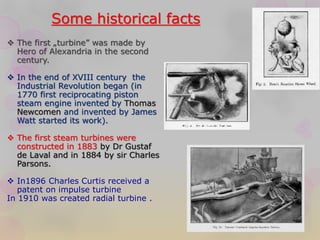
 The first „turbine” was made by
Hero of Alexandria in the second
century.
 In the end of XVIII century the
Industrial Revolution began (in
1770 first reciprocating piston
steam engine invented by Thomas
Newcomen and invented by James
Watt started its work).
 The first steam turbines were
constructed in 1883 by Dr Gustaf
de Laval and in 1884 by sir Charles
Parsons.
 In1896 Charles Curtis received a
patent on impulse turbine
In 1910 was created radial turbine .
Some historical facts
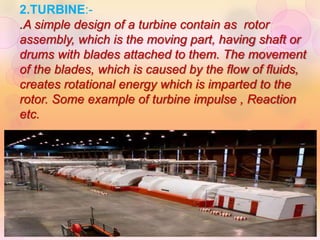
2.TURBINE:-
.A simple design of a turbine contain as rotor
assembly, which is the moving part, having shaft or
drums with blades attached to them. The movement
of the blades, which is caused by the flow of fluids,
creates rotational energy which is imparted to the
rotor. Some example of turbine impulse , Reaction
etc.
2.Theories of operations of turbines
A flowing or working fluid contains kinetic as well as
potential energy and the fluid may be compressible as well as
incompressible. The energy of these fluids is trapped by
turbines in several ways.
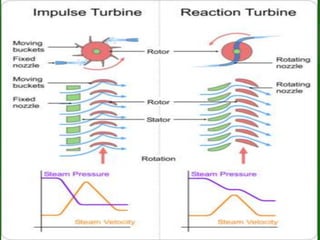
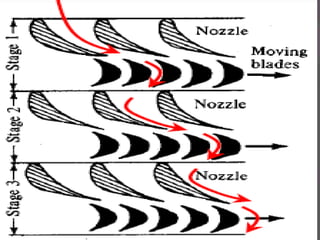
Impulse turbines- The impulse generated by
changing the direction of flow of high velocity fluid
or gas jet is used to spin the turbine. This leaves
the fluid flow with a decreased amount of kinetic
energy. The fluid or gases in the turbine blades
have no pressure change and the entire pressure
drop takes place in the stationery blades. The fluid
is accelerated using a nozzle, which changes its
pressure head to velocity head. This is done before
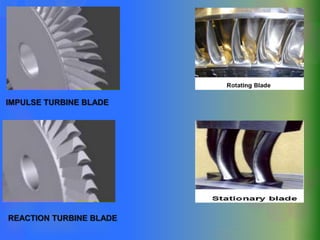
IMPULSE TURBINE BLADE
REACTION TURBINE BLADE
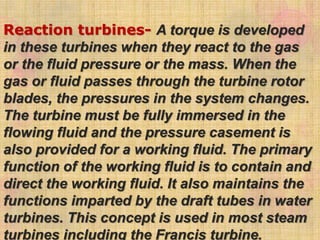
Reaction turbines- A torque is developed
in these turbines when they react to the gas
or the fluid pressure or the mass. When the
gas or fluid passes through the turbine rotor
blades, the pressures in the system changes.
The turbine must be fully immersed in the
flowing fluid and the pressure casement is
also provided for a working fluid. The primary
function of the working fluid is to contain and
direct the working fluid. It also maintains the
functions imparted by the draft tubes in water
turbines. This concept is used in most steam
turbines including the Francis turbine.
CLASSIFICATIONS OF TURBINES:-
1.Steam turbine
2.Gas turbine
3.Transonic turbine
4.Contra Rotating Turbine
5.Ceramic Turbine
6.Shrounded Turbine
7.Bladeless turbine
8.Wind turbine
9.Water Turbine
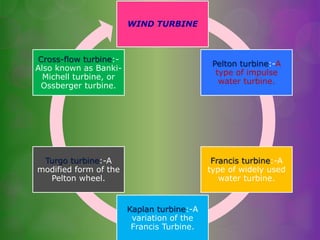
WIND TURBINE
Pelton turbine:-A
type of impulse
water turbine.
Francis turbine:-A
type of widely used
water turbine.
Kaplan turbine:-A
variation of the
Francis Turbine.
Turgo turbine:-A
modified form of the
Pelton wheel.
Cross-flow turbine:-
Also known as Banki-
Michell turbine, or
Ossberger turbine.
STEAM TURBINE:-
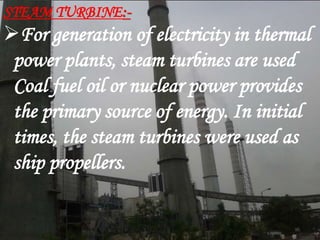
For generation of electricity in thermal
power plants, steam turbines are used
Coal fuel oil or nuclear power provides
the primary source of energy. In initial
times, the steam turbines were used as
ship propellers.
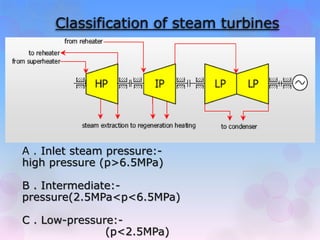
Classification of steam turbines
A . Inlet steam pressure:-
high pressure (p>6.5MPa)
B . Intermediate:-
pressure(2.5MPa<p<6.5MPa)
C . Low-pressure:-
(p<2.5MPa)
Advantages of turbines
 Large power achieved by relatively small size
 High efficiency
 Simple design
 High revolution
Turbine.....Samriddha Shil.....S@S

Turbine.....Samriddha Shil.....S@S

  • 1.
    PRESENTED BY :- SAMRIDDHASHIL MECHANICAL ENGINEER GARGI MEMORIAL INSTITUTE OF TECHNOLOGY PRESENTATION ON : TURBINE
  • 2.
    INDEX 1.INTRODUCTION 2.TURBINE 3.THEORIES OF OPERATIONSOF TURBINES 4.CLASSIFICATIONS OF TURBINES 5.STEAM TURBINE
  • 3.
    1.INTRODUCTION:- The device inwhich the kinetic ,potential or intermolecular energy held by the fluid is converted in the form of mechanical energy of a rotating member is known as a turbine . Also , defined as all machines in which hydraulic energy is transferred into mechanical energy (in the form of rotating shaft ) ,or in some other moving parts are known as ‘turbines’ or hydraulic motors.
  • 4.
     The first„turbine” was made by Hero of Alexandria in the second century.  In the end of XVIII century the Industrial Revolution began (in 1770 first reciprocating piston steam engine invented by Thomas Newcomen and invented by James Watt started its work).  The first steam turbines were constructed in 1883 by Dr Gustaf de Laval and in 1884 by sir Charles Parsons.  In1896 Charles Curtis received a patent on impulse turbine In 1910 was created radial turbine . Some historical facts
  • 5.
    2.TURBINE:- .A simple designof a turbine contain as rotor assembly, which is the moving part, having shaft or drums with blades attached to them. The movement of the blades, which is caused by the flow of fluids, creates rotational energy which is imparted to the rotor. Some example of turbine impulse , Reaction etc.
  • 6.
    2.Theories of operationsof turbines A flowing or working fluid contains kinetic as well as potential energy and the fluid may be compressible as well as incompressible. The energy of these fluids is trapped by turbines in several ways. Impulse turbines- The impulse generated by changing the direction of flow of high velocity fluid or gas jet is used to spin the turbine. This leaves the fluid flow with a decreased amount of kinetic energy. The fluid or gases in the turbine blades have no pressure change and the entire pressure drop takes place in the stationery blades. The fluid is accelerated using a nozzle, which changes its pressure head to velocity head. This is done before
  • 7.
  • 9.
    Reaction turbines- Atorque is developed in these turbines when they react to the gas or the fluid pressure or the mass. When the gas or fluid passes through the turbine rotor blades, the pressures in the system changes. The turbine must be fully immersed in the flowing fluid and the pressure casement is also provided for a working fluid. The primary function of the working fluid is to contain and direct the working fluid. It also maintains the functions imparted by the draft tubes in water turbines. This concept is used in most steam turbines including the Francis turbine.
  • 11.
    CLASSIFICATIONS OF TURBINES:- 1.Steamturbine 2.Gas turbine 3.Transonic turbine 4.Contra Rotating Turbine 5.Ceramic Turbine 6.Shrounded Turbine 7.Bladeless turbine 8.Wind turbine 9.Water Turbine
  • 12.
    WIND TURBINE Pelton turbine:-A typeof impulse water turbine. Francis turbine:-A type of widely used water turbine. Kaplan turbine:-A variation of the Francis Turbine. Turgo turbine:-A modified form of the Pelton wheel. Cross-flow turbine:- Also known as Banki- Michell turbine, or Ossberger turbine.
  • 13.
    STEAM TURBINE:- For generationof electricity in thermal power plants, steam turbines are used Coal fuel oil or nuclear power provides the primary source of energy. In initial times, the steam turbines were used as ship propellers.
  • 14.
    Classification of steamturbines A . Inlet steam pressure:- high pressure (p>6.5MPa) B . Intermediate:- pressure(2.5MPa<p<6.5MPa) C . Low-pressure:- (p<2.5MPa)
  • 15.
    Advantages of turbines Large power achieved by relatively small size  High efficiency  Simple design  High revolution