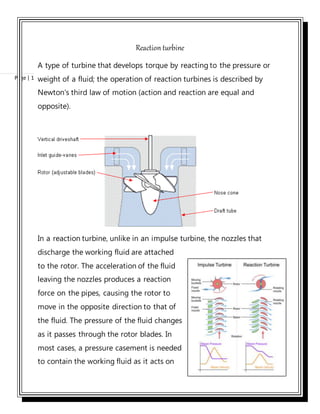
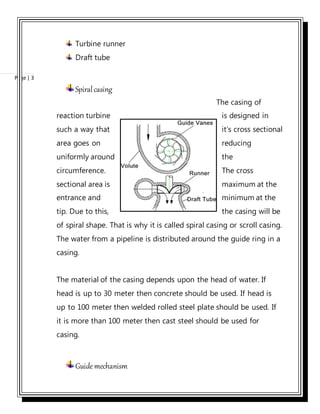
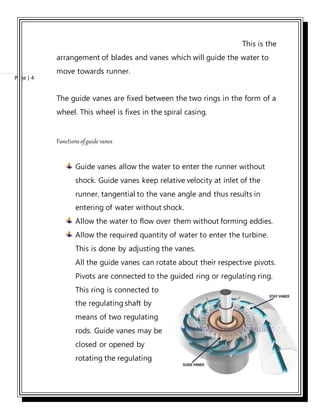
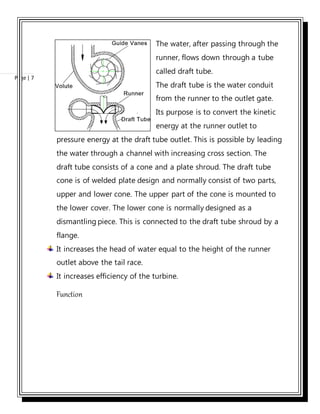
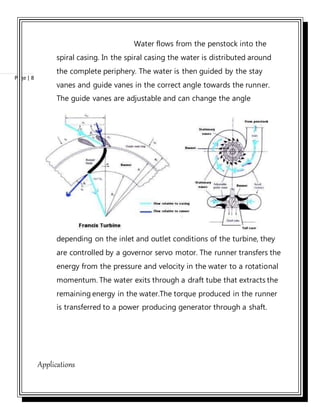
(1) A reaction turbine develops torque through the reaction of fluid pressure on its rotor. As fluid passes through the rotor blades, its pressure changes and a reaction force causes the rotor to turn in the opposite direction. (2) Its key components include a spiral casing to distribute fluid, adjustable guide vanes to direct flow to the rotor, and a draft tube that recovers kinetic energy and increases efficiency. (3) The most common type is the Francis turbine, widely used for its high efficiency over a large range of heads and flows.