Unit No:02
Energy Conversion Devices
Prof. Yash B. Parikh
M.Tech (Computer Integrated Manufacturing)
B.E.(Mechanical Engineering)
Assistant Professor
Department of Mechanical Engineering
2
Preface
3
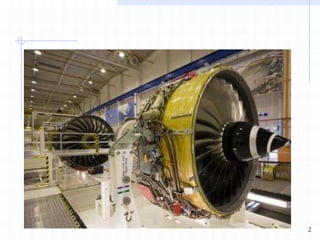
 When you go to an airport and see the commercial
jets there, you can't help but notice the huge engines
that power them.
 Most commercial jets are powered by turbofan
engines, and turbofans are one example of a general
class of engines called gas turbine engines.
 You may have never heard of gas turbine engines,
but they are used in all kinds of unexpected places.
 For example, they are used in many of the
helicopters, smaller power plants and even in the M-1
Tank.
History
4
 The word "turbine" was coined in 1822 by the French
mining engineer Claude Burdin.
 It’s derived from the Latin word turbo, which means
a spinning object.
 During the 18th and 19th centuries, much progress
was made toward extracting the kinetic energy of
flowing water.
 This in turn devised water turbines.
Introduction
5
 Turbines are devices that spin in the presence of a
moving fluid.
 A turbine looks like a large wheel with many small
radiating blades around its rim.
 There are four broad classes of turbine:
water (hydraulic), steam, wind, and gas.
 The most important application of the first three is
the generation of electricity; gas turbines are most
often used in aircraft.
Steam Turbine
6
 Most power plants use coal, natural gas, oil or
a nuclear reactor to create steam.
 A steam turbine is a rotary machine which is
designed to convert the energy of high pressure and
high temperature steam into mechanical power.
 The steam runs through a huge and very carefully
designed multi-stage turbine to spin an output shaft
that drives the plant's generator.
Principle of Operation of Steam Turbine
7
 The high pressure-low velocity steam is first
expanded in a passage (called as a nozzle) which
converts the steam into low pressure-high velocity jet
of steam.
 The resultant high velocity steam is passed over the
curved vanes (or blades).
 Due to this, there is a change in momentum and it
will exert a resultant force on the blades.
 These blades are attached to a disc on a shaft which
is free to rotate.
 The resultant force cause the rotor to rotate, and
thus the power is developed.
Types of Steam Turbine
8
 There are mainly two types of steam turbines :
1. Impulse Turbines
2. Reaction Turbines
Impulse Turbine
9
 These turbines use the principle of impulse.
 In which the stationary nozzles are used to exert a
force on a ring of moving blades.
Impulse Turbine
10
 Impulse turbines convert the kinetic energy of a jet
of water to mechanical energy.
 e.g. Pelton Wheel
Reaction Turbine
11
 Reaction turbines convert potential energy in to
mechanical energy.
 Reaction turbines develop torque by reacting to the
fluid's pressure or mass.
Reaction Turbine
12
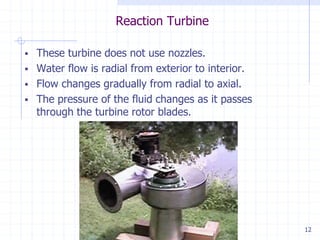
 These turbine does not use nozzles.
 Water flow is radial from exterior to interior.
 Flow changes gradually from radial to axial.
 The pressure of the fluid changes as it passes
through the turbine rotor blades.
Reaction Turbine
13
 The overall efficiency of a reaction turbine is slightly
higher than the equivalent impulse turbine for the
same thermal energy conversion.
 e.g. Kaplan Turbine, Francis Turbine.
Difference between Impulse & Reaction Turbine
14
 In an impulse turbine entire pressure energy is
converted in to kinetic energy (as in case of a pelton
turbine where the nozzle does this).
 In a reaction turbine only a part of the pressure
energy is converted to kinetic energy (as in case of
Francis and Kaplan turbines.)
 Impulse turbine is less efficient compared to reaction
turbine.
 In impulse turbine we get as high as 30,000 rpm
speed of rotor which is very difficult to handle.
 In reaction turbine rotor speeds are relatively low.
 Impulse turbines occupies less space than reaction
turbines.
 Impulse turbines are used for small scale applications
15
Introduction
16
 A gas turbine is an extension of the same concept
as that of steam turbines.
 In a gas turbine, a pressurized gas spins the turbine.
 In all modern gas turbine engines, the engine
produces its own pressurized gas, and it does this by
burning something like propane, natural gas,
kerosene or jet fuel.
 The heat that comes from burning the fuel expands
air, and the high-speed rush of this hot air spins the
turbine.
 Gas turbines are used to produce large quantities of
power in a self contained and compact unit.
 It has got low weight to power ratio than that of
I.C.Engines.
Introduction
17
 Wind turbines, also known as wind mills, use the
wind as their motive force.
 A wind turbine looks nothing like a steam turbine or a
water turbine because wind is slow moving and very
light, but again, the principle is the same.

Energy conversion devices 01-02

  • 1.
    Unit No:02 Energy ConversionDevices Prof. Yash B. Parikh M.Tech (Computer Integrated Manufacturing) B.E.(Mechanical Engineering) Assistant Professor Department of Mechanical Engineering
  • 2.
  • 3.
    Preface 3  When yougo to an airport and see the commercial jets there, you can't help but notice the huge engines that power them.  Most commercial jets are powered by turbofan engines, and turbofans are one example of a general class of engines called gas turbine engines.  You may have never heard of gas turbine engines, but they are used in all kinds of unexpected places.  For example, they are used in many of the helicopters, smaller power plants and even in the M-1 Tank.
  • 4.
    History 4  The word"turbine" was coined in 1822 by the French mining engineer Claude Burdin.  It’s derived from the Latin word turbo, which means a spinning object.  During the 18th and 19th centuries, much progress was made toward extracting the kinetic energy of flowing water.  This in turn devised water turbines.
  • 5.
    Introduction 5  Turbines aredevices that spin in the presence of a moving fluid.  A turbine looks like a large wheel with many small radiating blades around its rim.  There are four broad classes of turbine: water (hydraulic), steam, wind, and gas.  The most important application of the first three is the generation of electricity; gas turbines are most often used in aircraft.
  • 6.
    Steam Turbine 6  Mostpower plants use coal, natural gas, oil or a nuclear reactor to create steam.  A steam turbine is a rotary machine which is designed to convert the energy of high pressure and high temperature steam into mechanical power.  The steam runs through a huge and very carefully designed multi-stage turbine to spin an output shaft that drives the plant's generator.
  • 7.
    Principle of Operationof Steam Turbine 7  The high pressure-low velocity steam is first expanded in a passage (called as a nozzle) which converts the steam into low pressure-high velocity jet of steam.  The resultant high velocity steam is passed over the curved vanes (or blades).  Due to this, there is a change in momentum and it will exert a resultant force on the blades.  These blades are attached to a disc on a shaft which is free to rotate.  The resultant force cause the rotor to rotate, and thus the power is developed.
  • 8.
    Types of SteamTurbine 8  There are mainly two types of steam turbines : 1. Impulse Turbines 2. Reaction Turbines
  • 9.
    Impulse Turbine 9  Theseturbines use the principle of impulse.  In which the stationary nozzles are used to exert a force on a ring of moving blades.
  • 10.
    Impulse Turbine 10  Impulseturbines convert the kinetic energy of a jet of water to mechanical energy.  e.g. Pelton Wheel
  • 11.
    Reaction Turbine 11  Reactionturbines convert potential energy in to mechanical energy.  Reaction turbines develop torque by reacting to the fluid's pressure or mass.
  • 12.
    Reaction Turbine 12  Theseturbine does not use nozzles.  Water flow is radial from exterior to interior.  Flow changes gradually from radial to axial.  The pressure of the fluid changes as it passes through the turbine rotor blades.
  • 13.
    Reaction Turbine 13  Theoverall efficiency of a reaction turbine is slightly higher than the equivalent impulse turbine for the same thermal energy conversion.  e.g. Kaplan Turbine, Francis Turbine.
  • 14.
    Difference between Impulse& Reaction Turbine 14  In an impulse turbine entire pressure energy is converted in to kinetic energy (as in case of a pelton turbine where the nozzle does this).  In a reaction turbine only a part of the pressure energy is converted to kinetic energy (as in case of Francis and Kaplan turbines.)  Impulse turbine is less efficient compared to reaction turbine.  In impulse turbine we get as high as 30,000 rpm speed of rotor which is very difficult to handle.  In reaction turbine rotor speeds are relatively low.  Impulse turbines occupies less space than reaction turbines.  Impulse turbines are used for small scale applications
  • 15.
  • 16.
    Introduction 16  A gasturbine is an extension of the same concept as that of steam turbines.  In a gas turbine, a pressurized gas spins the turbine.  In all modern gas turbine engines, the engine produces its own pressurized gas, and it does this by burning something like propane, natural gas, kerosene or jet fuel.  The heat that comes from burning the fuel expands air, and the high-speed rush of this hot air spins the turbine.  Gas turbines are used to produce large quantities of power in a self contained and compact unit.  It has got low weight to power ratio than that of I.C.Engines.
  • 17.
    Introduction 17  Wind turbines,also known as wind mills, use the wind as their motive force.  A wind turbine looks nothing like a steam turbine or a water turbine because wind is slow moving and very light, but again, the principle is the same.