Tuberculosis
Tuberculosis is a chronic infectious
disease caused by Mycobacterium
tuberculosis.
Tuberculosis is widely prevalent
throughout the world with nearly
1,70,000 children dying of it every
year
Contd…
Contd..
Contd….
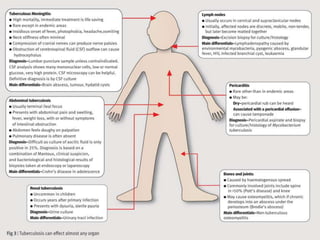
 The disease primarily affect
lungs.
 It can also affect intestine,
meninges, bones and joints, lymph
glands, skin and other tissues of
the body
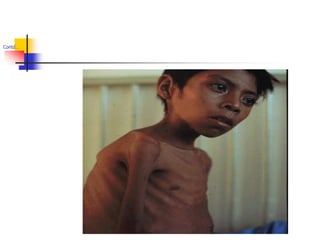
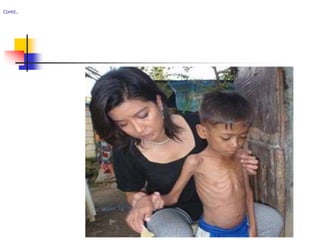
 Young and malnourished children
are more vulnerable to this
disease
Transmission:
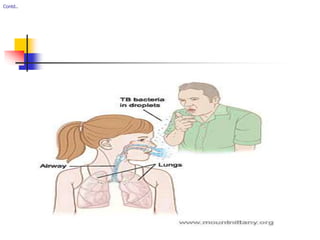
 The usual mode of infection
transmission is through inhalation of
droplets of infected secretions
 The infected sputum spitted carelessly
by cases of TB dries up and the
tubercle bacilli are resuspended in the
dust and air
 This may be a source of infection
through breathing
Contd..
 Infection through ingestion of infected
materials is rare
 Rarely infection may be transmitted
through skin, mucous membrane or
transplacentally
Contd..
Contd…
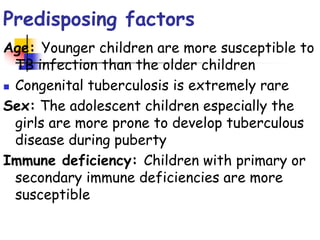
Predisposing factors
Age: Younger children are more susceptible to
TB infection than the older children
 Congenital tuberculosis is extremely rare
Sex: The adolescent children especially the
girls are more prone to develop tuberculous
disease during puberty
Immune deficiency: Children with primary or
secondary immune deficiencies are more
susceptible
Contd…
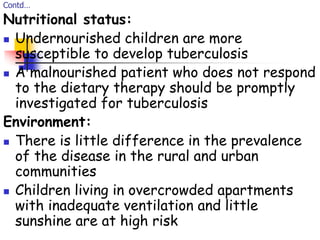
Nutritional status:
 Undernourished children are more
susceptible to develop tuberculosis
 A malnourished patient who does not respond
to the dietary therapy should be promptly
investigated for tuberculosis
Environment:
 There is little difference in the prevalence
of the disease in the rural and urban
communities
 Children living in overcrowded apartments
with inadequate ventilation and little
sunshine are at high risk
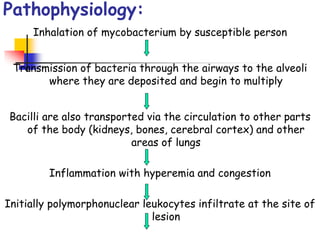
Pathophysiology:
Inhalation of mycobacterium by susceptible person
Transmission of bacteria through the airways to the alveoli
where they are deposited and begin to multiply
Bacilli are also transported via the circulation to other parts
of the body (kidneys, bones, cerebral cortex) and other
areas of lungs
Inflammation with hyperemia and congestion
Initially polymorphonuclear leukocytes infiltrate at the site of
lesion
Contd….
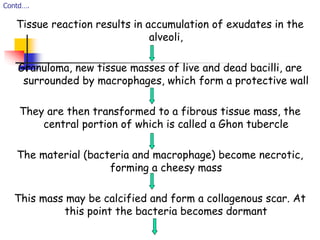
Tissue reaction results in accumulation of exudates in the
alveoli,
Granuloma, new tissue masses of live and dead bacilli, are
surrounded by macrophages, which form a protective wall
They are then transformed to a fibrous tissue mass, the
central portion of which is called a Ghon tubercle
The material (bacteria and macrophage) become necrotic,
forming a cheesy mass
This mass may be calcified and form a collagenous scar. At
this point the bacteria becomes dormant
Contd…
After initial exposure and infection, active disease may
develop because of a compromised or inadequate immune
system response
Active disease also may occur with reinfection and activation
dormant bacteria
When the Ghon tubercle ulcerates releasing cheesy material
into bronchi, the bacteria becomes airborne
Ulcerated tubercle heals and forms scar tissue
Infected lungs become more inflamed
Unless the process is arrested, it spreads slowly downward to
the hilum of lungs and extends to the adjacent lobes
Clinical features:
Incubation period:
 The incubation period varies between 4
and 8 weeks
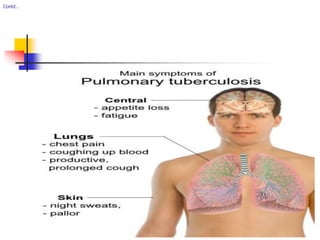
 Gradual onset of fever of unexplained
origin, dyspnoea, coughing, pleural
effusion may present if lungs are
affected
 Loss of interest in play and child is
fatigued easily
Contd…
 Loss of appetite and loss of weight
 Night sweat
 Dry or often productive cough
 Hemoptysis may also occur
 Cyanosis and wheezing may also
occur
Types:
i. Intrathoracic tuberculosis:
Primary infection
 Pulmonary primary complex is formed
 It usually passes of unrecognized
Progressive primary disease
 It is the result of the progression of
primary disease
 Children may present with high grade
fever and cough
Contd…
Miliary tuberculosis:
 It is characterized by heavy
hematogenous spread and progressive
development of innumerable small foci
throughout the body
 Disease is most common in infants and
young children
 Children may have high-grade fever,
which is quite unlike other forms of
tuberculosis
ii. Extrathoracic tuberculosis:
 The most common forms of extrathoracic
disease in children include tuberculosis of
the superficial lymph nodes and the central
nervous system
 Other rare forms of extrathoracic disease
in children include abdominal,
gastrointestinal, genitourinary, cutaneous
etc.
 TB of superficial lymph nodes can be
associated with drinking unpasturized cow’s
milk or extension of primary lesions
Contd…
 Central nervous system disease is the
most serious complication of
tuberculosis in children and arise from
formation of caseous lesion in the
cerebral cortex or meninges
 Infants and young children are likely to
experience a rapid progression to
hydrocephalous, seizures and cerebral
edema.
 TB of abdomen is often due to
hematogenous spread from the lungs
Diagnosis:
 The diagnosis of TB is based on clinical
features, history of contact with adult
patients
 Clinical features may be non-specific
 A history of contact with an infective
case contact is defined as any child who
lives in a household with an adult taking
antitubercular therapy or has taken
such therapy in past 2 years.
Contd…
 Tracing of contact is important not only
for confirming the diagnosis but also
for the protection of other vulnerable
children from the disease
 Symptoms suggestive of TB include
fever for more than weeks, recent loss
of appetite and weight or failure to
thrive
Tuberculin test:
 The tuberculin test is a useful
diagnostic aid. Montoux test and
multiple puncture test are used in this
Contd….
Montoux reaction:
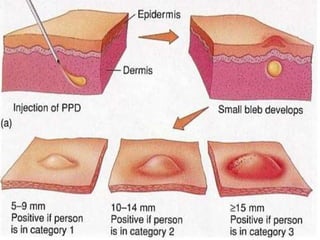
 0.1 mL of a suitable dilution of tuberculin
PPD (purified protein derivative) is injected
intradermal on the forearm
 A weal of 5mm should be raised
 The reaction is read after 48 hours to 72
hours
 Antigen should not be drawn into the
syringe more than one hour before use
 An induration of more than 10mm is
suggestive of infection
Contd…
Laboratory tests:
a. ESR and blood counts have no value in
diagnosis or follow up of TB
b. Demonstration of acid-fast bacilli:
 Most children do not expectorate out
the sputum but swallow it
 Therefore the sputum is not available
for examination
 A laryngeal swab may be obtained for
smear and culture examination for
mycobacteria
contd,…
c. Histopathology: Glands, liver and
other tissues may be examined for
histological evidence of TB by FNAC
d. Radiology: Chest X-ray is usually
sufficient. CT scan of chest is not
routinely required
 Ultrasonography is useful of enlarged
lymph or peritoneal fluid in suspected
abdominal tuberculosis
Causes of false positive and false
negative Mantoux test
False positive results:
 BCG vaccination, infection at the site of test
False negative results:
 Infections- Viral ( measles, mumps, HIV),
Bacterial ( Typhoid, leprosy)
 Metabolic derangements- Chronic renal
failure, severe malnutrition
 Drugs- Corticosteroids, other
immunosuppressive agents
 Age- Newborns, elderly patients
Contd…
 Stress- Surgery, burns, mental illness
 Factors related to the tuberculin used-
Improper storage, improper dilutions,
chemical denaturation
 Factors related to the method of
administration- injection of too little
antigens, subcutaneous injection, delayed
administration after drawing into the
syringe, injection too close to other skin
tests
 Factors related to reading the test and
recording the results- inexperienced reader,
conscious or unconscious bias, error in
recording
Treatment of tuberculosis:
Principle of treatment:
 The diagnosis should be made early
 Treatment should be prompt, adequate,
vigorous and prolonged depending upon
the severity of illness
 All drugs should be given in a single
daily dose on empty stomach
 Pyridoxine (vitamin B6) is not necessary
in children taking isoniazid
Contd…
 Nutrition of the child should be
improved by an appetizing, nutritionally
balanced diet with adequate calories
and protein
 Intercurrent infections should be
prevented or treated vigorously
 Living condition should be improved by
better hygienic measures and improved
sanitation
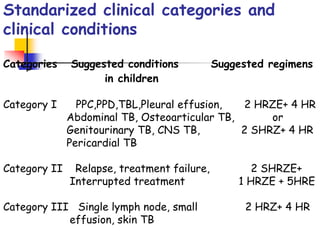
Standarized clinical categories and
clinical conditions
Categories Suggested conditions Suggested regimens
in children
Category I PPC,PPD,TBL,Pleural effusion, 2 HRZE+ 4 HR
Abdominal TB, Osteoarticular TB, or
Genitourinary TB, CNS TB, 2 SHRZ+ 4 HR
Pericardial TB
Category II Relapse, treatment failure, 2 SHRZE+
Interrupted treatment 1 HRZE + 5HRE
Category III Single lymph node, small 2 HRZ+ 4 HR
effusion, skin TB
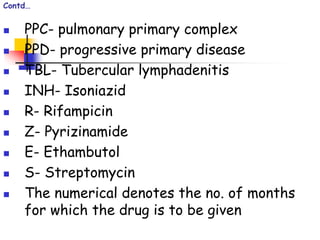
Contd…
 PPC- pulmonary primary complex
 PPD- progressive primary disease
 TBL- Tubercular lymphadenitis
 INH- Isoniazid
 R- Rifampicin
 Z- Pyrizinamide
 E- Ethambutol
 S- Streptomycin
 The numerical denotes the no. of months
for which the drug is to be given
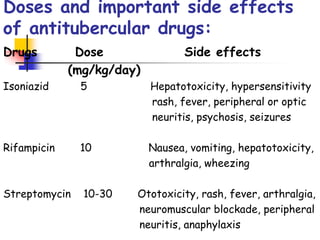
Doses and important side effects
of antitubercular drugs:
Drugs Dose Side effects
(mg/kg/day)
Isoniazid 5 Hepatotoxicity, hypersensitivity
rash, fever, peripheral or optic
neuritis, psychosis, seizures
Rifampicin 10 Nausea, vomiting, hepatotoxicity,
arthralgia, wheezing
Streptomycin 10-30 Ototoxicity, rash, fever, arthralgia,
neuromuscular blockade, peripheral
neuritis, anaphylaxis
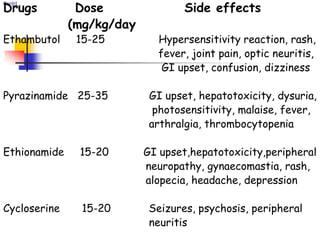
Contd…
Drugs Dose Side effects
(mg/kg/day
Ethambutol 15-25 Hypersensitivity reaction, rash,
fever, joint pain, optic neuritis,
GI upset, confusion, dizziness
Pyrazinamide 25-35 GI upset, hepatotoxicity, dysuria,
photosensitivity, malaise, fever,
arthralgia, thrombocytopenia
Ethionamide 15-20 GI upset,hepatotoxicity,peripheral
neuropathy, gynaecomastia, rash,
alopecia, headache, depression
Cycloserine 15-20 Seizures, psychosis, peripheral
neuritis
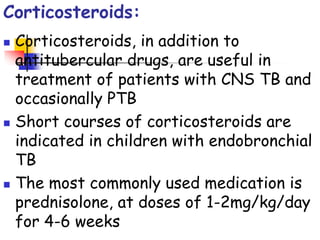
Corticosteroids:
 Corticosteroids, in addition to
antitubercular drugs, are useful in
treatment of patients with CNS TB and
occasionally PTB
 Short courses of corticosteroids are
indicated in children with endobronchial
TB
 The most commonly used medication is
prednisolone, at doses of 1-2mg/kg/day
for 4-6 weeks
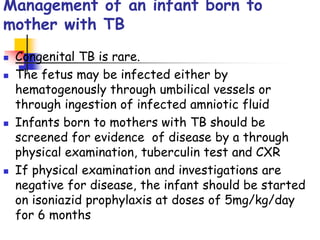
Management of an infant born to
mother with TB
 Congenital TB is rare.
 The fetus may be infected either by
hematogenously through umbilical vessels or
through ingestion of infected amniotic fluid
 Infants born to mothers with TB should be
screened for evidence of disease by a through
physical examination, tuberculin test and CXR
 If physical examination and investigations are
negative for disease, the infant should be started
on isoniazid prophylaxis at doses of 5mg/kg/day
for 6 months
Contd….
 After 3 months, the patient should be
examined for evidence of infection and a
repeat tuberculin test is done
 If tuberculin test is negative, the infant can
be immunized with BCG and INH can be
stopped
 If tuberculin test is positive, but the infant
is asymptomatic, INH prophylaxis is
continued for another 3 months
 Infants with congenital TB should be treated
with 4 drugs (isoniazid, rifampicin,
pyrizinamide, streptomycin) in the intensive
phase
Contd…
 It is followed by two drugs (isoniazid,
rifampicin) during maintenance phase for
next 4 months
 Intensive phase: (two months) the goal of
this phase is to eliminate the bacterial
overload and prevent the emergence of drug
resistant strains
- At least 3 bactericidal drugs (Rifampicin,
isoniazid, pyrizinamide, streptomycin) are
used during this phase
 Continuation Phase: (four months) At least
two bactericidal drugs are used to continue
and complete the therapy
Management of a child in contact
with an adult with tuberculosis
 Nearly one third of the children (aged less than 5
years) in contact with adult tuberculosis disease
may have evidence of tuberculosis
 The infection is more commonly associated with
younger age, severe malnutrition, absence of BCG
vaccination and exposure to environmental tobacco
smoke
 It is suggested that children below 5 years of age
in contact with adult patient with sputum positive
TB should receive 6 months of isoniazid prophylaxis

Tuberculosis.ppt

  • 1.
    Tuberculosis Tuberculosis is achronic infectious disease caused by Mycobacterium tuberculosis. Tuberculosis is widely prevalent throughout the world with nearly 1,70,000 children dying of it every year
  • 2.
  • 3.
  • 4.
    Contd….  The diseaseprimarily affect lungs.  It can also affect intestine, meninges, bones and joints, lymph glands, skin and other tissues of the body  Young and malnourished children are more vulnerable to this disease
  • 5.
    Transmission:  The usualmode of infection transmission is through inhalation of droplets of infected secretions  The infected sputum spitted carelessly by cases of TB dries up and the tubercle bacilli are resuspended in the dust and air  This may be a source of infection through breathing
  • 6.
    Contd..  Infection throughingestion of infected materials is rare  Rarely infection may be transmitted through skin, mucous membrane or transplacentally
  • 7.
  • 8.
  • 9.
    Predisposing factors Age: Youngerchildren are more susceptible to TB infection than the older children  Congenital tuberculosis is extremely rare Sex: The adolescent children especially the girls are more prone to develop tuberculous disease during puberty Immune deficiency: Children with primary or secondary immune deficiencies are more susceptible
  • 10.
    Contd… Nutritional status:  Undernourishedchildren are more susceptible to develop tuberculosis  A malnourished patient who does not respond to the dietary therapy should be promptly investigated for tuberculosis Environment:  There is little difference in the prevalence of the disease in the rural and urban communities  Children living in overcrowded apartments with inadequate ventilation and little sunshine are at high risk
  • 11.
    Pathophysiology: Inhalation of mycobacteriumby susceptible person Transmission of bacteria through the airways to the alveoli where they are deposited and begin to multiply Bacilli are also transported via the circulation to other parts of the body (kidneys, bones, cerebral cortex) and other areas of lungs Inflammation with hyperemia and congestion Initially polymorphonuclear leukocytes infiltrate at the site of lesion
  • 12.
    Contd…. Tissue reaction resultsin accumulation of exudates in the alveoli, Granuloma, new tissue masses of live and dead bacilli, are surrounded by macrophages, which form a protective wall They are then transformed to a fibrous tissue mass, the central portion of which is called a Ghon tubercle The material (bacteria and macrophage) become necrotic, forming a cheesy mass This mass may be calcified and form a collagenous scar. At this point the bacteria becomes dormant
  • 13.
    Contd… After initial exposureand infection, active disease may develop because of a compromised or inadequate immune system response Active disease also may occur with reinfection and activation dormant bacteria When the Ghon tubercle ulcerates releasing cheesy material into bronchi, the bacteria becomes airborne Ulcerated tubercle heals and forms scar tissue Infected lungs become more inflamed Unless the process is arrested, it spreads slowly downward to the hilum of lungs and extends to the adjacent lobes
  • 14.
    Clinical features: Incubation period: The incubation period varies between 4 and 8 weeks  Gradual onset of fever of unexplained origin, dyspnoea, coughing, pleural effusion may present if lungs are affected  Loss of interest in play and child is fatigued easily
  • 15.
    Contd…  Loss ofappetite and loss of weight  Night sweat  Dry or often productive cough  Hemoptysis may also occur  Cyanosis and wheezing may also occur
  • 17.
    Types: i. Intrathoracic tuberculosis: Primaryinfection  Pulmonary primary complex is formed  It usually passes of unrecognized Progressive primary disease  It is the result of the progression of primary disease  Children may present with high grade fever and cough
  • 18.
    Contd… Miliary tuberculosis:  Itis characterized by heavy hematogenous spread and progressive development of innumerable small foci throughout the body  Disease is most common in infants and young children  Children may have high-grade fever, which is quite unlike other forms of tuberculosis
  • 19.
    ii. Extrathoracic tuberculosis: The most common forms of extrathoracic disease in children include tuberculosis of the superficial lymph nodes and the central nervous system  Other rare forms of extrathoracic disease in children include abdominal, gastrointestinal, genitourinary, cutaneous etc.  TB of superficial lymph nodes can be associated with drinking unpasturized cow’s milk or extension of primary lesions
  • 20.
    Contd…  Central nervoussystem disease is the most serious complication of tuberculosis in children and arise from formation of caseous lesion in the cerebral cortex or meninges  Infants and young children are likely to experience a rapid progression to hydrocephalous, seizures and cerebral edema.  TB of abdomen is often due to hematogenous spread from the lungs
  • 21.
    Diagnosis:  The diagnosisof TB is based on clinical features, history of contact with adult patients  Clinical features may be non-specific  A history of contact with an infective case contact is defined as any child who lives in a household with an adult taking antitubercular therapy or has taken such therapy in past 2 years.
  • 22.
    Contd…  Tracing ofcontact is important not only for confirming the diagnosis but also for the protection of other vulnerable children from the disease  Symptoms suggestive of TB include fever for more than weeks, recent loss of appetite and weight or failure to thrive Tuberculin test:  The tuberculin test is a useful diagnostic aid. Montoux test and multiple puncture test are used in this
  • 23.
    Contd…. Montoux reaction:  0.1mL of a suitable dilution of tuberculin PPD (purified protein derivative) is injected intradermal on the forearm  A weal of 5mm should be raised  The reaction is read after 48 hours to 72 hours  Antigen should not be drawn into the syringe more than one hour before use  An induration of more than 10mm is suggestive of infection
  • 25.
    Contd… Laboratory tests: a. ESRand blood counts have no value in diagnosis or follow up of TB b. Demonstration of acid-fast bacilli:  Most children do not expectorate out the sputum but swallow it  Therefore the sputum is not available for examination  A laryngeal swab may be obtained for smear and culture examination for mycobacteria
  • 26.
    contd,… c. Histopathology: Glands,liver and other tissues may be examined for histological evidence of TB by FNAC d. Radiology: Chest X-ray is usually sufficient. CT scan of chest is not routinely required  Ultrasonography is useful of enlarged lymph or peritoneal fluid in suspected abdominal tuberculosis
  • 27.
    Causes of falsepositive and false negative Mantoux test False positive results:  BCG vaccination, infection at the site of test False negative results:  Infections- Viral ( measles, mumps, HIV), Bacterial ( Typhoid, leprosy)  Metabolic derangements- Chronic renal failure, severe malnutrition  Drugs- Corticosteroids, other immunosuppressive agents  Age- Newborns, elderly patients
  • 28.
    Contd…  Stress- Surgery,burns, mental illness  Factors related to the tuberculin used- Improper storage, improper dilutions, chemical denaturation  Factors related to the method of administration- injection of too little antigens, subcutaneous injection, delayed administration after drawing into the syringe, injection too close to other skin tests  Factors related to reading the test and recording the results- inexperienced reader, conscious or unconscious bias, error in recording
  • 29.
    Treatment of tuberculosis: Principleof treatment:  The diagnosis should be made early  Treatment should be prompt, adequate, vigorous and prolonged depending upon the severity of illness  All drugs should be given in a single daily dose on empty stomach  Pyridoxine (vitamin B6) is not necessary in children taking isoniazid
  • 30.
    Contd…  Nutrition ofthe child should be improved by an appetizing, nutritionally balanced diet with adequate calories and protein  Intercurrent infections should be prevented or treated vigorously  Living condition should be improved by better hygienic measures and improved sanitation
  • 31.
    Standarized clinical categoriesand clinical conditions Categories Suggested conditions Suggested regimens in children Category I PPC,PPD,TBL,Pleural effusion, 2 HRZE+ 4 HR Abdominal TB, Osteoarticular TB, or Genitourinary TB, CNS TB, 2 SHRZ+ 4 HR Pericardial TB Category II Relapse, treatment failure, 2 SHRZE+ Interrupted treatment 1 HRZE + 5HRE Category III Single lymph node, small 2 HRZ+ 4 HR effusion, skin TB
  • 32.
    Contd…  PPC- pulmonaryprimary complex  PPD- progressive primary disease  TBL- Tubercular lymphadenitis  INH- Isoniazid  R- Rifampicin  Z- Pyrizinamide  E- Ethambutol  S- Streptomycin  The numerical denotes the no. of months for which the drug is to be given
  • 33.
    Doses and importantside effects of antitubercular drugs: Drugs Dose Side effects (mg/kg/day) Isoniazid 5 Hepatotoxicity, hypersensitivity rash, fever, peripheral or optic neuritis, psychosis, seizures Rifampicin 10 Nausea, vomiting, hepatotoxicity, arthralgia, wheezing Streptomycin 10-30 Ototoxicity, rash, fever, arthralgia, neuromuscular blockade, peripheral neuritis, anaphylaxis
  • 34.
    Contd… Drugs Dose Sideeffects (mg/kg/day Ethambutol 15-25 Hypersensitivity reaction, rash, fever, joint pain, optic neuritis, GI upset, confusion, dizziness Pyrazinamide 25-35 GI upset, hepatotoxicity, dysuria, photosensitivity, malaise, fever, arthralgia, thrombocytopenia Ethionamide 15-20 GI upset,hepatotoxicity,peripheral neuropathy, gynaecomastia, rash, alopecia, headache, depression Cycloserine 15-20 Seizures, psychosis, peripheral neuritis
  • 35.
    Corticosteroids:  Corticosteroids, inaddition to antitubercular drugs, are useful in treatment of patients with CNS TB and occasionally PTB  Short courses of corticosteroids are indicated in children with endobronchial TB  The most commonly used medication is prednisolone, at doses of 1-2mg/kg/day for 4-6 weeks
  • 36.
    Management of aninfant born to mother with TB  Congenital TB is rare.  The fetus may be infected either by hematogenously through umbilical vessels or through ingestion of infected amniotic fluid  Infants born to mothers with TB should be screened for evidence of disease by a through physical examination, tuberculin test and CXR  If physical examination and investigations are negative for disease, the infant should be started on isoniazid prophylaxis at doses of 5mg/kg/day for 6 months
  • 37.
    Contd….  After 3months, the patient should be examined for evidence of infection and a repeat tuberculin test is done  If tuberculin test is negative, the infant can be immunized with BCG and INH can be stopped  If tuberculin test is positive, but the infant is asymptomatic, INH prophylaxis is continued for another 3 months  Infants with congenital TB should be treated with 4 drugs (isoniazid, rifampicin, pyrizinamide, streptomycin) in the intensive phase
  • 38.
    Contd…  It isfollowed by two drugs (isoniazid, rifampicin) during maintenance phase for next 4 months  Intensive phase: (two months) the goal of this phase is to eliminate the bacterial overload and prevent the emergence of drug resistant strains - At least 3 bactericidal drugs (Rifampicin, isoniazid, pyrizinamide, streptomycin) are used during this phase  Continuation Phase: (four months) At least two bactericidal drugs are used to continue and complete the therapy
  • 39.
    Management of achild in contact with an adult with tuberculosis  Nearly one third of the children (aged less than 5 years) in contact with adult tuberculosis disease may have evidence of tuberculosis  The infection is more commonly associated with younger age, severe malnutrition, absence of BCG vaccination and exposure to environmental tobacco smoke  It is suggested that children below 5 years of age in contact with adult patient with sputum positive TB should receive 6 months of isoniazid prophylaxis