Tube Thoracostomy  Management  By  M.A.Moneim ICU Specialist -- IABFH-ICU
Introduction The mechanics of ventilation relate to the negative intrathoracic pressure that draws air into the lungs during spontaneous respiration. This negative pressure is best maintained in the pleural space, which is the potential space between the parietal and visceral layers of the pleura  Collections of air, fluid, or blood in the pleural space not only compress the lung tissue but also cause the pleural pressures to become positive, causing inappropriate ventilation Chest drains are inserted to remove pathological collections of air or fluid in the pleural space, to allow the re-creation of the essential negative pressures in the chest, and to permit complete expansion of the lung, thereby restoring normal ventilation
Introduction Chest drains are very simple and effective tools in the management of thoracic and pleural pathology. They need proper safe insertion and correct management  Chest drains are lifesaving in critical care Chest drainage systems work by combining the following 3 efforts: Expiratory positive pressure from the patient helps push air and fluid out of the chest (eg, cough, Valsalva maneuver) Gravity helps fluid drainage as long as the chest drainage system is placed below the level of the patient’s chest Suction can improve the speed at which air and fluid are pulled from the chest Introduction
Indications Pneumothorax (spontaneous, tension, iatrogenic, traumatic)  Pleural collection Pus (empyema)  Blood (hemothorax)  Chyle (chylothorax)  Malignant effusions (pleurodesis)  Postoperative  Thoracotomy  Video-assisted thoracic surgery (VATS)
 
 
Contraindications When a chest drain is needed for any of the indications listed above, no absolute contraindications exist for chest drain insertion
Equipment Chest drainage bottles Adequate length (1.5 – 2 m) of sterile, transparent, plastic tubing (eg, vinyl/silastic)  Appropriate sterile connectors  Adhesive tape  Angled clamps (2) for clamping the tube when needed  Distilled water to fill in the drainage bottle
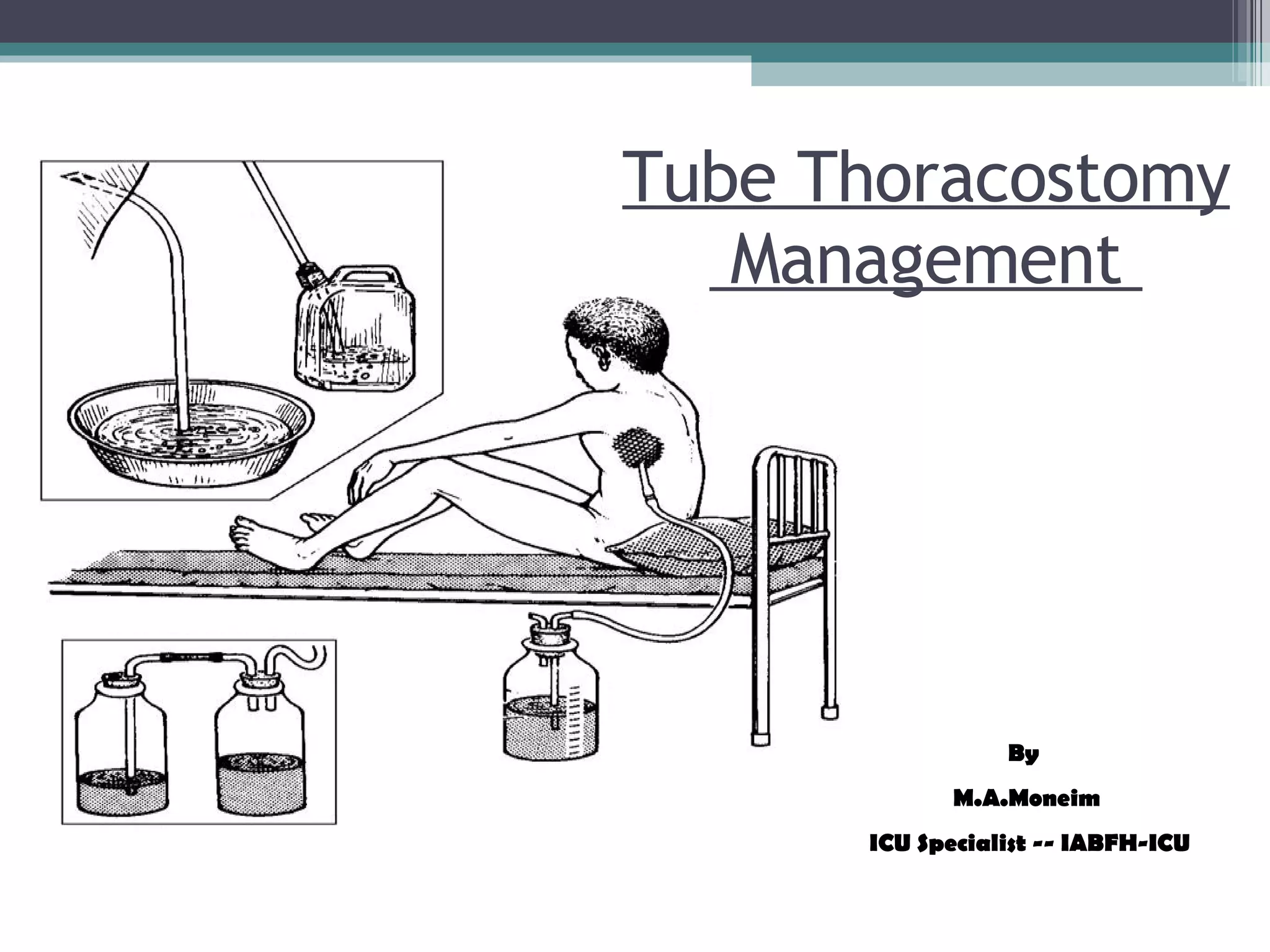
Drainage system The typical drainage system consists of 3 bottles : Underwater seal bottle Trap bottle Suction regulator bottle
The underwater drainage bottle The underwater seal bottle is the most important element in pleural drainage. It is essentially an extension of the chest tube underwater; a low-resistance, one-way valve for the evacuation of pleural contents The underwater seal is a conduit for the expulsion of air and fluid from the chest against minimal resistance. When intrapleural pressure rises (eg, expiration, coughing), air is forced out of the lungs through the mouth, and free contents of the pleural space are forced out through the chest tube and into the underwater seal drainage bottle
The underwater seal is also an anti-reflux valve. Re-entry of air into the pleural space when intrapleural pressures become negative (eg, inspiration), is blocked by the underwater seal.  Water can be drawn up the tube only to the height equal to the negative intrathoracic pressure (usually up to -20 cm of water). Therefore, the apparatus must be kept far enough below the patient to prevent water from being sucked up into the chest (100 cm is sufficient). The water in this tube is referred to as the "column" of water; it reflects the changes in intrathoracic pressure with each inspiration and expiration  The underwater drainage bottle
The underwater drainage bottle The end of the tube in the underwater seal bottle must remain covered with water at all times.  The end of the tube must not be kept too far below the surface of water because the resistance to expulsion of air from the chest is equal to the length of tubing that is underwater. Keeping the tip of the tube 2-3 cm below the surface of water should be enough to act as a constant valve. The whole system is placed erect, 100 cm below the level of the patient’s chest. This placement aids gravity drainage of chest contents into the bottle and prevents reentry of fluid into the chest during the upward swing of the fluid in the tube during inspiration.
Trap bottle When excessive fluid drains from the chest, the level of fluid in the underwater seal is raised. This increases resistance to further outflow of fluid from the chest To decrease this resistance, a trap bottle is introduced between the chest tube and the underwater seal The trap bottle collects the fluid draining out of the chest, while the air passes on to the second bottle. This keeps the underwater seal at a constant level
Suction regulator bottle Suction hastens the expansion of the lung. Another bottle is needed to introduce suction regulation to this system The suction regulator bottle has a 3-hole stopcock Short tubes are passed through 2 of the holes. One short tube connects to the underwater seal bottle’s vent tube and the other short tube connects to the suction source An atmospheric vent runs through the 3rd hole, passing below the level of water in this bottle When suction is applied, air is drawn down the atmospheric vent in this bottle, equal to the pressure inside the bottle that is decreased by the vacuum.  Under stronger vacuum, airflow through the atmospheric vent commences, and air bubbles through the water in the bottle, but the level of suction in the bottle remains the same
Suction regulator bottle This constant level of low pressure suction is now transmitted to the underwater seal bottle and then into the pleural cavity, thus aiding evacuation of contents there, allowing a quicker reexpansion of the underlying lung. The maximum force of suction is determined by the depth of the atmospheric vent underwater in the suction regulation bottle.1  To obtain a suction of -20 cm of water, set the tip of the tube 20 cm below the surface of the fluid. Now, increase the vacuum gradually until air bubbles gently and constantly through the atmospheric vent in the water during both phases of respiration. A constant pressure of -20 cm of water is now transmitted to the underwater seal and on to the chest drain The role of suction is now being debated. Some schools of thought say suction delays the sealing of air leaks from the underlying lung.8
Positioning Emergent and elective chest drains are usually placed in the triangle of safety, an area delineated by the anterior border of latissimus dorsi, the lateral border of pectoralis major, and a horizontal line lateral at the level of the nipple, or about the 5th intercostal space. This corresponds to an insertion area between the midaxillary and anterior axillary lines at the level of the nipple The correct taping of the emerging chest tube from the patient is with a "mesentry" fold of adhesive tape that holds the tube to the trunk of the patient. This allows some side-to-side movement of the tube, prevents kinking of the tube as it passes through the chest wall, and is far less painful to the patient than taping the tube directly to the chest wall
Multifunction chest drainage system   The multiple bottles and numerous connections of the typical 3-bottle system result in a bulky bedside device, which can be prone to accidental disconnections and blocks in the system. In addition, sterility is difficult to maintain in such a system.  These systems, therefore, have been largely replaced by commercially produced, disposable plastic multifunction units (eg, Codman, Pleurovac, Atrium) that fit into a single box and work on the same principles
Chest drain multipurpose unit Multifunction chest drainage systems have been designed primarily for management of chest tubes after cardiothoracic surgery and chest trauma Multichamber bottles are provided, incorporating both functional and safety features. They combine patient protection with effective drainage, accurate fluid loss measurement, and clear detection of air leaks  The multifunction systems allow single or multicatheter drainage and are suitable for both gravity-assisted and suction-assisted drainage. The unit has a latex-free patient tube and a filtered water seal to prevent contamination  Units with 3 or 4 chambers are also available, which provide 2 independent collection chambers, an automatic positive pressure relief vent, and a filtered negative pressure valve.9
 
Chest drain multipurpose unit Each multifunction chest drainage system contains the following:  Collection chamber: Fluids drain directly into this chamber, which is calibrated in mL Water seal: This is a one-way valve, U-tube design that can monitor air leaks and changes in intrathoracic pressure  Suction control chamber: This chamber is also a U-tube; the narrow arm is the atmospheric vent, and the large arm is the fluid reservoir. The system is regulated, and controlling negative pressure is easy. The suction chamber also helps monitor intrathoracic pressure For gravity drainage without suction, the level of water in the water seal chamber equals the intrathoracic pressure  For suction-assisted drainage, the level of water in the suction control chamber plus the level of water in the water seal  chamber equals the intrathoracic pressure
Multifunction chest drainage system setup   Follow the manufacturer’s instructions for adding water to the chambers. This is usually 2 cm in the water seal chamber and 20 cm in the suction control chamber Connect the 6-ft patient tube to the thoracic catheter  Connect the drain to vacuum Slowly increase vacuum until gentle bubbling appears in the suction control chamber Be sure not to allow too much bubbling in the suction control chamber Excessive bubbling is not needed clinically in 98% of patients  Vigorous bubbling is loud and disturbing to most patients Vigorous bubbling also causes rapid evaporation in the chamber,   which lowers the level of suction
Management of Chest Drains Analgesia Chest drains are painful for the patient. Adequate analgesia (orally, rectally, or parenterally) helps the patient cooperate better for the chest exercises and physiotherapy Patients whose chest tubes were inserted postoperatively or who have associated rib fractures need stronger forms of analgesia, such as patient-controlled anesthesia (PCA) with diluted opioids or even an epidural catheter for direct delivery of the analgesic medication
Breathing exercises and chest physiotherapy Breathing exercises and chest physiotherapy are the mainstays for the quick expansion of the lung. Incentive spirometry (eg, TriFlo incentive spirometer) gives the patient the impetus to expand the lung quickly Upper limb movements, especially at the shoulder, help restore the movements of the chest wall Steam inhalations and nebulized bronchodilators also encourage quick lung expansion Management of Chest Drains
Nursing management Keep the patient in a propped-up position (ie, 45-90°) Check that all connections are secure All joints must be well-taped with adhesive A single layer of tape across the long axis of each joint holds better than layers of circular tape over the joint. This prevents disconnection and the subsequent loss of the negative pressure Always ensure the correct position of the underwater seal bottle The bottle should be erect and at least 100 cm below the level of the patient’s chest The tip of the glass tube that connects to the chest drain should be at least 2 cm below the fluid level in the bottle (and not more than 7 cm below the fluid level)
In addition to vital signs, the following items need to be monitored every 4 hours:  Swinging or oscillation of the column of water in the glass tube connected to the chest drain  Blowing or air bubbling in drainage bottle with quiet respiration and on coughing (Bubbling of air indicates that the lung is still leaking air. The cessation of bubbling during both quiet respiration and coughing indicates that the air leak in the lung has closed)  Type and quantity of drainage (Inform physician if drainage is >100 mL/h or if frank blood) Never lift the drainage bottle above the level of the patient’s chest, as fluid from the bottle may siphon off into the patient’s chest Keep 2 clamps (angled) at the bed side  Nursing management
Do not clamp a bubbling chest drain  All nursing procedures, patient movement, and physiotherapy are permitted without clamping the drain. Clamp tubes only for procedures related to the tube or bottle (eg, to change the tube or bottle, to empty the bottle, to reconnect an accidental disconnection of the tube at any of the joints) Avoid kinks in the tubes. Teach the patient to look for kinks and to avoid sitting or lying on the tubes "Milk" the tubes frequently to avoid blockage by fibrin plugs or clots Change the connecting tube and bottle at least once every 48 hours, and replace them with sterile equivalents. Wash and disinfect equipment to remove all residue before sterilization Nursing management
Suction  When suction is needed, it should be a constant low-pressure suction to fully remove the pleural contents without causing pain to the patient.   The recommended level of suction is -5 to -20 cm of water. (The measurement of -20 cm of water is based on convention, not research.)  Higher negative pressure can increase the flow rate out of the chest, but it can also damage tissue Suction can improve the speed at which air and fluid are pulled from the chest.  However, recent research has shown that suction may actually prolong air leaks from the lung by pulling air through an opening that would otherwise close on its own Radiography Serial chest radiographs are needed to monitor and confirm the expansion of the lung Antibiotics Antibiotics are not needed during the presence of a chest drain for a simple pneumothorax or hydrothorax  The antibiotic cephalexin can be used to prevent the development of an empyema when a chest drain has been used in thoracic trauma Management of Chest Drains
Tube removal Timing of tube removal The timing of tube removal depends on clinical and radiological evidence of complete expulsion of all contents of the pleural cavity with complete expansion of the lung.  Minimal drainage should have occurred over the previous 24 h (<25 mL/d) When the patient coughs or performs the Valsalva maneuver, no air leak should ensue The chest radiograph should confirm complete expansion of the lung  The swing in the fluid level in the tube in the underwater seal bottle should be minimal, relating to the normal negative pressures in the chest during the phases of respiration Generally, for pneumothorax, a trial period of tube clamping for 6 hours is done A repeat chest radiograph is then taken. If this shows complete expansion of the lung, it confirms that the lung leak has sealed and that a proper adhesion between the layers of the pleura has occurred  The tube may be safely removed at that time
Tube removal Method of tube removal  Tube thoracostomy removal is a sterile procedure that requires a physician and an assistant Before removal, give the patient a bolus dose of analgesia. Infiltrating 5 mL of 1% lidocaine hydrochloride with a 24-gauge needle around the emerging chest drain can increase patient comfort Cut loose the securing stitch while the tube is being supported Free the mattress (sealing) stitch that was inserted and kept long at the time of tube insertion. If this stitch is not in position, place a vertical mattress stitch with strong suture material (NW 3397 of Ethicon) across the center of the incision Hold the ends of the mattress suture ready to tie a knot Instruct the patient to cease respiration in full expiration. Gently ease out the tube while simultaneously tying the knot to close the track Apply a soft dressing If the stitch breaks or cuts through, simply compress the oblique track and apply an occlusive dressing.9  Follow-up radiography  A chest radiograph is repeated 4 hours after the removal of the tube thoracostomy The results of this radiograph should confirm that no air has entered the chest and that the lung continues to remain fully expanded Tube removal
Pearls The underwater seal acts as a one-way valve through which air is expelled from the pleural space and prevented from reentering during the next inspiration Retrograde flow of fluid may occur if the collection chamber is raised above the level of the patient’s chest. The collection chamber should be kept below the level of the patient’s chest at all times to prevent fluid being siphoned into the pleural space Absence of fluid oscillations may indicate obstruction of the drainage system by clots or kinks, loss of subatmospheric pressure, or complete reexpansion of the lung
Persistent bubbling indicates a continuing bronchopleural air leak Clamping a pleural drain in the presence of a continuing air leak results in a tension pneumothorax The water seal is a window into the pleural space. It reflects the pressure in the pleural space and exhibits bubbling if air is leaving the chest. In the multifunction chest drainage systems, a graduated air leak meter (graduated 1-5) provides a way to measure the leak and monitor over time Pearls
Troubleshooting chest drain management   Column is not oscillating: If the column of fluid in the tube that connects the chest drain to below the water level in the drainage bottle is not oscillating, the tube has been blocked. All efforts must be made to restore patency of the tube by squeezing, milking, and even flushing the drainage tubing. Restoration of patency is confirmed by a respiration-related swing in the draining tube Tubes got disconnected: This is no great disaster. Reconnect the tubes and ask the patient to cough; any air that has entered the chest is forced out Tube has been pulled out: If the tube has been pulled out, it needs to be repositioned. Using all sterile precautions, position a new tube into the chest and secure it properly. The new tube should not be inserted through the same hole. A new thoracostomy is used, and the initial site is sealed with a vertical mattress suture
Leak around the tube: A leak around the tube indicates a partial block in the draining system. If all blocks have been removed and the leak around the tube persists, a single suture may need to be placed along the side of the tube to narrow the wound and seal the leak. Use of tapes and heavy dressings to occlude such leaks is not useful Underwater seal bottle broken: A broken bottle has to be replaced immediately with a fresh bottle with a 2-hole stopcock, and the underwater seal must be recreated. Then ask the patient to cough. Any air that has entered the chest is forced out Troubleshooting chest drain management  
Chest drain complications Blocked tube due to poor positioning: Sometimes the tube gets trapped in the major fissure of the lung. If this occurs, the tube needs to be withdrawn and reinserted Cardiac dysrhythmia: The tube may abut the mediastinum and occasionally cause cardiac irregularities. First, try withdrawing the tube 2-3 cm. If this does not resolve the problem, the tube may need to be reinserted at a separate location. Medical management of the arrhythmia is also needed Persistent pneumothorax: If a pneumothorax persists, check for obstructions or leaks. Clear any obstructions and seal any leaks in the drainage system. If no leak or obstruction is found, apply suction of up to -20 cm of water to the drainage system
Failure of the lung to fully reexpand: This is rarely due to blockage of the tubes, and change of tubes seldom helps. The common causes of nonexpansion of the lung are as follows:  Bronchial blockage leading to collapse, usually by retained sputum (Fiberoptic bronchoscopy helps clear secretions and rule out other causes of bronchial obstruction [eg, tumor].)  The presence of a fibrinous &quot;peel&quot; (cortex) over the lung (This is the thickened visceral pleura over the collapsed lung tissue and is usual in cases of delayed treatment of an empyema. A decortication is the best way to deal with this problem) Infections: Infections occur rarely with chest drains but can range from wound infection to empyemas. They reflect breaks in sterility and incorrect management of the chest drai Re-expansion pulmonary edema: This is also a rare chest drain complication and is seen when large effusions are drained in a short period of time. It is best prevented by gradual decompression Chest drain complications
Frequently Asked Questions What size chest drains should be used?  Use as large a tube as will pass comfortably through the intercostal space. By rule of thumb, in an adult patient, 24-28F is adequate to drain air, but 32-36F may be necessary to drain fluid Can chest drains be clamped?  Never clamp a bubbling drain, as the resultant pneumothorax can cause more problems to the patient. Check that all connections are secure, and then the patient can be subject to all nursing procedures, movement, and physiotherapy with no clamps on the drain.12
When are chest drains clamped?  Drains are clamped only in the following situations: When the draining tubes and underwater seal bottle are to be changed  Just prior to tube removal, as a trial of clamping for 4-6 hours, to confirm that the air leak has stopped  When reconnecting an accidentally disconnected tube that resulted in loss of the underwater seal If the drain is clamped, it should be unclamped as soon as possible by the same individual who put the clamp on. Clamps are sometimes overlooked when patients are handed over during shift changes of medical personnel. Clamps that are not removed lead to deterioration of the patient Can a patient with a chest drain inserted be moved?  Yes, patients with chest drains can be moved around as usual. All connections have to be checked for security, and the underwater seal bottle has to be kept erect at a level of about 100 cm below the patient’s chest Frequently Asked Questions
Frequently Asked Questions What suction pressure should be applied? As a general rule, suction pressures need to be between -10 and -20 cm of water (-2 to - 3 kPa). While up to 25 cm of water suction pressure is needed for massive air leaks, 5 cm of suction pressure is sufficient to help drain fluid contents out of the chest How long should chest drains be left in? Apposition of the 2 layers of the pleura is essential to seal air leaks and reduce the drainage. All air leaks eventually stop if the lung can be kept fully expanded constantly. This usually occurs within a week, but it may take as long as 4-6 weeks If the air leak persists, the case needs to be reviewed by a thoracic surgeon. If significant discharge is evident, but the lung seems to be adherent, conversion to open tube drainage may be needed
Do alternatives to underwater bottle drainage exist?  Yes; artificially made one-way valve systems may be alternatives to underwater bottle drainage The flutter valve (Heimlich):  This is a one-way system created with a plastic diaphragm, which allows air to escape from the chest and yet maintains expansion of the lung. It is attached to the chest drain and strapped to the patient’s side, allowing greater mobility of the patient. The flutter valve can be used for pneumothorax only Frequently Asked Questions
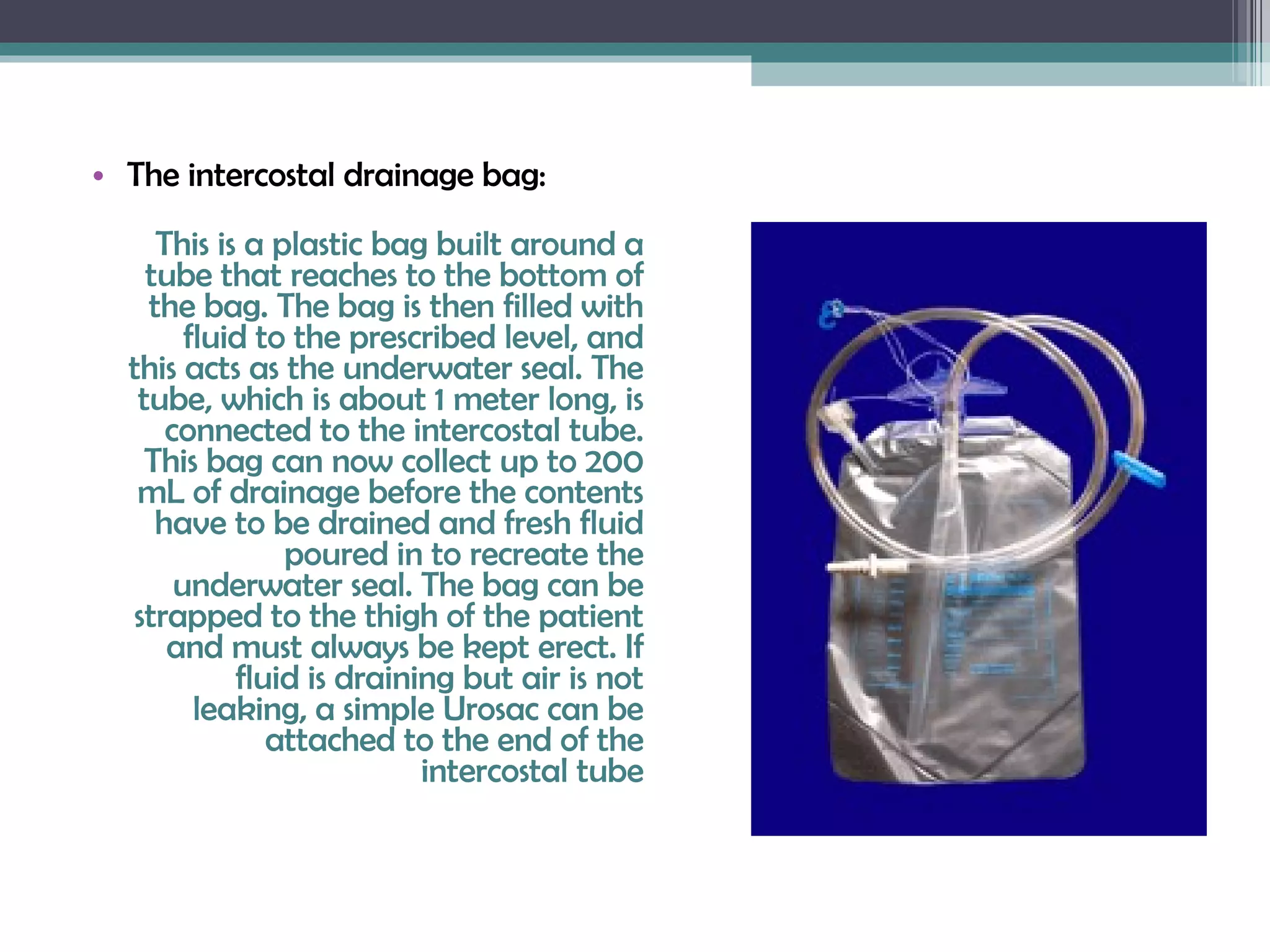
The intercostal drainage bag:  This is a plastic bag built around a tube that reaches to the bottom of the bag. The bag is then filled with fluid to the prescribed level, and this acts as the underwater seal. The tube, which is about 1 meter long, is connected to the intercostal tube. This bag can now collect up to 200 mL of drainage before the contents have to be drained and fresh fluid poured in to recreate the underwater seal. The bag can be strapped to the thigh of the patient and must always be kept erect. If fluid is draining but air is not leaking, a simple Urosac can be attached to the end of the intercostal tube
 

Tube Thoracostomy, Management

  • 1.
    Tube Thoracostomy Management By M.A.Moneim ICU Specialist -- IABFH-ICU
  • 2.
    Introduction The mechanicsof ventilation relate to the negative intrathoracic pressure that draws air into the lungs during spontaneous respiration. This negative pressure is best maintained in the pleural space, which is the potential space between the parietal and visceral layers of the pleura Collections of air, fluid, or blood in the pleural space not only compress the lung tissue but also cause the pleural pressures to become positive, causing inappropriate ventilation Chest drains are inserted to remove pathological collections of air or fluid in the pleural space, to allow the re-creation of the essential negative pressures in the chest, and to permit complete expansion of the lung, thereby restoring normal ventilation
  • 3.
    Introduction Chest drainsare very simple and effective tools in the management of thoracic and pleural pathology. They need proper safe insertion and correct management Chest drains are lifesaving in critical care Chest drainage systems work by combining the following 3 efforts: Expiratory positive pressure from the patient helps push air and fluid out of the chest (eg, cough, Valsalva maneuver) Gravity helps fluid drainage as long as the chest drainage system is placed below the level of the patient’s chest Suction can improve the speed at which air and fluid are pulled from the chest Introduction
  • 4.
    Indications Pneumothorax (spontaneous,tension, iatrogenic, traumatic) Pleural collection Pus (empyema) Blood (hemothorax) Chyle (chylothorax) Malignant effusions (pleurodesis) Postoperative Thoracotomy Video-assisted thoracic surgery (VATS)
  • 5.
  • 6.
  • 7.
    Contraindications When achest drain is needed for any of the indications listed above, no absolute contraindications exist for chest drain insertion
  • 8.
    Equipment Chest drainagebottles Adequate length (1.5 – 2 m) of sterile, transparent, plastic tubing (eg, vinyl/silastic) Appropriate sterile connectors Adhesive tape Angled clamps (2) for clamping the tube when needed Distilled water to fill in the drainage bottle
  • 9.
    Drainage system Thetypical drainage system consists of 3 bottles : Underwater seal bottle Trap bottle Suction regulator bottle
  • 10.
    The underwater drainagebottle The underwater seal bottle is the most important element in pleural drainage. It is essentially an extension of the chest tube underwater; a low-resistance, one-way valve for the evacuation of pleural contents The underwater seal is a conduit for the expulsion of air and fluid from the chest against minimal resistance. When intrapleural pressure rises (eg, expiration, coughing), air is forced out of the lungs through the mouth, and free contents of the pleural space are forced out through the chest tube and into the underwater seal drainage bottle
  • 11.
    The underwater sealis also an anti-reflux valve. Re-entry of air into the pleural space when intrapleural pressures become negative (eg, inspiration), is blocked by the underwater seal. Water can be drawn up the tube only to the height equal to the negative intrathoracic pressure (usually up to -20 cm of water). Therefore, the apparatus must be kept far enough below the patient to prevent water from being sucked up into the chest (100 cm is sufficient). The water in this tube is referred to as the &quot;column&quot; of water; it reflects the changes in intrathoracic pressure with each inspiration and expiration The underwater drainage bottle
  • 12.
    The underwater drainagebottle The end of the tube in the underwater seal bottle must remain covered with water at all times. The end of the tube must not be kept too far below the surface of water because the resistance to expulsion of air from the chest is equal to the length of tubing that is underwater. Keeping the tip of the tube 2-3 cm below the surface of water should be enough to act as a constant valve. The whole system is placed erect, 100 cm below the level of the patient’s chest. This placement aids gravity drainage of chest contents into the bottle and prevents reentry of fluid into the chest during the upward swing of the fluid in the tube during inspiration.
  • 13.
    Trap bottle Whenexcessive fluid drains from the chest, the level of fluid in the underwater seal is raised. This increases resistance to further outflow of fluid from the chest To decrease this resistance, a trap bottle is introduced between the chest tube and the underwater seal The trap bottle collects the fluid draining out of the chest, while the air passes on to the second bottle. This keeps the underwater seal at a constant level
  • 14.
    Suction regulator bottleSuction hastens the expansion of the lung. Another bottle is needed to introduce suction regulation to this system The suction regulator bottle has a 3-hole stopcock Short tubes are passed through 2 of the holes. One short tube connects to the underwater seal bottle’s vent tube and the other short tube connects to the suction source An atmospheric vent runs through the 3rd hole, passing below the level of water in this bottle When suction is applied, air is drawn down the atmospheric vent in this bottle, equal to the pressure inside the bottle that is decreased by the vacuum. Under stronger vacuum, airflow through the atmospheric vent commences, and air bubbles through the water in the bottle, but the level of suction in the bottle remains the same
  • 15.
    Suction regulator bottleThis constant level of low pressure suction is now transmitted to the underwater seal bottle and then into the pleural cavity, thus aiding evacuation of contents there, allowing a quicker reexpansion of the underlying lung. The maximum force of suction is determined by the depth of the atmospheric vent underwater in the suction regulation bottle.1 To obtain a suction of -20 cm of water, set the tip of the tube 20 cm below the surface of the fluid. Now, increase the vacuum gradually until air bubbles gently and constantly through the atmospheric vent in the water during both phases of respiration. A constant pressure of -20 cm of water is now transmitted to the underwater seal and on to the chest drain The role of suction is now being debated. Some schools of thought say suction delays the sealing of air leaks from the underlying lung.8
  • 16.
    Positioning Emergent andelective chest drains are usually placed in the triangle of safety, an area delineated by the anterior border of latissimus dorsi, the lateral border of pectoralis major, and a horizontal line lateral at the level of the nipple, or about the 5th intercostal space. This corresponds to an insertion area between the midaxillary and anterior axillary lines at the level of the nipple The correct taping of the emerging chest tube from the patient is with a &quot;mesentry&quot; fold of adhesive tape that holds the tube to the trunk of the patient. This allows some side-to-side movement of the tube, prevents kinking of the tube as it passes through the chest wall, and is far less painful to the patient than taping the tube directly to the chest wall
  • 17.
    Multifunction chest drainagesystem The multiple bottles and numerous connections of the typical 3-bottle system result in a bulky bedside device, which can be prone to accidental disconnections and blocks in the system. In addition, sterility is difficult to maintain in such a system. These systems, therefore, have been largely replaced by commercially produced, disposable plastic multifunction units (eg, Codman, Pleurovac, Atrium) that fit into a single box and work on the same principles
  • 18.
    Chest drain multipurposeunit Multifunction chest drainage systems have been designed primarily for management of chest tubes after cardiothoracic surgery and chest trauma Multichamber bottles are provided, incorporating both functional and safety features. They combine patient protection with effective drainage, accurate fluid loss measurement, and clear detection of air leaks The multifunction systems allow single or multicatheter drainage and are suitable for both gravity-assisted and suction-assisted drainage. The unit has a latex-free patient tube and a filtered water seal to prevent contamination Units with 3 or 4 chambers are also available, which provide 2 independent collection chambers, an automatic positive pressure relief vent, and a filtered negative pressure valve.9
  • 19.
  • 20.
    Chest drain multipurposeunit Each multifunction chest drainage system contains the following: Collection chamber: Fluids drain directly into this chamber, which is calibrated in mL Water seal: This is a one-way valve, U-tube design that can monitor air leaks and changes in intrathoracic pressure Suction control chamber: This chamber is also a U-tube; the narrow arm is the atmospheric vent, and the large arm is the fluid reservoir. The system is regulated, and controlling negative pressure is easy. The suction chamber also helps monitor intrathoracic pressure For gravity drainage without suction, the level of water in the water seal chamber equals the intrathoracic pressure For suction-assisted drainage, the level of water in the suction control chamber plus the level of water in the water seal chamber equals the intrathoracic pressure
  • 21.
    Multifunction chest drainagesystem setup   Follow the manufacturer’s instructions for adding water to the chambers. This is usually 2 cm in the water seal chamber and 20 cm in the suction control chamber Connect the 6-ft patient tube to the thoracic catheter Connect the drain to vacuum Slowly increase vacuum until gentle bubbling appears in the suction control chamber Be sure not to allow too much bubbling in the suction control chamber Excessive bubbling is not needed clinically in 98% of patients Vigorous bubbling is loud and disturbing to most patients Vigorous bubbling also causes rapid evaporation in the chamber, which lowers the level of suction
  • 22.
    Management of ChestDrains Analgesia Chest drains are painful for the patient. Adequate analgesia (orally, rectally, or parenterally) helps the patient cooperate better for the chest exercises and physiotherapy Patients whose chest tubes were inserted postoperatively or who have associated rib fractures need stronger forms of analgesia, such as patient-controlled anesthesia (PCA) with diluted opioids or even an epidural catheter for direct delivery of the analgesic medication
  • 23.
    Breathing exercises andchest physiotherapy Breathing exercises and chest physiotherapy are the mainstays for the quick expansion of the lung. Incentive spirometry (eg, TriFlo incentive spirometer) gives the patient the impetus to expand the lung quickly Upper limb movements, especially at the shoulder, help restore the movements of the chest wall Steam inhalations and nebulized bronchodilators also encourage quick lung expansion Management of Chest Drains
  • 24.
    Nursing management Keep thepatient in a propped-up position (ie, 45-90°) Check that all connections are secure All joints must be well-taped with adhesive A single layer of tape across the long axis of each joint holds better than layers of circular tape over the joint. This prevents disconnection and the subsequent loss of the negative pressure Always ensure the correct position of the underwater seal bottle The bottle should be erect and at least 100 cm below the level of the patient’s chest The tip of the glass tube that connects to the chest drain should be at least 2 cm below the fluid level in the bottle (and not more than 7 cm below the fluid level)
  • 25.
    In addition tovital signs, the following items need to be monitored every 4 hours: Swinging or oscillation of the column of water in the glass tube connected to the chest drain Blowing or air bubbling in drainage bottle with quiet respiration and on coughing (Bubbling of air indicates that the lung is still leaking air. The cessation of bubbling during both quiet respiration and coughing indicates that the air leak in the lung has closed) Type and quantity of drainage (Inform physician if drainage is >100 mL/h or if frank blood) Never lift the drainage bottle above the level of the patient’s chest, as fluid from the bottle may siphon off into the patient’s chest Keep 2 clamps (angled) at the bed side Nursing management
  • 26.
    Do not clampa bubbling chest drain All nursing procedures, patient movement, and physiotherapy are permitted without clamping the drain. Clamp tubes only for procedures related to the tube or bottle (eg, to change the tube or bottle, to empty the bottle, to reconnect an accidental disconnection of the tube at any of the joints) Avoid kinks in the tubes. Teach the patient to look for kinks and to avoid sitting or lying on the tubes &quot;Milk&quot; the tubes frequently to avoid blockage by fibrin plugs or clots Change the connecting tube and bottle at least once every 48 hours, and replace them with sterile equivalents. Wash and disinfect equipment to remove all residue before sterilization Nursing management
  • 27.
    Suction  When suctionis needed, it should be a constant low-pressure suction to fully remove the pleural contents without causing pain to the patient.  The recommended level of suction is -5 to -20 cm of water. (The measurement of -20 cm of water is based on convention, not research.) Higher negative pressure can increase the flow rate out of the chest, but it can also damage tissue Suction can improve the speed at which air and fluid are pulled from the chest. However, recent research has shown that suction may actually prolong air leaks from the lung by pulling air through an opening that would otherwise close on its own Radiography Serial chest radiographs are needed to monitor and confirm the expansion of the lung Antibiotics Antibiotics are not needed during the presence of a chest drain for a simple pneumothorax or hydrothorax The antibiotic cephalexin can be used to prevent the development of an empyema when a chest drain has been used in thoracic trauma Management of Chest Drains
  • 28.
    Tube removal Timingof tube removal The timing of tube removal depends on clinical and radiological evidence of complete expulsion of all contents of the pleural cavity with complete expansion of the lung. Minimal drainage should have occurred over the previous 24 h (<25 mL/d) When the patient coughs or performs the Valsalva maneuver, no air leak should ensue The chest radiograph should confirm complete expansion of the lung The swing in the fluid level in the tube in the underwater seal bottle should be minimal, relating to the normal negative pressures in the chest during the phases of respiration Generally, for pneumothorax, a trial period of tube clamping for 6 hours is done A repeat chest radiograph is then taken. If this shows complete expansion of the lung, it confirms that the lung leak has sealed and that a proper adhesion between the layers of the pleura has occurred The tube may be safely removed at that time
  • 29.
    Tube removal Methodof tube removal Tube thoracostomy removal is a sterile procedure that requires a physician and an assistant Before removal, give the patient a bolus dose of analgesia. Infiltrating 5 mL of 1% lidocaine hydrochloride with a 24-gauge needle around the emerging chest drain can increase patient comfort Cut loose the securing stitch while the tube is being supported Free the mattress (sealing) stitch that was inserted and kept long at the time of tube insertion. If this stitch is not in position, place a vertical mattress stitch with strong suture material (NW 3397 of Ethicon) across the center of the incision Hold the ends of the mattress suture ready to tie a knot Instruct the patient to cease respiration in full expiration. Gently ease out the tube while simultaneously tying the knot to close the track Apply a soft dressing If the stitch breaks or cuts through, simply compress the oblique track and apply an occlusive dressing.9 Follow-up radiography A chest radiograph is repeated 4 hours after the removal of the tube thoracostomy The results of this radiograph should confirm that no air has entered the chest and that the lung continues to remain fully expanded Tube removal
  • 30.
    Pearls The underwaterseal acts as a one-way valve through which air is expelled from the pleural space and prevented from reentering during the next inspiration Retrograde flow of fluid may occur if the collection chamber is raised above the level of the patient’s chest. The collection chamber should be kept below the level of the patient’s chest at all times to prevent fluid being siphoned into the pleural space Absence of fluid oscillations may indicate obstruction of the drainage system by clots or kinks, loss of subatmospheric pressure, or complete reexpansion of the lung
  • 31.
    Persistent bubbling indicatesa continuing bronchopleural air leak Clamping a pleural drain in the presence of a continuing air leak results in a tension pneumothorax The water seal is a window into the pleural space. It reflects the pressure in the pleural space and exhibits bubbling if air is leaving the chest. In the multifunction chest drainage systems, a graduated air leak meter (graduated 1-5) provides a way to measure the leak and monitor over time Pearls
  • 32.
    Troubleshooting chest drainmanagement   Column is not oscillating: If the column of fluid in the tube that connects the chest drain to below the water level in the drainage bottle is not oscillating, the tube has been blocked. All efforts must be made to restore patency of the tube by squeezing, milking, and even flushing the drainage tubing. Restoration of patency is confirmed by a respiration-related swing in the draining tube Tubes got disconnected: This is no great disaster. Reconnect the tubes and ask the patient to cough; any air that has entered the chest is forced out Tube has been pulled out: If the tube has been pulled out, it needs to be repositioned. Using all sterile precautions, position a new tube into the chest and secure it properly. The new tube should not be inserted through the same hole. A new thoracostomy is used, and the initial site is sealed with a vertical mattress suture
  • 33.
    Leak around thetube: A leak around the tube indicates a partial block in the draining system. If all blocks have been removed and the leak around the tube persists, a single suture may need to be placed along the side of the tube to narrow the wound and seal the leak. Use of tapes and heavy dressings to occlude such leaks is not useful Underwater seal bottle broken: A broken bottle has to be replaced immediately with a fresh bottle with a 2-hole stopcock, and the underwater seal must be recreated. Then ask the patient to cough. Any air that has entered the chest is forced out Troubleshooting chest drain management  
  • 34.
    Chest drain complicationsBlocked tube due to poor positioning: Sometimes the tube gets trapped in the major fissure of the lung. If this occurs, the tube needs to be withdrawn and reinserted Cardiac dysrhythmia: The tube may abut the mediastinum and occasionally cause cardiac irregularities. First, try withdrawing the tube 2-3 cm. If this does not resolve the problem, the tube may need to be reinserted at a separate location. Medical management of the arrhythmia is also needed Persistent pneumothorax: If a pneumothorax persists, check for obstructions or leaks. Clear any obstructions and seal any leaks in the drainage system. If no leak or obstruction is found, apply suction of up to -20 cm of water to the drainage system
  • 35.
    Failure of thelung to fully reexpand: This is rarely due to blockage of the tubes, and change of tubes seldom helps. The common causes of nonexpansion of the lung are as follows: Bronchial blockage leading to collapse, usually by retained sputum (Fiberoptic bronchoscopy helps clear secretions and rule out other causes of bronchial obstruction [eg, tumor].) The presence of a fibrinous &quot;peel&quot; (cortex) over the lung (This is the thickened visceral pleura over the collapsed lung tissue and is usual in cases of delayed treatment of an empyema. A decortication is the best way to deal with this problem) Infections: Infections occur rarely with chest drains but can range from wound infection to empyemas. They reflect breaks in sterility and incorrect management of the chest drai Re-expansion pulmonary edema: This is also a rare chest drain complication and is seen when large effusions are drained in a short period of time. It is best prevented by gradual decompression Chest drain complications
  • 36.
    Frequently Asked QuestionsWhat size chest drains should be used? Use as large a tube as will pass comfortably through the intercostal space. By rule of thumb, in an adult patient, 24-28F is adequate to drain air, but 32-36F may be necessary to drain fluid Can chest drains be clamped? Never clamp a bubbling drain, as the resultant pneumothorax can cause more problems to the patient. Check that all connections are secure, and then the patient can be subject to all nursing procedures, movement, and physiotherapy with no clamps on the drain.12
  • 37.
    When are chestdrains clamped? Drains are clamped only in the following situations: When the draining tubes and underwater seal bottle are to be changed Just prior to tube removal, as a trial of clamping for 4-6 hours, to confirm that the air leak has stopped When reconnecting an accidentally disconnected tube that resulted in loss of the underwater seal If the drain is clamped, it should be unclamped as soon as possible by the same individual who put the clamp on. Clamps are sometimes overlooked when patients are handed over during shift changes of medical personnel. Clamps that are not removed lead to deterioration of the patient Can a patient with a chest drain inserted be moved? Yes, patients with chest drains can be moved around as usual. All connections have to be checked for security, and the underwater seal bottle has to be kept erect at a level of about 100 cm below the patient’s chest Frequently Asked Questions
  • 38.
    Frequently Asked QuestionsWhat suction pressure should be applied? As a general rule, suction pressures need to be between -10 and -20 cm of water (-2 to - 3 kPa). While up to 25 cm of water suction pressure is needed for massive air leaks, 5 cm of suction pressure is sufficient to help drain fluid contents out of the chest How long should chest drains be left in? Apposition of the 2 layers of the pleura is essential to seal air leaks and reduce the drainage. All air leaks eventually stop if the lung can be kept fully expanded constantly. This usually occurs within a week, but it may take as long as 4-6 weeks If the air leak persists, the case needs to be reviewed by a thoracic surgeon. If significant discharge is evident, but the lung seems to be adherent, conversion to open tube drainage may be needed
  • 39.
    Do alternatives tounderwater bottle drainage exist? Yes; artificially made one-way valve systems may be alternatives to underwater bottle drainage The flutter valve (Heimlich): This is a one-way system created with a plastic diaphragm, which allows air to escape from the chest and yet maintains expansion of the lung. It is attached to the chest drain and strapped to the patient’s side, allowing greater mobility of the patient. The flutter valve can be used for pneumothorax only Frequently Asked Questions
  • 40.
    The intercostal drainagebag: This is a plastic bag built around a tube that reaches to the bottom of the bag. The bag is then filled with fluid to the prescribed level, and this acts as the underwater seal. The tube, which is about 1 meter long, is connected to the intercostal tube. This bag can now collect up to 200 mL of drainage before the contents have to be drained and fresh fluid poured in to recreate the underwater seal. The bag can be strapped to the thigh of the patient and must always be kept erect. If fluid is draining but air is not leaking, a simple Urosac can be attached to the end of the intercostal tube
  • 41.