By Dr Salah Zaki
A chest tube
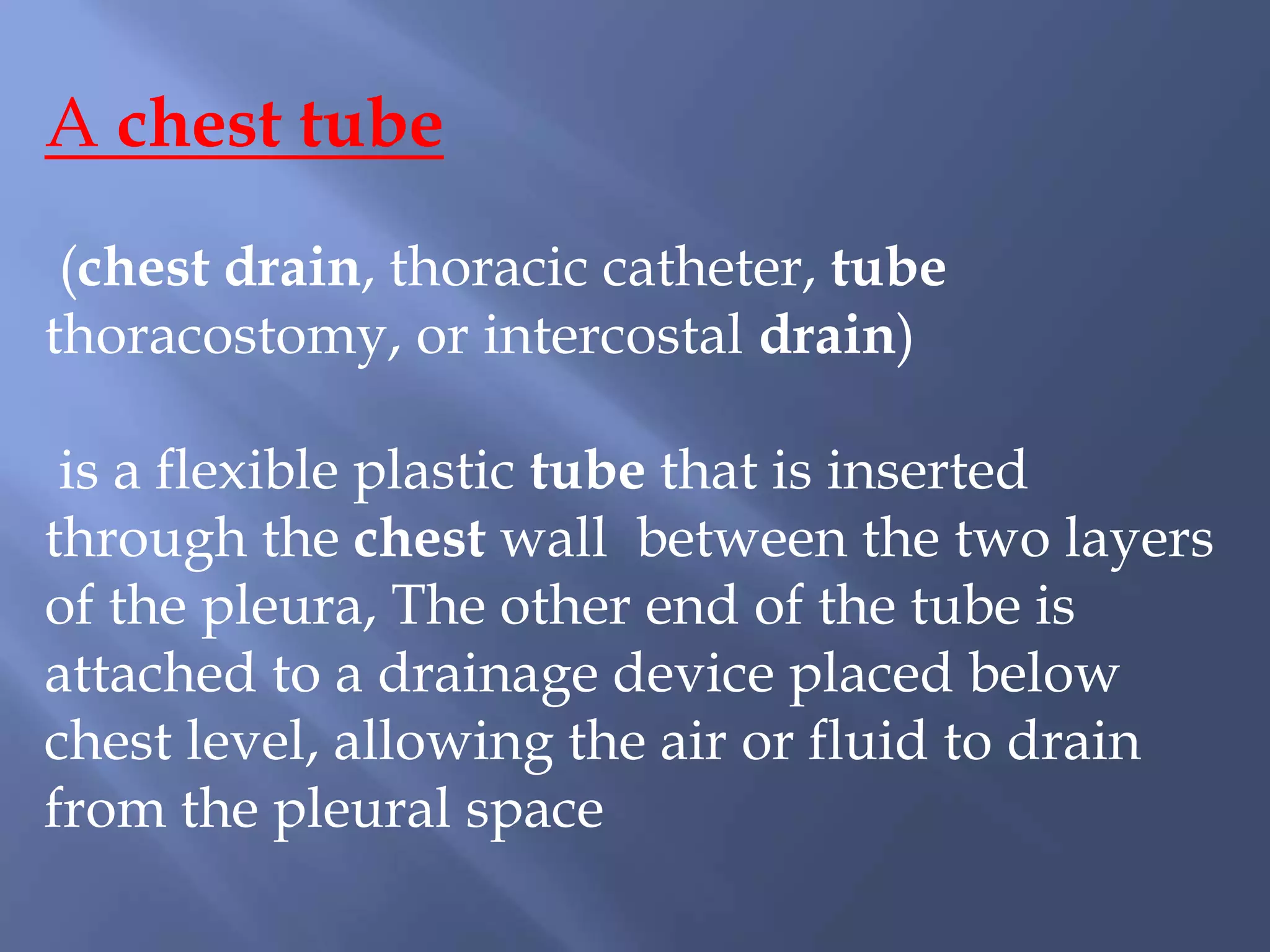
(chest drain, thoracic catheter, tube
thoracostomy, or intercostal drain)
is a flexible plastic tube that is inserted
through the chest wall between the two layers
of the pleura, The other end of the tube is
attached to a drainage device placed below
chest level, allowing the air or fluid to drain
from the pleural space
Indications
Pneumothorax: air or gas in the pleural space.
• in any ventilated patient
• tension pneumothorax after initial needle
relief
• persistent or recurrent pneumothorax
after simple aspiration
• large secondary spontaneous pneumot-
horax in patients over 50 years
•Pleural effusion: fluid in the pleural space
•Chylothorax: lymphatic fluid in the pleural space
•Empyema: pyogenic infection of the pleural space
•Hemothorax: accumulation of blood in the pleural
space
•Hydrothorax: accumulation of serous fluid in the
pleural space
•Postoperative: for example, thoracotomy,
oesophagectomy, cardiac surgery
Technique OF Tube thoracostomy
EQUIPMENT
All the equipment required to insert a chest tube
should be available
•Sterile gloves and gown
•Skin antiseptic solution, e.g. iodine
•Sterile drapes
•Gauze swabs
•A selection of syringes and needles (21–25
gauge)
•Local anaesthetic, e.g. lignocaine 1%
•Scalpel and blade
•Suture (e.g. “1” silk)
•Instrument for blunt dissection
British Thoracic Society recommends the tube is
inserted in an area described as the "safe zone"
a region bordered by: the lateral border of pectoralis
major, and, the anterior border of latissimus dorsi and a
horizontal line superior to the nipple. More specifically,
the tube is inserted into the 5th intercostal space slightly
anterior to the mid axillary line
1) Clean the area with a disinfectant
2) Inject a local anesthesia into the location of the target
4th or 5th intercostal space
On an obese patient it can be difficult to palpate the ribs.
However, the 4th or 5th rib will be approximately at a
level just above the nipple.
3) Make a small incision through the skin
approximately 4cm long parallel to the ribs.
4) Using hemostats (forceps) in a spreading motion to
part the skin and subcutaneous tissue widening the
opening.
5) Force your finger into the opening and spread
subcutaneous tissue sufficiently to feel the ribs
6) Using hemostats, push the closed end through the
intercostal muscles and spread the hemostats forcefully
open to form a hole in the intercostal muscles..
7) Push your finger back into the space, and twisting
your finger press any lung tissue back from the hole.
8) Grasp the chest tube end with forceps and feed it into
the opening. Tube incertion should be made just above
and parallel to a rib
10) After insertion, the tube is typically
secured by a suture and the entry area
covered by dressings. “Purse string” sutures
must not be used.
In the case of acute haemothorax, however,
large bore tubes(28–30 F minimum) continue
to be recommended for their
dual role of drainage of the thoracic cavity
and assessment of continuing blood loss
11) The chest tube is then attached to a
drainage system which only allows one
direction of flow.
The respiratory swing in the fluid in
the chest tube is useful for assessing tube
patency and confirms the position of the
tube in the pleural cavity.
Once in place, a chest X-ray is performed to
verify the location of the drain.
MANAGEMENT OF DRAINAGE SYSTEM
Clamping drain
•A bubbling chest tube should never be clamped.
•Drainage of a large pleural effusion should be
controlled to prevent the potential complication of
re-expansion pulmonary oedema.
•In cases of pneumothorax, clamping of the chest tube
should usually be avoided.
Removal of the chest tube
The timing of removal is dependent
on the original reason for insertion and clinical
progress
•In cases of pneumothorax, the chest tube should not
be clamped at the time of its removal there is no
evidence that clamping a chest drain at the time of its
removal is beneficial.
The chest tube should be removed during expiration
with a brisk firm movement while an assistant ties the
previouslyplaced closure suture.
Tube thoracostomy

Tube thoracostomy

  • 1.
  • 2.
    A chest tube (chestdrain, thoracic catheter, tube thoracostomy, or intercostal drain) is a flexible plastic tube that is inserted through the chest wall between the two layers of the pleura, The other end of the tube is attached to a drainage device placed below chest level, allowing the air or fluid to drain from the pleural space
  • 5.
    Indications Pneumothorax: air orgas in the pleural space. • in any ventilated patient • tension pneumothorax after initial needle relief • persistent or recurrent pneumothorax after simple aspiration • large secondary spontaneous pneumot- horax in patients over 50 years
  • 6.
    •Pleural effusion: fluidin the pleural space •Chylothorax: lymphatic fluid in the pleural space •Empyema: pyogenic infection of the pleural space •Hemothorax: accumulation of blood in the pleural space •Hydrothorax: accumulation of serous fluid in the pleural space •Postoperative: for example, thoracotomy, oesophagectomy, cardiac surgery
  • 7.
    Technique OF Tubethoracostomy
  • 8.
    EQUIPMENT All the equipmentrequired to insert a chest tube should be available •Sterile gloves and gown •Skin antiseptic solution, e.g. iodine •Sterile drapes •Gauze swabs •A selection of syringes and needles (21–25 gauge) •Local anaesthetic, e.g. lignocaine 1% •Scalpel and blade •Suture (e.g. “1” silk) •Instrument for blunt dissection
  • 10.
    British Thoracic Societyrecommends the tube is inserted in an area described as the "safe zone" a region bordered by: the lateral border of pectoralis major, and, the anterior border of latissimus dorsi and a horizontal line superior to the nipple. More specifically, the tube is inserted into the 5th intercostal space slightly anterior to the mid axillary line
  • 11.
    1) Clean thearea with a disinfectant 2) Inject a local anesthesia into the location of the target 4th or 5th intercostal space On an obese patient it can be difficult to palpate the ribs. However, the 4th or 5th rib will be approximately at a level just above the nipple. 3) Make a small incision through the skin approximately 4cm long parallel to the ribs. 4) Using hemostats (forceps) in a spreading motion to part the skin and subcutaneous tissue widening the opening.
  • 12.
    5) Force yourfinger into the opening and spread subcutaneous tissue sufficiently to feel the ribs 6) Using hemostats, push the closed end through the intercostal muscles and spread the hemostats forcefully open to form a hole in the intercostal muscles.. 7) Push your finger back into the space, and twisting your finger press any lung tissue back from the hole. 8) Grasp the chest tube end with forceps and feed it into the opening. Tube incertion should be made just above and parallel to a rib
  • 13.
    10) After insertion,the tube is typically secured by a suture and the entry area covered by dressings. “Purse string” sutures must not be used. In the case of acute haemothorax, however, large bore tubes(28–30 F minimum) continue to be recommended for their dual role of drainage of the thoracic cavity and assessment of continuing blood loss
  • 14.
    11) The chesttube is then attached to a drainage system which only allows one direction of flow. The respiratory swing in the fluid in the chest tube is useful for assessing tube patency and confirms the position of the tube in the pleural cavity. Once in place, a chest X-ray is performed to verify the location of the drain.
  • 15.
    MANAGEMENT OF DRAINAGESYSTEM Clamping drain •A bubbling chest tube should never be clamped. •Drainage of a large pleural effusion should be controlled to prevent the potential complication of re-expansion pulmonary oedema. •In cases of pneumothorax, clamping of the chest tube should usually be avoided.
  • 16.
    Removal of thechest tube The timing of removal is dependent on the original reason for insertion and clinical progress •In cases of pneumothorax, the chest tube should not be clamped at the time of its removal there is no evidence that clamping a chest drain at the time of its removal is beneficial. The chest tube should be removed during expiration with a brisk firm movement while an assistant ties the previouslyplaced closure suture.