Water Seal / Chest Tube
Drainage
Prepared and presented by
Mr.Sarathchandran M.B
Nursing Tutor.
Swami Vivekananda College Of Nursing.
Udgir, Maharashtra.
Water Seal /Chest Tube
Drainage
Subject: Medical Surgical Nursing -1
Unit: III
Topic: Water Seal/Intercostal /Chest Tube Drainage
Time duration: 60 Minutes
Group: B.Sc Nursing IV Year
Water Seal or Chest tube Drainage
General objective:After going through this content thoroughly the students will
have more confidence to deal people with water seal drainage.
Specific Objective: After the lecture as per plan students will be able to
● Define water seal drainage.
● Indications for it.
● Chest tube insertion site
● Types and mechanism of ICD
● Nurses responsibility in caring clients with ICD
Reference: https://www.kau.edu.sa/Files/0012869/Subjects/underwaterseal%20Bridging-Sohad2014.pdf
https://www.slideshare.net/aashishparihar/water-seal-drainage?qid=8740e4e6-3f22-4665-9b29-d3d80a158169&v=&b=&fro
m_search=1
Content
● Introduction and definition
● Purpose of Indications
● Contraindications & complications.
● Site and Insertion if ICD
● Types of ICD
● Principles of ICD
● Factors affecting ICD
● Nurses responsibility ICD
○ Care of apparatus.
○ Caring patients with ICD
○ Specimen collection from ICD
○ Disconnected tube.
○ Accidental fall out of ICD
○ Transport of cliet with ICD
○ Removal of ICD
10 mins
Introduction and
definitions,Indications.
10 mins
Site and insertion of ICD
Types of ICD
15 mins
Principles and Factors
affecting ICD
20 mins
Nurses Responsibility
with ICD clients
5 mins
Removal of ICD and
conclusion
INTRODUCTION AND DEFINITION
What does water seal mean?
A seal or trap formed by a small amount of water (liquid) to prevent the passage of gas to the other
side as the seal it acts as a one-way valve. The best example is the foul gas lock system of
commonly used sanitary toilets.
What is Drainage system?
In medicine, drainage refers to the removal , taking or letting out of fluids and/or gases from a body
part. Examples include thoracentesis, paracentesis, incision and drainage(I/D or
I&D)etc.,Approaches or system conventionally followed for it refers to drainage system.
Why is a water seal is important in drainage systems ?
When a water seal arranged in a specific way it acts as a one-way valve: it allows air to exit
through the system while preventing air from re-entering in to the system, applied mainly to the
pleural space, where the accumulation of air could lead to pneumothorax.
How to Define Water seal drainage system?
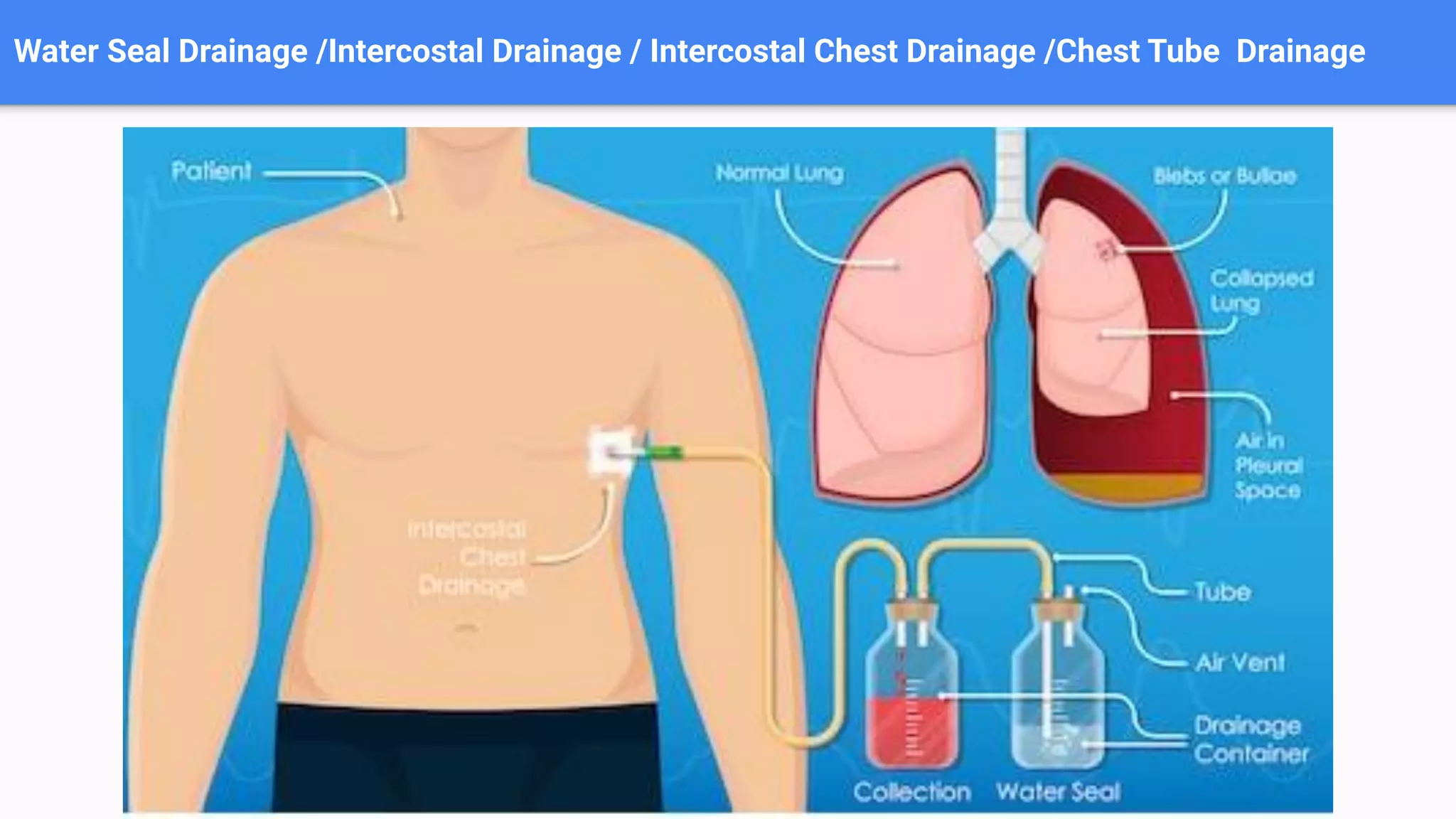
Water seal drainage is a closed chest drainage system used to allow air and fluid to escape from
the pleural space with each exhalation and to prevent their return flow with each inhalation. Chest
tube or ICD or intercostal chest drainage is the other name of it.
Water Seal Drainage /Intercostal Drainage / Intercostal Chest Drainage /Chest Tube Drainage
Purposes and Indications for Water Seal/Intercostal /Chest Tube Drainage
In water seal drainage system the water seals off atmospheric air thus prevents entry of air or fluid back
into the pleural space and the fluids and gas in the pleural space is allowed to escape/drain through the
tubing, ensuring the essential negative pressure inside the pleura, so we can precisely state the main
purposes are as follows:
● To permit drainage of air and excess fluid from the pleural cavity.
● To establish normal negative pressure in the pleural cavity for lung expansion.
● To equalize pressure on both sides of the thoracic cavity.
● This assists in the re expansion of remaining lung tissue.
● To provide continuous suction to prevent tension pneumothorax.
Indications:
● Pneumothorax.
○ Traumatic pneumothorax.
○ Hemopneumothorax.
○ Spontaneous pneumothorax.
○ Iatrogenic pneumothorax.
● Bronchopleural fistula.
● Emphysema.
● Pleural effusion.
● Blebs and bullae in lungs.
● Surgeries
○ Thoracic Surgeries/open heart
surgeries.
○ Thoraco-abdominal surgeries.
● Malignancy
Contraindications and tube insertion site for Water Seal/Chest Tube Drainage/ICD
Contra Indications:
● Coagulopathy( Clotting disorders).
● Diaphragmatic hernia.
● Scarring of pleural space (adhesion).
Site of chest tube insertion: Site of chest tube insertion varies according to indications,
underlying Principle is : Air and gas Rises upwards and Fluid gravitates/settle downwards.
● To free the air in the pleural space (Pneumothorax): the tube is placed above the 2nd (or 3rd)
intercostal space along the midclavicular or the anterior axillary line.
● To free the fluids in the pleural space: (e.g.: Hemothorax ,pleural effusion).
● Fluids gravitate to the most dependent point, tubes placed at the 4th to 5th intercostal space.
● Mediastinal tubes are put in place after cardiac surgery to drain fluid around heart.
● Two tubes are placed in cardiothoracic surgeries: one anterior chest tube at upper/anterior
chest wall inserted in the 2nd intercostal space to remove the air arising from the pleural cavity
and the second one, posterior chest tube placed at the posterior chest in the 8th or 9th
intercostal space at the mid-axillary line, to remove serosanguineous fluid from the lower area
of pleural cavity. Diameter of tube in the lower section is wider or longer compare to the upper
tube.
Complications of Water Seal/Intercostal /Chest Tube Drainage
Acute Complications:
● Hemothorax, usually from laceration of intercostals vessel (may require thoracotomy)
● Lung laceration (placed too deep).
● Diaphragm / Abdominal cavity penetration (placed too low).
● Tube placed subcutaneously (not in thoracic cavity).
● Tube placed too far (pain).
● Tube falls out (not secured).
Late Complications:
● Blocked tube (clot).
● Empyema (collection of pus within a naturally existing anatomical cavity, such as the lung pleura)
infection.
● Pneumothorax after removal (poor technique).
Insertion of Chest tube and Chest Drainage Systems: Procedure.
Insertion of Chest tube is done by surgeon or physician. Patient preparation and the article
arrangement are comes under nurses responsibility.
● The skin is prepared and anesthetized using local anesthetic with a short 25 G needle.
● The needle catheter is inserted through the needle into the pleural space.
● A small incision through the muscle in the intercostal space is performed.
● chest tube is inserted into the pleural space and connected to a drainage system.
● The catheter is attached to a connector/tubing and attached to drainage system
(underwater-seal or commercial system).
● The tube is sutured in place and covered with a sterile dressing.
Chest Drainage Systems: There are mainly 4 type systems of water seal drainage:
1. The single bottle system,
2. The two bottle system,
3.The three bottle System and
4. Pleurovac/ commercial drainage system:
Insertion of Chest tube ( done by surgen or physician )
The Single-Bottle Water-Seal System
(1) Connecting or drainage tubing joins the
patient's chest tube with a drainage tube that
enters the drainage bottle.
(2) The end of the glass rod is submerged in
water, extending about 2-3 cm below the
water level(The higher the fluid level, the
more pressure it takes to push air through
the fluid as it leaves the chest).
(3) The water seal provides a low-resistance,
one-way valve that allows air to leave the
chest while preventing atmospheric air from
being pulled into the chest during breathing.
(4) Drainage depends upon gravity.
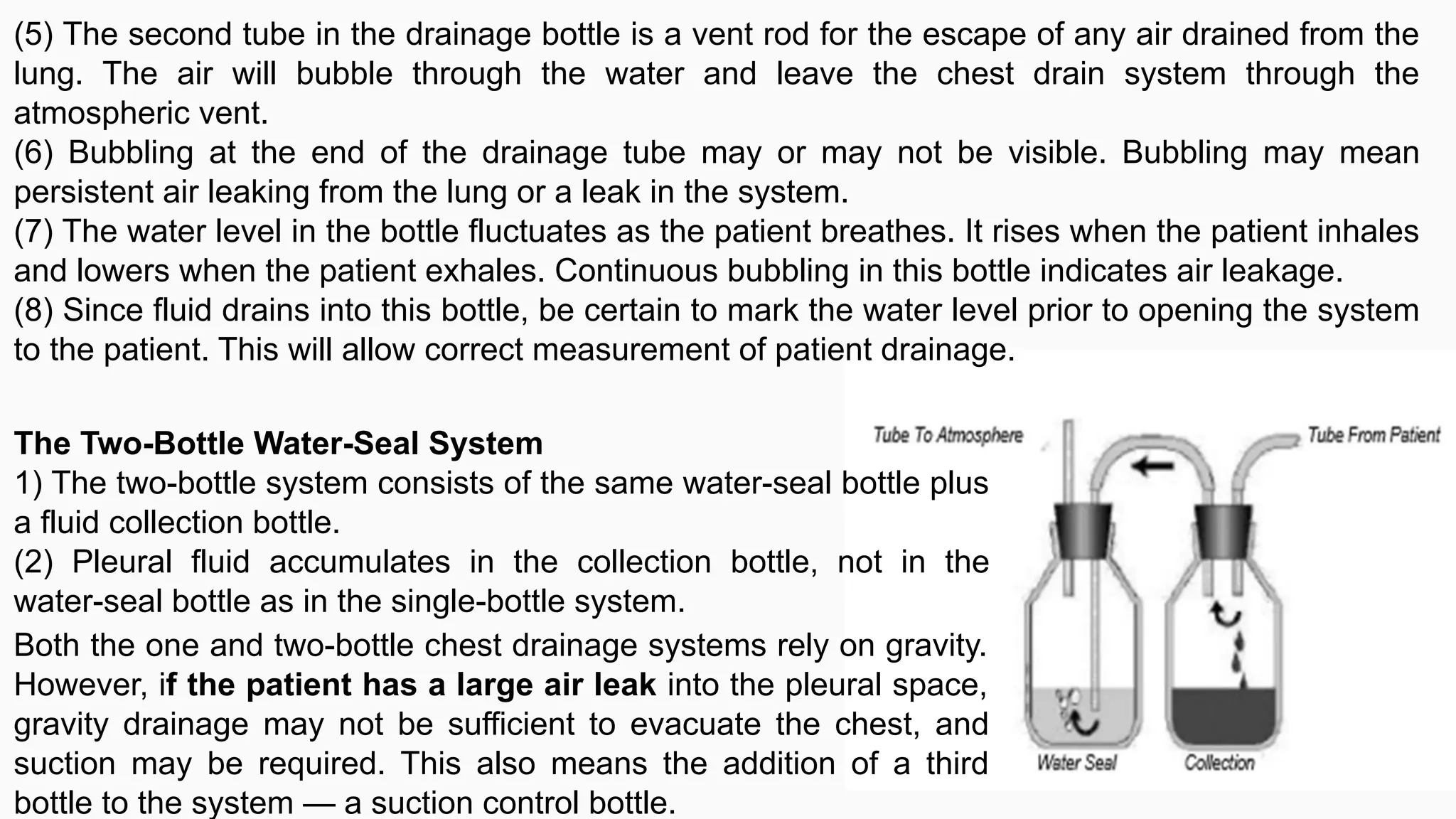
The Two-Bottle Water-Seal System
1) The two-bottle system consists of the same water-seal bottle plus
a fluid collection bottle.
(2) Pleural fluid accumulates in the collection bottle, not in the
water-seal bottle as in the single-bottle system.
Both the one and two-bottle chest drainage systems rely on gravity.
However, if the patient has a large air leak into the pleural space,
gravity drainage may not be sufficient to evacuate the chest, and
suction may be required. This also means the addition of a third
bottle to the system — a suction control bottle.
(5) The second tube in the drainage bottle is a vent rod for the escape of any air drained from the
lung. The air will bubble through the water and leave the chest drain system through the
atmospheric vent.
(6) Bubbling at the end of the drainage tube may or may not be visible. Bubbling may mean
persistent air leaking from the lung or a leak in the system.
(7) The water level in the bottle fluctuates as the patient breathes. It rises when the patient inhales
and lowers when the patient exhales. Continuous bubbling in this bottle indicates air leakage.
(8) Since fluid drains into this bottle, be certain to mark the water level prior to opening the system
to the patient. This will allow correct measurement of patient drainage.
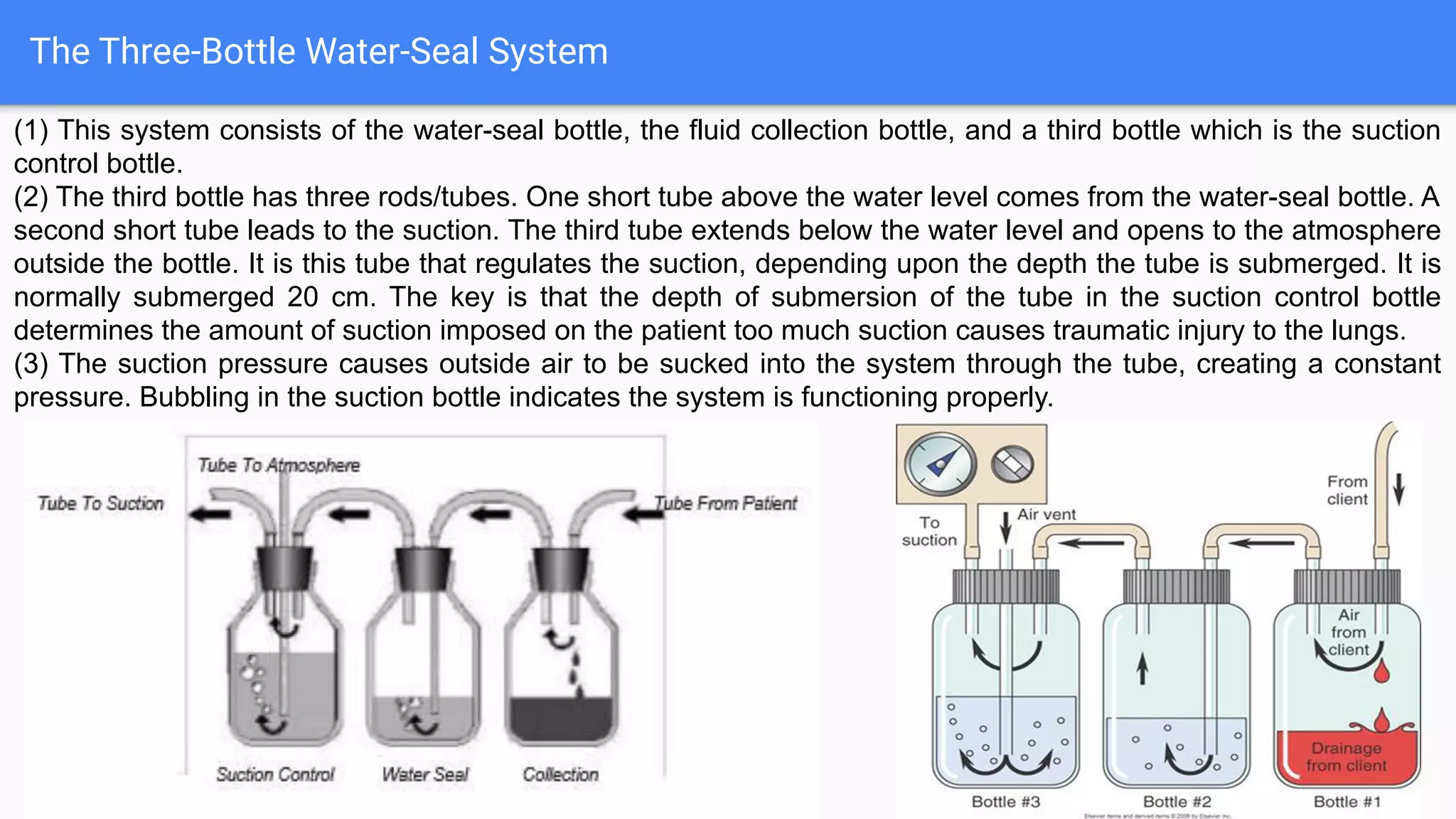
The Three-Bottle Water-Seal System
(1) This system consists of the water-seal bottle, the fluid collection bottle, and a third bottle which is the suction
control bottle.
(2) The third bottle has three rods/tubes. One short tube above the water level comes from the water-seal bottle. A
second short tube leads to the suction. The third tube extends below the water level and opens to the atmosphere
outside the bottle. It is this tube that regulates the suction, depending upon the depth the tube is submerged. It is
normally submerged 20 cm. The key is that the depth of submersion of the tube in the suction control bottle
determines the amount of suction imposed on the patient too much suction causes traumatic injury to the lungs.
(3) The suction pressure causes outside air to be sucked into the system through the tube, creating a constant
pressure. Bubbling in the suction bottle indicates the system is functioning properly.
PRINCIPLES OF WATER SEAL/CHEST TUBE DRAINAGE.
Water seal drainage /or chest tube drainage is working centred on three principles:
● Gravity :
○ Gravity Enhances flow from high to low.
○ To take this advantage chest drain is placed below client’s bed(chest level ) at a particular height.
● Water seal :
○ Is a barrier to prevents backflow into pleural space.
○ Made with help of two adjustable glass rods fixed on a airtight bottle lid.
○ Chest tube side rod – depth determines the negative pressure.(2-4cm generally in single bottle.)
○ Air bubbles is released through the chest tube rod.
○ Air vent side rod – to allow drained air to escape to prevent pressure build up.
● Suction: It is s a pulling force over an area produced by or resulted from a pressure difference.
○ Purpose for the suction is, when :
○ Gravity drainage is not enough.
○ Patient’s respiration and cough are too weak .
○ Air leak is fast into the pleural space.
○ Need to speed up removal of fluid/gas from pleural space.
Factors affecting water seal drainage:
● Proper placement of chest catheter
● Proper placement of chest drainage apparatus
● Maintenance of air tight drainage system
● Length of drainage tubing
1. Proper placement of chest catheter: Anterior and posterior respectively at 2 & 3rd intercostal space
and 8 & 9th intercostal space. These catheters should be connected to the separate bottle. When there
is single tube it is usually placed in lower intercostal space.
2. Proper placement of drainage apparatus : Drainage apparatus should be placed at lower level than
the chest, It helps in gravity and also prevent the backflow of air and fluid into pleural cavity. While
transferring patient apparatus should be placed over the bed or trolley after clamping the tubing at two
place.
3. Length of drainage tubing: Drainage tubing neither too short nor too long. It should fall in straight line
to the drainage system. There should not be any loop of drainage tubing. Too short drainage tubing may
restrict the movement of patient on bed or it may get disconnected from the catheter.
● Patency of chest tubing
● Position of the client
● Application of mechanical suction
● Activity of the client.
Factors affecting water seal drainage:
4. Patency of chest tubing: Patency of chest tube should be checked frequently. Any kink or pressure over
chest tubing may obstruct the flow from pleural space, Ensure that patient is not lying over the tubing, Any
clot or mucus plug in pleural space may also obstruct the flow. Milking the tube helps to dislodge the plug.
Never clamp the tubing until it is necessary.
5. Maintenance of air tight drainage system: Drainage system should be air tight with stoppers and all the
tubing should be taped well.
6. Position of the client: Fowler’s position is preferred. So that fluid can be localized in lower pleural space
and can be drained out easily.
7. Application of mechanical suction : Continuous and gentle suction is used when :
● gravity drainage is not enough.
● patient’s respiration and cough are too weak
● air leak is fast into the pleural space
● need to speed up removal from pleural space
8. Activity of the client: Movement of the patient on bed helps the fluid to drain from chest. Patient should be
encouraged to cough and deep breath. Which helps in rising the intrapleural and intrapulmonary pressure.
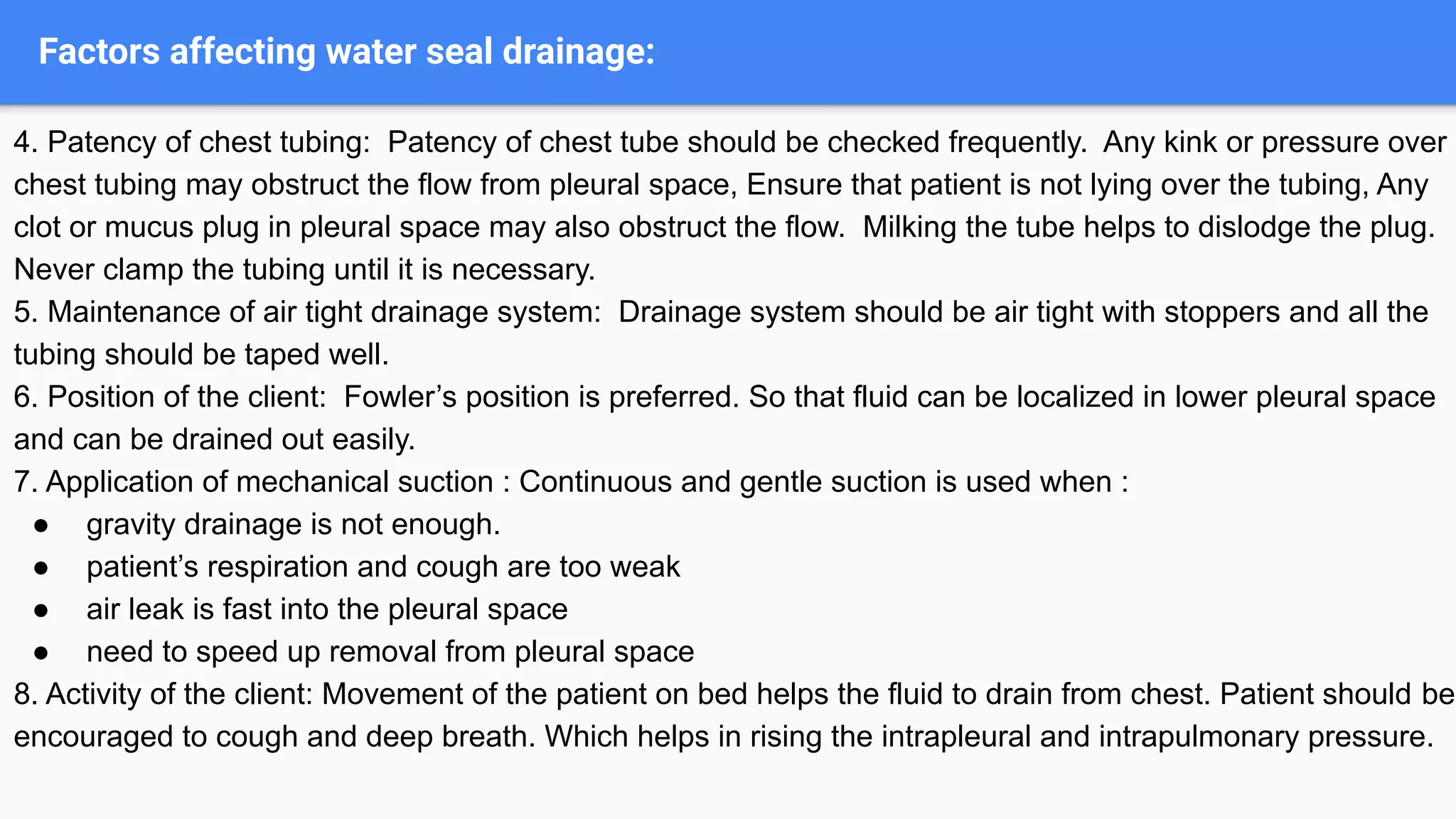
Pleurovac/ Commercial drainage system
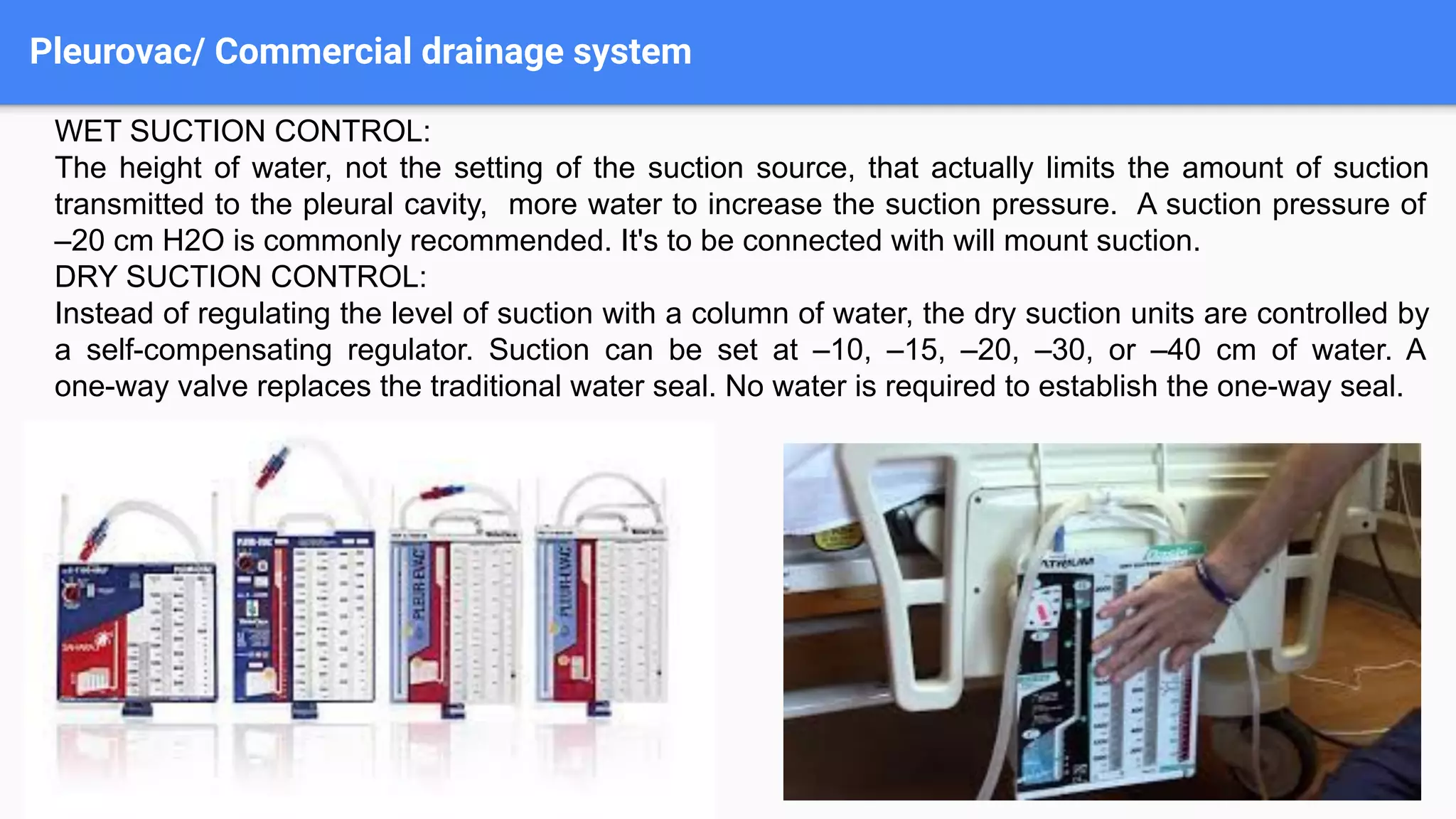
WET SUCTION CONTROL:
The height of water, not the setting of the suction source, that actually limits the amount of suction
transmitted to the pleural cavity, more water to increase the suction pressure. A suction pressure of
–20 cm H2O is commonly recommended. It's to be connected with will mount suction.
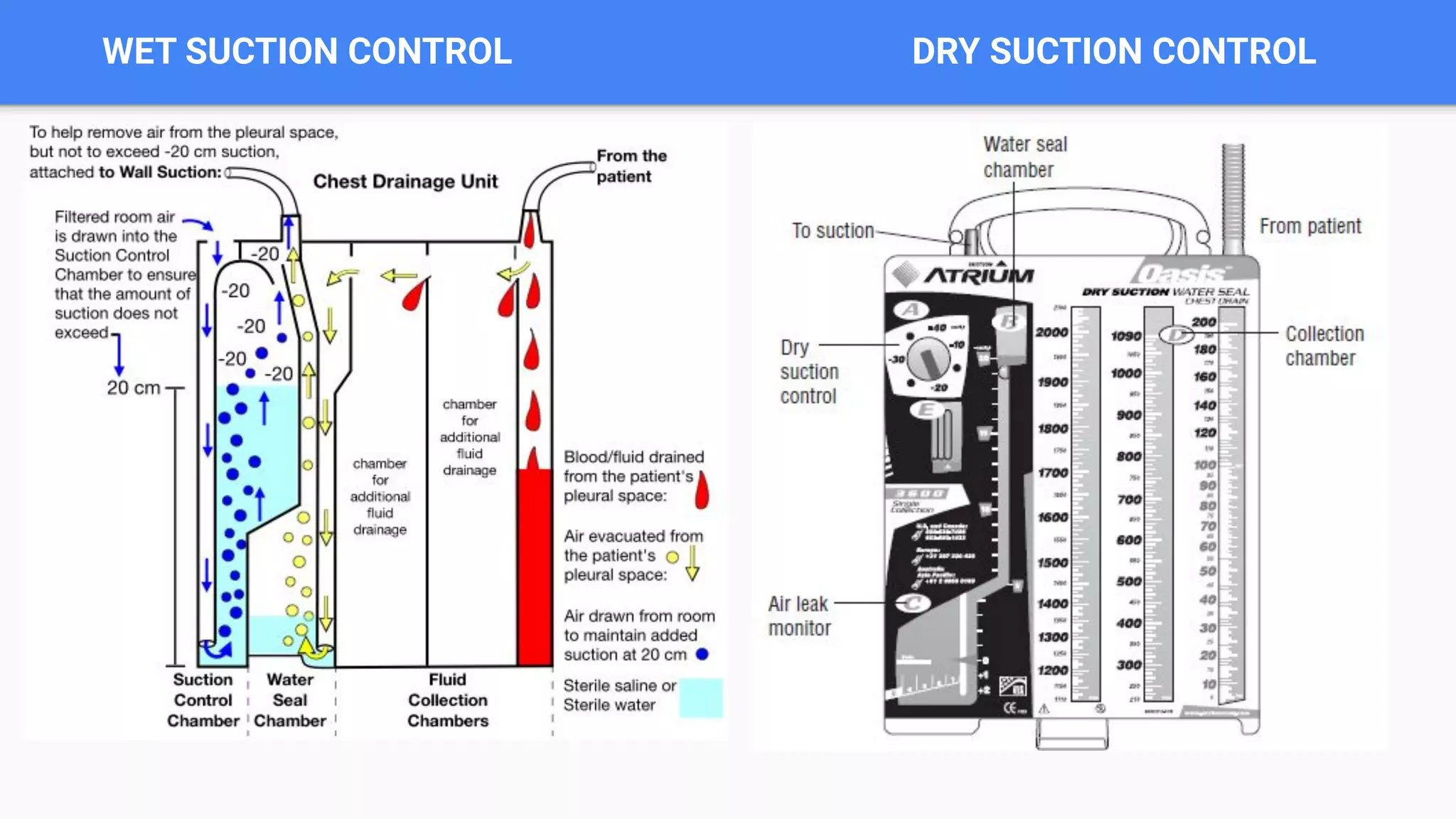
DRY SUCTION CONTROL:
Instead of regulating the level of suction with a column of water, the dry suction units are controlled by
a self-compensating regulator. Suction can be set at –10, –15, –20, –30, or –40 cm of water. A
one-way valve replaces the traditional water seal. No water is required to establish the one-way seal.
WET SUCTION CONTROL DRY SUCTION CONTROL
Nursing Responsibilities
Nursing Responsibilities: Criteria for good functioning of water seal drainage apparatus
● Observe for the fluctuating movement of fluid inside the tubing
● Observe the chest drainage Watch for bubbling in water seal bottle (intermittent bubbling is normal)
● Know the reasons for malfunction of suction are-
○ Air leaking into the pleural space
○ Air leaking into the drainage apparatus
○ Mechanical problem to the pump.
○ water level should be at 2 cm mark
Nursing Responsibilities: Nursing care of the patient with water seal drainage
● As a nurse we should have proper knowledge of purpose, principles, equipments used and early
sign and symptoms of complication of water seal drainage.
● Instruct the client and bystanders how to clamp the drainage in emergency situation and how to
handle the water seal drainage. You will apply clamp for the following reasons:
○ Prior to removing chest tube to determine if patient can do without chest tube(s).
○ Assessing for air leak (clamp only briefly)
○ Changing the chest drainage unit (clamp only briefly)
○ Performing physician-ordered procedure.
○ Some instances when sudden large volumes of fluid are evacuated.
○ Warning: Leaving chest tube clamped caused a tension pneumothorax and mediastinal shift.
Nursing Responsibilities (continued.. )
Nursing Responsibilities Nursing care of the patient with water seal drainage
● Assess for pain and cardiopulmonary statues of the patient and vitals every 2 hrs.Teach the same if
bystanders are competent enough.
● Monitor characteristics of drainage fluid in color , amount, & consistency & marked significant
increase or decrease out put.
● Assess suction control system for air bubbling & at level ordered.
● Monitor air leak: Water seal is a window into the pleural space.If air is leaving the chest, bubbling
will be seen here. If worsens (continuous) or occurs in absence of pneumothorax may indicate air
leak.
● Sutured site should be well padded and secured with adhesive tapes. Assess actual chest tube
insertion site for signs of infection.
● Change dressing every other day or when ordered.
● 2 Clamp or hemostat clamp should be readily available near to the patient.
● Never clamp the chest tubing until it is necessary or ordered by the physician.
● Apparatus of chest drainage should be kept lower than the chest level of the patient.
● During transportation clamp the tubing and keep the apparatus top of the bed.
● Make sure that position of the client should not exert pressure over the chest tubing.
● Chest tubing neither too short nor too long.
● Do not use pins to secure the tubing with bed.
Nursing Responsibilities
● Check the patency of chest tubing regularly.
● Ensure the air tightening of the chest drainage
● Follow the strict aseptic technique
● Encourage the deep breathing and coughing exercises
● Ensure that tubes are immersed in water well to create water seal drainage.
● Assess the proper functioning of the water seal drainage
● While replacing the chest drainage bottle follow these instructions.
● Assemble the bottle with tube and stopper and check their functioning.
● Clamp the chest tube near to the chest prior to disconnecting it.
● Disconnect the bottle and connect the new bottle but remember that chest tubing should not be
contaminated.
● Be certain that bottle/s are kept well below the chest level.
● Unclamp the chest tubing and check the functioning of the system.
● Observe the patient for any complication before leaving.
Specimen Collection
● At time of chest tube insertion, collect drainage in sterile container.
● If specimen required later:
○ cleanse with alcohol/chlorhexidine swab, let dry
○ crimp tubing below the port.
○ use 20 gauge needle, withdraw drainage from port and transfer to sterile container or
○ kink tubing, cleanse, aspirate fluid with 20 gauge needle, (the silicone tubing will reseal itself).
Nursing Responsibilities
● What to do if the chest tube becomes disconnected?
○ Clamp tube Using PPE (gloves)
○ Cleanse connector with Chlorhexidine 2%/70% /Alcohol solution
○ Reattach tube to system
○ Unclamp tube
○ Notify MD
● What to do if the Chest Tube Mistakenly Falls out???
○ Cover site with dry sterile dressing
○ Call physician If there is air leaking from site or the patient becomes distressed, leave one side of
dressing open to allow air to escape and prevent tension pneumothorax
○ Wear PPE
● Activity and transport:
○ Patient should be able to move comfortably in their room.
○ If air leak detected & depending on the size of air leak, your patient may be required to be connected
to suction at all times. (obtain a portable suction)
○ If no air leak, patients are able to leave their rooms and ambulate, without suction, provided a
doctor's order received
○ You will require a support for the chest drainage unit. DO NOT CLAMP the chest drainage system, as
air needs to escape.
○ Ensure atrium is below level of chest.
○ If unsure of suction requirements with mobility, contact Physician
Criteria or Indications of chest tube removal:
● One day after cessation of air leak.
● Drainage less than 50-100ml of fluid per day.
● 1-3 days post cardiac surgery.
● 2-6 days post thoracic surgery.
● Haemoserous drainage from around the chest tube insertion site
● Chest X-ray should reveal the re-expansion of lungs well.
○ Prior to removal of the water seal drainage system chest tubing should be clamped at least for two
hours.
○ After removal, wound should be covered with sterile petroleum gauze and firm dressing secured with
wide strip of adhesive tapes
○ Observe the patient for any respiratory distress post removal the water seal drainage system
Conclusion: If the essential negative pressure is not maintained with in the plural cavity the alveoli will gradually
collapse and lungs will shrink. It happens if there is bleeding, air, inflammation, surgery, To prevent that or
reverse that water seal drainage or the intercostal drainage is used.
Home work
During your assessment, you note
new bubbling in the water seal
chamber. Describe what you would
do to determine where this air leak
is from.
Home work
Answer
● Clamp the chest tube momentarily,
beginning at the patient. Look at the
chamber to see whether the bubbling
has stopped. If you clamp and the
bubbling goes away, the leak is
coming from the chest.
○ Action: reinforce dressing with
Jelonet, inform physician.
● If you clamp at the chest and the
bubbling persists, the leak is between
the clamp and the water seal
chamber.
○ Action: change tubing.
Learning
/answering hint.
One frequently asked question from
this topic is “ what ate the principles
of water seal drainage? “ you can
answer it directly by listing and
describing the three princples from
the content, and if the question is
for long answer add factors
influencing the water seal drainage
and some nurses responsibility or
importance of knowing the
principles.
Thankyou
● to the one who made it easy.
●
● to the one from whom i understood it.
●
● to the one who attempt to understand it.
●
● to the one taxed for my time and effort.
●
● to the one who corrected it further.
●
● to the one who executes this idea.
●
● to the one who share it further.
●
● to the one who is missed out.

Medical surgical nursing topic ,intercostal drainage or water seal drainage or chest tube drainage and nursing principles of water seal drainage ,chest tube ,intercostal chest drainage and nursing responsibilities

  • 1.
    Water Seal /Chest Tube Drainage Prepared and presented by Mr.Sarathchandran M.B Nursing Tutor. Swami Vivekananda College Of Nursing. Udgir, Maharashtra.
  • 2.
    Water Seal /ChestTube Drainage Subject: Medical Surgical Nursing -1 Unit: III Topic: Water Seal/Intercostal /Chest Tube Drainage Time duration: 60 Minutes Group: B.Sc Nursing IV Year
  • 3.
    Water Seal orChest tube Drainage General objective:After going through this content thoroughly the students will have more confidence to deal people with water seal drainage. Specific Objective: After the lecture as per plan students will be able to ● Define water seal drainage. ● Indications for it. ● Chest tube insertion site ● Types and mechanism of ICD ● Nurses responsibility in caring clients with ICD Reference: https://www.kau.edu.sa/Files/0012869/Subjects/underwaterseal%20Bridging-Sohad2014.pdf https://www.slideshare.net/aashishparihar/water-seal-drainage?qid=8740e4e6-3f22-4665-9b29-d3d80a158169&v=&b=&fro m_search=1
  • 4.
    Content ● Introduction anddefinition ● Purpose of Indications ● Contraindications & complications. ● Site and Insertion if ICD ● Types of ICD ● Principles of ICD ● Factors affecting ICD ● Nurses responsibility ICD ○ Care of apparatus. ○ Caring patients with ICD ○ Specimen collection from ICD ○ Disconnected tube. ○ Accidental fall out of ICD ○ Transport of cliet with ICD ○ Removal of ICD
  • 5.
    10 mins Introduction and definitions,Indications. 10mins Site and insertion of ICD Types of ICD 15 mins Principles and Factors affecting ICD 20 mins Nurses Responsibility with ICD clients 5 mins Removal of ICD and conclusion
  • 6.
    INTRODUCTION AND DEFINITION Whatdoes water seal mean? A seal or trap formed by a small amount of water (liquid) to prevent the passage of gas to the other side as the seal it acts as a one-way valve. The best example is the foul gas lock system of commonly used sanitary toilets. What is Drainage system? In medicine, drainage refers to the removal , taking or letting out of fluids and/or gases from a body part. Examples include thoracentesis, paracentesis, incision and drainage(I/D or I&D)etc.,Approaches or system conventionally followed for it refers to drainage system. Why is a water seal is important in drainage systems ? When a water seal arranged in a specific way it acts as a one-way valve: it allows air to exit through the system while preventing air from re-entering in to the system, applied mainly to the pleural space, where the accumulation of air could lead to pneumothorax. How to Define Water seal drainage system? Water seal drainage is a closed chest drainage system used to allow air and fluid to escape from the pleural space with each exhalation and to prevent their return flow with each inhalation. Chest tube or ICD or intercostal chest drainage is the other name of it.
  • 7.
    Water Seal Drainage/Intercostal Drainage / Intercostal Chest Drainage /Chest Tube Drainage
  • 8.
    Purposes and Indicationsfor Water Seal/Intercostal /Chest Tube Drainage In water seal drainage system the water seals off atmospheric air thus prevents entry of air or fluid back into the pleural space and the fluids and gas in the pleural space is allowed to escape/drain through the tubing, ensuring the essential negative pressure inside the pleura, so we can precisely state the main purposes are as follows: ● To permit drainage of air and excess fluid from the pleural cavity. ● To establish normal negative pressure in the pleural cavity for lung expansion. ● To equalize pressure on both sides of the thoracic cavity. ● This assists in the re expansion of remaining lung tissue. ● To provide continuous suction to prevent tension pneumothorax. Indications: ● Pneumothorax. ○ Traumatic pneumothorax. ○ Hemopneumothorax. ○ Spontaneous pneumothorax. ○ Iatrogenic pneumothorax. ● Bronchopleural fistula. ● Emphysema. ● Pleural effusion. ● Blebs and bullae in lungs. ● Surgeries ○ Thoracic Surgeries/open heart surgeries. ○ Thoraco-abdominal surgeries. ● Malignancy
  • 9.
    Contraindications and tubeinsertion site for Water Seal/Chest Tube Drainage/ICD Contra Indications: ● Coagulopathy( Clotting disorders). ● Diaphragmatic hernia. ● Scarring of pleural space (adhesion). Site of chest tube insertion: Site of chest tube insertion varies according to indications, underlying Principle is : Air and gas Rises upwards and Fluid gravitates/settle downwards. ● To free the air in the pleural space (Pneumothorax): the tube is placed above the 2nd (or 3rd) intercostal space along the midclavicular or the anterior axillary line. ● To free the fluids in the pleural space: (e.g.: Hemothorax ,pleural effusion). ● Fluids gravitate to the most dependent point, tubes placed at the 4th to 5th intercostal space. ● Mediastinal tubes are put in place after cardiac surgery to drain fluid around heart. ● Two tubes are placed in cardiothoracic surgeries: one anterior chest tube at upper/anterior chest wall inserted in the 2nd intercostal space to remove the air arising from the pleural cavity and the second one, posterior chest tube placed at the posterior chest in the 8th or 9th intercostal space at the mid-axillary line, to remove serosanguineous fluid from the lower area of pleural cavity. Diameter of tube in the lower section is wider or longer compare to the upper tube.
  • 10.
    Complications of WaterSeal/Intercostal /Chest Tube Drainage Acute Complications: ● Hemothorax, usually from laceration of intercostals vessel (may require thoracotomy) ● Lung laceration (placed too deep). ● Diaphragm / Abdominal cavity penetration (placed too low). ● Tube placed subcutaneously (not in thoracic cavity). ● Tube placed too far (pain). ● Tube falls out (not secured). Late Complications: ● Blocked tube (clot). ● Empyema (collection of pus within a naturally existing anatomical cavity, such as the lung pleura) infection. ● Pneumothorax after removal (poor technique).
  • 11.
    Insertion of Chesttube and Chest Drainage Systems: Procedure. Insertion of Chest tube is done by surgeon or physician. Patient preparation and the article arrangement are comes under nurses responsibility. ● The skin is prepared and anesthetized using local anesthetic with a short 25 G needle. ● The needle catheter is inserted through the needle into the pleural space. ● A small incision through the muscle in the intercostal space is performed. ● chest tube is inserted into the pleural space and connected to a drainage system. ● The catheter is attached to a connector/tubing and attached to drainage system (underwater-seal or commercial system). ● The tube is sutured in place and covered with a sterile dressing. Chest Drainage Systems: There are mainly 4 type systems of water seal drainage: 1. The single bottle system, 2. The two bottle system, 3.The three bottle System and 4. Pleurovac/ commercial drainage system:
  • 12.
    Insertion of Chesttube ( done by surgen or physician )
  • 13.
    The Single-Bottle Water-SealSystem (1) Connecting or drainage tubing joins the patient's chest tube with a drainage tube that enters the drainage bottle. (2) The end of the glass rod is submerged in water, extending about 2-3 cm below the water level(The higher the fluid level, the more pressure it takes to push air through the fluid as it leaves the chest). (3) The water seal provides a low-resistance, one-way valve that allows air to leave the chest while preventing atmospheric air from being pulled into the chest during breathing. (4) Drainage depends upon gravity.
  • 14.
    The Two-Bottle Water-SealSystem 1) The two-bottle system consists of the same water-seal bottle plus a fluid collection bottle. (2) Pleural fluid accumulates in the collection bottle, not in the water-seal bottle as in the single-bottle system. Both the one and two-bottle chest drainage systems rely on gravity. However, if the patient has a large air leak into the pleural space, gravity drainage may not be sufficient to evacuate the chest, and suction may be required. This also means the addition of a third bottle to the system — a suction control bottle. (5) The second tube in the drainage bottle is a vent rod for the escape of any air drained from the lung. The air will bubble through the water and leave the chest drain system through the atmospheric vent. (6) Bubbling at the end of the drainage tube may or may not be visible. Bubbling may mean persistent air leaking from the lung or a leak in the system. (7) The water level in the bottle fluctuates as the patient breathes. It rises when the patient inhales and lowers when the patient exhales. Continuous bubbling in this bottle indicates air leakage. (8) Since fluid drains into this bottle, be certain to mark the water level prior to opening the system to the patient. This will allow correct measurement of patient drainage.
  • 15.
    The Three-Bottle Water-SealSystem (1) This system consists of the water-seal bottle, the fluid collection bottle, and a third bottle which is the suction control bottle. (2) The third bottle has three rods/tubes. One short tube above the water level comes from the water-seal bottle. A second short tube leads to the suction. The third tube extends below the water level and opens to the atmosphere outside the bottle. It is this tube that regulates the suction, depending upon the depth the tube is submerged. It is normally submerged 20 cm. The key is that the depth of submersion of the tube in the suction control bottle determines the amount of suction imposed on the patient too much suction causes traumatic injury to the lungs. (3) The suction pressure causes outside air to be sucked into the system through the tube, creating a constant pressure. Bubbling in the suction bottle indicates the system is functioning properly.
  • 16.
    PRINCIPLES OF WATERSEAL/CHEST TUBE DRAINAGE. Water seal drainage /or chest tube drainage is working centred on three principles: ● Gravity : ○ Gravity Enhances flow from high to low. ○ To take this advantage chest drain is placed below client’s bed(chest level ) at a particular height. ● Water seal : ○ Is a barrier to prevents backflow into pleural space. ○ Made with help of two adjustable glass rods fixed on a airtight bottle lid. ○ Chest tube side rod – depth determines the negative pressure.(2-4cm generally in single bottle.) ○ Air bubbles is released through the chest tube rod. ○ Air vent side rod – to allow drained air to escape to prevent pressure build up. ● Suction: It is s a pulling force over an area produced by or resulted from a pressure difference. ○ Purpose for the suction is, when : ○ Gravity drainage is not enough. ○ Patient’s respiration and cough are too weak . ○ Air leak is fast into the pleural space. ○ Need to speed up removal of fluid/gas from pleural space.
  • 17.
    Factors affecting waterseal drainage: ● Proper placement of chest catheter ● Proper placement of chest drainage apparatus ● Maintenance of air tight drainage system ● Length of drainage tubing 1. Proper placement of chest catheter: Anterior and posterior respectively at 2 & 3rd intercostal space and 8 & 9th intercostal space. These catheters should be connected to the separate bottle. When there is single tube it is usually placed in lower intercostal space. 2. Proper placement of drainage apparatus : Drainage apparatus should be placed at lower level than the chest, It helps in gravity and also prevent the backflow of air and fluid into pleural cavity. While transferring patient apparatus should be placed over the bed or trolley after clamping the tubing at two place. 3. Length of drainage tubing: Drainage tubing neither too short nor too long. It should fall in straight line to the drainage system. There should not be any loop of drainage tubing. Too short drainage tubing may restrict the movement of patient on bed or it may get disconnected from the catheter. ● Patency of chest tubing ● Position of the client ● Application of mechanical suction ● Activity of the client.
  • 18.
    Factors affecting waterseal drainage: 4. Patency of chest tubing: Patency of chest tube should be checked frequently. Any kink or pressure over chest tubing may obstruct the flow from pleural space, Ensure that patient is not lying over the tubing, Any clot or mucus plug in pleural space may also obstruct the flow. Milking the tube helps to dislodge the plug. Never clamp the tubing until it is necessary. 5. Maintenance of air tight drainage system: Drainage system should be air tight with stoppers and all the tubing should be taped well. 6. Position of the client: Fowler’s position is preferred. So that fluid can be localized in lower pleural space and can be drained out easily. 7. Application of mechanical suction : Continuous and gentle suction is used when : ● gravity drainage is not enough. ● patient’s respiration and cough are too weak ● air leak is fast into the pleural space ● need to speed up removal from pleural space 8. Activity of the client: Movement of the patient on bed helps the fluid to drain from chest. Patient should be encouraged to cough and deep breath. Which helps in rising the intrapleural and intrapulmonary pressure.
  • 19.
    Pleurovac/ Commercial drainagesystem WET SUCTION CONTROL: The height of water, not the setting of the suction source, that actually limits the amount of suction transmitted to the pleural cavity, more water to increase the suction pressure. A suction pressure of –20 cm H2O is commonly recommended. It's to be connected with will mount suction. DRY SUCTION CONTROL: Instead of regulating the level of suction with a column of water, the dry suction units are controlled by a self-compensating regulator. Suction can be set at –10, –15, –20, –30, or –40 cm of water. A one-way valve replaces the traditional water seal. No water is required to establish the one-way seal.
  • 20.
    WET SUCTION CONTROLDRY SUCTION CONTROL
  • 21.
    Nursing Responsibilities Nursing Responsibilities:Criteria for good functioning of water seal drainage apparatus ● Observe for the fluctuating movement of fluid inside the tubing ● Observe the chest drainage Watch for bubbling in water seal bottle (intermittent bubbling is normal) ● Know the reasons for malfunction of suction are- ○ Air leaking into the pleural space ○ Air leaking into the drainage apparatus ○ Mechanical problem to the pump. ○ water level should be at 2 cm mark Nursing Responsibilities: Nursing care of the patient with water seal drainage ● As a nurse we should have proper knowledge of purpose, principles, equipments used and early sign and symptoms of complication of water seal drainage. ● Instruct the client and bystanders how to clamp the drainage in emergency situation and how to handle the water seal drainage. You will apply clamp for the following reasons: ○ Prior to removing chest tube to determine if patient can do without chest tube(s). ○ Assessing for air leak (clamp only briefly) ○ Changing the chest drainage unit (clamp only briefly) ○ Performing physician-ordered procedure. ○ Some instances when sudden large volumes of fluid are evacuated. ○ Warning: Leaving chest tube clamped caused a tension pneumothorax and mediastinal shift.
  • 22.
    Nursing Responsibilities (continued..) Nursing Responsibilities Nursing care of the patient with water seal drainage ● Assess for pain and cardiopulmonary statues of the patient and vitals every 2 hrs.Teach the same if bystanders are competent enough. ● Monitor characteristics of drainage fluid in color , amount, & consistency & marked significant increase or decrease out put. ● Assess suction control system for air bubbling & at level ordered. ● Monitor air leak: Water seal is a window into the pleural space.If air is leaving the chest, bubbling will be seen here. If worsens (continuous) or occurs in absence of pneumothorax may indicate air leak. ● Sutured site should be well padded and secured with adhesive tapes. Assess actual chest tube insertion site for signs of infection. ● Change dressing every other day or when ordered. ● 2 Clamp or hemostat clamp should be readily available near to the patient. ● Never clamp the chest tubing until it is necessary or ordered by the physician. ● Apparatus of chest drainage should be kept lower than the chest level of the patient. ● During transportation clamp the tubing and keep the apparatus top of the bed. ● Make sure that position of the client should not exert pressure over the chest tubing. ● Chest tubing neither too short nor too long. ● Do not use pins to secure the tubing with bed.
  • 23.
    Nursing Responsibilities ● Checkthe patency of chest tubing regularly. ● Ensure the air tightening of the chest drainage ● Follow the strict aseptic technique ● Encourage the deep breathing and coughing exercises ● Ensure that tubes are immersed in water well to create water seal drainage. ● Assess the proper functioning of the water seal drainage ● While replacing the chest drainage bottle follow these instructions. ● Assemble the bottle with tube and stopper and check their functioning. ● Clamp the chest tube near to the chest prior to disconnecting it. ● Disconnect the bottle and connect the new bottle but remember that chest tubing should not be contaminated. ● Be certain that bottle/s are kept well below the chest level. ● Unclamp the chest tubing and check the functioning of the system. ● Observe the patient for any complication before leaving. Specimen Collection ● At time of chest tube insertion, collect drainage in sterile container. ● If specimen required later: ○ cleanse with alcohol/chlorhexidine swab, let dry ○ crimp tubing below the port. ○ use 20 gauge needle, withdraw drainage from port and transfer to sterile container or ○ kink tubing, cleanse, aspirate fluid with 20 gauge needle, (the silicone tubing will reseal itself).
  • 24.
    Nursing Responsibilities ● Whatto do if the chest tube becomes disconnected? ○ Clamp tube Using PPE (gloves) ○ Cleanse connector with Chlorhexidine 2%/70% /Alcohol solution ○ Reattach tube to system ○ Unclamp tube ○ Notify MD ● What to do if the Chest Tube Mistakenly Falls out??? ○ Cover site with dry sterile dressing ○ Call physician If there is air leaking from site or the patient becomes distressed, leave one side of dressing open to allow air to escape and prevent tension pneumothorax ○ Wear PPE ● Activity and transport: ○ Patient should be able to move comfortably in their room. ○ If air leak detected & depending on the size of air leak, your patient may be required to be connected to suction at all times. (obtain a portable suction) ○ If no air leak, patients are able to leave their rooms and ambulate, without suction, provided a doctor's order received ○ You will require a support for the chest drainage unit. DO NOT CLAMP the chest drainage system, as air needs to escape. ○ Ensure atrium is below level of chest. ○ If unsure of suction requirements with mobility, contact Physician
  • 25.
    Criteria or Indicationsof chest tube removal: ● One day after cessation of air leak. ● Drainage less than 50-100ml of fluid per day. ● 1-3 days post cardiac surgery. ● 2-6 days post thoracic surgery. ● Haemoserous drainage from around the chest tube insertion site ● Chest X-ray should reveal the re-expansion of lungs well. ○ Prior to removal of the water seal drainage system chest tubing should be clamped at least for two hours. ○ After removal, wound should be covered with sterile petroleum gauze and firm dressing secured with wide strip of adhesive tapes ○ Observe the patient for any respiratory distress post removal the water seal drainage system Conclusion: If the essential negative pressure is not maintained with in the plural cavity the alveoli will gradually collapse and lungs will shrink. It happens if there is bleeding, air, inflammation, surgery, To prevent that or reverse that water seal drainage or the intercostal drainage is used.
  • 26.
    Home work During yourassessment, you note new bubbling in the water seal chamber. Describe what you would do to determine where this air leak is from.
  • 27.
    Home work Answer ● Clampthe chest tube momentarily, beginning at the patient. Look at the chamber to see whether the bubbling has stopped. If you clamp and the bubbling goes away, the leak is coming from the chest. ○ Action: reinforce dressing with Jelonet, inform physician. ● If you clamp at the chest and the bubbling persists, the leak is between the clamp and the water seal chamber. ○ Action: change tubing.
  • 28.
    Learning /answering hint. One frequentlyasked question from this topic is “ what ate the principles of water seal drainage? “ you can answer it directly by listing and describing the three princples from the content, and if the question is for long answer add factors influencing the water seal drainage and some nurses responsibility or importance of knowing the principles.
  • 29.
    Thankyou ● to theone who made it easy. ● ● to the one from whom i understood it. ● ● to the one who attempt to understand it. ● ● to the one taxed for my time and effort. ● ● to the one who corrected it further. ● ● to the one who executes this idea. ● ● to the one who share it further. ● ● to the one who is missed out.