WATERSEAL DRAINAGE
Definition
Water seal drainage system is a closed
chest drainage system used to allow air
and fluid to escape from the plural space
with each exhalation and to prevent their
return flow with each inhalation.
Indication
1. Traumatic pneumothorax
2. Hemopneumothorax
3. Spontaneous pneumothorax
4. Iatrogenic pneumothorax
5. Broncho-pleural fistula
6. Emphysema
7. Malignancy
8. Pleural effusion
9. Thoracic or thoraco-abdominal surgeries
Purposes
• To permit drainage of air and fluid from
the pleural cavity
• To establish normal negative pressure in
the pleural cavity for lung expansion
• To equalize pressure on both sides of the
thoracic cavity
• To provide continuous suction to prevent
tension pneumothorax
Site for chest tube insertion
1. Thoracic surgery:- Two chest tube are inserted
• Anterior chest tube:
 Upper/anterior chest wall
 Inserted in the 2nd Intercostal space to remove the
air arising from the pleural cavity
• Posterior chest tube:
 Placed at the posterior chest in the 8th or 9th
Intercostal space at the mid-Axillary line.
 Indication to remove sero-sangeneous fluid at the
lower area of pleural cavity
 Diameter of tube in the lower section is wider or
longer compare to the upper tube.
Site for chest tube insertion
2.Pneumothorax :
Tube placed at the 2nd or 3rd Intercostal
space along mid- clavicle or anterior Axillary
line.
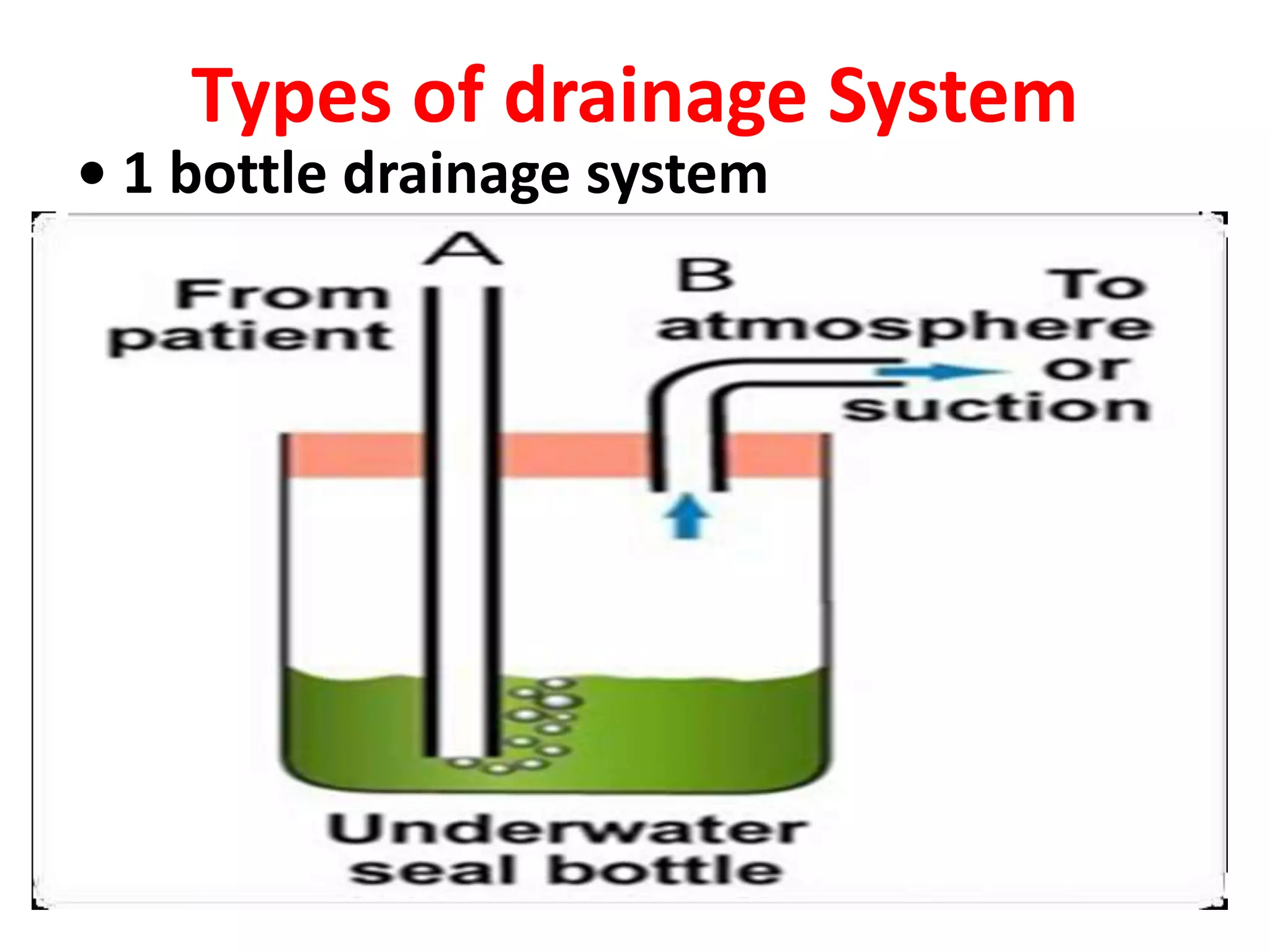
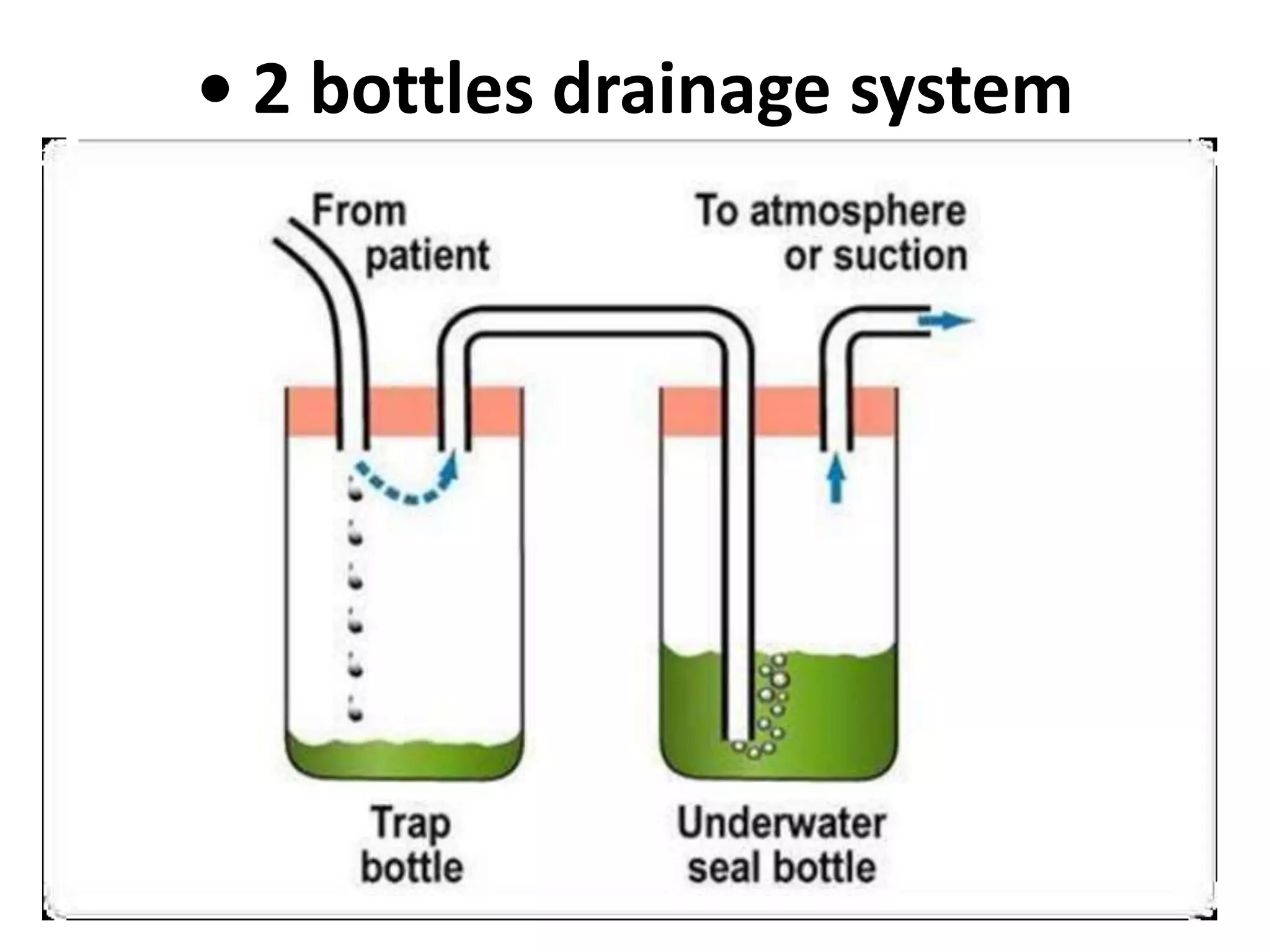
Types of drainage System
• 1 bottle drainage system
• 2 bottles drainage system
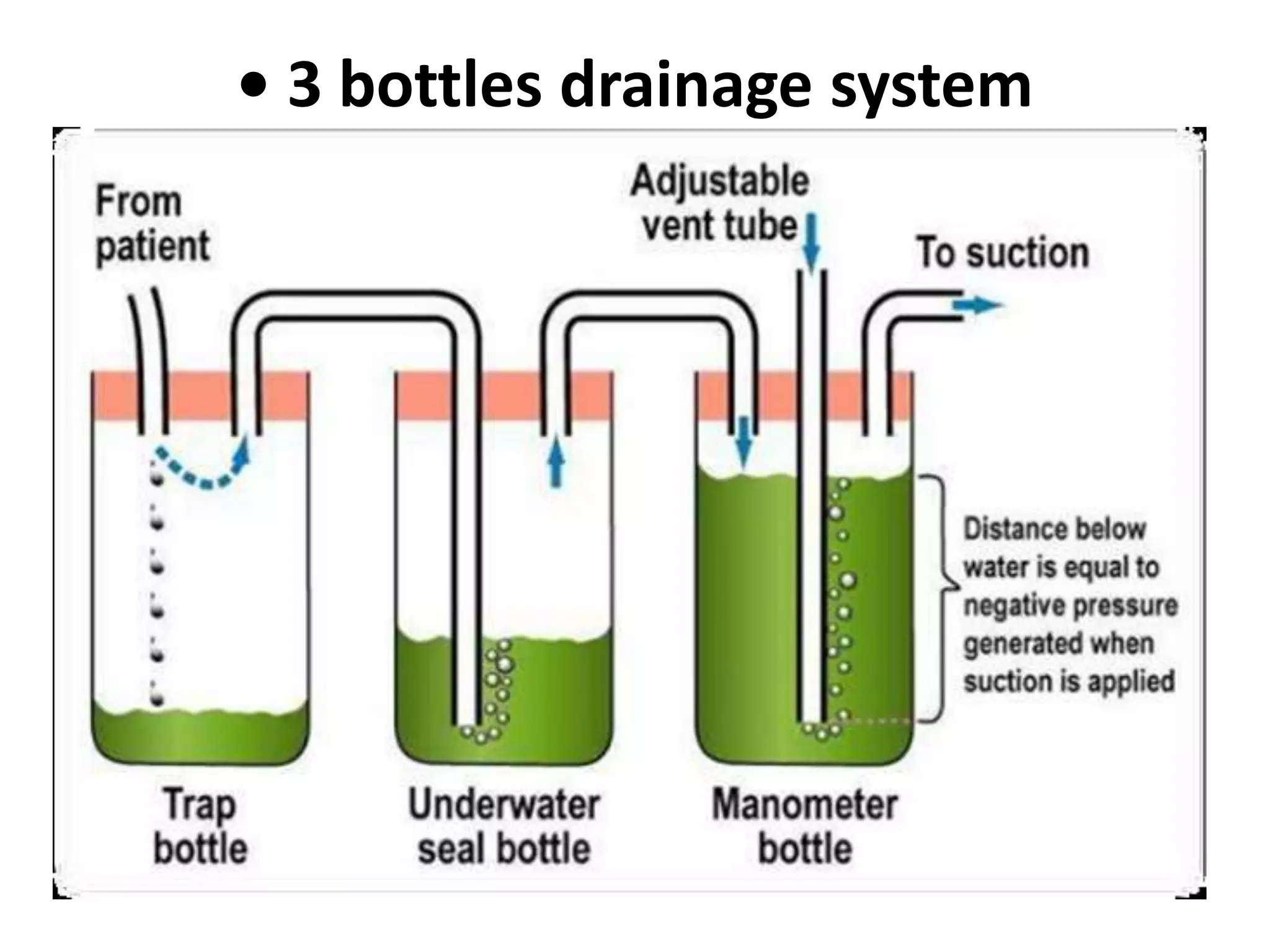
• 3 bottles drainage system
Principles of the chest tube
1. Gravity
• Enhances flow from high to low
Chest drain is placed below client’s
bed
2. Under water seal
• Is a barrier to prevents backflow into
pleural space.
• Rod – depth determines the negative
pressure
• Air bubbles is released through the rod
• Air vent – to allow drained air to
escape to prevent pressure build up
3. Suction
• Is a pull force
• MUST be in another bottle
• Purpose for the suction is, when :
gravity drainage is not enough.
 patient’s respiration and cough are too weak
air leak is fast into the pleural space ie. - need
to speed up removal from pleural space
Factors affecting water seal
drainage
1. Proper placement of chest catheter
2. Proper placement of chest drainage apparatus
3. Length of drainage tubing
4. Patency of chest tubing
5. Maintenance of air tight drainage system
6. Position of the client
7. Application of mechanical suction
8. Activity of the client
1. Proper placement of chest catheter
• 2 & 3rd intercostal space and 8 &9th
intercostal space
• These catheter should be connected to
the separate bottle
• When there is single tube it is usually
placed in lower intercostal space
2. Proper placement of drainage
apparatus
• Drainage apparatus should be placed at
lower level then the chest
• It helps in gravity and also prevent the
back flow of air and fluid into pleural cavity
• While transferring patient apparatus
should be placed over the bed or trolley
after clamping the tubing at two places
3. Length of drainage tubing
• Drainage tubing neither too short nor too long
• It should fall in straight line to the drainage
system
• There should not be any loop of drainage
tubing
• Too short drainage tubing may restrict the
movement of patient on bed or it may get
disconnected from the catheter
4. Patency of chest tubing
• Patency of chest tube should be checked
frequently
• Any kink or pressure over chest tubing may
obstruct the flow from pleural space
• Ensure that patient is not lying over the tubing
• Any clot or mucus plug in pleural space may also
obstruct the flow
• Milking the tube helps to dislodge the plug
• Never clamp the tubing until it is necessary.
5. Maintenance of air tight drainage
system
• Drainage system should be air tight with
stoppers and all the tubing should be taped
well
6. Position of the client
• Fowler’s position
• So that fluid can be localized in lower
pleural space and can be drained out easily
7. Application of mechanical
suction
• Continuous and gentle suction is used
when :
Gravity drainage is not enough.
Patient’s respiration and cough are too
weak
Air leak is fast into the pleural space
Need to speed up removal from pleural
space
8. Activity of the client
• Movement of the patient on bed helps
the fluid to drain from chest.
• Patient should be encouraged to cough
and deep breath (Breathing exercise).
• Which helps in rising the intra-pleural
and intra- pulmonary pressure
Nursing Responsibilities
• Criteria for good functioning of
water seal drainage apparatus
• Nursing care of the patient with
water seal drainage.
Criteria for good functioning of water
seal drainage apparatus
• Observe for the fluctuating movement of
fluid inside the tubing
• Observe the chest drainage
• Watch for bubbling in water seal bottle
(intermittent bubbling is normal)
Reason for mal function of suction are:
• Air leaking into the pleural space
• Air leaking into the drainage apparatus
• Mechanical problem to the pump.
Nursing care of the patient with
water seal drainage
• As a nurse we should have proper
knowledge of purpose, principles,
equipments used and early sign and
symptoms of complication of water seal
drainage.
• Instruct the client and bystanders how to
clamp the drainage in emergency situation
and how to handle the water seal drainage.
Cont….
Affix a sign board “do n. ot handle”
• • Sutured site should be well padded and
• secured with adhesive tapes
• • Clamp or hemostat clamp should be readily
• available near to the patient.
• • Never clamp the chest tubing until it is
• necessary or ordered by the physician
Cont….
• Apparatus of chest drainage should be kept
lower than the chest level of the patient
• During transportation clamp the tubing and
keep the apparatus top of the bed.
• Make sure that position of the client should
not exert pressure over the chest tubing.
• Chest tubing neither too short nor too long
Cont….
• Do not use pins to secure the tubing with bed
• Check the patency of chest tubing regularly
• Ensure the air tightening of the chest drainage
• Follow the strict aseptic technique
• Encourage the deep breathing and coughing
exercises
• Ensure that tubes are immersed in water well
to create water seal drainage
Instructions for replacing
1. Assemble the bottle with tube and
stopper and check their functioning
2. Clamp the chest tube near to the
chest prior to disconnecting it
3. Disconnect the bottle and connect
the new bottle but remember that
chest tubing should not be
contaminated
Cont…
4.Be certain that bottle/s are kept well
below the chest level
5. Unclamp the chest tubing and check the
functioning of the system
6. Observe the patient for any complication
before leaving.
Criteria for removal
1. Absence of air leak
2. Drained fluid is less than 75 ml/day
3. Chest X-ray should reveal the re-
expansion of lungs well contd..
Cont…
• Prior to removal of the water seal drainage
system chest tubing should be clamped at least
for two hours.
• After removal, wound should be covered with
sterile petroleum gauze and firm dressing
secured with wide strip of adhesive tapes
• Observe the patient for any respiratory distress
post removal the water seal drainage system
Reference
• Smeltzer – Brunner & Suddharth Textbook of
Medical Surgical Nursing, Wolters kluwer
publishers, 12th edition 2009.
• Black – Medical Surgical Nursing, Elsevier
publishers, 8th edition 2009.
• Nettina – Lippincott manual of Nursing
Practice, Wolters kluwer publishers, 7th edition
2014.
• Lewis – Medical Surgical Nursing, Elsevier
publishers, 10th edition, 2017
THANK
YOU

Water seal drainage ppt.pptx

  • 1.
  • 2.
    Definition Water seal drainagesystem is a closed chest drainage system used to allow air and fluid to escape from the plural space with each exhalation and to prevent their return flow with each inhalation.
  • 3.
    Indication 1. Traumatic pneumothorax 2.Hemopneumothorax 3. Spontaneous pneumothorax 4. Iatrogenic pneumothorax 5. Broncho-pleural fistula 6. Emphysema 7. Malignancy 8. Pleural effusion 9. Thoracic or thoraco-abdominal surgeries
  • 4.
    Purposes • To permitdrainage of air and fluid from the pleural cavity • To establish normal negative pressure in the pleural cavity for lung expansion • To equalize pressure on both sides of the thoracic cavity • To provide continuous suction to prevent tension pneumothorax
  • 5.
    Site for chesttube insertion 1. Thoracic surgery:- Two chest tube are inserted • Anterior chest tube:  Upper/anterior chest wall  Inserted in the 2nd Intercostal space to remove the air arising from the pleural cavity • Posterior chest tube:  Placed at the posterior chest in the 8th or 9th Intercostal space at the mid-Axillary line.  Indication to remove sero-sangeneous fluid at the lower area of pleural cavity  Diameter of tube in the lower section is wider or longer compare to the upper tube.
  • 6.
    Site for chesttube insertion 2.Pneumothorax : Tube placed at the 2nd or 3rd Intercostal space along mid- clavicle or anterior Axillary line.
  • 7.
    Types of drainageSystem • 1 bottle drainage system
  • 8.
    • 2 bottlesdrainage system
  • 9.
    • 3 bottlesdrainage system
  • 10.
    Principles of thechest tube 1. Gravity • Enhances flow from high to low Chest drain is placed below client’s bed
  • 11.
    2. Under waterseal • Is a barrier to prevents backflow into pleural space. • Rod – depth determines the negative pressure • Air bubbles is released through the rod • Air vent – to allow drained air to escape to prevent pressure build up
  • 12.
    3. Suction • Isa pull force • MUST be in another bottle • Purpose for the suction is, when : gravity drainage is not enough.  patient’s respiration and cough are too weak air leak is fast into the pleural space ie. - need to speed up removal from pleural space
  • 13.
    Factors affecting waterseal drainage 1. Proper placement of chest catheter 2. Proper placement of chest drainage apparatus 3. Length of drainage tubing 4. Patency of chest tubing 5. Maintenance of air tight drainage system 6. Position of the client 7. Application of mechanical suction 8. Activity of the client
  • 14.
    1. Proper placementof chest catheter • 2 & 3rd intercostal space and 8 &9th intercostal space • These catheter should be connected to the separate bottle • When there is single tube it is usually placed in lower intercostal space
  • 15.
    2. Proper placementof drainage apparatus • Drainage apparatus should be placed at lower level then the chest • It helps in gravity and also prevent the back flow of air and fluid into pleural cavity • While transferring patient apparatus should be placed over the bed or trolley after clamping the tubing at two places
  • 16.
    3. Length ofdrainage tubing • Drainage tubing neither too short nor too long • It should fall in straight line to the drainage system • There should not be any loop of drainage tubing • Too short drainage tubing may restrict the movement of patient on bed or it may get disconnected from the catheter
  • 17.
    4. Patency ofchest tubing • Patency of chest tube should be checked frequently • Any kink or pressure over chest tubing may obstruct the flow from pleural space • Ensure that patient is not lying over the tubing • Any clot or mucus plug in pleural space may also obstruct the flow • Milking the tube helps to dislodge the plug • Never clamp the tubing until it is necessary.
  • 18.
    5. Maintenance ofair tight drainage system • Drainage system should be air tight with stoppers and all the tubing should be taped well 6. Position of the client • Fowler’s position • So that fluid can be localized in lower pleural space and can be drained out easily
  • 19.
    7. Application ofmechanical suction • Continuous and gentle suction is used when : Gravity drainage is not enough. Patient’s respiration and cough are too weak Air leak is fast into the pleural space Need to speed up removal from pleural space
  • 20.
    8. Activity ofthe client • Movement of the patient on bed helps the fluid to drain from chest. • Patient should be encouraged to cough and deep breath (Breathing exercise). • Which helps in rising the intra-pleural and intra- pulmonary pressure
  • 21.
    Nursing Responsibilities • Criteriafor good functioning of water seal drainage apparatus • Nursing care of the patient with water seal drainage.
  • 22.
    Criteria for goodfunctioning of water seal drainage apparatus • Observe for the fluctuating movement of fluid inside the tubing • Observe the chest drainage • Watch for bubbling in water seal bottle (intermittent bubbling is normal) Reason for mal function of suction are: • Air leaking into the pleural space • Air leaking into the drainage apparatus • Mechanical problem to the pump.
  • 23.
    Nursing care ofthe patient with water seal drainage • As a nurse we should have proper knowledge of purpose, principles, equipments used and early sign and symptoms of complication of water seal drainage. • Instruct the client and bystanders how to clamp the drainage in emergency situation and how to handle the water seal drainage.
  • 24.
    Cont…. Affix a signboard “do n. ot handle” • • Sutured site should be well padded and • secured with adhesive tapes • • Clamp or hemostat clamp should be readily • available near to the patient. • • Never clamp the chest tubing until it is • necessary or ordered by the physician
  • 25.
    Cont…. • Apparatus ofchest drainage should be kept lower than the chest level of the patient • During transportation clamp the tubing and keep the apparatus top of the bed. • Make sure that position of the client should not exert pressure over the chest tubing. • Chest tubing neither too short nor too long
  • 26.
    Cont…. • Do notuse pins to secure the tubing with bed • Check the patency of chest tubing regularly • Ensure the air tightening of the chest drainage • Follow the strict aseptic technique • Encourage the deep breathing and coughing exercises • Ensure that tubes are immersed in water well to create water seal drainage
  • 27.
    Instructions for replacing 1.Assemble the bottle with tube and stopper and check their functioning 2. Clamp the chest tube near to the chest prior to disconnecting it 3. Disconnect the bottle and connect the new bottle but remember that chest tubing should not be contaminated
  • 28.
    Cont… 4.Be certain thatbottle/s are kept well below the chest level 5. Unclamp the chest tubing and check the functioning of the system 6. Observe the patient for any complication before leaving.
  • 29.
    Criteria for removal 1.Absence of air leak 2. Drained fluid is less than 75 ml/day 3. Chest X-ray should reveal the re- expansion of lungs well contd..
  • 30.
    Cont… • Prior toremoval of the water seal drainage system chest tubing should be clamped at least for two hours. • After removal, wound should be covered with sterile petroleum gauze and firm dressing secured with wide strip of adhesive tapes • Observe the patient for any respiratory distress post removal the water seal drainage system
  • 31.
    Reference • Smeltzer –Brunner & Suddharth Textbook of Medical Surgical Nursing, Wolters kluwer publishers, 12th edition 2009. • Black – Medical Surgical Nursing, Elsevier publishers, 8th edition 2009. • Nettina – Lippincott manual of Nursing Practice, Wolters kluwer publishers, 7th edition 2014. • Lewis – Medical Surgical Nursing, Elsevier publishers, 10th edition, 2017
  • 32.