Plant Ecology
important terms
M.SC BOTANY
ENVIRONMENTAL STUDIES
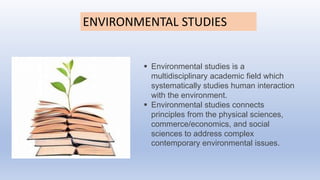
 Environmental studies is a
multidisciplinary academic field which
systematically studies human interaction
with the environment.
 Environmental studies connects
principles from the physical sciences,
commerce/economics, and social
sciences to address complex
contemporary environmental issues.
 Environment literally means Surrounding in
which we are living.
 Environment includes all those things on which
we are directly or indirectly dependent for our
survival, whether it is living component like
animals, plants or non living component like
soil, air water.
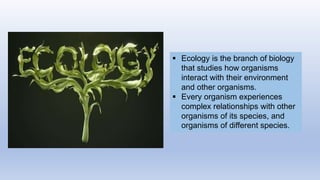
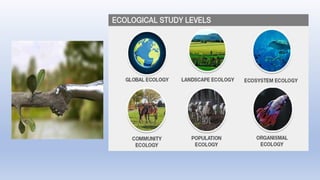
 Ecology is the branch of biology
that studies how organisms
interact with their environment
and other organisms.
 Every organism experiences
complex relationships with other
organisms of its species, and
organisms of different species.
1.It helps in environmental
conservation
2. Ensures proper resource allocation
3. Enhances energy conservation
4.It helps with disease and pest
control
5.It promotes eco-friendliness
6.It enhances energy conservation
ECOLOGY CONSERVATION
Conservation ecology is the
branch of ecology and
evolutionary biology that deals
with the preservation and
management of biodiversity
and natural resources.
The flow of energy through an ecosystem is called ecological
energetic. Energy is the ability to do some work. The sun emits
light and other types of radiation. Some of these radiations fall
on the earth.
The source of energy on the earth is the sun. A small amount of
the radiant energy is absorbed by the green plants. They
change this energy into chemical energy in the form of glucose.
All the other living organisms obtain this chemical energy from
the plants. A large amount of energy is lost in the form of heat.
ecological energetics
The bioenergetics is discuss under three headings;
(a) Productivity of ecosystem,
(b) Food chain, Trophic levels and food web and
(c) Ecological pyramids
Circadian rhythms
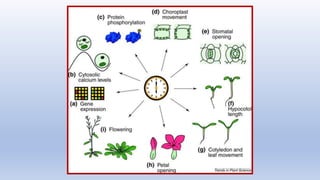
 Circadian rhythms regulate many aspects of plant physiology
including leaf, organ and stomatal movements, growth and
signalling. The genetic identity of some of the components of the
core circadian oscillator has recently become known.
 Circadian rhythms allow plants to cope with adverse
surroundings, as well as to synchronise themselves with
predictable changes, such as the change from day to night. The
circadian rhythm of an organism depends on their surrounding
environment.
 Cyclomorphosis (also known as seasonal polyphenism) is the name
given to the occurrence of cyclic or seasonal changes in
the phenotype of an organism through successive generations.
 It occurs in small aquatic invertebrates that reproduce
by parthenogenesis and give rise to several generations annually. It
occurs especially in marine planktonic animals, and is thought to be
caused by the epigenetic effect of environmental cues on the organism,
thereby altering the course of their development.
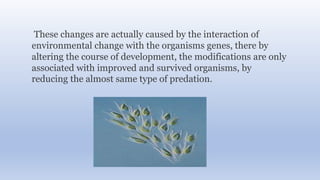
Cyclomorphosis
These changes are actually caused by the interaction of
environmental change with the organisms genes, there by
altering the course of development, the modifications are only
associated with improved and survived organisms, by
reducing the almost same type of predation.
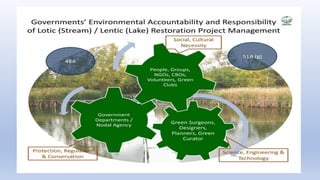
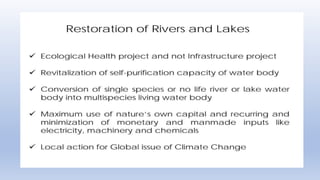
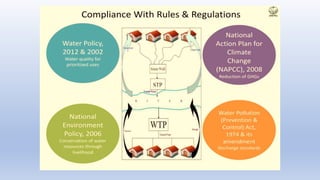
RESTORATION
ECOLOGY
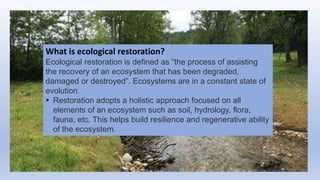
What is ecological restoration?
Ecological restoration is defined as “the process of assisting
the recovery of an ecosystem that has been degraded,
damaged or destroyed”. Ecosystems are in a constant state of
evolution.
 Restoration adopts a holistic approach focused on all
elements of an ecosystem such as soil, hydrology, flora,
fauna, etc. This helps build resilience and regenerative ability
of the ecosystem.
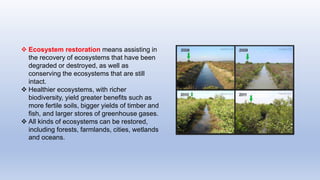
 Ecosystem restoration means assisting in
the recovery of ecosystems that have been
degraded or destroyed, as well as
conserving the ecosystems that are still
intact.
 Healthier ecosystems, with richer
biodiversity, yield greater benefits such as
more fertile soils, bigger yields of timber and
fish, and larger stores of greenhouse gases.
 All kinds of ecosystems can be restored,
including forests, farmlands, cities, wetlands
and oceans.
Beyond conservation, why our natural ecosystems need restoration
• Ecosystem degradation has emerged as one of the biggest
environmental threats around the world over the last three
decades.
• Traditional approaches to ecological conservation focus on
protecting and keeping natural spaces inviolate.
• Many of our ecosystems today are damaged beyond
unassisted self-recovery.
• We are, therefore, in a situation where conservation alone is
no longer enough.
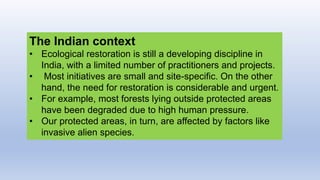
The Indian context
• Ecological restoration is still a developing discipline in
India, with a limited number of practitioners and projects.
• Most initiatives are small and site-specific. On the other
hand, the need for restoration is considerable and urgent.
• For example, most forests lying outside protected areas
have been degraded due to high human pressure.
• Our protected areas, in turn, are affected by factors like
invasive alien species.
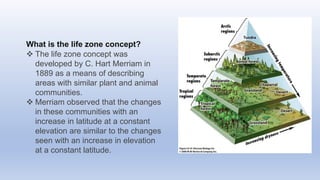
What is the life zone concept?
 The life zone concept was
developed by C. Hart Merriam in
1889 as a means of describing
areas with similar plant and animal
communities.
 Merriam observed that the changes
in these communities with an
increase in latitude at a constant
elevation are similar to the changes
seen with an increase in elevation
at a constant latitude.
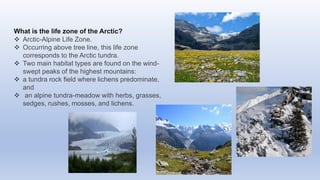
What is the life zone of the Arctic?
 Arctic-Alpine Life Zone.
 Occurring above tree line, this life zone
corresponds to the Arctic tundra.
 Two main habitat types are found on the wind-
swept peaks of the highest mountains:
 a tundra rock field where lichens predominate,
and
 an alpine tundra-meadow with herbs, grasses,
sedges, rushes, mosses, and lichens.
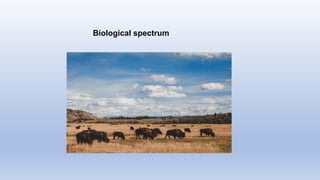
Biological spectrum
 The biological spectrum consists of all living organisms
divided into three domains, coexisting across various
levels of biological organization.
 Microbiologist Carl Woese organized all known organisms
into a phylogenetic tree of life based on RNA and common
ancestor comparisons.
 The three domains are bacteria, archaea and eukaryota,
which are further subdivided into kingdoms.
 All three domains exist on various levels of biological
organization, from a cellular level to its biosphere.
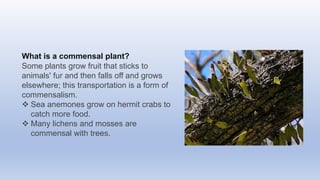
What is a commensal plant?
Some plants grow fruit that sticks to
animals' fur and then falls off and grows
elsewhere; this transportation is a form of
commensalism.
 Sea anemones grow on hermit crabs to
catch more food.
 Many lichens and mosses are
commensal with trees.
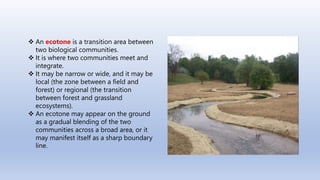
 An ecotone is a transition area between
two biological communities.
 It is where two communities meet and
integrate.
 It may be narrow or wide, and it may be
local (the zone between a field and
forest) or regional (the transition
between forest and grassland
ecosystems).
 An ecotone may appear on the ground
as a gradual blending of the two
communities across a broad area, or it
may manifest itself as a sharp boundary
line.
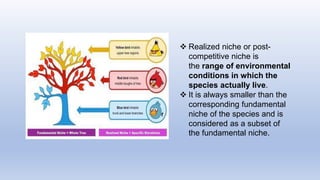
 Realized niche or post-
competitive niche is
the range of environmental
conditions in which the
species actually live.
 It is always smaller than the
corresponding fundamental
niche of the species and is
considered as a subset of
the fundamental niche.
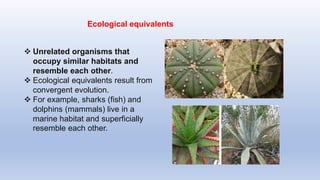
 Unrelated organisms that
occupy similar habitats and
resemble each other.
 Ecological equivalents result from
convergent evolution.
 For example, sharks (fish) and
dolphins (mammals) live in a
marine habitat and superficially
resemble each other.
Ecological equivalents
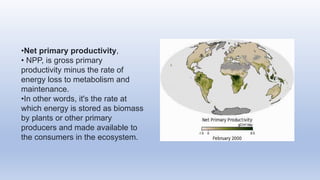
•Net primary productivity,
• NPP, is gross primary
productivity minus the rate of
energy loss to metabolism and
maintenance.
•In other words, it's the rate at
which energy is stored as biomass
by plants or other primary
producers and made available to
the consumers in the ecosystem.
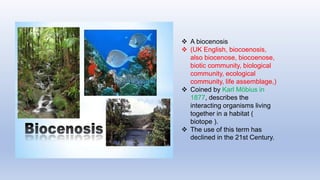
 A biocenosis
 (UK English, biocoenosis,
also biocenose, biocoenose,
biotic community, biological
community, ecological
community, life assemblage,)
 Coined by Karl Möbius in
1877, describes the
interacting organisms living
together in a habitat (
biotope ).
 The use of this term has
declined in the 21st Century.
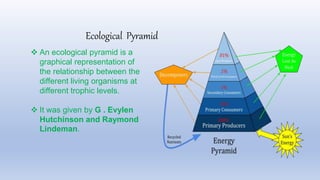
 An ecological pyramid is a
graphical representation of
the relationship between the
different living organisms at
different trophic levels.
 It was given by G . Evylen
Hutchinson and Raymond
Lindeman.
Ecological Pyramid
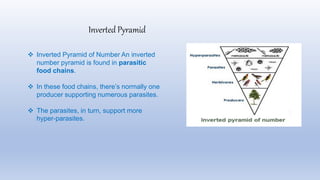
 Inverted Pyramid of Number An inverted
number pyramid is found in parasitic
food chains.
 In these food chains, there’s normally one
producer supporting numerous parasites.
 The parasites, in turn, support more
hyper-parasites.
Inverted Pyramid
Key Terms
•interspecific: existing or occurring between different species territorial competition
•intraspecific: occurring among members of the same species compete for identical resources
(space, food, and mate)
•fecundity: number, rate, or capacity of offspring production self-incompatibility flowering plants
 Natality - Refers to the number of births during a given period in
the population that are added to the initial density.
 Mortality is the term used to calculate the number of people who
died within a population. It refers to the incidence of death. It is
expressed as the number of deaths per 100 people per year.
Population regulation
Key Points
•The density of a population can be regulated by various factors,
including biotic and abiotic factors and population size.
•Density-dependent regulation can be affected by factors that affect
birth and death rates such as competition and predation.
•Density-independent regulation can be affected by factors that affect
birth and death rates such as abiotic factors and environmental factors,
i.e. severe weather and conditions such as fire.
•New models of life history incorporate ecological concepts that are
typically included in r- and K-selection theory in combination with
population age structures and mortality factors
 Density dependent factors are biological factors used by the population
as a resource.
 These can be things like food, shelter, or other limited resources.
Density dependent factors cause variable changes in the population as
its density changes.
 When the population is small, these factors typically favor increased
birth rates and lower death rates, allowing the population to
expand.
 When the population is large and dense, these factors become limited
and decrease the birth rate while raising the death rate.
 This tends to make populations experiencing density dependent factors
to show logistic growth.
 Density-independent factors are the ones that are not dependent on
the population density.
 They affect the species regardless of how dense the population is.
 These include natural disasters, like floods, drought, tornadoes, etc.,
climate, and even human activities.
 What are density independent factors?
 Density-dependent factors only come into play when the population
reaches a certain level. Larger the population, stronger the impact.
 Density-independent factors do not have size constraint.
 They are effective in the case of both, large populations and small
populations.
Density-dependent regulation
In population ecology, density-dependent processes occur when
population growth rates are regulated by the density of a
population.
Most density-dependent factors, which are biological in nature
(biotic), include predation, inter- and intraspecific competition,
accumulation of waste, and diseases such as those caused by
parasites. Usually, the denser a population is, the greater its
mortality rate.
For example, during intra- and interspecific competition, the
reproductive rates of the individuals will usually be lower, reducing
their population’s rate of growth.
In addition, low prey density increases the mortality of its predator
because it has more difficulty locating its food source.
 An example of density-dependent regulation is shown with results from a study focusing
on the giant intestinal roundworm (Ascaris lumbricoides), a parasite of humans and
other mammals.
 The data shows that denser populations of the parasite exhibit lower fecundity: they
contained fewer eggs. One possible explanation for this phenomenon was that females
would be smaller in more dense populations due to limited resources so they would have
fewer eggs.
 This hypothesis was tested and disproved in a 2009 study which showed that female
weight had no influence. The actual cause of the density-dependence of fecundity in this
organism is still unclear and awaiting further investigation
 Density-independent regulation and interaction with density-dependent factors
 Many factors, typically physical or chemical in nature (abiotic), influence the mortality of a
population regardless of its density.
 They include weather, natural disasters, and pollution. An individual deer may be killed in a
forest fire regardless of how many deer happen to be in that area.
 Its chances of survival are the same whether the population density is high or low.
 In real-life situations, population regulation is very complicated and density-dependent and
independent factors can interact.
 A dense population that is reduced in a density-independent manner by some environmental
factor(s) will be able to recover differently than would a sparse population.
 For example, a population of deer affected by a harsh winter will recover faster if there are
more deer remaining to reproduce
 Life history strategy is correlated with many aspects of an organism's
reproductive strategy and life history, as well as with demographic variables
such as generation time and life span, and population parameters such
as population density and population dynamics .
 In the initial phase, population growth is very rapid and largely dependent
on the variable r, which represents the intrinsic rate of natural increase of a
species.
 A population grows rapidly in its initial phase because there are abundant
resources, and consequently little or no competition between individuals.
 Thus, r -selected species exist in circumstances where they are often at this
stage of rapid growth.
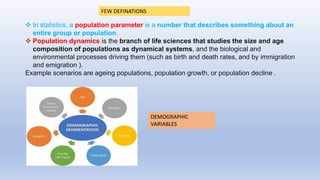
 In statistics, a population parameter is a number that describes something about an
entire group or population.
 Population dynamics is the branch of life sciences that studies the size and age
composition of populations as dynamical systems, and the biological and
environmental processes driving them (such as birth and death rates, and by immigration
and emigration ).
Example scenarios are ageing populations, population growth, or population decline .
DEMOGRAPHIC
VARIABLES
FEW DEFINATIONS
Plant ecology (Important terms) [Part -1]

Plant ecology (Important terms) [Part -1]

  • 1.
  • 2.
    ENVIRONMENTAL STUDIES  Environmentalstudies is a multidisciplinary academic field which systematically studies human interaction with the environment.  Environmental studies connects principles from the physical sciences, commerce/economics, and social sciences to address complex contemporary environmental issues.
  • 4.
     Environment literallymeans Surrounding in which we are living.  Environment includes all those things on which we are directly or indirectly dependent for our survival, whether it is living component like animals, plants or non living component like soil, air water.
  • 5.
     Ecology isthe branch of biology that studies how organisms interact with their environment and other organisms.  Every organism experiences complex relationships with other organisms of its species, and organisms of different species.
  • 7.
    1.It helps inenvironmental conservation 2. Ensures proper resource allocation 3. Enhances energy conservation 4.It helps with disease and pest control 5.It promotes eco-friendliness 6.It enhances energy conservation
  • 8.
    ECOLOGY CONSERVATION Conservation ecologyis the branch of ecology and evolutionary biology that deals with the preservation and management of biodiversity and natural resources.
  • 9.
    The flow ofenergy through an ecosystem is called ecological energetic. Energy is the ability to do some work. The sun emits light and other types of radiation. Some of these radiations fall on the earth. The source of energy on the earth is the sun. A small amount of the radiant energy is absorbed by the green plants. They change this energy into chemical energy in the form of glucose. All the other living organisms obtain this chemical energy from the plants. A large amount of energy is lost in the form of heat. ecological energetics
  • 10.
    The bioenergetics isdiscuss under three headings; (a) Productivity of ecosystem, (b) Food chain, Trophic levels and food web and (c) Ecological pyramids
  • 11.
    Circadian rhythms  Circadianrhythms regulate many aspects of plant physiology including leaf, organ and stomatal movements, growth and signalling. The genetic identity of some of the components of the core circadian oscillator has recently become known.  Circadian rhythms allow plants to cope with adverse surroundings, as well as to synchronise themselves with predictable changes, such as the change from day to night. The circadian rhythm of an organism depends on their surrounding environment.
  • 13.
     Cyclomorphosis (alsoknown as seasonal polyphenism) is the name given to the occurrence of cyclic or seasonal changes in the phenotype of an organism through successive generations.  It occurs in small aquatic invertebrates that reproduce by parthenogenesis and give rise to several generations annually. It occurs especially in marine planktonic animals, and is thought to be caused by the epigenetic effect of environmental cues on the organism, thereby altering the course of their development. Cyclomorphosis
  • 14.
    These changes areactually caused by the interaction of environmental change with the organisms genes, there by altering the course of development, the modifications are only associated with improved and survived organisms, by reducing the almost same type of predation.
  • 15.
  • 16.
    What is ecologicalrestoration? Ecological restoration is defined as “the process of assisting the recovery of an ecosystem that has been degraded, damaged or destroyed”. Ecosystems are in a constant state of evolution.  Restoration adopts a holistic approach focused on all elements of an ecosystem such as soil, hydrology, flora, fauna, etc. This helps build resilience and regenerative ability of the ecosystem.
  • 17.
     Ecosystem restorationmeans assisting in the recovery of ecosystems that have been degraded or destroyed, as well as conserving the ecosystems that are still intact.  Healthier ecosystems, with richer biodiversity, yield greater benefits such as more fertile soils, bigger yields of timber and fish, and larger stores of greenhouse gases.  All kinds of ecosystems can be restored, including forests, farmlands, cities, wetlands and oceans.
  • 18.
    Beyond conservation, whyour natural ecosystems need restoration • Ecosystem degradation has emerged as one of the biggest environmental threats around the world over the last three decades. • Traditional approaches to ecological conservation focus on protecting and keeping natural spaces inviolate. • Many of our ecosystems today are damaged beyond unassisted self-recovery. • We are, therefore, in a situation where conservation alone is no longer enough.
  • 19.
    The Indian context •Ecological restoration is still a developing discipline in India, with a limited number of practitioners and projects. • Most initiatives are small and site-specific. On the other hand, the need for restoration is considerable and urgent. • For example, most forests lying outside protected areas have been degraded due to high human pressure. • Our protected areas, in turn, are affected by factors like invasive alien species.
  • 27.
    What is thelife zone concept?  The life zone concept was developed by C. Hart Merriam in 1889 as a means of describing areas with similar plant and animal communities.  Merriam observed that the changes in these communities with an increase in latitude at a constant elevation are similar to the changes seen with an increase in elevation at a constant latitude.
  • 28.
    What is thelife zone of the Arctic?  Arctic-Alpine Life Zone.  Occurring above tree line, this life zone corresponds to the Arctic tundra.  Two main habitat types are found on the wind- swept peaks of the highest mountains:  a tundra rock field where lichens predominate, and  an alpine tundra-meadow with herbs, grasses, sedges, rushes, mosses, and lichens.
  • 29.
  • 30.
     The biologicalspectrum consists of all living organisms divided into three domains, coexisting across various levels of biological organization.  Microbiologist Carl Woese organized all known organisms into a phylogenetic tree of life based on RNA and common ancestor comparisons.  The three domains are bacteria, archaea and eukaryota, which are further subdivided into kingdoms.  All three domains exist on various levels of biological organization, from a cellular level to its biosphere.
  • 31.
    What is acommensal plant? Some plants grow fruit that sticks to animals' fur and then falls off and grows elsewhere; this transportation is a form of commensalism.  Sea anemones grow on hermit crabs to catch more food.  Many lichens and mosses are commensal with trees.
  • 32.
     An ecotoneis a transition area between two biological communities.  It is where two communities meet and integrate.  It may be narrow or wide, and it may be local (the zone between a field and forest) or regional (the transition between forest and grassland ecosystems).  An ecotone may appear on the ground as a gradual blending of the two communities across a broad area, or it may manifest itself as a sharp boundary line.
  • 33.
     Realized nicheor post- competitive niche is the range of environmental conditions in which the species actually live.  It is always smaller than the corresponding fundamental niche of the species and is considered as a subset of the fundamental niche.
  • 34.
     Unrelated organismsthat occupy similar habitats and resemble each other.  Ecological equivalents result from convergent evolution.  For example, sharks (fish) and dolphins (mammals) live in a marine habitat and superficially resemble each other. Ecological equivalents
  • 35.
    •Net primary productivity, •NPP, is gross primary productivity minus the rate of energy loss to metabolism and maintenance. •In other words, it's the rate at which energy is stored as biomass by plants or other primary producers and made available to the consumers in the ecosystem.
  • 36.
     A biocenosis (UK English, biocoenosis, also biocenose, biocoenose, biotic community, biological community, ecological community, life assemblage,)  Coined by Karl Möbius in 1877, describes the interacting organisms living together in a habitat ( biotope ).  The use of this term has declined in the 21st Century.
  • 37.
     An ecologicalpyramid is a graphical representation of the relationship between the different living organisms at different trophic levels.  It was given by G . Evylen Hutchinson and Raymond Lindeman. Ecological Pyramid
  • 38.
     Inverted Pyramidof Number An inverted number pyramid is found in parasitic food chains.  In these food chains, there’s normally one producer supporting numerous parasites.  The parasites, in turn, support more hyper-parasites. Inverted Pyramid
  • 39.
    Key Terms •interspecific: existingor occurring between different species territorial competition •intraspecific: occurring among members of the same species compete for identical resources (space, food, and mate) •fecundity: number, rate, or capacity of offspring production self-incompatibility flowering plants  Natality - Refers to the number of births during a given period in the population that are added to the initial density.  Mortality is the term used to calculate the number of people who died within a population. It refers to the incidence of death. It is expressed as the number of deaths per 100 people per year.
  • 40.
    Population regulation Key Points •Thedensity of a population can be regulated by various factors, including biotic and abiotic factors and population size. •Density-dependent regulation can be affected by factors that affect birth and death rates such as competition and predation. •Density-independent regulation can be affected by factors that affect birth and death rates such as abiotic factors and environmental factors, i.e. severe weather and conditions such as fire. •New models of life history incorporate ecological concepts that are typically included in r- and K-selection theory in combination with population age structures and mortality factors
  • 41.
     Density dependentfactors are biological factors used by the population as a resource.  These can be things like food, shelter, or other limited resources. Density dependent factors cause variable changes in the population as its density changes.  When the population is small, these factors typically favor increased birth rates and lower death rates, allowing the population to expand.  When the population is large and dense, these factors become limited and decrease the birth rate while raising the death rate.  This tends to make populations experiencing density dependent factors to show logistic growth.
  • 42.
     Density-independent factorsare the ones that are not dependent on the population density.  They affect the species regardless of how dense the population is.  These include natural disasters, like floods, drought, tornadoes, etc., climate, and even human activities.  What are density independent factors?  Density-dependent factors only come into play when the population reaches a certain level. Larger the population, stronger the impact.  Density-independent factors do not have size constraint.  They are effective in the case of both, large populations and small populations.
  • 43.
    Density-dependent regulation In populationecology, density-dependent processes occur when population growth rates are regulated by the density of a population. Most density-dependent factors, which are biological in nature (biotic), include predation, inter- and intraspecific competition, accumulation of waste, and diseases such as those caused by parasites. Usually, the denser a population is, the greater its mortality rate. For example, during intra- and interspecific competition, the reproductive rates of the individuals will usually be lower, reducing their population’s rate of growth. In addition, low prey density increases the mortality of its predator because it has more difficulty locating its food source.
  • 44.
     An exampleof density-dependent regulation is shown with results from a study focusing on the giant intestinal roundworm (Ascaris lumbricoides), a parasite of humans and other mammals.  The data shows that denser populations of the parasite exhibit lower fecundity: they contained fewer eggs. One possible explanation for this phenomenon was that females would be smaller in more dense populations due to limited resources so they would have fewer eggs.  This hypothesis was tested and disproved in a 2009 study which showed that female weight had no influence. The actual cause of the density-dependence of fecundity in this organism is still unclear and awaiting further investigation
  • 45.
     Density-independent regulationand interaction with density-dependent factors  Many factors, typically physical or chemical in nature (abiotic), influence the mortality of a population regardless of its density.  They include weather, natural disasters, and pollution. An individual deer may be killed in a forest fire regardless of how many deer happen to be in that area.  Its chances of survival are the same whether the population density is high or low.  In real-life situations, population regulation is very complicated and density-dependent and independent factors can interact.  A dense population that is reduced in a density-independent manner by some environmental factor(s) will be able to recover differently than would a sparse population.  For example, a population of deer affected by a harsh winter will recover faster if there are more deer remaining to reproduce
  • 46.
     Life historystrategy is correlated with many aspects of an organism's reproductive strategy and life history, as well as with demographic variables such as generation time and life span, and population parameters such as population density and population dynamics .  In the initial phase, population growth is very rapid and largely dependent on the variable r, which represents the intrinsic rate of natural increase of a species.  A population grows rapidly in its initial phase because there are abundant resources, and consequently little or no competition between individuals.  Thus, r -selected species exist in circumstances where they are often at this stage of rapid growth.
  • 47.
     In statistics,a population parameter is a number that describes something about an entire group or population.  Population dynamics is the branch of life sciences that studies the size and age composition of populations as dynamical systems, and the biological and environmental processes driving them (such as birth and death rates, and by immigration and emigration ). Example scenarios are ageing populations, population growth, or population decline . DEMOGRAPHIC VARIABLES FEW DEFINATIONS