Environmental challenges to  Agriculture and the emerging  solutions A.K. Joshi Department of Genetics & Plant Breeding Institute of Agricultural Sciences Banaras Hindu University
Environment & Agriculture Agriculture is strongly linked to environment and they both to human population Initially, challenges to agriculture increased since human population increased As population grew, cities emerged and pressure on agriculture increased further, causing “Non-sustainability”
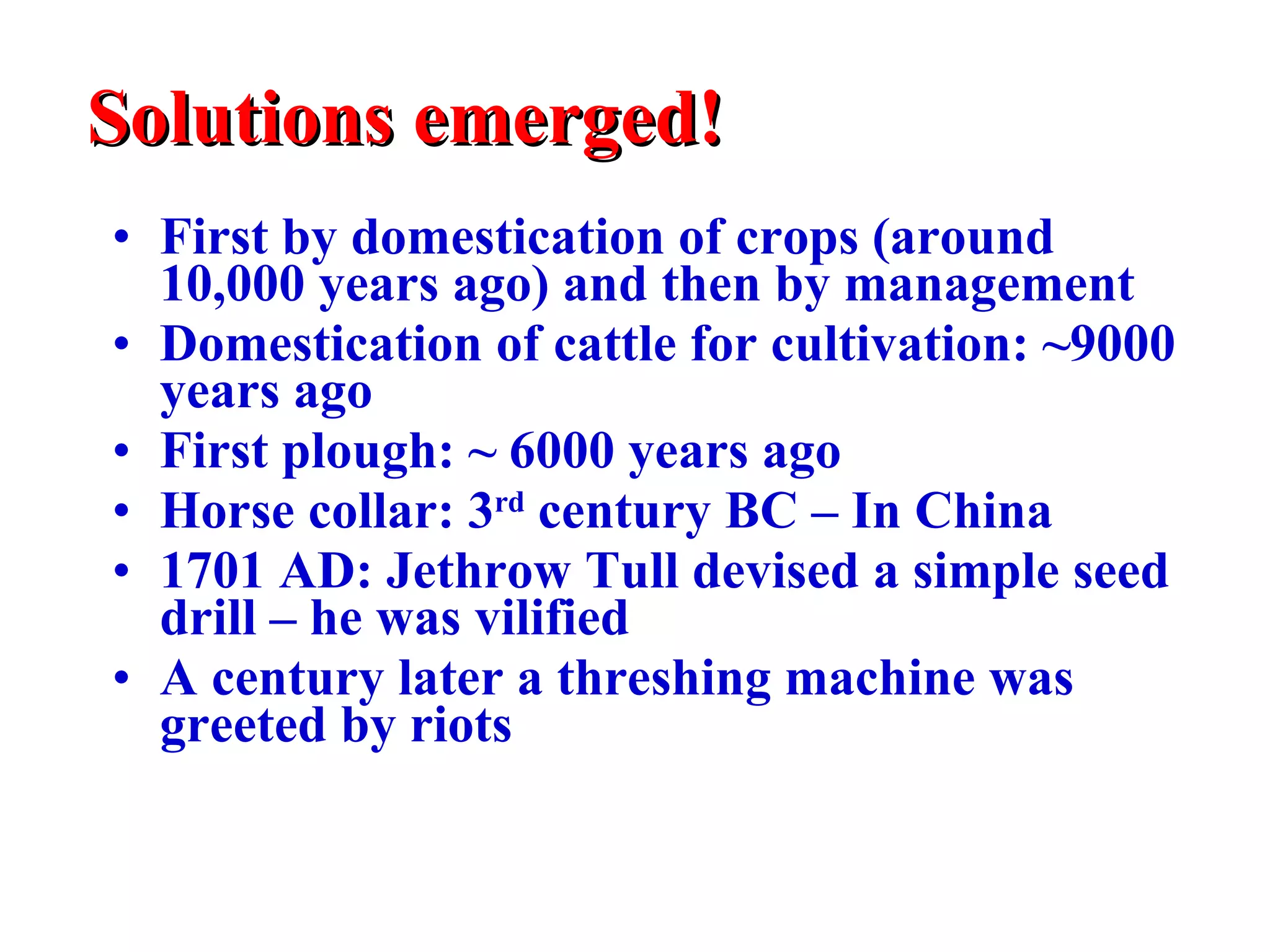
Solutions emerged! First by domestication of crops (around 10,000 years ago) and then by management Domestication of cattle for cultivation:  ~ 9000 years ago First plough:  ~  6000 years ago Horse collar: 3 rd  century BC – In China 1701 AD: Jethrow Tull devised a simple seed drill – he was vilified A century later a threshing machine was greeted by riots
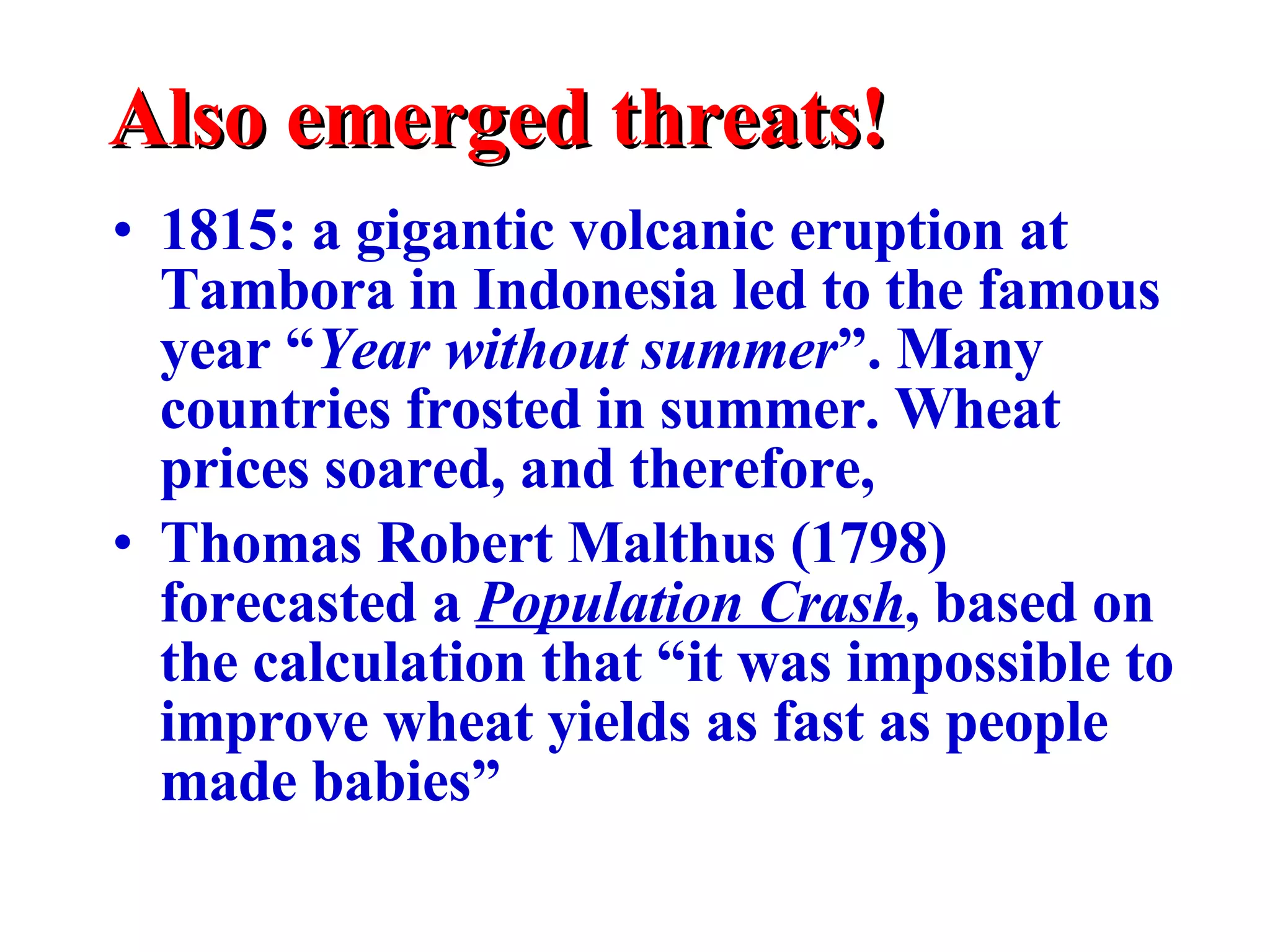
Also emerged threats! 1815: a gigantic volcanic eruption at Tambora in Indonesia led to the famous year “ Year without summer ”. Many countries frosted in summer. Wheat prices soared, and therefore, Thomas Robert Malthus (1798) forecasted a  Population Crash , based on the calculation that “it was impossible to improve wheat yields as fast as people made babies”
More land under plough Malthusian crash was staved off in the 19 th  century by bringing more land under plough – in N. America, Argentina and Australia But, famines became worse in Asia Then it was the Tractor (early 1800s) that averted Malthusian disaster –  the first tractor had few advantages but they did not eat hay or oats . It released around 25% more land for crops
More land but less nutrients Again, Malthusian limit started approaching without sufficient nitrogen, phosphorus and potassium 1830 – a magic ingredient was discovered:  Guano  – In dry seabird islands of S. America and S. African coasts, immense deposits of bird droppings, rich in N & P, deposited over centuries
Guano Rush In 1843- a tiny island of Ichaboe (S.W. Africa) was discovered; covered in 25 feet of Penguin and gannet excrement It led to -  “Guano Rush” followed by mutinies and battles During 1840-1880, guano nitrogen made a vast difference to European agriculture But soon the vast deposits were exhausted
Search for more nitrates In late 19 th  century, the rich mineral nitrate deposits of Chile took the place of Guano. These nitrate mines fuelled Chilean economy and fertilized Europe’s farms On 2 nd  July, 1909 - Carl Bosch (BASF) and Fritz Haber combined N (from air) with hydrogen (from coal) to make  ammonia Then in few years, BASF started mining  sky for nitrogen
Consequences Today, nearly half of the N atoms in the proteins of an average human beings came at some time or another through an ammonia factory Haber – nearly saved the German war effort as it was running out of nitrogen explosives in 1914, cut off from Chilean nitrates, but then went on to make lethal gas for chemical warfare and genocide
More N needed further technology Haber’s nitrogen was not welcome till middle of 20 th  century Because it was a powder, and It was lodging the crop Then, dwarf varieties rescued the world as it made crops responsive to nitrogen More nitrogen = more food
Wheat drove the first major change India got 18000 tonnes of dwarf wheat from CIMMYT, Mexico in 1965 Sir N.E. Borlaug loaded 35 trucks in Mexico and sent to Los Angeles for transport to India And, thus introduced  Green   Revolution
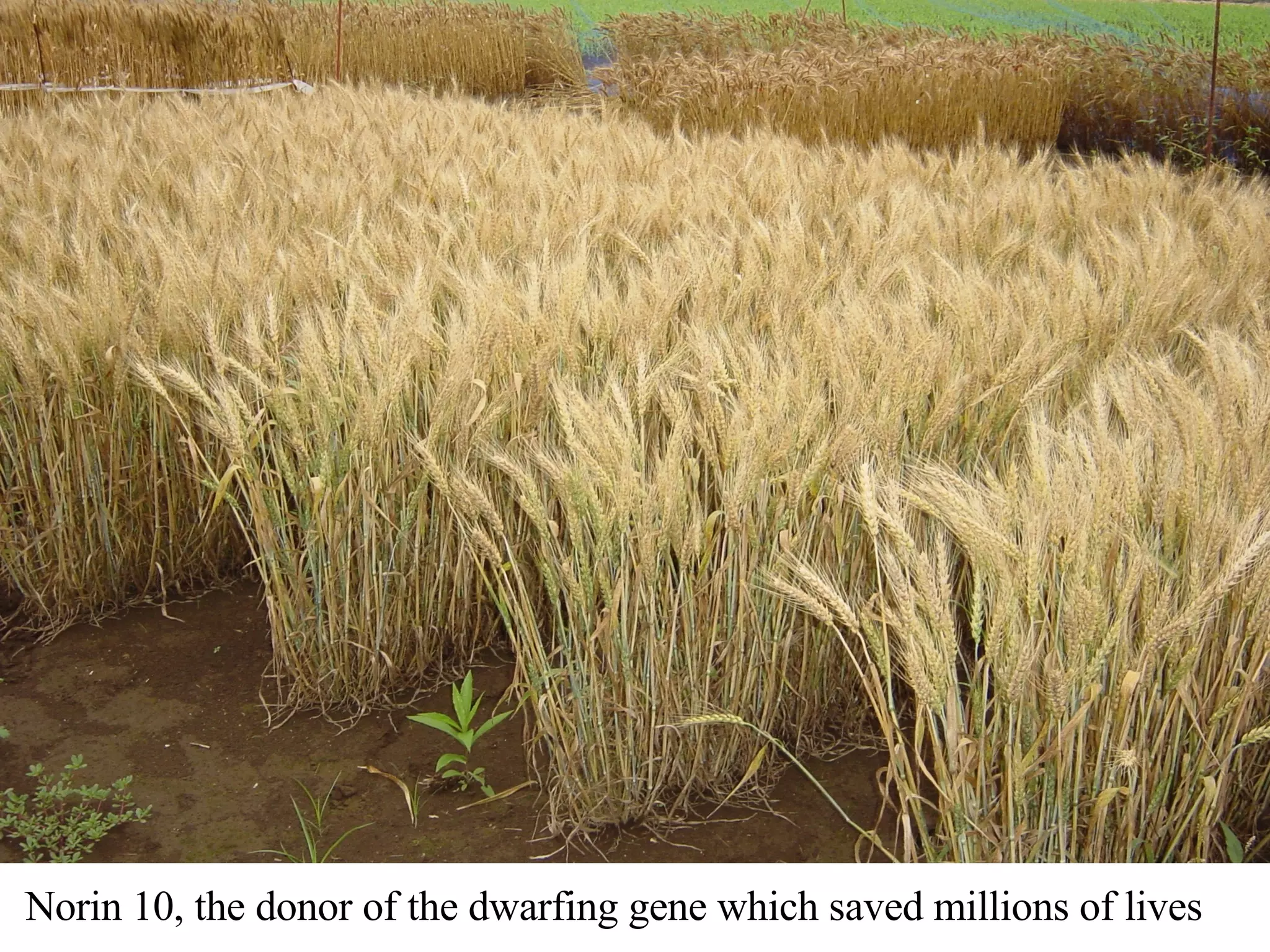
Norin 10, the donor of the dwarfing gene which saved millions of lives
After 50 years of Green Revolution  “w e need further efforts to feed the world, but the world is not the same”
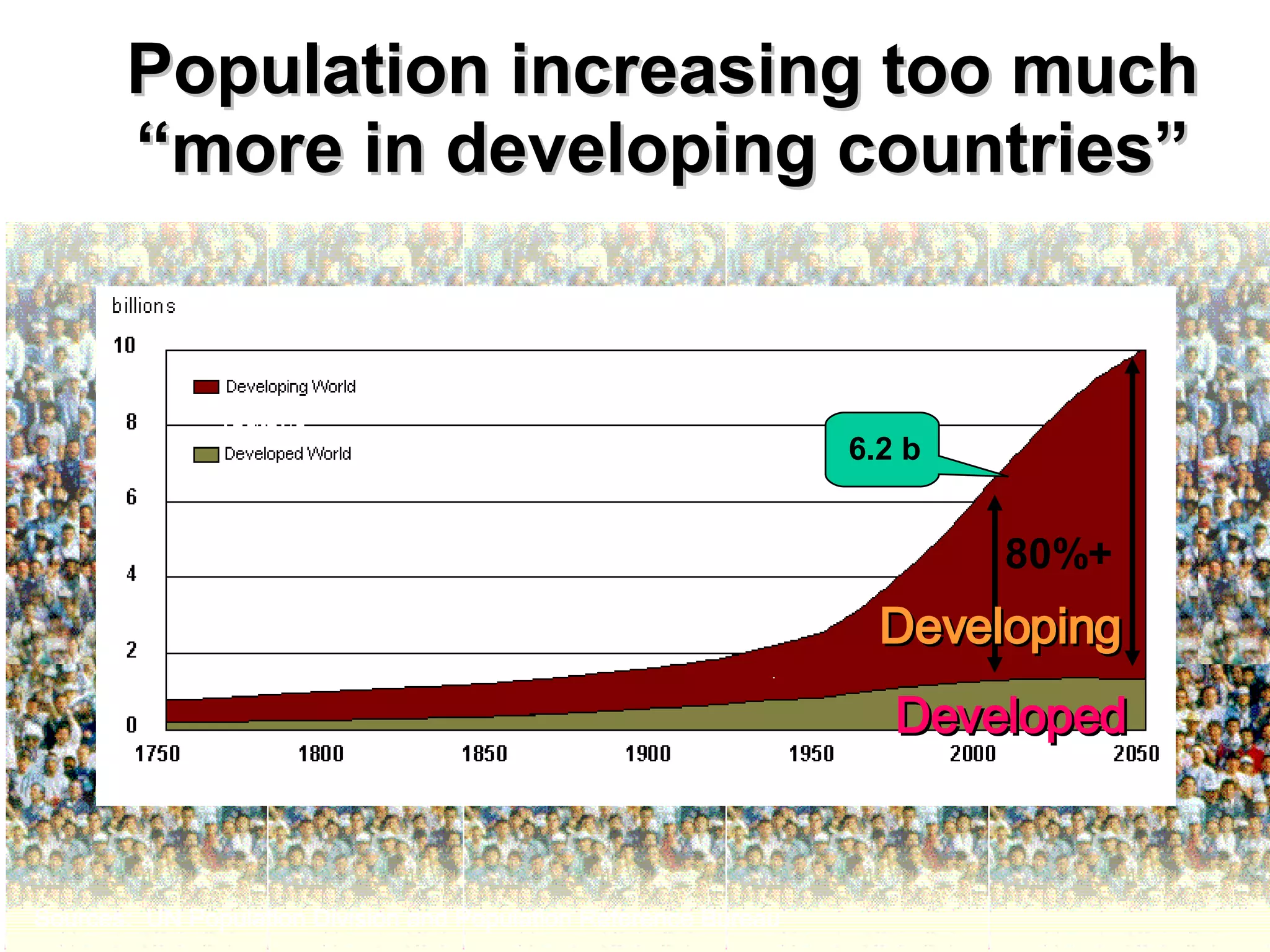
Population increasing too much “more in developing countries” Sources:  UN Population Division and Population Reference Bureau Developed 6.2 b 80%+ Developing
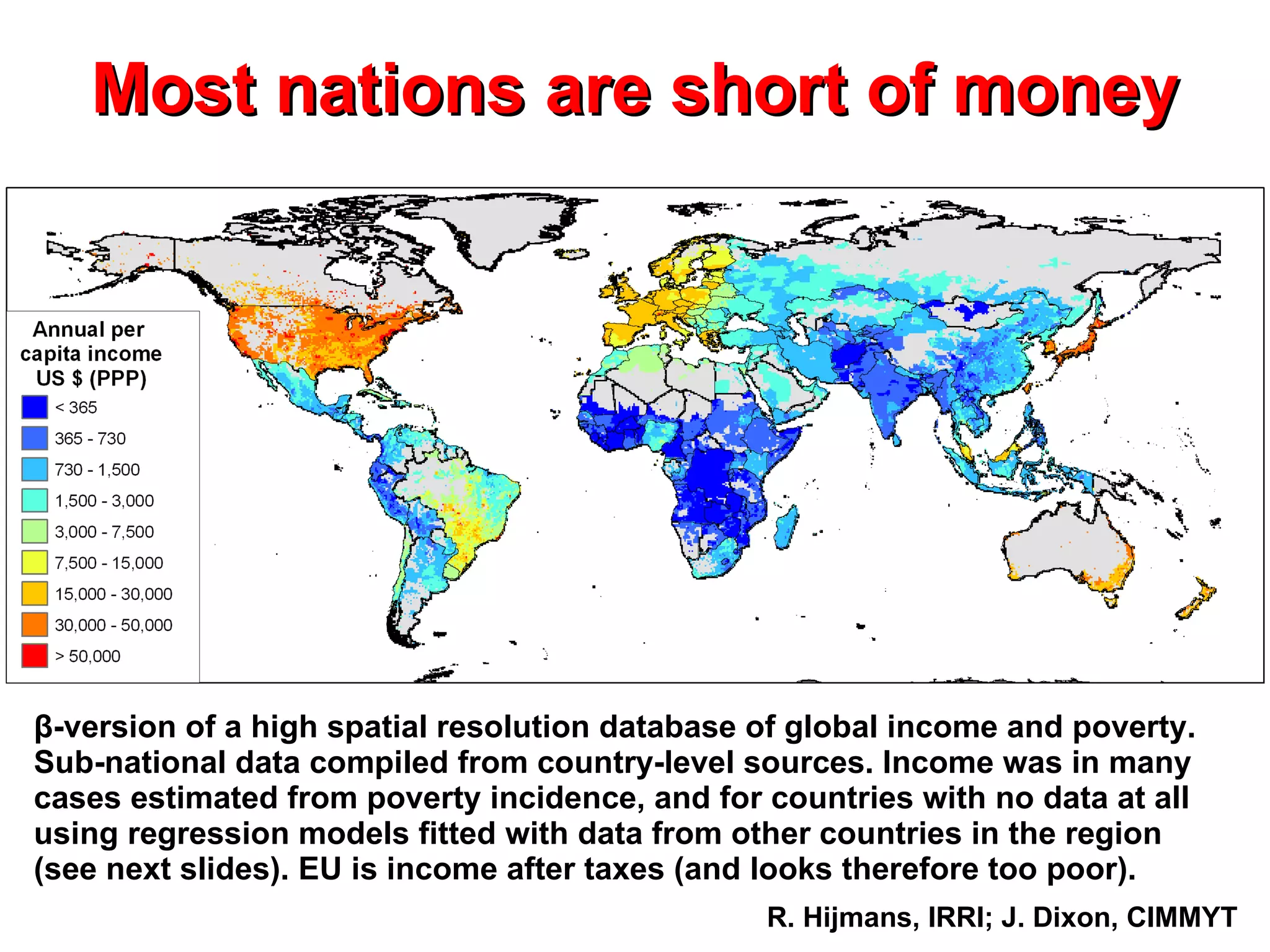
Most nations are short of money β -version of a  high spatial resolution database of global income and poverty. Sub-national data compiled from country-level sources. Income was in many cases estimated from poverty incidence, and for countries with no data at all using regression models fitted with data from other countries in the region (see next slides). EU is income after taxes (and looks therefore too poor). R. Hijmans, IRRI; J. Dixon, CIMMYT
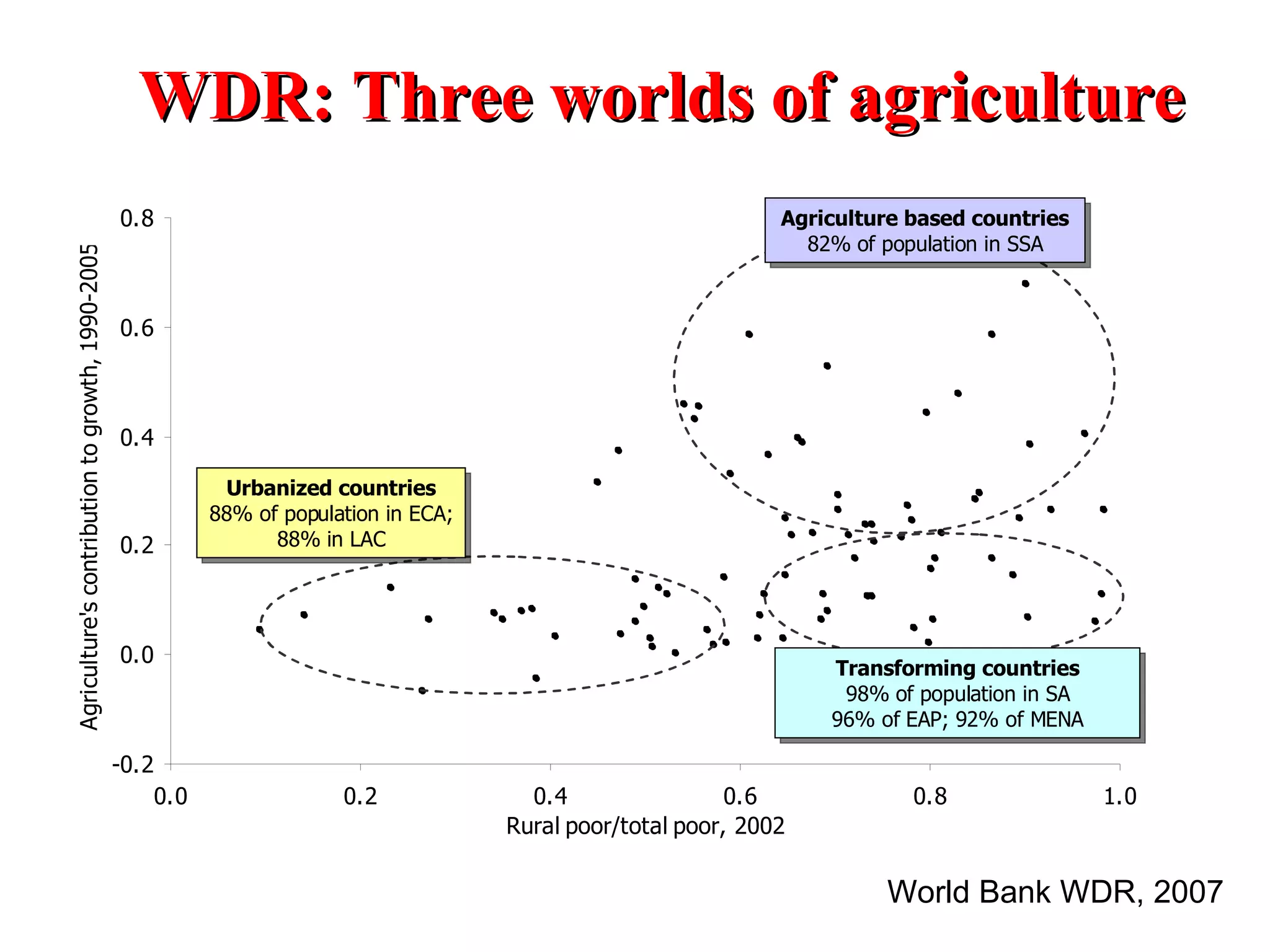
WDR: Three worlds of agriculture Urbanizing Agriculture based countries 82% of population in SSA Transforming countries 98% of population in SA 96% of EAP; 92% of MENA Urbanized countries 88% of population in ECA; 88% in LAC World Bank WDR, 2007
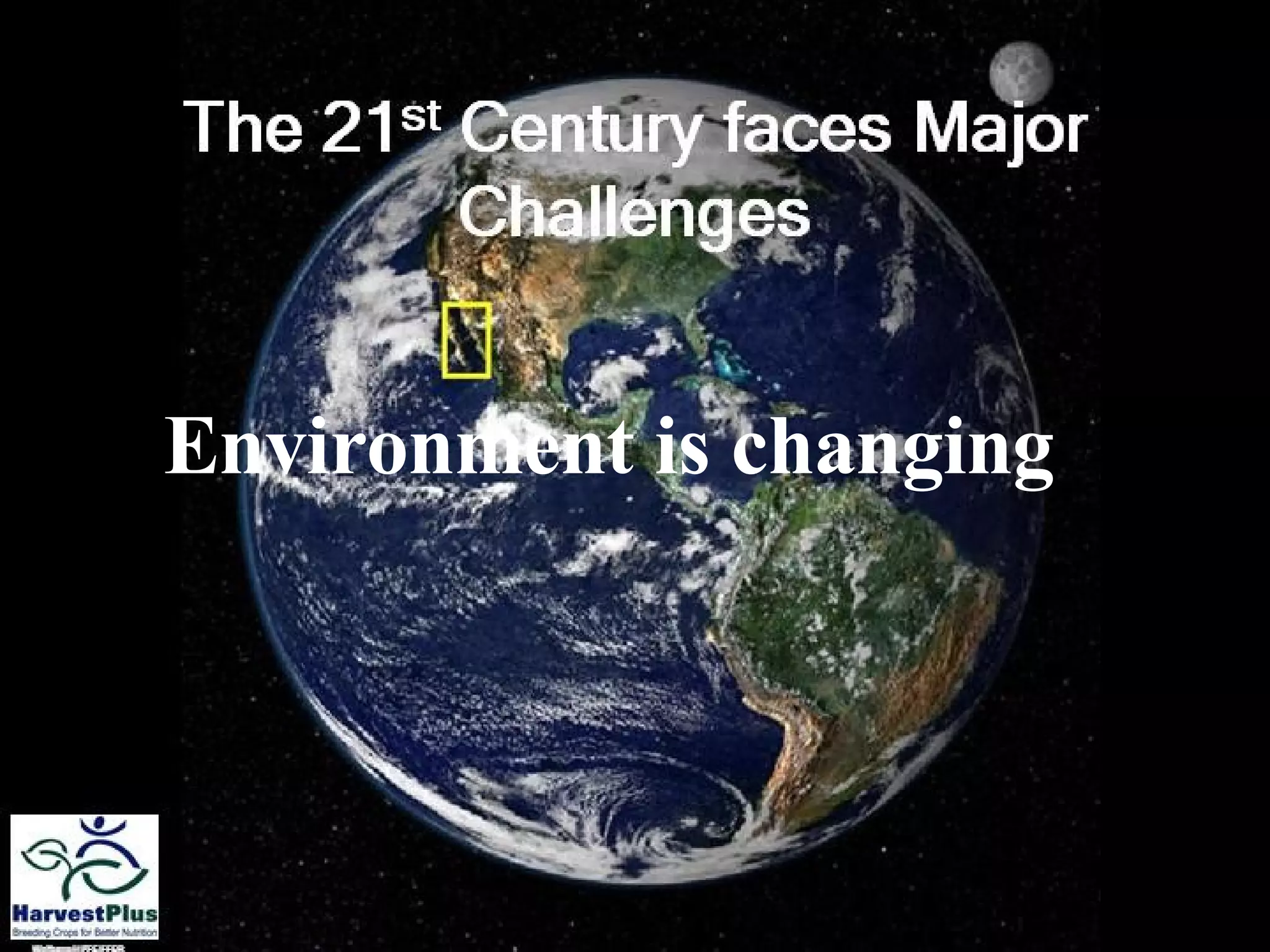
Environment is changing
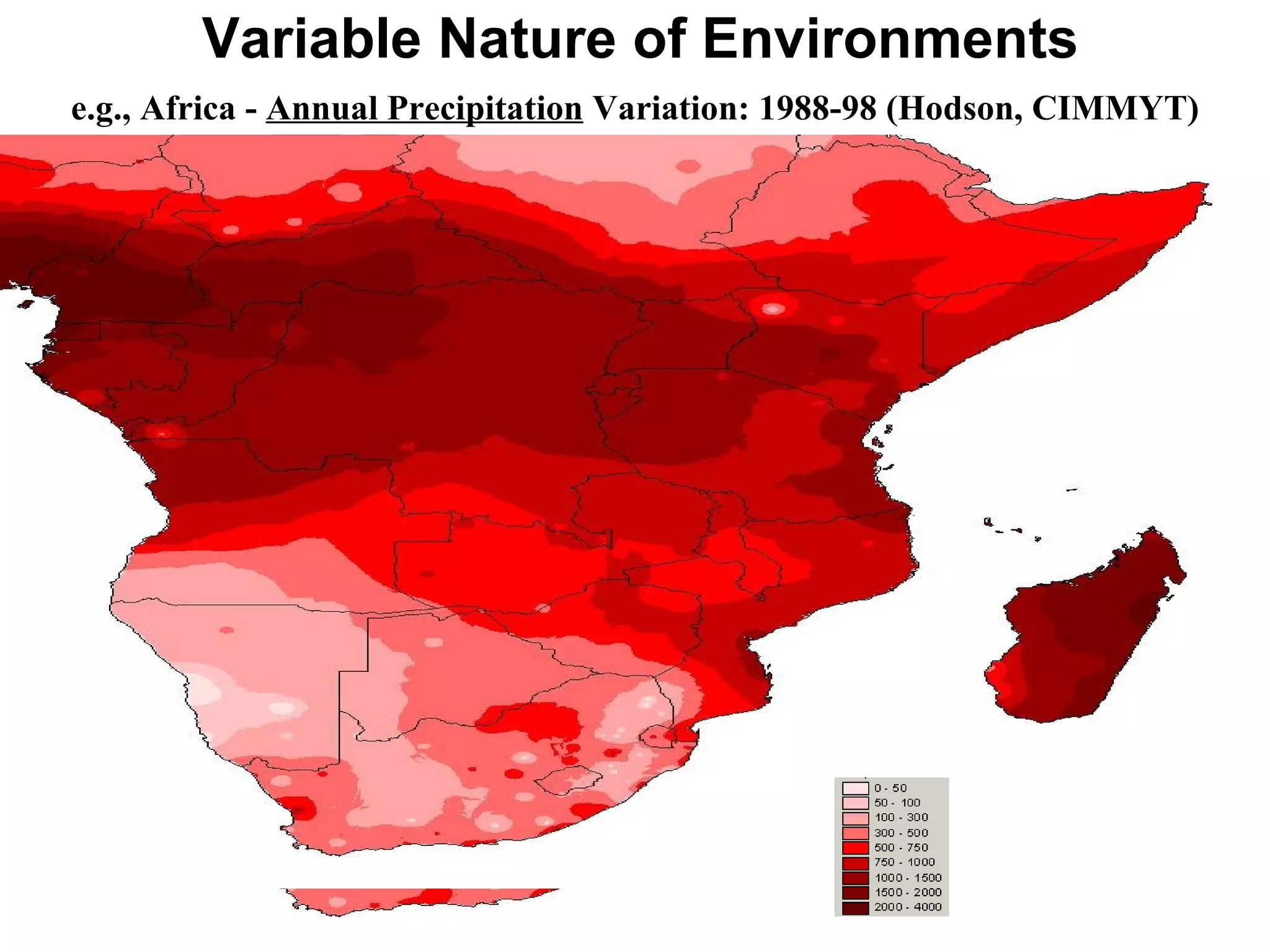
e.g., Africa -  Annual Precipitation  Variation: 1988-98 (Hodson, CIMMYT) Variable Nature of Environments
A shift in thinking! No one understands better than farmers do how the weather change can affect people and their land But now, emerging weather patterns have made lot of other people worried, too, and their concerns are well founded (Yvo de Boer, Executive Sect. UN’s Framework Convention on Climate Change - UNFCCC)
Some environmental challenges – case study from India
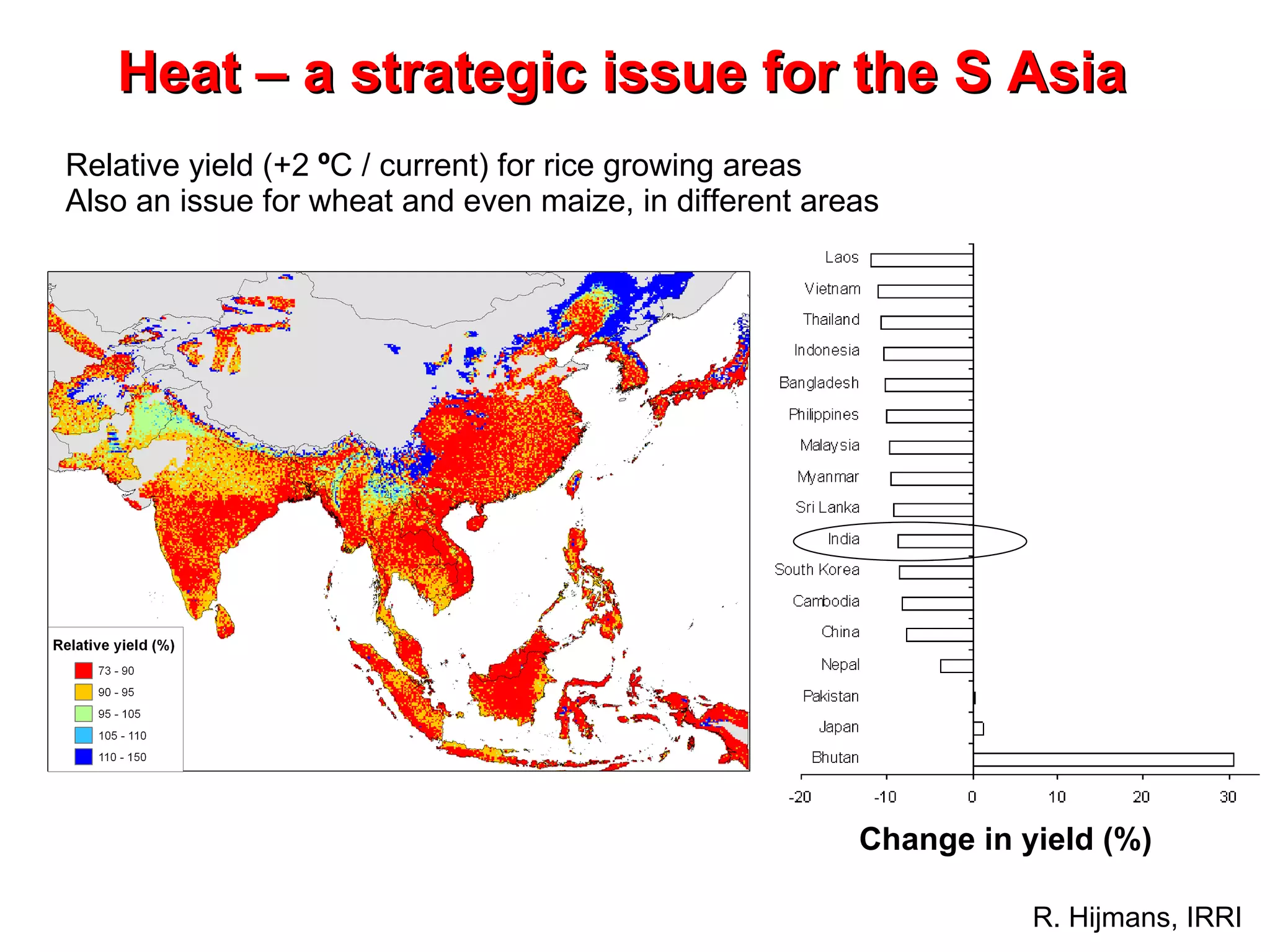
Heat – a strategic issue for the S Asia Relative yield (+2  º C / current) for rice growing areas  Also an issue for wheat and even maize, in different areas  Change in yield (%) R. Hijmans, IRRI
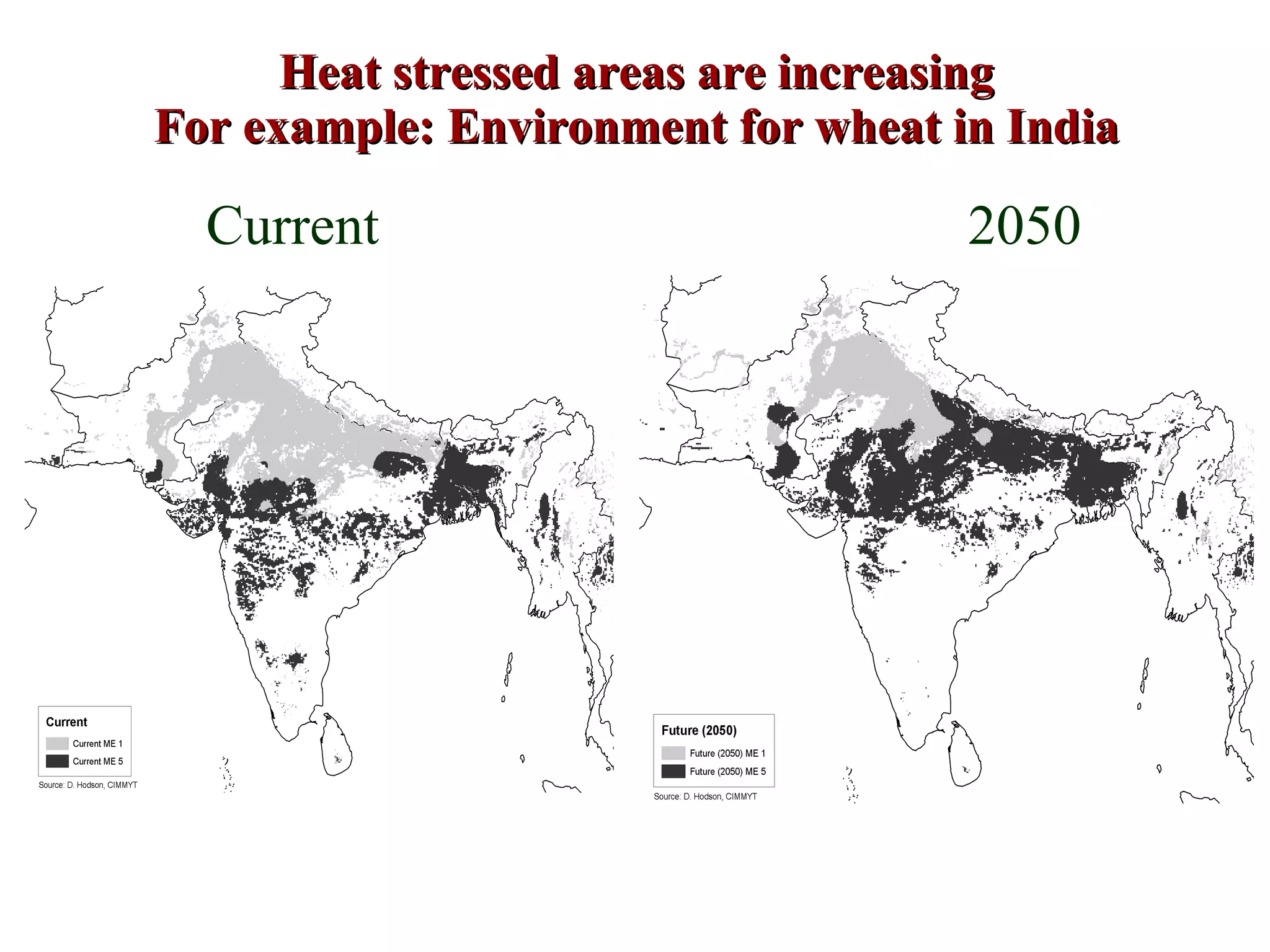
Heat stressed areas are increasing For example: Environment for wheat in India Current 2050
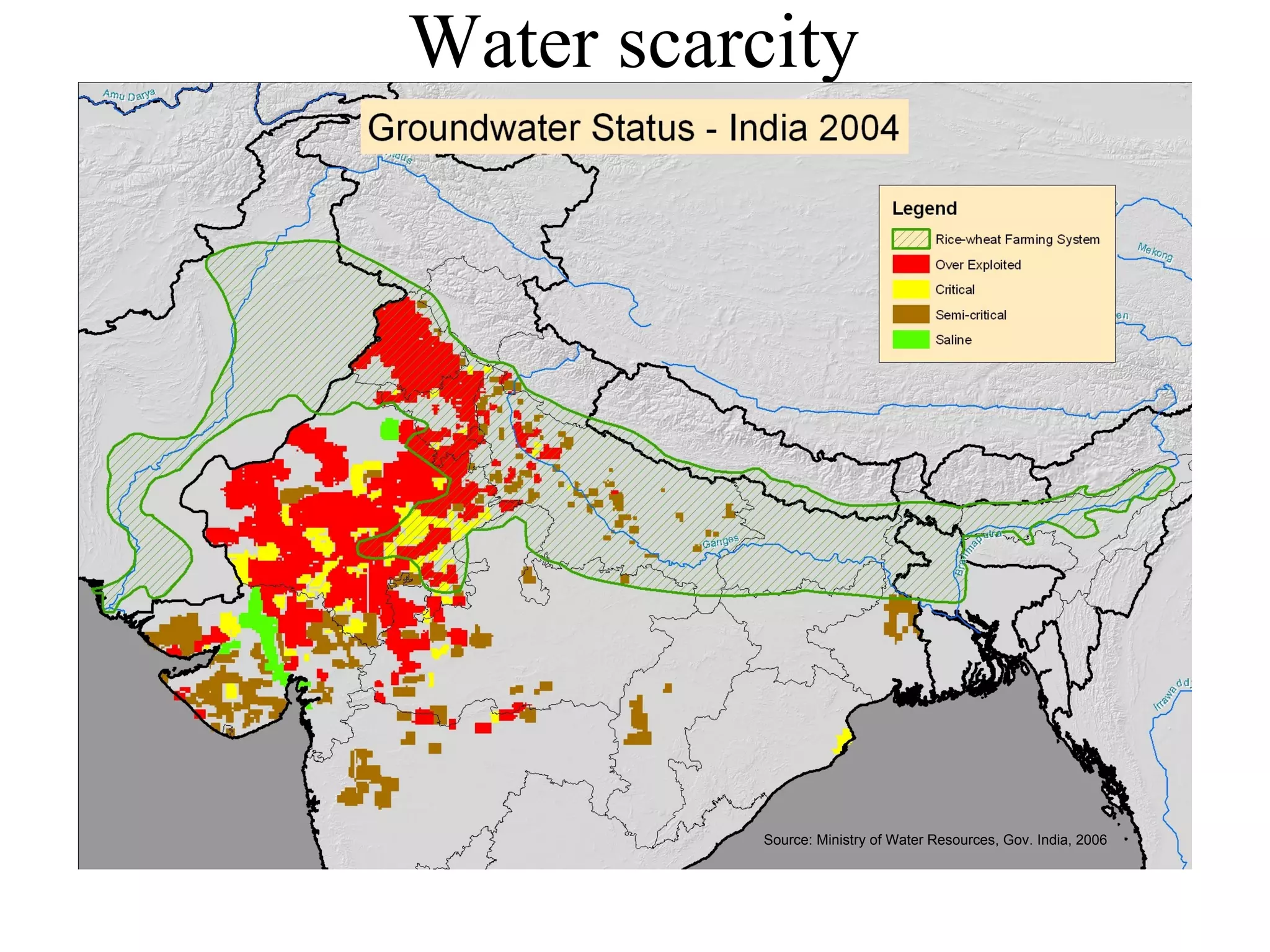
Water scarcity Source: Ministry of Water Resources, Gov. India, 2006
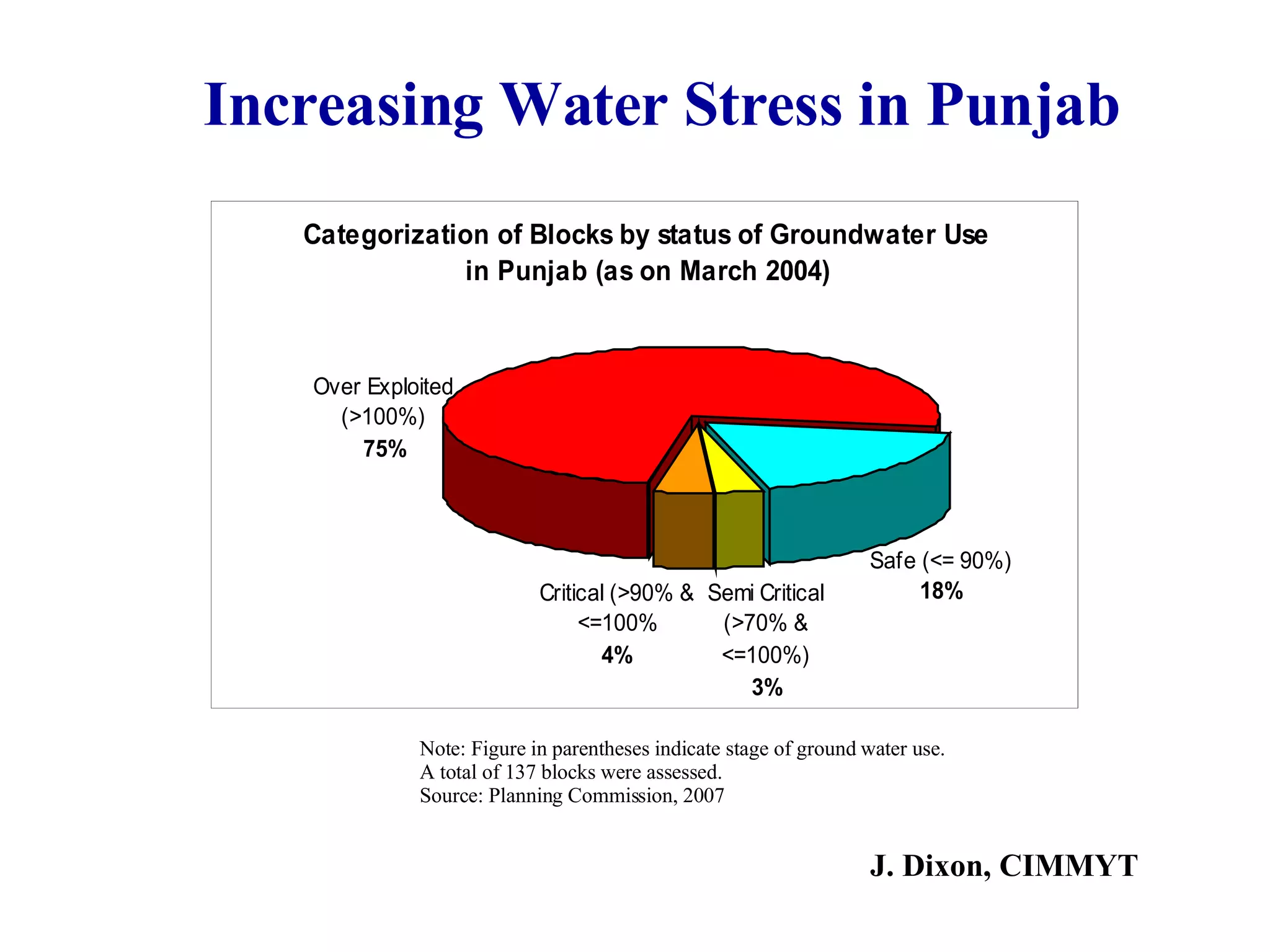
Increasing Water Stress in Punjab Note: Figure in parentheses indicate stage of ground water use.  A total of 137 blocks were assessed.  Source: Planning Commission, 2007  J. Dixon, CIMMYT
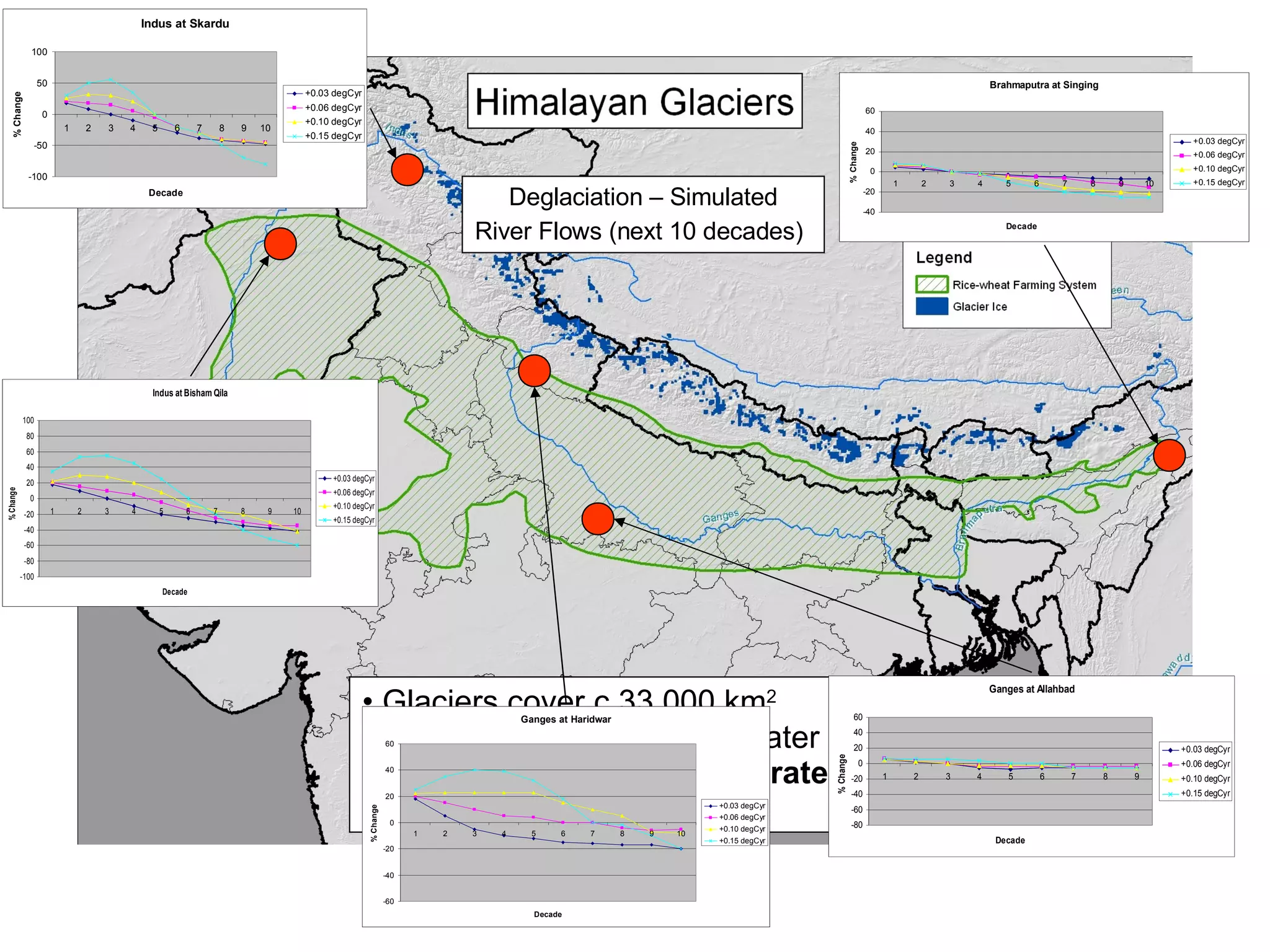
Glaciers cover c.33,000 km 2 Provide c.8.6 X 10 6  m 3  of water / year 67% Retreating at a rapid rate Deglaciation – Simulated River Flows (next 10 decades)
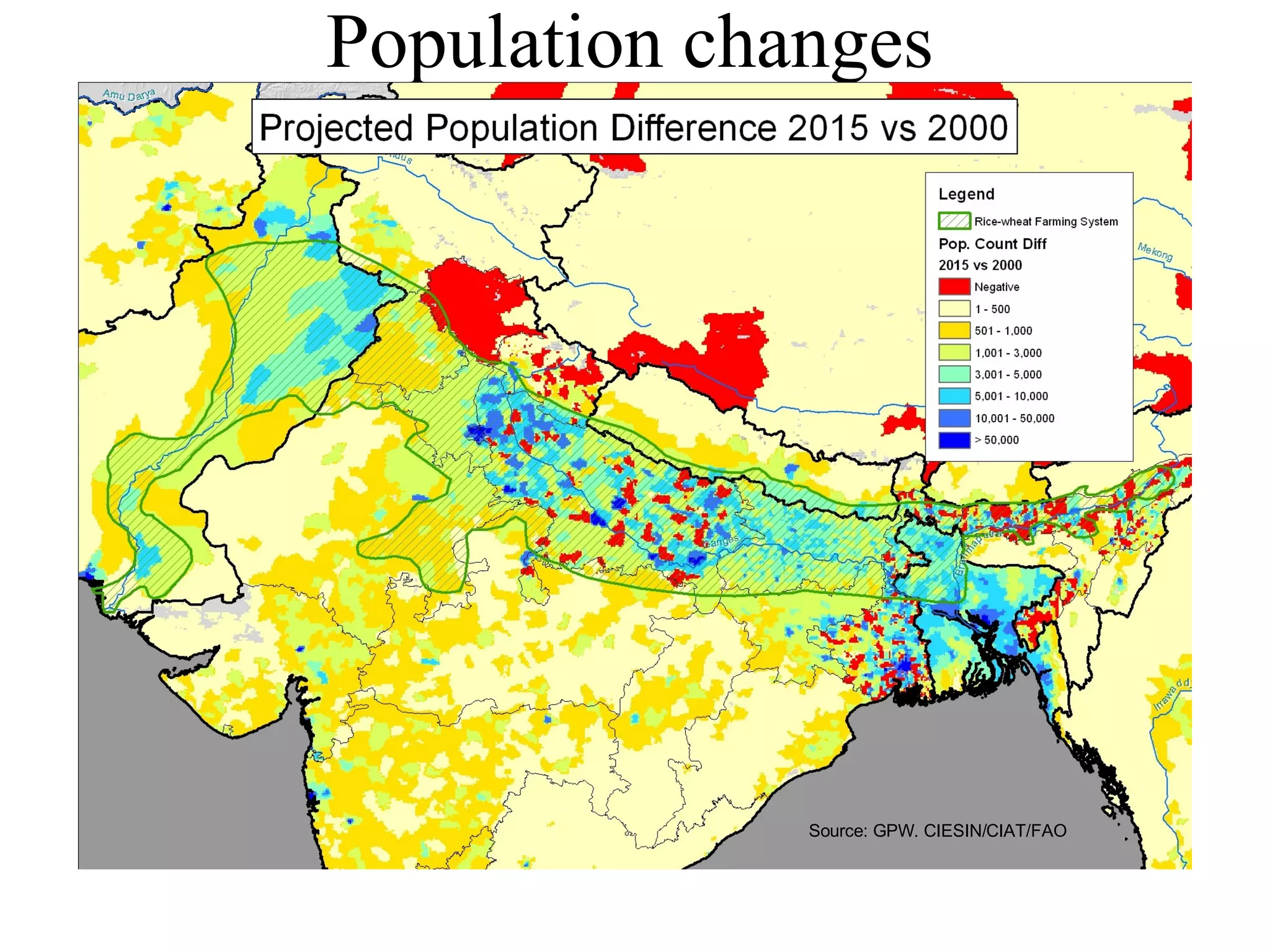
Population changes Source: GPW. CIESIN/CIAT/FAO
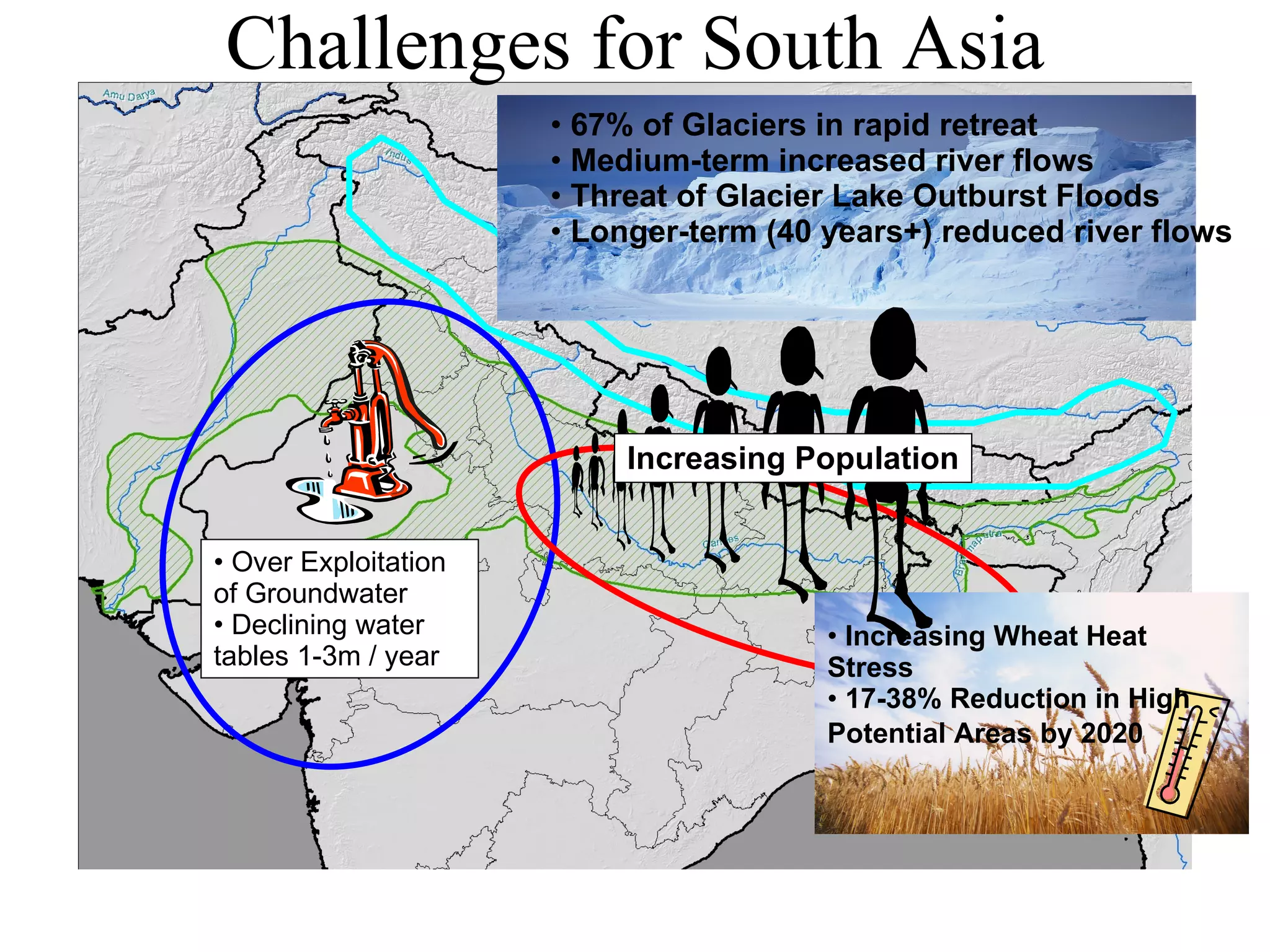
Challenges for South Asia Over Exploitation of Groundwater Declining water tables 1-3m / year 67% of Glaciers in rapid retreat Medium-term increased river flows Threat of Glacier Lake Outburst Floods Longer-term (40 years+) reduced river flows Increasing Wheat Heat Stress 17-38% Reduction in High  Potential Areas by 2020   Increasing Population
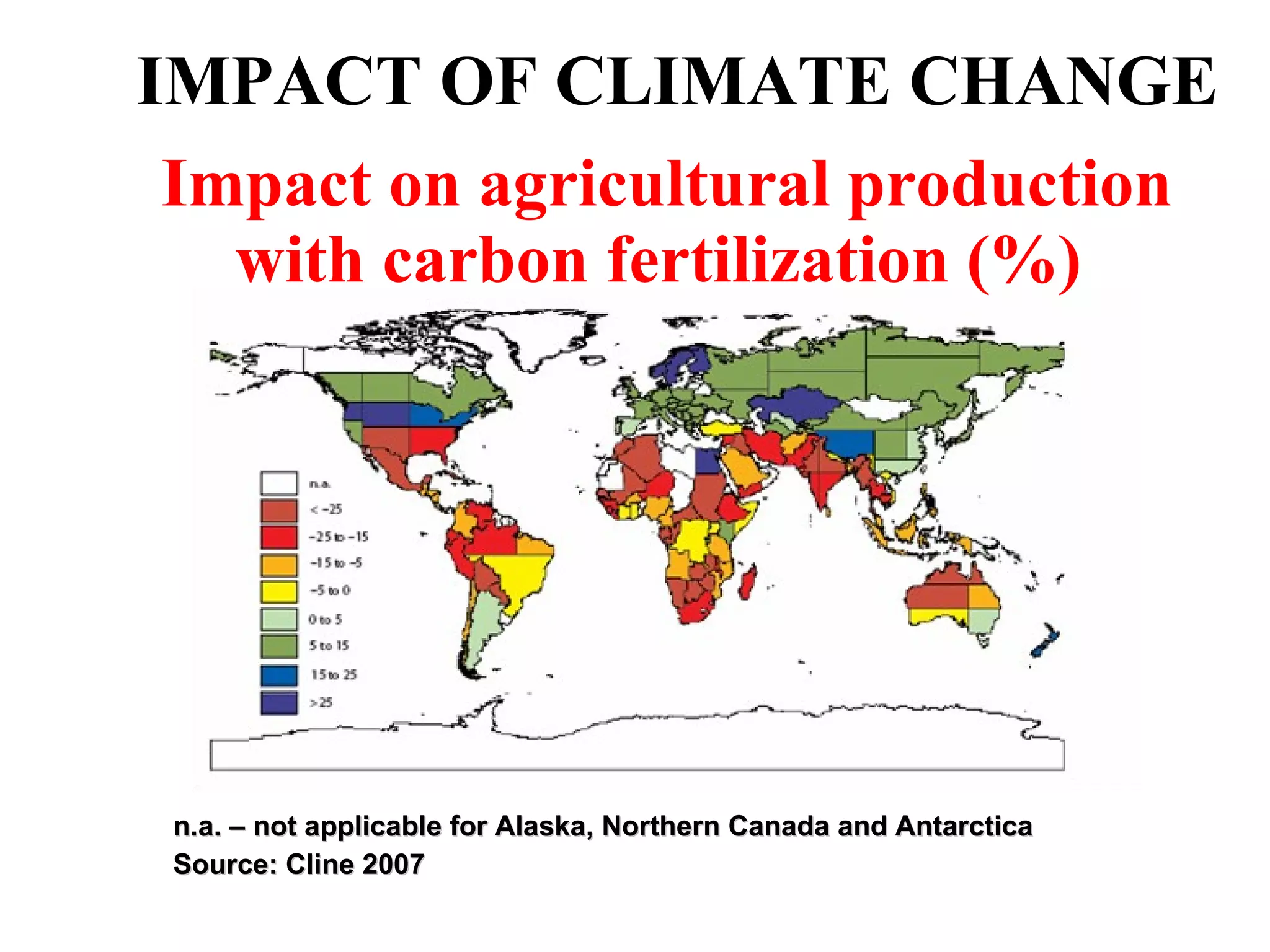
IMPACT OF CLIMATE CHANGE n.a. – not applicable for Alaska, Northern Canada and Antarctica Source: Cline 2007 Impact on agricultural production with carbon fertilization (%)
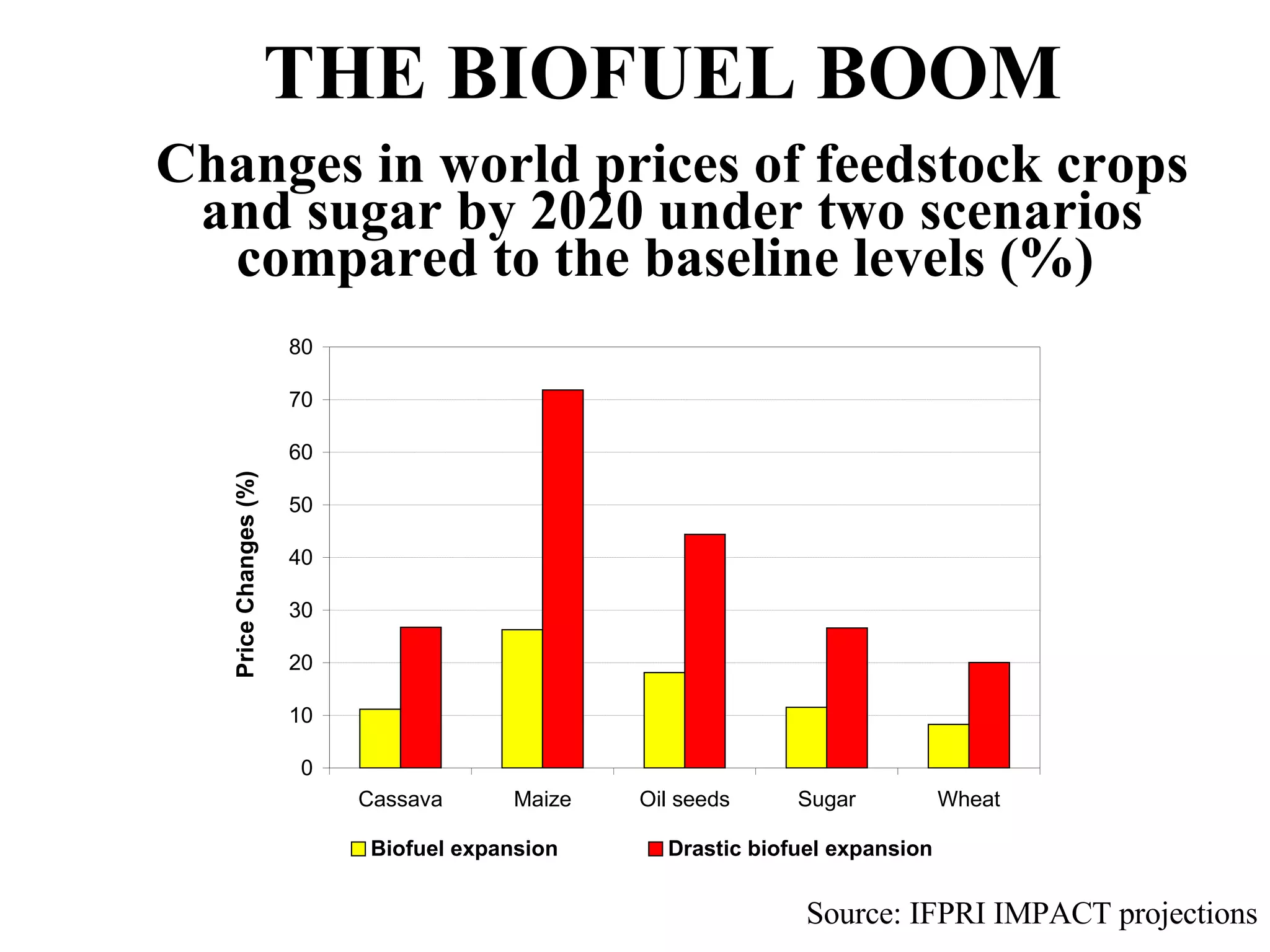
THE BIOFUEL BOOM  Source: IFPRI IMPACT projections Changes in world prices of feedstock crops and sugar by 2020 under two scenarios compared to the baseline levels (%)
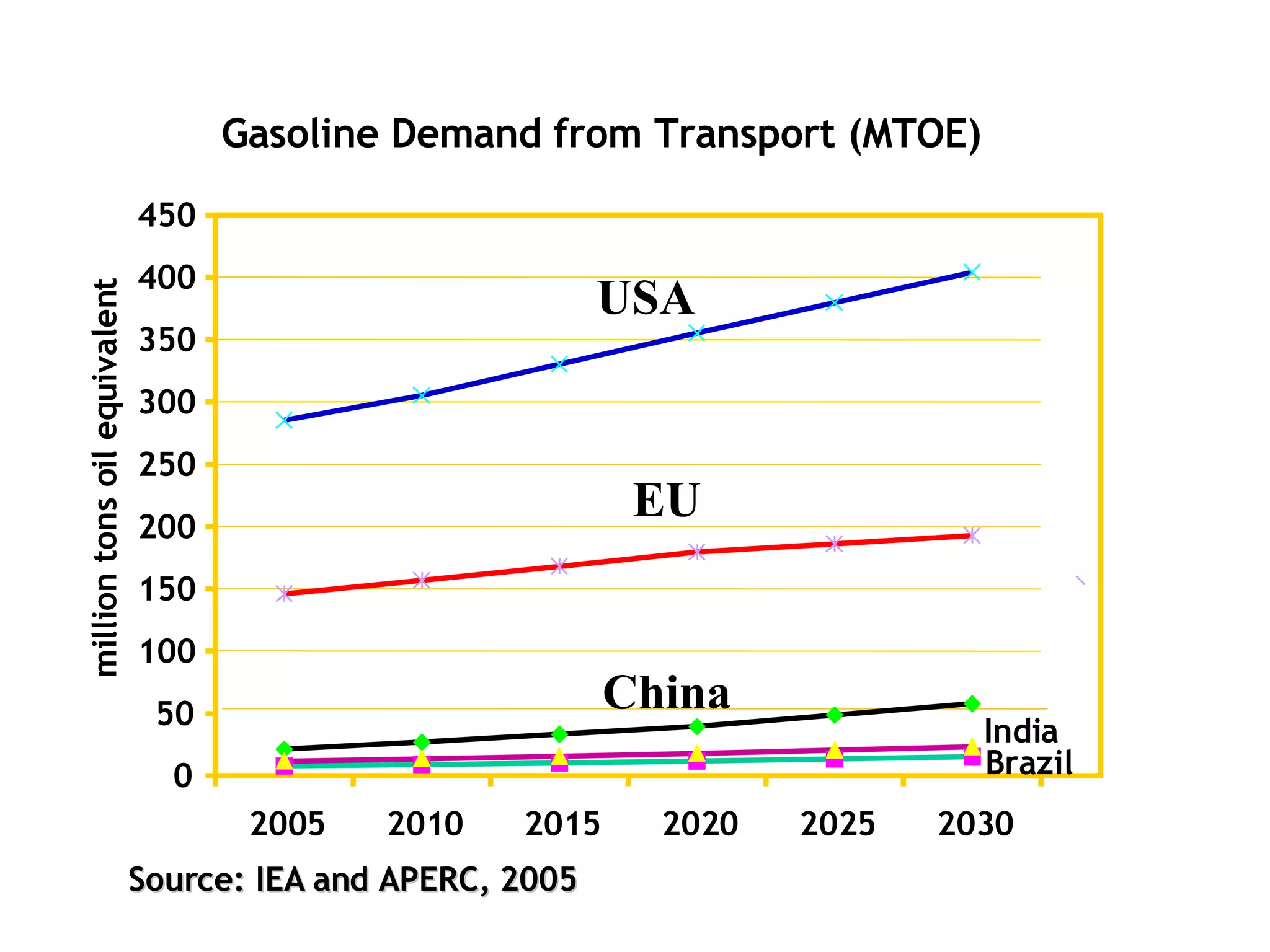
Source: IEA and APERC, 2005  Gasoline Demand from Transport (MTOE)‏ 0 50 100 150 200 250 300 350 400 450 2005 2010 2015 2020 2025 2030 million tons oil equivalent India Brazil USA EU China
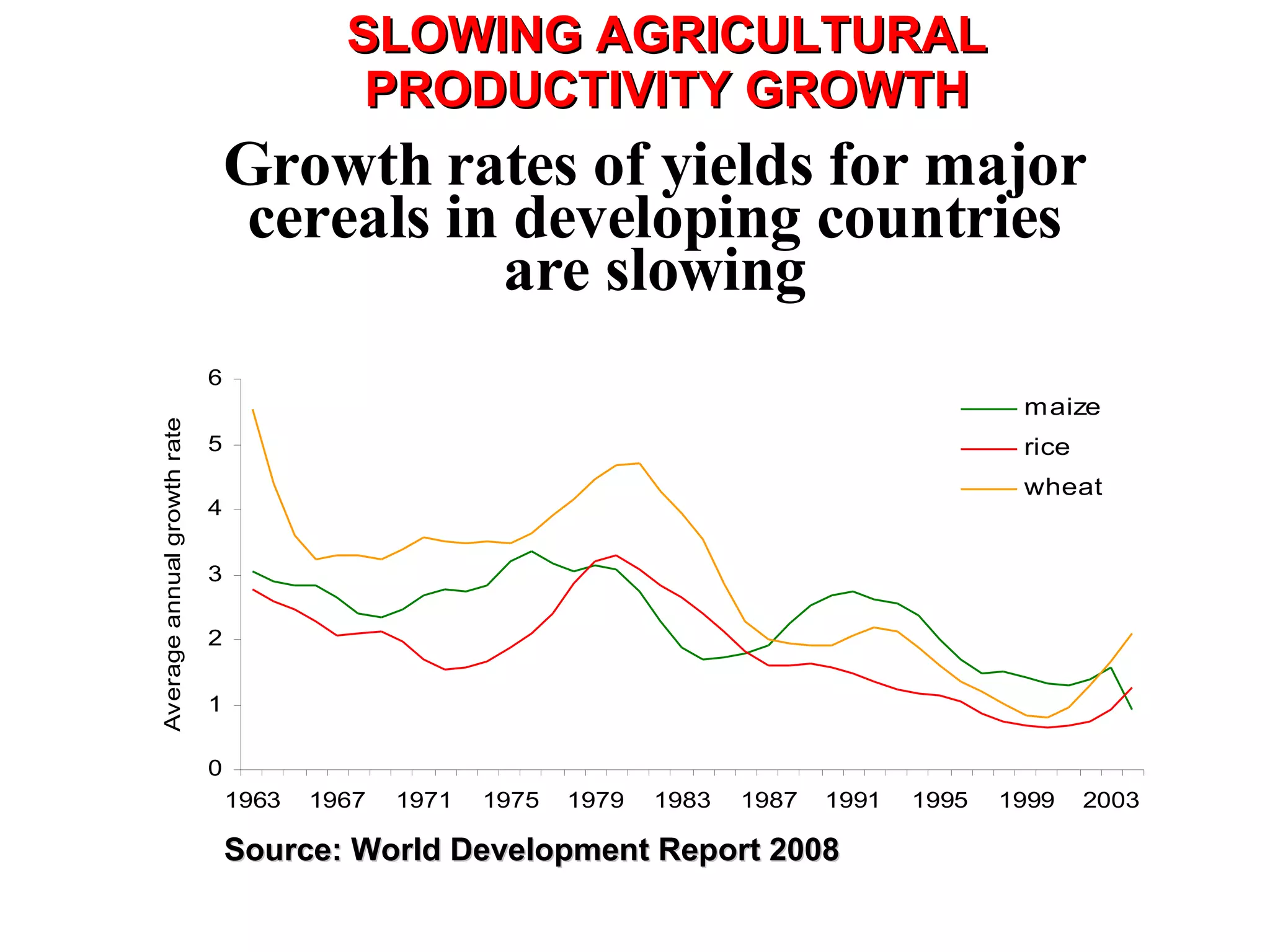
Growth rates of yields for major cereals in developing countries are slowing Source: World Development Report 2008 SLOWING AGRICULTURAL PRODUCTIVITY GROWTH
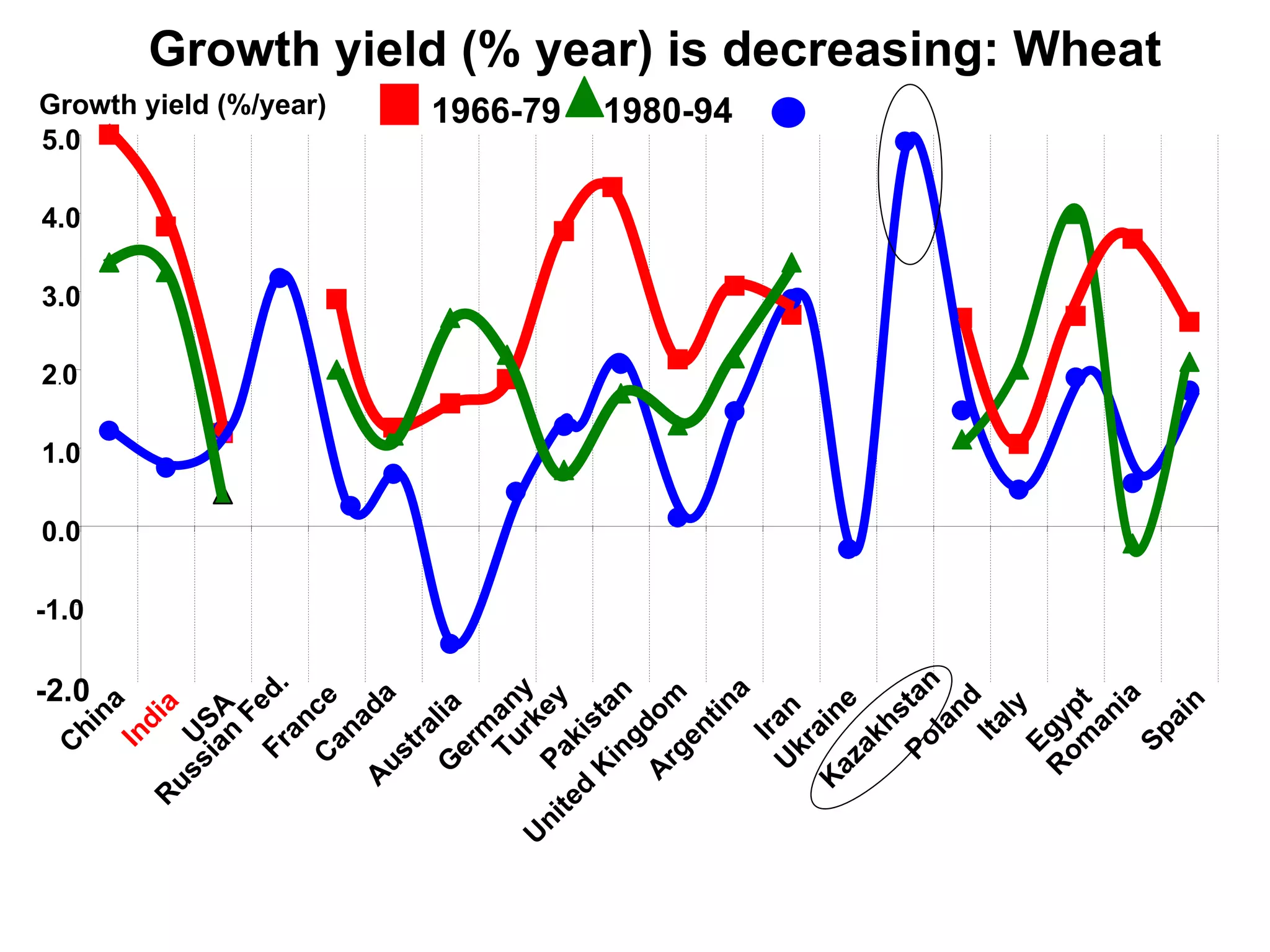
Growth yield (% year) is decreasing: Wheat -2.0 -1.0 0.0 1.0 2 . 0 3.0 4.0 5.0 China India USA Russian Fed. France Canada Australia Germany Turkey Pakistan United Kingdom Argentina Iran Ukraine Kazakhstan Poland Italy Egypt Romania Spain Growth yield (%/year) 1966-79 1980-94
Solutions on the way?
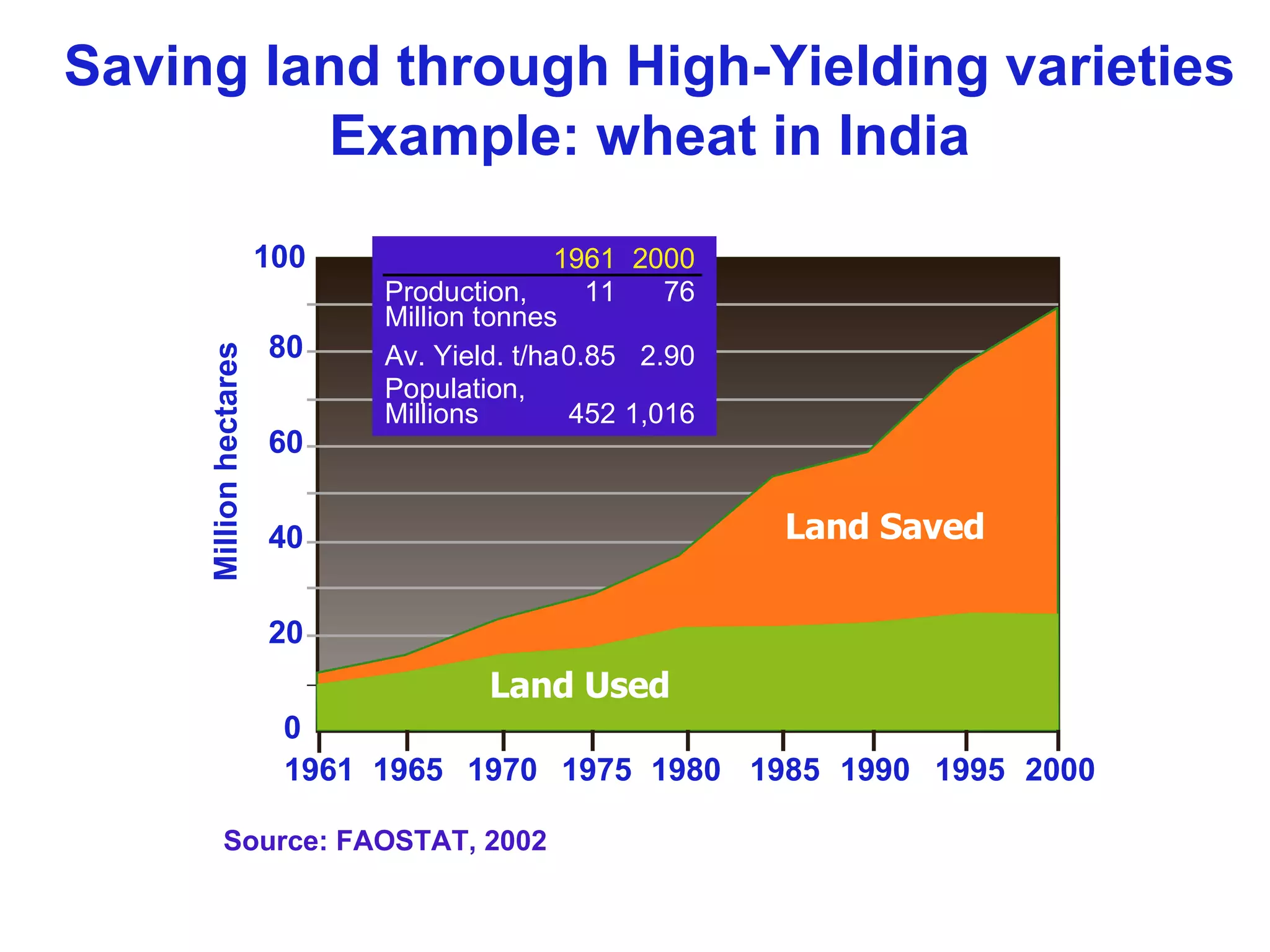
Saving land through High-Yielding varieties Example: wheat in India 100 60 40 20 0 1961 1965 1970 1975 1980 1985 1990 1995 2000 Million hectares Land Used Land Saved 80 1961 2000 Production, 11 76 Million tonnes Av. Yield. t/ha 0.85 2.90 Population, Millions 452 1,016 Source: FAOSTAT, 2002
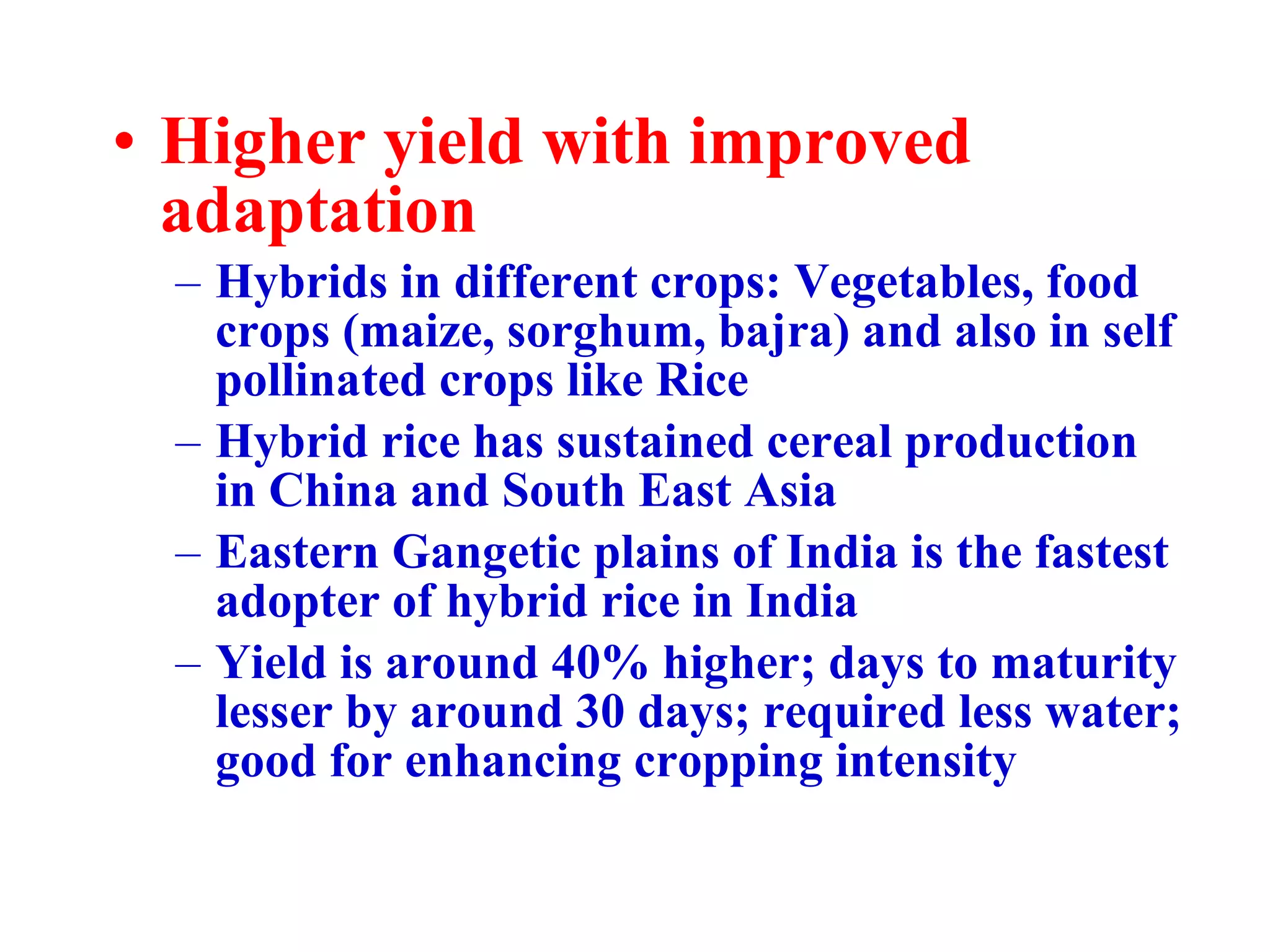
Higher yield with improved adaptation Hybrids in different crops: Vegetables, food crops (maize, sorghum, bajra) and also in self pollinated crops like Rice Hybrid rice has sustained cereal production in China and South East Asia Eastern Gangetic plains of India is the fastest adopter of hybrid rice in India Yield is around 40% higher; days to maturity lesser by around 30 days; required less water; good for enhancing cropping intensity
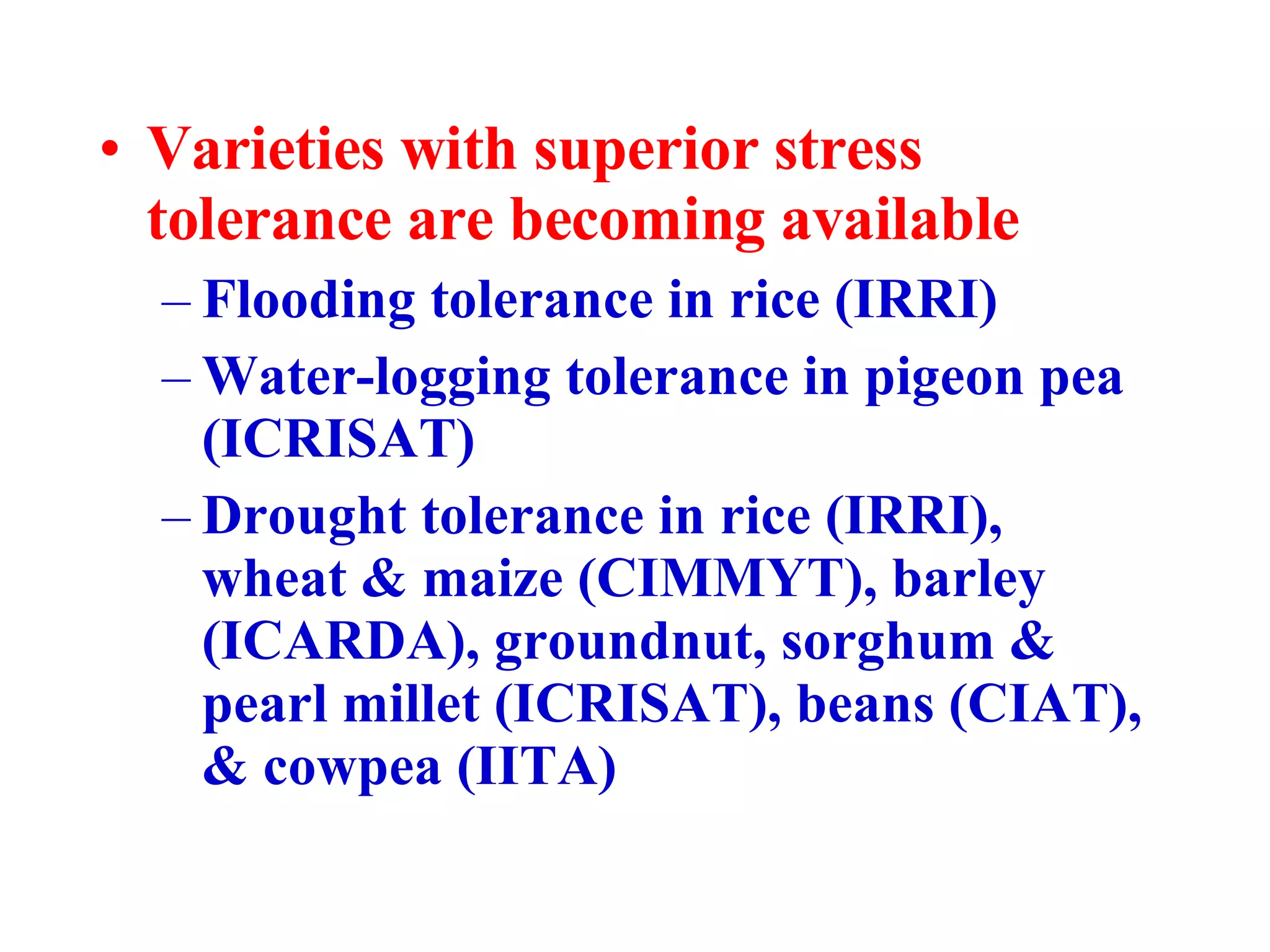
Varieties with superior stress tolerance are becoming available Flooding tolerance in rice (IRRI) Water-logging tolerance in pigeon pea (ICRISAT) Drought tolerance in rice (IRRI), wheat & maize (CIMMYT), barley (ICARDA), groundnut, sorghum & pearl millet (ICRISAT), beans (CIAT), & cowpea (IITA)
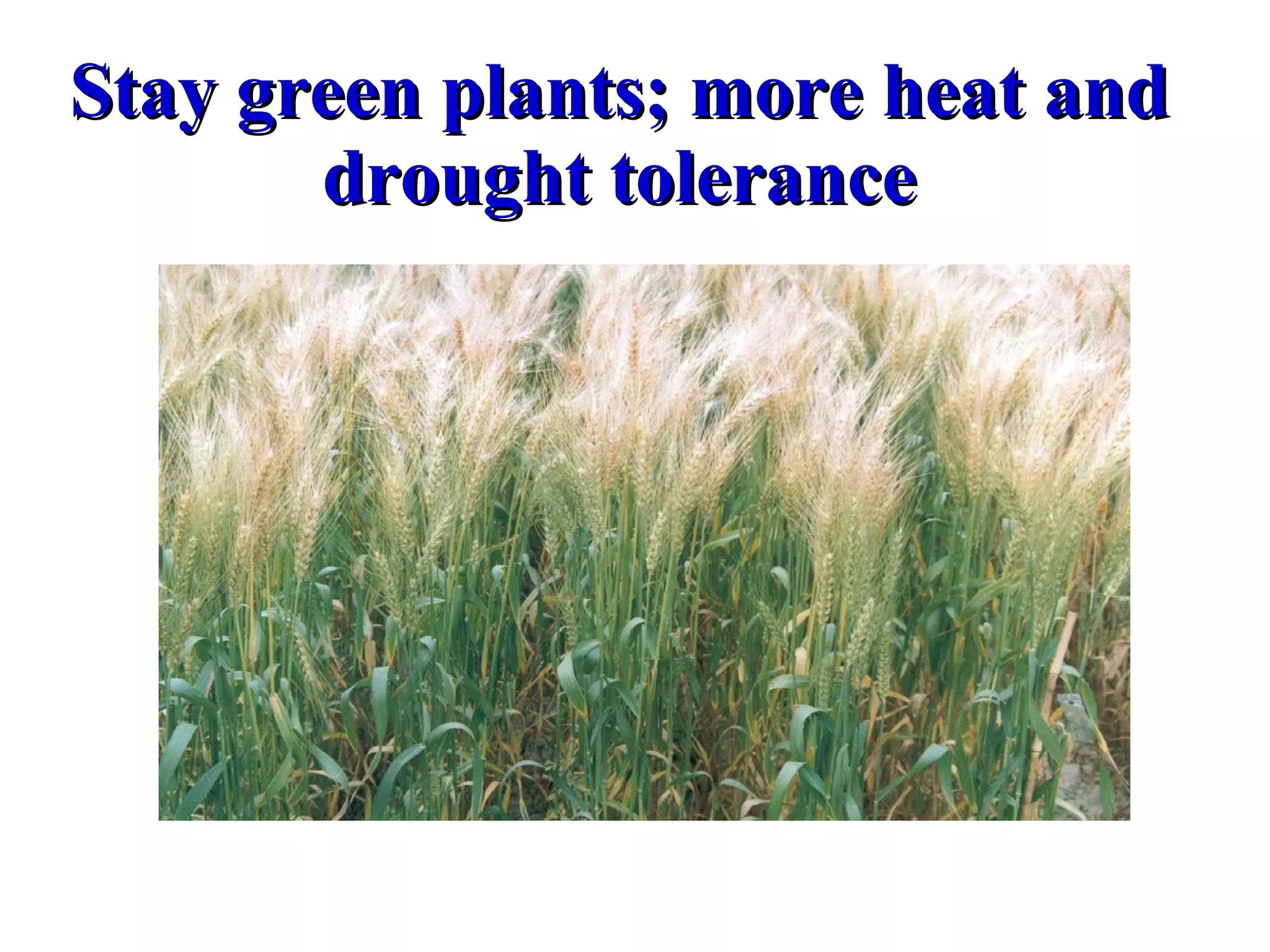
Stay green plants; more heat and drought tolerance
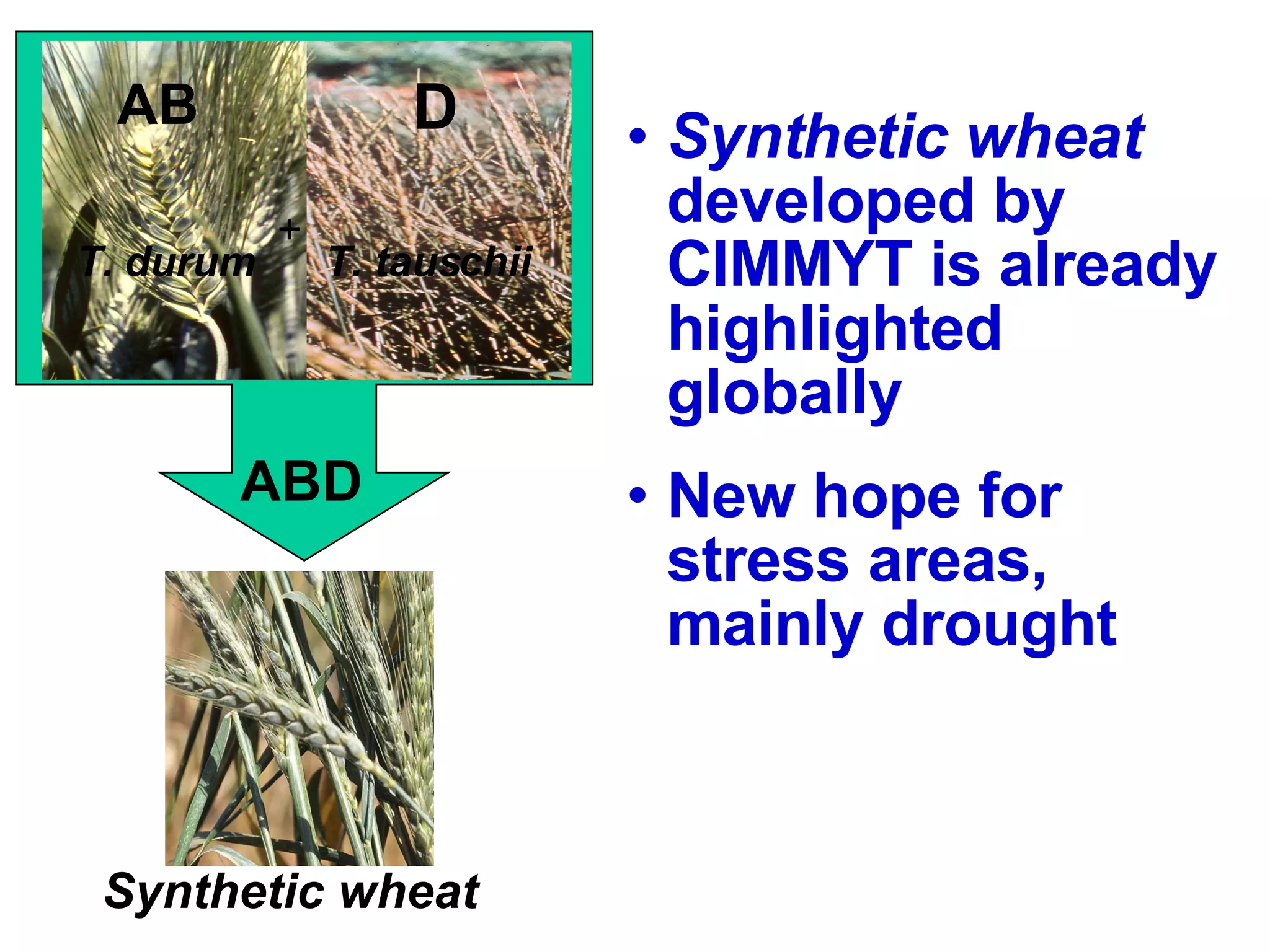
T. durum T. tauschii ABD Synthetic   wheat  developed by CIMMYT is already highlighted globally  New hope for stress areas, mainly drought D + AB Synthetic wheat
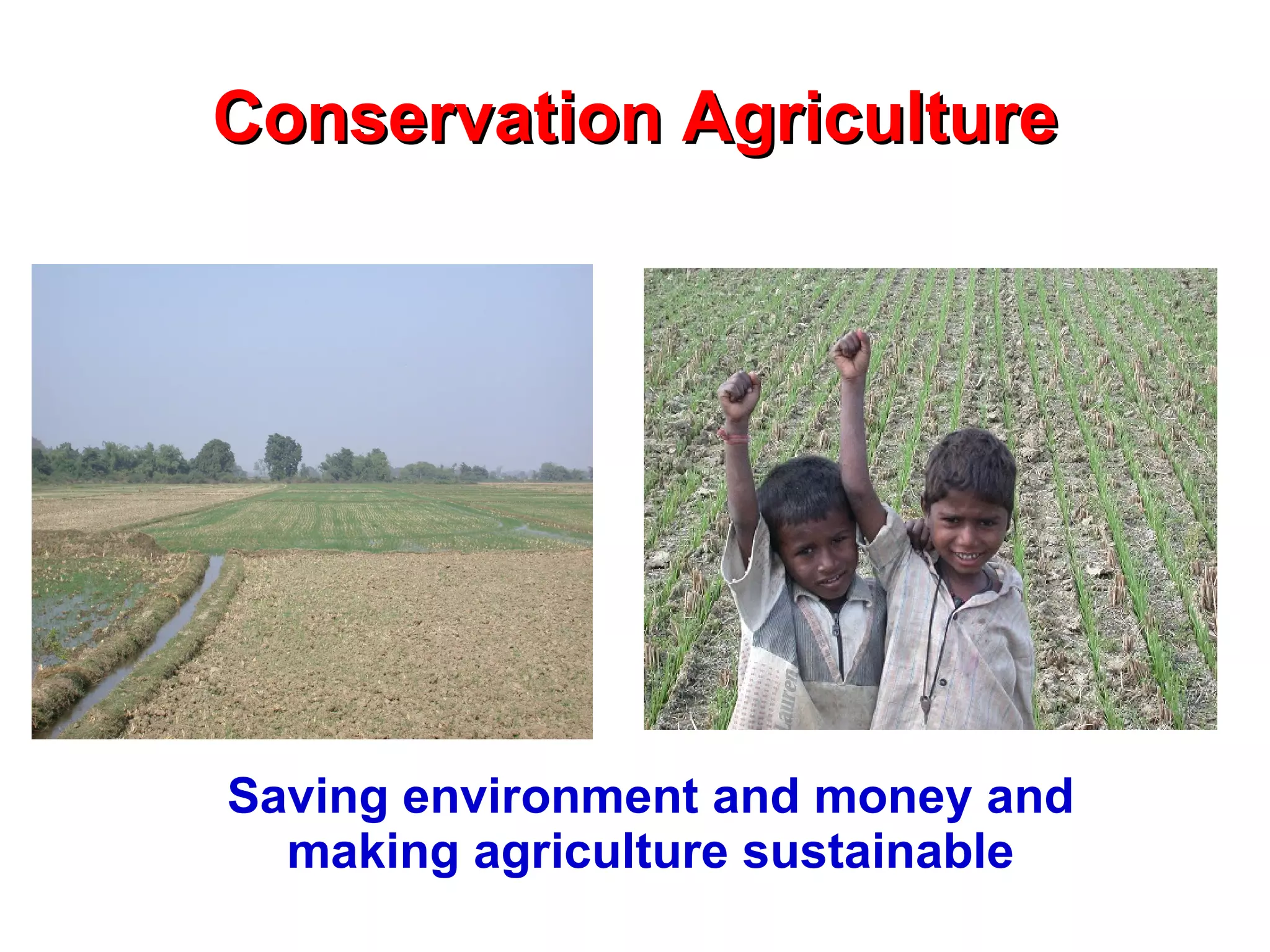
Conservation Agriculture Saving environment and money and making agriculture sustainable
Transgenics!
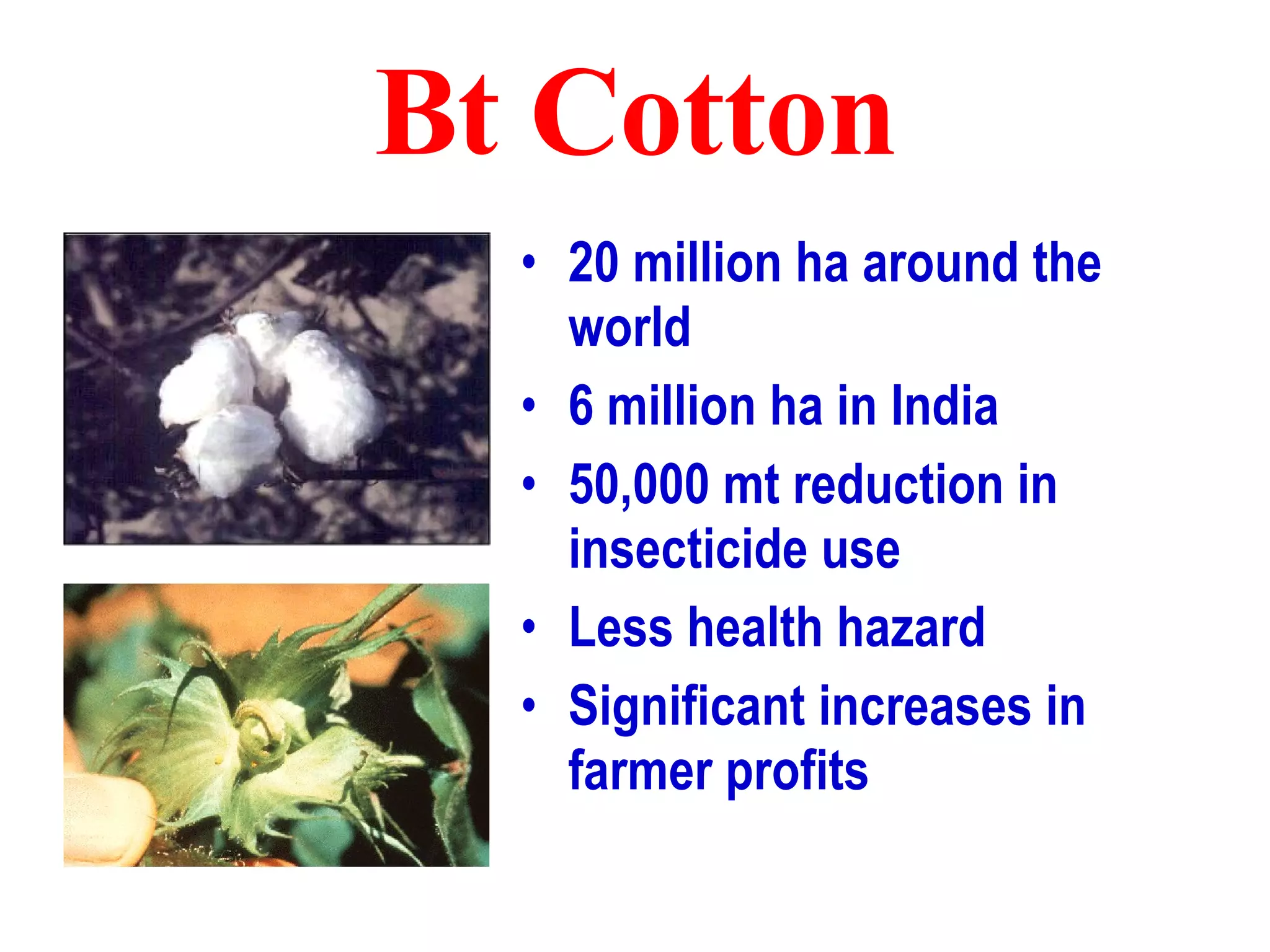
Bt Cotton 20 million ha around the world 6 million ha in India 50,000 mt reduction in insecticide use Less health hazard Significant increases in farmer profits
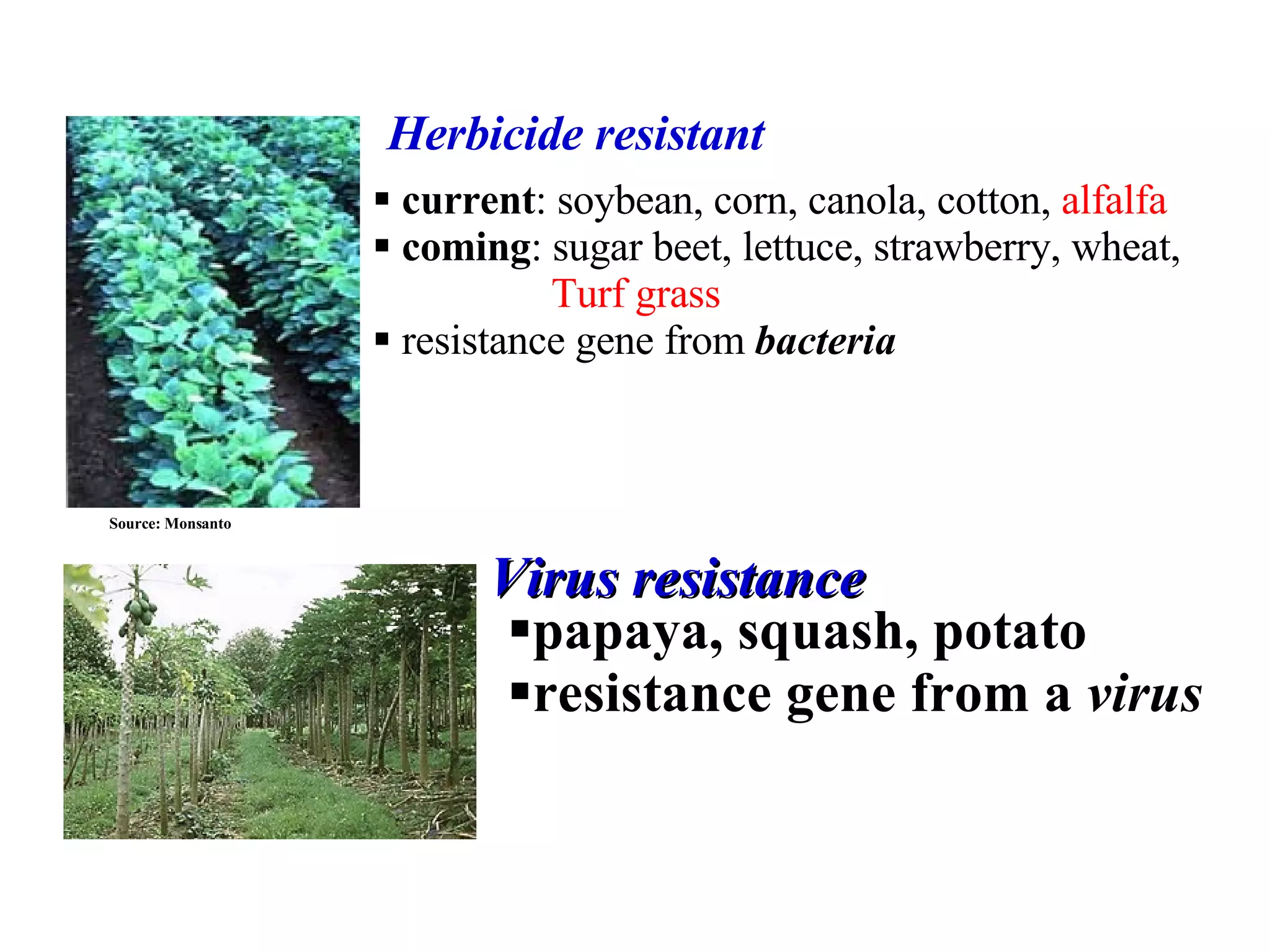
Virus resistance Source: Monsanto Herbicide resistant current : soybean, corn, canola, cotton,  alfalfa coming : sugar beet, lettuce, strawberry, wheat,  Turf grass resistance gene from  bacteria papaya, squash, potato resistance gene from a  virus
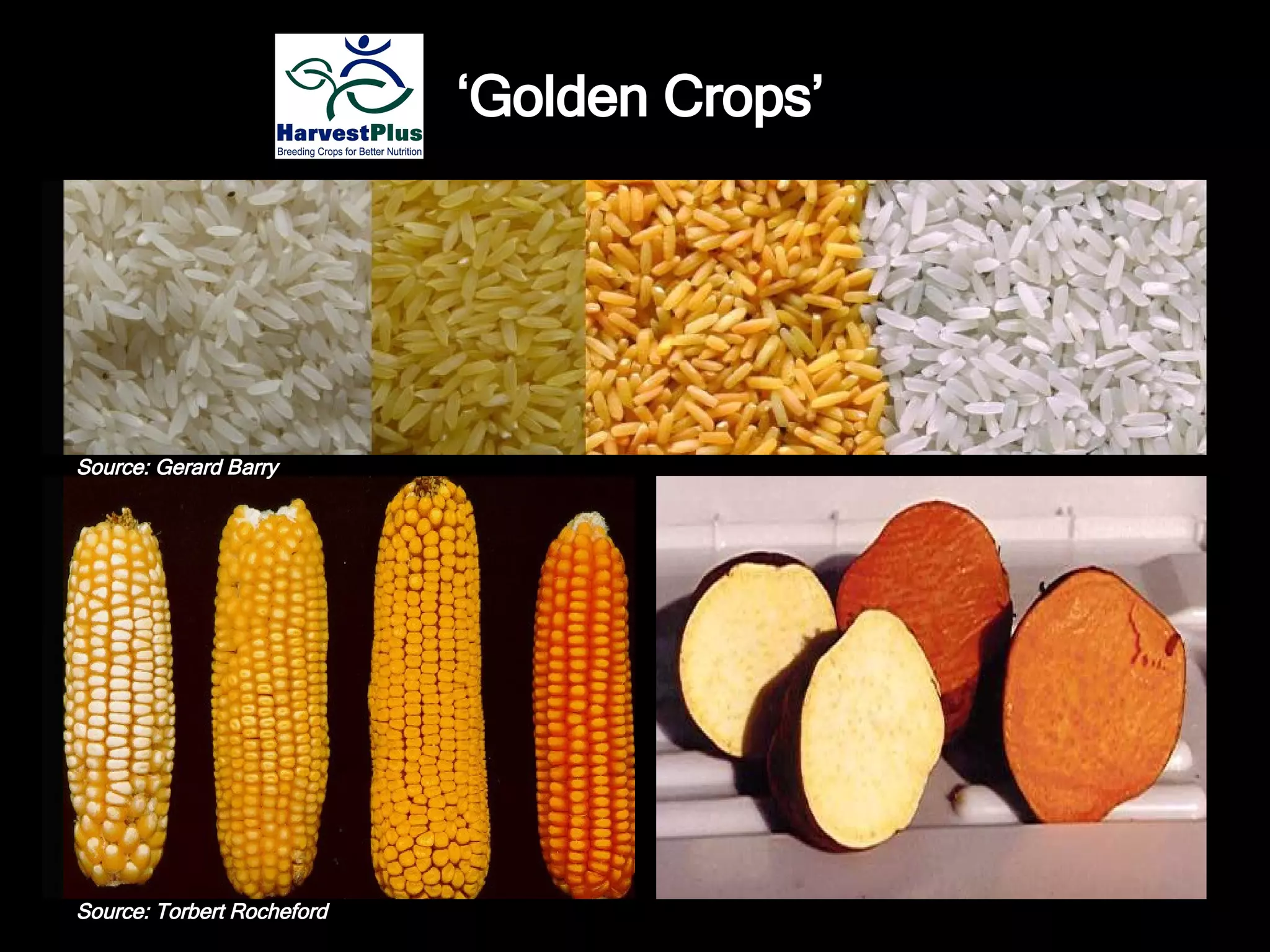
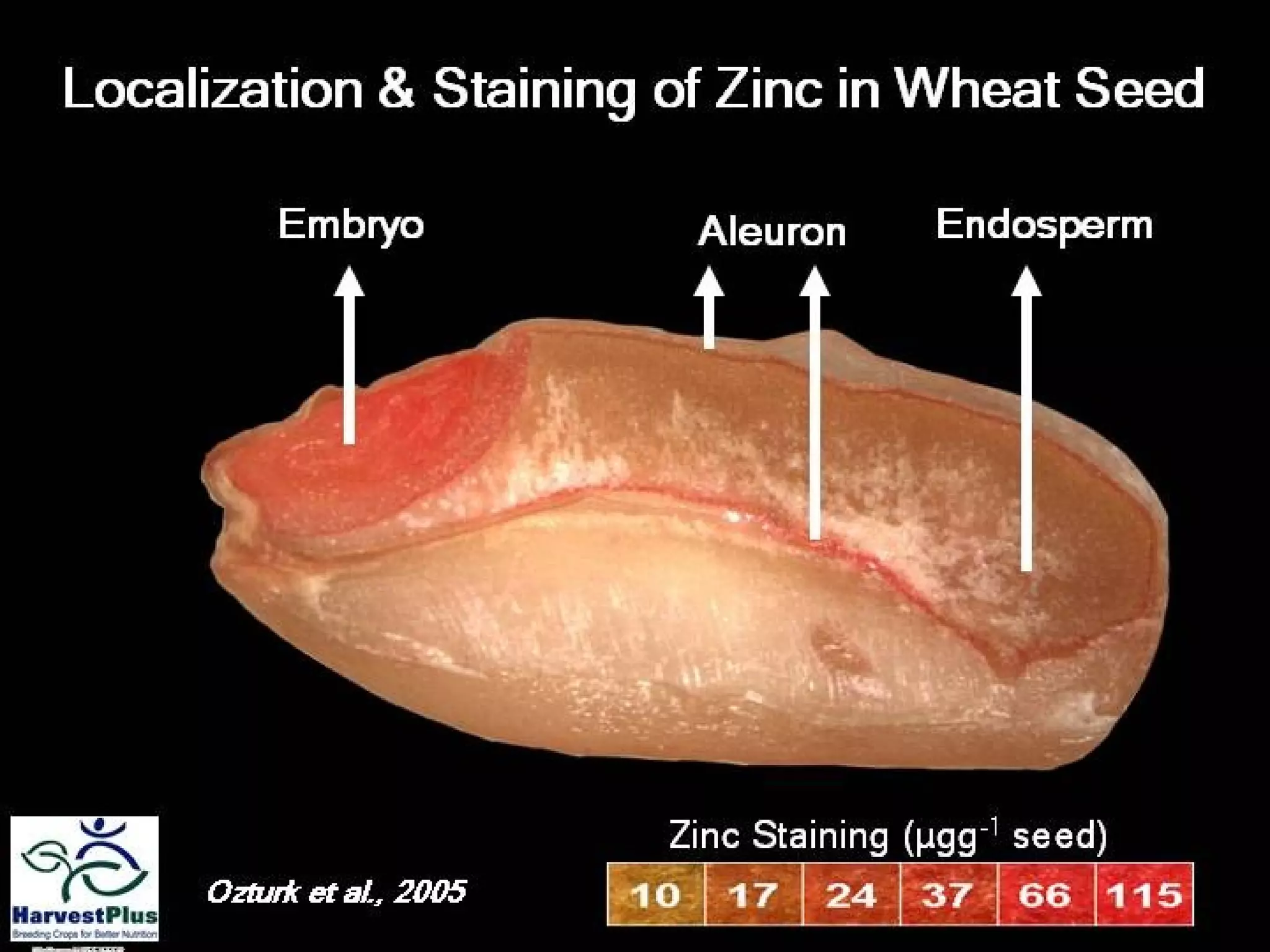
Molecular tools are being used for employing bio-fortified varieties of crops “ Bio-fortification”  means producing crops that have higher levels of nutrition in their edible parts
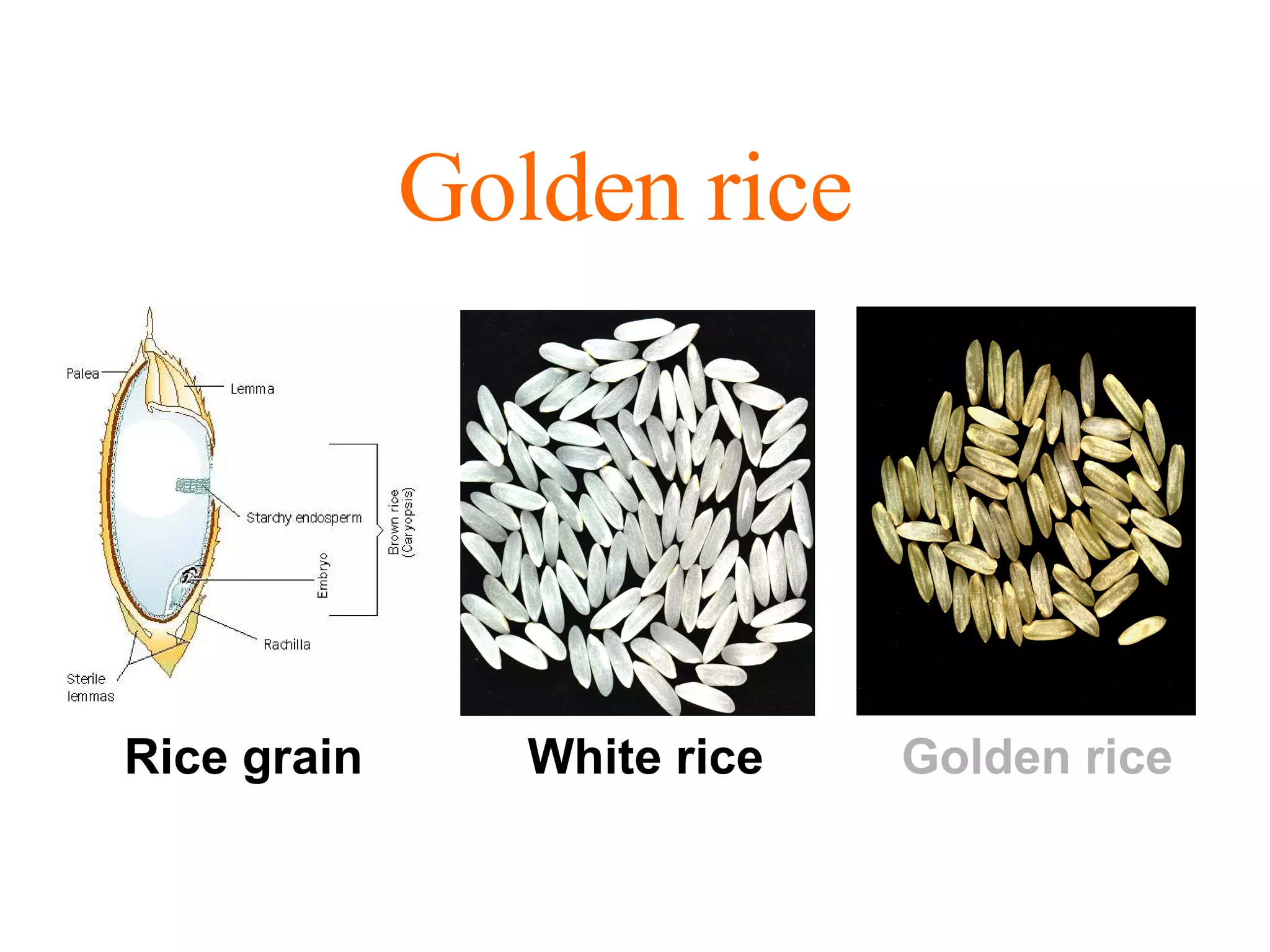
Golden rice Rice grain White rice Golden rice
‘ Golden Crops’ Source: Gerard Barry Source: Torbert Rocheford
 
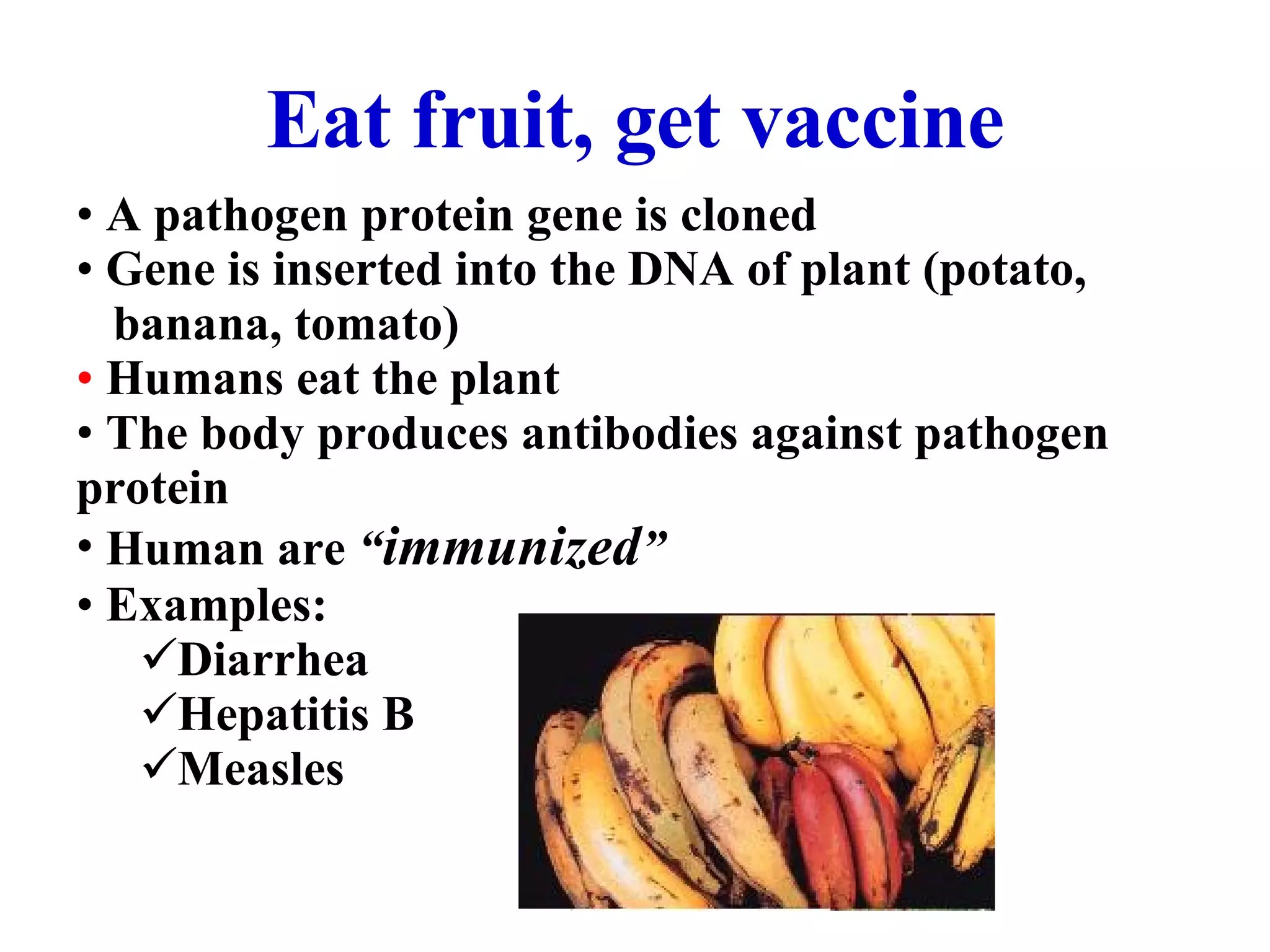
Eat fruit, get vaccine A pathogen protein gene is cloned Gene is inserted into the DNA of plant (potato, banana, tomato) Humans eat the plant  The body produces antibodies against pathogen protein Human are  “ immunized ” Examples: Diarrhea Hepatitis B Measles
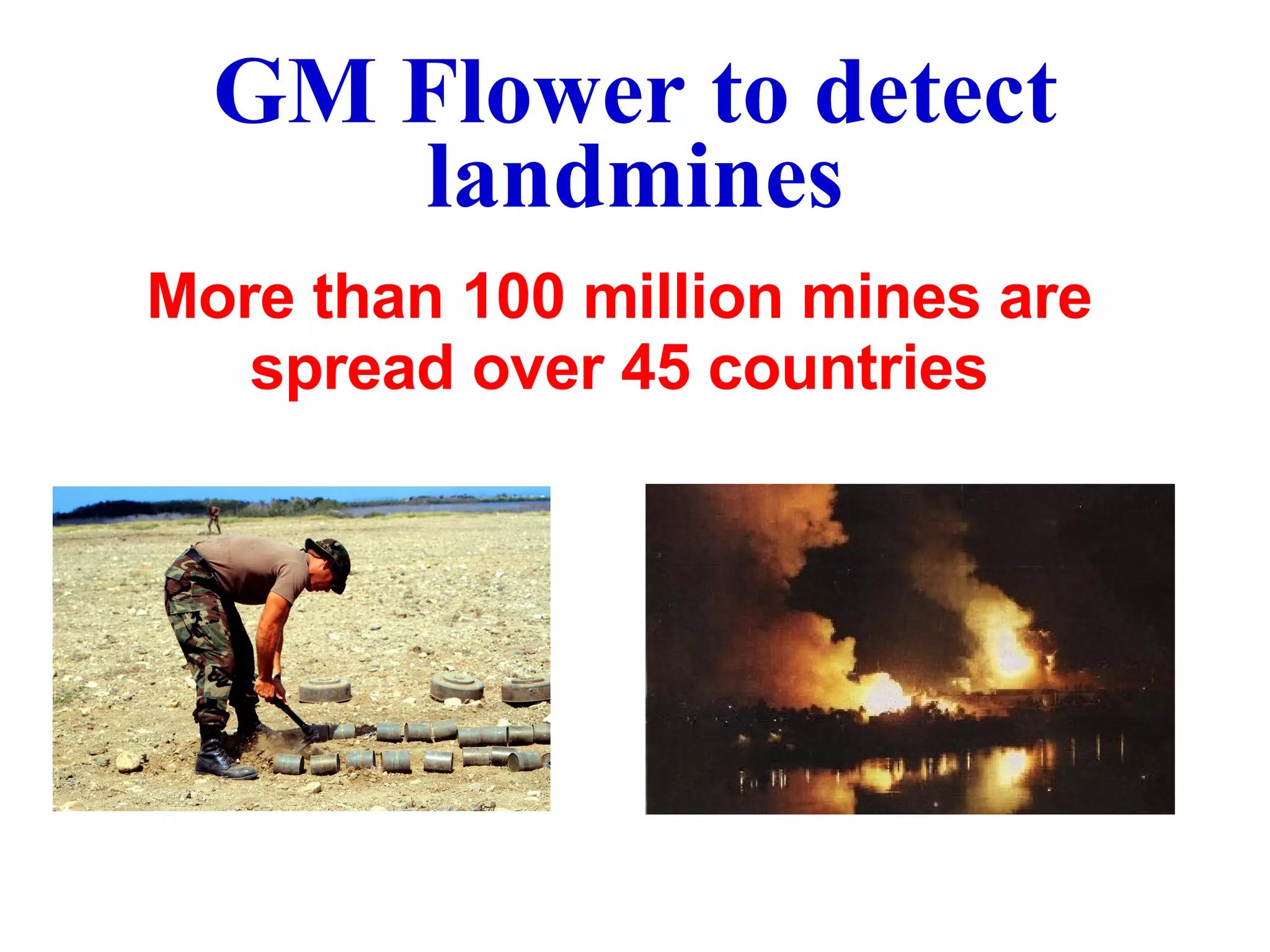
GM Flower to detect landmines More than 100 million mines are spread over 45 countries
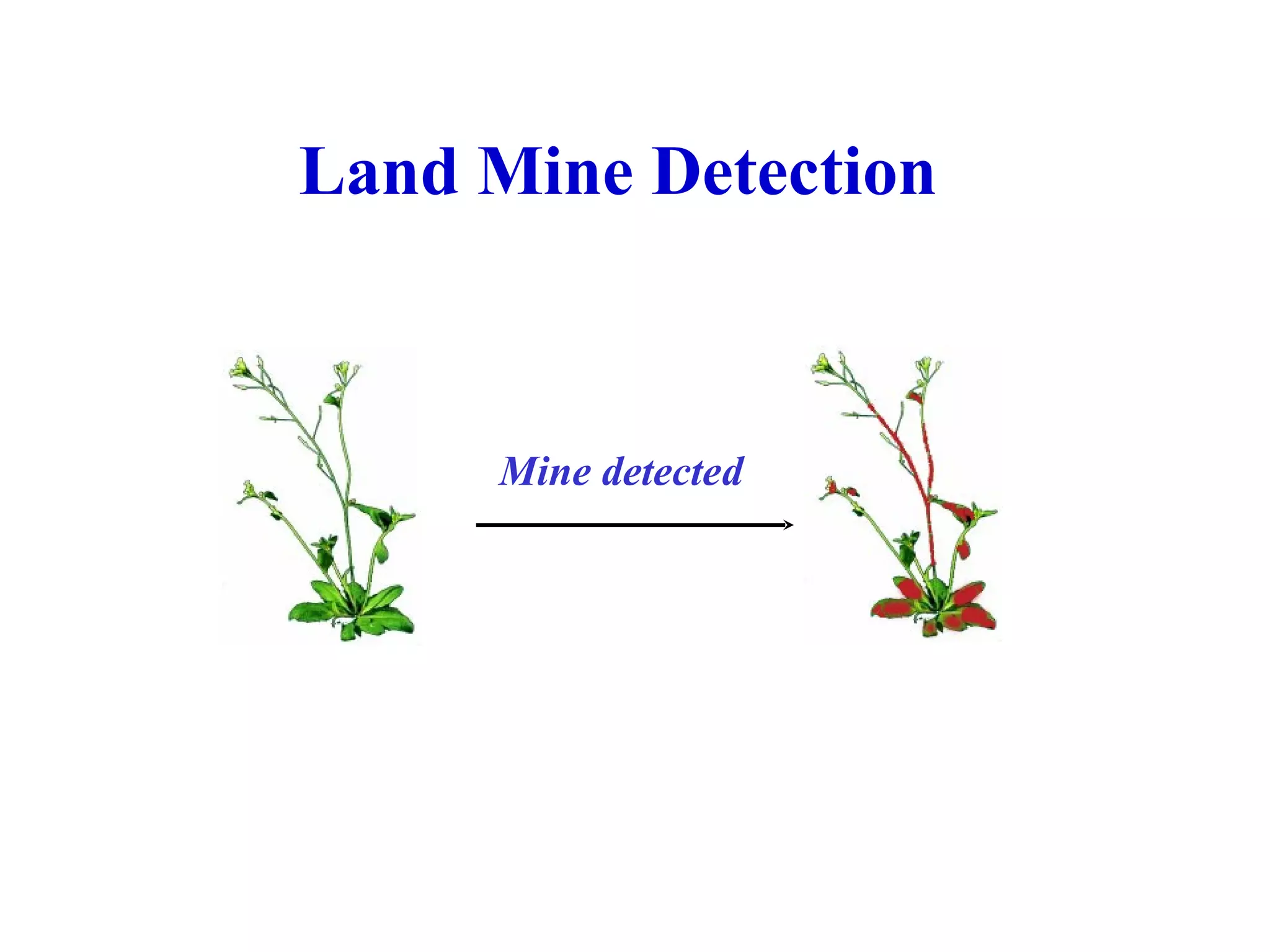
Land mines detecting flowers Danish Company: Aresa Biodetection Thale cress: a weed Coded to change colour of flower to  red  when root comes in contact with Nitrogenous gases   evaporating from explosives ! Flowers with in 3-6 weeks of sowings
Land Mine Detection   Mine detected
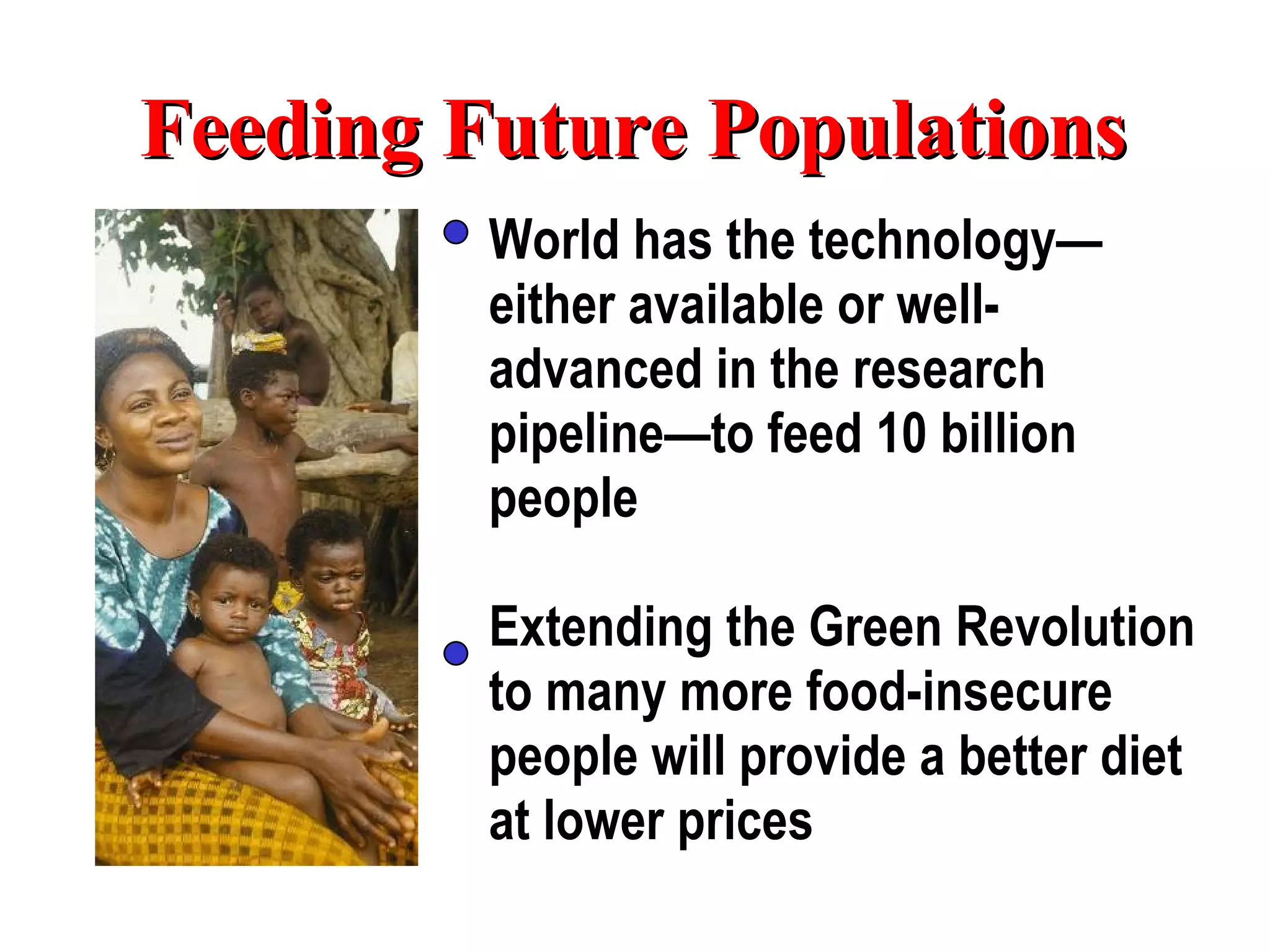
Feeding Future Populations World has the technology—either available or well-advanced in the research pipeline—to feed 10 billion people Extending the Green Revolution   to many more food-insecure people will provide a better diet at lower prices
Thanks for your attention /kU;okn

Evs Emerging Challenges

  • 1.
    Environmental challenges to Agriculture and the emerging solutions A.K. Joshi Department of Genetics & Plant Breeding Institute of Agricultural Sciences Banaras Hindu University
  • 2.
    Environment & AgricultureAgriculture is strongly linked to environment and they both to human population Initially, challenges to agriculture increased since human population increased As population grew, cities emerged and pressure on agriculture increased further, causing “Non-sustainability”
  • 3.
    Solutions emerged! Firstby domestication of crops (around 10,000 years ago) and then by management Domestication of cattle for cultivation: ~ 9000 years ago First plough: ~ 6000 years ago Horse collar: 3 rd century BC – In China 1701 AD: Jethrow Tull devised a simple seed drill – he was vilified A century later a threshing machine was greeted by riots
  • 4.
    Also emerged threats!1815: a gigantic volcanic eruption at Tambora in Indonesia led to the famous year “ Year without summer ”. Many countries frosted in summer. Wheat prices soared, and therefore, Thomas Robert Malthus (1798) forecasted a Population Crash , based on the calculation that “it was impossible to improve wheat yields as fast as people made babies”
  • 5.
    More land underplough Malthusian crash was staved off in the 19 th century by bringing more land under plough – in N. America, Argentina and Australia But, famines became worse in Asia Then it was the Tractor (early 1800s) that averted Malthusian disaster – the first tractor had few advantages but they did not eat hay or oats . It released around 25% more land for crops
  • 6.
    More land butless nutrients Again, Malthusian limit started approaching without sufficient nitrogen, phosphorus and potassium 1830 – a magic ingredient was discovered: Guano – In dry seabird islands of S. America and S. African coasts, immense deposits of bird droppings, rich in N & P, deposited over centuries
  • 7.
    Guano Rush In1843- a tiny island of Ichaboe (S.W. Africa) was discovered; covered in 25 feet of Penguin and gannet excrement It led to - “Guano Rush” followed by mutinies and battles During 1840-1880, guano nitrogen made a vast difference to European agriculture But soon the vast deposits were exhausted
  • 8.
    Search for morenitrates In late 19 th century, the rich mineral nitrate deposits of Chile took the place of Guano. These nitrate mines fuelled Chilean economy and fertilized Europe’s farms On 2 nd July, 1909 - Carl Bosch (BASF) and Fritz Haber combined N (from air) with hydrogen (from coal) to make ammonia Then in few years, BASF started mining sky for nitrogen
  • 9.
    Consequences Today, nearlyhalf of the N atoms in the proteins of an average human beings came at some time or another through an ammonia factory Haber – nearly saved the German war effort as it was running out of nitrogen explosives in 1914, cut off from Chilean nitrates, but then went on to make lethal gas for chemical warfare and genocide
  • 10.
    More N neededfurther technology Haber’s nitrogen was not welcome till middle of 20 th century Because it was a powder, and It was lodging the crop Then, dwarf varieties rescued the world as it made crops responsive to nitrogen More nitrogen = more food
  • 11.
    Wheat drove thefirst major change India got 18000 tonnes of dwarf wheat from CIMMYT, Mexico in 1965 Sir N.E. Borlaug loaded 35 trucks in Mexico and sent to Los Angeles for transport to India And, thus introduced Green Revolution
  • 12.
    Norin 10, thedonor of the dwarfing gene which saved millions of lives
  • 13.
    After 50 yearsof Green Revolution “w e need further efforts to feed the world, but the world is not the same”
  • 14.
    Population increasing toomuch “more in developing countries” Sources: UN Population Division and Population Reference Bureau Developed 6.2 b 80%+ Developing
  • 15.
    Most nations areshort of money β -version of a high spatial resolution database of global income and poverty. Sub-national data compiled from country-level sources. Income was in many cases estimated from poverty incidence, and for countries with no data at all using regression models fitted with data from other countries in the region (see next slides). EU is income after taxes (and looks therefore too poor). R. Hijmans, IRRI; J. Dixon, CIMMYT
  • 16.
    WDR: Three worldsof agriculture Urbanizing Agriculture based countries 82% of population in SSA Transforming countries 98% of population in SA 96% of EAP; 92% of MENA Urbanized countries 88% of population in ECA; 88% in LAC World Bank WDR, 2007
  • 17.
  • 18.
    e.g., Africa - Annual Precipitation Variation: 1988-98 (Hodson, CIMMYT) Variable Nature of Environments
  • 19.
    A shift inthinking! No one understands better than farmers do how the weather change can affect people and their land But now, emerging weather patterns have made lot of other people worried, too, and their concerns are well founded (Yvo de Boer, Executive Sect. UN’s Framework Convention on Climate Change - UNFCCC)
  • 20.
    Some environmental challenges– case study from India
  • 21.
    Heat – astrategic issue for the S Asia Relative yield (+2 º C / current) for rice growing areas Also an issue for wheat and even maize, in different areas Change in yield (%) R. Hijmans, IRRI
  • 22.
    Heat stressed areasare increasing For example: Environment for wheat in India Current 2050
  • 23.
    Water scarcity Source:Ministry of Water Resources, Gov. India, 2006
  • 24.
    Increasing Water Stressin Punjab Note: Figure in parentheses indicate stage of ground water use. A total of 137 blocks were assessed. Source: Planning Commission, 2007 J. Dixon, CIMMYT
  • 25.
    Glaciers cover c.33,000km 2 Provide c.8.6 X 10 6 m 3 of water / year 67% Retreating at a rapid rate Deglaciation – Simulated River Flows (next 10 decades)
  • 26.
    Population changes Source:GPW. CIESIN/CIAT/FAO
  • 27.
    Challenges for SouthAsia Over Exploitation of Groundwater Declining water tables 1-3m / year 67% of Glaciers in rapid retreat Medium-term increased river flows Threat of Glacier Lake Outburst Floods Longer-term (40 years+) reduced river flows Increasing Wheat Heat Stress 17-38% Reduction in High Potential Areas by 2020 Increasing Population
  • 28.
    IMPACT OF CLIMATECHANGE n.a. – not applicable for Alaska, Northern Canada and Antarctica Source: Cline 2007 Impact on agricultural production with carbon fertilization (%)
  • 29.
    THE BIOFUEL BOOM Source: IFPRI IMPACT projections Changes in world prices of feedstock crops and sugar by 2020 under two scenarios compared to the baseline levels (%)
  • 30.
    Source: IEA andAPERC, 2005 Gasoline Demand from Transport (MTOE)‏ 0 50 100 150 200 250 300 350 400 450 2005 2010 2015 2020 2025 2030 million tons oil equivalent India Brazil USA EU China
  • 31.
    Growth rates ofyields for major cereals in developing countries are slowing Source: World Development Report 2008 SLOWING AGRICULTURAL PRODUCTIVITY GROWTH
  • 32.
    Growth yield (%year) is decreasing: Wheat -2.0 -1.0 0.0 1.0 2 . 0 3.0 4.0 5.0 China India USA Russian Fed. France Canada Australia Germany Turkey Pakistan United Kingdom Argentina Iran Ukraine Kazakhstan Poland Italy Egypt Romania Spain Growth yield (%/year) 1966-79 1980-94
  • 33.
  • 34.
    Saving land throughHigh-Yielding varieties Example: wheat in India 100 60 40 20 0 1961 1965 1970 1975 1980 1985 1990 1995 2000 Million hectares Land Used Land Saved 80 1961 2000 Production, 11 76 Million tonnes Av. Yield. t/ha 0.85 2.90 Population, Millions 452 1,016 Source: FAOSTAT, 2002
  • 35.
    Higher yield withimproved adaptation Hybrids in different crops: Vegetables, food crops (maize, sorghum, bajra) and also in self pollinated crops like Rice Hybrid rice has sustained cereal production in China and South East Asia Eastern Gangetic plains of India is the fastest adopter of hybrid rice in India Yield is around 40% higher; days to maturity lesser by around 30 days; required less water; good for enhancing cropping intensity
  • 36.
    Varieties with superiorstress tolerance are becoming available Flooding tolerance in rice (IRRI) Water-logging tolerance in pigeon pea (ICRISAT) Drought tolerance in rice (IRRI), wheat & maize (CIMMYT), barley (ICARDA), groundnut, sorghum & pearl millet (ICRISAT), beans (CIAT), & cowpea (IITA)
  • 37.
    Stay green plants;more heat and drought tolerance
  • 38.
    T. durum T.tauschii ABD Synthetic wheat developed by CIMMYT is already highlighted globally New hope for stress areas, mainly drought D + AB Synthetic wheat
  • 39.
    Conservation Agriculture Savingenvironment and money and making agriculture sustainable
  • 40.
  • 41.
    Bt Cotton 20million ha around the world 6 million ha in India 50,000 mt reduction in insecticide use Less health hazard Significant increases in farmer profits
  • 42.
    Virus resistance Source:Monsanto Herbicide resistant current : soybean, corn, canola, cotton, alfalfa coming : sugar beet, lettuce, strawberry, wheat, Turf grass resistance gene from bacteria papaya, squash, potato resistance gene from a virus
  • 43.
    Molecular tools arebeing used for employing bio-fortified varieties of crops “ Bio-fortification” means producing crops that have higher levels of nutrition in their edible parts
  • 44.
    Golden rice Ricegrain White rice Golden rice
  • 45.
    ‘ Golden Crops’Source: Gerard Barry Source: Torbert Rocheford
  • 46.
  • 47.
    Eat fruit, getvaccine A pathogen protein gene is cloned Gene is inserted into the DNA of plant (potato, banana, tomato) Humans eat the plant The body produces antibodies against pathogen protein Human are “ immunized ” Examples: Diarrhea Hepatitis B Measles
  • 48.
    GM Flower todetect landmines More than 100 million mines are spread over 45 countries
  • 49.
    Land mines detectingflowers Danish Company: Aresa Biodetection Thale cress: a weed Coded to change colour of flower to red when root comes in contact with Nitrogenous gases evaporating from explosives ! Flowers with in 3-6 weeks of sowings
  • 50.
    Land Mine Detection Mine detected
  • 51.
    Feeding Future PopulationsWorld has the technology—either available or well-advanced in the research pipeline—to feed 10 billion people Extending the Green Revolution to many more food-insecure people will provide a better diet at lower prices
  • 52.
    Thanks for yourattention /kU;okn