TEACHER TIPS 2nd
Batxillerat
LESSON 4
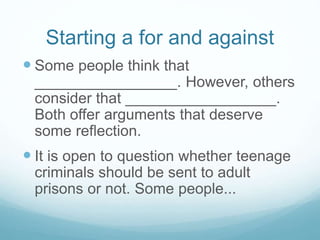
Starting a for and against
 Some people think that
_________________. However, others
consider that __________________.
Both offer arguments that deserve
some reflection.
 It is open to question whether teenage
criminals should be sent to adult
prisons or not. Some people...
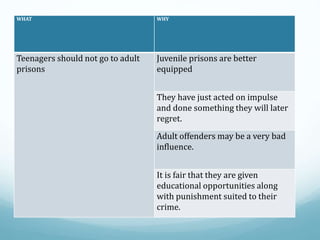
WHAT WHY
Teenagers should not go to adult
prisons
Juvenile prisons are better
equipped
They have just acted on impulse
and done something they will later
regret.
Adult offenders may be a very bad
influence.
It is fair that they are given
educational opportunities along
with punishment suited to their
crime.
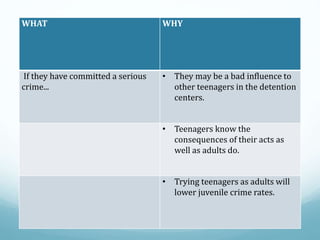
WHAT WHY
If they have committed a serious
crime...
• They may be a bad influence to
other teenagers in the detention
centers.
• Teenagers know the
consequences of their acts as
well as adults do.
• Trying teenagers as adults will
lower juvenile crime rates.
“For” and “To” to express
reason
 Both “to” and “for” are used to express reason and can
be translated as “para”
 Remember to is used before verbs
 I came to Esplugues to work.
 Remember to use for before nouns
 I came to Esplugues for a new job.
 Never use “for to”
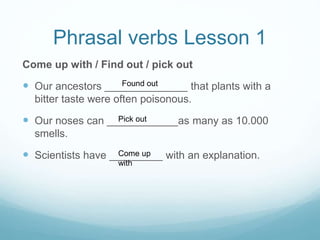
Phrasal verbs Lesson 1
Come up with / Find out / pick out
 Our ancestors ______________ that plants with a
bitter taste were often poisonous.
 Our noses can ____________as many as 10.000
smells.
 Scientists have _________ with an explanation.
Found out
Pick out
Come up
with
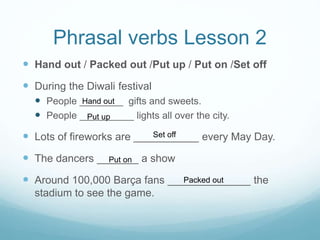
Phrasal verbs Lesson 2
 Hand out / Packed out /Put up / Put on /Set off
 During the Diwali festival
 People ________ gifts and sweets.
 People __________ lights all over the city.
 Lots of fireworks are ___________ every May Day.
 The dancers _______ a show
 Around 100,000 Barça fans ______________ the
stadium to see the game.
Put on
Hand out
Set off
Put up
Packed out
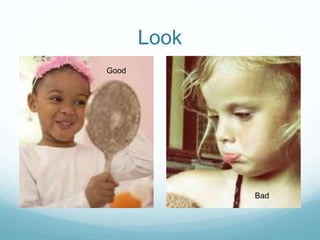
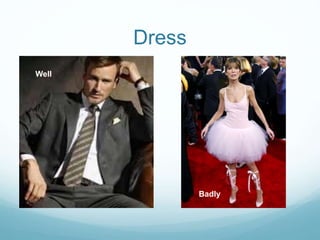
Look
Good
Bad
Dress
Well
Badly
Vocabulary page 43
A stunning picture
Strive to look beautiful
Spread the word
To be taken aback
To be let off the
hook
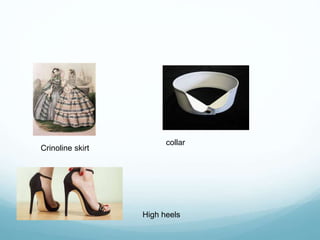
Crinoline skirt
collar
High heels
Basics about the Passive 1
 We use it when the actor or agent is:
 unknown – My laptop was taken!
 Unimportant - Coffee is produced in Brazil
 We do not want to put the blame on anyone-
The window was broken
 You are stating a general truth – They are
made for each other
 The focus is on whatever / whoever gets the
action done - My car is being repaired
 To talk about processes – After soda is
mixed with water…
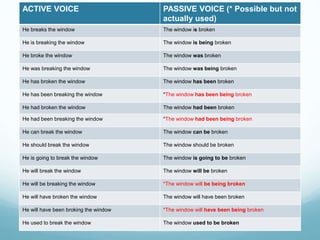
Basics about the passive II
 We only use the passive with transitive verbs, that is,
verbs that have an object.
 We sometimes replace the verb be with the verb get.
This is more common in spoken English.
 Students who do not hand in their homework in time
will get punished.
 It is possible to convert almost any structure from active
to passive
 The passive is NOT formal register in English, unlike in
Spanish or Catalan.
ACTIVE VOICE PASSIVE VOICE (* Possible but not
actually used)
He breaks the window The window is broken
He is breaking the window The window is being broken
He broke the window The window was broken
He was breaking the window The window was being broken
He has broken the window The window has been broken
He has been breaking the window *The window has been being broken
He had broken the window The window had been broken
He had been breaking the window *The window had been being broken
He can break the window The window can be broken
He should break the window The window should be broken
He is going to break the window The window is going to be broken
He will break the window The window will be broken
He will be breaking the window *The window will be being broken
He will have broken the window The window will have been broken
He will have been broking the window *The window will have been being broken
He used to break the window The window used to be broken
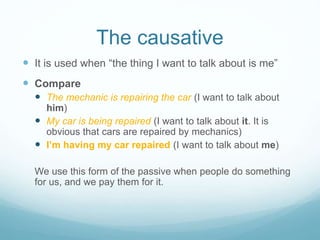
The causative
 It is used when “the thing I want to talk about is me”
 Compare
 The mechanic is repairing the car (I want to talk about
him)
 My car is being repaired (I want to talk about it. It is
obvious that cars are repaired by mechanics)
 I’m having my car repaired (I want to talk about me)
We use this form of the passive when people do something
for us, and we pay them for it.
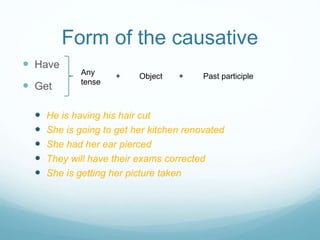
Form of the causative
 Have
 Get
 He is having his hair cut
 She is going to get her kitchen renovated
 She had her ear pierced
 They will have their exams corrected
 She is getting her picture taken
Any
tense
+ Object + Past participle
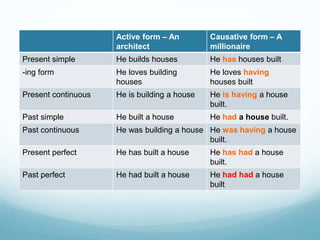
Active form – An
architect
Causative form – A
millionaire
Present simple He builds houses He has houses built
-ing form He loves building
houses
He loves having
houses built
Present continuous He is building a house He is having a house
built.
Past simple He built a house He had a house built.
Past continuous He was building a house He was having a house
built.
Present perfect He has built a house He has had a house
built.
Past perfect He had built a house He had had a house
built
Phrasal Verbs
Wrap
up
Pull on
Dress up
Catch on
Settle down
And more
Chilling out
Clothes hangers
Go with
Stripes / stripped
Checkered shirt
Tt 2ndbatx lesson4

Tt 2ndbatx lesson4

  • 1.
  • 2.
    Starting a forand against  Some people think that _________________. However, others consider that __________________. Both offer arguments that deserve some reflection.  It is open to question whether teenage criminals should be sent to adult prisons or not. Some people...
  • 3.
    WHAT WHY Teenagers shouldnot go to adult prisons Juvenile prisons are better equipped They have just acted on impulse and done something they will later regret. Adult offenders may be a very bad influence. It is fair that they are given educational opportunities along with punishment suited to their crime.
  • 4.
    WHAT WHY If theyhave committed a serious crime... • They may be a bad influence to other teenagers in the detention centers. • Teenagers know the consequences of their acts as well as adults do. • Trying teenagers as adults will lower juvenile crime rates.
  • 5.
    “For” and “To”to express reason  Both “to” and “for” are used to express reason and can be translated as “para”  Remember to is used before verbs  I came to Esplugues to work.  Remember to use for before nouns  I came to Esplugues for a new job.  Never use “for to”
  • 6.
    Phrasal verbs Lesson1 Come up with / Find out / pick out  Our ancestors ______________ that plants with a bitter taste were often poisonous.  Our noses can ____________as many as 10.000 smells.  Scientists have _________ with an explanation. Found out Pick out Come up with
  • 7.
    Phrasal verbs Lesson2  Hand out / Packed out /Put up / Put on /Set off  During the Diwali festival  People ________ gifts and sweets.  People __________ lights all over the city.  Lots of fireworks are ___________ every May Day.  The dancers _______ a show  Around 100,000 Barça fans ______________ the stadium to see the game. Put on Hand out Set off Put up Packed out
  • 8.
  • 9.
  • 10.
    Vocabulary page 43 Astunning picture Strive to look beautiful Spread the word To be taken aback To be let off the hook
  • 11.
  • 12.
    Basics about thePassive 1  We use it when the actor or agent is:  unknown – My laptop was taken!  Unimportant - Coffee is produced in Brazil  We do not want to put the blame on anyone- The window was broken  You are stating a general truth – They are made for each other  The focus is on whatever / whoever gets the action done - My car is being repaired  To talk about processes – After soda is mixed with water…
  • 13.
    Basics about thepassive II  We only use the passive with transitive verbs, that is, verbs that have an object.  We sometimes replace the verb be with the verb get. This is more common in spoken English.  Students who do not hand in their homework in time will get punished.  It is possible to convert almost any structure from active to passive  The passive is NOT formal register in English, unlike in Spanish or Catalan.
  • 14.
    ACTIVE VOICE PASSIVEVOICE (* Possible but not actually used) He breaks the window The window is broken He is breaking the window The window is being broken He broke the window The window was broken He was breaking the window The window was being broken He has broken the window The window has been broken He has been breaking the window *The window has been being broken He had broken the window The window had been broken He had been breaking the window *The window had been being broken He can break the window The window can be broken He should break the window The window should be broken He is going to break the window The window is going to be broken He will break the window The window will be broken He will be breaking the window *The window will be being broken He will have broken the window The window will have been broken He will have been broking the window *The window will have been being broken He used to break the window The window used to be broken
  • 15.
    The causative  Itis used when “the thing I want to talk about is me”  Compare  The mechanic is repairing the car (I want to talk about him)  My car is being repaired (I want to talk about it. It is obvious that cars are repaired by mechanics)  I’m having my car repaired (I want to talk about me) We use this form of the passive when people do something for us, and we pay them for it.
  • 16.
    Form of thecausative  Have  Get  He is having his hair cut  She is going to get her kitchen renovated  She had her ear pierced  They will have their exams corrected  She is getting her picture taken Any tense + Object + Past participle
  • 17.
    Active form –An architect Causative form – A millionaire Present simple He builds houses He has houses built -ing form He loves building houses He loves having houses built Present continuous He is building a house He is having a house built. Past simple He built a house He had a house built. Past continuous He was building a house He was having a house built. Present perfect He has built a house He has had a house built. Past perfect He had built a house He had had a house built
  • 18.
    Phrasal Verbs Wrap up Pull on Dressup Catch on Settle down
  • 19.
    And more Chilling out Clotheshangers Go with Stripes / stripped Checkered shirt

Editor's Notes

  • #11 Let off the hook – librarse de responsablilidades Will Barcenas be let off the hook? Will Partido Popular let Barcenas off the hook?