International School
                                                                  Cartagena
                                                                    CLASE

                           Versión         00-12          Código         FO-DC-01         Página         1 de 4

Área:                 English               Asignatura:           English                      Curso:         8th
Fecha:                25 al 03-03           Periodo:        I     Nº Hor:          12hr        Semana:        6
Tema:                 Thepassivevoice
Indicador             Students will be able to use the passive voice.
de Logro


          Exploración        to use the passive voice
          Contextualización

                                           Using the active and passive voice


          An active sentence like I drank two cups of coffee has the subject first (the person or thing that does
          the verb), followed by the verb, and finally the object (the person or thing that the action happens to).

          So, in this example, the subject is I, the verb is drank and the object is two cups of coffee.

          But, we don't always need to make sentences this way. We might want to put the object first, or not say
          who did something, for lots of reasons (see the explanation further down the page).

          In this case, we can use a passive, which puts the object first: for example, two cups of coffee were
          drunk. We can add by me if we want, but it isn't necessary.


          Conceptualización


          The Passive in English

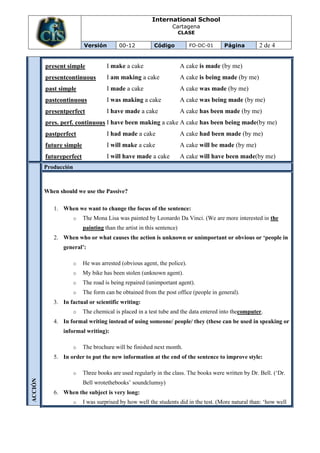
          We make it by putting the verb 'to be' into whatever tense we need and then adding the past participle.

          (For regular verbs, we make the past participle by adding 'ed' to the infinitive -
          play becomes played, click here to learn about irregular verbs)
EMOCIÓN


                       g                       ACTIVE                                PASSIVE
International School
                                                                 Cartagena
                                                                       CLASE

                          Versión         00-12          Código           FO-DC-01    Página          2 de 4


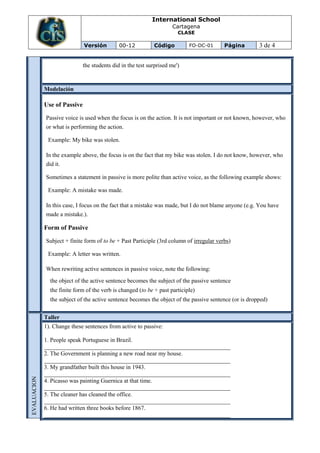
         present simple             I make a cake                      A cake is made (by me)
         presentcontinuous          I am making a cake                 A cake is being made (by me)
         past simple                I made a cake                      A cake was made (by me)
         pastcontinuous             I was making a cake                A cake was being made (by me)
         presentperfect             I have made a cake                 A cake has been made (by me)
         pres. perf. continuous I have been making a cake A cake has been being made(by me)
         pastperfect                I had made a cake                  A cake had been made (by me)
         future simple              I will make a cake                 A cake will be made (by me)
         futureperfect              I will have made a cake            A cake will have been made(by me)
         Producción


         When should we use the Passive?

            1. When we want to change the focus of the sentence:
                      o   The Mona Lisa was painted by Leonardo Da Vinci. (We are more interested in the
                          painting than the artist in this sentence)
            2. When who or what causes the action is unknown or unimportant or obvious or ‘people in
                general’:

                      o   He was arrested (obvious agent, the police).
                      o   My bike has been stolen (unknown agent).
                      o   The road is being repaired (unimportant agent).
                      o   The form can be obtained from the post office (people in general).
            3. In factual or scientific writing:
                      o   The chemical is placed in a test tube and the data entered into thecomputer.
            4. In formal writing instead of using someone/ people/ they (these can be used in speaking or
                informal writing):

                      o   The brochure will be finished next month.
            5. In order to put the new information at the end of the sentence to improve style:

                      o   Three books are used regularly in the class. The books were written by Dr. Bell. (‘Dr.
ACCIÓN


                          Bell wrotethebooks’ soundclumsy)
            6. When the subject is very long:
                      o   I was surprised by how well the students did in the test. (More natural than: ‘how well
International School
                                                                         Cartagena
                                                                            CLASE

                                  Versión         00-12          Código         FO-DC-01      Página        3 de 4


                                  the students did in the test surprised me')


                 Modelación

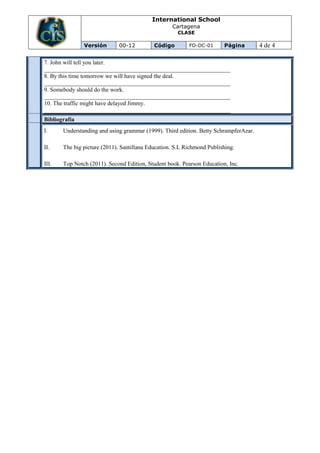
                 Use of Passive

                 Passive voice is used when the focus is on the action. It is not important or not known, however, who
                 or what is performing the action.

                  Example: My bike was stolen.

                 In the example above, the focus is on the fact that my bike was stolen. I do not know, however, who
                 did it.

                 Sometimes a statement in passive is more polite than active voice, as the following example shows:

                  Example: A mistake was made.

                 In this case, I focus on the fact that a mistake was made, but I do not blame anyone (e.g. You have
                 made a mistake.).

                 Form of Passive

                 Subject + finite form of to be + Past Participle (3rd column of irregular verbs)

                  Example: A letter was written.

                 When rewriting active sentences in passive voice, note the following:
                  the object of the active sentence becomes the subject of the passive sentence
                  the finite form of the verb is changed (to be + past participle)
                  the subject of the active sentence becomes the object of the passive sentence (or is dropped)


                 Taller
                 1). Change these sentences from active to passive:

                 1. People speak Portuguese in Brazil.
                 _______________________________________________________________
                 2. The Government is planning a new road near my house.
                 _______________________________________________________________
                 3. My grandfather built this house in 1943.
                 _______________________________________________________________
EVALUACION


                 4. Picasso was painting Guernica at that time.
                 _______________________________________________________________
                 5. The cleaner has cleaned the office.
                 _______________________________________________________________
                 6. He had written three books before 1867.
                 _______________________________________________________________
International School
                                                   Cartagena
                                                     CLASE

               Versión       00-12          Código        FO-DC-01      Página        4 de 4

7. John will tell you later.
_______________________________________________________________
8. By this time tomorrow we will have signed the deal.
_______________________________________________________________
9. Somebody should do the work.
_______________________________________________________________
10. The traffic might have delayed Jimmy.
_______________________________________________________________
Bibliografía
I.     Understanding and using grammar (1999). Third edition. Betty SchrampferAzar.

II.    The big picture (2011). Santillana Education. S.L Richmond Publishing.

III.   Top Notch (2011). Second Edition, Student book. Pearson Education, Inc.

Formato plano 8th week6_passive_present

  • 1.
    International School Cartagena CLASE Versión 00-12 Código FO-DC-01 Página 1 de 4 Área: English Asignatura: English Curso: 8th Fecha: 25 al 03-03 Periodo: I Nº Hor: 12hr Semana: 6 Tema: Thepassivevoice Indicador Students will be able to use the passive voice. de Logro Exploración to use the passive voice Contextualización Using the active and passive voice An active sentence like I drank two cups of coffee has the subject first (the person or thing that does the verb), followed by the verb, and finally the object (the person or thing that the action happens to). So, in this example, the subject is I, the verb is drank and the object is two cups of coffee. But, we don't always need to make sentences this way. We might want to put the object first, or not say who did something, for lots of reasons (see the explanation further down the page). In this case, we can use a passive, which puts the object first: for example, two cups of coffee were drunk. We can add by me if we want, but it isn't necessary. Conceptualización The Passive in English We make it by putting the verb 'to be' into whatever tense we need and then adding the past participle. (For regular verbs, we make the past participle by adding 'ed' to the infinitive - play becomes played, click here to learn about irregular verbs) EMOCIÓN g ACTIVE PASSIVE
  • 2.
    International School Cartagena CLASE Versión 00-12 Código FO-DC-01 Página 2 de 4 present simple I make a cake A cake is made (by me) presentcontinuous I am making a cake A cake is being made (by me) past simple I made a cake A cake was made (by me) pastcontinuous I was making a cake A cake was being made (by me) presentperfect I have made a cake A cake has been made (by me) pres. perf. continuous I have been making a cake A cake has been being made(by me) pastperfect I had made a cake A cake had been made (by me) future simple I will make a cake A cake will be made (by me) futureperfect I will have made a cake A cake will have been made(by me) Producción When should we use the Passive? 1. When we want to change the focus of the sentence: o The Mona Lisa was painted by Leonardo Da Vinci. (We are more interested in the painting than the artist in this sentence) 2. When who or what causes the action is unknown or unimportant or obvious or ‘people in general’: o He was arrested (obvious agent, the police). o My bike has been stolen (unknown agent). o The road is being repaired (unimportant agent). o The form can be obtained from the post office (people in general). 3. In factual or scientific writing: o The chemical is placed in a test tube and the data entered into thecomputer. 4. In formal writing instead of using someone/ people/ they (these can be used in speaking or informal writing): o The brochure will be finished next month. 5. In order to put the new information at the end of the sentence to improve style: o Three books are used regularly in the class. The books were written by Dr. Bell. (‘Dr. ACCIÓN Bell wrotethebooks’ soundclumsy) 6. When the subject is very long: o I was surprised by how well the students did in the test. (More natural than: ‘how well
  • 3.
    International School Cartagena CLASE Versión 00-12 Código FO-DC-01 Página 3 de 4 the students did in the test surprised me') Modelación Use of Passive Passive voice is used when the focus is on the action. It is not important or not known, however, who or what is performing the action. Example: My bike was stolen. In the example above, the focus is on the fact that my bike was stolen. I do not know, however, who did it. Sometimes a statement in passive is more polite than active voice, as the following example shows: Example: A mistake was made. In this case, I focus on the fact that a mistake was made, but I do not blame anyone (e.g. You have made a mistake.). Form of Passive Subject + finite form of to be + Past Participle (3rd column of irregular verbs) Example: A letter was written. When rewriting active sentences in passive voice, note the following:  the object of the active sentence becomes the subject of the passive sentence  the finite form of the verb is changed (to be + past participle)  the subject of the active sentence becomes the object of the passive sentence (or is dropped) Taller 1). Change these sentences from active to passive: 1. People speak Portuguese in Brazil. _______________________________________________________________ 2. The Government is planning a new road near my house. _______________________________________________________________ 3. My grandfather built this house in 1943. _______________________________________________________________ EVALUACION 4. Picasso was painting Guernica at that time. _______________________________________________________________ 5. The cleaner has cleaned the office. _______________________________________________________________ 6. He had written three books before 1867. _______________________________________________________________
  • 4.
    International School Cartagena CLASE Versión 00-12 Código FO-DC-01 Página 4 de 4 7. John will tell you later. _______________________________________________________________ 8. By this time tomorrow we will have signed the deal. _______________________________________________________________ 9. Somebody should do the work. _______________________________________________________________ 10. The traffic might have delayed Jimmy. _______________________________________________________________ Bibliografía I. Understanding and using grammar (1999). Third edition. Betty SchrampferAzar. II. The big picture (2011). Santillana Education. S.L Richmond Publishing. III. Top Notch (2011). Second Edition, Student book. Pearson Education, Inc.