
So that’s what it means! Modals of Possibility, adverbs  and  Modals to express permission By Profr. José Ma. Jaramillo S. February, 2009
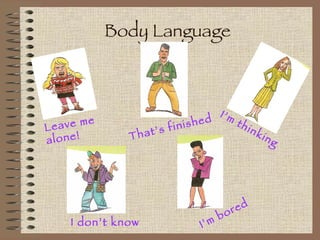
Body Language Leave me alone! I don’t know I’m thinking That’s finished I’m bored
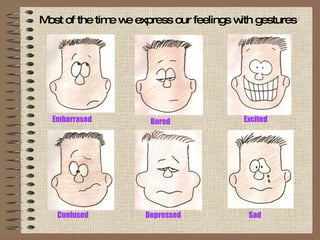
Most of the time we express our feelings with gestures Embarrased Bored Excited Confused Depressed Sad
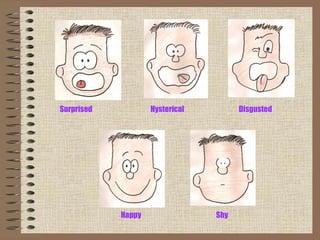
Surprised Disgusted Hysterical Happy Shy
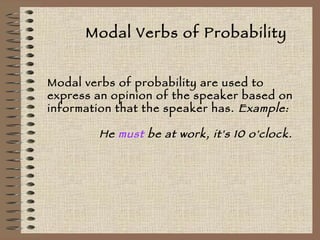
Modal verbs of probability are used to express an opinion of the speaker based on information that the speaker has.  Example:    He  must  be at work, it's 10 o'clock.   Modal Verbs of Probability
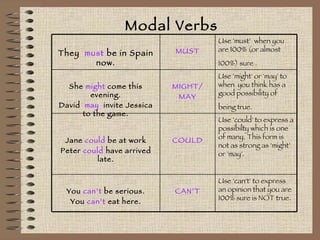
Modal Verbs They  must  be in Spain now. MUST Use 'must‘  when you are 100% (or almost 100%) sure .   She  might  come this evening. David  may   invite Jessica to the game. MIGHT/ MAY Use 'might' or 'may' to when  you think has a good possibility of being true.   Jane  could  be at work Peter  could  have arrived late. COULD Use 'could' to express a possibilty which is one of many. This form is not as strong as 'might' or 'may'.  You  can’t  be serious. You  can’t  eat here. CAN’T Use 'can't' to express an opinion that you are 100% sure is NOT true.
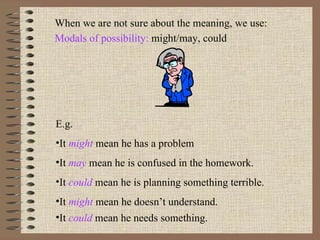
When we are not sure about the meaning, we use: Modals of possibility:  might/may, could E.g. It  might  mean he has a problem It  may   mean he is confused in the homework. It  could  mean he is planning something terrible. It  might  mean he doesn’t understand. It  could  mean he needs something.
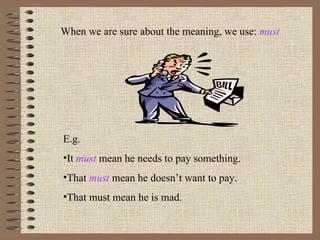
When we are sure about the meaning, we use:  must E.g. It  must  mean he needs to pay something. That  must  mean he doesn’t want to pay. That must mean he is mad.
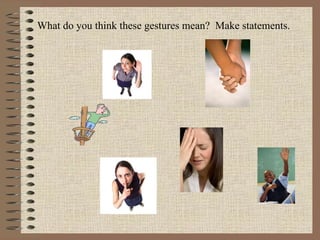
What do you think these gestures mean?  Make statements.
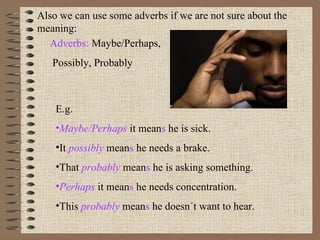
Also we can use some adverbs if we are not sure about the meaning: Adverbs:  Maybe/Perhaps, Possibly, Probably E.g. Maybe/Perhaps  it mean s  he is sick.  It  possibly   mean s  he needs a brake. That  probably  mean s  he is asking something. Perhaps  it mean s  he needs concentration. This  probably  mean s  he doesn´t want to hear.
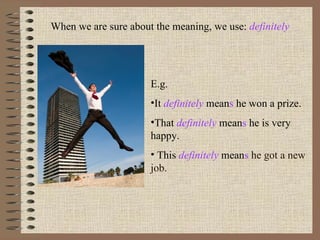
When we are sure about the meaning, we use:  definitely E.g. It  definitely  mean s  he won a prize. That  definitely  mean s  he is very happy. This  definitely  mean s  he got a new job.
 
 
So that’s what it means! Part II
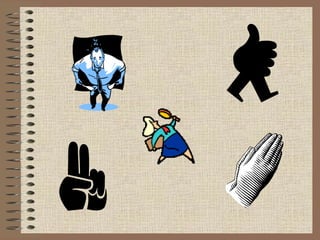
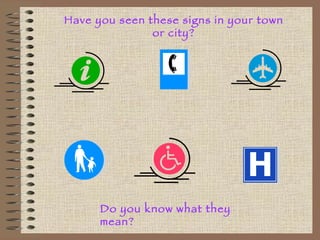
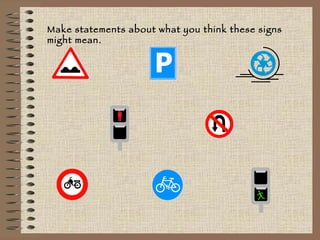
Have you seen these signs in your town or city? Do you know what they mean?
Using modals to express permission, obligation and prohibition. Prohibition:  can’t, isn’t allowed to He  isn’t allowed to  go out. He  can’t  enjoy his freedom. He  isn’t allowed to  invite his family to his room. He  can’t  visit his friends. He  can’t  do what he want
Permission:  can, be allowed to He  can  practice a sport there. He  is allowed to  write letters. He  is allowed to  recieve visits once a week He  can  develop his skills. He  can  make new friends. Obligation:  have to, have got to He  has to  wear a uniform. He  has to  follow the rules. He  has got to  serve the jugdment. He’ s got to  be obey
Make statements about what you think these signs might mean.
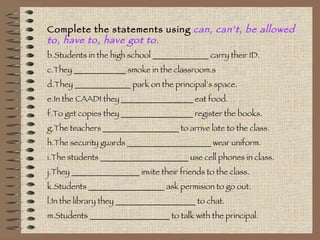
Complete the statements using  can, can’t, be allowed to, have to, have got to. Students in the high school ______________ carry their ID. They _____________ smoke in the classroom.s They ______________ park on the principal’s space. In the CAADI they __________________ eat food. To get copies they __________________ register the books. The teachers ___________________ to arrive late to the class. The security guards _____________________ wear uniform. The students ______________________ use cell phones in class. They _________________ invite their friends to the class. Students ___________________ ask permision to go out. In the library they ____________________ to chat. Students ____________________ to talk with the principal.
Proverbs Proverbs are used them for a lot of people. They are most impressive because you can express a lot of information saying a few words.
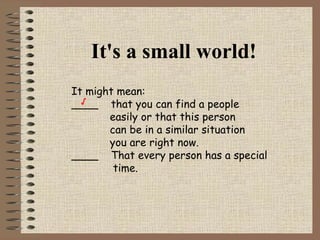
It's a small world! It might mean: ____  that you can find a people    easily or that this person    can be in a similar situation   you are right now.  ____  That every person has a special time. √
He that would have the fruit must climb the tree. It probably means: ____  you can get everthing you need    just reasing your hand. ____  that if you want something you    need to work hard to get it. √
If you lie down with dogs, you'll get up with fleas. That could mean: ____  that you can get something just   sleeping well. ____  you can learn good or bad habits   according the place you live in. √
Every dog has its day. This definitly  means: ____  Everybody has his/her special moment   in life. ____  that every person needs  to be    patient to end something. √
Where there's smoke, there's fire It may mean: ____  that you can get some information   about something if you hear something   about it there. ____  that all the things have a reason to    happen. √
Let’s practice with on your books! More information:  [email_address]

Unit 14 L4

  • 1.
    So that’s whatit means! Modals of Possibility, adverbs and Modals to express permission By Profr. José Ma. Jaramillo S. February, 2009
  • 2.
    Body Language Leaveme alone! I don’t know I’m thinking That’s finished I’m bored
  • 3.
    Most of thetime we express our feelings with gestures Embarrased Bored Excited Confused Depressed Sad
  • 4.
  • 5.
    Modal verbs ofprobability are used to express an opinion of the speaker based on information that the speaker has. Example: He must be at work, it's 10 o'clock. Modal Verbs of Probability
  • 6.
    Modal Verbs They must be in Spain now. MUST Use 'must‘ when you are 100% (or almost 100%) sure . She might come this evening. David may invite Jessica to the game. MIGHT/ MAY Use 'might' or 'may' to when you think has a good possibility of being true. Jane could be at work Peter could have arrived late. COULD Use 'could' to express a possibilty which is one of many. This form is not as strong as 'might' or 'may'. You can’t be serious. You can’t eat here. CAN’T Use 'can't' to express an opinion that you are 100% sure is NOT true.
  • 7.
    When we arenot sure about the meaning, we use: Modals of possibility: might/may, could E.g. It might mean he has a problem It may mean he is confused in the homework. It could mean he is planning something terrible. It might mean he doesn’t understand. It could mean he needs something.
  • 8.
    When we aresure about the meaning, we use: must E.g. It must mean he needs to pay something. That must mean he doesn’t want to pay. That must mean he is mad.
  • 9.
    What do youthink these gestures mean? Make statements.
  • 10.
    Also we canuse some adverbs if we are not sure about the meaning: Adverbs: Maybe/Perhaps, Possibly, Probably E.g. Maybe/Perhaps it mean s he is sick. It possibly mean s he needs a brake. That probably mean s he is asking something. Perhaps it mean s he needs concentration. This probably mean s he doesn´t want to hear.
  • 11.
    When we aresure about the meaning, we use: definitely E.g. It definitely mean s he won a prize. That definitely mean s he is very happy. This definitely mean s he got a new job.
  • 12.
  • 13.
  • 14.
    So that’s whatit means! Part II
  • 15.
    Have you seenthese signs in your town or city? Do you know what they mean?
  • 16.
    Using modals toexpress permission, obligation and prohibition. Prohibition: can’t, isn’t allowed to He isn’t allowed to go out. He can’t enjoy his freedom. He isn’t allowed to invite his family to his room. He can’t visit his friends. He can’t do what he want
  • 17.
    Permission: can,be allowed to He can practice a sport there. He is allowed to write letters. He is allowed to recieve visits once a week He can develop his skills. He can make new friends. Obligation: have to, have got to He has to wear a uniform. He has to follow the rules. He has got to serve the jugdment. He’ s got to be obey
  • 18.
    Make statements aboutwhat you think these signs might mean.
  • 19.
    Complete the statementsusing can, can’t, be allowed to, have to, have got to. Students in the high school ______________ carry their ID. They _____________ smoke in the classroom.s They ______________ park on the principal’s space. In the CAADI they __________________ eat food. To get copies they __________________ register the books. The teachers ___________________ to arrive late to the class. The security guards _____________________ wear uniform. The students ______________________ use cell phones in class. They _________________ invite their friends to the class. Students ___________________ ask permision to go out. In the library they ____________________ to chat. Students ____________________ to talk with the principal.
  • 20.
    Proverbs Proverbs areused them for a lot of people. They are most impressive because you can express a lot of information saying a few words.
  • 21.
    It's a smallworld! It might mean: ____ that you can find a people easily or that this person can be in a similar situation you are right now. ____ That every person has a special time. √
  • 22.
    He that wouldhave the fruit must climb the tree. It probably means: ____ you can get everthing you need just reasing your hand. ____ that if you want something you need to work hard to get it. √
  • 23.
    If you liedown with dogs, you'll get up with fleas. That could mean: ____ that you can get something just sleeping well. ____ you can learn good or bad habits according the place you live in. √
  • 24.
    Every dog hasits day. This definitly means: ____ Everybody has his/her special moment in life. ____ that every person needs to be patient to end something. √
  • 25.
    Where there's smoke,there's fire It may mean: ____ that you can get some information about something if you hear something about it there. ____ that all the things have a reason to happen. √
  • 26.
    Let’s practice withon your books! More information: [email_address]