Formal / neutral Email
Writing
The Basics
0
Three types of styles
1
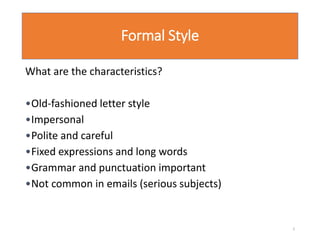
Formal Style
What are the characteristics?
•Old-fashioned letter style
•Impersonal
•Polite and careful
•Fixed expressions and long words
•Grammar and punctuation important
•Not common in emails (serious subjects)
2
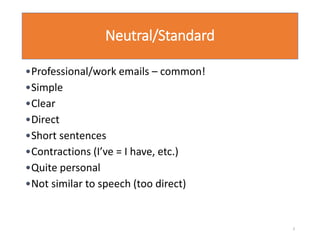
Neutral/Standard
•Professional/work emails – common!
•Simple
•Clear
•Direct
•Short sentences
•Contractions (I’ve = I have, etc.)
•Quite personal
•Not similar to speech (too direct)
3
Informal
•Between friends – common
•Similar to speech
•Everyday words and conversational
•Reader is more tolerant of bad grammar, etc.
•Includes personal news or funny comments
4
Exercise
Rewrite the phrase in italics with more informal phrases.
Use contractions (e.g. I’ll) where appropriate.
Example
I am afraid I will not be able to attend the meeting on
Thursday.
Sorry I can’t make it on Thursday.
5
Longer sentences in formal style
6
Missing words
Missing out words is common in emails and
informal speech. It happens where people know
each other very well and the situation is relaxed and
friendly. The meaning is clear from the context, so
the full grammatical form is not necessary.
Example
That’s a good idea! - Good idea!
I hope everything is ok. - Hope everything is ok.
7
Missing word rules
1. The subject ‘I’ can be left out, especially with mental
verbs like think, hope, etc.
2. In a question, the subject ‘you’ and the auxiliary verb can
be omitted.
3. The subject ‘I’ and the auxiliary (be, have, will) can be left
out.
4. The words ‘that’ or ‘it’ can be left out, often with a form
of ‘be’ as well.
5. The word ‘the’ can occasionally be left out.
6. A form of ‘be’ can be left out on its own.
8
Missing words exercise
1) I think your idea is great.
2) I’ll speak to you later.
3) If you have any problems, give me a call.
4) It’s a pity you can’t come.
5) Your idea is good, but it needs clarification.
6) Are you going to the conference?
7) I will catch up with you sometime next week.
8) Friday would be better than Wednesday.
9
Put the missing words back into the
following email...
•Great evening, wasn’t it? Really enjoyed the meal, and nice to see
Mary and Roger again. Had a chance to speak to Lucy yet? Don’t
worry if you haven’t, will be seeing her tomorrow.
•About next week - film you suggested sounds great. Been talking
to some colleagues about it. Not sure about the day, though.
Tuesday might be difficult, Perhaps Wednesday better? Let me
know.
•Going to my parents on weekend - looking forward to it. They live
in Chichester. Ever been there?
•Sometime soon we need to talk about holiday plans for next
summer. Things still a bit uncertain at work. Might be possible to
take two weeks off in July, but can’t be sure. Three weeks
impossible. A pity.
•Anyway, got to go now. Hope you’re well. See you next week.
10
11
•It was a great evening, wasn’t it? I Really enjoyed the meal, and it
was nice to see Mary and Roger again. Have you had a chance to
speak to Lucy ,yet? Don’t worry if you haven’t, I will be seeing her
tomorrow.
•About next week - the film you suggested sounds great. I have
been talking to some colleagues about it. Not sure about the day,
though. Tuesday might be difficult, Perhaps Wednesday better?
Let me know.
•Going to my parents on weekend - looking forward to it. They live
in Chichester. Ever been there?
•Sometime soon we need to talk about holiday plans for next
summer. Things still a bit uncertain at work. Might be possible to
take two weeks off in July, but can’t be sure. Three weeks
impossible. A pity.
•Anyway, got to go now. Hope you’re well. See you next week.
Abbreviations
Only use common abbreviations or abbreviations you
are sure the reader will understand!
Examples
•i.e. (id est) …
•e.g. (exempli gratia) …
•NB (nota bene) …
•PS (postscript) …
•BTW (by the way)
•asap (as soon as possible)
12
Opening and ending an email
13
Formal words vs. informal words
Formal
assistance, due to, enquire, further, inform, information,
obtain/receive, occupation, possess, provide, repair, request,
requirements, reserve, verify
Informal
help, because of, ask, more, tell, facts, get, job, have, give, fix, ask for,
needs, book, check/prove
Notice longer words of Latin origin sound more formal, and
shorter words sound more informal.
14
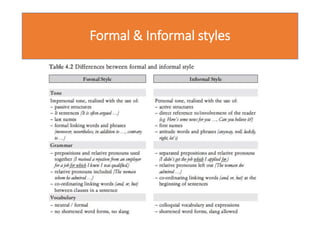
Formal & Informal styles
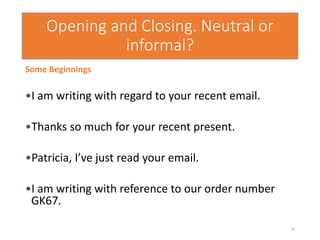
Opening and Closing. Neutral or
informal?
Some Beginnings
•I am writing with regard to your recent email.
•Thanks so much for your recent present.
•Patricia, I’ve just read your email.
•I am writing with reference to our order number
GK67.
16
Some Endings. Neutral or infomal?
•I look forward to receiving this information as
soon as possible.
•Thanks gain for the gift and give my regards to
your family.
•I’ll call you at the weekend to see how things
are.
•Should you require any further information, we
will be happy to assist you.
17
Exercise
Read the following sentences. Decide whether they are beginnings or
endings. Then decide whether they are neutral or informal.
1.The computer network will be shut down for maintenance at 5pm on
Friday.
2.What a surprise – how nice to hear from you!
3.I’m so happy for you! Write again soon and tell me how it’s going.
4.Just a quick note to say I really enjoyed last night.
5.Please find attached my report, as promised in Monday’s meeting.
6.Bye for now. See you soon.
7.I hope that everything is okay, but do not hesitate to contact me if you
need clarification.
8.We are writing to advise you about some changes in our price list.
18
Subject lines
19
Subject Lines
To consider the reader, use only one subject per email.
The subject line should:
- be clear and short
- tell the reader exactly what is in the email
20
Email examples
21
Example Email
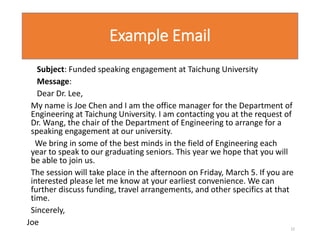
Subject: Funded speaking engagement at Taichung University
Message:
Dear Dr. Lee,
My name is Joe Chen and I am the office manager for the Department of
Engineering at Taichung University. I am contacting you at the request of
Dr. Wang, the chair of the Department of Engineering to arrange for a
speaking engagement at our university.
We bring in some of the best minds in the field of Engineering each
year to speak to our graduating seniors. This year we hope that you will
be able to join us.
The session will take place in the afternoon on Friday, March 5. If you are
interested please let me know at your earliest convenience. We can
further discuss funding, travel arrangements, and other specifics at that
time.
Sincerely,
Joe
22
Informal – and unclear
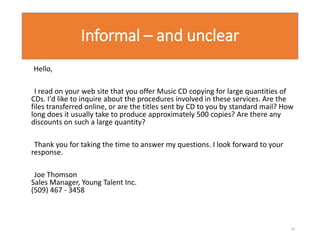
Hello,
I read on your web site that you offer Music CD copying for large quantities of
CDs. I'd like to inquire about the procedures involved in these services. Are the
files transferred online, or are the titles sent by CD to you by standard mail? How
long does it usually take to produce approximately 500 copies? Are there any
discounts on such a large quantity?
Thank you for taking the time to answer my questions. I look forward to your
response.
Joe Thomson
Sales Manager, Young Talent Inc.
(509) 467 - 3458
23
Clearer layout
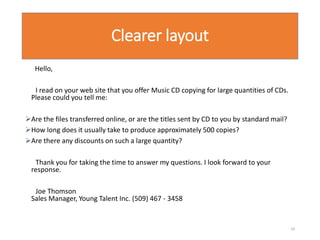
Hello,
I read on your web site that you offer Music CD copying for large quantities of CDs.
Please could you tell me:
Are the files transferred online, or are the titles sent by CD to you by standard mail?
How long does it usually take to produce approximately 500 copies?
Are there any discounts on such a large quantity?
Thank you for taking the time to answer my questions. I look forward to your
response.
Joe Thomson
Sales Manager, Young Talent Inc. (509) 467 - 3458
24
Key phrases
25
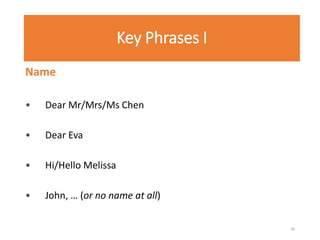
Key Phrases I
Name
• Dear Mr/Mrs/Ms Chen
• Dear Eva
• Hi/Hello Melissa
• John, … (or no name at all)
26
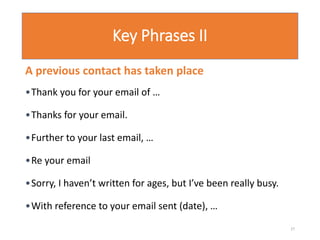
Key Phrases II
A previous contact has taken place
•Thank you for your email of …
•Thanks for your email.
•Further to your last email, …
•Re your email
•Sorry, I haven’t written for ages, but I’ve been really busy.
•With reference to your email sent (date), …
27
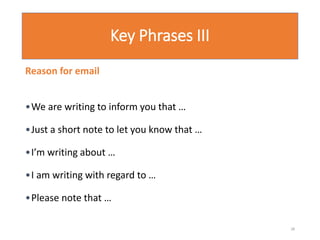
Key Phrases III
Reason for email
•We are writing to inform you that …
•Just a short note to let you know that …
•I’m writing about …
•I am writing with regard to …
•Please note that …
28
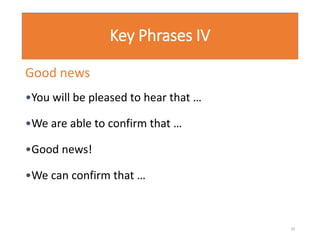
Key Phrases IV
Good news
•You will be pleased to hear that …
•We are able to confirm that …
•Good news!
•We can confirm that …
29
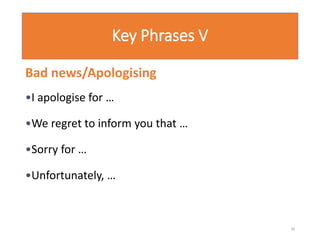
Key Phrases V
Bad news/Apologising
•I apologise for …
•We regret to inform you that …
•Sorry for …
•Unfortunately, …
30
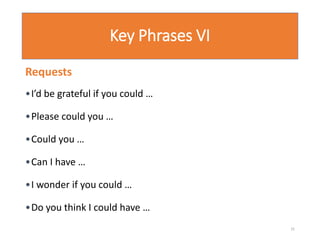
Key Phrases VI
Requests
•I’d be grateful if you could …
•Please could you …
•Could you …
•Can I have …
•I wonder if you could …
•Do you think I could have …
31
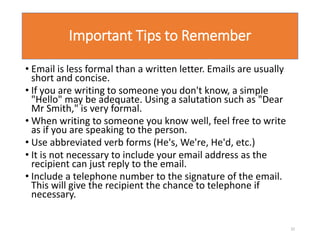
Important Tips to Remember
• Email is less formal than a written letter. Emails are usually
short and concise.
• If you are writing to someone you don't know, a simple
"Hello" may be adequate. Using a salutation such as "Dear
Mr Smith," is very formal.
• When writing to someone you know well, feel free to write
as if you are speaking to the person.
• Use abbreviated verb forms (He's, We're, He'd, etc.)
• It is not necessary to include your email address as the
recipient can just reply to the email.
• Include a telephone number to the signature of the email.
This will give the recipient the chance to telephone if
necessary.
32
Do not
forget to check
Grammar
Spelling
Punctuation
Style
Is everything clear, well-structured and
easy to understand?
33

Formal informal letters

  • 1.
    Formal / neutralEmail Writing The Basics 0
  • 2.
  • 3.
    Formal Style What arethe characteristics? •Old-fashioned letter style •Impersonal •Polite and careful •Fixed expressions and long words •Grammar and punctuation important •Not common in emails (serious subjects) 2
  • 4.
    Neutral/Standard •Professional/work emails –common! •Simple •Clear •Direct •Short sentences •Contractions (I’ve = I have, etc.) •Quite personal •Not similar to speech (too direct) 3
  • 5.
    Informal •Between friends –common •Similar to speech •Everyday words and conversational •Reader is more tolerant of bad grammar, etc. •Includes personal news or funny comments 4
  • 6.
    Exercise Rewrite the phrasein italics with more informal phrases. Use contractions (e.g. I’ll) where appropriate. Example I am afraid I will not be able to attend the meeting on Thursday. Sorry I can’t make it on Thursday. 5
  • 7.
    Longer sentences informal style 6
  • 8.
    Missing words Missing outwords is common in emails and informal speech. It happens where people know each other very well and the situation is relaxed and friendly. The meaning is clear from the context, so the full grammatical form is not necessary. Example That’s a good idea! - Good idea! I hope everything is ok. - Hope everything is ok. 7
  • 9.
    Missing word rules 1.The subject ‘I’ can be left out, especially with mental verbs like think, hope, etc. 2. In a question, the subject ‘you’ and the auxiliary verb can be omitted. 3. The subject ‘I’ and the auxiliary (be, have, will) can be left out. 4. The words ‘that’ or ‘it’ can be left out, often with a form of ‘be’ as well. 5. The word ‘the’ can occasionally be left out. 6. A form of ‘be’ can be left out on its own. 8
  • 10.
    Missing words exercise 1)I think your idea is great. 2) I’ll speak to you later. 3) If you have any problems, give me a call. 4) It’s a pity you can’t come. 5) Your idea is good, but it needs clarification. 6) Are you going to the conference? 7) I will catch up with you sometime next week. 8) Friday would be better than Wednesday. 9
  • 11.
    Put the missingwords back into the following email... •Great evening, wasn’t it? Really enjoyed the meal, and nice to see Mary and Roger again. Had a chance to speak to Lucy yet? Don’t worry if you haven’t, will be seeing her tomorrow. •About next week - film you suggested sounds great. Been talking to some colleagues about it. Not sure about the day, though. Tuesday might be difficult, Perhaps Wednesday better? Let me know. •Going to my parents on weekend - looking forward to it. They live in Chichester. Ever been there? •Sometime soon we need to talk about holiday plans for next summer. Things still a bit uncertain at work. Might be possible to take two weeks off in July, but can’t be sure. Three weeks impossible. A pity. •Anyway, got to go now. Hope you’re well. See you next week. 10
  • 12.
    11 •It was agreat evening, wasn’t it? I Really enjoyed the meal, and it was nice to see Mary and Roger again. Have you had a chance to speak to Lucy ,yet? Don’t worry if you haven’t, I will be seeing her tomorrow. •About next week - the film you suggested sounds great. I have been talking to some colleagues about it. Not sure about the day, though. Tuesday might be difficult, Perhaps Wednesday better? Let me know. •Going to my parents on weekend - looking forward to it. They live in Chichester. Ever been there? •Sometime soon we need to talk about holiday plans for next summer. Things still a bit uncertain at work. Might be possible to take two weeks off in July, but can’t be sure. Three weeks impossible. A pity. •Anyway, got to go now. Hope you’re well. See you next week.
  • 13.
    Abbreviations Only use commonabbreviations or abbreviations you are sure the reader will understand! Examples •i.e. (id est) … •e.g. (exempli gratia) … •NB (nota bene) … •PS (postscript) … •BTW (by the way) •asap (as soon as possible) 12
  • 14.
    Opening and endingan email 13
  • 15.
    Formal words vs.informal words Formal assistance, due to, enquire, further, inform, information, obtain/receive, occupation, possess, provide, repair, request, requirements, reserve, verify Informal help, because of, ask, more, tell, facts, get, job, have, give, fix, ask for, needs, book, check/prove Notice longer words of Latin origin sound more formal, and shorter words sound more informal. 14
  • 16.
  • 17.
    Opening and Closing.Neutral or informal? Some Beginnings •I am writing with regard to your recent email. •Thanks so much for your recent present. •Patricia, I’ve just read your email. •I am writing with reference to our order number GK67. 16
  • 18.
    Some Endings. Neutralor infomal? •I look forward to receiving this information as soon as possible. •Thanks gain for the gift and give my regards to your family. •I’ll call you at the weekend to see how things are. •Should you require any further information, we will be happy to assist you. 17
  • 19.
    Exercise Read the followingsentences. Decide whether they are beginnings or endings. Then decide whether they are neutral or informal. 1.The computer network will be shut down for maintenance at 5pm on Friday. 2.What a surprise – how nice to hear from you! 3.I’m so happy for you! Write again soon and tell me how it’s going. 4.Just a quick note to say I really enjoyed last night. 5.Please find attached my report, as promised in Monday’s meeting. 6.Bye for now. See you soon. 7.I hope that everything is okay, but do not hesitate to contact me if you need clarification. 8.We are writing to advise you about some changes in our price list. 18
  • 20.
  • 21.
    Subject Lines To considerthe reader, use only one subject per email. The subject line should: - be clear and short - tell the reader exactly what is in the email 20
  • 22.
  • 23.
    Example Email Subject: Fundedspeaking engagement at Taichung University Message: Dear Dr. Lee, My name is Joe Chen and I am the office manager for the Department of Engineering at Taichung University. I am contacting you at the request of Dr. Wang, the chair of the Department of Engineering to arrange for a speaking engagement at our university. We bring in some of the best minds in the field of Engineering each year to speak to our graduating seniors. This year we hope that you will be able to join us. The session will take place in the afternoon on Friday, March 5. If you are interested please let me know at your earliest convenience. We can further discuss funding, travel arrangements, and other specifics at that time. Sincerely, Joe 22
  • 24.
    Informal – andunclear Hello, I read on your web site that you offer Music CD copying for large quantities of CDs. I'd like to inquire about the procedures involved in these services. Are the files transferred online, or are the titles sent by CD to you by standard mail? How long does it usually take to produce approximately 500 copies? Are there any discounts on such a large quantity? Thank you for taking the time to answer my questions. I look forward to your response. Joe Thomson Sales Manager, Young Talent Inc. (509) 467 - 3458 23
  • 25.
    Clearer layout Hello, I readon your web site that you offer Music CD copying for large quantities of CDs. Please could you tell me: Are the files transferred online, or are the titles sent by CD to you by standard mail? How long does it usually take to produce approximately 500 copies? Are there any discounts on such a large quantity? Thank you for taking the time to answer my questions. I look forward to your response. Joe Thomson Sales Manager, Young Talent Inc. (509) 467 - 3458 24
  • 26.
  • 27.
    Key Phrases I Name •Dear Mr/Mrs/Ms Chen • Dear Eva • Hi/Hello Melissa • John, … (or no name at all) 26
  • 28.
    Key Phrases II Aprevious contact has taken place •Thank you for your email of … •Thanks for your email. •Further to your last email, … •Re your email •Sorry, I haven’t written for ages, but I’ve been really busy. •With reference to your email sent (date), … 27
  • 29.
    Key Phrases III Reasonfor email •We are writing to inform you that … •Just a short note to let you know that … •I’m writing about … •I am writing with regard to … •Please note that … 28
  • 30.
    Key Phrases IV Goodnews •You will be pleased to hear that … •We are able to confirm that … •Good news! •We can confirm that … 29
  • 31.
    Key Phrases V Badnews/Apologising •I apologise for … •We regret to inform you that … •Sorry for … •Unfortunately, … 30
  • 32.
    Key Phrases VI Requests •I’dbe grateful if you could … •Please could you … •Could you … •Can I have … •I wonder if you could … •Do you think I could have … 31
  • 33.
    Important Tips toRemember • Email is less formal than a written letter. Emails are usually short and concise. • If you are writing to someone you don't know, a simple "Hello" may be adequate. Using a salutation such as "Dear Mr Smith," is very formal. • When writing to someone you know well, feel free to write as if you are speaking to the person. • Use abbreviated verb forms (He's, We're, He'd, etc.) • It is not necessary to include your email address as the recipient can just reply to the email. • Include a telephone number to the signature of the email. This will give the recipient the chance to telephone if necessary. 32
  • 34.
    Do not forget tocheck Grammar Spelling Punctuation Style Is everything clear, well-structured and easy to understand? 33