Total Shoulder
 Replacement
              Amal Alam
            David Babayev
            Rakshya Bista
           Shreenath Varma
             Wahaj Patel


                             S
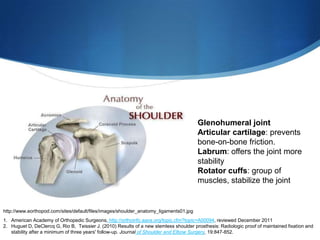
Glenohumeral joint
                                                                                        Articular cartilage: prevents
                                                                                        bone-on-bone friction.
                                                                                        Labrum: offers the joint more
                                                                                        stability
                                                                                        Rotator cuffs: group of
                                                                                        muscles, stabilize the joint


http://www.eorthopod.com/sites/default/files/images/shoulder_anatomy_ligaments01.jpg
1. American Academy of Orthopedic Surgeons, http://orthoinfo.aaos.org/topic.cfm?topic=A00094, reviewed December 2011
2. Huguet D, DeClercq G, Rio B, Teissier J. (2010) Results of a new stemless shoulder prosthesis: Radiologic proof of maintained fixation and
   stability after a minimum of three years' follow-up. Journal of Shoulder and Elbow Surgery, 19:847-852.
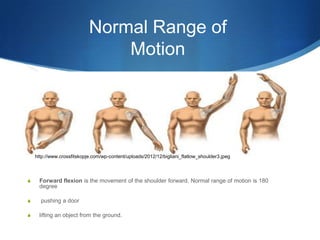
Normal Range of
                                Motion


    http://www.crossfitskopje.com/wp-content/uploads/2012/12/bigliani_flatlow_shoulder3.jpeg


S    Forward flexion is the movement of the shoulder forward. Normal range of motion is 180
     degree

S     pushing a door

S    lifting an object from the ground.
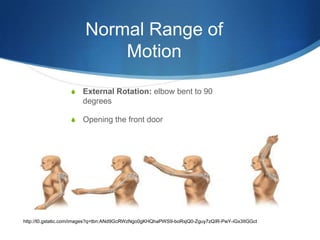
Normal Range of
                            Motion

                  S    External Rotation: elbow bent to 90
                       degrees

                  S    Opening the front door

                  S    Normal range of Motion is 70 to 90 degrees


http://t0.gstatic.com/images?q=tbn:ANd9GcRWzNgo0gKHQhaPWS9-boRsjQ0-Zguy7zQIR-PwY-iGx3ItGGct
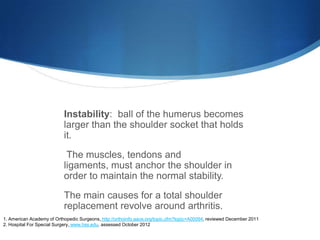
Instability: ball of the humerus becomes
                           larger than the shoulder socket that holds
                           it.
                            The muscles, tendons and
                           ligaments, must anchor the shoulder in
                           order to maintain the normal stability.
                           The main causes for a total shoulder
                           replacement revolve around arthritis.
1. American Academy of Orthopedic Surgeons, http://orthoinfo.aaos.org/topic.cfm?topic=A00094, reviewed December 2011
2. Hospital For Special Surgery, www.hss.edu, assessed October 2012
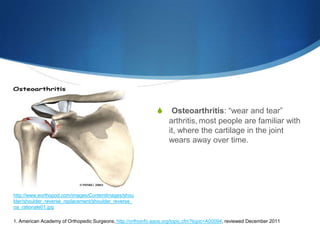
S     Osteoarthritis: “wear and tear”
                                                                   arthritis, most people are familiar with
                                                                   it, where the cartilage in the joint
                                                                   wears away over time.


http://www.eorthopod.com/images/ContentImages/shou
lder/shoulder_reverse_replacement/shoulder_reverse_
oa_rationale01.jpg

1. American Academy of Orthopedic Surgeons, http://orthoinfo.aaos.org/topic.cfm?topic=A00094, reviewed December 2011
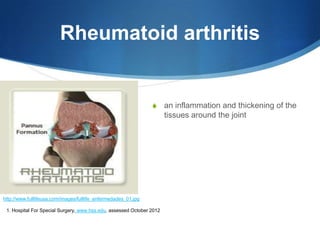
Rheumatoid arthritis


                                                                 S     an inflammation and thickening of the
                                                                       tissues around the joint


http://www.fulllifeusa.com/images/fulllife_enfermedades_01.jpg

 1. Hospital For Special Surgery, www.hss.edu, assessed October 2012
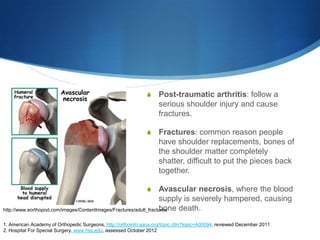
S    Post-traumatic arthritis: follow a
                                                                   serious shoulder injury and cause
                                                                   fractures.

                                                              S    Fractures: common reason people
                                                                   have shoulder replacements, bones of
                                                                   the shoulder matter completely
                                                                   shatter, difficult to put the pieces back
                                                                   together.

                                                              S    Avascular necrosis, where the blood
                                                                   supply is severely hampered, causing
                                                                   bone death.
http://www.eorthopod.com/images/ContentImages/Fractures/adult_fractures


1. American Academy of Orthopedic Surgeons, http://orthoinfo.aaos.org/topic.cfm?topic=A00094, reviewed December 2011
2. Hospital For Special Surgery, www.hss.edu, assessed October 2012
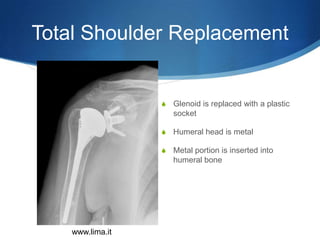
Total Shoulder Replacement


                  S   Glenoid is replaced with a plastic
                      socket

                  S   Humeral head is metal

                  S   Metal portion is inserted into
                      humeral bone


    www.lima.it
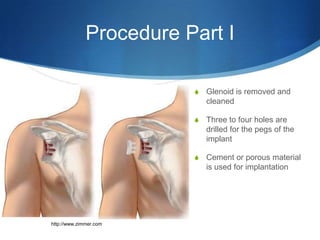
Procedure Part I

                         S   Glenoid is removed and
                             cleaned

                         S   Three to four holes are
                             drilled for the pegs of the
                             implant

                         S   Cement or porous material
                             is used for implantation


http://www.zimmer.com
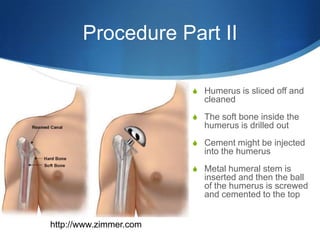
Procedure Part II

                        S Humerus is sliced off and
                          cleaned
                        S The soft bone inside the
                          humerus is drilled out
                        S Cement might be injected
                          into the humerus
                        S Metal humeral stem is
                          inserted and then the ball
                          of the humerus is screwed
                          and cemented to the top


http://www.zimmer.com
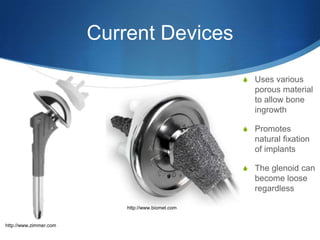
Current Devices

                                                    S Uses various
                                                      porous material
                                                      to allow bone
                                                      ingrowth

                                                    S Promotes
                                                      natural fixation
                                                      of implants

                                                    S The glenoid can
                                                      become loose
                                                      regardless

                            http://www.biomet.com


http://www.zimmer.com
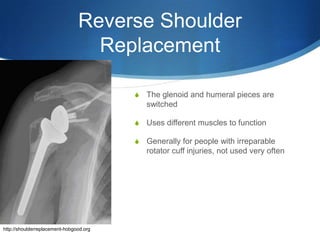
Reverse Shoulder
                                  Replacement

                                         S   The glenoid and humeral pieces are
                                             switched

                                         S   Uses different muscles to function

                                         S   Generally for people with irreparable
                                             rotator cuff injuries, not used very often


http://shoulderreplacement-hobgood.org
Experimental Set Up


S In Vivo human clinical trial

S Anterior Active Elevation and Exterior Active Rotation will
  be measured in subjects at intervals of six months every
  two years

S IRB Approved Clinical Trial
Working Hypothesis


S The new device should increase both the external active
  rotation and anterior active elevation
Control Group


S We will receive control group data from Biomet via
  collaboration on their Comprehensive ÂŽ Total Shoulder
  Replacement Model, which was tailored to patients with
  osteoarthritis.
Experimental Group
                                               People with Osteoarthritis
                                                People of all ages 18+
                                                  Patient Screening


Reference:
                                                                                                                          S
http://img.webmd.com/dtmcms/live/webmd/consumer_assets/site_images/rich_media_quiz/topic/rmq_coping_with_acne/getty_rf_photo_of_diver
se_group_of_people_of_all_ages.jpg
Power Analysis


IMAGE and reference of tool used to calculate power
analysis
Power Analysis

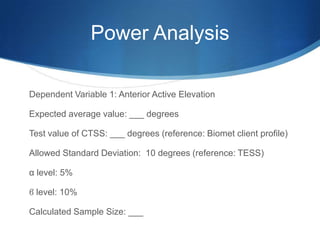
Dependent Variable 1: Anterior Active Elevation

Expected average value: ___ degrees

Test value of CTSS: ___ degrees (reference: Biomet client profile)

Allowed Standard Deviation: 10 degrees (reference: TESS)

Îą level: 5%

ϐ level: 10%

Calculated Sample Size: ___
Power Analysis

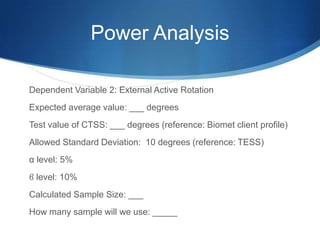
Dependent Variable 2: External Active Rotation
Expected average value: ___ degrees
Test value of CTSS: ___ degrees (reference: Biomet client profile)
Allowed Standard Deviation: 10 degrees (reference: TESS)
Îą level: 5%
ϐ level: 10%
Calculated Sample Size: ___
How many sample will we use: _____
Minimizing Sample Loss

S Substantial Discount for device

S Sample size needed for dependent variable 2 is much
  smaller okay for some subject to leave mid-study


                       Reference: http://modernpivotdoors.com/pivot-doors/security-door-
                       locks/defendius-security-door-lock.jpg
Statistical Analysis


                          S
      mediacrushllc.com
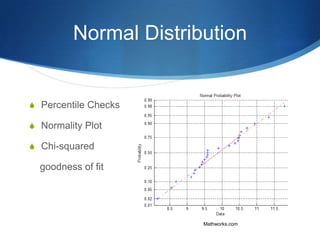
Normal Distribution


S Percentile Checks

S Normality Plot

S Chi-squared

  goodness of fit


                       Mathworks.com
Parametric Tests


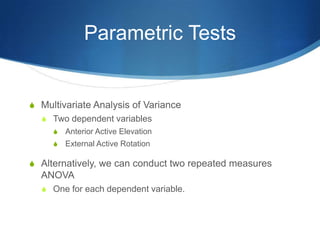
S Multivariate Analysis of Variance
  S Two dependent variables
     S   Anterior Active Elevation
     S   External Active Rotation

S Alternatively, we can conduct two repeated measures
  ANOVA
  S One for each dependent variable.
Nonparametric Test

S Friedman Statistic


                        Guardian.co.uk
Questions


 scotttowler.blogspot.com

Tsr presentation slides

  • 1.
    Total Shoulder Replacement Amal Alam David Babayev Rakshya Bista Shreenath Varma Wahaj Patel S
  • 2.
    Glenohumeral joint Articular cartilage: prevents bone-on-bone friction. Labrum: offers the joint more stability Rotator cuffs: group of muscles, stabilize the joint http://www.eorthopod.com/sites/default/files/images/shoulder_anatomy_ligaments01.jpg 1. American Academy of Orthopedic Surgeons, http://orthoinfo.aaos.org/topic.cfm?topic=A00094, reviewed December 2011 2. Huguet D, DeClercq G, Rio B, Teissier J. (2010) Results of a new stemless shoulder prosthesis: Radiologic proof of maintained fixation and stability after a minimum of three years' follow-up. Journal of Shoulder and Elbow Surgery, 19:847-852.
  • 3.
    Normal Range of Motion http://www.crossfitskopje.com/wp-content/uploads/2012/12/bigliani_flatlow_shoulder3.jpeg S Forward flexion is the movement of the shoulder forward. Normal range of motion is 180 degree S pushing a door S lifting an object from the ground.
  • 4.
    Normal Range of Motion S External Rotation: elbow bent to 90 degrees S Opening the front door S Normal range of Motion is 70 to 90 degrees http://t0.gstatic.com/images?q=tbn:ANd9GcRWzNgo0gKHQhaPWS9-boRsjQ0-Zguy7zQIR-PwY-iGx3ItGGct
  • 5.
    Instability: ball ofthe humerus becomes larger than the shoulder socket that holds it. The muscles, tendons and ligaments, must anchor the shoulder in order to maintain the normal stability. The main causes for a total shoulder replacement revolve around arthritis. 1. American Academy of Orthopedic Surgeons, http://orthoinfo.aaos.org/topic.cfm?topic=A00094, reviewed December 2011 2. Hospital For Special Surgery, www.hss.edu, assessed October 2012
  • 6.
    S Osteoarthritis: “wear and tear” arthritis, most people are familiar with it, where the cartilage in the joint wears away over time. http://www.eorthopod.com/images/ContentImages/shou lder/shoulder_reverse_replacement/shoulder_reverse_ oa_rationale01.jpg 1. American Academy of Orthopedic Surgeons, http://orthoinfo.aaos.org/topic.cfm?topic=A00094, reviewed December 2011
  • 7.
    Rheumatoid arthritis S an inflammation and thickening of the tissues around the joint http://www.fulllifeusa.com/images/fulllife_enfermedades_01.jpg 1. Hospital For Special Surgery, www.hss.edu, assessed October 2012
  • 8.
    S Post-traumatic arthritis: follow a serious shoulder injury and cause fractures. S Fractures: common reason people have shoulder replacements, bones of the shoulder matter completely shatter, difficult to put the pieces back together. S Avascular necrosis, where the blood supply is severely hampered, causing bone death. http://www.eorthopod.com/images/ContentImages/Fractures/adult_fractures 1. American Academy of Orthopedic Surgeons, http://orthoinfo.aaos.org/topic.cfm?topic=A00094, reviewed December 2011 2. Hospital For Special Surgery, www.hss.edu, assessed October 2012
  • 9.
    Total Shoulder Replacement S Glenoid is replaced with a plastic socket S Humeral head is metal S Metal portion is inserted into humeral bone www.lima.it
  • 10.
    Procedure Part I S Glenoid is removed and cleaned S Three to four holes are drilled for the pegs of the implant S Cement or porous material is used for implantation http://www.zimmer.com
  • 11.
    Procedure Part II S Humerus is sliced off and cleaned S The soft bone inside the humerus is drilled out S Cement might be injected into the humerus S Metal humeral stem is inserted and then the ball of the humerus is screwed and cemented to the top http://www.zimmer.com
  • 12.
    Current Devices S Uses various porous material to allow bone ingrowth S Promotes natural fixation of implants S The glenoid can become loose regardless http://www.biomet.com http://www.zimmer.com
  • 13.
    Reverse Shoulder Replacement S The glenoid and humeral pieces are switched S Uses different muscles to function S Generally for people with irreparable rotator cuff injuries, not used very often http://shoulderreplacement-hobgood.org
  • 14.
    Experimental Set Up SIn Vivo human clinical trial S Anterior Active Elevation and Exterior Active Rotation will be measured in subjects at intervals of six months every two years S IRB Approved Clinical Trial
  • 15.
    Working Hypothesis S Thenew device should increase both the external active rotation and anterior active elevation
  • 16.
    Control Group S Wewill receive control group data from Biomet via collaboration on their Comprehensive ÂŽ Total Shoulder Replacement Model, which was tailored to patients with osteoarthritis.
  • 17.
    Experimental Group People with Osteoarthritis People of all ages 18+ Patient Screening Reference: S http://img.webmd.com/dtmcms/live/webmd/consumer_assets/site_images/rich_media_quiz/topic/rmq_coping_with_acne/getty_rf_photo_of_diver se_group_of_people_of_all_ages.jpg
  • 18.
    Power Analysis IMAGE andreference of tool used to calculate power analysis
  • 19.
    Power Analysis Dependent Variable1: Anterior Active Elevation Expected average value: ___ degrees Test value of CTSS: ___ degrees (reference: Biomet client profile) Allowed Standard Deviation: 10 degrees (reference: TESS) ι level: 5% ϐ level: 10% Calculated Sample Size: ___
  • 20.
    Power Analysis Dependent Variable2: External Active Rotation Expected average value: ___ degrees Test value of CTSS: ___ degrees (reference: Biomet client profile) Allowed Standard Deviation: 10 degrees (reference: TESS) ι level: 5% ϐ level: 10% Calculated Sample Size: ___ How many sample will we use: _____
  • 21.
    Minimizing Sample Loss SSubstantial Discount for device S Sample size needed for dependent variable 2 is much smaller okay for some subject to leave mid-study Reference: http://modernpivotdoors.com/pivot-doors/security-door- locks/defendius-security-door-lock.jpg
  • 22.
    Statistical Analysis S mediacrushllc.com
  • 23.
    Normal Distribution S PercentileChecks S Normality Plot S Chi-squared goodness of fit Mathworks.com
  • 24.
    Parametric Tests S MultivariateAnalysis of Variance S Two dependent variables S Anterior Active Elevation S External Active Rotation S Alternatively, we can conduct two repeated measures ANOVA S One for each dependent variable.
  • 25.
    Nonparametric Test S FriedmanStatistic Guardian.co.uk
  • 26.