TOTAL ANKLE
REPLACEMENT
CHAIRPERSON – DR. M. Y. PATIL
PRESENTER – DR. SRINATH GUPTA
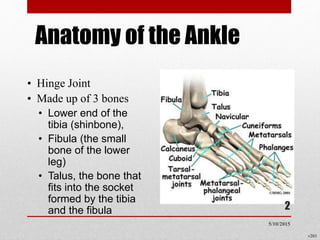
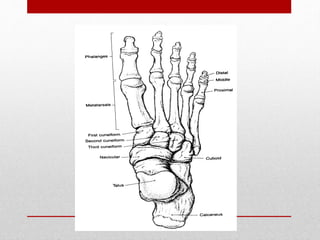
Anatomy of the Ankle
• Hinge Joint
• Made up of 3 bones
• Lower end of the
tibia (shinbone),
• Fibula (the small
bone of the lower
leg)
• Talus, the bone that
fits into the socket
formed by the tibia
and the fibula
v203
2
5/10/2015
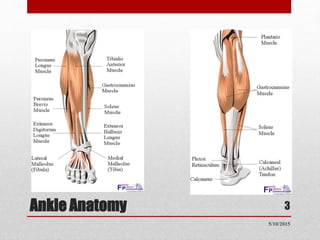
Ankle Anatomy 3
5/10/2015
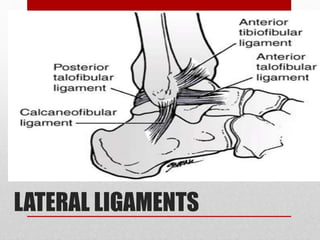
LATERAL LIGAMENTS
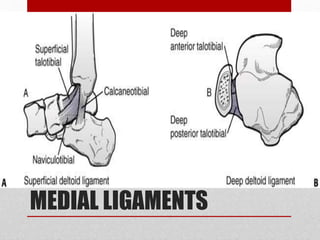
MEDIAL LIGAMENTS
Ankle-FOOT COMPLEX
• Stability demands-
1.Providing a stable base of support for the
body in a variety of weight bearing postures
without undue muscular activity and
energy expenditure.
2.Acting as a lever for effective push-off
during gait.
Mobility demands-
1.Dampening of rotations imposed by more
proximal joints of LL.
2.Being flexible enough as a shock absorber
3.Permitting the foot to conform to the
changing and varied terrain on which foot is
placed.
Ankle Anatomy
9
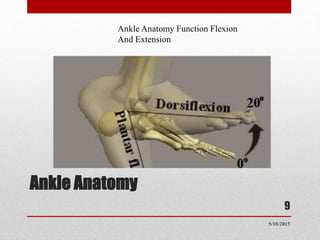
Ankle Anatomy Function Flexion
And Extension
5/10/2015
Ankle Anatomy 10
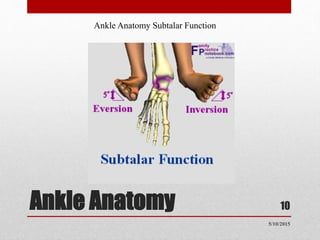
Ankle Anatomy Subtalar Function
5/10/2015
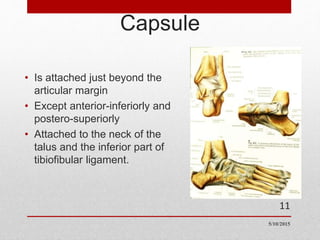
Capsule
• Is attached just beyond the
articular margin
• Except anterior-inferiorly and
postero-superiorly
• Attached to the neck of the
talus and the inferior part of
tibiofibular ligament.
11
5/10/2015
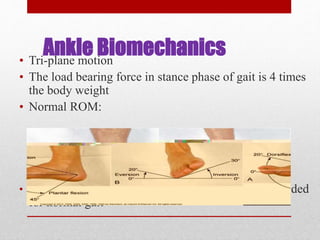
Ankle Biomechanics• Tri-plane motion
• The load bearing force in stance phase of gait is 4 times
the body weight
• Normal ROM:
• At least 10 degrees of dorsiflexion (extension) is needed
for normal gait
CAUSES OF ANKLE ARTHRITIS
• Primary Osteoarthritis of the Ankle
• Post traumatic Osteoarthritis
• Secondary Osteoarthritis
• Rheumatoid
• Hemochromatosis
• Hemophilia
13
5/10/2015
SYMPTOMS
• Pain
• During activity
• At rest or sleeping
• Swelling and Tightness
• Squeaking or grinding sound when ankle is moved.
• Stiffness and decreased movement
v206
14
5/10/2015
Examination
5/10/2015
15
Physical Exam
• Note obvious deformities
• Neurovascular exam
• Pain to palpation of malleoli and ligaments
• Pain at the ankle with compression
• syndesmotic injury
• Examine the hindfoot and forefoot for associated injuries
Stability Tests
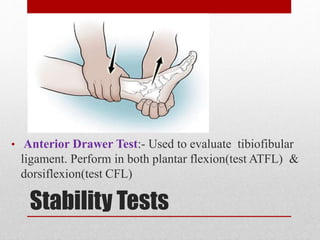
• Anterior Drawer Test:- Used to evaluate tibiofibular
ligament. Perform in both plantar flexion(test ATFL) &
dorsiflexion(test CFL)
Continued…
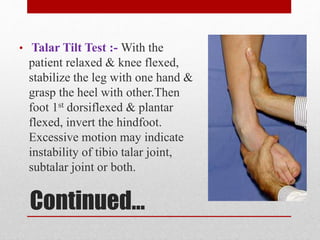
• Talar Tilt Test :- With the
patient relaxed & knee flexed,
stabilize the leg with one hand &
grasp the heel with other.Then
foot 1st dorsiflexed & plantar
flexed, invert the hindfoot.
Excessive motion may indicate
instability of tibio talar joint,
subtalar joint or both.
Continued…
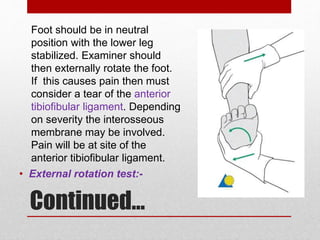
• External rotation test:-
Foot should be in neutral
position with the lower leg
stabilized. Examiner should
then externally rotate the foot.
If this causes pain then must
consider a tear of the anterior
tibiofibular ligament. Depending
on severity the interosseous
membrane may be involved.
Pain will be at site of the
anterior tibiofibular ligament.
TREATMENT
• Nonsurgical and
• Surgical
20
5/10/2015
NONSURGICAL
• Pain relievers and anti – inflammatory meds
• Orthotics such as Soft pads or arch supports
• Custom made shoes – Stiff soled shoe with a rocker
bottom
• An Ankle – Foot – Orthosis
• Physical therapy and exercises
• Steroid medications injected into the joint
21
5/10/2015
SURGICAL
• Arthroscopic debridement is helpful in early cases of
Arthritis.
• Arthrodesis
• Total Ankle Replacement
22
5/10/2015
ARTHROPLASTY
• Recommended in patients with Advanced arthritis
• Destroyed ankle joint surfaces
• An ankle condition that interferes with daily activities
23
5/10/2015
Classification of Total
Ankle Replacement
5/10/2015
24
• Surgical approach
• Bearing type
• External surface
• Bearing surface
• Sulcus type
• Surface morphology
ABSOLUTE
CONTRAINDICATION
• Neuropathy ( Charcot foot)
• Non – manageable hind foot malalignment
• Massive joint laxity (Eg: Marfan disease)
• Highly compromised periarticular soft tissue
• Severe senomotoric dysfunction of foot and ankle
• Advanced soft tissue or bony infection
• AVN of talus ( needs custom made implants )
25
5/10/2015
HISTORY
• First ankle replacement was performed in 1970s
• Two types of designs were developed
 Constrained
 Unconstrained
26
5/10/2015
• Constrained
• Greater stability but with reduced motion
• Increased stresses at the bone – cement – implant interfaces
leading to early loosening and failure
Ex – St. George/Buchholz, Imperial College London Hospital,
Conaxial and Mayo designs
27
5/10/2015
• Unconstrained
• Improved ROM in multiple planes but with reduced
stability.
• Less stress at the bone – cement – implant interface
Ex – Waugh / Irvine, Smith and Newton Prostheses
5/10/2015
28
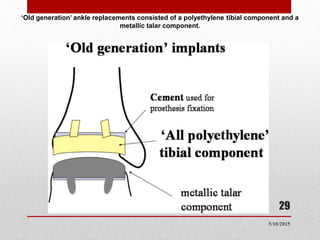
‘Old generation’ ankle replacements consisted of a polyethylene tibial component and a
metallic talar component.
29
5/10/2015
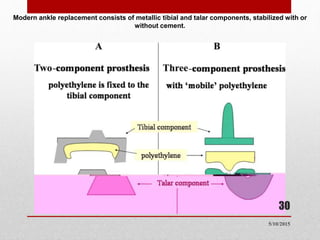
Modern ankle replacement consists of metallic tibial and talar components, stabilized with or
without cement.
30
5/10/2015
• In 1970, study was done by Lord and Marotte and was
concluded with the current implants, Arthrodesis is a
better option than Arthroplasty.
• Inverted hip stem was used for tibia, talus was completely
removed and then a cemented acetabular cup was inserted
in the calcaneum
31
5/10/2015
32
5/10/2015
NEW GEN IMPLANTS
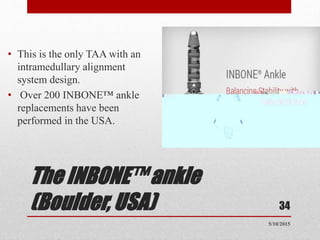
• The new generation implants presently in use can be
classified
• (a) as two- or three-component designs and
• (b) as fixed or mobile-bearing designs.
33
5/10/2015
The INBONE™ ankle
(Boulder, USA)
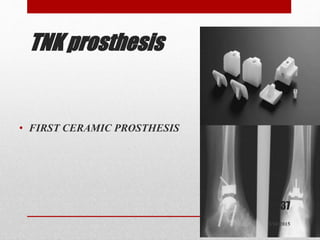
• This is the only TAA with an
intramedullary alignment
system design.
• Over 200 INBONE™ ankle
replacements have been
performed in the USA.
34
5/10/2015
The ESKA ankle
prosthesis (Germany) 35
5/10/2015
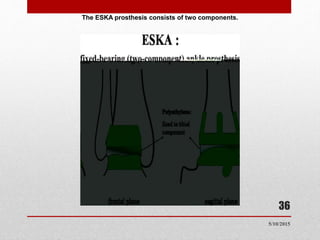
The ESKA prosthesis consists of two components.
36
5/10/2015
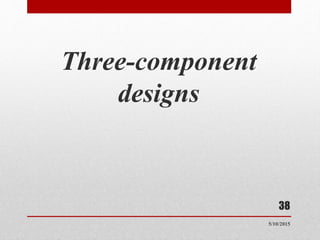
TNK prosthesis
• FIRST CERAMIC PROSTHESIS
37
5/10/2015
Three-component
designs
38
5/10/2015
The BP total ankle
replacement
• Its upper surface is flat, whereas its lower surface
conforms to the trochlear surface, thereby providing
unconstrained, sliding cylindrical motion with LCS on the
bearing surfaces, allowing inversion, eversion motion.
39
5/10/2015
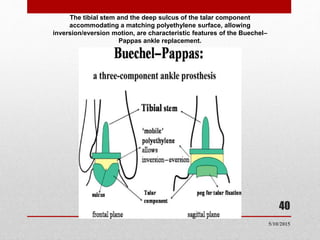
The tibial stem and the deep sulcus of the talar component
accommodating a matching polyethylene surface, allowing
inversion/eversion motion, are characteristic features of the Buechel–
Pappas ankle replacement.
40
5/10/2015
The Scandinavian Total
Ankle Replacement
(STAR)
41
5/10/2015
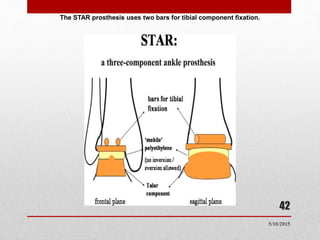
The STAR prosthesis uses two bars for tibial component fixation.
42
5/10/2015
The HINTEGRA TAA
43
5/10/2015
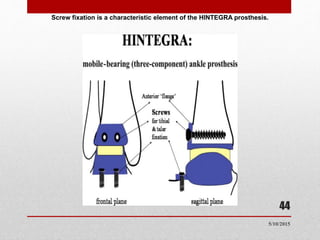
Screw fixation is a characteristic element of the HINTEGRA prosthesis.
44
5/10/2015
The SALTO Talaris™ anatomic
ankle (Tornier)
45
5/10/2015
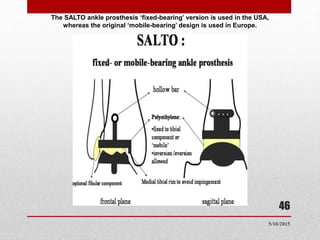
The SALTO ankle prosthesis ‘fixed-bearing’ version is used in the USA,
whereas the original ‘mobile-bearing’ design is used in Europe.
46
5/10/2015
47
5/10/2015
The Agility total ankle
replacement
48
5/10/2015
49
5/10/2015
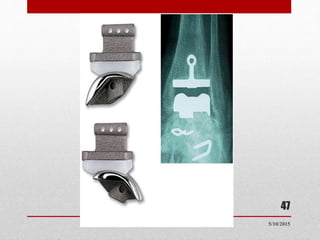
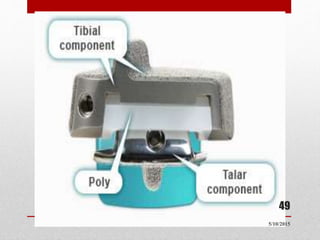
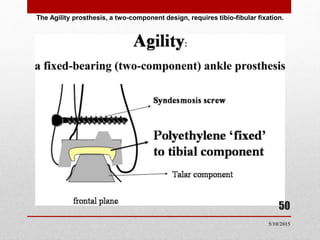
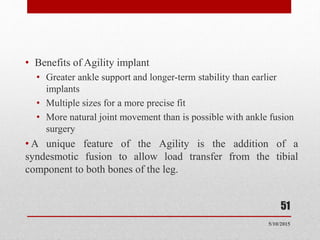
The Agility prosthesis, a two-component design, requires tibio-fibular fixation.
50
5/10/2015
• Benefits of Agility implant
• Greater ankle support and longer-term stability than earlier
implants
• Multiple sizes for a more precise fit
• More natural joint movement than is possible with ankle fusion
surgery
• A unique feature of the Agility is the addition of a
syndesmotic fusion to allow load transfer from the tibial
component to both bones of the leg.
51
5/10/2015
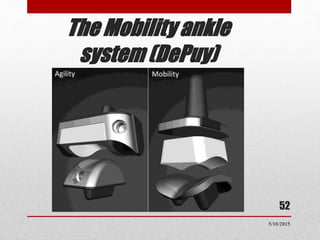
The Mobility ankle
system (DePuy)
52
5/10/2015
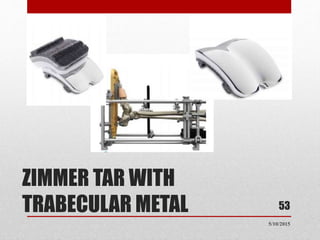
ZIMMER TAR WITH
TRABECULAR METAL 53
5/10/2015
OTHER NEW IMPLANTS
• BOX Total Ankle Replacement
• The German Ankle System
• The ZENITH total ankle replacement system (Corin,
UK)
• The Alphanorm total ankle replacement
• The TARIC prosthesis
• The CCI evolution total ankle prosthesis
54
5/10/2015
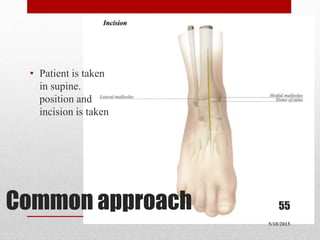
Common approach
5/10/2015
55
• Patient is taken
in supine.
position and
incision is taken
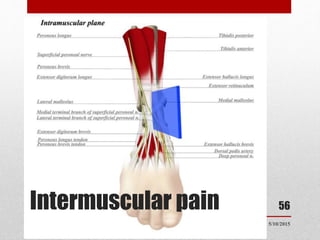
Intermuscular pain
5/10/2015
56
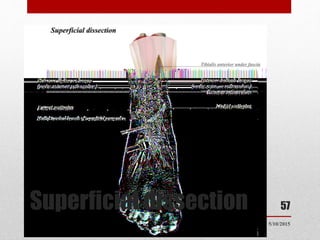
Superficial dissection
5/10/2015
57
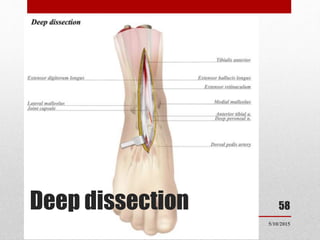
Deep dissection
5/10/2015
58
5/10/2015
59
5/10/2015
60
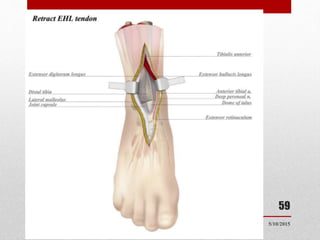
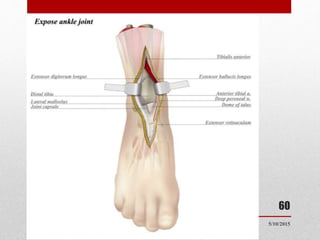
Structures at risk
• Cutaneous branches of the superficial peroneal nerve
• Neurovascular bundle consisting of
• Deep peroneal nerve and
• Anterior tibial artery
5/10/2015
61
• video
5/10/2015
62
POST-OP Protocol
• ROM within first week. Non weight bearing walking.
• 6 weeks (with Doctors Instruction)
• Gradually put weight on the leg
• Use of a cane or walker.
• Begin Driving
• 6 to 8 weeks - automatic shift
• 12 weeks – manual shift
• 12 weeks - low-impact activities, such as walking.
• Up to 1 year - may require the use of an ankle support
63
5/10/2015
THANK YOU
64
5/10/2015

ankle replacement evolution

  • 1.
    TOTAL ANKLE REPLACEMENT CHAIRPERSON –DR. M. Y. PATIL PRESENTER – DR. SRINATH GUPTA
  • 2.
    Anatomy of theAnkle • Hinge Joint • Made up of 3 bones • Lower end of the tibia (shinbone), • Fibula (the small bone of the lower leg) • Talus, the bone that fits into the socket formed by the tibia and the fibula v203 2 5/10/2015
  • 3.
  • 4.
  • 5.
  • 6.
    Ankle-FOOT COMPLEX • Stabilitydemands- 1.Providing a stable base of support for the body in a variety of weight bearing postures without undue muscular activity and energy expenditure. 2.Acting as a lever for effective push-off during gait.
  • 7.
    Mobility demands- 1.Dampening ofrotations imposed by more proximal joints of LL. 2.Being flexible enough as a shock absorber 3.Permitting the foot to conform to the changing and varied terrain on which foot is placed.
  • 9.
    Ankle Anatomy 9 Ankle AnatomyFunction Flexion And Extension 5/10/2015
  • 10.
    Ankle Anatomy 10 AnkleAnatomy Subtalar Function 5/10/2015
  • 11.
    Capsule • Is attachedjust beyond the articular margin • Except anterior-inferiorly and postero-superiorly • Attached to the neck of the talus and the inferior part of tibiofibular ligament. 11 5/10/2015
  • 12.
    Ankle Biomechanics• Tri-planemotion • The load bearing force in stance phase of gait is 4 times the body weight • Normal ROM: • At least 10 degrees of dorsiflexion (extension) is needed for normal gait
  • 13.
    CAUSES OF ANKLEARTHRITIS • Primary Osteoarthritis of the Ankle • Post traumatic Osteoarthritis • Secondary Osteoarthritis • Rheumatoid • Hemochromatosis • Hemophilia 13 5/10/2015
  • 14.
    SYMPTOMS • Pain • Duringactivity • At rest or sleeping • Swelling and Tightness • Squeaking or grinding sound when ankle is moved. • Stiffness and decreased movement v206 14 5/10/2015
  • 15.
  • 16.
    Physical Exam • Noteobvious deformities • Neurovascular exam • Pain to palpation of malleoli and ligaments • Pain at the ankle with compression • syndesmotic injury • Examine the hindfoot and forefoot for associated injuries
  • 17.
    Stability Tests • AnteriorDrawer Test:- Used to evaluate tibiofibular ligament. Perform in both plantar flexion(test ATFL) & dorsiflexion(test CFL)
  • 18.
    Continued… • Talar TiltTest :- With the patient relaxed & knee flexed, stabilize the leg with one hand & grasp the heel with other.Then foot 1st dorsiflexed & plantar flexed, invert the hindfoot. Excessive motion may indicate instability of tibio talar joint, subtalar joint or both.
  • 19.
    Continued… • External rotationtest:- Foot should be in neutral position with the lower leg stabilized. Examiner should then externally rotate the foot. If this causes pain then must consider a tear of the anterior tibiofibular ligament. Depending on severity the interosseous membrane may be involved. Pain will be at site of the anterior tibiofibular ligament.
  • 20.
    TREATMENT • Nonsurgical and •Surgical 20 5/10/2015
  • 21.
    NONSURGICAL • Pain relieversand anti – inflammatory meds • Orthotics such as Soft pads or arch supports • Custom made shoes – Stiff soled shoe with a rocker bottom • An Ankle – Foot – Orthosis • Physical therapy and exercises • Steroid medications injected into the joint 21 5/10/2015
  • 22.
    SURGICAL • Arthroscopic debridementis helpful in early cases of Arthritis. • Arthrodesis • Total Ankle Replacement 22 5/10/2015
  • 23.
    ARTHROPLASTY • Recommended inpatients with Advanced arthritis • Destroyed ankle joint surfaces • An ankle condition that interferes with daily activities 23 5/10/2015
  • 24.
    Classification of Total AnkleReplacement 5/10/2015 24 • Surgical approach • Bearing type • External surface • Bearing surface • Sulcus type • Surface morphology
  • 25.
    ABSOLUTE CONTRAINDICATION • Neuropathy (Charcot foot) • Non – manageable hind foot malalignment • Massive joint laxity (Eg: Marfan disease) • Highly compromised periarticular soft tissue • Severe senomotoric dysfunction of foot and ankle • Advanced soft tissue or bony infection • AVN of talus ( needs custom made implants ) 25 5/10/2015
  • 26.
    HISTORY • First anklereplacement was performed in 1970s • Two types of designs were developed  Constrained  Unconstrained 26 5/10/2015
  • 27.
    • Constrained • Greaterstability but with reduced motion • Increased stresses at the bone – cement – implant interfaces leading to early loosening and failure Ex – St. George/Buchholz, Imperial College London Hospital, Conaxial and Mayo designs 27 5/10/2015
  • 28.
    • Unconstrained • ImprovedROM in multiple planes but with reduced stability. • Less stress at the bone – cement – implant interface Ex – Waugh / Irvine, Smith and Newton Prostheses 5/10/2015 28
  • 29.
    ‘Old generation’ anklereplacements consisted of a polyethylene tibial component and a metallic talar component. 29 5/10/2015
  • 30.
    Modern ankle replacementconsists of metallic tibial and talar components, stabilized with or without cement. 30 5/10/2015
  • 31.
    • In 1970,study was done by Lord and Marotte and was concluded with the current implants, Arthrodesis is a better option than Arthroplasty. • Inverted hip stem was used for tibia, talus was completely removed and then a cemented acetabular cup was inserted in the calcaneum 31 5/10/2015
  • 32.
  • 33.
    NEW GEN IMPLANTS •The new generation implants presently in use can be classified • (a) as two- or three-component designs and • (b) as fixed or mobile-bearing designs. 33 5/10/2015
  • 34.
    The INBONE™ ankle (Boulder,USA) • This is the only TAA with an intramedullary alignment system design. • Over 200 INBONE™ ankle replacements have been performed in the USA. 34 5/10/2015
  • 35.
    The ESKA ankle prosthesis(Germany) 35 5/10/2015
  • 36.
    The ESKA prosthesisconsists of two components. 36 5/10/2015
  • 37.
    TNK prosthesis • FIRSTCERAMIC PROSTHESIS 37 5/10/2015
  • 38.
  • 39.
    The BP totalankle replacement • Its upper surface is flat, whereas its lower surface conforms to the trochlear surface, thereby providing unconstrained, sliding cylindrical motion with LCS on the bearing surfaces, allowing inversion, eversion motion. 39 5/10/2015
  • 40.
    The tibial stemand the deep sulcus of the talar component accommodating a matching polyethylene surface, allowing inversion/eversion motion, are characteristic features of the Buechel– Pappas ankle replacement. 40 5/10/2015
  • 41.
    The Scandinavian Total AnkleReplacement (STAR) 41 5/10/2015
  • 42.
    The STAR prosthesisuses two bars for tibial component fixation. 42 5/10/2015
  • 43.
  • 44.
    Screw fixation isa characteristic element of the HINTEGRA prosthesis. 44 5/10/2015
  • 45.
    The SALTO Talaris™anatomic ankle (Tornier) 45 5/10/2015
  • 46.
    The SALTO ankleprosthesis ‘fixed-bearing’ version is used in the USA, whereas the original ‘mobile-bearing’ design is used in Europe. 46 5/10/2015
  • 47.
  • 48.
    The Agility totalankle replacement 48 5/10/2015
  • 49.
  • 50.
    The Agility prosthesis,a two-component design, requires tibio-fibular fixation. 50 5/10/2015
  • 51.
    • Benefits ofAgility implant • Greater ankle support and longer-term stability than earlier implants • Multiple sizes for a more precise fit • More natural joint movement than is possible with ankle fusion surgery • A unique feature of the Agility is the addition of a syndesmotic fusion to allow load transfer from the tibial component to both bones of the leg. 51 5/10/2015
  • 52.
    The Mobility ankle system(DePuy) 52 5/10/2015
  • 53.
    ZIMMER TAR WITH TRABECULARMETAL 53 5/10/2015
  • 54.
    OTHER NEW IMPLANTS •BOX Total Ankle Replacement • The German Ankle System • The ZENITH total ankle replacement system (Corin, UK) • The Alphanorm total ankle replacement • The TARIC prosthesis • The CCI evolution total ankle prosthesis 54 5/10/2015
  • 55.
    Common approach 5/10/2015 55 • Patientis taken in supine. position and incision is taken
  • 56.
  • 57.
  • 58.
  • 59.
  • 60.
  • 61.
    Structures at risk •Cutaneous branches of the superficial peroneal nerve • Neurovascular bundle consisting of • Deep peroneal nerve and • Anterior tibial artery 5/10/2015 61
  • 62.
  • 63.
    POST-OP Protocol • ROMwithin first week. Non weight bearing walking. • 6 weeks (with Doctors Instruction) • Gradually put weight on the leg • Use of a cane or walker. • Begin Driving • 6 to 8 weeks - automatic shift • 12 weeks – manual shift • 12 weeks - low-impact activities, such as walking. • Up to 1 year - may require the use of an ankle support 63 5/10/2015
  • 64.