CED 426
Structural Theory II
Lecture 3
Method of Virtual Work
(Beams and Frames)
Mary Joanne C. Aniñon
Instructor
Method of Virtual
Work: Beams and
Frames
• The method of virtual work can also
be applied to deflection problems
involving beams and frames.
• The principle of virtual work or
virtual force, may be formulated for
beam deflections by considering the
beam shown in figure (b)
• Here the displacement ∆ at point A
is to be determined
Method of Virtual Work: Beams and Frames
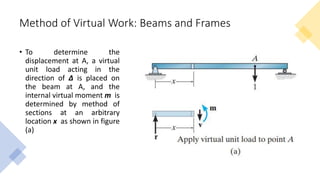
• To determine the
displacement at A, a virtual
unit load acting in the
direction of ∆ is placed on
the beam at A, and the
internal virtual moment m is
determined by method of
sections at an arbitrary
location x as shown in figure
(a)
Method of Virtual Work: Beams and Frames
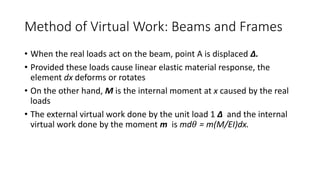
• When the real loads act on the beam, point A is displaced ∆.
• Provided these loads cause linear elastic material response, the
element dx deforms or rotates
• On the other hand, M is the internal moment at x caused by the real
loads
• The external virtual work done by the unit load 1 ∆ and the internal
virtual work done by the moment m is md𝜃 = m(M/EI)dx.
Method of Virtual Work: Beams and Frames
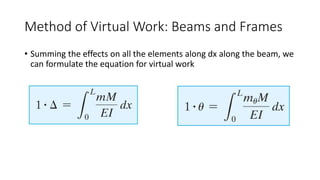
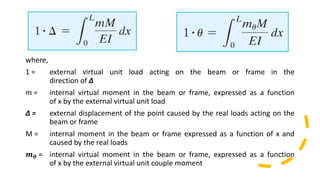
• Summing the effects on all the elements along dx along the beam, we
can formulate the equation for virtual work
where,
1 = external virtual unit load acting on the beam or frame in the
direction of ∆
m = internal virtual moment in the beam or frame, expressed as a function
of x by the external virtual unit load
∆ = external displacement of the point caused by the real loads acting on the
beam or frame
M = internal moment in the beam or frame expressed as a function of x and
caused by the real loads
𝒎𝜽 = internal virtual moment in the beam or frame, expressed as a function
of x by the external virtual unit couple moment
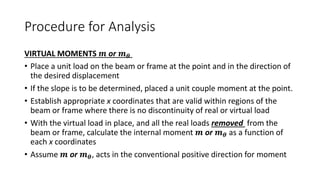
Procedure for Analysis
VIRTUAL MOMENTS 𝒎 or 𝒎𝜽
• Place a unit load on the beam or frame at the point and in the direction of
the desired displacement
• If the slope is to be determined, placed a unit couple moment at the point.
• Establish appropriate x coordinates that are valid within regions of the
beam or frame where there is no discontinuity of real or virtual load
• With the virtual load in place, and all the real loads removed from the
beam or frame, calculate the internal moment 𝒎 or 𝒎𝜽 as a function of
each x coordinates
• Assume 𝒎 or 𝒎𝜽, acts in the conventional positive direction for moment
Procedure for Analysis
REAL MOMENTS M
• Using the same x coordinates as those established for 𝒎 or 𝒎𝜽,
determine the internal moments M caused only by the real loads.
• Since 𝒎 or 𝒎𝜽 was assumed to act in the conventional positive
direction, it is important that positive M acts in the same direction.
This is necessary since positive or negative internal work depends
upon the directional sense of the load.
Procedure for Analysis
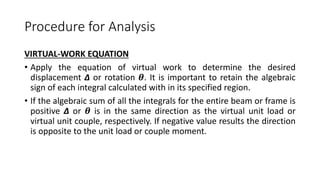
VIRTUAL-WORK EQUATION
• Apply the equation of virtual work to determine the desired
displacement ∆ or rotation 𝜽. It is important to retain the algebraic
sign of each integral calculated with in its specified region.
• If the algebraic sum of all the integrals for the entire beam or frame is
positive ∆ or 𝜽 is in the same direction as the virtual unit load or
virtual unit couple, respectively. If negative value results the direction
is opposite to the unit load or couple moment.
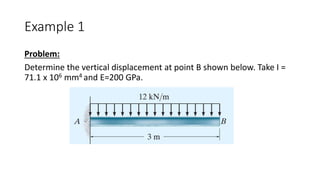
Example 1
Problem:
Determine the vertical displacement at point B shown below. Take I =
71.1 x 106 mm4 and E=200 GPa.
Example 1
Virtual Moment m:
A vertical displacement of point B is obtained by placing a virtual load
of 1 kN at point B. Note that there are no discontinuities of loading on
the beam for both the real and virtual loads. Thus, a single x coordinate
is used.
Example 1
Virtual Moment m:
The x coordinate will be
selected with its origin at B,
since then the reactions at
point A do not have to be
determined in order to find
the internal moments m and
M
Using the method of sections,
the internal virtual moment m
is shown,
Example 1
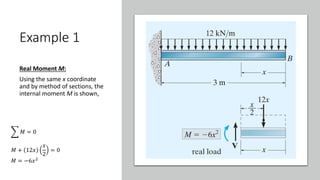
Real Moment M:
Using the same x coordinate
and by method of sections, the
internal moment M is shown,
𝑀 = 0
𝑀 + 12𝑥
𝑥
2
= 0
𝑀 = −6𝑥2
Example 1
• Virtual-Work Equation:
Once m and M are determined, we can now apply the virtual-work
equation to solve for the displacement at B.
0
3
6𝑥3
𝐸𝐼
𝑑𝑥 =
6 3 4
4
− [
6(0)4
4
]
Example 2
Problem:
Determine the slope at point B shown below. Take I = 60 x 106 mm4 and
E=200 GPa.
Example 2
Virtual Moment m:
The slope at B is determined by
placing a virtual couple moment of
1 kN-m at B. Here two x coordinates
must be selected in order to
determine the total virtual strain
energy in the beam. Coordinate 𝑥1
accounts for the strain energy
within segment AB and coordinate
𝑥2 accounts for that in segment BC
Example 2
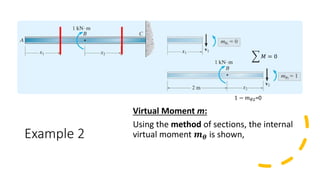
Virtual Moment m:
Using the method of sections, the internal
virtual moment 𝒎𝜽 is shown,
𝑀 = 0
1 − 𝑚𝜃2=0
Example 2
Real Moments M:
Using the same coordinates 𝑥1 and 𝑥2 the
internal moments M are shown
Example 2
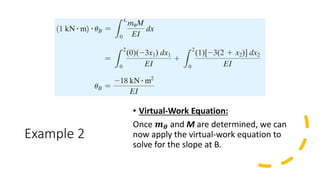
• Virtual-Work Equation:
Once 𝒎𝜽 and M are determined, we can
now apply the virtual-work equation to
solve for the slope at B.
Example 3
Problem:
Determine the horizontal
displacement of point C on the frame
shown below. Take E = 200 Gpa and I =
235 (106) mm4 for both members.
Example 3
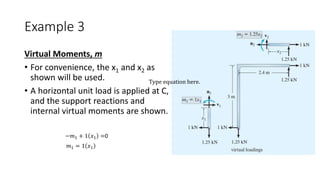
Virtual Moments, m
• For convenience, the x1 and x2 as
shown will be used.
• A horizontal unit load is applied at C,
and the support reactions and
internal virtual moments are shown.
Type equation here.
−𝑚1 + 1 𝑥1 =0
𝑚1 = 1 𝑥1
Example 3
Real Moments, M
• In similar manner, the support
reactions and real moments are
shown.
Example 3
Virtual-Work Equation

Topic1_Method of Virtual Work Beams and Frames.pptx

  • 1.
    CED 426 Structural TheoryII Lecture 3 Method of Virtual Work (Beams and Frames) Mary Joanne C. Aniñon Instructor
  • 2.
    Method of Virtual Work:Beams and Frames • The method of virtual work can also be applied to deflection problems involving beams and frames. • The principle of virtual work or virtual force, may be formulated for beam deflections by considering the beam shown in figure (b) • Here the displacement ∆ at point A is to be determined
  • 3.
    Method of VirtualWork: Beams and Frames • To determine the displacement at A, a virtual unit load acting in the direction of ∆ is placed on the beam at A, and the internal virtual moment m is determined by method of sections at an arbitrary location x as shown in figure (a)
  • 4.
    Method of VirtualWork: Beams and Frames • When the real loads act on the beam, point A is displaced ∆. • Provided these loads cause linear elastic material response, the element dx deforms or rotates • On the other hand, M is the internal moment at x caused by the real loads • The external virtual work done by the unit load 1 ∆ and the internal virtual work done by the moment m is md𝜃 = m(M/EI)dx.
  • 5.
    Method of VirtualWork: Beams and Frames • Summing the effects on all the elements along dx along the beam, we can formulate the equation for virtual work
  • 6.
    where, 1 = externalvirtual unit load acting on the beam or frame in the direction of ∆ m = internal virtual moment in the beam or frame, expressed as a function of x by the external virtual unit load ∆ = external displacement of the point caused by the real loads acting on the beam or frame M = internal moment in the beam or frame expressed as a function of x and caused by the real loads 𝒎𝜽 = internal virtual moment in the beam or frame, expressed as a function of x by the external virtual unit couple moment
  • 7.
    Procedure for Analysis VIRTUALMOMENTS 𝒎 or 𝒎𝜽 • Place a unit load on the beam or frame at the point and in the direction of the desired displacement • If the slope is to be determined, placed a unit couple moment at the point. • Establish appropriate x coordinates that are valid within regions of the beam or frame where there is no discontinuity of real or virtual load • With the virtual load in place, and all the real loads removed from the beam or frame, calculate the internal moment 𝒎 or 𝒎𝜽 as a function of each x coordinates • Assume 𝒎 or 𝒎𝜽, acts in the conventional positive direction for moment
  • 8.
    Procedure for Analysis REALMOMENTS M • Using the same x coordinates as those established for 𝒎 or 𝒎𝜽, determine the internal moments M caused only by the real loads. • Since 𝒎 or 𝒎𝜽 was assumed to act in the conventional positive direction, it is important that positive M acts in the same direction. This is necessary since positive or negative internal work depends upon the directional sense of the load.
  • 9.
    Procedure for Analysis VIRTUAL-WORKEQUATION • Apply the equation of virtual work to determine the desired displacement ∆ or rotation 𝜽. It is important to retain the algebraic sign of each integral calculated with in its specified region. • If the algebraic sum of all the integrals for the entire beam or frame is positive ∆ or 𝜽 is in the same direction as the virtual unit load or virtual unit couple, respectively. If negative value results the direction is opposite to the unit load or couple moment.
  • 10.
    Example 1 Problem: Determine thevertical displacement at point B shown below. Take I = 71.1 x 106 mm4 and E=200 GPa.
  • 11.
    Example 1 Virtual Momentm: A vertical displacement of point B is obtained by placing a virtual load of 1 kN at point B. Note that there are no discontinuities of loading on the beam for both the real and virtual loads. Thus, a single x coordinate is used.
  • 12.
    Example 1 Virtual Momentm: The x coordinate will be selected with its origin at B, since then the reactions at point A do not have to be determined in order to find the internal moments m and M Using the method of sections, the internal virtual moment m is shown,
  • 13.
    Example 1 Real MomentM: Using the same x coordinate and by method of sections, the internal moment M is shown, 𝑀 = 0 𝑀 + 12𝑥 𝑥 2 = 0 𝑀 = −6𝑥2
  • 14.
    Example 1 • Virtual-WorkEquation: Once m and M are determined, we can now apply the virtual-work equation to solve for the displacement at B. 0 3 6𝑥3 𝐸𝐼 𝑑𝑥 = 6 3 4 4 − [ 6(0)4 4 ]
  • 15.
    Example 2 Problem: Determine theslope at point B shown below. Take I = 60 x 106 mm4 and E=200 GPa.
  • 16.
    Example 2 Virtual Momentm: The slope at B is determined by placing a virtual couple moment of 1 kN-m at B. Here two x coordinates must be selected in order to determine the total virtual strain energy in the beam. Coordinate 𝑥1 accounts for the strain energy within segment AB and coordinate 𝑥2 accounts for that in segment BC
  • 17.
    Example 2 Virtual Momentm: Using the method of sections, the internal virtual moment 𝒎𝜽 is shown, 𝑀 = 0 1 − 𝑚𝜃2=0
  • 18.
    Example 2 Real MomentsM: Using the same coordinates 𝑥1 and 𝑥2 the internal moments M are shown
  • 19.
    Example 2 • Virtual-WorkEquation: Once 𝒎𝜽 and M are determined, we can now apply the virtual-work equation to solve for the slope at B.
  • 20.
    Example 3 Problem: Determine thehorizontal displacement of point C on the frame shown below. Take E = 200 Gpa and I = 235 (106) mm4 for both members.
  • 21.
    Example 3 Virtual Moments,m • For convenience, the x1 and x2 as shown will be used. • A horizontal unit load is applied at C, and the support reactions and internal virtual moments are shown. Type equation here. −𝑚1 + 1 𝑥1 =0 𝑚1 = 1 𝑥1
  • 22.
    Example 3 Real Moments,M • In similar manner, the support reactions and real moments are shown.
  • 23.