





Learning Online: Alone and in Nets,
Sets and Groups
Terry Anderson, Ph.D.
Values
‱ We can (and must) continuously improve the
quality, effectiveness, appeal, cost and time
efficiency of the learning experience.
‱ Student control and freedom is integral to 21st
century life-long education and learning.
‱ Continuing education opportunity is a basic
human right.
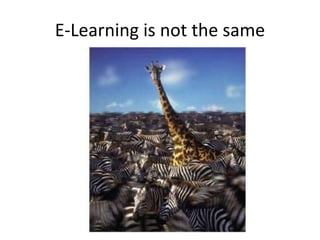
E-Learning is not the same
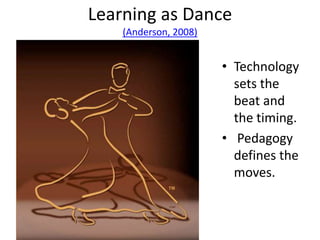
Learning as Dance
(Anderson, 2008)
‱ Technology
sets the
beat and
the timing.
‱ Pedagogy
defines the
moves.
Understanding Online Pedagogies and
Fitting them into our social boxes
Outline
‱ Different elearning , different pedagogies and
different technologies
‱ Generations of Online Education Pedagogy
‱ Social Forms to Match Pedagogies
‱ Beyond the LMS
– Athabasca Landing boutique social network
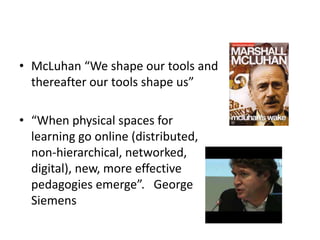
‱ McLuhan “We shape our tools and
thereafter our tools shape us”
‱ “When physical spaces for
learning go online (distributed,
non-hierarchical, networked,
digital), new, more effective
pedagogies emerge”. George
Siemens
Three Generations of
Online Learning Pedagogy
1. Behaviourist/Cognitive –
2. Social Constructivist –
3. Connectivist
Anderson, T., & Dron, J. (2011). Three generations of
distance education pedagogy.
IRRODL, 12(3), 80-97
1. Behavioural/Cognitive Pedagogies
‱ “tell ‘em what you’re
gonna tell ‘em,
‱ tell ‘em
‱ then tell ‘em what you
told ‘em”
Direct Instruction
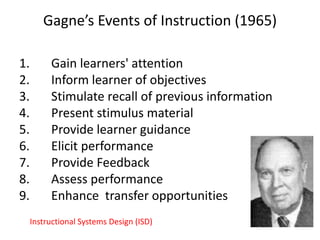
Gagne’s Events of Instruction (1965)
1. Gain learners' attention
2. Inform learner of objectives
3. Stimulate recall of previous information
4. Present stimulus material
5. Provide learner guidance
6. Elicit performance
7. Provide Feedback
8. Assess performance
9. Enhance transfer opportunities
Instructional Systems Design (ISD)
Enhanced by the “cognitive
revolution”
‱ Chunking
‱ Cognitive Load
‱ Working Memory
‱ Multiple Representations
‱ Split-attention effect
‱ Variability Effect
‱ Multi-media effect
– (Sorden, 2005)
“learning as acquiring and using conceptual and cognitive structures”
Greeno, Collins and Resnick, 1996
Technologies of Ist generation
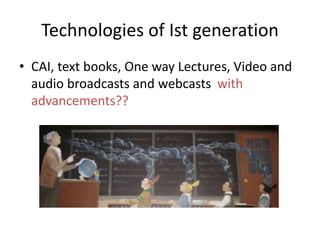
‱ CAI, text books, One way Lectures, Video and
audio broadcasts and webcasts with
advancements??
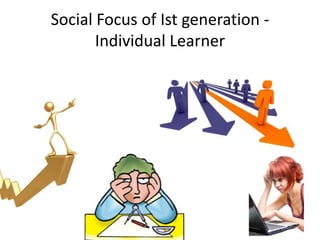
Social Focus of Ist generation -
Individual Learner
Learning Alone
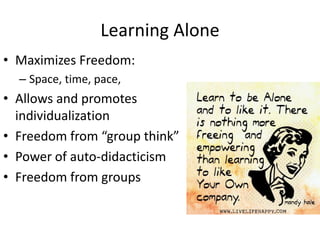
‱ Maximizes Freedom:
– Space, time, pace,
‱ Allows and promotes
individualization
‱ Freedom from “group think”
‱ Power of auto-didacticism
‱ Freedom from groups
Cognitive Behaviourist Ontology
‱ Knowledge is logically coherent, existing
independent of perspective
‱ Context free
‱ Capable of being transmitted
‱ Assumes closed systems with discoverable
relationships between inputs and outputs
Behavioural/Cognitive Developments
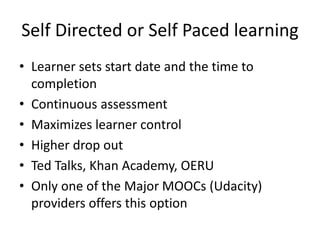
Self Directed or Self Paced learning
‱ Learner sets start date and the time to
completion
‱ Continuous assessment
‱ Maximizes learner control
‱ Higher drop out
‱ Ted Talks, Khan Academy, OERU
‱ Only one of the Major MOOCs (Udacity)
providers offers this option
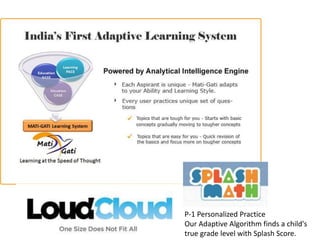
P-1 Personalized Practice
Our Adaptive Algorithm finds a child's
true grade level with Splash Score.
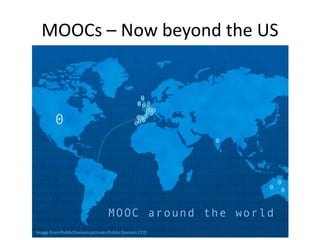
MOOCs – Now beyond the US
Everyone can own a MOOC
Open Educational Resources
Open Texts
Because it saves time!!!
Learning Analytics - Dashboard
Big Data &Education
1) Technology: maximizing computation power and
algorithmic accuracy to gather, analyze, link, and
compare large data sets.
2) Analysis: drawing on large data sets to identify
patterns in order to make economic, social, technical,
and legal claims and design interventions.
3) Mythology: the widespread belief that large data sets
offer a higher form of intelligence and knowledge that
can generate insights that were previously impossible,
with the aura of truth, objectivity, and accuracy.
Boyd, d. & Crawford, K. (2013). Critical Questions for Big Data: Provocations
for a Cultural, Technological, and Scholarly Phenomenon
Khan Academy Offers Student
Tracking/Analytics
New Forms of Accrediting
Challenge Exams for Credit
1st Generation,
Cognitive Behavioural Pedagogy
Summary
‱ Scalable
‱ Few requirements, or opportunities, for social
learning
‱ Works most efficiently with individual
learning models
‱ Effective and efficient for some types of
learning
‱ Have we really taught learners to succeed as
life long learners with this type of learning?
27
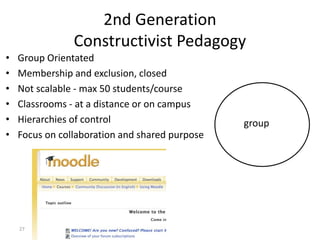
2nd Generation
Constructivist Pedagogy
‱ Group Orientated
‱ Membership and exclusion, closed
‱ Not scalable - max 50 students/course
‱ Classrooms - at a distance or on campus
‱ Hierarchies of control
‱ Focus on collaboration and shared purpose
group
Constructivist Knowledge is:
‱ Knowledge is constructed, not transmitted
‱ Arrived at through dialogic encounters
(Bakhtin,) - the presence of others adds
motivation, conflicting ideas, social validation
‱ Teacher as group facilitator
“Dialogic as an epistemological framework supports an account of
education as the discursive construction of shared knowledge”
Wegerif, R.
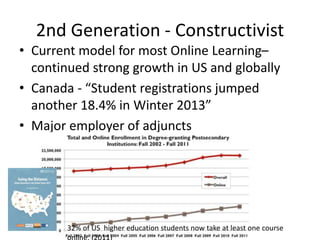
2nd Generation - Constructivist
‱ Current model for most Online Learning–
continued strong growth in US and globally
‱ Canada - “Student registrations jumped
another 18.4% in Winter 2013”
‱ Major employer of adjuncts
32% of US higher education students now take at least one course
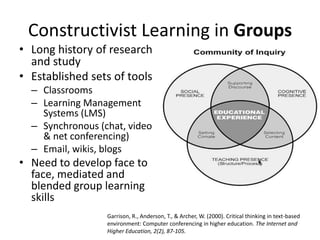
Constructivist Learning in Groups
‱ Long history of research
and study
‱ Established sets of tools
– Classrooms
– Learning Management
Systems (LMS)
– Synchronous (chat, video
& net conferencing)
– Email, wikis, blogs
‱ Need to develop face to
face, mediated and
blended group learning
skills
Garrison, R., Anderson, T., & Archer, W. (2000). Critical thinking in text-based
environment: Computer conferencing in higher education. The Internet and
Higher Education, 2(2), 87-105.
‱ Increase in learning outcomes, social skills,
positive attitudes to learning BUT
‱ “the need for cooperative teams to mature
implies that cooperative learning does not
yield an immediate improvement 
need for
patience and persistence
 students
experienced in cooperative learning”
Hsiung, C.-m. (2012). The Effectiveness of Cooperative Learning. Journal of Engineering
Education, 101(1), 119-137.
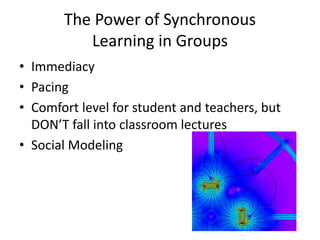
The Power of Synchronous
Learning in Groups
‱ Immediacy
‱ Pacing
‱ Comfort level for student and teachers, but
DON’T fall into classroom lectures
‱ Social Modeling
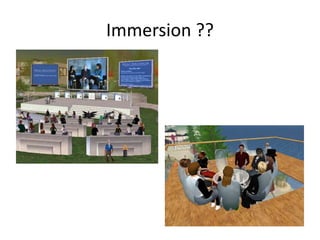
Immersion ??
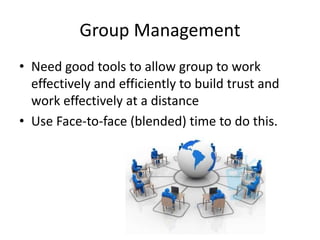
Group Management
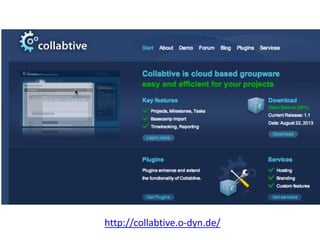
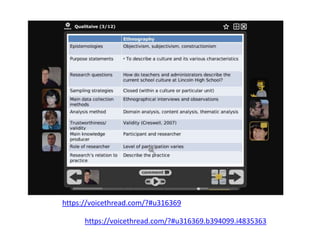
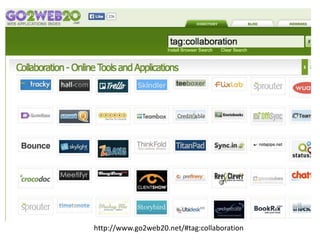
‱ Need good tools to allow group to work
effectively and efficiently to build trust and
work effectively at a distance
‱ Use Face-to-face (blended) time to do this.
http://www.collaborativelearning.org/scien
iology.html
http://collabtive.o-dyn.de/
https://voicethread.com/?#u316369
https://voicethread.com/?#u316369.b394099.i4835363
http://www.go2web20.net/#tag:collaboration
Flipped Classroom
Social Constructivist Social forms
‱ Group
‱ Limited in size
– Dunbar’s Max ~150 for a tribe
‱ Mutual awareness of each other
‱ Techer domination and dependency?
2nd Generation
Social Constructivist Pedagogy
Summary
‱ Not scalable, expensive in terms of time and
money
‱ New group tools enhance efficiency
‱ Helps teachers and learners transition to
online learning a transference from good
classroom teaching
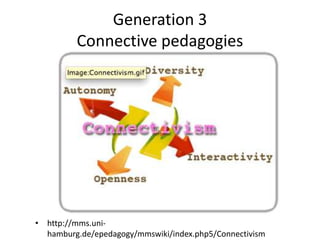
Generation 3
Connective pedagogies
‱ http://mms.uni-
hamburg.de/epedagogy/mmswiki/index.php5/Connectivism
3rd generation Connective
Pedagogies
‱ Heutagogy – Hase, S., & Kenyon, C. (2000).
From Andragogy to Heutagogy.
‱ Chaos Theory
‱ Activity Theory & Actor Network Theory (ANT)
– “systemic interactions of people and the objects
that they use in their interactions.”
Connectivism
‱ “connectivism is the thesis that knowledge is
distributed across a network of connections,
and therefore that learning consists of the
ability to construct and traverse those
networks.” Stephen Downes 2007
See special issue of
IRRODL.org
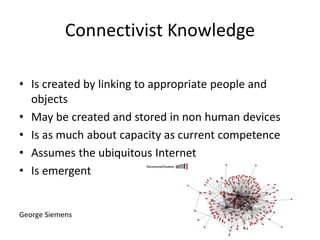
Connectivist Knowledge
‱ Is created by linking to appropriate people and
objects
‱ May be created and stored in non human devices
‱ Is as much about capacity as current competence
‱ Assumes the ubiquitous Internet
‱ Is emergent
George Siemens
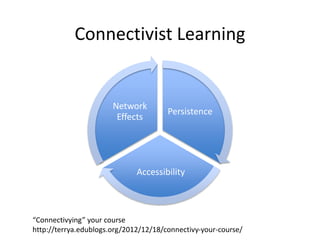
Connectivist Learning
Persistence
Accessibility
Network
Effects
“Connectivying” your course
http://terrya.edublogs.org/2012/12/18/connectivy-your-course/
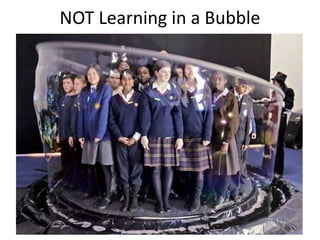
NOT Learning in a Bubble
Disruptions of Connectivism
‱ Demands net literacy and net
presence of students and
teachers
‱ Openness is scary
‱ New roles for teachers and
students
‱ Artifact ownership,
persistence and privacy
‱ Too manic for some
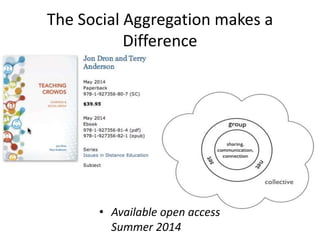
The Social Aggregation makes a
Difference
‱ Available open access
Summer 2014
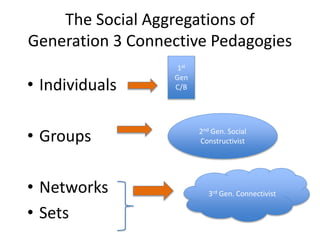
The Social Aggregations of
Generation 3 Connective Pedagogies
‱ Individuals
‱ Groups
‱ Networks
‱ Sets
3rd Gen. Connectivist
2nd Gen. Social
Constructivist
1st
Gen
C/B
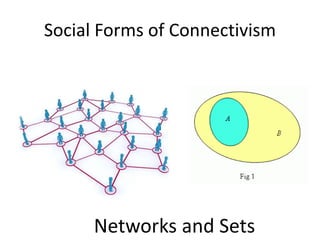
Social Forms of Connectivism
Networks and Sets
Social Networks
‱ Facebook, LinkedIn,
‱ Academia,
‱ Twitter
‱ Blogs
‱ Listservs
‱ Private
– NING
– ELGG
– Drupal,
– Word Press
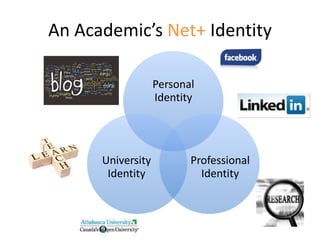
Personal
Identity
Professional
Identity
University
Identity
An Academic’s Net+ Identity
‱ “If Google cannot find a faculty scholar's work
or the work of the scholar's colleagues,
department, or institution, then it is
essentially irrelevant — even nonexistent —
because people will not find, read, apply, or
build on the work if they cannot locate it via a
quick Google searchLowenthal & Dunlap
(2012)
Lowenthal, P., & Dunlap, J. (2012). Intentional Web Presence: 10 SEO
Strategies Every Academic Needs to Know. Educause.
http://www.educause.edu/ero/article/intentional-web-presence-10-
seo-strategies-every-academic-needs-know.
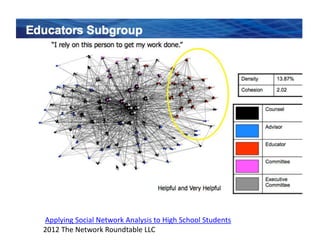
Applying Social Network Analysis to High School Students
2012 The Network Roundtable LLC
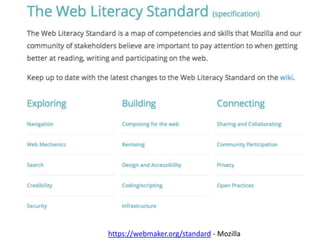
https://webmaker.org/standard - Mozilla
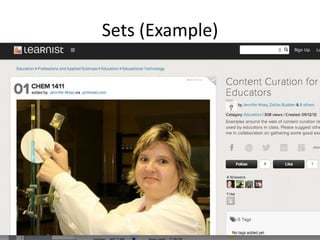
Sets
‱ Aggregation of all people/things sharing a
particular interest, commonality.
‱ Example: Set of all graduates of X, all
psychology resources
‱ Can be curated resources with social
involvement limited to votes, comments, links
‱ Sets MAY develop into networks or groups.
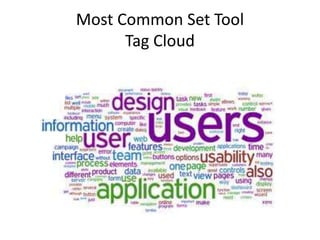
Most Common Set Tool
Tag Cloud
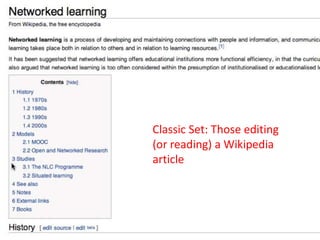
Classic Set: Those editing
(or reading) a Wikipedia
article
Sets Tools: Pintere.st
Sets (Example)
Connectivist Learning Summary
‱ Born on the Net
‱ Focuses on students being responsible for
their own learning and building their own
learning networks
‱ Is emergent and can be disruptive
‱ For advanced learners only??
Conclusion:
‱ the best part of Online Learning– is eclectic
allowing student exploration of their own
learning needs and gifts.
‱ Need to matching pedagogy, technology,
social forms and learning outcomes
‱ Empowerment, lifelong learning and smart
(not more) work for teachers
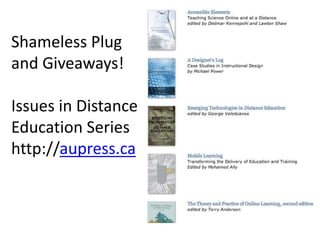
Shameless Plug
and Giveaways!
Issues in Distance
Education Series
http://aupress.ca
‱ Anderson, T. & Dron, J. (2011). Three generations of
distance education pedagogy. International Review of
Research on Distance and Open Learning, 12(3), 80-97.
http://www.irrodl.org/index.php/irrodl/article/view/890/1
826.
‱ Anderson, T. & Dron, J. (2012). Learning technology through
three generations of technology enhanced distance
education pedagogy. European Journal of Open, Distance
and E-Learning, 2012/2. Retrieved from
http://www.eurodl.org/?p=current&article=523.
‱ Dron, J. & Anderson, T. (in press). Teaching crowds: the role
of social media in distance learning Edmonton, Canada:
Athabasca University Press.
Terry Anderson terrya@athabascau.ca
Blog: terrya.edublogs.org
Your comments &
questions
most welcomed!
Slides available http://www.slideshare.net/terrya/edutec-2013-costa-rica
If Time Allows
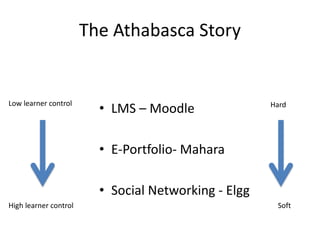
The Athabasca Story
‱ LMS – Moodle
‱ E-Portfolio- Mahara
‱ Social Networking - Elgg
Hard
Soft
Low learner control
High learner control
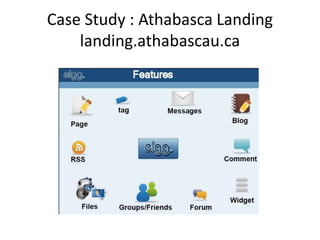
Case Study : Athabasca Landing
landing.athabascau.ca
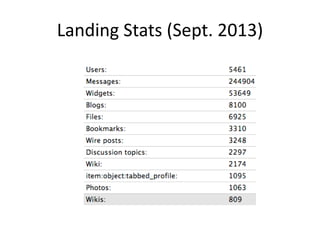
Landing Stats (Sept. 2013)
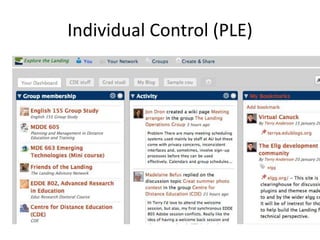
Individual Control (PLE)
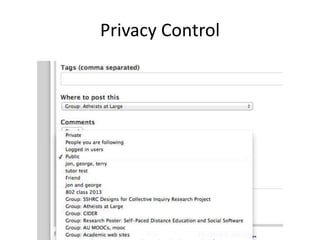
Privacy Control
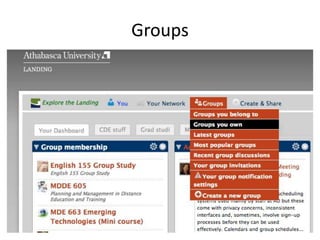
Groups
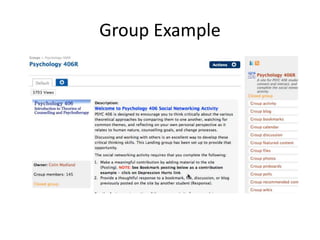
Group Example
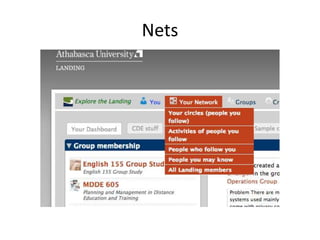
Nets
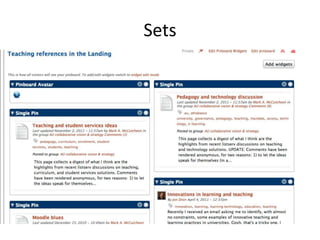
Sets
Student view
‱ "I have managed to gain more useful
knowledge through one course conducted
here on Landing than from all the others
combined. ”
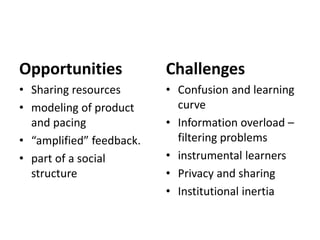
Opportunities
‱ Sharing resources
‱ modeling of product
and pacing
‱ “amplified” feedback.
‱ part of a social
structure
Challenges
‱ Confusion and learning
curve
‱ Information overload –
filtering problems
‱ instrumental learners
‱ Privacy and sharing
‱ Institutional inertia

Tru open learning 2014

  • 1.
    Learning Online: Aloneand in Nets, Sets and Groups Terry Anderson, Ph.D.
  • 2.
    Values ‱ We can(and must) continuously improve the quality, effectiveness, appeal, cost and time efficiency of the learning experience. ‱ Student control and freedom is integral to 21st century life-long education and learning. ‱ Continuing education opportunity is a basic human right.
  • 3.
  • 4.
    Learning as Dance (Anderson,2008) ‱ Technology sets the beat and the timing. ‱ Pedagogy defines the moves.
  • 5.
    Understanding Online Pedagogiesand Fitting them into our social boxes
  • 6.
    Outline ‱ Different elearning, different pedagogies and different technologies ‱ Generations of Online Education Pedagogy ‱ Social Forms to Match Pedagogies ‱ Beyond the LMS – Athabasca Landing boutique social network
  • 7.
    ‱ McLuhan “Weshape our tools and thereafter our tools shape us” ‱ “When physical spaces for learning go online (distributed, non-hierarchical, networked, digital), new, more effective pedagogies emerge”. George Siemens
  • 8.
    Three Generations of OnlineLearning Pedagogy 1. Behaviourist/Cognitive – 2. Social Constructivist – 3. Connectivist Anderson, T., & Dron, J. (2011). Three generations of distance education pedagogy. IRRODL, 12(3), 80-97
  • 9.
    1. Behavioural/Cognitive Pedagogies ‱“tell ‘em what you’re gonna tell ‘em, ‱ tell ‘em ‱ then tell ‘em what you told ‘em” Direct Instruction
  • 10.
    Gagne’s Events ofInstruction (1965) 1. Gain learners' attention 2. Inform learner of objectives 3. Stimulate recall of previous information 4. Present stimulus material 5. Provide learner guidance 6. Elicit performance 7. Provide Feedback 8. Assess performance 9. Enhance transfer opportunities Instructional Systems Design (ISD)
  • 11.
    Enhanced by the“cognitive revolution” ‱ Chunking ‱ Cognitive Load ‱ Working Memory ‱ Multiple Representations ‱ Split-attention effect ‱ Variability Effect ‱ Multi-media effect – (Sorden, 2005) “learning as acquiring and using conceptual and cognitive structures” Greeno, Collins and Resnick, 1996
  • 12.
    Technologies of Istgeneration ‱ CAI, text books, One way Lectures, Video and audio broadcasts and webcasts with advancements??
  • 13.
    Social Focus ofIst generation - Individual Learner
  • 14.
    Learning Alone ‱ MaximizesFreedom: – Space, time, pace, ‱ Allows and promotes individualization ‱ Freedom from “group think” ‱ Power of auto-didacticism ‱ Freedom from groups
  • 15.
    Cognitive Behaviourist Ontology ‱Knowledge is logically coherent, existing independent of perspective ‱ Context free ‱ Capable of being transmitted ‱ Assumes closed systems with discoverable relationships between inputs and outputs
  • 16.
  • 17.
    Self Directed orSelf Paced learning ‱ Learner sets start date and the time to completion ‱ Continuous assessment ‱ Maximizes learner control ‱ Higher drop out ‱ Ted Talks, Khan Academy, OERU ‱ Only one of the Major MOOCs (Udacity) providers offers this option
  • 18.
    P-1 Personalized Practice OurAdaptive Algorithm finds a child's true grade level with Splash Score.
  • 19.
    MOOCs – Nowbeyond the US
  • 20.
  • 21.
    Open Educational Resources OpenTexts Because it saves time!!!
  • 22.
  • 23.
    Big Data &Education 1)Technology: maximizing computation power and algorithmic accuracy to gather, analyze, link, and compare large data sets. 2) Analysis: drawing on large data sets to identify patterns in order to make economic, social, technical, and legal claims and design interventions. 3) Mythology: the widespread belief that large data sets offer a higher form of intelligence and knowledge that can generate insights that were previously impossible, with the aura of truth, objectivity, and accuracy. Boyd, d. & Crawford, K. (2013). Critical Questions for Big Data: Provocations for a Cultural, Technological, and Scholarly Phenomenon
  • 24.
    Khan Academy OffersStudent Tracking/Analytics
  • 25.
    New Forms ofAccrediting Challenge Exams for Credit
  • 26.
    1st Generation, Cognitive BehaviouralPedagogy Summary ‱ Scalable ‱ Few requirements, or opportunities, for social learning ‱ Works most efficiently with individual learning models ‱ Effective and efficient for some types of learning ‱ Have we really taught learners to succeed as life long learners with this type of learning?
  • 27.
    27 2nd Generation Constructivist Pedagogy ‱Group Orientated ‱ Membership and exclusion, closed ‱ Not scalable - max 50 students/course ‱ Classrooms - at a distance or on campus ‱ Hierarchies of control ‱ Focus on collaboration and shared purpose group
  • 28.
    Constructivist Knowledge is: ‱Knowledge is constructed, not transmitted ‱ Arrived at through dialogic encounters (Bakhtin,) - the presence of others adds motivation, conflicting ideas, social validation ‱ Teacher as group facilitator “Dialogic as an epistemological framework supports an account of education as the discursive construction of shared knowledge” Wegerif, R.
  • 29.
    2nd Generation -Constructivist ‱ Current model for most Online Learning– continued strong growth in US and globally ‱ Canada - “Student registrations jumped another 18.4% in Winter 2013” ‱ Major employer of adjuncts 32% of US higher education students now take at least one course
  • 30.
    Constructivist Learning inGroups ‱ Long history of research and study ‱ Established sets of tools – Classrooms – Learning Management Systems (LMS) – Synchronous (chat, video & net conferencing) – Email, wikis, blogs ‱ Need to develop face to face, mediated and blended group learning skills Garrison, R., Anderson, T., & Archer, W. (2000). Critical thinking in text-based environment: Computer conferencing in higher education. The Internet and Higher Education, 2(2), 87-105.
  • 31.
    ‱ Increase inlearning outcomes, social skills, positive attitudes to learning BUT ‱ “the need for cooperative teams to mature implies that cooperative learning does not yield an immediate improvement 
need for patience and persistence
 students experienced in cooperative learning” Hsiung, C.-m. (2012). The Effectiveness of Cooperative Learning. Journal of Engineering Education, 101(1), 119-137.
  • 32.
    The Power ofSynchronous Learning in Groups ‱ Immediacy ‱ Pacing ‱ Comfort level for student and teachers, but DON’T fall into classroom lectures ‱ Social Modeling
  • 33.
  • 34.
    Group Management ‱ Needgood tools to allow group to work effectively and efficiently to build trust and work effectively at a distance ‱ Use Face-to-face (blended) time to do this.
  • 35.
  • 36.
  • 37.
  • 38.
  • 39.
  • 40.
    Social Constructivist Socialforms ‱ Group ‱ Limited in size – Dunbar’s Max ~150 for a tribe ‱ Mutual awareness of each other ‱ Techer domination and dependency?
  • 41.
    2nd Generation Social ConstructivistPedagogy Summary ‱ Not scalable, expensive in terms of time and money ‱ New group tools enhance efficiency ‱ Helps teachers and learners transition to online learning a transference from good classroom teaching
  • 42.
    Generation 3 Connective pedagogies ‱http://mms.uni- hamburg.de/epedagogy/mmswiki/index.php5/Connectivism
  • 43.
    3rd generation Connective Pedagogies ‱Heutagogy – Hase, S., & Kenyon, C. (2000). From Andragogy to Heutagogy. ‱ Chaos Theory ‱ Activity Theory & Actor Network Theory (ANT) – “systemic interactions of people and the objects that they use in their interactions.”
  • 44.
    Connectivism ‱ “connectivism isthe thesis that knowledge is distributed across a network of connections, and therefore that learning consists of the ability to construct and traverse those networks.” Stephen Downes 2007 See special issue of IRRODL.org
  • 45.
    Connectivist Knowledge ‱ Iscreated by linking to appropriate people and objects ‱ May be created and stored in non human devices ‱ Is as much about capacity as current competence ‱ Assumes the ubiquitous Internet ‱ Is emergent George Siemens
  • 46.
    Connectivist Learning Persistence Accessibility Network Effects “Connectivying” yourcourse http://terrya.edublogs.org/2012/12/18/connectivy-your-course/
  • 47.
  • 48.
    Disruptions of Connectivism ‱Demands net literacy and net presence of students and teachers ‱ Openness is scary ‱ New roles for teachers and students ‱ Artifact ownership, persistence and privacy ‱ Too manic for some
  • 49.
    The Social Aggregationmakes a Difference ‱ Available open access Summer 2014
  • 50.
    The Social Aggregationsof Generation 3 Connective Pedagogies ‱ Individuals ‱ Groups ‱ Networks ‱ Sets 3rd Gen. Connectivist 2nd Gen. Social Constructivist 1st Gen C/B
  • 51.
    Social Forms ofConnectivism Networks and Sets
  • 52.
    Social Networks ‱ Facebook,LinkedIn, ‱ Academia, ‱ Twitter ‱ Blogs ‱ Listservs ‱ Private – NING – ELGG – Drupal, – Word Press
  • 53.
  • 54.
    ‱ “If Googlecannot find a faculty scholar's work or the work of the scholar's colleagues, department, or institution, then it is essentially irrelevant — even nonexistent — because people will not find, read, apply, or build on the work if they cannot locate it via a quick Google searchLowenthal & Dunlap (2012) Lowenthal, P., & Dunlap, J. (2012). Intentional Web Presence: 10 SEO Strategies Every Academic Needs to Know. Educause. http://www.educause.edu/ero/article/intentional-web-presence-10- seo-strategies-every-academic-needs-know.
  • 55.
    Applying Social NetworkAnalysis to High School Students 2012 The Network Roundtable LLC
  • 56.
  • 57.
    Sets ‱ Aggregation ofall people/things sharing a particular interest, commonality. ‱ Example: Set of all graduates of X, all psychology resources ‱ Can be curated resources with social involvement limited to votes, comments, links ‱ Sets MAY develop into networks or groups.
  • 58.
    Most Common SetTool Tag Cloud
  • 59.
    Classic Set: Thoseediting (or reading) a Wikipedia article
  • 60.
  • 61.
  • 62.
    Connectivist Learning Summary ‱Born on the Net ‱ Focuses on students being responsible for their own learning and building their own learning networks ‱ Is emergent and can be disruptive ‱ For advanced learners only??
  • 63.
    Conclusion: ‱ the bestpart of Online Learning– is eclectic allowing student exploration of their own learning needs and gifts. ‱ Need to matching pedagogy, technology, social forms and learning outcomes ‱ Empowerment, lifelong learning and smart (not more) work for teachers
  • 64.
    Shameless Plug and Giveaways! Issuesin Distance Education Series http://aupress.ca
  • 65.
    ‱ Anderson, T.& Dron, J. (2011). Three generations of distance education pedagogy. International Review of Research on Distance and Open Learning, 12(3), 80-97. http://www.irrodl.org/index.php/irrodl/article/view/890/1 826. ‱ Anderson, T. & Dron, J. (2012). Learning technology through three generations of technology enhanced distance education pedagogy. European Journal of Open, Distance and E-Learning, 2012/2. Retrieved from http://www.eurodl.org/?p=current&article=523. ‱ Dron, J. & Anderson, T. (in press). Teaching crowds: the role of social media in distance learning Edmonton, Canada: Athabasca University Press.
  • 66.
    Terry Anderson terrya@athabascau.ca Blog:terrya.edublogs.org Your comments & questions most welcomed! Slides available http://www.slideshare.net/terrya/edutec-2013-costa-rica
  • 67.
  • 68.
    The Athabasca Story ‱LMS – Moodle ‱ E-Portfolio- Mahara ‱ Social Networking - Elgg Hard Soft Low learner control High learner control
  • 69.
    Case Study :Athabasca Landing landing.athabascau.ca
  • 70.
  • 71.
  • 72.
  • 73.
  • 74.
  • 75.
  • 76.
  • 77.
    Student view ‱ "Ihave managed to gain more useful knowledge through one course conducted here on Landing than from all the others combined. ”
  • 78.
    Opportunities ‱ Sharing resources ‱modeling of product and pacing ‱ “amplified” feedback. ‱ part of a social structure Challenges ‱ Confusion and learning curve ‱ Information overload – filtering problems ‱ instrumental learners ‱ Privacy and sharing ‱ Institutional inertia