Learning in 3rd space
Prof. II Reijo Kupiainen

http://www.slideshare.net/rkupiainen
See: http://bit.ly/1eO9ExX!
Third space
The idea of third space comes from hybridity theory
(Homi Bhabha), which refers to to mixture, posits that
people draw on multiple resources or funds to make a
sense of the world and constitute their identity.
Originally hybridity is a cross between two separate
cultures: not diversity but hybridity
Cultural hybridity is a in-between place, which brings
together contradictory knowledges, practices, and
discourses: signs can be appropriated, translated,
rehistoricized, and read anew (c.f. remixing culture)
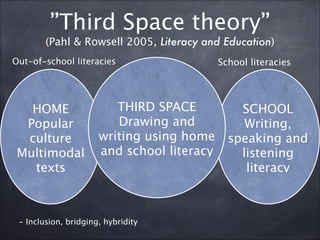
”Third Space theory”

(Pahl & Rowsell 2005, Literacy and Education)
HOME
Popular

culture

Multimodal

texts
SCHOOL
Writing,

speaking and

listening

literacy

THIRD SPACE
Drawing and

writing using home

and school literacy
Out-of-school literacies School literacies
- Inclusion, bridging, hybridity
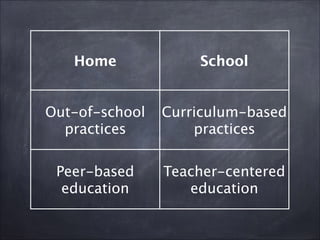
Home School
Out-of-school
practices
Curriculum-based
practices
Peer-based
education
Teacher-centered
education
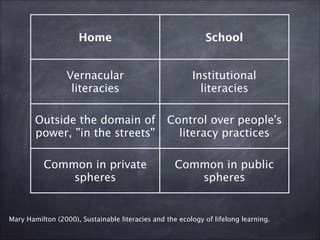
Home School
Vernacular

literacies
Institutional

literacies
Outside the domain of
power, ”in the streets”
Control over people’s
literacy practices
Common in private
spheres
Common in public
spheres
Mary Hamilton (2000), Sustainable literacies and the ecology of lifelong learning.

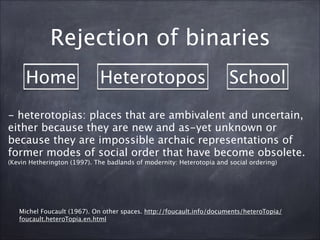
Home Heterotopos School
Rejection of binaries
Michel Foucault (1967). On other spaces. http://foucault.info/documents/heteroTopia/
foucault.heteroTopia.en.html
- heterotopias: places that are ambivalent and uncertain,
either because they are new and as-yet unknown or
because they are impossible archaic representations of
former modes of social order that have become obsolete.
(Kevin Hetherington (1997). The badlands of modernity: Heterotopia and social ordering)
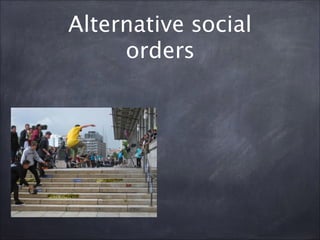
Alternative social
orders
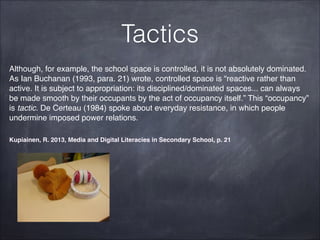
Tactics
Although, for example, the school space is controlled, it is not absolutely dominated.
As Ian Buchanan (1993, para. 21) wrote, controlled space is “reactive rather than
active. It is subject to appropriation: its disciplined/dominated spaces... can always
be made smooth by their occupants by the act of occupancy itself.” This “occupancy”
is tactic. De Certeau (1984) spoke about everyday resistance, in which people
undermine imposed power relations.!
Kupiainen, R. 2013, Media and Digital Literacies in Secondary School, p. 21
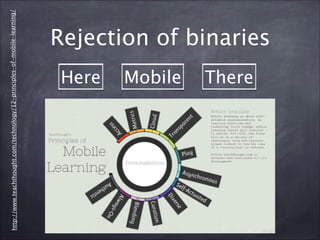
Rejection of binaries
Here Mobile There
http://www.teachthought.com/technology/12-principles-of-mobile-learning/
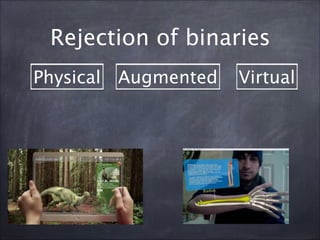
Rejection of binaries
Physical Augmented Virtual
Rejection of binaries
Private Networked
publics
Public
- Networked publics are spaces that are constructed
through networked technologies and collective spaces
that emerge from the intersection of people,
technology, and practice (danah boyd (2011). Social network sites as
networked publics: Affordances, dynamics, and implications. In Z. Papacharissi, (Ed.) A
Networked self: Identity, community, and culture on social network sites)
Third-space learning
Creating new learning spaces in education
Learning in hybrid, networked, bridged
(between lifeworld and schooling), dynamic,
multimodal, and open time-space.
”Learning in the context of everyday
experiences of participation in the world”
Problems
”Knowmad society” (knowledge + nomad)
(Besselink, de Bree, Cobo, Hart et al., Knowmad Society)
Connected with everybody, everywhere,
anytime
Lifelong learning = ”life imprisonment
learning”
Flexible workers in the new economy
Technological determinism
Links
Sugata Mitra

http://www.ted.com/talks/sugata_mitra_build_a_school_in_the_cloud.html
12 Principles on mobile learning

http://www.teachthought.com/technology/12-principles-of-mobile-
learning/
Google Goggles

http://www.youtube.com/watch?v=Hhgfz0zPmH4
QR codes at school

http://www.youtube.com/watch?v=ayW032sKtj8
Pinterest: http://pinterest.com/rkupiainen/
Scoop: http://www.scoop.it/u/reijo-kupiainen
Thank you!
reijo.p.kupiainen@svt.ntnu.no

Learning in Third Space

  • 1.
    Learning in 3rdspace Prof. II Reijo Kupiainen
 http://www.slideshare.net/rkupiainen See: http://bit.ly/1eO9ExX!
  • 2.
    Third space The ideaof third space comes from hybridity theory (Homi Bhabha), which refers to to mixture, posits that people draw on multiple resources or funds to make a sense of the world and constitute their identity. Originally hybridity is a cross between two separate cultures: not diversity but hybridity Cultural hybridity is a in-between place, which brings together contradictory knowledges, practices, and discourses: signs can be appropriated, translated, rehistoricized, and read anew (c.f. remixing culture)
  • 3.
    ”Third Space theory”
 (Pahl& Rowsell 2005, Literacy and Education) HOME Popular
 culture
 Multimodal
 texts SCHOOL Writing,
 speaking and
 listening
 literacy
 THIRD SPACE Drawing and
 writing using home
 and school literacy Out-of-school literacies School literacies - Inclusion, bridging, hybridity
  • 4.
  • 5.
    Home School Vernacular
 literacies Institutional
 literacies Outside thedomain of power, ”in the streets” Control over people’s literacy practices Common in private spheres Common in public spheres Mary Hamilton (2000), Sustainable literacies and the ecology of lifelong learning.

  • 6.
    Home Heterotopos School Rejectionof binaries Michel Foucault (1967). On other spaces. http://foucault.info/documents/heteroTopia/ foucault.heteroTopia.en.html - heterotopias: places that are ambivalent and uncertain, either because they are new and as-yet unknown or because they are impossible archaic representations of former modes of social order that have become obsolete. (Kevin Hetherington (1997). The badlands of modernity: Heterotopia and social ordering)
  • 7.
  • 8.
    Tactics Although, for example,the school space is controlled, it is not absolutely dominated. As Ian Buchanan (1993, para. 21) wrote, controlled space is “reactive rather than active. It is subject to appropriation: its disciplined/dominated spaces... can always be made smooth by their occupants by the act of occupancy itself.” This “occupancy” is tactic. De Certeau (1984) spoke about everyday resistance, in which people undermine imposed power relations.! Kupiainen, R. 2013, Media and Digital Literacies in Secondary School, p. 21
  • 9.
    Rejection of binaries HereMobile There http://www.teachthought.com/technology/12-principles-of-mobile-learning/
  • 10.
  • 11.
    Rejection of binaries PrivateNetworked publics Public - Networked publics are spaces that are constructed through networked technologies and collective spaces that emerge from the intersection of people, technology, and practice (danah boyd (2011). Social network sites as networked publics: Affordances, dynamics, and implications. In Z. Papacharissi, (Ed.) A Networked self: Identity, community, and culture on social network sites)
  • 12.
    Third-space learning Creating newlearning spaces in education Learning in hybrid, networked, bridged (between lifeworld and schooling), dynamic, multimodal, and open time-space. ”Learning in the context of everyday experiences of participation in the world”
  • 13.
    Problems ”Knowmad society” (knowledge+ nomad) (Besselink, de Bree, Cobo, Hart et al., Knowmad Society) Connected with everybody, everywhere, anytime Lifelong learning = ”life imprisonment learning” Flexible workers in the new economy Technological determinism
  • 14.
    Links Sugata Mitra
 http://www.ted.com/talks/sugata_mitra_build_a_school_in_the_cloud.html 12 Principleson mobile learning
 http://www.teachthought.com/technology/12-principles-of-mobile- learning/ Google Goggles
 http://www.youtube.com/watch?v=Hhgfz0zPmH4 QR codes at school
 http://www.youtube.com/watch?v=ayW032sKtj8 Pinterest: http://pinterest.com/rkupiainen/ Scoop: http://www.scoop.it/u/reijo-kupiainen
  • 15.