Trihalomethanes
(THMs)
BAGHDAD UNIVERSITY
SANITARY ENGINEERING DEPARTMENT
M.SC. STUDENT : MARWA MOHAMMED
 the process of adding chlorine (Cl
2) or hypochlorite to water. This method
is used to kill certain bacteria and other
microbes in tap water as chlorine is
highly toxic. In particular, chlorination
is used to prevent the spread
of waterborne diseases such
as cholera, dysentery, and typhoid.
Chlorination
Chlorination
1- The process is economical and cheap .
2- It is harmless to human beings
.
3- It is reliable and effective .
4- Residual chlorine can be maintained in the water.
5- Easy to apply and ease to measure .
Disadvantages of Chlorination
* Formation of Trihalomethanes (THMs) , such
as carcinogen chloroform (CHCL3) .
* To avoid the formation of THMs , water
should be removed of organic impurities as
much as possible before chlorination .
Percolate
A perchlorate is the name for a chemical compound
containing the perchlorate ion, ClO−The preponderance
of perchlorates are produced commercially
Perchlorate salts are mainly used for propellants,
exploiting properties as powerful oxidizing agents.
Perchlorate contamination in the environment has been
extensively studied as it has effects on human health.
Perchlorate has been linked to its negative influence on
the thyroid gland
Most perchlorates are colorless solids that are soluble
in water. Four perchlorates are of primary
commercial interest: ammonium perchlorate
(NH4ClO4), perchloric acid (HClO4), potassium
perchlorate (KClO4), and sodium perchlorate
(NaClO4). Perchlorate is the anion resulting from the
dissociation of perchloric acid and its salts upon their
dissolution in water. Many perchlorate salts are
soluble in non-aqueous solutions.
The THMs forming
When chlorine is added to water with organic
material, such as algae, river weeds, and decaying
leaves, THMs are formed. Residual chlorine
molecules react with this harmless organic material
to form a group of chlorinated chemical compounds,
THMs. They are tasteless and odorless, but harmful
and potentially toxic. The quantity of byproducts
formed is determined by several factors, such as the
amount and type of organic material present in
water, temperature, pH, chlorine dosage, contact
time available for chlorine, and bromide
concentration in the water.
The THMs forming
The organic matter in water mainly
consists of
1- humic substance, which is
the organic portion of soil
that remains after prolonged
microbial decomposition
formed by the decay of
leaves, wood, and other
vegetable matter
2- fulvic acid, which is a water
soluble substance of low
molecular weight that is
derived from humus .
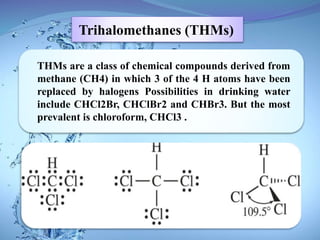
Trihalomethanes (THMs)
THMs are a class of chemical compounds derived from
methane (CH4) in which 3 of the 4 H atoms have been
replaced by halogens Possibilities in drinking water
include CHCl2Br, CHClBr2 and CHBr3. But the most
prevalent is chloroform, CHCl3 .
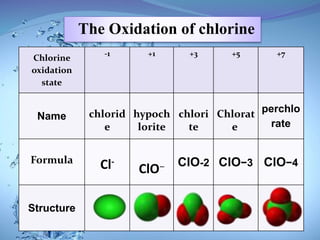
The Oxidation of chlorine
+7+5+3+1-1
Chlorine
oxidation
state
perchlo
rate
Chlorat
e
chlori
te
hypoch
lorite
chlorid
e
Name
ClO−4ClO−3ClO-2
ClO−Cl-Formula
Structure
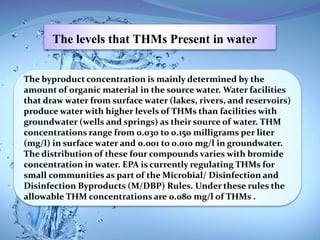
The byproduct concentration is mainly determined by the
amount of organic material in the source water. Water facilities
that draw water from surface water (lakes, rivers, and reservoirs)
produce water with higher levels of THMs than facilities with
groundwater (wells and springs) as their source of water. THM
concentrations range from 0.030 to 0.150 milligrams per liter
(mg/l) in surface water and 0.001 to 0.010 mg/l in groundwater.
The distribution of these four compounds varies with bromide
concentration in water. EPA is currently regulating THMs for
small communities as part of the Microbial/ Disinfection and
Disinfection Byproducts (M/DBP) Rules. Under these rules the
allowable THM concentrations are 0.080 mg/l of THMs .
The levels that THMs Present in water
exposure to THMs may pose an increased risk of cancer.
Two THMs, chloroform and dibromochloromethane, are
carcinogens; and another THM, bromodichloromethane,
has been identified as a mutagen, which alters DNA.
Mutagens are considered to affect the genetics of future
generations in addition to being carcinogenic. THMs may
be responsible for reproductive problems and miscarriage.
some study found a miscarriage rate of 15.7 percent for
women who drank five or more glasses of cold water
containing more than 0.075 mg/l THM, compared to a
miscarriage rate of 9.5 percent for women with low THM
exposure. In addition to these risks, THMs are linked to
bladder cancer, heart, lungs, kidney, liver, and central
nervous system damage .
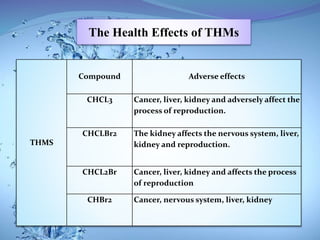
The Health Effects of THMs
THMS
Compound Adverse effects
CHCL3 Cancer, liver, kidney and adversely affect the
process of reproduction.
CHCLBr2 The kidney affects the nervous system, liver,
kidney and reproduction.
CHCL2Br Cancer, liver, kidney and affects the process
of reproduction
CHBr2 Cancer, nervous system, liver, kidney
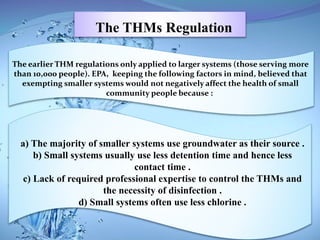
The earlier THM regulations only applied to larger systems (those serving more
than 10,000 people). EPA, keeping the following factors in mind, believed that
exempting smaller systems would not negatively affect the health of small
community people because :
The THMs Regulation
a) The majority of smaller systems use groundwater as their source .
b) Small systems usually use less detention time and hence less
contact time .
c) Lack of required professional expertise to control the THMs and
the necessity of disinfection .
d) Small systems often use less chlorine .
Cleanup
There have been many attempts to eliminate
perchlorate contamination. Current
remediation technologies for perchlorate
have negative downsides of high costs and
difficulty in operation. Thus, there have
been interests in developing systems that
would offer economic and green alternatives.
Drinking water systems can reduce THM formation in
several ways. How to best treat and dispose of the
residual waste materials that result from wastewater
treatment processes (sewage sludge and domestic
septage, for example) is a hot topic in many small
communities. By managing these wastes as biosolids
in accordance with federal, state, and local
regulations, communities often can cost-effectively
recycle and beneficially apply these wastes to improve
soils or to rehabilitate land damaged by mining or
other industries
The THMs Reducing systems
Recommendations No.1
a) Reduce the organic material before hlorinating the water.
Treatment techniques, such as coagulation, sedimentation,
and filtration can remove most of the organic materials.
However, activated carbon can be used to remove greater
amounts of organic material than can be removed by other
techniques.
b) Optimize chlorine usage.
c) Change the point of chlorine addition in the treatment
series. If the point of chlorine addition is moved to a location
after sedimentation or filtration, THM production can be
reduced as these processes remove parts of the organic matter.
Recommendations No.2
d) Use alternative disinfection methods. Using a mixture
of chlorine and ammonia (chloramine) reduces THM
formation. Chloramine also disinfects, but doesn’t form
THMs. Ozone can be used along with chlorine and
chloramine. Chlorine dioxide is another alternative. The
combination of disinfectants not only reduces the
formation of THMs, but also maintains the residual
concentration in the distribution system. But changing
the disinfectant may alter the whole treatment process
and might affect the removal of other contaminants.
e) Other methods: These include filtration, aeration,
boiling, distillation, commercial home treatment systems
or filters, nanofiltration, activated . carbon filtering, or
leaving tap water standing in a pitcher in the fridge
overnight.
THANK YOU FOR LISTENING

Trihalomethanes THMS

  • 1.
    Trihalomethanes (THMs) BAGHDAD UNIVERSITY SANITARY ENGINEERINGDEPARTMENT M.SC. STUDENT : MARWA MOHAMMED
  • 2.
     the processof adding chlorine (Cl 2) or hypochlorite to water. This method is used to kill certain bacteria and other microbes in tap water as chlorine is highly toxic. In particular, chlorination is used to prevent the spread of waterborne diseases such as cholera, dysentery, and typhoid. Chlorination
  • 3.
    Chlorination 1- The processis economical and cheap . 2- It is harmless to human beings . 3- It is reliable and effective . 4- Residual chlorine can be maintained in the water. 5- Easy to apply and ease to measure .
  • 4.
    Disadvantages of Chlorination *Formation of Trihalomethanes (THMs) , such as carcinogen chloroform (CHCL3) . * To avoid the formation of THMs , water should be removed of organic impurities as much as possible before chlorination .
  • 5.
    Percolate A perchlorate isthe name for a chemical compound containing the perchlorate ion, ClO−The preponderance of perchlorates are produced commercially Perchlorate salts are mainly used for propellants, exploiting properties as powerful oxidizing agents. Perchlorate contamination in the environment has been extensively studied as it has effects on human health. Perchlorate has been linked to its negative influence on the thyroid gland
  • 6.
    Most perchlorates arecolorless solids that are soluble in water. Four perchlorates are of primary commercial interest: ammonium perchlorate (NH4ClO4), perchloric acid (HClO4), potassium perchlorate (KClO4), and sodium perchlorate (NaClO4). Perchlorate is the anion resulting from the dissociation of perchloric acid and its salts upon their dissolution in water. Many perchlorate salts are soluble in non-aqueous solutions.
  • 7.
    The THMs forming Whenchlorine is added to water with organic material, such as algae, river weeds, and decaying leaves, THMs are formed. Residual chlorine molecules react with this harmless organic material to form a group of chlorinated chemical compounds, THMs. They are tasteless and odorless, but harmful and potentially toxic. The quantity of byproducts formed is determined by several factors, such as the amount and type of organic material present in water, temperature, pH, chlorine dosage, contact time available for chlorine, and bromide concentration in the water.
  • 8.
  • 9.
    The organic matterin water mainly consists of 1- humic substance, which is the organic portion of soil that remains after prolonged microbial decomposition formed by the decay of leaves, wood, and other vegetable matter 2- fulvic acid, which is a water soluble substance of low molecular weight that is derived from humus .
  • 10.
    Trihalomethanes (THMs) THMs area class of chemical compounds derived from methane (CH4) in which 3 of the 4 H atoms have been replaced by halogens Possibilities in drinking water include CHCl2Br, CHClBr2 and CHBr3. But the most prevalent is chloroform, CHCl3 .
  • 11.
    The Oxidation ofchlorine +7+5+3+1-1 Chlorine oxidation state perchlo rate Chlorat e chlori te hypoch lorite chlorid e Name ClO−4ClO−3ClO-2 ClO−Cl-Formula Structure
  • 12.
    The byproduct concentrationis mainly determined by the amount of organic material in the source water. Water facilities that draw water from surface water (lakes, rivers, and reservoirs) produce water with higher levels of THMs than facilities with groundwater (wells and springs) as their source of water. THM concentrations range from 0.030 to 0.150 milligrams per liter (mg/l) in surface water and 0.001 to 0.010 mg/l in groundwater. The distribution of these four compounds varies with bromide concentration in water. EPA is currently regulating THMs for small communities as part of the Microbial/ Disinfection and Disinfection Byproducts (M/DBP) Rules. Under these rules the allowable THM concentrations are 0.080 mg/l of THMs . The levels that THMs Present in water
  • 13.
    exposure to THMsmay pose an increased risk of cancer. Two THMs, chloroform and dibromochloromethane, are carcinogens; and another THM, bromodichloromethane, has been identified as a mutagen, which alters DNA. Mutagens are considered to affect the genetics of future generations in addition to being carcinogenic. THMs may be responsible for reproductive problems and miscarriage. some study found a miscarriage rate of 15.7 percent for women who drank five or more glasses of cold water containing more than 0.075 mg/l THM, compared to a miscarriage rate of 9.5 percent for women with low THM exposure. In addition to these risks, THMs are linked to bladder cancer, heart, lungs, kidney, liver, and central nervous system damage . The Health Effects of THMs
  • 14.
    The Health Effectsof THMs THMS Compound Adverse effects CHCL3 Cancer, liver, kidney and adversely affect the process of reproduction. CHCLBr2 The kidney affects the nervous system, liver, kidney and reproduction. CHCL2Br Cancer, liver, kidney and affects the process of reproduction CHBr2 Cancer, nervous system, liver, kidney
  • 15.
    The earlier THMregulations only applied to larger systems (those serving more than 10,000 people). EPA, keeping the following factors in mind, believed that exempting smaller systems would not negatively affect the health of small community people because : The THMs Regulation a) The majority of smaller systems use groundwater as their source . b) Small systems usually use less detention time and hence less contact time . c) Lack of required professional expertise to control the THMs and the necessity of disinfection . d) Small systems often use less chlorine .
  • 16.
    Cleanup There have beenmany attempts to eliminate perchlorate contamination. Current remediation technologies for perchlorate have negative downsides of high costs and difficulty in operation. Thus, there have been interests in developing systems that would offer economic and green alternatives.
  • 17.
    Drinking water systemscan reduce THM formation in several ways. How to best treat and dispose of the residual waste materials that result from wastewater treatment processes (sewage sludge and domestic septage, for example) is a hot topic in many small communities. By managing these wastes as biosolids in accordance with federal, state, and local regulations, communities often can cost-effectively recycle and beneficially apply these wastes to improve soils or to rehabilitate land damaged by mining or other industries The THMs Reducing systems
  • 18.
    Recommendations No.1 a) Reducethe organic material before hlorinating the water. Treatment techniques, such as coagulation, sedimentation, and filtration can remove most of the organic materials. However, activated carbon can be used to remove greater amounts of organic material than can be removed by other techniques. b) Optimize chlorine usage. c) Change the point of chlorine addition in the treatment series. If the point of chlorine addition is moved to a location after sedimentation or filtration, THM production can be reduced as these processes remove parts of the organic matter.
  • 19.
    Recommendations No.2 d) Usealternative disinfection methods. Using a mixture of chlorine and ammonia (chloramine) reduces THM formation. Chloramine also disinfects, but doesn’t form THMs. Ozone can be used along with chlorine and chloramine. Chlorine dioxide is another alternative. The combination of disinfectants not only reduces the formation of THMs, but also maintains the residual concentration in the distribution system. But changing the disinfectant may alter the whole treatment process and might affect the removal of other contaminants. e) Other methods: These include filtration, aeration, boiling, distillation, commercial home treatment systems or filters, nanofiltration, activated . carbon filtering, or leaving tap water standing in a pitcher in the fridge overnight.
  • 20.
    THANK YOU FORLISTENING