25 solved   Trigonometric Problems Law of Sine Law of Cosines Law of Tangents Graphs of Sine and Cosine Graphs of Other Functions Pampanga Agricultural College Magalang, Pampanga, Philippines
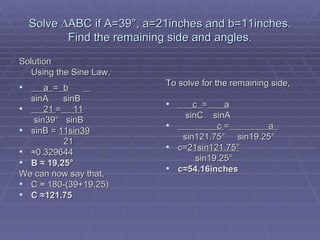
Solve  ∆ABC if A=39°, a=21inches and b=11inches. Find the remaining side and angles. Solution Using the Sine Law, a  =   b   sinA  sinB 21  =   11 sin39 °  sinB sinB =  11sin39   21 ≈ 0.329644 B ≈ 19,25° We can now say that, C ≈ 180-(39+19.25) C ≈121.75 To solve for the remaining side, c  =   a sinC  sinA c  =   a  sin121.75 °   sin19.25 ° c= 21sin121.75° sin19.25° c≈54.16inches
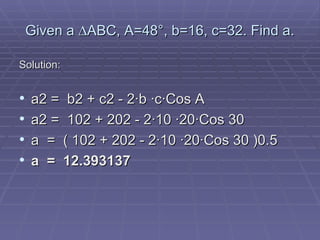
Given a  ∆ABC, A=48°, b=16, c=32. Find a. Solution: a2 =  b2 + c2 - 2·b ·c·Cos A   a2 =  102 + 202 - 2·10 ·20·Cos 30 a  =  ( 102 + 202 - 2·10 ·20·Cos 30 )0.5 a  =  12.393137      
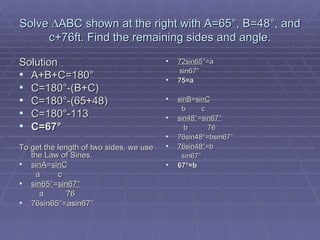
Solve  ∆ABC shown at the right with A=65°, B=48°, and c+76ft. Find the remaining sides and angle. Solution A+B+C=180 ° C=180°-(B+C) C=180°-(65+48) C=180°-113 C=67° To get the length of two sides, we use the Law of Sines. sinA = sinC     a  c sin65 ° = sin67° a  76 76sin65 °=asin67° 72sin65 °=a sin67° 75=a sinB = sinC   b  c sin48° = sin67°   b   76 76sin48°=bsin67° 76sin48° =b sin67° 67°=b
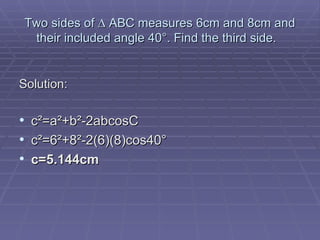
Two sides of  ∆ ABC measures 6cm and 8cm and their included angle 40°. Find the third side.  Solution: c ²=a²+b²-2abcosC c²=6²+8²-2(6)(8)cos40° c=5.144cm
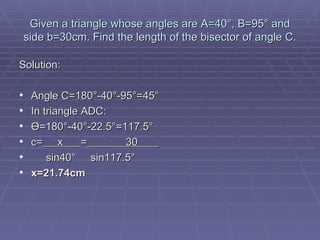
Given a triangle whose angles are A=40 °, B=95° and side b=30cm. Find the length of the bisector of angle C. Solution: Angle C=180°-40°-95°=45° In triangle ADC: Ө =180 °-40°-22.5°=117.5° c=   x  =   30  sin40 °  sin117.5° x=21.74cm
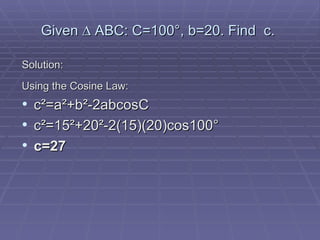
Given  ∆ ABC : C=100 °, b=20. Find  c.   Solution: Using the Cosine Law: c ²=a²+b²-2abcosC c²=15²+20²-2(15)(20)cos100° c=27
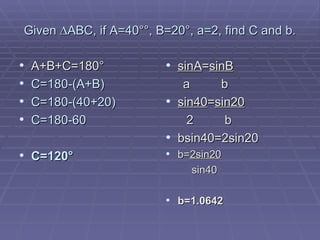
Given ∆ABC, if A=40°°, B=20°, a=2, find C and b. A+B+C=180 ° C=180-(A+B) C=180-(40+20) C=180-60 C=120° sinA = sinB a  b sin40 = sin20 2  b bsin40=2sin20 b= 2sin20 sin40 b=1.0642
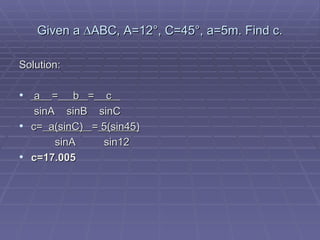
Given a  ∆ABC, A=12°, C=45°, a=5m. Find c. Solution: a  =   b  =   c    sinA  sinB  sinC c=   a(sinC)  =  5(sin45)   sinA   sin12 c=17.005
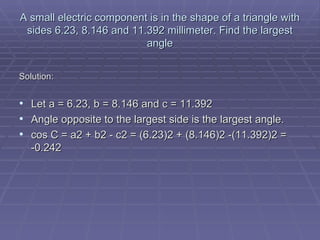
A small electric component is in the shape of a triangle with sides 6.23, 8.146 and 11.392 millimeter. Find the largest angle Solution: Let a = 6.23, b = 8.146 and c = 11.392  Angle opposite to the largest side is the largest angle.  cos C = a2 + b2 - c2 = (6.23)2 + (8.146)2 -(11.392)2 =   -0.242
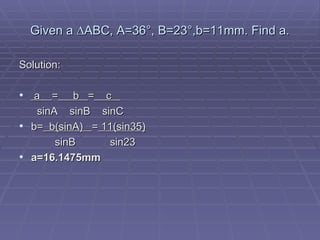
Given a  ∆ABC, A=36°, B=23°,b=11mm. Find a. Solution: a  =   b  =   c    sinA  sinB  sinC b=   b(sinA)  =  11(sin35)   sinB   sin23 a=16.1475mm
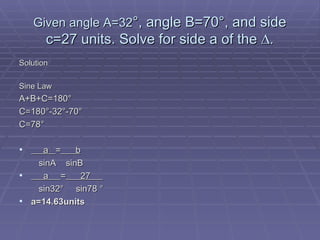
Given angle A=32 °, angle B=70°, and side c=27 units. Solve for side a of the ∆. Solution Sine Law A+B+C=180 ° C=180°-32°-70° C=78°   a  =   b   sinA  sinB a  =   27    sin32 °  sin78 ° a=14.63units
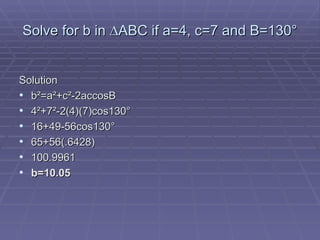
Solve for b in  ∆ABC if a=4, c=7 and B=130° Solution b ²=a²+c²-2accosB 4²+7²-2(4)(7)cos130° 16+49-56cos130° 65+56(.6428) 100.9961 b=10.05
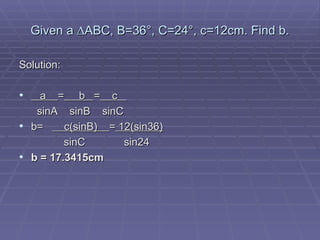
Given a ∆ABC, B=36°, C=24°, c=12cm. Find b. Solution: a  =   b  =   c    sinA  sinB  sinC b=  c(sinB)  =  12(sin36)   sinC   sin24 b = 17.3415cm
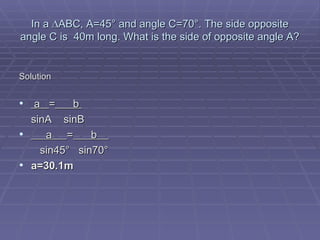
In a ∆ABC, A=45° and angle C=70°. The side opposite angle C is  40m long. What is the side of opposite angle A? Solution a  =   b    sinA  sinB a  =   b    sin45°  sin70 ° a=30.1m
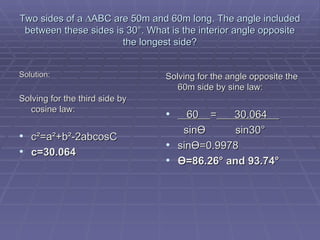
Two sides of a  ∆ABC are 50m and 60m long. The angle included between these sides is 30°. What is the interior angle opposite the longest side? Solution: Solving for the third side by cosine law: c²=a²+b²-2abcosC c=30.064 Solving for the angle opposite the 60m side by sine law: 60  =   30.064    sin Ө   sin30 ° sin Ө =0.9978 Ө =86.26° and 93.74°
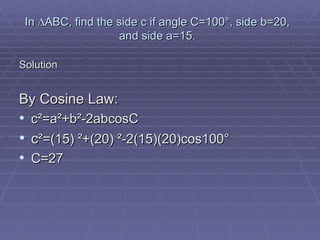
In  ∆ABC, find the side c if angle C=100°, side b=20, and side a=15. Solution By Cosine Law: c ²=a²+b²-2abcosC c ²=(15) ²+(20) ²-2(15)(20)cos100° C=27
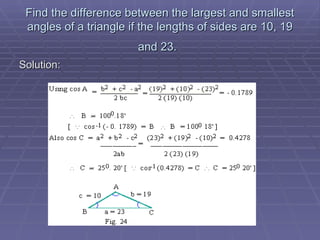
Find the difference between the largest and smallest angles of a triangle if the lengths of sides are 10, 19 and 23.   Solution:
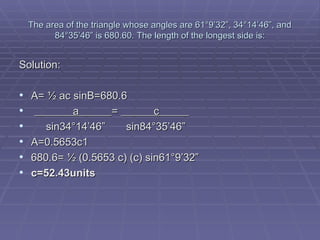
The area of the triangle whose angles are 61 °9’32”, 34°14’46”, and 84°35’46” is 680.60. The length of the longest side is: Solution: A= ½ ac sinB=680.6  a  =  c    sin34°14’46”  sin84°35’46”  A=0.5653c1 680.6= ½ (0.5653 c) (c) sin61°9’32”  c=52.43units
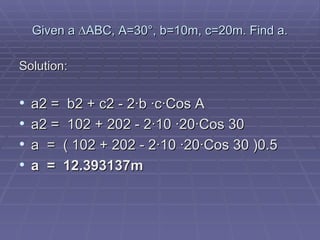
Given a  ∆ABC, A=30°, b=10m, c=20m. Find a. Solution: a2 =  b2 + c2 - 2·b ·c·Cos A   a2 =  102 + 202 - 2·10 ·20·Cos 30 a  =  ( 102 + 202 - 2·10 ·20·Cos 30 )0.5 a  =  12.393137m     
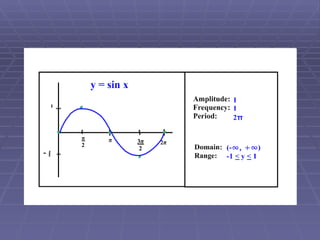
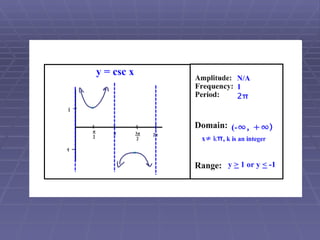
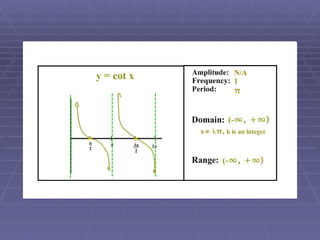
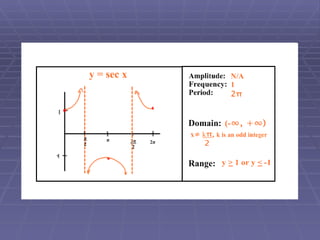
Graphs of Sine, Cosine and Tangents
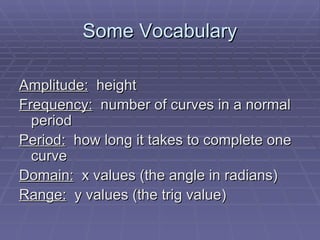
Some Vocabulary Amplitude:   height Frequency:   number of curves in a normal period Period:   how long it takes to complete one curve Domain:   x values (the angle in radians) Range:   y values (the trig value)
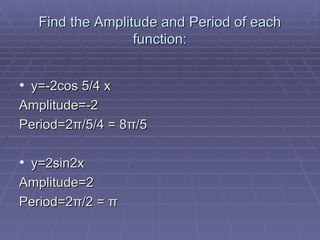
Find the Amplitude and Period of each function: y=-2cos 5/4 x Amplitude=-2 Period=2 π/5/4 = 8π/5 y=2sin2x Amplitude=2 Period=2π/2 = π
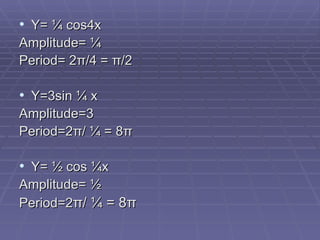
Y= ¼ cos4x Amplitude= ¼ Period= 2π/4 = π/2 Y=3sin ¼ x Amplitude=3 Period=2π/ ¼ = 8π Y= ½ cos ¼x Amplitude= ½  Period=2 π/ ¼ = 8π


Prepared by: Paula P. Alfonso Agricultural Science Curriculum 3 rd  year High School  [email_address]

Trigonometric Problems

  • 1.
    25 solved Trigonometric Problems Law of Sine Law of Cosines Law of Tangents Graphs of Sine and Cosine Graphs of Other Functions Pampanga Agricultural College Magalang, Pampanga, Philippines
  • 2.
    Solve ∆ABCif A=39°, a=21inches and b=11inches. Find the remaining side and angles. Solution Using the Sine Law, a = b sinA sinB 21 = 11 sin39 ° sinB sinB = 11sin39 21 ≈ 0.329644 B ≈ 19,25° We can now say that, C ≈ 180-(39+19.25) C ≈121.75 To solve for the remaining side, c = a sinC sinA c = a sin121.75 ° sin19.25 ° c= 21sin121.75° sin19.25° c≈54.16inches
  • 3.
    Given a ∆ABC, A=48°, b=16, c=32. Find a. Solution: a2 =  b2 + c2 - 2·b ·c·Cos A  a2 =  102 + 202 - 2·10 ·20·Cos 30 a  =  ( 102 + 202 - 2·10 ·20·Cos 30 )0.5 a  =  12.393137      
  • 4.
    Solve ∆ABCshown at the right with A=65°, B=48°, and c+76ft. Find the remaining sides and angle. Solution A+B+C=180 ° C=180°-(B+C) C=180°-(65+48) C=180°-113 C=67° To get the length of two sides, we use the Law of Sines. sinA = sinC a c sin65 ° = sin67° a 76 76sin65 °=asin67° 72sin65 °=a sin67° 75=a sinB = sinC b c sin48° = sin67° b 76 76sin48°=bsin67° 76sin48° =b sin67° 67°=b
  • 5.
    Two sides of ∆ ABC measures 6cm and 8cm and their included angle 40°. Find the third side. Solution: c ²=a²+b²-2abcosC c²=6²+8²-2(6)(8)cos40° c=5.144cm
  • 6.
    Given a trianglewhose angles are A=40 °, B=95° and side b=30cm. Find the length of the bisector of angle C. Solution: Angle C=180°-40°-95°=45° In triangle ADC: Ө =180 °-40°-22.5°=117.5° c= x = 30 sin40 ° sin117.5° x=21.74cm
  • 7.
    Given ∆ABC : C=100 °, b=20. Find c. Solution: Using the Cosine Law: c ²=a²+b²-2abcosC c²=15²+20²-2(15)(20)cos100° c=27
  • 8.
    Given ∆ABC, ifA=40°°, B=20°, a=2, find C and b. A+B+C=180 ° C=180-(A+B) C=180-(40+20) C=180-60 C=120° sinA = sinB a b sin40 = sin20 2 b bsin40=2sin20 b= 2sin20 sin40 b=1.0642
  • 9.
    Given a ∆ABC, A=12°, C=45°, a=5m. Find c. Solution: a = b = c sinA sinB sinC c= a(sinC) = 5(sin45) sinA sin12 c=17.005
  • 10.
    A small electriccomponent is in the shape of a triangle with sides 6.23, 8.146 and 11.392 millimeter. Find the largest angle Solution: Let a = 6.23, b = 8.146 and c = 11.392 Angle opposite to the largest side is the largest angle. cos C = a2 + b2 - c2 = (6.23)2 + (8.146)2 -(11.392)2 =   -0.242
  • 11.
    Given a ∆ABC, A=36°, B=23°,b=11mm. Find a. Solution: a = b = c sinA sinB sinC b= b(sinA) = 11(sin35) sinB sin23 a=16.1475mm
  • 12.
    Given angle A=32°, angle B=70°, and side c=27 units. Solve for side a of the ∆. Solution Sine Law A+B+C=180 ° C=180°-32°-70° C=78° a = b sinA sinB a = 27 sin32 ° sin78 ° a=14.63units
  • 13.
    Solve for bin ∆ABC if a=4, c=7 and B=130° Solution b ²=a²+c²-2accosB 4²+7²-2(4)(7)cos130° 16+49-56cos130° 65+56(.6428) 100.9961 b=10.05
  • 14.
    Given a ∆ABC,B=36°, C=24°, c=12cm. Find b. Solution: a = b = c sinA sinB sinC b= c(sinB) = 12(sin36) sinC sin24 b = 17.3415cm
  • 15.
    In a ∆ABC,A=45° and angle C=70°. The side opposite angle C is 40m long. What is the side of opposite angle A? Solution a = b sinA sinB a = b sin45° sin70 ° a=30.1m
  • 16.
    Two sides ofa ∆ABC are 50m and 60m long. The angle included between these sides is 30°. What is the interior angle opposite the longest side? Solution: Solving for the third side by cosine law: c²=a²+b²-2abcosC c=30.064 Solving for the angle opposite the 60m side by sine law: 60 = 30.064 sin Ө sin30 ° sin Ө =0.9978 Ө =86.26° and 93.74°
  • 17.
    In ∆ABC,find the side c if angle C=100°, side b=20, and side a=15. Solution By Cosine Law: c ²=a²+b²-2abcosC c ²=(15) ²+(20) ²-2(15)(20)cos100° C=27
  • 18.
    Find the differencebetween the largest and smallest angles of a triangle if the lengths of sides are 10, 19 and 23. Solution:
  • 19.
    The area ofthe triangle whose angles are 61 °9’32”, 34°14’46”, and 84°35’46” is 680.60. The length of the longest side is: Solution: A= ½ ac sinB=680.6 a = c sin34°14’46” sin84°35’46” A=0.5653c1 680.6= ½ (0.5653 c) (c) sin61°9’32” c=52.43units
  • 20.
    Given a ∆ABC, A=30°, b=10m, c=20m. Find a. Solution: a2 =  b2 + c2 - 2·b ·c·Cos A  a2 =  102 + 202 - 2·10 ·20·Cos 30 a  =  ( 102 + 202 - 2·10 ·20·Cos 30 )0.5 a  =  12.393137m     
  • 21.
    Graphs of Sine,Cosine and Tangents
  • 22.
    Some Vocabulary Amplitude: height Frequency: number of curves in a normal period Period: how long it takes to complete one curve Domain: x values (the angle in radians) Range: y values (the trig value)
  • 23.
    Find the Amplitudeand Period of each function: y=-2cos 5/4 x Amplitude=-2 Period=2 π/5/4 = 8π/5 y=2sin2x Amplitude=2 Period=2π/2 = π
  • 24.
    Y= ¼ cos4xAmplitude= ¼ Period= 2π/4 = π/2 Y=3sin ¼ x Amplitude=3 Period=2π/ ¼ = 8π Y= ½ cos ¼x Amplitude= ½ Period=2 π/ ¼ = 8π
  • 25.
  • 26.
  • 27.
  • 28.
  • 29.
    Prepared by: PaulaP. Alfonso Agricultural Science Curriculum 3 rd year High School [email_address]