BARRIENTOS, Lei Anne
MARTIREZ, Wilbur
MORIONES, Jan Ebenezer
NERI, Laiza Paulene
MAPUA INSTITUTE OF TECHNOLOGY
MEC32/A1
Members:
TOPICS
 THEORY ON BEARING STRESS
 FORMULA FOR BEARING STRESS
 EXAMPLES ON BEARING STRESS
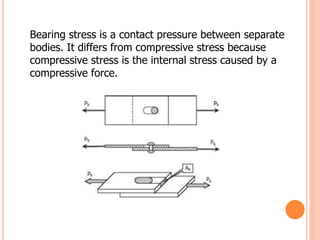
Bearing stress is a contact pressure between separate
bodies. It differs from compressive stress because
compressive stress is the internal stress caused by a
compressive force.
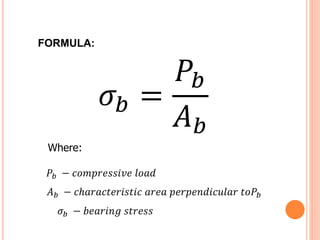
FORMULA:
𝜎 𝑏 =
𝑃𝑏
𝐴 𝑏
Where:
𝑃𝑏 − 𝑐𝑜𝑚𝑝𝑟𝑒𝑠𝑠𝑖𝑣𝑒 𝑙𝑜𝑎𝑑
𝐴 𝑏 − 𝑐ℎ𝑎𝑟𝑎𝑐𝑡𝑒𝑟𝑖𝑠𝑡𝑖𝑐 𝑎𝑟𝑒𝑎 𝑝𝑒𝑟𝑝𝑒𝑛𝑑𝑖𝑐𝑢𝑙𝑎𝑟 𝑡𝑜𝑃𝑏
𝜎𝑏 − 𝑏𝑒𝑎𝑟𝑖𝑛𝑔 𝑠𝑡𝑟𝑒𝑠𝑠
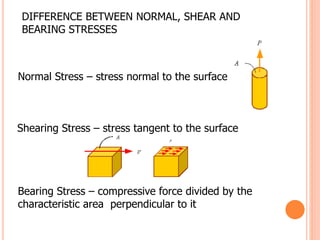
DIFFERENCE BETWEEN NORMAL, SHEAR AND
BEARING STRESSES
Normal Stress – stress normal to the surface
Shearing Stress – stress tangent to the surface
Bearing Stress – compressive force divided by the
characteristic area perpendicular to it
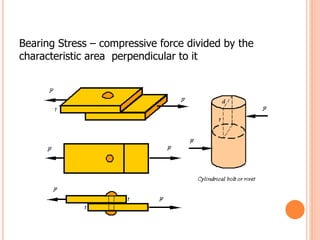
Bearing Stress – compressive force divided by the
characteristic area perpendicular to it
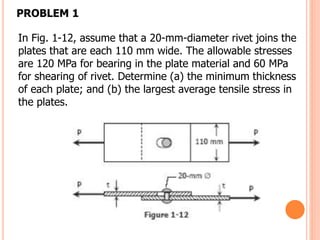
In Fig. 1-12, assume that a 20-mm-diameter rivet joins the
plates that are each 110 mm wide. The allowable stresses
are 120 MPa for bearing in the plate material and 60 MPa
for shearing of rivet. Determine (a) the minimum thickness
of each plate; and (b) the largest average tensile stress in
the plates.
PROBLEM 1
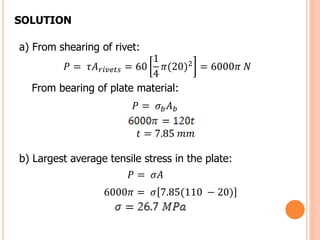
a) From shearing of rivet:
𝑃 = 𝜏𝐴 𝑟𝑖𝑣𝑒𝑡𝑠 = 60
1
4
𝜋(20)2 = 6000𝜋 𝑁
From bearing of plate material:
𝑃 = 𝜎𝑏 𝐴 𝑏
𝑡 = 7.85 𝑚𝑚
b) Largest average tensile stress in the plate:
𝑃 = 𝜎𝐴
6000𝜋 = 𝜎 7.85(110 − 20)
SOLUTION
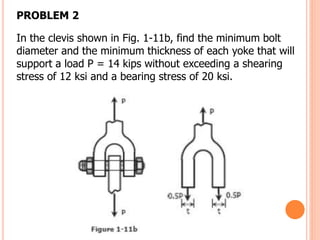
In the clevis shown in Fig. 1-11b, find the minimum bolt
diameter and the minimum thickness of each yoke that will
support a load P = 14 kips without exceeding a shearing
stress of 12 ksi and a bearing stress of 20 ksi.
PROBLEM 2
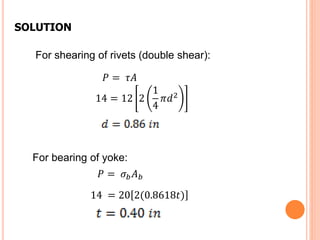
For shearing of rivets (double shear):
𝑃 = 𝜏𝐴
14 = 20 2(0.8618𝑡)
14 = 12 2
1
4
𝜋𝑑2
For bearing of yoke:
𝑃 = 𝜎𝑏 𝐴 𝑏
SOLUTION
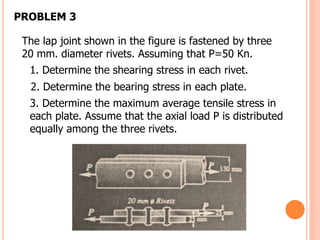
The lap joint shown in the figure is fastened by three
20 mm. diameter rivets. Assuming that P=50 Kn.
1. Determine the shearing stress in each rivet.
2. Determine the bearing stress in each plate.
3. Determine the maximum average tensile stress in
each plate. Assume that the axial load P is distributed
equally among the three rivets.
PROBLEM 3
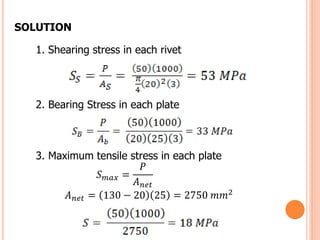
SOLUTION
1. Shearing stress in each rivet
2. Bearing Stress in each plate
3. Maximum tensile stress in each plate
𝑆 𝑚𝑎𝑥 =
𝑃
𝐴 𝑛𝑒𝑡
𝐴 𝑛𝑒𝑡 = 130 − 20 25 = 2750 𝑚𝑚2
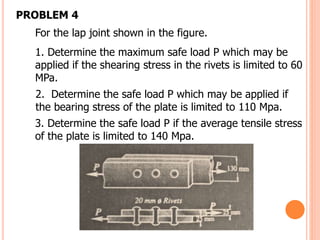
For the lap joint shown in the figure.
1. Determine the maximum safe load P which may be
applied if the shearing stress in the rivets is limited to 60
MPa.
2. Determine the safe load P which may be applied if
the bearing stress of the plate is limited to 110 Mpa.
3. Determine the safe load P if the average tensile stress
of the plate is limited to 140 Mpa.
PROBLEM 4
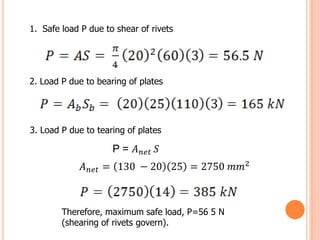
1. Safe load P due to shear of rivets
2. Load P due to bearing of plates
3. Load P due to tearing of plates
P = 𝐴 𝑛𝑒𝑡 𝑆
𝐴 𝑛𝑒𝑡 = 130 − 20 25 = 2750 𝑚𝑚2
Therefore, maximum safe load, P=56 5 N
(shearing of rivets govern).
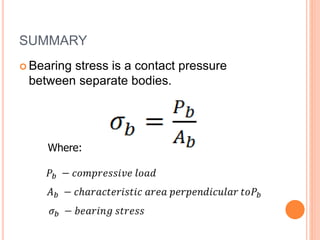
SUMMARY
 Bearing stress is a contact pressure
between separate bodies.
Where:
Strength of Materials 4th Edition by
Andrew Pytel and Ferdinand L. Singer
Mechanics of Materials 2nd Edition by
Andrew Pytel and Jaan Kiusalaas
“How materials carry load?” http://emweb.unl.edu/
Department of Engineering Mechanics, University of Nebraska,
Lincoln, NE
Last modified at: 3:07 PM, Wednesday, August 30, 2000

Bearing stress

  • 1.
    BARRIENTOS, Lei Anne MARTIREZ,Wilbur MORIONES, Jan Ebenezer NERI, Laiza Paulene MAPUA INSTITUTE OF TECHNOLOGY MEC32/A1 Members:
  • 2.
    TOPICS  THEORY ONBEARING STRESS  FORMULA FOR BEARING STRESS  EXAMPLES ON BEARING STRESS
  • 3.
    Bearing stress isa contact pressure between separate bodies. It differs from compressive stress because compressive stress is the internal stress caused by a compressive force.
  • 4.
    FORMULA: 𝜎 𝑏 = 𝑃𝑏 𝐴𝑏 Where: 𝑃𝑏 − 𝑐𝑜𝑚𝑝𝑟𝑒𝑠𝑠𝑖𝑣𝑒 𝑙𝑜𝑎𝑑 𝐴 𝑏 − 𝑐ℎ𝑎𝑟𝑎𝑐𝑡𝑒𝑟𝑖𝑠𝑡𝑖𝑐 𝑎𝑟𝑒𝑎 𝑝𝑒𝑟𝑝𝑒𝑛𝑑𝑖𝑐𝑢𝑙𝑎𝑟 𝑡𝑜𝑃𝑏 𝜎𝑏 − 𝑏𝑒𝑎𝑟𝑖𝑛𝑔 𝑠𝑡𝑟𝑒𝑠𝑠
  • 5.
    DIFFERENCE BETWEEN NORMAL,SHEAR AND BEARING STRESSES Normal Stress – stress normal to the surface Shearing Stress – stress tangent to the surface Bearing Stress – compressive force divided by the characteristic area perpendicular to it
  • 6.
    Bearing Stress –compressive force divided by the characteristic area perpendicular to it
  • 7.
    In Fig. 1-12,assume that a 20-mm-diameter rivet joins the plates that are each 110 mm wide. The allowable stresses are 120 MPa for bearing in the plate material and 60 MPa for shearing of rivet. Determine (a) the minimum thickness of each plate; and (b) the largest average tensile stress in the plates. PROBLEM 1
  • 8.
    a) From shearingof rivet: 𝑃 = 𝜏𝐴 𝑟𝑖𝑣𝑒𝑡𝑠 = 60 1 4 𝜋(20)2 = 6000𝜋 𝑁 From bearing of plate material: 𝑃 = 𝜎𝑏 𝐴 𝑏 𝑡 = 7.85 𝑚𝑚 b) Largest average tensile stress in the plate: 𝑃 = 𝜎𝐴 6000𝜋 = 𝜎 7.85(110 − 20) SOLUTION
  • 9.
    In the clevisshown in Fig. 1-11b, find the minimum bolt diameter and the minimum thickness of each yoke that will support a load P = 14 kips without exceeding a shearing stress of 12 ksi and a bearing stress of 20 ksi. PROBLEM 2
  • 10.
    For shearing ofrivets (double shear): 𝑃 = 𝜏𝐴 14 = 20 2(0.8618𝑡) 14 = 12 2 1 4 𝜋𝑑2 For bearing of yoke: 𝑃 = 𝜎𝑏 𝐴 𝑏 SOLUTION
  • 11.
    The lap jointshown in the figure is fastened by three 20 mm. diameter rivets. Assuming that P=50 Kn. 1. Determine the shearing stress in each rivet. 2. Determine the bearing stress in each plate. 3. Determine the maximum average tensile stress in each plate. Assume that the axial load P is distributed equally among the three rivets. PROBLEM 3
  • 12.
    SOLUTION 1. Shearing stressin each rivet 2. Bearing Stress in each plate 3. Maximum tensile stress in each plate 𝑆 𝑚𝑎𝑥 = 𝑃 𝐴 𝑛𝑒𝑡 𝐴 𝑛𝑒𝑡 = 130 − 20 25 = 2750 𝑚𝑚2
  • 13.
    For the lapjoint shown in the figure. 1. Determine the maximum safe load P which may be applied if the shearing stress in the rivets is limited to 60 MPa. 2. Determine the safe load P which may be applied if the bearing stress of the plate is limited to 110 Mpa. 3. Determine the safe load P if the average tensile stress of the plate is limited to 140 Mpa. PROBLEM 4
  • 14.
    1. Safe loadP due to shear of rivets 2. Load P due to bearing of plates 3. Load P due to tearing of plates P = 𝐴 𝑛𝑒𝑡 𝑆 𝐴 𝑛𝑒𝑡 = 130 − 20 25 = 2750 𝑚𝑚2 Therefore, maximum safe load, P=56 5 N (shearing of rivets govern).
  • 15.
    SUMMARY  Bearing stressis a contact pressure between separate bodies. Where:
  • 16.
    Strength of Materials4th Edition by Andrew Pytel and Ferdinand L. Singer Mechanics of Materials 2nd Edition by Andrew Pytel and Jaan Kiusalaas “How materials carry load?” http://emweb.unl.edu/ Department of Engineering Mechanics, University of Nebraska, Lincoln, NE Last modified at: 3:07 PM, Wednesday, August 30, 2000