Trigonometric Functions of Any Angle
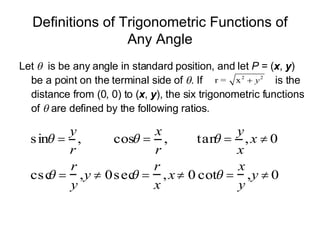
Definitions of Trigonometric Functions of Any Angle Let     is be any angle in standard position, and let  P  = ( x ,  y ) be a point on the terminal side of   . If   is the distance from (0, 0) to ( x ,  y ), the six trigonometric functions of    are defined by the following ratios.
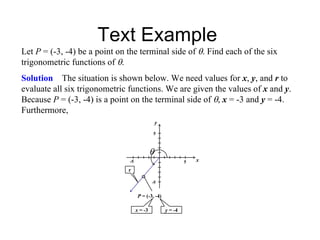
Text Example Let  P  = (-3, -4) be a point on the terminal side of   . Find each of the six trigonometric functions of   . Solution   The situation is shown below. We need values for  x ,  y , and  r  to evaluate all six trigonometric functions. We are given the values of  x  and  y . Because  P  = (-3, -4) is a point on the terminal side of   ,  x  = -3 and  y  = -4. Furthermore,  r x  = -3 y  = -4 P  = (-3, -4)  x y -5 5 -5 5
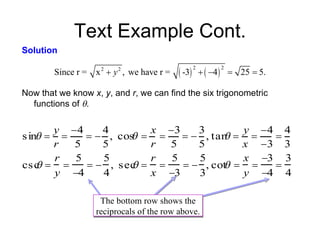
Text Example Cont. Solution Now that we know  x ,  y , and  r , we can find the six trigonometric functions of   . The bottom row shows the reciprocals of the row above.
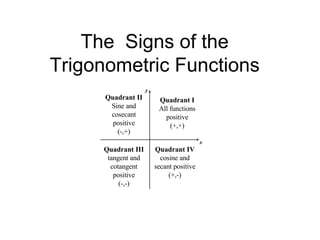
The  Signs of the Trigonometric Functions x y Quadrant II Sine and cosecant positive (-,+) Quadrant I All functions positive (+,+) Quadrant III tangent and cotangent positive (-,-) Quadrant IV cosine and secant positive (+,-)
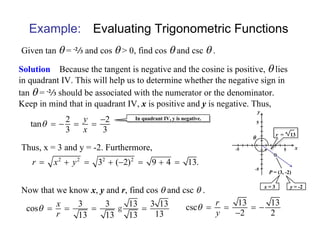
Example: Evaluating Trigonometric Functions Given tan    =  -2 / 3  and cos    > 0, find cos    and csc    . Solution   Because the tangent is negative and the cosine is positive,    lies in quadrant IV. This will help us to determine whether the negative sign in tan    =  -2 / 3  should be associated with the numerator or the denominator. Keep in mind that in quadrant IV,  x  is positive and  y  is negative. Thus,  In quadrant IV, y is negative. x  = 3 y  = -2 P  = (3, -2)  x y -5 5 -5 5 r   =  13 Thus, x = 3 and y = -2. Furthermore, Now that we know  x ,  y  and  r , find cos    and csc    .
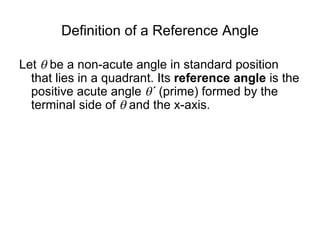
Definition of a Reference Angle Let    be a non-acute angle in standard position that lies in a quadrant. Its  reference angle  is the positive acute angle   ´  (prime) formed by the terminal side of    and the x-axis.
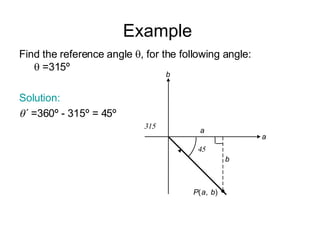
Example  Find the reference angle   , for the following angle:     =315º Solution:  ´  =360º - 315º = 45º a b   a b P ( a ,  b )
Using Reference Angles to Evaluate Trigonometric Functions The values of a trigonometric functions of a given angle,   , are the same as the values for the trigonometric functions of the reference angle,   ´,  except possibly for the sign . A function value of the acute angle,   ´, is always positive. However, the same functions value for    may be positive or negative.
A Procedure for Using Reference Angles to Evaluate Trigonometric Functions The value of a trigonometric function of any angle    is found as follows: Find the associated reference angle,   ´ , and the function value for   ´ . Use the quadrant in which    lies to prefix the  appropriate sign  to the function value in step 1.
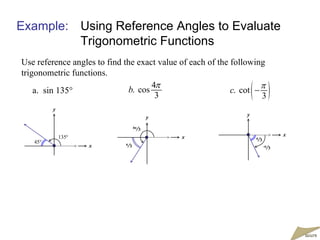
Example: Using Reference Angles to Evaluate  Trigonometric Functions Use reference angles to find the exact value of each of the following trigonometric functions. a.  sin 135° x y 135° 45° more more x y 4  / 3  / 3 x y  / 3 -  / 3

Trigonometric Function Of Any Angle

  • 1.
  • 2.
    Definitions of TrigonometricFunctions of Any Angle Let  is be any angle in standard position, and let P = ( x , y ) be a point on the terminal side of  . If is the distance from (0, 0) to ( x , y ), the six trigonometric functions of  are defined by the following ratios.
  • 3.
    Text Example Let P = (-3, -4) be a point on the terminal side of  . Find each of the six trigonometric functions of  . Solution The situation is shown below. We need values for x , y , and r to evaluate all six trigonometric functions. We are given the values of x and y . Because P = (-3, -4) is a point on the terminal side of  , x = -3 and y = -4. Furthermore, r x = -3 y = -4 P = (-3, -4)  x y -5 5 -5 5
  • 4.
    Text Example Cont.Solution Now that we know x , y , and r , we can find the six trigonometric functions of  . The bottom row shows the reciprocals of the row above.
  • 5.
    The Signsof the Trigonometric Functions x y Quadrant II Sine and cosecant positive (-,+) Quadrant I All functions positive (+,+) Quadrant III tangent and cotangent positive (-,-) Quadrant IV cosine and secant positive (+,-)
  • 6.
    Example: Evaluating TrigonometricFunctions Given tan  = -2 / 3 and cos  > 0, find cos  and csc  . Solution Because the tangent is negative and the cosine is positive,  lies in quadrant IV. This will help us to determine whether the negative sign in tan  = -2 / 3 should be associated with the numerator or the denominator. Keep in mind that in quadrant IV, x is positive and y is negative. Thus, In quadrant IV, y is negative. x = 3 y = -2 P = (3, -2)  x y -5 5 -5 5 r = 13 Thus, x = 3 and y = -2. Furthermore, Now that we know x , y and r , find cos  and csc  .
  • 7.
    Definition of aReference Angle Let  be a non-acute angle in standard position that lies in a quadrant. Its reference angle is the positive acute angle  ´ (prime) formed by the terminal side of  and the x-axis.
  • 8.
    Example Findthe reference angle  , for the following angle:  =315º Solution:  ´ =360º - 315º = 45º a b   a b P ( a , b )
  • 9.
    Using Reference Anglesto Evaluate Trigonometric Functions The values of a trigonometric functions of a given angle,  , are the same as the values for the trigonometric functions of the reference angle,  ´, except possibly for the sign . A function value of the acute angle,  ´, is always positive. However, the same functions value for  may be positive or negative.
  • 10.
    A Procedure forUsing Reference Angles to Evaluate Trigonometric Functions The value of a trigonometric function of any angle  is found as follows: Find the associated reference angle,  ´ , and the function value for  ´ . Use the quadrant in which  lies to prefix the appropriate sign to the function value in step 1.
  • 11.
    Example: Using ReferenceAngles to Evaluate Trigonometric Functions Use reference angles to find the exact value of each of the following trigonometric functions. a. sin 135° x y 135° 45° more more x y 4  / 3  / 3 x y  / 3 -  / 3