


Conversation Points:
Trends in Technology & Society


Dr. Alec Couros
University of Regina
me
The Blur
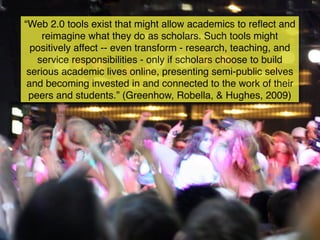
“Web 2.0 tools exist that might allow academics to reflect and
     reimagine what they do as scholars. Such tools might
  positively affect -- even transform - research, teaching, and
   service responsibilities - only if scholars choose to build
 serious academic lives online, presenting semi-public selves
 and becoming invested in and connected to the work of their
 peers and students.” (Greenhow, Robella, & Hughes, 2009)
context
enablers
Social Tools


http://www.flickr.com/photos/9119028@N05/591163479/
@jonmott
Free/Open
 Content
Access
Age of
                       Networks


http://www.flowtown.com/blog/the-2010-social-networking-map
http://www.flickr.com/photos/scriptingnews/2699829038/sizes/l/
quick stats (2009)

•   90 trillion emails sent annually from 1.4 billion email
    users

•   234 million websites

•   1.73 billion Internet users

•   126 millions blogs

•   350 million Facebook users

•   4 billion images on Flickr

•   1 billion Youtube videos served daily.

                                  Stats as of Jan 22/10 via Royal Pingdom
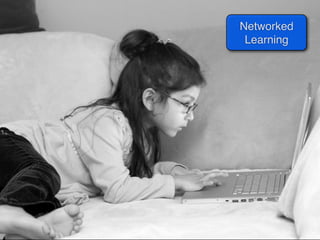
affordances
Networked
 Learning
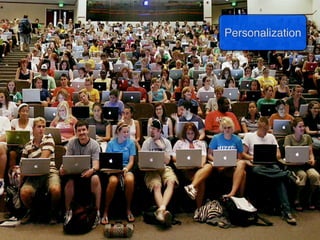
Personalization
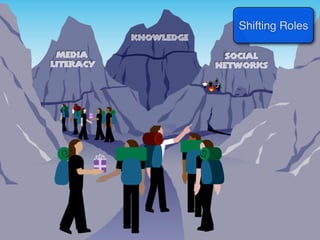
Shifting Roles
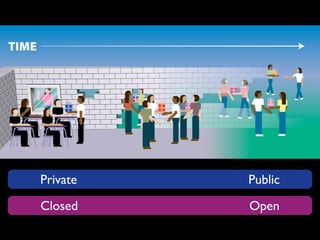
Private   Public

Closed    Open
practice
“Understanding how networks
work is one of the most important
 literacies of the 21st century.”
            (Rheingold, 2010)
real time collaboration
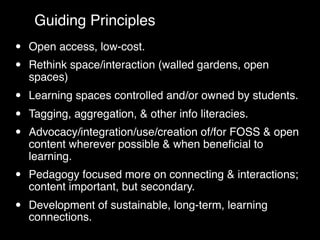
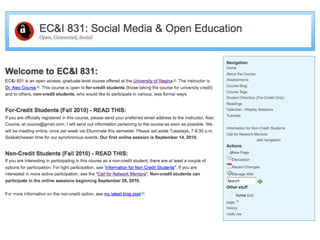
Guiding Principles
•   Open access, low-cost.
•   Rethink space/interaction (walled gardens, open
    spaces)
•   Learning spaces controlled and/or owned by students.
•   Tagging, aggregation, & other info literacies.
•   Advocacy/integration/use/creation of/for FOSS & open
    content wherever possible & when beneficial to
    learning.
•   Pedagogy focused more on connecting & interactions;
    content important, but secondary.
•   Development of sustainable, long-term, learning
    connections.
location of
 mentors
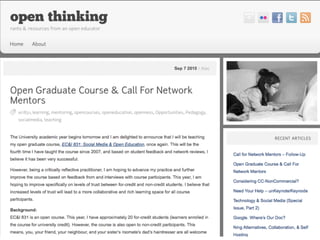
“The course ... has been the most profound pd
experience Iʼve ever had. It forced me to critique & review
 my practice. I never knew how important social networks
    were. Now, I couldnʼt be a teacher without being
connected. Itʼs drastically changed my view of education.”
moving forward
“We need to move beyond the
 idea that education is something
     that is provided for us, and
toward the idea that an education
    is something that we create
              ourselves.”
            (Downes, 2010)
web: couros.ca
  twitter: courosa
  google: couros
couros@gmail.com

Trends in Tech & Society