Learning in the Open:
Networked Student Identities


  University of Prince Edward Island
             February 2013
         Bonnie Stewart
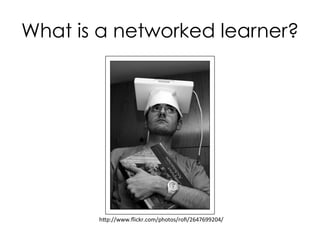
What is a networked learner?


       h"p://www.flickr.com/photos/rofi/2647699204/	
  
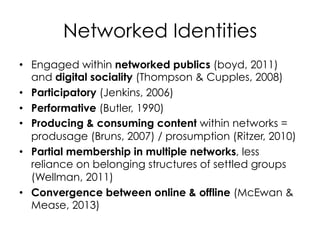
Networked Identities
•  Engaged within networked publics (boyd, 2011)
   and digital sociality (Thompson & Cupples, 2008)
•  Participatory (Jenkins, 2006)
•  Performative (Butler, 1990)
•  Producing & consuming content within networks =
   produsage (Bruns, 2007) / prosumption (Ritzer, 2010)
•  Partial membership in multiple networks, less
   reliance on belonging structures of settled groups
   (Wellman, 2011)
•  Convergence between online & offline (McEwan &
   Mease, 2013)
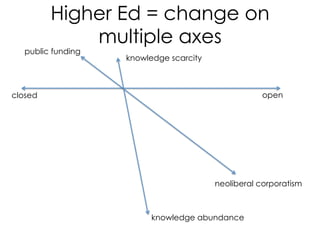
Higher Ed = change on
             multiple axes
   public funding
                    knowledge scarcity


closed                                              open


                                         neoliberal corporatism


                          knowledge abundance
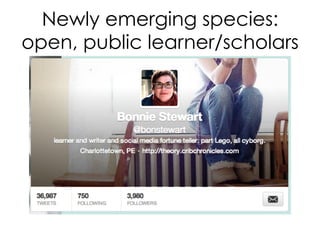
Newly emerging species:
open, public learner/scholars
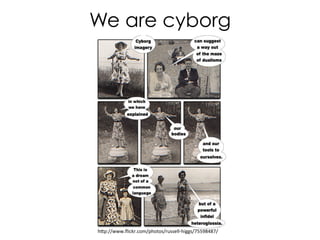
We are cyborg


h"p://www.flickr.com/photos/russell-­‐higgs/75598487/	
  
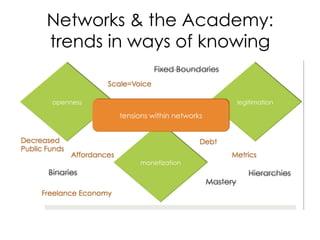
Networks & the Academy:
trends in ways of knowing
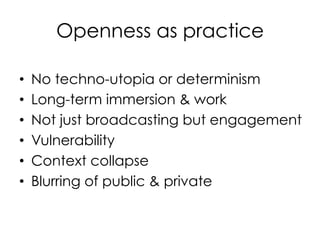
Openness as practice

•    No techno-utopia or determinism
•    Long-term immersion & work
•    Not just broadcasting but engagement
•    Vulnerability
•    Context collapse
•    Blurring of public & private
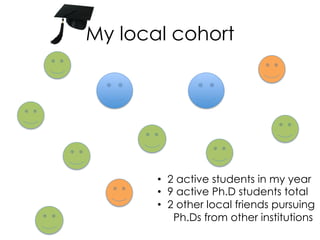
My local cohort


       •  2 active students in my year
       •  9 active Ph.D students total
       •  2 other local friends pursuing
           Ph.Ds from other institutions
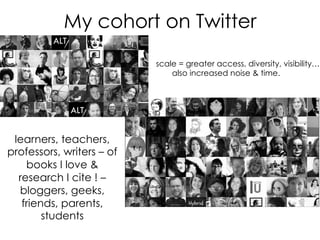
My cohort on Twitter 	
  
                           scale = greater access, diversity, visibility…
                               also increased noise & time.


 learners, teachers,
professors, writers – of
    books I love &
  research I cite ! –
  bloggers, geeks,
   friends, parents,
        students
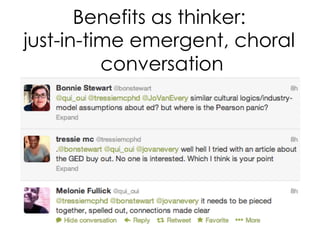
Benefits as thinker:
just-in-time emergent, choral
          conversation
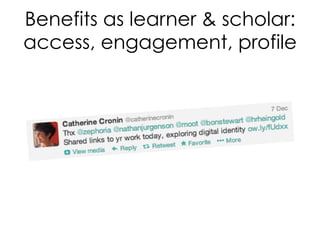
Benefits as learner & scholar:
access, engagement, profile
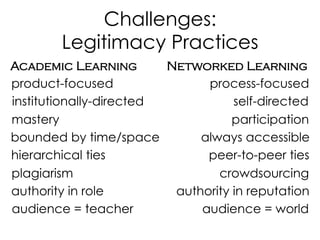
Challenges:
               Legitimacy Practices
Academic Learning        Networked Learning
product-focused                process-focused
institutionally-directed            self-directed
mastery                             participation
bounded by time/space         always accessible
hierarchical ties              peer-to-peer ties
plagiarism                       crowdsourcing
authority in role         authority in reputation
audience = teacher            audience = world


Thank you.


@bonstewart

Learning in the open: Networked student identities

  • 1.
    Learning in theOpen: Networked Student Identities University of Prince Edward Island February 2013 Bonnie Stewart
  • 2.
    What is anetworked learner? h"p://www.flickr.com/photos/rofi/2647699204/  
  • 3.
    Networked Identities •  Engagedwithin networked publics (boyd, 2011) and digital sociality (Thompson & Cupples, 2008) •  Participatory (Jenkins, 2006) •  Performative (Butler, 1990) •  Producing & consuming content within networks = produsage (Bruns, 2007) / prosumption (Ritzer, 2010) •  Partial membership in multiple networks, less reliance on belonging structures of settled groups (Wellman, 2011) •  Convergence between online & offline (McEwan & Mease, 2013)
  • 4.
    Higher Ed =change on multiple axes public funding knowledge scarcity closed open neoliberal corporatism knowledge abundance
  • 5.
    Newly emerging species: open,public learner/scholars
  • 6.
  • 7.
    Networks & theAcademy: trends in ways of knowing
  • 8.
    Openness as practice •  No techno-utopia or determinism •  Long-term immersion & work •  Not just broadcasting but engagement •  Vulnerability •  Context collapse •  Blurring of public & private
  • 9.
    My local cohort •  2 active students in my year •  9 active Ph.D students total •  2 other local friends pursuing Ph.Ds from other institutions
  • 10.
    My cohort onTwitter   scale = greater access, diversity, visibility… also increased noise & time. learners, teachers, professors, writers – of books I love & research I cite ! – bloggers, geeks, friends, parents, students
  • 11.
    Benefits as thinker: just-in-timeemergent, choral conversation
  • 12.
    Benefits as learner& scholar: access, engagement, profile
  • 13.
    Challenges: Legitimacy Practices Academic Learning Networked Learning product-focused process-focused institutionally-directed self-directed mastery participation bounded by time/space always accessible hierarchical ties peer-to-peer ties plagiarism crowdsourcing authority in role authority in reputation audience = teacher audience = world                      
  • 14.