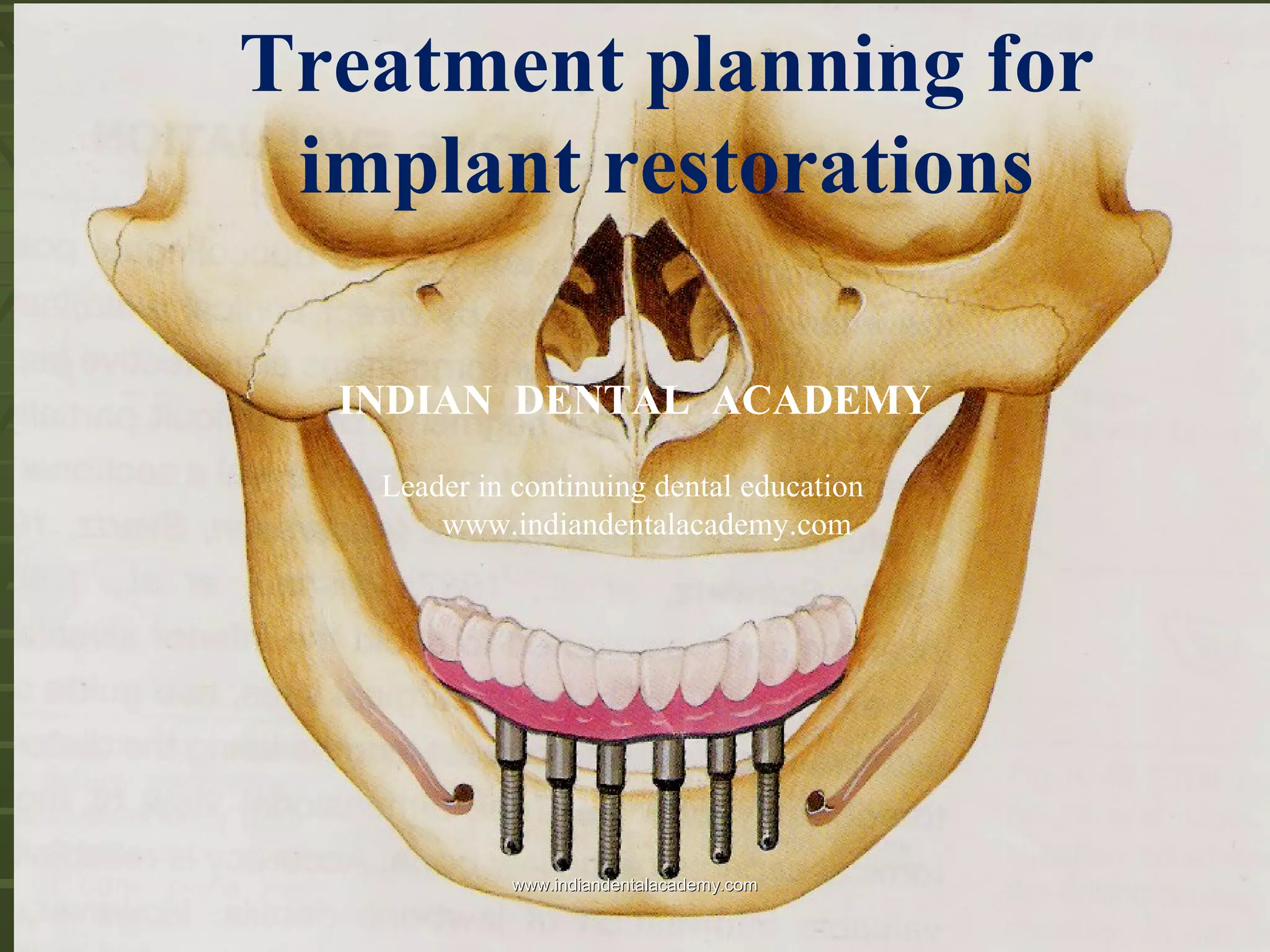
Treatment planning for
implant restorations
INDIAN DENTAL ACADEMY
Leader in continuing dental education
www.indiandentalacademy.com
www.indiandentalacademy.comwww.indiandentalacademy.com
ContentsContents
 IntroductionIntroduction
 Available bone and implantAvailable bone and implant
 Classification and treatment plans forClassification and treatment plans for
partially and completely edentulouspartially and completely edentulous
 Treatment options for mandibular implantTreatment options for mandibular implant
over denturesover dentures
 ConclusionConclusion
 ReferencesReferences
www.indiandentalacademy.comwww.indiandentalacademy.com
INTRODUCTIONINTRODUCTION
The treatment plan should begin withThe treatment plan should begin with
a clear idea of the end result which shoulda clear idea of the end result which should
fulfill the functional and aesthetic needs offulfill the functional and aesthetic needs of
the patient. It is important that these goalsthe patient. It is important that these goals
are realistic, predictable and readilyare realistic, predictable and readily
maintainable.maintainable.
www.indiandentalacademy.comwww.indiandentalacademy.com
Available BoneAvailable Bone
 Available bone is that portion of a partiallyAvailable bone is that portion of a partially
or totally edentulous alveolar ridge thator totally edentulous alveolar ridge that
can be used to insert an endostealcan be used to insert an endosteal
implant, or basal bone that can be used toimplant, or basal bone that can be used to
support a subperiosteal implant.support a subperiosteal implant. (Charles(Charles
M.M. Weiss)Weiss)
www.indiandentalacademy.comwww.indiandentalacademy.com
ATWOODS CLASSIFICATION
 Order I:Order I: pre-extraction.pre-extraction.
 Order II:Order II: post extraction.post extraction.
 Order III:Order III: high, wellhigh, well
rounded.rounded.
 Order IV:Order IV: knife edge.knife edge.
 Order V:Order V: low, well rounded.low, well rounded.
 Order VI:Order VI: depressed.depressed.
www.indiandentalacademy.comwww.indiandentalacademy.com
 CLASSIFICATION ACCORDING TO THE AMERICANCLASSIFICATION ACCORDING TO THE AMERICAN
COLLEGE OF PROSTHODONTISTS:COLLEGE OF PROSTHODONTISTS:
 Based on bone height (mandible only) that isBased on bone height (mandible only) that is
measured at least vertical height of the mandiblemeasured at least vertical height of the mandible
 Type I:Type I: Residual bone height of 21mm or greater.Residual bone height of 21mm or greater.
 Type II:Type II: Residual bone height of 16-20mm.Residual bone height of 16-20mm.
 Type III:Type III: Residual alveolar bone height of 11-15mm.Residual alveolar bone height of 11-15mm.
 Type IV:Type IV: Residual alveolar bone height of 10mm or less.Residual alveolar bone height of 10mm or less.
www.indiandentalacademy.comwww.indiandentalacademy.com
AVAILABLE BONEAVAILABLE BONE
Available bone describes the amount of bone in the
edentulous area considered for implantation and is
measured in: Height.
Width.
Length
Angulation.
Crown-Implant body ratio.
www.indiandentalacademy.comwww.indiandentalacademy.com
AVAILABLE BONE HEIGHTAVAILABLE BONE HEIGHT
www.indiandentalacademy.comwww.indiandentalacademy.com
The minimum height of the available bone
for endosteal implants is related to the density of
the bone.
The minimum bone height for a predictable long-
term endosteal implant survival is 10mm.
Failure rates higher - < 9 MM
www.indiandentalacademy.comwww.indiandentalacademy.com
 The height of the implant also affects its totalThe height of the implant also affects its total
surface areasurface area..
 An implant 3 mm longer provides more than 10%An implant 3 mm longer provides more than 10%
increase in surface area.increase in surface area.
 The advantage of increased height helps inThe advantage of increased height helps in initialinitial
stability, the overall amount of bone-implantstability, the overall amount of bone-implant
interface, and long term resistance to momentinterface, and long term resistance to moment
forcesforces..
www.indiandentalacademy.comwww.indiandentalacademy.com
 ANTERIOR OF THE MANDIBLEANTERIOR OF THE MANDIBLE
www.indiandentalacademy.comwww.indiandentalacademy.com
 The root form implants ofThe root form implants of
4.0 mm4.0 mm crestal diametercrestal diameter
usually require more thanusually require more than
5.0 mm5.0 mm of bone width toof bone width to
ensure sufficient boneensure sufficient bone
thickness and blood supplythickness and blood supply
around the implant foraround the implant for
predictable survival. Thesepredictable survival. These
dimensions provide moredimensions provide more
thanthan 0.5 mm0.5 mm bone on eachbone on each
side of the implant.side of the implant.
AVAILABLE BONE WIDTHAVAILABLE BONE WIDTH
www.indiandentalacademy.comwww.indiandentalacademy.com
 Each 1mm increase in diameter corresponds to aEach 1mm increase in diameter corresponds to a
surface area increase of approximately 20% tosurface area increase of approximately 20% to
30%.30%.
 StressStress equals force / functional area over which it isequals force / functional area over which it is
applied, theapplied, the greater diameter decreases thegreater diameter decreases the
amount of stress at the crestal bone-implantamount of stress at the crestal bone-implant
interface.interface.
www.indiandentalacademy.comwww.indiandentalacademy.com
1 mm1 mm – Bone remaining after implant– Bone remaining after implant
placement to anatomical structuresplacement to anatomical structures
2 mm2 mm – Tooth to implant– Tooth to implant
3 mm3 mm – Implant to implant– Implant to implant
7 mm7 mm - Implant to implant in over denture- Implant to implant in over denture
www.indiandentalacademy.comwww.indiandentalacademy.com
AVAILABLE BONE LENGTHAVAILABLE BONE LENGTH
The mesio-distal length of available bone in
an edentulous area is often limited by adjacent
teeth or implants. The length of available bone
necessary for endosteal implant survival depends
on the width of the bone.
www.indiandentalacademy.comwww.indiandentalacademy.com
 For bone more than 5 mm wide, a minimumFor bone more than 5 mm wide, a minimum
mesiodistal length of 7 mm is usually sufficientmesiodistal length of 7 mm is usually sufficient
for each implant.for each implant.
 A width of bone less than 5 mm requires a 3.2A width of bone less than 5 mm requires a 3.2
mm implant with compromises such as lessmm implant with compromises such as less
surface area and greater crestal concentration ofsurface area and greater crestal concentration of
stressstress..
www.indiandentalacademy.comwww.indiandentalacademy.com
AVAILABLE BONE ANGULATIONAVAILABLE BONE ANGULATION
Ideally the bone angulation is aligned with
the forces of occlusion and is parallel to the long
axis of the Prosthodontic restoration.
www.indiandentalacademy.comwww.indiandentalacademy.com
 TheThe limiting factor of angulationlimiting factor of angulation of force betweenof force between
the body and the abutment of an implant isthe body and the abutment of an implant is
correlated to the width of bone.correlated to the width of bone.
 In edentulous areas with aIn edentulous areas with a wide ridgewide ridge, wider root, wider root
form implants may be used. Such implants allowform implants may be used. Such implants allow
modifications up tomodifications up to 30 degrees divergence30 degrees divergence
 Narrow yet adequate width ridgeNarrow yet adequate width ridge often requires aoften requires a
narrower design root form implant. This limits thenarrower design root form implant. This limits the
acceptable angulation of bone toacceptable angulation of bone to 2020 degreesdegrees
www.indiandentalacademy.comwww.indiandentalacademy.com
CROWN-IMPLANT BODY RATIOCROWN-IMPLANT BODY RATIO
The crown height is measured from the
occlusal or incisal plane to the crest of the ridge
and the endosteal implant height from the crest
of the ridge to its apex.
www.indiandentalacademy.comwww.indiandentalacademy.com
 The greater the crown height, the greater theThe greater the crown height, the greater the
lever arm with any lateral force.lever arm with any lateral force.
 As theAs the crown-implant ratio increasescrown-implant ratio increases, the, the
number of implants and/or wider implantsnumber of implants and/or wider implants shouldshould
be inserted to counteract the increase in stressbe inserted to counteract the increase in stress
www.indiandentalacademy.comwww.indiandentalacademy.com
DIVISIONSDIVISIONS
OFOF
AVAILABLE BONEAVAILABLE BONE
 Division A (Abundant Bone)
 Division B (Barely Sufficient Bone)
 Division C (Compromised Bone)
 Division D (Deficient Bone)
www.indiandentalacademy.comwww.indiandentalacademy.com
Division ADivision A
(Abundant Bone)(Abundant Bone)
 >5mm width>5mm width
 >12 mm height>12 mm height
 >7mm mesio-distal>7mm mesio-distal
lengthlength
 <30 degrees<30 degrees
angulationangulation
 <15 mm crown height<15 mm crown height
 C/I ratio <1C/I ratio <1
www.indiandentalacademy.comwww.indiandentalacademy.com
 Division A is mostDivision A is most
often restored withoften restored with
Division A root formDivision A root form
implant.implant.
 Root form implantsRoot form implants
presents severalpresents several
advantages to otheradvantages to other
endosteal designs asendosteal designs as
the plate form orthe plate form or
transosteal implants.transosteal implants.
www.indiandentalacademy.comwww.indiandentalacademy.com
DIVISION A ROOT FORM IMPLANTDIVISION A ROOT FORM IMPLANT
ADVANTAGESADVANTAGES
 Greatest surface areaGreatest surface area
 Improved stress distributionImproved stress distribution
 Less fracture of implant and componentsLess fracture of implant and components
 Designed for variable bone densityDesigned for variable bone density
 More esthetic conditionsMore esthetic conditions
www.indiandentalacademy.comwww.indiandentalacademy.com
Division B (Barely sufficientDivision B (Barely sufficient
bone)bone)
 As the bone resorbs, the width of available boneAs the bone resorbs, the width of available bone
first decreases at the expense of the facialfirst decreases at the expense of the facial
cortical plate.cortical plate.
 There is 25% decrease in bone width the firstThere is 25% decrease in bone width the first
year, and 40% decrease in bone width within theyear, and 40% decrease in bone width within the
first 1 to 3 years after tooth extraction.first 1 to 3 years after tooth extraction.
 Once this Division B bone volume is reached, itOnce this Division B bone volume is reached, it
may remain for more than 20 years.may remain for more than 20 years.
www.indiandentalacademy.comwww.indiandentalacademy.com
Division BDivision B
(Barely Sufficient Bone)(Barely Sufficient Bone)
2.5-5mm width2.5-5mm width
>12 mm height>12 mm height
>6 mm mesio-distal>6 mm mesio-distal
lengthlength
<20 degree angulation<20 degree angulation
between implant bodybetween implant body
and occlusal planeand occlusal plane
Crown/Implant ratio <1Crown/Implant ratio <1
www.indiandentalacademy.comwww.indiandentalacademy.com
Treatment options available for theTreatment options available for the
Division B edentulous ridgeDivision B edentulous ridge
 Insert division B implantsInsert division B implants
 OSTEOPLASTYOSTEOPLASTY
Converts to division A when greater than 12Converts to division A when greater than 12
mm bone height resultsmm bone height results
Converts to division C-H when less than 12 mmConverts to division C-H when less than 12 mm
bone height resultsbone height results
www.indiandentalacademy.comwww.indiandentalacademy.com
DISADVANTAGES OF DIVISION B ROOTDISADVANTAGES OF DIVISION B ROOT
FORMSFORMS
 Almost twice the stress is concentrated at the top crestalAlmost twice the stress is concentrated at the top crestal
region around the implantregion around the implant
 Lateral loads on the implant result in almost 3 timesLateral loads on the implant result in almost 3 times
greater stress than division A root formsgreater stress than division A root forms
 Fatigue fractures of the abutment post are increased.Fatigue fractures of the abutment post are increased.
 The crown emergence profile is less estheticThe crown emergence profile is less esthetic
 Implant costs are not related to diameter, so an increaseImplant costs are not related to diameter, so an increase
in implant number results in greater cost to the doctorin implant number results in greater cost to the doctor
and patientand patient
www.indiandentalacademy.comwww.indiandentalacademy.com
Division CDivision C
(Compromised Bone)(Compromised Bone)
Unfavorable in: WidthUnfavorable in: Width
(C-w)(C-w)
Height (C-h)Height (C-h)
Angulation (C-a)Angulation (C-a)
C/I ratio >1C/I ratio >1
www.indiandentalacademy.comwww.indiandentalacademy.com
 The resorption of the available bone occurs first inThe resorption of the available bone occurs first in
bone width, and then in height.bone width, and then in height.
 As a result, Division B ridge continues to resorb inAs a result, Division B ridge continues to resorb in
width although height of bone is still present, untilwidth although height of bone is still present, until
it becomes inadequate for any design ofit becomes inadequate for any design of
endosteal implants. This bone category is calledendosteal implants. This bone category is called
Division C-wDivision C-w..
 This resorption process continues, and theThis resorption process continues, and the
available bone is then reduced in height andavailable bone is then reduced in height and
calledcalled Division C-hDivision C-h
www.indiandentalacademy.comwww.indiandentalacademy.com
Treatment options available for theTreatment options available for the
Division C edentulous ridgeDivision C edentulous ridge
(1) Osteoplasty(1) Osteoplasty
(2) Augmentation procedures(2) Augmentation procedures
(3) Root form implants(3) Root form implants
(4) Subperiosteal implants(4) Subperiosteal implants
(5) Ramus frame implants(5) Ramus frame implants
(6) Transosteal implants(6) Transosteal implants
www.indiandentalacademy.comwww.indiandentalacademy.com
Division DDivision D
(Deficient Bone)(Deficient Bone)
Severe atrophySevere atrophy
Basal bone lossBasal bone loss
Flat maxillaFlat maxilla
pencil thin mandiblepencil thin mandible
www.indiandentalacademy.comwww.indiandentalacademy.com
Treatment options available for theTreatment options available for the
Division D edentulous ridgeDivision D edentulous ridge
 The completely edentulous Division D patient is mostThe completely edentulous Division D patient is most
difficult to treat in implant dentistry.difficult to treat in implant dentistry.
 The choice to render treatment is the doctor’s, notThe choice to render treatment is the doctor’s, not
the patient’sthe patient’s
 Benefits must carefully be weighed against the risksBenefits must carefully be weighed against the risks
www.indiandentalacademy.comwww.indiandentalacademy.com
 If implant failure occurs, the patient may become aIf implant failure occurs, the patient may become a
dental cripple, unable to wear any prosthesis.dental cripple, unable to wear any prosthesis.
 Therefore autogenous bone grafts to upgrade theTherefore autogenous bone grafts to upgrade the
division are strongly recommended before anydivision are strongly recommended before any
implant treatment is attemptedimplant treatment is attempted
 Once autogenous grafts are in place and allowedOnce autogenous grafts are in place and allowed
to heal for 5 or more months, endosteal orto heal for 5 or more months, endosteal or
subperiosteal implants may be inserted,subperiosteal implants may be inserted,
depending on the division of bone obtaineddepending on the division of bone obtained..
www.indiandentalacademy.comwww.indiandentalacademy.com
 Autogenous grafts are not intended forAutogenous grafts are not intended for
soft tissue born prosthesissoft tissue born prosthesis
 Repeated relinesRepeated relines
 Highly mobile tissueHighly mobile tissue
 Sore spotsSore spots
 Patient frustrationPatient frustration
www.indiandentalacademy.comwww.indiandentalacademy.com
Treatment planning forTreatment planning for
implant restorations inimplant restorations in
partially edentulouspartially edentulous
archesarches
www.indiandentalacademy.comwww.indiandentalacademy.com
 The implant dentistry bone volumeThe implant dentistry bone volume
classification developed byclassification developed by Misch and JudyMisch and Judy
builds on the four classes of partialbuilds on the four classes of partial
edentulism described in the Kennedy-edentulism described in the Kennedy-
Applegate system.Applegate system.
www.indiandentalacademy.comwww.indiandentalacademy.com
Class IClass I
www.indiandentalacademy.comwww.indiandentalacademy.com
Class IIClass II
www.indiandentalacademy.comwww.indiandentalacademy.com
CLASS IIICLASS III
www.indiandentalacademy.comwww.indiandentalacademy.com
CLASS IVCLASS IV
www.indiandentalacademy.comwww.indiandentalacademy.com
Class I - Division AClass I - Division A
Bone height > 10 mm
Length > 7 mm
Angulation < 30 degrees
Crown height < 15 mm
Removable prosthesis
Root form implants
www.indiandentalacademy.comwww.indiandentalacademy.com
Class I division BClass I division B
Bone width 2.5-5
mm
Bone height > 10
mm
Angulation < 20
degrees
Crown height < 15
mm
Osteoplasty
Small implants
augmentation
www.indiandentalacademy.comwww.indiandentalacademy.com
CLASS I – Division CCLASS I – Division C
Inadequate
available bone
height, Length
,Angulation.
Crown height > 15
mm
 Augmentation and
Sub periosteal
implants
Nerve repositioning
www.indiandentalacademy.comwww.indiandentalacademy.com
CLASS I Division DCLASS I Division D
Inadequate available bone
due to Severly resorbed
ridge involving basal bone
Crown height more than
20 mm
Augmentation
www.indiandentalacademy.comwww.indiandentalacademy.com
CLASS II Division ACLASS II Division A
www.indiandentalacademy.comwww.indiandentalacademy.com
CLASS II Division CCLASS II Division C
www.indiandentalacademy.comwww.indiandentalacademy.com
CLASS IIICLASS III
DIVISION A DIVISION C
www.indiandentalacademy.comwww.indiandentalacademy.com
CLASS IVCLASS IV
www.indiandentalacademy.comwww.indiandentalacademy.com
TREATMENT PLANSTREATMENT PLANS
FOR COMPLETELYFOR COMPLETELY
EDENTULOUS ARCHESEDENTULOUS ARCHES
www.indiandentalacademy.comwww.indiandentalacademy.com
Classification of completelyClassification of completely
edentulous arches is also basededentulous arches is also based
on bone volume and locationon bone volume and location
present given bypresent given by Kent andKent and
Lousiana Dental schoolLousiana Dental school
 Edentulous jaw is divided into 3Edentulous jaw is divided into 3
regions:regions:
www.indiandentalacademy.comwww.indiandentalacademy.com
TYPE ITYPE I
www.indiandentalacademy.comwww.indiandentalacademy.com
TYPE IITYPE II
www.indiandentalacademy.comwww.indiandentalacademy.com
TYPE IIITYPE III
www.indiandentalacademy.comwww.indiandentalacademy.com
TYPE I DIVISION ATYPE I DIVISION A
www.indiandentalacademy.comwww.indiandentalacademy.com
TYPE I DIVISION C-HTYPE I DIVISION C-H
www.indiandentalacademy.comwww.indiandentalacademy.com
TYPE I DIVISION DTYPE I DIVISION D
www.indiandentalacademy.comwww.indiandentalacademy.com
TYPE II DIVISION A,BTYPE II DIVISION A,B
www.indiandentalacademy.comwww.indiandentalacademy.com
TYPE II DIVISION B,CTYPE II DIVISION B,C
www.indiandentalacademy.comwww.indiandentalacademy.com
TYPE III DIVISION A,B,DTYPE III DIVISION A,B,D
www.indiandentalacademy.comwww.indiandentalacademy.com
TYPE III DIVISION C,D,CTYPE III DIVISION C,D,C
www.indiandentalacademy.comwww.indiandentalacademy.com
IMPLANTIMPLANT
OVERDENTURESOVERDENTURES
www.indiandentalacademy.comwww.indiandentalacademy.com
Many edentulous patients experience problems withMany edentulous patients experience problems with
their dentures, especially lack of stability andtheir dentures, especially lack of stability and
retention, together with a decrease of chewing ability.retention, together with a decrease of chewing ability.
one possibilty of solving this problem is the use ofone possibilty of solving this problem is the use of
endosseous implants to which an overdenture can beendosseous implants to which an overdenture can be
attached.attached.
www.indiandentalacademy.comwww.indiandentalacademy.com
Implant Overdenture AdvantagesImplant Overdenture Advantages
1.1. Minimum anterior bone loss; prevents boneMinimum anterior bone loss; prevents bone
lossloss
2.2. Improved estheticsImproved esthetics
3.3. Improved stability (reduces or eliminatesImproved stability (reduces or eliminates
prosthesis movement)prosthesis movement)
4.4. Decrease in soft tissue abrasionsDecrease in soft tissue abrasions
5.5. Improved chewing efficiency - 20 %Improved chewing efficiency - 20 %
www.indiandentalacademy.comwww.indiandentalacademy.com
6. Improved retention6. Improved retention
7. Improved support7. Improved support
8.Improved speech8.Improved speech
9. Reduced prosthesis size (eliminates palate9. Reduced prosthesis size (eliminates palate
flanges)flanges)
10. improved10. improved maxillofacial prosthesesmaxillofacial prostheses
www.indiandentalacademy.comwww.indiandentalacademy.com
Implant overdenture advantages versus fixedImplant overdenture advantages versus fixed
prosthesisprosthesis
 Fewer implantsFewer implants
less bone graftless bone graft
less specific placementless specific placement
 Improved estheticsImproved esthetics
Labial flangeLabial flange
Denture teethDenture teeth
www.indiandentalacademy.comwww.indiandentalacademy.com
 Soft tissue considerationsSoft tissue considerations
Improved periimplant probingImproved periimplant probing
HygieneHygiene
 Reduced stressReduced stress
Nocturnal parafunctionNocturnal parafunction
Stress-relief attachmentStress-relief attachment
www.indiandentalacademy.comwww.indiandentalacademy.com
 Less cost and laboratory costLess cost and laboratory cost
Fewer implantsFewer implants
Less bone graftingLess bone grafting
Easy repairEasy repair
Laboratory cost decreaseLaboratory cost decrease
 Transitional device until fixedTransitional device until fixed
restoration guidelines are complete.restoration guidelines are complete.
www.indiandentalacademy.comwww.indiandentalacademy.com
Over denture disadvantagesOver denture disadvantages
1.1.Psychological (need for non removablePsychological (need for non removable
teeth)teeth)
2.2.Abutment crown height space requiredAbutment crown height space required
3.3.Long-term maintenanceLong-term maintenance
4.4.Attachments (change)Attachments (change)
5.5.RelinesRelines
www.indiandentalacademy.comwww.indiandentalacademy.com
6. New prosthesis every 7 years6. New prosthesis every 7 years
7. Continued posterior bone loss7. Continued posterior bone loss
8. Food impaction8. Food impaction
9. Movement9. Movement
www.indiandentalacademy.comwww.indiandentalacademy.com
Treatment planning for
implant restorations
DR.K.V. KRISHNAM RAJU
www.indiandentalacademy.comwww.indiandentalacademy.com
MAXILLARY ANTERIOR SINGLE TOOTHMAXILLARY ANTERIOR SINGLE TOOTH
REPLACEMENT:REPLACEMENT:
Factors influencing treatment:Factors influencing treatment:
 Patients agePatients age
 Patient desiresPatient desires
 Patient compliance/ patient fearPatient compliance/ patient fear
 Treatment timeTreatment time
 Consequence of failure: potential damage toConsequence of failure: potential damage to
adjacent teethadjacent teeth
www.indiandentalacademy.comwww.indiandentalacademy.com
 costcost
 Transitional prosthesisTransitional prosthesis
 Adjacent tooth mobilityAdjacent tooth mobility
 EstheticsEsthetics
www.indiandentalacademy.comwww.indiandentalacademy.com
Smile lineSmile line
www.indiandentalacademy.comwww.indiandentalacademy.com
GINGIVAL BIOTYPE
THIN SCALLOPEDTHIN SCALLOPED
PERIODONTIUMPERIODONTIUM
THICK PERIODONTIUM.
www.indiandentalacademy.comwww.indiandentalacademy.com
2-3 MM
www.indiandentalacademy.comwww.indiandentalacademy.com
INTERDENTAL PAPILLAINTERDENTAL PAPILLA
www.indiandentalacademy.comwww.indiandentalacademy.com
BUCCOLINGUAL POSITIONBUCCOLINGUAL POSITION
www.indiandentalacademy.comwww.indiandentalacademy.com
BUCCOLINGUAL POSITIONBUCCOLINGUAL POSITION
www.indiandentalacademy.comwww.indiandentalacademy.com
MESIODISTAL POSITIONMESIODISTAL POSITION
www.indiandentalacademy.comwww.indiandentalacademy.com
APICOCORONAL POSITIONAPICOCORONAL POSITION
www.indiandentalacademy.comwww.indiandentalacademy.com
Timing of implant placement following toothTiming of implant placement following tooth
removal:removal:
According to Garber:According to Garber:
 Immediate placementImmediate placement
 Atraumatic extractionAtraumatic extraction
 Delayed placement after 3 months.Delayed placement after 3 months.
www.indiandentalacademy.comwww.indiandentalacademy.com
Implant placement in edentulous sites:Implant placement in edentulous sites:
Garber classification:Garber classification:
 Garber class 1Garber class 1
 Garber class 2Garber class 2
 Garber class 3Garber class 3
 Garber class 4Garber class 4
 Garber class 5Garber class 5
www.indiandentalacademy.comwww.indiandentalacademy.com
Posterior single tooth replacementPosterior single tooth replacement
Alternative options of single toothAlternative options of single tooth
replacement :replacement :
1.1.Removable partial dentureRemovable partial denture
2.2.Resin retained prosthesisResin retained prosthesis
3.3.Space maintainerSpace maintainer
4.4.Fixed partial dentureFixed partial denture
5.5.Implant prosthesisImplant prosthesis
www.indiandentalacademy.comwww.indiandentalacademy.com
ADVANTAGES OF POSTERIOR SINGLEADVANTAGES OF POSTERIOR SINGLE
TOOTH IMPLANTSTOOTH IMPLANTS
1.1. longevitylongevity
2.2. Improved estheticsImproved esthetics
3.3. Maintainence of bone in edentulous regionMaintainence of bone in edentulous region
4.4. Psychological advantagePsychological advantage
5.5. Decreased risk of abutment tooth lossDecreased risk of abutment tooth loss
www.indiandentalacademy.comwww.indiandentalacademy.com
DISADVANTAGES OF POSTERIORDISADVANTAGES OF POSTERIOR
SINGLE TOOTH IMPLANTSSINGLE TOOTH IMPLANTS
1.1. Consequence of implant failureConsequence of implant failure
2.2. CostCost
3.3. Extended treatment timeExtended treatment time
www.indiandentalacademy.comwww.indiandentalacademy.com
CONTRAINDICATION TO POSTERIORCONTRAINDICATION TO POSTERIOR
SINGLE TOOTH IMPLANTSSINGLE TOOTH IMPLANTS
1.1. Inadequate bone volumeInadequate bone volume
a.a. faciopalatal bone <5 mmfaciopalatal bone <5 mm
b.b. mesiodistal bone <7 mmmesiodistal bone <7 mm
c.c. Height >9 mmHeight >9 mm
2. Moderate to advanced mobility of two to four adjacent2. Moderate to advanced mobility of two to four adjacent
teeth greater than +1teeth greater than +1
3. Limited time for patient treatment3. Limited time for patient treatment
4. cost4. cost
www.indiandentalacademy.comwww.indiandentalacademy.com
First premolar implant replacementFirst premolar implant replacement
www.indiandentalacademy.comwww.indiandentalacademy.com
First Molar implant replacementFirst Molar implant replacement
www.indiandentalacademy.comwww.indiandentalacademy.com
Replacing mandibular II molarReplacing mandibular II molar
1.1. Not in esthetic zoneNot in esthetic zone
2.2. Less than 5 % of chewing efficiencyLess than 5 % of chewing efficiency
3.3. Bite force 10 % higherBite force 10 % higher
4.4. Mandibular canal is located higher in that siteMandibular canal is located higher in that site
5.5. Less dense boneLess dense bone
www.indiandentalacademy.comwww.indiandentalacademy.com
 Limited access for correct implant bodyLimited access for correct implant body
placementplacement
 Hygiene access more difficultHygiene access more difficult
 Greater mandibular flexureGreater mandibular flexure
www.indiandentalacademy.comwww.indiandentalacademy.com
Implant requirements:Implant requirements:
Fixed restorations:Fixed restorations:
Anterior teeth Suggested number of implantsAnterior teeth Suggested number of implants
requiredrequired
 One missing toothOne missing tooth 11
 Two missing teethTwo missing teeth 22
 Three missing teethThree missing teeth 2 or 32 or 3
 Four missing teethFour missing teeth 2, 3 or 42, 3 or 4
 Molar teethMolar teeth
 One missing toothOne missing tooth 1 or 21 or 2
 Two missing teethTwo missing teeth 2 or 32 or 3
www.indiandentalacademy.comwww.indiandentalacademy.com
Full arch bridgesFull arch bridges
 Edentulous maxilla at leastEdentulous maxilla at least 66
 Edentulous mandible at leastEdentulous mandible at least 4 or 54 or 5
OverdenturesOverdentures
 Edentulous maxilla at leastEdentulous maxilla at least 44 joinedjoined
 Edentulous mandibleEdentulous mandible 22 joined or separatejoined or separate
www.indiandentalacademy.comwww.indiandentalacademy.com
Treatment options for ImplantTreatment options for Implant
retained overdentureretained overdenture
www.indiandentalacademy.comwww.indiandentalacademy.com
Categorization of potential implant site in mandible –Categorization of potential implant site in mandible –
By Carl E MischBy Carl E Misch
www.indiandentalacademy.comwww.indiandentalacademy.com
Option OneOption One
106106www.indiandentalacademy.comwww.indiandentalacademy.com
Option twoOption two
www.indiandentalacademy.comwww.indiandentalacademy.com
Disadvantages of A and E splinted implantsDisadvantages of A and E splinted implants
Difficulty with speechDifficulty with speech
 Anterior tipping of over dentureAnterior tipping of over denture
 5 times greater flexure than B and D5 times greater flexure than B and D
positionspositions
BAB D
A E
www.indiandentalacademy.comwww.indiandentalacademy.com
Option threeOption three
www.indiandentalacademy.comwww.indiandentalacademy.com
 If posterior ridge formIf posterior ridge form
is good , implants areis good , implants are
placed on A, C, Eplaced on A, C, E
 if posterior ridge isif posterior ridge is
poor, implants placedpoor, implants placed
in B, C, D regions.in B, C, D regions.
www.indiandentalacademy.comwww.indiandentalacademy.com
Option four (Resilient Hybrid bar design)Option four (Resilient Hybrid bar design)
Four implants areFour implants are
placed inplaced in
A, B, D and E position.A, B, D and E position.
IndicationsIndications
 Poor posteriorPoor posterior
anatomyanatomy
 Lack of retention andLack of retention and
stabilitystability
 Soft tissue abrasionSoft tissue abrasion
 Speech difficultiesSpeech difficulties
 Very high patientVery high patient
expectationsexpectations
www.indiandentalacademy.comwww.indiandentalacademy.com
 Typically fourTypically four
attachments areattachments are
placed evenly. Twoplaced evenly. Two
anterior and twoanterior and two
posterior.posterior.
www.indiandentalacademy.comwww.indiandentalacademy.com
ALL ON FOUR CONCEPTALL ON FOUR CONCEPT
www.indiandentalacademy.comwww.indiandentalacademy.com
Option five (Rigid Hybrid bar design)Option five (Rigid Hybrid bar design)
Five implants are placed in (A, B, C, D, E).Five implants are placed in (A, B, C, D, E).
www.indiandentalacademy.comwww.indiandentalacademy.com
IndicationsIndications
Inability to wear conventional denturesInability to wear conventional dentures
Very high expectationsVery high expectations
Unfavourable anatomyUnfavourable anatomy
Problems with function and stabilityProblems with function and stability
Posterior sore spotsPosterior sore spots
115115www.indiandentalacademy.comwww.indiandentalacademy.com
Mandibular full arch implantMandibular full arch implant
fixed prosthetic optionsfixed prosthetic options
www.indiandentalacademy.comwww.indiandentalacademy.com
Prosthodontic classificationProsthodontic classification
 Fp 1Fp 1 fixed prosthesis; replaces only crown; looks like afixed prosthesis; replaces only crown; looks like a
natural tooth.natural tooth.
 Fp 2Fp 2 fixed prosthesis; replaces crown and portion of root.fixed prosthesis; replaces crown and portion of root.
 Fp 3Fp 3 fixed prosthesis; replaces missing crowns andfixed prosthesis; replaces missing crowns and
gingival color and portion of the edentulous site.gingival color and portion of the edentulous site.
www.indiandentalacademy.comwww.indiandentalacademy.com
Rp-4Rp-4 Removable prosthesis ; over dentureRemovable prosthesis ; over denture
supported completely by implantsupported completely by implant
Rp-5Rp-5 Removable prosthesis ; over dentureRemovable prosthesis ; over denture
supported by soft tissue and implantsupported by soft tissue and implant
www.indiandentalacademy.comwww.indiandentalacademy.com
Mandibular full arch implant fixed prostheticMandibular full arch implant fixed prosthetic
optionsoptions
Advantages:Advantages:
1.1. Psychological: feels like teethPsychological: feels like teeth
2.2. Less prosthetic maintainenceLess prosthetic maintainence
AttachmentsAttachments
RelinesRelines
New over dentureNew over denture
3. Less food entrapment3. Less food entrapment
www.indiandentalacademy.comwww.indiandentalacademy.com
Medial movementMedial movement
800 micro m
1500 micro m
www.indiandentalacademy.comwww.indiandentalacademy.com
TorsionTorsion
www.indiandentalacademy.comwww.indiandentalacademy.com
Consequences of cross arch connectionConsequences of cross arch connection
includes:includes:
1.1.Bone loss around implantsBone loss around implants
2.2.Loss of implant fixationLoss of implant fixation
3.3.Components fractureComponents fracture
4.4.Unretained restorationsUnretained restorations
5.5.Discomfort on openingDiscomfort on opening
www.indiandentalacademy.comwww.indiandentalacademy.com
Implant treatment optionsImplant treatment options
Treatment option 1: the branemarkTreatment option 1: the branemark
approachapproach
Force factors
Number
Size
design www.indiandentalacademy.comwww.indiandentalacademy.com
Antero posterior distanceAntero posterior distance
www.indiandentalacademy.comwww.indiandentalacademy.com
Treatment option 2Treatment option 2
12 mm
www.indiandentalacademy.comwww.indiandentalacademy.com
Treatment option 3Treatment option 3
A-P spread is 1.5 – 2 times
www.indiandentalacademy.comwww.indiandentalacademy.com
Treatment option 4Treatment option 4
Division C-H , subperiosteal or disc implantswww.indiandentalacademy.comwww.indiandentalacademy.com
Treatment option 5Treatment option 5
www.indiandentalacademy.comwww.indiandentalacademy.com
CONCLUSIONCONCLUSION
Treatment planning for implant restorationsTreatment planning for implant restorations
may at first appear complicated. It is imperative tomay at first appear complicated. It is imperative to
consider all treatment options with the patient, andconsider all treatment options with the patient, and
during detailed planning it may become apparent that anduring detailed planning it may become apparent that an
alternative solution is preferred. In all cases the implantalternative solution is preferred. In all cases the implant
treatment should be part of an overall plan to ensuretreatment should be part of an overall plan to ensure
health of any remaining teeth. The cost of the proposedhealth of any remaining teeth. The cost of the proposed
treatment plan is also of great relevance.treatment plan is also of great relevance.
www.indiandentalacademy.comwww.indiandentalacademy.com
REFERENCESREFERENCES
1.1. Atlas of oral implantology – A.Norman CraninAtlas of oral implantology – A.Norman Cranin
2.2. Contemporary implant dentistry – Carl.E.mischContemporary implant dentistry – Carl.E.misch
3.3. Implants in clinical dentistry –Implants in clinical dentistry –
Richard.M.PalmerRichard.M.Palmer
4.4. Implant prosthodontics – Stevens FriedricksonImplant prosthodontics – Stevens Friedrickson
www.indiandentalacademy.comwww.indiandentalacademy.com
5.5. Atlas of tooth and implant supportedAtlas of tooth and implant supported
prosthodontics – Lawrence.A.Weinbergprosthodontics – Lawrence.A.Weinberg
6.6. color atlas of implantology – hubertuscolor atlas of implantology – hubertus
spiekermanspiekerman
7. Treatment planning for implant restorations.7. Treatment planning for implant restorations.
British dental journal, volume 187, no. 6,British dental journal, volume 187, no. 6,
september 25 1999september 25 1999
www.indiandentalacademy.comwww.indiandentalacademy.com
8. “All-on-four” immediate function concept and clinlical
report of treatment of an edentulous mandible with a
fixed complete denture. J Prosthodont 2008;17:47-51.
9. Classification system for complete edentulism.
J Prosthodont 1999;8:27-39.
10. implants in the esthetic zone. Dent Clin N Am10. implants in the esthetic zone. Dent Clin N Am
2006:50:391-407.2006:50:391-407.
www.indiandentalacademy.comwww.indiandentalacademy.com

Treatment planning for dental implants/fixed orthodontics courses

  • 1.
    Treatment planning for implantrestorations INDIAN DENTAL ACADEMY Leader in continuing dental education www.indiandentalacademy.com www.indiandentalacademy.comwww.indiandentalacademy.com
  • 2.
    ContentsContents  IntroductionIntroduction  Availablebone and implantAvailable bone and implant  Classification and treatment plans forClassification and treatment plans for partially and completely edentulouspartially and completely edentulous  Treatment options for mandibular implantTreatment options for mandibular implant over denturesover dentures  ConclusionConclusion  ReferencesReferences www.indiandentalacademy.comwww.indiandentalacademy.com
  • 3.
    INTRODUCTIONINTRODUCTION The treatment planshould begin withThe treatment plan should begin with a clear idea of the end result which shoulda clear idea of the end result which should fulfill the functional and aesthetic needs offulfill the functional and aesthetic needs of the patient. It is important that these goalsthe patient. It is important that these goals are realistic, predictable and readilyare realistic, predictable and readily maintainable.maintainable. www.indiandentalacademy.comwww.indiandentalacademy.com
  • 4.
  • 5.
    Available BoneAvailable Bone Available bone is that portion of a partiallyAvailable bone is that portion of a partially or totally edentulous alveolar ridge thator totally edentulous alveolar ridge that can be used to insert an endostealcan be used to insert an endosteal implant, or basal bone that can be used toimplant, or basal bone that can be used to support a subperiosteal implant.support a subperiosteal implant. (Charles(Charles M.M. Weiss)Weiss) www.indiandentalacademy.comwww.indiandentalacademy.com
  • 6.
    ATWOODS CLASSIFICATION  OrderI:Order I: pre-extraction.pre-extraction.  Order II:Order II: post extraction.post extraction.  Order III:Order III: high, wellhigh, well rounded.rounded.  Order IV:Order IV: knife edge.knife edge.  Order V:Order V: low, well rounded.low, well rounded.  Order VI:Order VI: depressed.depressed. www.indiandentalacademy.comwww.indiandentalacademy.com
  • 7.
     CLASSIFICATION ACCORDINGTO THE AMERICANCLASSIFICATION ACCORDING TO THE AMERICAN COLLEGE OF PROSTHODONTISTS:COLLEGE OF PROSTHODONTISTS:  Based on bone height (mandible only) that isBased on bone height (mandible only) that is measured at least vertical height of the mandiblemeasured at least vertical height of the mandible  Type I:Type I: Residual bone height of 21mm or greater.Residual bone height of 21mm or greater.  Type II:Type II: Residual bone height of 16-20mm.Residual bone height of 16-20mm.  Type III:Type III: Residual alveolar bone height of 11-15mm.Residual alveolar bone height of 11-15mm.  Type IV:Type IV: Residual alveolar bone height of 10mm or less.Residual alveolar bone height of 10mm or less. www.indiandentalacademy.comwww.indiandentalacademy.com
  • 8.
    AVAILABLE BONEAVAILABLE BONE Availablebone describes the amount of bone in the edentulous area considered for implantation and is measured in: Height. Width. Length Angulation. Crown-Implant body ratio. www.indiandentalacademy.comwww.indiandentalacademy.com
  • 9.
  • 10.
    AVAILABLE BONE HEIGHTAVAILABLEBONE HEIGHT www.indiandentalacademy.comwww.indiandentalacademy.com
  • 11.
    The minimum heightof the available bone for endosteal implants is related to the density of the bone. The minimum bone height for a predictable long- term endosteal implant survival is 10mm. Failure rates higher - < 9 MM www.indiandentalacademy.comwww.indiandentalacademy.com
  • 12.
     The heightof the implant also affects its totalThe height of the implant also affects its total surface areasurface area..  An implant 3 mm longer provides more than 10%An implant 3 mm longer provides more than 10% increase in surface area.increase in surface area.  The advantage of increased height helps inThe advantage of increased height helps in initialinitial stability, the overall amount of bone-implantstability, the overall amount of bone-implant interface, and long term resistance to momentinterface, and long term resistance to moment forcesforces.. www.indiandentalacademy.comwww.indiandentalacademy.com
  • 13.
     ANTERIOR OFTHE MANDIBLEANTERIOR OF THE MANDIBLE www.indiandentalacademy.comwww.indiandentalacademy.com
  • 14.
  • 15.
  • 16.
     The rootform implants ofThe root form implants of 4.0 mm4.0 mm crestal diametercrestal diameter usually require more thanusually require more than 5.0 mm5.0 mm of bone width toof bone width to ensure sufficient boneensure sufficient bone thickness and blood supplythickness and blood supply around the implant foraround the implant for predictable survival. Thesepredictable survival. These dimensions provide moredimensions provide more thanthan 0.5 mm0.5 mm bone on eachbone on each side of the implant.side of the implant. AVAILABLE BONE WIDTHAVAILABLE BONE WIDTH www.indiandentalacademy.comwww.indiandentalacademy.com
  • 17.
     Each 1mmincrease in diameter corresponds to aEach 1mm increase in diameter corresponds to a surface area increase of approximately 20% tosurface area increase of approximately 20% to 30%.30%.  StressStress equals force / functional area over which it isequals force / functional area over which it is applied, theapplied, the greater diameter decreases thegreater diameter decreases the amount of stress at the crestal bone-implantamount of stress at the crestal bone-implant interface.interface. www.indiandentalacademy.comwww.indiandentalacademy.com
  • 18.
    1 mm1 mm– Bone remaining after implant– Bone remaining after implant placement to anatomical structuresplacement to anatomical structures 2 mm2 mm – Tooth to implant– Tooth to implant 3 mm3 mm – Implant to implant– Implant to implant 7 mm7 mm - Implant to implant in over denture- Implant to implant in over denture www.indiandentalacademy.comwww.indiandentalacademy.com
  • 19.
    AVAILABLE BONE LENGTHAVAILABLEBONE LENGTH The mesio-distal length of available bone in an edentulous area is often limited by adjacent teeth or implants. The length of available bone necessary for endosteal implant survival depends on the width of the bone. www.indiandentalacademy.comwww.indiandentalacademy.com
  • 20.
     For bonemore than 5 mm wide, a minimumFor bone more than 5 mm wide, a minimum mesiodistal length of 7 mm is usually sufficientmesiodistal length of 7 mm is usually sufficient for each implant.for each implant.  A width of bone less than 5 mm requires a 3.2A width of bone less than 5 mm requires a 3.2 mm implant with compromises such as lessmm implant with compromises such as less surface area and greater crestal concentration ofsurface area and greater crestal concentration of stressstress.. www.indiandentalacademy.comwww.indiandentalacademy.com
  • 21.
    AVAILABLE BONE ANGULATIONAVAILABLEBONE ANGULATION Ideally the bone angulation is aligned with the forces of occlusion and is parallel to the long axis of the Prosthodontic restoration. www.indiandentalacademy.comwww.indiandentalacademy.com
  • 22.
     TheThe limitingfactor of angulationlimiting factor of angulation of force betweenof force between the body and the abutment of an implant isthe body and the abutment of an implant is correlated to the width of bone.correlated to the width of bone.  In edentulous areas with aIn edentulous areas with a wide ridgewide ridge, wider root, wider root form implants may be used. Such implants allowform implants may be used. Such implants allow modifications up tomodifications up to 30 degrees divergence30 degrees divergence  Narrow yet adequate width ridgeNarrow yet adequate width ridge often requires aoften requires a narrower design root form implant. This limits thenarrower design root form implant. This limits the acceptable angulation of bone toacceptable angulation of bone to 2020 degreesdegrees www.indiandentalacademy.comwww.indiandentalacademy.com
  • 23.
    CROWN-IMPLANT BODY RATIOCROWN-IMPLANTBODY RATIO The crown height is measured from the occlusal or incisal plane to the crest of the ridge and the endosteal implant height from the crest of the ridge to its apex. www.indiandentalacademy.comwww.indiandentalacademy.com
  • 24.
     The greaterthe crown height, the greater theThe greater the crown height, the greater the lever arm with any lateral force.lever arm with any lateral force.  As theAs the crown-implant ratio increasescrown-implant ratio increases, the, the number of implants and/or wider implantsnumber of implants and/or wider implants shouldshould be inserted to counteract the increase in stressbe inserted to counteract the increase in stress www.indiandentalacademy.comwww.indiandentalacademy.com
  • 25.
    DIVISIONSDIVISIONS OFOF AVAILABLE BONEAVAILABLE BONE Division A (Abundant Bone)  Division B (Barely Sufficient Bone)  Division C (Compromised Bone)  Division D (Deficient Bone) www.indiandentalacademy.comwww.indiandentalacademy.com
  • 26.
    Division ADivision A (AbundantBone)(Abundant Bone)  >5mm width>5mm width  >12 mm height>12 mm height  >7mm mesio-distal>7mm mesio-distal lengthlength  <30 degrees<30 degrees angulationangulation  <15 mm crown height<15 mm crown height  C/I ratio <1C/I ratio <1 www.indiandentalacademy.comwww.indiandentalacademy.com
  • 27.
     Division Ais mostDivision A is most often restored withoften restored with Division A root formDivision A root form implant.implant.  Root form implantsRoot form implants presents severalpresents several advantages to otheradvantages to other endosteal designs asendosteal designs as the plate form orthe plate form or transosteal implants.transosteal implants. www.indiandentalacademy.comwww.indiandentalacademy.com
  • 28.
    DIVISION A ROOTFORM IMPLANTDIVISION A ROOT FORM IMPLANT ADVANTAGESADVANTAGES  Greatest surface areaGreatest surface area  Improved stress distributionImproved stress distribution  Less fracture of implant and componentsLess fracture of implant and components  Designed for variable bone densityDesigned for variable bone density  More esthetic conditionsMore esthetic conditions www.indiandentalacademy.comwww.indiandentalacademy.com
  • 29.
    Division B (BarelysufficientDivision B (Barely sufficient bone)bone)  As the bone resorbs, the width of available boneAs the bone resorbs, the width of available bone first decreases at the expense of the facialfirst decreases at the expense of the facial cortical plate.cortical plate.  There is 25% decrease in bone width the firstThere is 25% decrease in bone width the first year, and 40% decrease in bone width within theyear, and 40% decrease in bone width within the first 1 to 3 years after tooth extraction.first 1 to 3 years after tooth extraction.  Once this Division B bone volume is reached, itOnce this Division B bone volume is reached, it may remain for more than 20 years.may remain for more than 20 years. www.indiandentalacademy.comwww.indiandentalacademy.com
  • 30.
    Division BDivision B (BarelySufficient Bone)(Barely Sufficient Bone) 2.5-5mm width2.5-5mm width >12 mm height>12 mm height >6 mm mesio-distal>6 mm mesio-distal lengthlength <20 degree angulation<20 degree angulation between implant bodybetween implant body and occlusal planeand occlusal plane Crown/Implant ratio <1Crown/Implant ratio <1 www.indiandentalacademy.comwww.indiandentalacademy.com
  • 31.
    Treatment options availablefor theTreatment options available for the Division B edentulous ridgeDivision B edentulous ridge  Insert division B implantsInsert division B implants  OSTEOPLASTYOSTEOPLASTY Converts to division A when greater than 12Converts to division A when greater than 12 mm bone height resultsmm bone height results Converts to division C-H when less than 12 mmConverts to division C-H when less than 12 mm bone height resultsbone height results www.indiandentalacademy.comwww.indiandentalacademy.com
  • 32.
  • 33.
    DISADVANTAGES OF DIVISIONB ROOTDISADVANTAGES OF DIVISION B ROOT FORMSFORMS  Almost twice the stress is concentrated at the top crestalAlmost twice the stress is concentrated at the top crestal region around the implantregion around the implant  Lateral loads on the implant result in almost 3 timesLateral loads on the implant result in almost 3 times greater stress than division A root formsgreater stress than division A root forms  Fatigue fractures of the abutment post are increased.Fatigue fractures of the abutment post are increased.  The crown emergence profile is less estheticThe crown emergence profile is less esthetic  Implant costs are not related to diameter, so an increaseImplant costs are not related to diameter, so an increase in implant number results in greater cost to the doctorin implant number results in greater cost to the doctor and patientand patient www.indiandentalacademy.comwww.indiandentalacademy.com
  • 34.
    Division CDivision C (CompromisedBone)(Compromised Bone) Unfavorable in: WidthUnfavorable in: Width (C-w)(C-w) Height (C-h)Height (C-h) Angulation (C-a)Angulation (C-a) C/I ratio >1C/I ratio >1 www.indiandentalacademy.comwww.indiandentalacademy.com
  • 35.
     The resorptionof the available bone occurs first inThe resorption of the available bone occurs first in bone width, and then in height.bone width, and then in height.  As a result, Division B ridge continues to resorb inAs a result, Division B ridge continues to resorb in width although height of bone is still present, untilwidth although height of bone is still present, until it becomes inadequate for any design ofit becomes inadequate for any design of endosteal implants. This bone category is calledendosteal implants. This bone category is called Division C-wDivision C-w..  This resorption process continues, and theThis resorption process continues, and the available bone is then reduced in height andavailable bone is then reduced in height and calledcalled Division C-hDivision C-h www.indiandentalacademy.comwww.indiandentalacademy.com
  • 36.
    Treatment options availablefor theTreatment options available for the Division C edentulous ridgeDivision C edentulous ridge (1) Osteoplasty(1) Osteoplasty (2) Augmentation procedures(2) Augmentation procedures (3) Root form implants(3) Root form implants (4) Subperiosteal implants(4) Subperiosteal implants (5) Ramus frame implants(5) Ramus frame implants (6) Transosteal implants(6) Transosteal implants www.indiandentalacademy.comwww.indiandentalacademy.com
  • 37.
    Division DDivision D (DeficientBone)(Deficient Bone) Severe atrophySevere atrophy Basal bone lossBasal bone loss Flat maxillaFlat maxilla pencil thin mandiblepencil thin mandible www.indiandentalacademy.comwww.indiandentalacademy.com
  • 38.
    Treatment options availablefor theTreatment options available for the Division D edentulous ridgeDivision D edentulous ridge  The completely edentulous Division D patient is mostThe completely edentulous Division D patient is most difficult to treat in implant dentistry.difficult to treat in implant dentistry.  The choice to render treatment is the doctor’s, notThe choice to render treatment is the doctor’s, not the patient’sthe patient’s  Benefits must carefully be weighed against the risksBenefits must carefully be weighed against the risks www.indiandentalacademy.comwww.indiandentalacademy.com
  • 39.
     If implantfailure occurs, the patient may become aIf implant failure occurs, the patient may become a dental cripple, unable to wear any prosthesis.dental cripple, unable to wear any prosthesis.  Therefore autogenous bone grafts to upgrade theTherefore autogenous bone grafts to upgrade the division are strongly recommended before anydivision are strongly recommended before any implant treatment is attemptedimplant treatment is attempted  Once autogenous grafts are in place and allowedOnce autogenous grafts are in place and allowed to heal for 5 or more months, endosteal orto heal for 5 or more months, endosteal or subperiosteal implants may be inserted,subperiosteal implants may be inserted, depending on the division of bone obtaineddepending on the division of bone obtained.. www.indiandentalacademy.comwww.indiandentalacademy.com
  • 40.
     Autogenous graftsare not intended forAutogenous grafts are not intended for soft tissue born prosthesissoft tissue born prosthesis  Repeated relinesRepeated relines  Highly mobile tissueHighly mobile tissue  Sore spotsSore spots  Patient frustrationPatient frustration www.indiandentalacademy.comwww.indiandentalacademy.com
  • 41.
    Treatment planning forTreatmentplanning for implant restorations inimplant restorations in partially edentulouspartially edentulous archesarches www.indiandentalacademy.comwww.indiandentalacademy.com
  • 42.
     The implantdentistry bone volumeThe implant dentistry bone volume classification developed byclassification developed by Misch and JudyMisch and Judy builds on the four classes of partialbuilds on the four classes of partial edentulism described in the Kennedy-edentulism described in the Kennedy- Applegate system.Applegate system. www.indiandentalacademy.comwww.indiandentalacademy.com
  • 43.
  • 44.
  • 45.
  • 46.
  • 47.
    Class I -Division AClass I - Division A Bone height > 10 mm Length > 7 mm Angulation < 30 degrees Crown height < 15 mm Removable prosthesis Root form implants www.indiandentalacademy.comwww.indiandentalacademy.com
  • 48.
    Class I divisionBClass I division B Bone width 2.5-5 mm Bone height > 10 mm Angulation < 20 degrees Crown height < 15 mm Osteoplasty Small implants augmentation www.indiandentalacademy.comwww.indiandentalacademy.com
  • 49.
    CLASS I –Division CCLASS I – Division C Inadequate available bone height, Length ,Angulation. Crown height > 15 mm  Augmentation and Sub periosteal implants Nerve repositioning www.indiandentalacademy.comwww.indiandentalacademy.com
  • 50.
  • 51.
    CLASS I DivisionDCLASS I Division D Inadequate available bone due to Severly resorbed ridge involving basal bone Crown height more than 20 mm Augmentation www.indiandentalacademy.comwww.indiandentalacademy.com
  • 52.
    CLASS II DivisionACLASS II Division A www.indiandentalacademy.comwww.indiandentalacademy.com
  • 53.
    CLASS II DivisionCCLASS II Division C www.indiandentalacademy.comwww.indiandentalacademy.com
  • 54.
    CLASS IIICLASS III DIVISIONA DIVISION C www.indiandentalacademy.comwww.indiandentalacademy.com
  • 55.
  • 56.
    TREATMENT PLANSTREATMENT PLANS FORCOMPLETELYFOR COMPLETELY EDENTULOUS ARCHESEDENTULOUS ARCHES www.indiandentalacademy.comwww.indiandentalacademy.com
  • 57.
    Classification of completelyClassificationof completely edentulous arches is also basededentulous arches is also based on bone volume and locationon bone volume and location present given bypresent given by Kent andKent and Lousiana Dental schoolLousiana Dental school  Edentulous jaw is divided into 3Edentulous jaw is divided into 3 regions:regions: www.indiandentalacademy.comwww.indiandentalacademy.com
  • 58.
  • 59.
  • 60.
  • 61.
    TYPE I DIVISIONATYPE I DIVISION A www.indiandentalacademy.comwww.indiandentalacademy.com
  • 62.
    TYPE I DIVISIONC-HTYPE I DIVISION C-H www.indiandentalacademy.comwww.indiandentalacademy.com
  • 63.
    TYPE I DIVISIONDTYPE I DIVISION D www.indiandentalacademy.comwww.indiandentalacademy.com
  • 64.
    TYPE II DIVISIONA,BTYPE II DIVISION A,B www.indiandentalacademy.comwww.indiandentalacademy.com
  • 65.
    TYPE II DIVISIONB,CTYPE II DIVISION B,C www.indiandentalacademy.comwww.indiandentalacademy.com
  • 66.
    TYPE III DIVISIONA,B,DTYPE III DIVISION A,B,D www.indiandentalacademy.comwww.indiandentalacademy.com
  • 67.
    TYPE III DIVISIONC,D,CTYPE III DIVISION C,D,C www.indiandentalacademy.comwww.indiandentalacademy.com
  • 68.
  • 69.
    Many edentulous patientsexperience problems withMany edentulous patients experience problems with their dentures, especially lack of stability andtheir dentures, especially lack of stability and retention, together with a decrease of chewing ability.retention, together with a decrease of chewing ability. one possibilty of solving this problem is the use ofone possibilty of solving this problem is the use of endosseous implants to which an overdenture can beendosseous implants to which an overdenture can be attached.attached. www.indiandentalacademy.comwww.indiandentalacademy.com
  • 70.
  • 71.
  • 72.
    Implant Overdenture AdvantagesImplantOverdenture Advantages 1.1. Minimum anterior bone loss; prevents boneMinimum anterior bone loss; prevents bone lossloss 2.2. Improved estheticsImproved esthetics 3.3. Improved stability (reduces or eliminatesImproved stability (reduces or eliminates prosthesis movement)prosthesis movement) 4.4. Decrease in soft tissue abrasionsDecrease in soft tissue abrasions 5.5. Improved chewing efficiency - 20 %Improved chewing efficiency - 20 % www.indiandentalacademy.comwww.indiandentalacademy.com
  • 73.
    6. Improved retention6.Improved retention 7. Improved support7. Improved support 8.Improved speech8.Improved speech 9. Reduced prosthesis size (eliminates palate9. Reduced prosthesis size (eliminates palate flanges)flanges) 10. improved10. improved maxillofacial prosthesesmaxillofacial prostheses www.indiandentalacademy.comwww.indiandentalacademy.com
  • 74.
    Implant overdenture advantagesversus fixedImplant overdenture advantages versus fixed prosthesisprosthesis  Fewer implantsFewer implants less bone graftless bone graft less specific placementless specific placement  Improved estheticsImproved esthetics Labial flangeLabial flange Denture teethDenture teeth www.indiandentalacademy.comwww.indiandentalacademy.com
  • 75.
     Soft tissueconsiderationsSoft tissue considerations Improved periimplant probingImproved periimplant probing HygieneHygiene  Reduced stressReduced stress Nocturnal parafunctionNocturnal parafunction Stress-relief attachmentStress-relief attachment www.indiandentalacademy.comwww.indiandentalacademy.com
  • 76.
     Less costand laboratory costLess cost and laboratory cost Fewer implantsFewer implants Less bone graftingLess bone grafting Easy repairEasy repair Laboratory cost decreaseLaboratory cost decrease  Transitional device until fixedTransitional device until fixed restoration guidelines are complete.restoration guidelines are complete. www.indiandentalacademy.comwww.indiandentalacademy.com
  • 77.
    Over denture disadvantagesOverdenture disadvantages 1.1.Psychological (need for non removablePsychological (need for non removable teeth)teeth) 2.2.Abutment crown height space requiredAbutment crown height space required 3.3.Long-term maintenanceLong-term maintenance 4.4.Attachments (change)Attachments (change) 5.5.RelinesRelines www.indiandentalacademy.comwww.indiandentalacademy.com
  • 78.
    6. New prosthesisevery 7 years6. New prosthesis every 7 years 7. Continued posterior bone loss7. Continued posterior bone loss 8. Food impaction8. Food impaction 9. Movement9. Movement www.indiandentalacademy.comwww.indiandentalacademy.com
  • 79.
    Treatment planning for implantrestorations DR.K.V. KRISHNAM RAJU www.indiandentalacademy.comwww.indiandentalacademy.com
  • 80.
    MAXILLARY ANTERIOR SINGLETOOTHMAXILLARY ANTERIOR SINGLE TOOTH REPLACEMENT:REPLACEMENT: Factors influencing treatment:Factors influencing treatment:  Patients agePatients age  Patient desiresPatient desires  Patient compliance/ patient fearPatient compliance/ patient fear  Treatment timeTreatment time  Consequence of failure: potential damage toConsequence of failure: potential damage to adjacent teethadjacent teeth www.indiandentalacademy.comwww.indiandentalacademy.com
  • 81.
     costcost  TransitionalprosthesisTransitional prosthesis  Adjacent tooth mobilityAdjacent tooth mobility  EstheticsEsthetics www.indiandentalacademy.comwww.indiandentalacademy.com
  • 82.
  • 83.
    GINGIVAL BIOTYPE THIN SCALLOPEDTHINSCALLOPED PERIODONTIUMPERIODONTIUM THICK PERIODONTIUM. www.indiandentalacademy.comwww.indiandentalacademy.com
  • 84.
  • 85.
  • 86.
  • 87.
  • 88.
  • 89.
  • 90.
    Timing of implantplacement following toothTiming of implant placement following tooth removal:removal: According to Garber:According to Garber:  Immediate placementImmediate placement  Atraumatic extractionAtraumatic extraction  Delayed placement after 3 months.Delayed placement after 3 months. www.indiandentalacademy.comwww.indiandentalacademy.com
  • 91.
    Implant placement inedentulous sites:Implant placement in edentulous sites: Garber classification:Garber classification:  Garber class 1Garber class 1  Garber class 2Garber class 2  Garber class 3Garber class 3  Garber class 4Garber class 4  Garber class 5Garber class 5 www.indiandentalacademy.comwww.indiandentalacademy.com
  • 92.
    Posterior single toothreplacementPosterior single tooth replacement Alternative options of single toothAlternative options of single tooth replacement :replacement : 1.1.Removable partial dentureRemovable partial denture 2.2.Resin retained prosthesisResin retained prosthesis 3.3.Space maintainerSpace maintainer 4.4.Fixed partial dentureFixed partial denture 5.5.Implant prosthesisImplant prosthesis www.indiandentalacademy.comwww.indiandentalacademy.com
  • 93.
    ADVANTAGES OF POSTERIORSINGLEADVANTAGES OF POSTERIOR SINGLE TOOTH IMPLANTSTOOTH IMPLANTS 1.1. longevitylongevity 2.2. Improved estheticsImproved esthetics 3.3. Maintainence of bone in edentulous regionMaintainence of bone in edentulous region 4.4. Psychological advantagePsychological advantage 5.5. Decreased risk of abutment tooth lossDecreased risk of abutment tooth loss www.indiandentalacademy.comwww.indiandentalacademy.com
  • 94.
    DISADVANTAGES OF POSTERIORDISADVANTAGESOF POSTERIOR SINGLE TOOTH IMPLANTSSINGLE TOOTH IMPLANTS 1.1. Consequence of implant failureConsequence of implant failure 2.2. CostCost 3.3. Extended treatment timeExtended treatment time www.indiandentalacademy.comwww.indiandentalacademy.com
  • 95.
    CONTRAINDICATION TO POSTERIORCONTRAINDICATIONTO POSTERIOR SINGLE TOOTH IMPLANTSSINGLE TOOTH IMPLANTS 1.1. Inadequate bone volumeInadequate bone volume a.a. faciopalatal bone <5 mmfaciopalatal bone <5 mm b.b. mesiodistal bone <7 mmmesiodistal bone <7 mm c.c. Height >9 mmHeight >9 mm 2. Moderate to advanced mobility of two to four adjacent2. Moderate to advanced mobility of two to four adjacent teeth greater than +1teeth greater than +1 3. Limited time for patient treatment3. Limited time for patient treatment 4. cost4. cost www.indiandentalacademy.comwww.indiandentalacademy.com
  • 96.
    First premolar implantreplacementFirst premolar implant replacement www.indiandentalacademy.comwww.indiandentalacademy.com
  • 97.
    First Molar implantreplacementFirst Molar implant replacement www.indiandentalacademy.comwww.indiandentalacademy.com
  • 98.
  • 99.
  • 100.
    Replacing mandibular IImolarReplacing mandibular II molar 1.1. Not in esthetic zoneNot in esthetic zone 2.2. Less than 5 % of chewing efficiencyLess than 5 % of chewing efficiency 3.3. Bite force 10 % higherBite force 10 % higher 4.4. Mandibular canal is located higher in that siteMandibular canal is located higher in that site 5.5. Less dense boneLess dense bone www.indiandentalacademy.comwww.indiandentalacademy.com
  • 101.
     Limited accessfor correct implant bodyLimited access for correct implant body placementplacement  Hygiene access more difficultHygiene access more difficult  Greater mandibular flexureGreater mandibular flexure www.indiandentalacademy.comwww.indiandentalacademy.com
  • 102.
    Implant requirements:Implant requirements: Fixedrestorations:Fixed restorations: Anterior teeth Suggested number of implantsAnterior teeth Suggested number of implants requiredrequired  One missing toothOne missing tooth 11  Two missing teethTwo missing teeth 22  Three missing teethThree missing teeth 2 or 32 or 3  Four missing teethFour missing teeth 2, 3 or 42, 3 or 4  Molar teethMolar teeth  One missing toothOne missing tooth 1 or 21 or 2  Two missing teethTwo missing teeth 2 or 32 or 3 www.indiandentalacademy.comwww.indiandentalacademy.com
  • 103.
    Full arch bridgesFullarch bridges  Edentulous maxilla at leastEdentulous maxilla at least 66  Edentulous mandible at leastEdentulous mandible at least 4 or 54 or 5 OverdenturesOverdentures  Edentulous maxilla at leastEdentulous maxilla at least 44 joinedjoined  Edentulous mandibleEdentulous mandible 22 joined or separatejoined or separate www.indiandentalacademy.comwww.indiandentalacademy.com
  • 104.
    Treatment options forImplantTreatment options for Implant retained overdentureretained overdenture www.indiandentalacademy.comwww.indiandentalacademy.com
  • 105.
    Categorization of potentialimplant site in mandible –Categorization of potential implant site in mandible – By Carl E MischBy Carl E Misch www.indiandentalacademy.comwww.indiandentalacademy.com
  • 106.
  • 107.
  • 108.
    Disadvantages of Aand E splinted implantsDisadvantages of A and E splinted implants Difficulty with speechDifficulty with speech  Anterior tipping of over dentureAnterior tipping of over denture  5 times greater flexure than B and D5 times greater flexure than B and D positionspositions BAB D A E www.indiandentalacademy.comwww.indiandentalacademy.com
  • 109.
  • 110.
     If posteriorridge formIf posterior ridge form is good , implants areis good , implants are placed on A, C, Eplaced on A, C, E  if posterior ridge isif posterior ridge is poor, implants placedpoor, implants placed in B, C, D regions.in B, C, D regions. www.indiandentalacademy.comwww.indiandentalacademy.com
  • 111.
    Option four (ResilientHybrid bar design)Option four (Resilient Hybrid bar design) Four implants areFour implants are placed inplaced in A, B, D and E position.A, B, D and E position. IndicationsIndications  Poor posteriorPoor posterior anatomyanatomy  Lack of retention andLack of retention and stabilitystability  Soft tissue abrasionSoft tissue abrasion  Speech difficultiesSpeech difficulties  Very high patientVery high patient expectationsexpectations www.indiandentalacademy.comwww.indiandentalacademy.com
  • 112.
     Typically fourTypicallyfour attachments areattachments are placed evenly. Twoplaced evenly. Two anterior and twoanterior and two posterior.posterior. www.indiandentalacademy.comwww.indiandentalacademy.com
  • 113.
    ALL ON FOURCONCEPTALL ON FOUR CONCEPT www.indiandentalacademy.comwww.indiandentalacademy.com
  • 114.
    Option five (RigidHybrid bar design)Option five (Rigid Hybrid bar design) Five implants are placed in (A, B, C, D, E).Five implants are placed in (A, B, C, D, E). www.indiandentalacademy.comwww.indiandentalacademy.com
  • 115.
    IndicationsIndications Inability to wearconventional denturesInability to wear conventional dentures Very high expectationsVery high expectations Unfavourable anatomyUnfavourable anatomy Problems with function and stabilityProblems with function and stability Posterior sore spotsPosterior sore spots 115115www.indiandentalacademy.comwww.indiandentalacademy.com
  • 116.
    Mandibular full archimplantMandibular full arch implant fixed prosthetic optionsfixed prosthetic options www.indiandentalacademy.comwww.indiandentalacademy.com
  • 117.
    Prosthodontic classificationProsthodontic classification Fp 1Fp 1 fixed prosthesis; replaces only crown; looks like afixed prosthesis; replaces only crown; looks like a natural tooth.natural tooth.  Fp 2Fp 2 fixed prosthesis; replaces crown and portion of root.fixed prosthesis; replaces crown and portion of root.  Fp 3Fp 3 fixed prosthesis; replaces missing crowns andfixed prosthesis; replaces missing crowns and gingival color and portion of the edentulous site.gingival color and portion of the edentulous site. www.indiandentalacademy.comwww.indiandentalacademy.com
  • 118.
    Rp-4Rp-4 Removable prosthesis; over dentureRemovable prosthesis ; over denture supported completely by implantsupported completely by implant Rp-5Rp-5 Removable prosthesis ; over dentureRemovable prosthesis ; over denture supported by soft tissue and implantsupported by soft tissue and implant www.indiandentalacademy.comwww.indiandentalacademy.com
  • 119.
    Mandibular full archimplant fixed prostheticMandibular full arch implant fixed prosthetic optionsoptions Advantages:Advantages: 1.1. Psychological: feels like teethPsychological: feels like teeth 2.2. Less prosthetic maintainenceLess prosthetic maintainence AttachmentsAttachments RelinesRelines New over dentureNew over denture 3. Less food entrapment3. Less food entrapment www.indiandentalacademy.comwww.indiandentalacademy.com
  • 120.
    Medial movementMedial movement 800micro m 1500 micro m www.indiandentalacademy.comwww.indiandentalacademy.com
  • 121.
  • 122.
    Consequences of crossarch connectionConsequences of cross arch connection includes:includes: 1.1.Bone loss around implantsBone loss around implants 2.2.Loss of implant fixationLoss of implant fixation 3.3.Components fractureComponents fracture 4.4.Unretained restorationsUnretained restorations 5.5.Discomfort on openingDiscomfort on opening www.indiandentalacademy.comwww.indiandentalacademy.com
  • 123.
    Implant treatment optionsImplanttreatment options Treatment option 1: the branemarkTreatment option 1: the branemark approachapproach Force factors Number Size design www.indiandentalacademy.comwww.indiandentalacademy.com
  • 124.
    Antero posterior distanceAnteroposterior distance www.indiandentalacademy.comwww.indiandentalacademy.com
  • 125.
    Treatment option 2Treatmentoption 2 12 mm www.indiandentalacademy.comwww.indiandentalacademy.com
  • 126.
    Treatment option 3Treatmentoption 3 A-P spread is 1.5 – 2 times www.indiandentalacademy.comwww.indiandentalacademy.com
  • 127.
    Treatment option 4Treatmentoption 4 Division C-H , subperiosteal or disc implantswww.indiandentalacademy.comwww.indiandentalacademy.com
  • 128.
    Treatment option 5Treatmentoption 5 www.indiandentalacademy.comwww.indiandentalacademy.com
  • 129.
    CONCLUSIONCONCLUSION Treatment planning forimplant restorationsTreatment planning for implant restorations may at first appear complicated. It is imperative tomay at first appear complicated. It is imperative to consider all treatment options with the patient, andconsider all treatment options with the patient, and during detailed planning it may become apparent that anduring detailed planning it may become apparent that an alternative solution is preferred. In all cases the implantalternative solution is preferred. In all cases the implant treatment should be part of an overall plan to ensuretreatment should be part of an overall plan to ensure health of any remaining teeth. The cost of the proposedhealth of any remaining teeth. The cost of the proposed treatment plan is also of great relevance.treatment plan is also of great relevance. www.indiandentalacademy.comwww.indiandentalacademy.com
  • 130.
    REFERENCESREFERENCES 1.1. Atlas oforal implantology – A.Norman CraninAtlas of oral implantology – A.Norman Cranin 2.2. Contemporary implant dentistry – Carl.E.mischContemporary implant dentistry – Carl.E.misch 3.3. Implants in clinical dentistry –Implants in clinical dentistry – Richard.M.PalmerRichard.M.Palmer 4.4. Implant prosthodontics – Stevens FriedricksonImplant prosthodontics – Stevens Friedrickson www.indiandentalacademy.comwww.indiandentalacademy.com
  • 131.
    5.5. Atlas oftooth and implant supportedAtlas of tooth and implant supported prosthodontics – Lawrence.A.Weinbergprosthodontics – Lawrence.A.Weinberg 6.6. color atlas of implantology – hubertuscolor atlas of implantology – hubertus spiekermanspiekerman 7. Treatment planning for implant restorations.7. Treatment planning for implant restorations. British dental journal, volume 187, no. 6,British dental journal, volume 187, no. 6, september 25 1999september 25 1999 www.indiandentalacademy.comwww.indiandentalacademy.com
  • 132.
    8. “All-on-four” immediatefunction concept and clinlical report of treatment of an edentulous mandible with a fixed complete denture. J Prosthodont 2008;17:47-51. 9. Classification system for complete edentulism. J Prosthodont 1999;8:27-39. 10. implants in the esthetic zone. Dent Clin N Am10. implants in the esthetic zone. Dent Clin N Am 2006:50:391-407.2006:50:391-407. www.indiandentalacademy.comwww.indiandentalacademy.com
  • 133.