CONCEPT IN IMPLANT DESIGN
AND SURFACE
PRESENTED BY
DR ARUN KUMAR C S
• A prosthetic device made of alloplastic material(s)
implanted into the oral tissues beneath the
mucosal and/or periosteal layer and on or within
the bone to provide retention and support for a
fixed or removable dental prosthesis.
-GPT 9
Implant
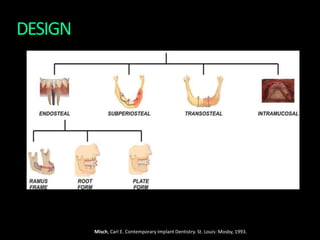
DESIGN
Misch, Carl E. Contemporary Implant Dentistry. St. Louis: Mosby, 1993.
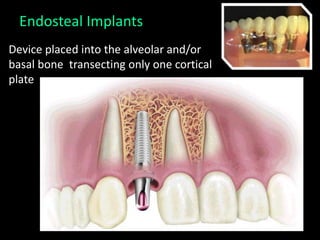
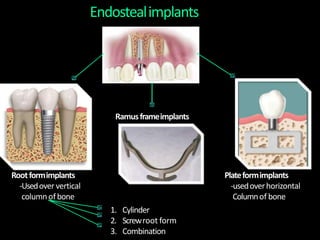
Endosteal Implants
Device placed into the alveolar and/or
basal bone transecting only one cortical
plate
Endostealimplants
Rootformimplants
-Usedover vertical
columnofbone
Plateformimplants
-usedoverhorizontal
Columnof bone
1. Cylinder
2. Screwroot form
3. Combination
Ramusframeimplants
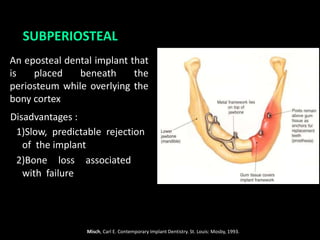
An eposteal dental implant that
is placed beneath the
periosteum while overlying the
bony cortex
Disadvantages :
1)Slow, predictable rejection
of the implant
2)Bone loss associated
with failure
SUBPERIOSTEAL
Misch, Carl E. Contemporary Implant Dentistry. St. Louis: Mosby, 1993.
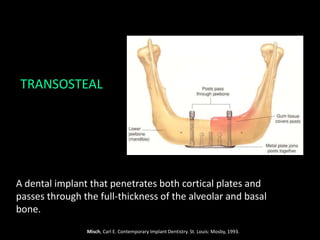
TRANSOSTEAL
A dental implant that penetrates both cortical plates and
passes through the full-thickness of the alveolar and basal
bone.
Misch, Carl E. Contemporary Implant Dentistry. St. Louis: Mosby, 1993.
Osseointegration
• The apparent direct attachment or connection
of osseous tissue to an inert, alloplastic
material without intervening fibrous
connective tissue.
-GPT 9
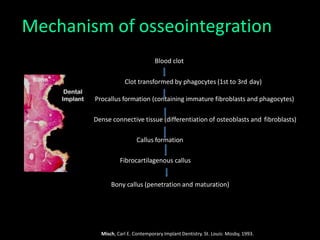
Mechanism of osseointegration
Blood clot
Clot transformed by phagocytes (1st to 3rd day)
Procallus formation (containing immature fibroblasts and phagocytes)
Dense connective tissue (differentiation of osteoblasts and fibroblasts)
Callus formation
Fibrocartilagenous callus
Bony callus (penetration and maturation)
Misch, Carl E. Contemporary Implant Dentistry. St. Louis: Mosby, 1993.
IMPLANT DESIGN
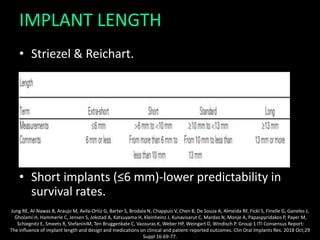
IMPLANT LENGTH
• Striezel & Reichart.
• Short implants (≤6 mm)-lower predictability in
survival rates.
Jung RE, Al-Nawas B, Araujo M, Avila-Ortiz G, Barter S, Brodala N, Chappuis V, Chen B, De Souza A, Almeida RF, Fickl S, Finelle G, Ganeles J,
Gholami H, Hammerle C, Jensen S, Jokstad A, Katsuyama H, Kleinheinz J, Kunavisarut C, Mardas N, Monje A, Papaspyridakos P, Payer M,
Schiegnitz E, Smeets R, StefaniniM, Ten Bruggenkate C, Vazouras K, Weber HP, Weingart D, Windisch P. Group 1 ITI Consensus Report:
The influence of implant length and design and medications on clinical and patient-reported outcomes. Clin Oral Implants Res. 2018 Oct;29
Suppl 16:69-77.
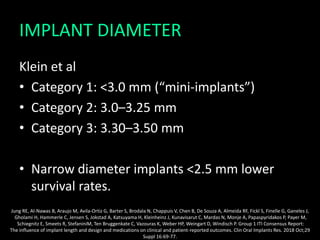
IMPLANT DIAMETER
Klein et al
• Category 1: <3.0 mm (“mini-implants”)
• Category 2: 3.0–3.25 mm
• Category 3: 3.30–3.50 mm
• Narrow diameter implants <2.5 mm lower
survival rates.
Jung RE, Al-Nawas B, Araujo M, Avila-Ortiz G, Barter S, Brodala N, Chappuis V, Chen B, De Souza A, Almeida RF, Fickl S, Finelle G, Ganeles J,
Gholami H, Hammerle C, Jensen S, Jokstad A, Katsuyama H, Kleinheinz J, Kunavisarut C, Mardas N, Monje A, Papaspyridakos P, Payer M,
Schiegnitz E, Smeets R, StefaniniM, Ten Bruggenkate C, Vazouras K, Weber HP, Weingart D, Windisch P. Group 1 ITI Consensus Report:
The influence of implant length and design and medications on clinical and patient-reported outcomes. Clin Oral Implants Res. 2018 Oct;29
Suppl 16:69-77.
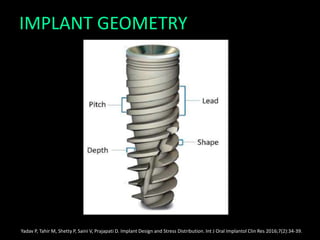
IMPLANT GEOMETRY
Yadav P, Tahir M, Shetty P, Saini V, Prajapati D. Implant Design and Stress Distribution. Int J Oral Implantol Clin Res 2016;7(2):34-39.
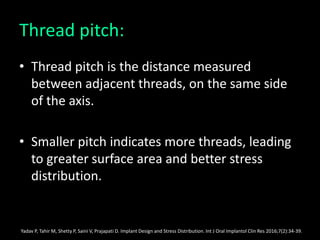
Thread pitch:
• Thread pitch is the distance measured
between adjacent threads, on the same side
of the axis.
• Smaller pitch indicates more threads, leading
to greater surface area and better stress
distribution.
Yadav P, Tahir M, Shetty P, Saini V, Prajapati D. Implant Design and Stress Distribution. Int J Oral Implantol Clin Res 2016;7(2):34-39.
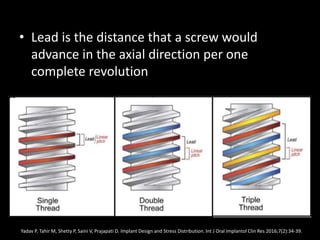
• Lead is the distance that a screw would
advance in the axial direction per one
complete revolution
Yadav P, Tahir M, Shetty P, Saini V, Prajapati D. Implant Design and Stress Distribution. Int J Oral Implantol Clin Res 2016;7(2):34-39.
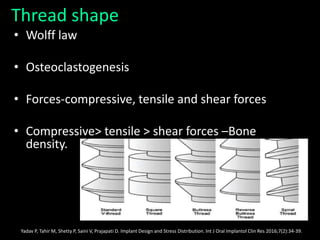
Thread shape
• Wolff law
• Osteoclastogenesis
• Forces-compressive, tensile and shear forces
• Compressive> tensile > shear forces –Bone
density.
Yadav P, Tahir M, Shetty P, Saini V, Prajapati D. Implant Design and Stress Distribution. Int J Oral Implantol Clin Res 2016;7(2):34-39.
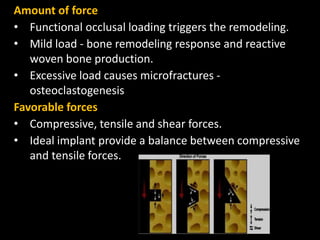
Amount of force
• Functional occlusal loading triggers the remodeling.
• Mild load - bone remodeling response and reactive
woven bone production.
• Excessive load causes microfractures -
osteoclastogenesis
Favorable forces
• Compressive, tensile and shear forces.
• Ideal implant provide a balance between compressive
and tensile forces.
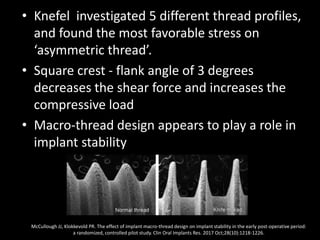
• Knefel investigated 5 different thread profiles,
and found the most favorable stress on
‘asymmetric thread’.
• Square crest - flank angle of 3 degrees
decreases the shear force and increases the
compressive load
• Macro-thread design appears to play a role in
implant stability
McCullough JJ, Klokkevold PR. The effect of implant macro-thread design on implant stability in the early post-operative period:
a randomized, controlled pilot study. Clin Oral Implants Res. 2017 Oct;28(10):1218-1226.
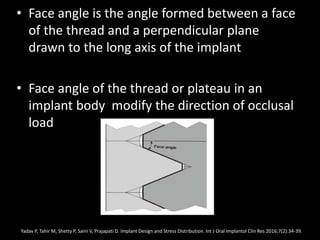
• Face angle is the angle formed between a face
of the thread and a perpendicular plane
drawn to the long axis of the implant
• Face angle of the thread or plateau in an
implant body modify the direction of occlusal
load
Yadav P, Tahir M, Shetty P, Saini V, Prajapati D. Implant Design and Stress Distribution. Int J Oral Implantol Clin Res 2016;7(2):34-39.
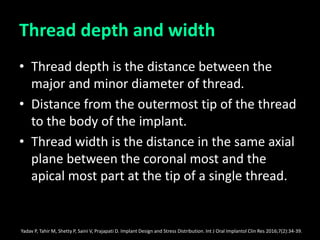
Thread depth and width
• Thread depth is the distance between the
major and minor diameter of thread.
• Distance from the outermost tip of the thread
to the body of the implant.
• Thread width is the distance in the same axial
plane between the coronal most and the
apical most part at the tip of a single thread.
Yadav P, Tahir M, Shetty P, Saini V, Prajapati D. Implant Design and Stress Distribution. Int J Oral Implantol Clin Res 2016;7(2):34-39.
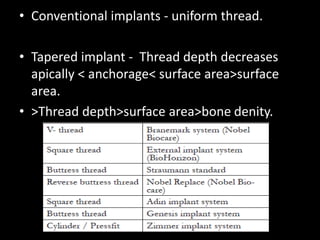
• Conventional implants - uniform thread.
• Tapered implant - Thread depth decreases
apically < anchorage< surface area>surface
area.
• >Thread depth>surface area>bone denity.
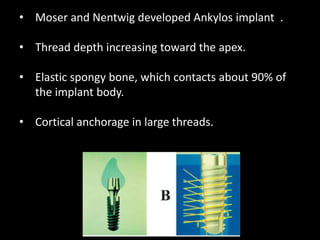
• Moser and Nentwig developed Ankylos implant .
• Thread depth increasing toward the apex.
• Elastic spongy bone, which contacts about 90% of
the implant body.
• Cortical anchorage in large threads.
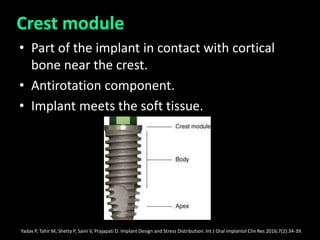
Crest module
• Part of the implant in contact with cortical
bone near the crest.
• Antirotation component.
• Implant meets the soft tissue.
Yadav P, Tahir M, Shetty P, Saini V, Prajapati D. Implant Design and Stress Distribution. Int J Oral Implantol Clin Res 2016;7(2):34-39.
• Slightly larger than the outer thread diameter
of the implant body.
• achieve primary stability.
• Smooth and polished to decrease plaque
retention.
• Microthreads.
Falco A, Berardini M, Trisi P. Correlation Between Implant Geometry, Implant Surface, Insertion Torque, and Primary Stability:
In Vitro Biomechanical Analysis. Int J Oral Maxillofac Implants. 2018 Jul/Aug;33(4):824-830.
Rough or Smooth neck
• Crest module was always smooth.
• Decreases plaque retention.
• Placed under the bone crest- increased shear forces -
marginal bone loss and pocket formation.
• Smooth neck - placed over the bone crest.
• Functionally loading the bone at the crest with a rough
implant neck induces a favorable stress and reduces
disuse atrophy
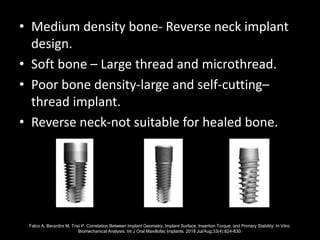
• Medium density bone- Reverse neck implant
design.
• Soft bone – Large thread and microthread.
• Poor bone density-large and self-cutting–
thread implant.
• Reverse neck-not suitable for healed bone.
Falco A, Berardini M, Trisi P. Correlation Between Implant Geometry, Implant Surface, Insertion Torque, and Primary Stability: In Vitro
Biomechanical Analysis. Int J Oral Maxillofac Implants. 2018 Jul/Aug;33(4):824-830.
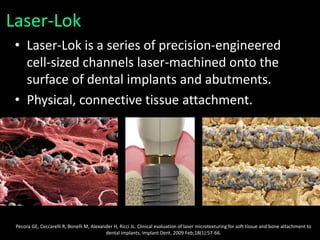
Laser-Lok
• Laser-Lok is a series of precision-engineered
cell-sized channels laser-machined onto the
surface of dental implants and abutments.
• Physical, connective tissue attachment.
Pecora GE, Ceccarelli R, Bonelli M, Alexander H, Ricci JL. Clinical evaluation of laser microtexturing for soft tissue and bone attachment to
dental implants. Implant Dent. 2009 Feb;18(1):57-66.
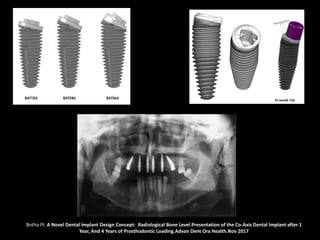
Botha PJ. A Novel Dental Implant Design Concept: Radiological Bone Level Presentation of the Co-Axis Dental Implant after 1
Year, And 4 Years of Prosthodontic Loading.Advan Dent Ora Health.Nov 2017
Surface characteristics
• “Hybrid implant”.
• Subgingival hard tissue interface of the endosseous
implant body.
• Soft tissue transgingival interface at the implant
neck and platform.
• Interface to the oral cavity with its salivary
environment at the transgingival and the
supragingival region .
Rupp F, Liang L, Geis-Gerstorfer J, Scheideler L, Hüttig F. Surface characteristics of dental implants: A review. Dent Mater. 2018 Jan;34(1):40-57.
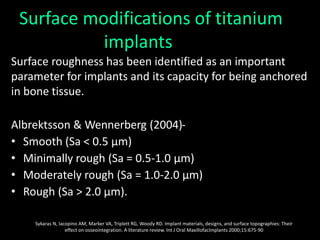
Surface modifications of titanium
implants
Surface roughness has been identified as an important
parameter for implants and its capacity for being anchored
in bone tissue.
Albrektsson & Wennerberg (2004)-
• Smooth (Sa < 0.5 μm)
• Minimally rough (Sa = 0.5-1.0 μm)
• Moderately rough (Sa = 1.0-2.0 μm)
• Rough (Sa > 2.0 μm).
Sykaras N, Iacopino AM, Marker VA, Triplett RG, Woody RD. Implant materials, designs, and surface topographies: Their
effect on osseointegration. A literature review. Int J Oral MaxillofacImplants 2000;15:675-90
Classification of Surface treatment
Classification -1
• Ablative/Subtractive processes-
Eg: Grit Blasting, Acid Etching, Anodisation, Laser peening
• Additive processes-
Eg: Plasma Spraying, Electrophoretic Deposition, Sol Gel
coating, Biomimetic precipitation
Classification -2
Based on texture :
• Concave texture: Additive treatments like
hydroxyapatite coating and titanium plasma
spraying.
• Convex texture: Subtractive treatment like
etching and blasting
Sykaras N, Iacopino AM, Marker VA, Triplett RG, Woody RD. Implant materials, designs, and surface topographies: Their
effect on osseointegration. A literature review. Int J Oral MaxillofacImplants 2000;15:675-90
Classification -3
Surface irregularities, implant surfaces :
 Isotropic surfaces: have the same topography
independent of measuring direction.
 Anisotropic surfaces: have clear directionality and differ
considerably in roughness
Brunette DM. The effects of implant surface topography on thebehavior of cells. Int J Oral Maxillofac Implants 1988;3:231-46.
Classification -4
 Physicochemical: modification of surface energy,
surface charge and surface composition to
improve the bone- implant interface.
 Morphological: alteration of surface morphology
and roughness to influence cell and tissue
response to implants
 Biochemical: increased biochemical interaction of
implant with bone.
Ito Y, Kajihara M, Imanishi Y. Materials for enhancing cell adhesion by immobilization of cell-adhesive peptide. J Biomed
Mater Res 1991;25:1325-37.
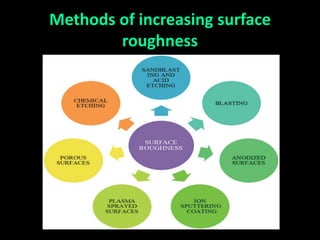
Methods of increasing surface
roughness
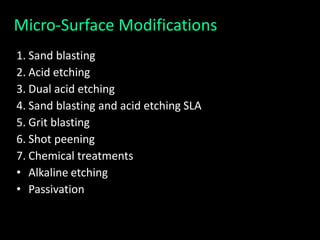
Micro-Surface Modifications
1. Sand blasting
2. Acid etching
3. Dual acid etching
4. Sand blasting and acid etching SLA
5. Grit blasting
6. Shot peening
7. Chemical treatments
• Alkaline etching
• Passivation
Micro-Surface Modifications
8. Electrochemical treatments
• Anodic oxidation /anodization.
9. Laser treatments – Laser peening
10.Vacuum treatment
11.Thermal treatments
12.Plasma spraying -- Titanium plasma spray (TPS)
13.Sputter deposition
14.Biomimetic precipitation
15.Ultrasonic spray pyrolysis
• Albrektsson et al - surface properties -
biological response .
• Grit-blasting, acid etching by mineral acids,
anodic oxidation, calcium-phosphate coatings
or combinations.
• Hydrophilic vs hydrophobic surfaces .
Rupp F, Liang L, Geis-Gerstorfer J, Scheideler L, Hüttig F. Surface characteristics of dental implants: A review. Dent Mater. 2018 Jan;34(1):40-57.
Machined and Blasted Surface
• Between the 25 and 250μm, 25μm showed significantly
more BIC.
• Leakage of different metallic ions.
• > 1,600 ppm in haversian canal.
• Enlarged surface area may have a negative effect on
enhanced ion release.
Sandblasting
Surface roughness is dependent on the bulk material,
the particle material, (size, shape, speed density),
duration of blasting, air pressure, and distance
between the source of the particles and implant
surface.
• Blasting media --Al2O3 or SiO2.
• 25 μm particles were rougher than machined
surface and smoother than 75 μm and 250 μm .
• Typical Sa values range from 0.5-2.0 μm
Goals of sand blasting:
• Cleaning implant surface and increasing
bioactivity.
• Roughening surfaces to increase effective /
functional SA.
• Accelerate osteoblasts adhesion and proliferation.
• Producing beneficial compressive residual stress.
• Exhibiting higher surface energy, surface chemical
and physical activities.
Acid-etching
• Immersing in strong acids (e.g., HNO3, HCl, HF, H2SO4)
creates a micro-roughness of 0.5–3 μm.
• Surface is pitted by removal of grains and grain
boundaries of the implant surface.
• Removes deposits.
• Macrotextured surface.
• Sa values are 0.3-1.0 μm .
Giner L, Mercadé M, Torrent S, Punset M, Pérez RA, Delgado LM, Gil FJ. Double acid etching treatment of dental implants for enhanced biologica
properties. J Appl Biomater Funct Mater. 2018 Apr;16(2):83-89.
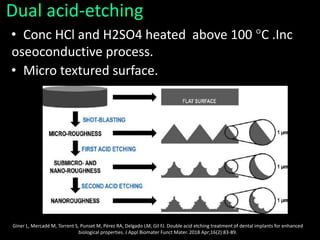
Dual acid-etching
• Conc HCl and H2SO4 heated above 100 °C .Inc
oseoconductive process.
• Micro textured surface.
Giner L, Mercadé M, Torrent S, Punset M, Pérez RA, Delgado LM, Gil FJ. Double acid etching treatment of dental implants for enhanced
biological properties. J Appl Biomater Funct Mater. 2018 Apr;16(2):83-89.
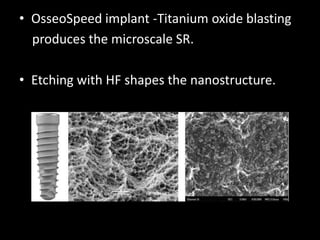
• OsseoSpeed implant -Titanium oxide blasting
produces the microscale SR.
• Etching with HF shapes the nanostructure.
Alkaline etching
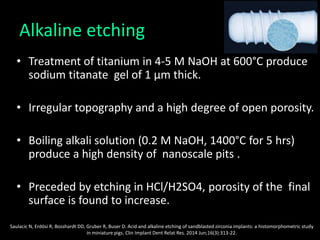
• Treatment of titanium in 4-5 M NaOH at 600°C produce
sodium titanate gel of 1 μm thick.
• Irregular topography and a high degree of open porosity.
• Boiling alkali solution (0.2 M NaOH, 1400°C for 5 hrs)
produce a high density of nanoscale pits .
• Preceded by etching in HCl/H2SO4, porosity of the final
surface is found to increase.
Saulacic N, Erdösi R, Bosshardt DD, Gruber R, Buser D. Acid and alkaline etching of sandblasted zirconia implants: a histomorphometric study
in miniature pigs. Clin Implant Dent Relat Res. 2014 Jun;16(3):313-22.
Grit blasting
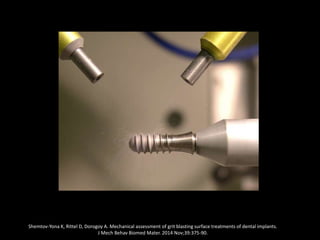
• Bombarded with hard dry particles in a liquid, through a
nozzle at high velocity by means of compressed air.
• Ceramic particles such as alumina, silica, Titanium oxide,
calcium phosphate particles are used.
• Blasting media is embedded in the implant surface.
• Residue particles have been released into the surrounding
tissues and interfered with osseointegration.
Shemtov-Yona K, Rittel D, Dorogoy A. Mechanical assessment of grit blasting surface treatments of dental implants.
J Mech Behav Biomed Mater. 2014 Nov;39:375-90.
Shemtov-Yona K, Rittel D, Dorogoy A. Mechanical assessment of grit blasting surface treatments of dental implants.
J Mech Behav Biomed Mater. 2014 Nov;39:375-90.
Sandblasted and acid etched surface (SLA)
• SLA – (Buser) Sandblasted, Large grit, Acid etched.
• In SLA ,titanium dental implant surface is first
sandblasted with large grits 250 - 500 μm.
• Acid-etched by HCL/H2SO4. Acid etching leads to micro
texturing and cleaning.
• Chemical modifications in a roughened implant surface
alter biologic events during the osseointegration and
enhances healing process.
Oates TW, Valderrama P, Bischof M, Nedir R, Jones A, Simpson J, Toutenburg H, Cochran DL. Enhanced implant stability with a chemically
modified SLA surface: a randomized pilot study. Int J Oral Maxillofac Implants. 2007 Sep-Oct;22(5):755-60.
• Toureg –ADIN
• Tuff-Norris
• The FRIADENT plus surface - Large gritblasting
(354–500 𝜇m), followed by etching in HCl,
H2SO4, HF with proprietary neutralizing
technique.
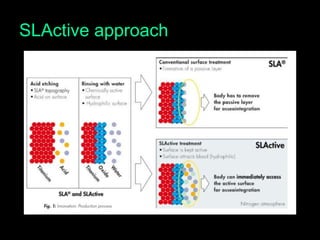
SLActive approach
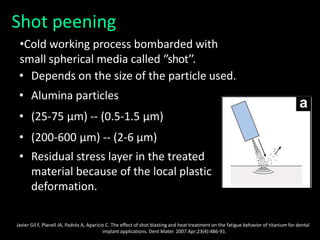
Shot peening
•Cold working process bombarded with
small spherical media called ‘’shot’’.
• Depends on the size of the particle used.
• Alumina particles
• (25-75 μm) -- (0.5-1.5 μm)
• (200-600 μm) -- (2-6 μm)
• Residual stress layer in the treated
material because of the local plastic
deformation.
Javier Gil F, Planell JA, Padrós A, Aparicio C. The effect of shot blasting and heat treatment on the fatigue behavior of titanium for dental
implant applications. Dent Mater. 2007 Apr;23(4):486-91.
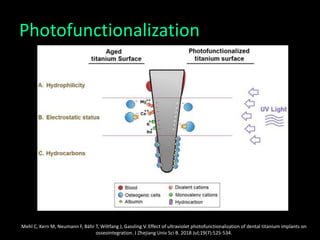
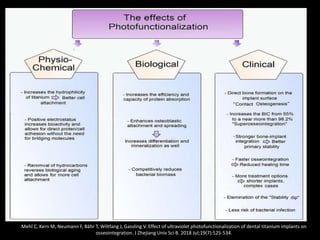
Photofunctionalization
Mehl C, Kern M, Neumann F, Bähr T, Wiltfang J, Gassling V. Effect of ultraviolet photofunctionalization of dental titanium implants on
osseointegration. J Zhejiang Univ Sci B. 2018 Jul;19(7):525-534.
Mehl C, Kern M, Neumann F, Bähr T, Wiltfang J, Gassling V. Effect of ultraviolet photofunctionalization of dental titanium implants on
osseointegration. J Zhejiang Univ Sci B. 2018 Jul;19(7):525-534.
Passivation treatments
• Obtain a uniformly oxidized surface to improve
corrosion resistance.
• Immersion of Ti for 30 min in 20-40 vol% sol of HNO3.
• After passivation, surface of the implant should be
neutralized, thoroughly rinsed and dried.
• Heat treatment - air at 400- 600 °C or ageing in boiling
deionized water for several hours.
Strnad G, Chirila N, Jakab-Farkas L. Effect of Surface Preparation and Passivation Treatment on Surface Topography of
Ti6Al4V for Dental Implants. Applied Mechanics and Materials 2015;809–810:513–8.
Anodic oxidation
• Produces roughness, porosity and chemical composition for
improved biocompatibility.
• Anodes in galvanic cells, with phosphoric acid as the
electrolyte
• Flat layer or tubular and can have amorphous or anatase
phase.
• Titanium oxide layer and a porous topography.
• Calcium and phosphorus are deposited on the titanium oxide
during anodization for the formation of HA.
• Xeal™: A hydrophilic abutment surface for the
Mucointegration™ process.
• TiUltra ™ -Protective Layer dissolves upon
contact with a fluid, i.e. blood.
• Significantly decreases carbon build-up
maintaining the surface chemistry for
hydrophilicity.
Bioceramics
• Hydroxyapatite (HA)
• Calcium phosphate phases.
Bioactive proteins
• Bone morphogenic proteins (BMP)
• Type 1 collagen
• RGD peptide sequence.
Ions
• Fluoride.
Polymers
• Chitosan.
BIOMIMETIC AGENTS
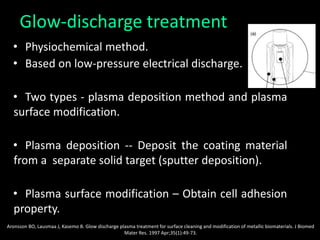
Glow-discharge treatment
• Physiochemical method.
• Based on low-pressure electrical discharge.
• Two types - plasma deposition method and plasma
surface modification.
• Plasma deposition -- Deposit the coating material
from a separate solid target (sputter deposition).
• Plasma surface modification – Obtain cell adhesion
property.
Aronsson BO, Lausmaa J, Kasemo B. Glow discharge plasma treatment for surface cleaning and modification of metallic biomaterials. J Biomed
Mater Res. 1997 Apr;35(1):49-73.
Titanium Plasma Spray (TPS)
• Created by having an electrical arc.
• Finger-type tungsten cathode and nozzle-type
copper anode inside the plasma torch.
• Inject titanium powders into a plasma torch at high
temperature.
• Ti particles projected on to the surface of the
implants where they condense and fuse together,
forming a film about 30μm thick.
Amarante ES, de Lima LA. [Optimization of implant surfaces: titanium plasma spray and acid-etched sandblasting -- current status]. Pesqui
Odontol Bras. 2001 Apr-Jun;15(2):166-73
• The thickness must reach 40-50μm to be uniform.
• TPS average roughness of around 7μm.
Amarante ES, de Lima LA. [Optimization of implant surfaces: titanium plasma spray and acid-etched sandblasting -- current status]. Pesqui
Odontol Bras. 2001 Apr-Jun;15(2):166-73
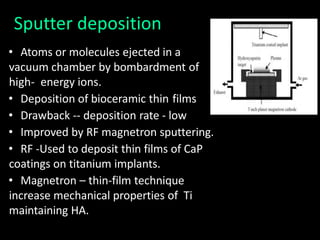
Sputter deposition
• Atoms or molecules ejected in a
vacuum chamber by bombardment of
high- energy ions.
• Deposition of bioceramic thin films
• Drawback -- deposition rate - low
• Improved by RF magnetron sputtering.
• RF -Used to deposit thin films of CaP
coatings on titanium implants.
• Magnetron – thin-film technique
increase mechanical properties of Ti
maintaining HA.
Electrophoretic Deposition
• Colloidal particles such as HP nanoprecipitates
suspended in a liquid medium migrate under electric
field and deposited onto counter charged electrode.
• Coating formed by pressure exerted by difference
between the electrodes.
• EPD can produce HA coatings ranging from <1 to
>500μmthick.
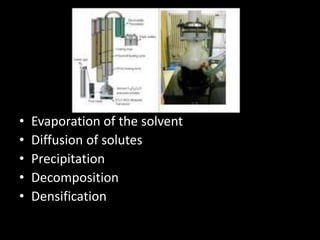
Ultrasonic spraypyrolysis
• Aerosol deposition of nanopowders.
• Particle morphology is the result of -- droplet size (1-
100μm), precursor concentration, operating
temperature and evaporation rate.
• Aerosol generation, thermal decomposition,
nanopowder collection.
• Evaporation of the solvent
• Diffusion of solutes
• Precipitation
• Decomposition
• Densification
Conclusion
• Knowledge of the benefits and limitations of
various implant surfaces, designs and systems
are vital for arriving at a clear clinical decision
to attain the best rehabilitation possible.
REFERENCE
• Misch, Carl E. Contemporary Implant Dentistry. St. Louis: Mosby,
1993.
• Yadav P, Tahir M, Shetty P, Prajapati D. Implant Design and Stress
Distribution. Int J Oral Implantol Clin Res 2016;7(2):34-39.
• McCullough JJ, Klokkevold PR. The effect of implant macro-thread
design on implant stability in the early post-operative period: a
randomized, controlled pilot study. Clin Oral Implants Res. 2017
Oct;28(10):1218-1226.
• Calì M, Zanetti EM, Oliveri SM, Asero R, Ciaramella S, Martorelli
M, Bignardi C. Influence of thread shape and inclination on the
biomechanical behaviour of plateau implant systems. Dent
Mater. 2018 Mar;34(3):460-469.
• Falco A, Berardini M, Trisi P. Correlation Between Implant Geometry,
Implant Surface, Insertion Torque, and Primary Stability: In Vitro
Biomechanical Analysis. Int J Oral Maxillofac Implants. 2018
Jul/Aug;33(4):824-830.
• Botha PJ. A Novel Dental Implant Design Concept: Radiological Bone
Level Presentation of the Co-Axis Dental Implant after 1 Year, And 4
Years of Prosthodontic Loading.Advan Dent Ora Health.Nov 2017.
• Sykaras N, Iacopino AM, Marker VA, Triplett RG, Woody RD. Implant
materials, designs, and surface topographies: Their effect on
osseointegration. A literature review. Int J Oral MaxillofacImplants
2000;15:675-90.
• Rupp F, Liang L, Geis-Gerstorfer J, Scheideler L, Hüttig F. Surface
characteristics of dental implants: A review. Dent Mater. 2018
Jan;34(1):40-57.
• Mehl C, Kern M, Neumann F, Bähr T, Wiltfang J, Gassling V.
Effect of ultraviolet photofunctionalization of dental titanium
implants on osseointegration. J Zhejiang Univ Sci B. 2018
Jul;19(7):525-534.
• Shemtov-Yona K, Rittel D, Dorogoy A. Mechanical assessment
of grit blasting surface treatments of dental implants. J Mech
Behav Biomed Mater. 2014 Nov;39:375-90.
• Javier Gil F, Planell JA, Padrós A, Aparicio C. The effect of shot
blasting and heat treatment on the fatigue behavior of
titanium for dental implant applications. Dent Mater. 2007
Apr;23(4):486-91.
• Giner L, Mercadé M, Torrent S, Punset M, Pérez RA, Delgado
LM, Gil FJ. Double acid etching treatment of dental implants
for enhanced biological properties. J Appl Biomater Funct
Mater. 2018 Apr;16(2):83-89.
• Oates TW, Valderrama P, Bischof M, Nedir R, Jones A, Simpson
J, Toutenburg H, Cochran DL. Enhanced implant stability with
a chemically modified SLA surface: a randomized pilot study.
Int J Oral Maxillofac Implants. 2007 Sep-Oct;22(5):755-60.
• Saulacic N, Erdösi R, Bosshardt DD, Gruber R, Buser D. Acid
and alkaline etching of sandblasted zirconia implants: a
histomorphometric study in miniature pigs. Clin Implant Dent
Relat Res. 2014 Jun;16(3):313-22.
• Strnad G, Chirila N, Jakab-Farkas L. Effect of Surface
Preparation and Passivation Treatment on Surface Topography
of Ti6Al4V for Dental Implants. Applied Mechanics and
Materials 2015;809–810:513–8.
• Aronsson BO, Lausmaa J, Kasemo B. Glow discharge plasma
treatment for surface cleaning and modification of metallic
biomaterials. J Biomed Mater Res. 1997 Apr;35(1):49-73.
• Amarante ES, de Lima LA. [Optimization of implant surfaces:
titanium plasma spray and acid-etched sandblasting -- current
status]. Pesqui Odontol Bras. 2001 Apr-Jun;15(2):166-73 .
• Al Mugeiren OM, Baseer MA. Dental Implant Bioactive Surface
Modifiers: An Update. J Int Soc Prev Community Dent. 2019
Jan-Feb;9(1):1-4.
THANK YOU

Implant design

  • 1.
    CONCEPT IN IMPLANTDESIGN AND SURFACE PRESENTED BY DR ARUN KUMAR C S
  • 2.
    • A prostheticdevice made of alloplastic material(s) implanted into the oral tissues beneath the mucosal and/or periosteal layer and on or within the bone to provide retention and support for a fixed or removable dental prosthesis. -GPT 9 Implant
  • 3.
    DESIGN Misch, Carl E.Contemporary Implant Dentistry. St. Louis: Mosby, 1993.
  • 4.
    Endosteal Implants Device placedinto the alveolar and/or basal bone transecting only one cortical plate
  • 5.
  • 6.
    An eposteal dentalimplant that is placed beneath the periosteum while overlying the bony cortex Disadvantages : 1)Slow, predictable rejection of the implant 2)Bone loss associated with failure SUBPERIOSTEAL Misch, Carl E. Contemporary Implant Dentistry. St. Louis: Mosby, 1993.
  • 7.
    TRANSOSTEAL A dental implantthat penetrates both cortical plates and passes through the full-thickness of the alveolar and basal bone. Misch, Carl E. Contemporary Implant Dentistry. St. Louis: Mosby, 1993.
  • 8.
    Osseointegration • The apparentdirect attachment or connection of osseous tissue to an inert, alloplastic material without intervening fibrous connective tissue. -GPT 9
  • 9.
    Mechanism of osseointegration Bloodclot Clot transformed by phagocytes (1st to 3rd day) Procallus formation (containing immature fibroblasts and phagocytes) Dense connective tissue (differentiation of osteoblasts and fibroblasts) Callus formation Fibrocartilagenous callus Bony callus (penetration and maturation) Misch, Carl E. Contemporary Implant Dentistry. St. Louis: Mosby, 1993.
  • 10.
  • 11.
    IMPLANT LENGTH • Striezel& Reichart. • Short implants (≤6 mm)-lower predictability in survival rates. Jung RE, Al-Nawas B, Araujo M, Avila-Ortiz G, Barter S, Brodala N, Chappuis V, Chen B, De Souza A, Almeida RF, Fickl S, Finelle G, Ganeles J, Gholami H, Hammerle C, Jensen S, Jokstad A, Katsuyama H, Kleinheinz J, Kunavisarut C, Mardas N, Monje A, Papaspyridakos P, Payer M, Schiegnitz E, Smeets R, StefaniniM, Ten Bruggenkate C, Vazouras K, Weber HP, Weingart D, Windisch P. Group 1 ITI Consensus Report: The influence of implant length and design and medications on clinical and patient-reported outcomes. Clin Oral Implants Res. 2018 Oct;29 Suppl 16:69-77.
  • 12.
    IMPLANT DIAMETER Klein etal • Category 1: <3.0 mm (“mini-implants”) • Category 2: 3.0–3.25 mm • Category 3: 3.30–3.50 mm • Narrow diameter implants <2.5 mm lower survival rates. Jung RE, Al-Nawas B, Araujo M, Avila-Ortiz G, Barter S, Brodala N, Chappuis V, Chen B, De Souza A, Almeida RF, Fickl S, Finelle G, Ganeles J, Gholami H, Hammerle C, Jensen S, Jokstad A, Katsuyama H, Kleinheinz J, Kunavisarut C, Mardas N, Monje A, Papaspyridakos P, Payer M, Schiegnitz E, Smeets R, StefaniniM, Ten Bruggenkate C, Vazouras K, Weber HP, Weingart D, Windisch P. Group 1 ITI Consensus Report: The influence of implant length and design and medications on clinical and patient-reported outcomes. Clin Oral Implants Res. 2018 Oct;29 Suppl 16:69-77.
  • 13.
    IMPLANT GEOMETRY Yadav P,Tahir M, Shetty P, Saini V, Prajapati D. Implant Design and Stress Distribution. Int J Oral Implantol Clin Res 2016;7(2):34-39.
  • 14.
    Thread pitch: • Threadpitch is the distance measured between adjacent threads, on the same side of the axis. • Smaller pitch indicates more threads, leading to greater surface area and better stress distribution. Yadav P, Tahir M, Shetty P, Saini V, Prajapati D. Implant Design and Stress Distribution. Int J Oral Implantol Clin Res 2016;7(2):34-39.
  • 15.
    • Lead isthe distance that a screw would advance in the axial direction per one complete revolution Yadav P, Tahir M, Shetty P, Saini V, Prajapati D. Implant Design and Stress Distribution. Int J Oral Implantol Clin Res 2016;7(2):34-39.
  • 16.
    Thread shape • Wolfflaw • Osteoclastogenesis • Forces-compressive, tensile and shear forces • Compressive> tensile > shear forces –Bone density. Yadav P, Tahir M, Shetty P, Saini V, Prajapati D. Implant Design and Stress Distribution. Int J Oral Implantol Clin Res 2016;7(2):34-39.
  • 17.
    Amount of force •Functional occlusal loading triggers the remodeling. • Mild load - bone remodeling response and reactive woven bone production. • Excessive load causes microfractures - osteoclastogenesis Favorable forces • Compressive, tensile and shear forces. • Ideal implant provide a balance between compressive and tensile forces.
  • 18.
    • Knefel investigated5 different thread profiles, and found the most favorable stress on ‘asymmetric thread’. • Square crest - flank angle of 3 degrees decreases the shear force and increases the compressive load • Macro-thread design appears to play a role in implant stability McCullough JJ, Klokkevold PR. The effect of implant macro-thread design on implant stability in the early post-operative period: a randomized, controlled pilot study. Clin Oral Implants Res. 2017 Oct;28(10):1218-1226.
  • 19.
    • Face angleis the angle formed between a face of the thread and a perpendicular plane drawn to the long axis of the implant • Face angle of the thread or plateau in an implant body modify the direction of occlusal load Yadav P, Tahir M, Shetty P, Saini V, Prajapati D. Implant Design and Stress Distribution. Int J Oral Implantol Clin Res 2016;7(2):34-39.
  • 20.
    Thread depth andwidth • Thread depth is the distance between the major and minor diameter of thread. • Distance from the outermost tip of the thread to the body of the implant. • Thread width is the distance in the same axial plane between the coronal most and the apical most part at the tip of a single thread. Yadav P, Tahir M, Shetty P, Saini V, Prajapati D. Implant Design and Stress Distribution. Int J Oral Implantol Clin Res 2016;7(2):34-39.
  • 21.
    • Conventional implants- uniform thread. • Tapered implant - Thread depth decreases apically < anchorage< surface area>surface area. • >Thread depth>surface area>bone denity.
  • 22.
    • Moser andNentwig developed Ankylos implant . • Thread depth increasing toward the apex. • Elastic spongy bone, which contacts about 90% of the implant body. • Cortical anchorage in large threads.
  • 23.
    Crest module • Partof the implant in contact with cortical bone near the crest. • Antirotation component. • Implant meets the soft tissue. Yadav P, Tahir M, Shetty P, Saini V, Prajapati D. Implant Design and Stress Distribution. Int J Oral Implantol Clin Res 2016;7(2):34-39.
  • 24.
    • Slightly largerthan the outer thread diameter of the implant body. • achieve primary stability. • Smooth and polished to decrease plaque retention. • Microthreads. Falco A, Berardini M, Trisi P. Correlation Between Implant Geometry, Implant Surface, Insertion Torque, and Primary Stability: In Vitro Biomechanical Analysis. Int J Oral Maxillofac Implants. 2018 Jul/Aug;33(4):824-830.
  • 25.
    Rough or Smoothneck • Crest module was always smooth. • Decreases plaque retention. • Placed under the bone crest- increased shear forces - marginal bone loss and pocket formation. • Smooth neck - placed over the bone crest. • Functionally loading the bone at the crest with a rough implant neck induces a favorable stress and reduces disuse atrophy
  • 26.
    • Medium densitybone- Reverse neck implant design. • Soft bone – Large thread and microthread. • Poor bone density-large and self-cutting– thread implant. • Reverse neck-not suitable for healed bone. Falco A, Berardini M, Trisi P. Correlation Between Implant Geometry, Implant Surface, Insertion Torque, and Primary Stability: In Vitro Biomechanical Analysis. Int J Oral Maxillofac Implants. 2018 Jul/Aug;33(4):824-830.
  • 27.
    Laser-Lok • Laser-Lok isa series of precision-engineered cell-sized channels laser-machined onto the surface of dental implants and abutments. • Physical, connective tissue attachment. Pecora GE, Ceccarelli R, Bonelli M, Alexander H, Ricci JL. Clinical evaluation of laser microtexturing for soft tissue and bone attachment to dental implants. Implant Dent. 2009 Feb;18(1):57-66.
  • 28.
    Botha PJ. ANovel Dental Implant Design Concept: Radiological Bone Level Presentation of the Co-Axis Dental Implant after 1 Year, And 4 Years of Prosthodontic Loading.Advan Dent Ora Health.Nov 2017
  • 29.
    Surface characteristics • “Hybridimplant”. • Subgingival hard tissue interface of the endosseous implant body. • Soft tissue transgingival interface at the implant neck and platform. • Interface to the oral cavity with its salivary environment at the transgingival and the supragingival region . Rupp F, Liang L, Geis-Gerstorfer J, Scheideler L, Hüttig F. Surface characteristics of dental implants: A review. Dent Mater. 2018 Jan;34(1):40-57.
  • 30.
    Surface modifications oftitanium implants Surface roughness has been identified as an important parameter for implants and its capacity for being anchored in bone tissue. Albrektsson & Wennerberg (2004)- • Smooth (Sa < 0.5 μm) • Minimally rough (Sa = 0.5-1.0 μm) • Moderately rough (Sa = 1.0-2.0 μm) • Rough (Sa > 2.0 μm). Sykaras N, Iacopino AM, Marker VA, Triplett RG, Woody RD. Implant materials, designs, and surface topographies: Their effect on osseointegration. A literature review. Int J Oral MaxillofacImplants 2000;15:675-90
  • 31.
    Classification of Surfacetreatment Classification -1 • Ablative/Subtractive processes- Eg: Grit Blasting, Acid Etching, Anodisation, Laser peening • Additive processes- Eg: Plasma Spraying, Electrophoretic Deposition, Sol Gel coating, Biomimetic precipitation
  • 32.
    Classification -2 Based ontexture : • Concave texture: Additive treatments like hydroxyapatite coating and titanium plasma spraying. • Convex texture: Subtractive treatment like etching and blasting Sykaras N, Iacopino AM, Marker VA, Triplett RG, Woody RD. Implant materials, designs, and surface topographies: Their effect on osseointegration. A literature review. Int J Oral MaxillofacImplants 2000;15:675-90
  • 33.
    Classification -3 Surface irregularities,implant surfaces :  Isotropic surfaces: have the same topography independent of measuring direction.  Anisotropic surfaces: have clear directionality and differ considerably in roughness Brunette DM. The effects of implant surface topography on thebehavior of cells. Int J Oral Maxillofac Implants 1988;3:231-46.
  • 34.
    Classification -4  Physicochemical:modification of surface energy, surface charge and surface composition to improve the bone- implant interface.  Morphological: alteration of surface morphology and roughness to influence cell and tissue response to implants  Biochemical: increased biochemical interaction of implant with bone. Ito Y, Kajihara M, Imanishi Y. Materials for enhancing cell adhesion by immobilization of cell-adhesive peptide. J Biomed Mater Res 1991;25:1325-37.
  • 35.
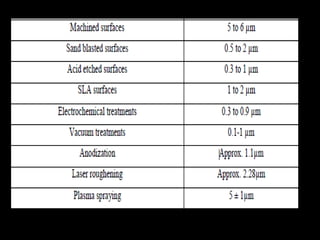
    Methods of increasingsurface roughness
  • 36.
    Micro-Surface Modifications 1. Sandblasting 2. Acid etching 3. Dual acid etching 4. Sand blasting and acid etching SLA 5. Grit blasting 6. Shot peening 7. Chemical treatments • Alkaline etching • Passivation
  • 37.
    Micro-Surface Modifications 8. Electrochemicaltreatments • Anodic oxidation /anodization. 9. Laser treatments – Laser peening 10.Vacuum treatment 11.Thermal treatments 12.Plasma spraying -- Titanium plasma spray (TPS) 13.Sputter deposition 14.Biomimetic precipitation 15.Ultrasonic spray pyrolysis
  • 38.
    • Albrektsson etal - surface properties - biological response . • Grit-blasting, acid etching by mineral acids, anodic oxidation, calcium-phosphate coatings or combinations. • Hydrophilic vs hydrophobic surfaces . Rupp F, Liang L, Geis-Gerstorfer J, Scheideler L, Hüttig F. Surface characteristics of dental implants: A review. Dent Mater. 2018 Jan;34(1):40-57.
  • 39.
    Machined and BlastedSurface • Between the 25 and 250μm, 25μm showed significantly more BIC. • Leakage of different metallic ions. • > 1,600 ppm in haversian canal. • Enlarged surface area may have a negative effect on enhanced ion release.
  • 40.
    Sandblasting Surface roughness isdependent on the bulk material, the particle material, (size, shape, speed density), duration of blasting, air pressure, and distance between the source of the particles and implant surface. • Blasting media --Al2O3 or SiO2. • 25 μm particles were rougher than machined surface and smoother than 75 μm and 250 μm . • Typical Sa values range from 0.5-2.0 μm
  • 41.
    Goals of sandblasting: • Cleaning implant surface and increasing bioactivity. • Roughening surfaces to increase effective / functional SA. • Accelerate osteoblasts adhesion and proliferation. • Producing beneficial compressive residual stress. • Exhibiting higher surface energy, surface chemical and physical activities.
  • 42.
    Acid-etching • Immersing instrong acids (e.g., HNO3, HCl, HF, H2SO4) creates a micro-roughness of 0.5–3 μm. • Surface is pitted by removal of grains and grain boundaries of the implant surface. • Removes deposits. • Macrotextured surface. • Sa values are 0.3-1.0 μm . Giner L, Mercadé M, Torrent S, Punset M, Pérez RA, Delgado LM, Gil FJ. Double acid etching treatment of dental implants for enhanced biologica properties. J Appl Biomater Funct Mater. 2018 Apr;16(2):83-89.
  • 43.
    Dual acid-etching • ConcHCl and H2SO4 heated above 100 °C .Inc oseoconductive process. • Micro textured surface. Giner L, Mercadé M, Torrent S, Punset M, Pérez RA, Delgado LM, Gil FJ. Double acid etching treatment of dental implants for enhanced biological properties. J Appl Biomater Funct Mater. 2018 Apr;16(2):83-89.
  • 44.
    • OsseoSpeed implant-Titanium oxide blasting produces the microscale SR. • Etching with HF shapes the nanostructure.
  • 45.
    Alkaline etching • Treatmentof titanium in 4-5 M NaOH at 600°C produce sodium titanate gel of 1 μm thick. • Irregular topography and a high degree of open porosity. • Boiling alkali solution (0.2 M NaOH, 1400°C for 5 hrs) produce a high density of nanoscale pits . • Preceded by etching in HCl/H2SO4, porosity of the final surface is found to increase. Saulacic N, Erdösi R, Bosshardt DD, Gruber R, Buser D. Acid and alkaline etching of sandblasted zirconia implants: a histomorphometric study in miniature pigs. Clin Implant Dent Relat Res. 2014 Jun;16(3):313-22.
  • 46.
    Grit blasting • Bombardedwith hard dry particles in a liquid, through a nozzle at high velocity by means of compressed air. • Ceramic particles such as alumina, silica, Titanium oxide, calcium phosphate particles are used. • Blasting media is embedded in the implant surface. • Residue particles have been released into the surrounding tissues and interfered with osseointegration. Shemtov-Yona K, Rittel D, Dorogoy A. Mechanical assessment of grit blasting surface treatments of dental implants. J Mech Behav Biomed Mater. 2014 Nov;39:375-90.
  • 47.
    Shemtov-Yona K, RittelD, Dorogoy A. Mechanical assessment of grit blasting surface treatments of dental implants. J Mech Behav Biomed Mater. 2014 Nov;39:375-90.
  • 48.
    Sandblasted and acidetched surface (SLA) • SLA – (Buser) Sandblasted, Large grit, Acid etched. • In SLA ,titanium dental implant surface is first sandblasted with large grits 250 - 500 μm. • Acid-etched by HCL/H2SO4. Acid etching leads to micro texturing and cleaning. • Chemical modifications in a roughened implant surface alter biologic events during the osseointegration and enhances healing process. Oates TW, Valderrama P, Bischof M, Nedir R, Jones A, Simpson J, Toutenburg H, Cochran DL. Enhanced implant stability with a chemically modified SLA surface: a randomized pilot study. Int J Oral Maxillofac Implants. 2007 Sep-Oct;22(5):755-60.
  • 49.
    • Toureg –ADIN •Tuff-Norris • The FRIADENT plus surface - Large gritblasting (354–500 𝜇m), followed by etching in HCl, H2SO4, HF with proprietary neutralizing technique.
  • 50.
  • 51.
    Shot peening •Cold workingprocess bombarded with small spherical media called ‘’shot’’. • Depends on the size of the particle used. • Alumina particles • (25-75 μm) -- (0.5-1.5 μm) • (200-600 μm) -- (2-6 μm) • Residual stress layer in the treated material because of the local plastic deformation. Javier Gil F, Planell JA, Padrós A, Aparicio C. The effect of shot blasting and heat treatment on the fatigue behavior of titanium for dental implant applications. Dent Mater. 2007 Apr;23(4):486-91.
  • 52.
    Photofunctionalization Mehl C, KernM, Neumann F, Bähr T, Wiltfang J, Gassling V. Effect of ultraviolet photofunctionalization of dental titanium implants on osseointegration. J Zhejiang Univ Sci B. 2018 Jul;19(7):525-534.
  • 53.
    Mehl C, KernM, Neumann F, Bähr T, Wiltfang J, Gassling V. Effect of ultraviolet photofunctionalization of dental titanium implants on osseointegration. J Zhejiang Univ Sci B. 2018 Jul;19(7):525-534.
  • 54.
    Passivation treatments • Obtaina uniformly oxidized surface to improve corrosion resistance. • Immersion of Ti for 30 min in 20-40 vol% sol of HNO3. • After passivation, surface of the implant should be neutralized, thoroughly rinsed and dried. • Heat treatment - air at 400- 600 °C or ageing in boiling deionized water for several hours. Strnad G, Chirila N, Jakab-Farkas L. Effect of Surface Preparation and Passivation Treatment on Surface Topography of Ti6Al4V for Dental Implants. Applied Mechanics and Materials 2015;809–810:513–8.
  • 55.
    Anodic oxidation • Producesroughness, porosity and chemical composition for improved biocompatibility. • Anodes in galvanic cells, with phosphoric acid as the electrolyte • Flat layer or tubular and can have amorphous or anatase phase. • Titanium oxide layer and a porous topography. • Calcium and phosphorus are deposited on the titanium oxide during anodization for the formation of HA.
  • 56.
    • Xeal™: Ahydrophilic abutment surface for the Mucointegration™ process. • TiUltra ™ -Protective Layer dissolves upon contact with a fluid, i.e. blood. • Significantly decreases carbon build-up maintaining the surface chemistry for hydrophilicity.
  • 57.
    Bioceramics • Hydroxyapatite (HA) •Calcium phosphate phases. Bioactive proteins • Bone morphogenic proteins (BMP) • Type 1 collagen • RGD peptide sequence. Ions • Fluoride. Polymers • Chitosan. BIOMIMETIC AGENTS
  • 58.
    Glow-discharge treatment • Physiochemicalmethod. • Based on low-pressure electrical discharge. • Two types - plasma deposition method and plasma surface modification. • Plasma deposition -- Deposit the coating material from a separate solid target (sputter deposition). • Plasma surface modification – Obtain cell adhesion property. Aronsson BO, Lausmaa J, Kasemo B. Glow discharge plasma treatment for surface cleaning and modification of metallic biomaterials. J Biomed Mater Res. 1997 Apr;35(1):49-73.
  • 59.
    Titanium Plasma Spray(TPS) • Created by having an electrical arc. • Finger-type tungsten cathode and nozzle-type copper anode inside the plasma torch. • Inject titanium powders into a plasma torch at high temperature. • Ti particles projected on to the surface of the implants where they condense and fuse together, forming a film about 30μm thick. Amarante ES, de Lima LA. [Optimization of implant surfaces: titanium plasma spray and acid-etched sandblasting -- current status]. Pesqui Odontol Bras. 2001 Apr-Jun;15(2):166-73
  • 60.
    • The thicknessmust reach 40-50μm to be uniform. • TPS average roughness of around 7μm. Amarante ES, de Lima LA. [Optimization of implant surfaces: titanium plasma spray and acid-etched sandblasting -- current status]. Pesqui Odontol Bras. 2001 Apr-Jun;15(2):166-73
  • 61.
    Sputter deposition • Atomsor molecules ejected in a vacuum chamber by bombardment of high- energy ions. • Deposition of bioceramic thin films • Drawback -- deposition rate - low • Improved by RF magnetron sputtering. • RF -Used to deposit thin films of CaP coatings on titanium implants. • Magnetron – thin-film technique increase mechanical properties of Ti maintaining HA.
  • 62.
    Electrophoretic Deposition • Colloidalparticles such as HP nanoprecipitates suspended in a liquid medium migrate under electric field and deposited onto counter charged electrode. • Coating formed by pressure exerted by difference between the electrodes. • EPD can produce HA coatings ranging from <1 to >500μmthick.
  • 63.
    Ultrasonic spraypyrolysis • Aerosoldeposition of nanopowders. • Particle morphology is the result of -- droplet size (1- 100μm), precursor concentration, operating temperature and evaporation rate. • Aerosol generation, thermal decomposition, nanopowder collection.
  • 64.
    • Evaporation ofthe solvent • Diffusion of solutes • Precipitation • Decomposition • Densification
  • 66.
    Conclusion • Knowledge ofthe benefits and limitations of various implant surfaces, designs and systems are vital for arriving at a clear clinical decision to attain the best rehabilitation possible.
  • 67.
    REFERENCE • Misch, CarlE. Contemporary Implant Dentistry. St. Louis: Mosby, 1993. • Yadav P, Tahir M, Shetty P, Prajapati D. Implant Design and Stress Distribution. Int J Oral Implantol Clin Res 2016;7(2):34-39. • McCullough JJ, Klokkevold PR. The effect of implant macro-thread design on implant stability in the early post-operative period: a randomized, controlled pilot study. Clin Oral Implants Res. 2017 Oct;28(10):1218-1226. • Calì M, Zanetti EM, Oliveri SM, Asero R, Ciaramella S, Martorelli M, Bignardi C. Influence of thread shape and inclination on the biomechanical behaviour of plateau implant systems. Dent Mater. 2018 Mar;34(3):460-469.
  • 68.
    • Falco A,Berardini M, Trisi P. Correlation Between Implant Geometry, Implant Surface, Insertion Torque, and Primary Stability: In Vitro Biomechanical Analysis. Int J Oral Maxillofac Implants. 2018 Jul/Aug;33(4):824-830. • Botha PJ. A Novel Dental Implant Design Concept: Radiological Bone Level Presentation of the Co-Axis Dental Implant after 1 Year, And 4 Years of Prosthodontic Loading.Advan Dent Ora Health.Nov 2017. • Sykaras N, Iacopino AM, Marker VA, Triplett RG, Woody RD. Implant materials, designs, and surface topographies: Their effect on osseointegration. A literature review. Int J Oral MaxillofacImplants 2000;15:675-90. • Rupp F, Liang L, Geis-Gerstorfer J, Scheideler L, Hüttig F. Surface characteristics of dental implants: A review. Dent Mater. 2018 Jan;34(1):40-57.
  • 69.
    • Mehl C,Kern M, Neumann F, Bähr T, Wiltfang J, Gassling V. Effect of ultraviolet photofunctionalization of dental titanium implants on osseointegration. J Zhejiang Univ Sci B. 2018 Jul;19(7):525-534. • Shemtov-Yona K, Rittel D, Dorogoy A. Mechanical assessment of grit blasting surface treatments of dental implants. J Mech Behav Biomed Mater. 2014 Nov;39:375-90. • Javier Gil F, Planell JA, Padrós A, Aparicio C. The effect of shot blasting and heat treatment on the fatigue behavior of titanium for dental implant applications. Dent Mater. 2007 Apr;23(4):486-91. • Giner L, Mercadé M, Torrent S, Punset M, Pérez RA, Delgado LM, Gil FJ. Double acid etching treatment of dental implants for enhanced biological properties. J Appl Biomater Funct Mater. 2018 Apr;16(2):83-89.
  • 70.
    • Oates TW,Valderrama P, Bischof M, Nedir R, Jones A, Simpson J, Toutenburg H, Cochran DL. Enhanced implant stability with a chemically modified SLA surface: a randomized pilot study. Int J Oral Maxillofac Implants. 2007 Sep-Oct;22(5):755-60. • Saulacic N, Erdösi R, Bosshardt DD, Gruber R, Buser D. Acid and alkaline etching of sandblasted zirconia implants: a histomorphometric study in miniature pigs. Clin Implant Dent Relat Res. 2014 Jun;16(3):313-22. • Strnad G, Chirila N, Jakab-Farkas L. Effect of Surface Preparation and Passivation Treatment on Surface Topography of Ti6Al4V for Dental Implants. Applied Mechanics and Materials 2015;809–810:513–8. • Aronsson BO, Lausmaa J, Kasemo B. Glow discharge plasma treatment for surface cleaning and modification of metallic biomaterials. J Biomed Mater Res. 1997 Apr;35(1):49-73.
  • 71.
    • Amarante ES,de Lima LA. [Optimization of implant surfaces: titanium plasma spray and acid-etched sandblasting -- current status]. Pesqui Odontol Bras. 2001 Apr-Jun;15(2):166-73 . • Al Mugeiren OM, Baseer MA. Dental Implant Bioactive Surface Modifiers: An Update. J Int Soc Prev Community Dent. 2019 Jan-Feb;9(1):1-4.
  • 72.