Prepared by : Dr. ALI WAQAR HASAN
FCPS – II Resident ORTHODONTICS
UCMD UOL Lahore
Supervised by : Dr. SAAD ASAD
Associate Professor of Orthodontics
UCMD UOL Lahore
THE ABO DISCREPANCY
INDEX (DI)
A MEASURE OF CASE
COMPLEXITY
TARGET DISORDERS FOR
DISCREPANCY INDEX
• Overjet
• Overbite
• Anterior Open Bite
• Lateral Open Bite
• Crowding
• Occlusal Relationship
• Lingual Posterior Crossbite
• Buccal Posterior Crossbite
• ANB Angle
• SN-MP Angle
• Lower Incisor to MP
• Other
OCCLUSAL RELATIONSHIP POSITION
OF THE MODELS
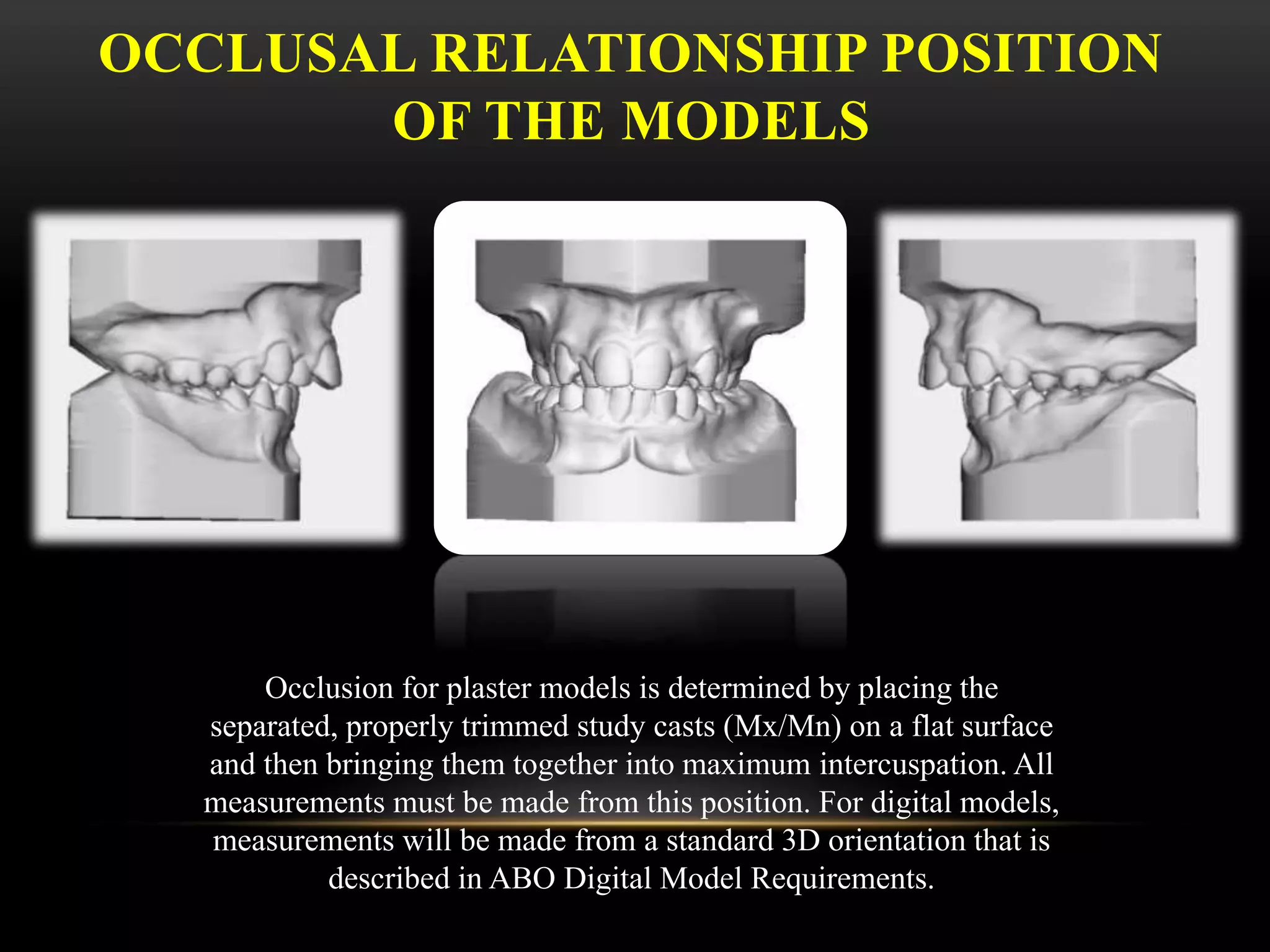
Occlusion for plaster models is determined by placing the
separated, properly trimmed study casts (Mx/Mn) on a flat surface
and then bringing them together into maximum intercuspation. All
measurements must be made from this position. For digital models,
measurements will be made from a standard 3D orientation that is
described in ABO Digital Model Requirements.
OVERJET (HORIZONTAL OVERLAP)
• Overjet Measurements
• For ≥0 to <1 mm, score 1 pt
(edge- to-edge)
• For ≥1 to ≤3 mm, score 0 pts
• For >3 to ≤5 mm, score 2 pts
• For >5 to ≤7 mm, score 3 pts
• For >7 to ≤9 mm, score 4 pts
• For >9 mm, score 5 pts
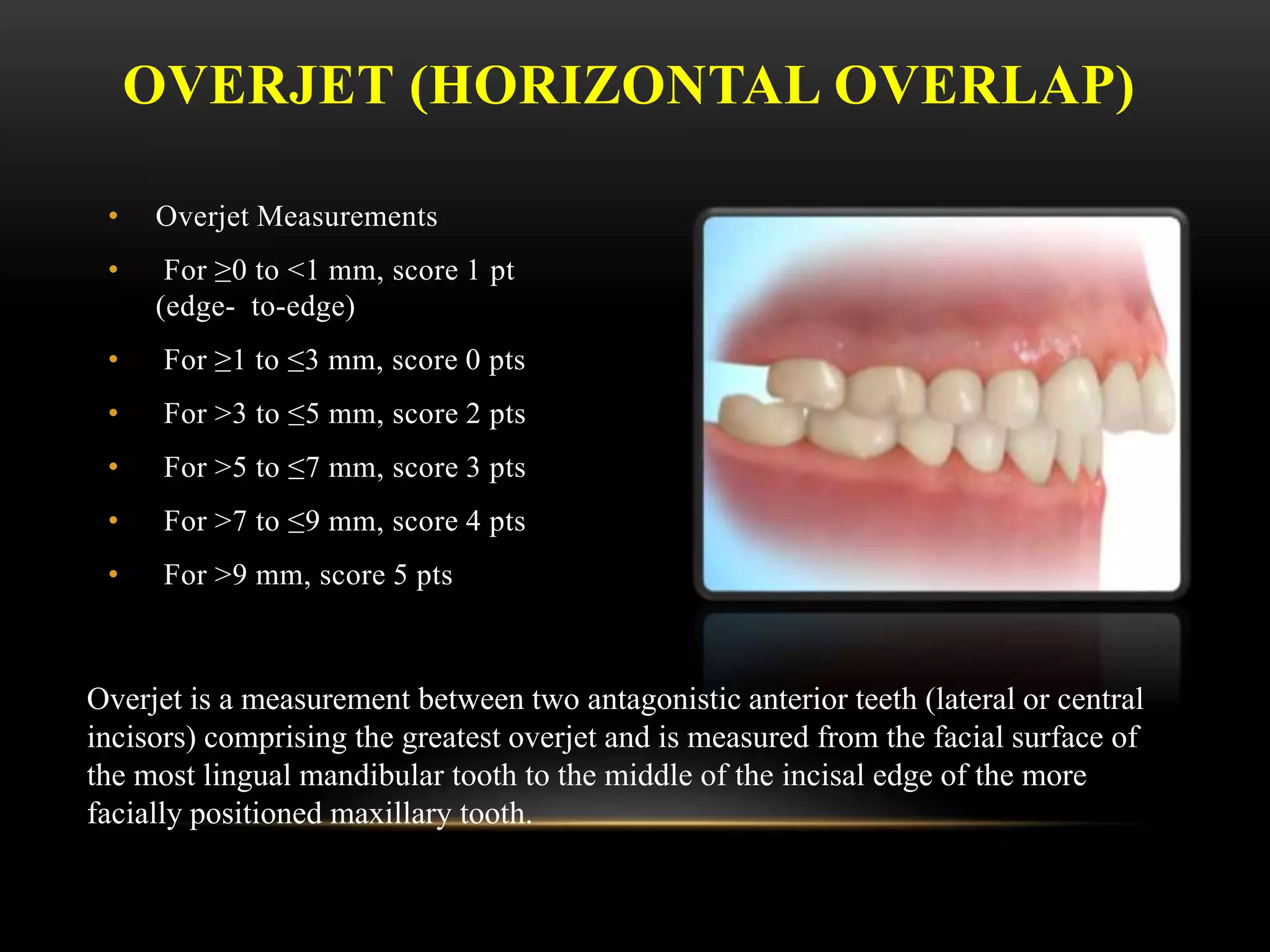
Overjet is a measurement between two antagonistic anterior teeth (lateral or central
incisors) comprising the greatest overjet and is measured from the facial surface of
the most lingual mandibular tooth to the middle of the incisal edge of the more
facially positioned maxillary tooth.
NEGATIVE OVERJET RELATIONSHIP
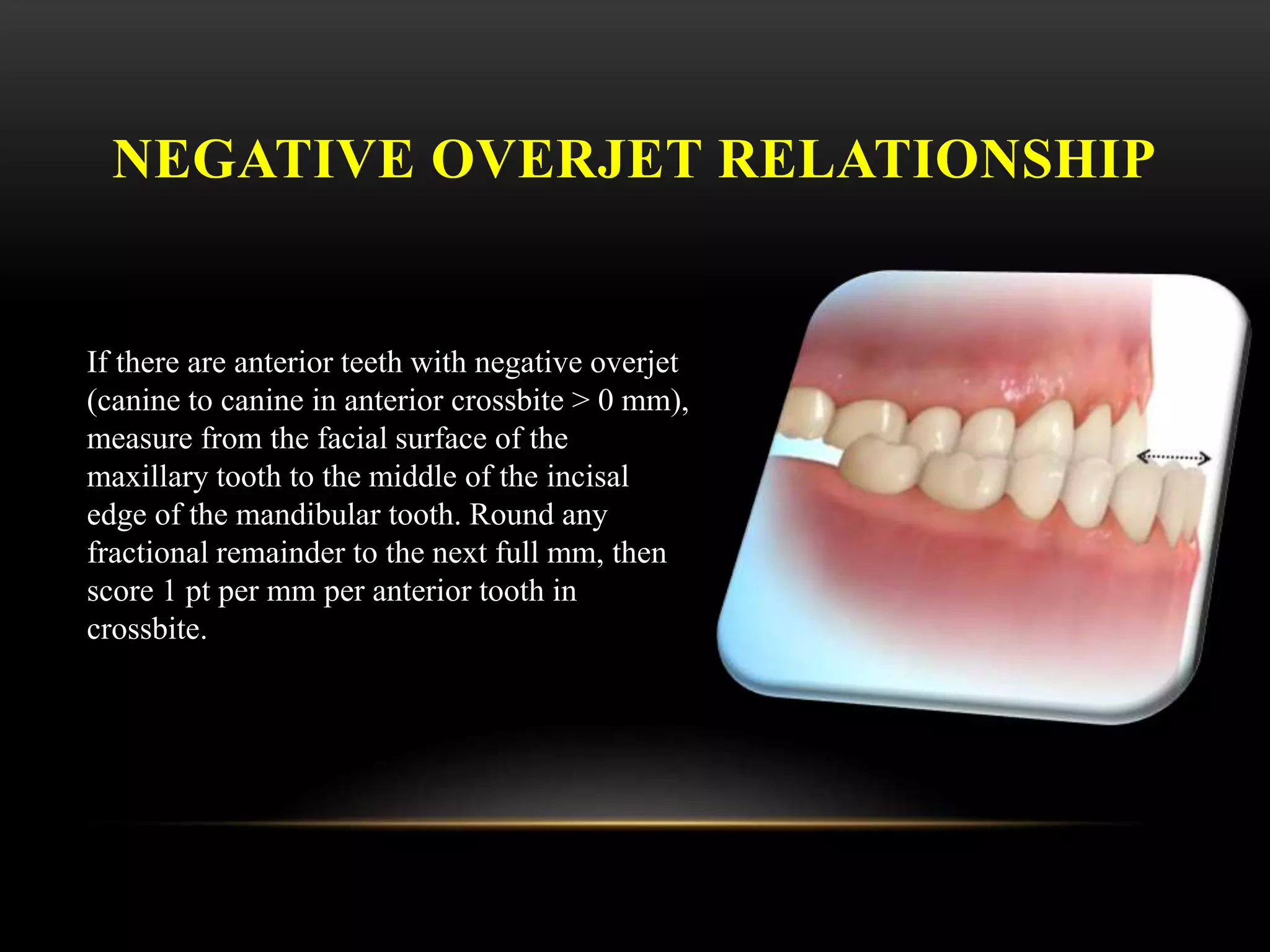
If there are anterior teeth with negative overjet
(canine to canine in anterior crossbite > 0 mm),
measure from the facial surface of the
maxillary tooth to the middle of the incisal
edge of the mandibular tooth. Round any
fractional remainder to the next full mm, then
score 1 pt per mm per anterior tooth in
crossbite.
OVERBITE (VERTICAL OVERLAP)
RELATIONSHIP
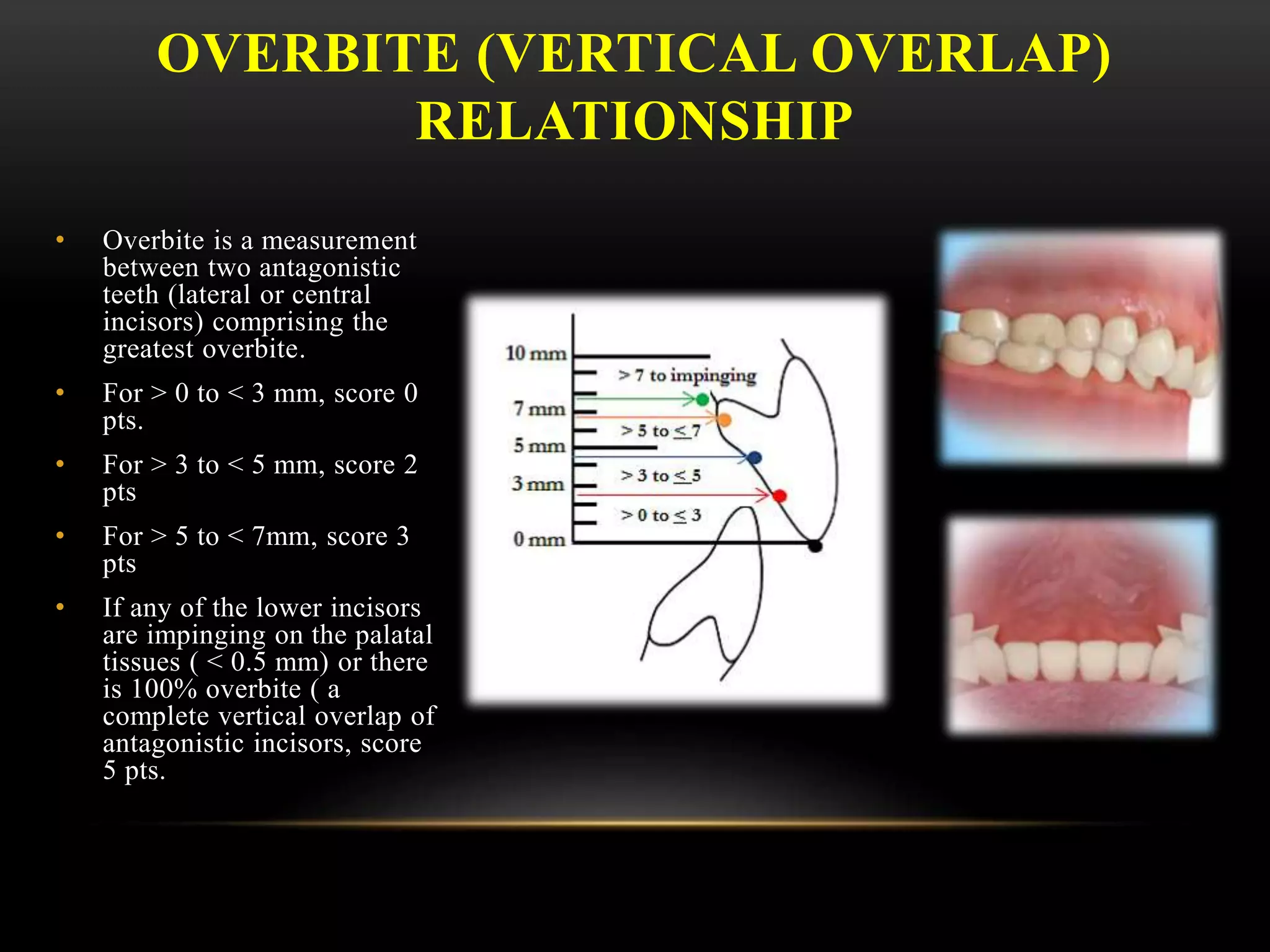
• Overbite is a measurement
between two antagonistic
teeth (lateral or central
incisors) comprising the
greatest overbite.
• For > 0 to < 3 mm, score 0
pts.
• For > 3 to < 5 mm, score 2
pts
• For > 5 to < 7mm, score 3
pts
• If any of the lower incisors
are impinging on the palatal
tissues ( < 0.5 mm) or there
is 100% overbite ( a
complete vertical overlap of
antagonistic incisors, score
5 pts.
ANTERIOR OPEN BITE RELATIONSHIP
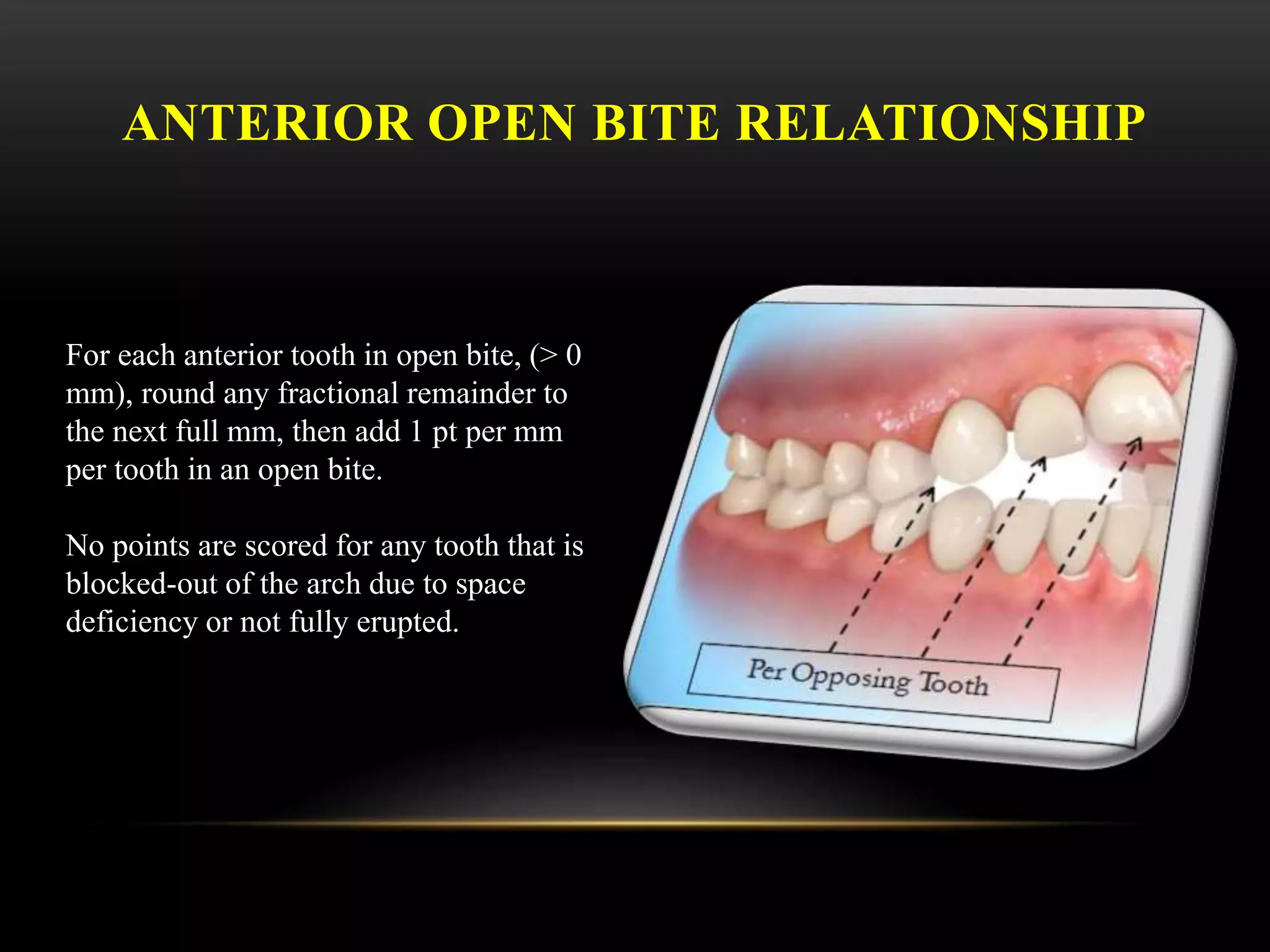
For each anterior tooth in open bite, (> 0
mm), round any fractional remainder to
the next full mm, then add 1 pt per mm
per tooth in an open bite.
No points are scored for any tooth that is
blocked-out of the arch due to space
deficiency or not fully erupted.
LATERAL OPEN BITE RELATIONSHIP
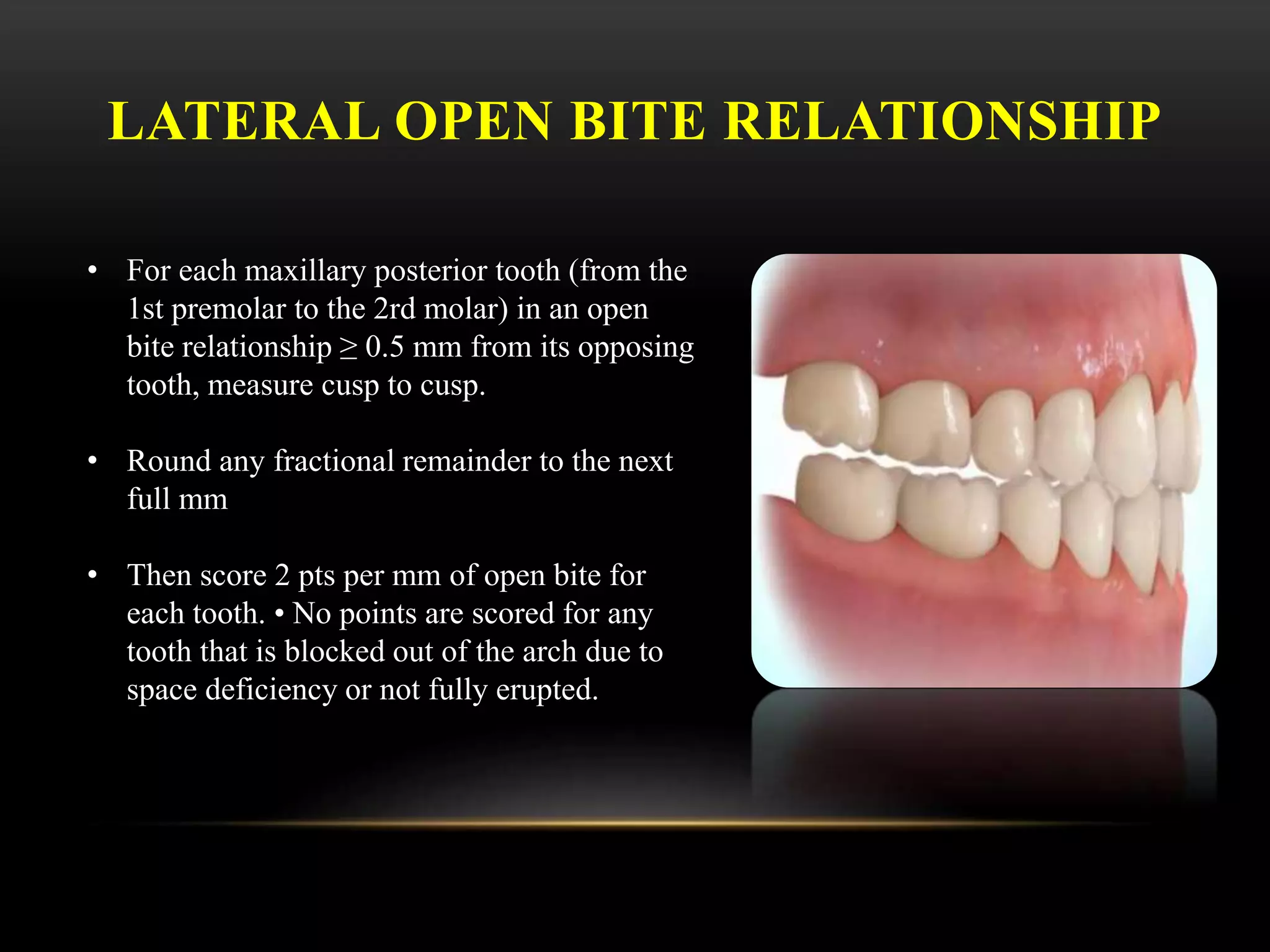
• For each maxillary posterior tooth (from the
1st premolar to the 2rd molar) in an open
bite relationship ≥ 0.5 mm from its opposing
tooth, measure cusp to cusp.
• Round any fractional remainder to the next
full mm
• Then score 2 pts per mm of open bite for
each tooth. • No points are scored for any
tooth that is blocked out of the arch due to
space deficiency or not fully erupted.
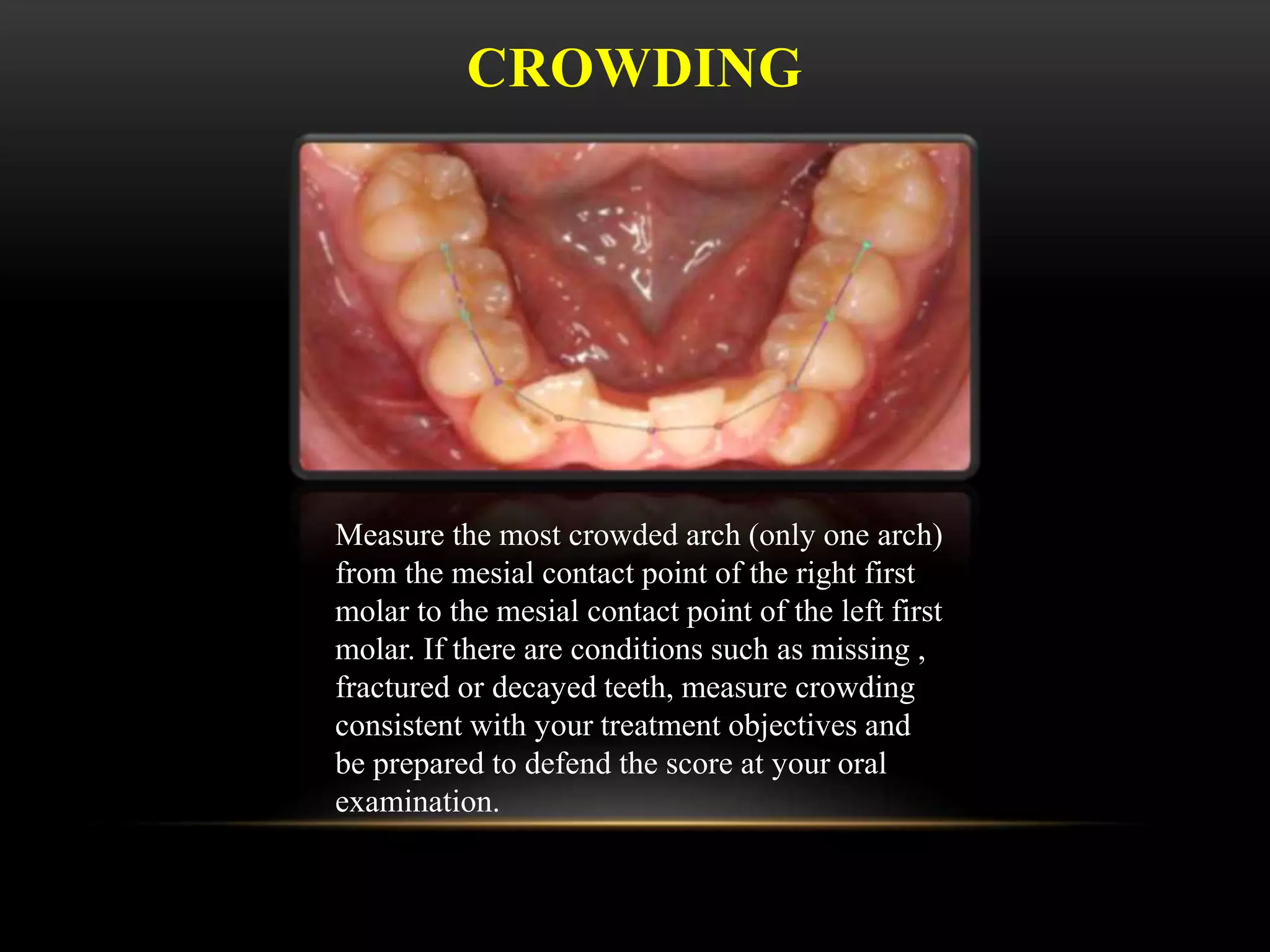
CROWDING
Measure the most crowded arch (only one arch)
from the mesial contact point of the right first
molar to the mesial contact point of the left first
molar. If there are conditions such as missing ,
fractured or decayed teeth, measure crowding
consistent with your treatment objectives and
be prepared to defend the score at your oral
examination.
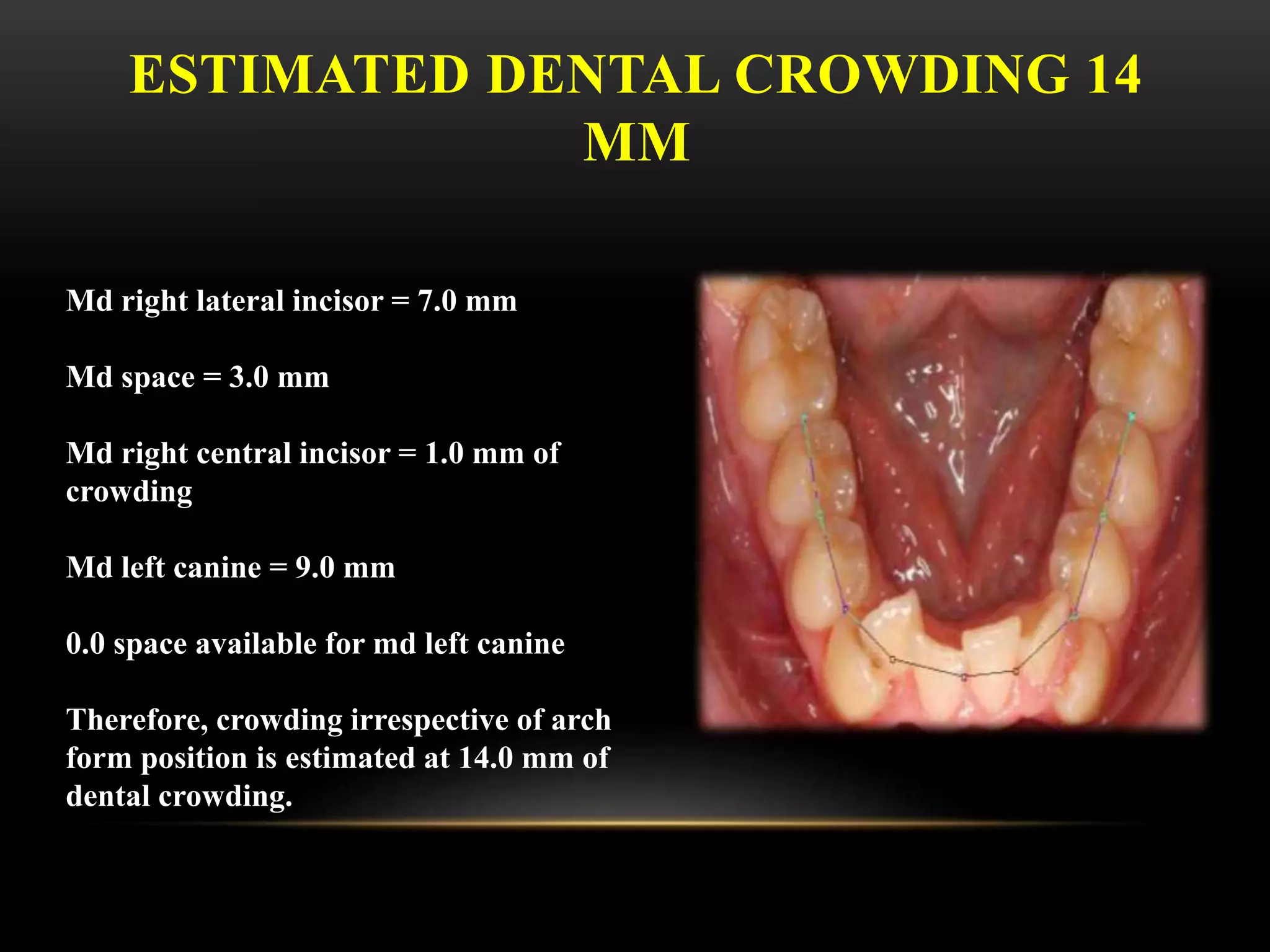
ESTIMATED DENTAL CROWDING 14
MM
Md right lateral incisor = 7.0 mm
Md space = 3.0 mm
Md right central incisor = 1.0 mm of
crowding
Md left canine = 9.0 mm
0.0 space available for md left canine
Therefore, crowding irrespective of arch
form position is estimated at 14.0 mm of
dental crowding.
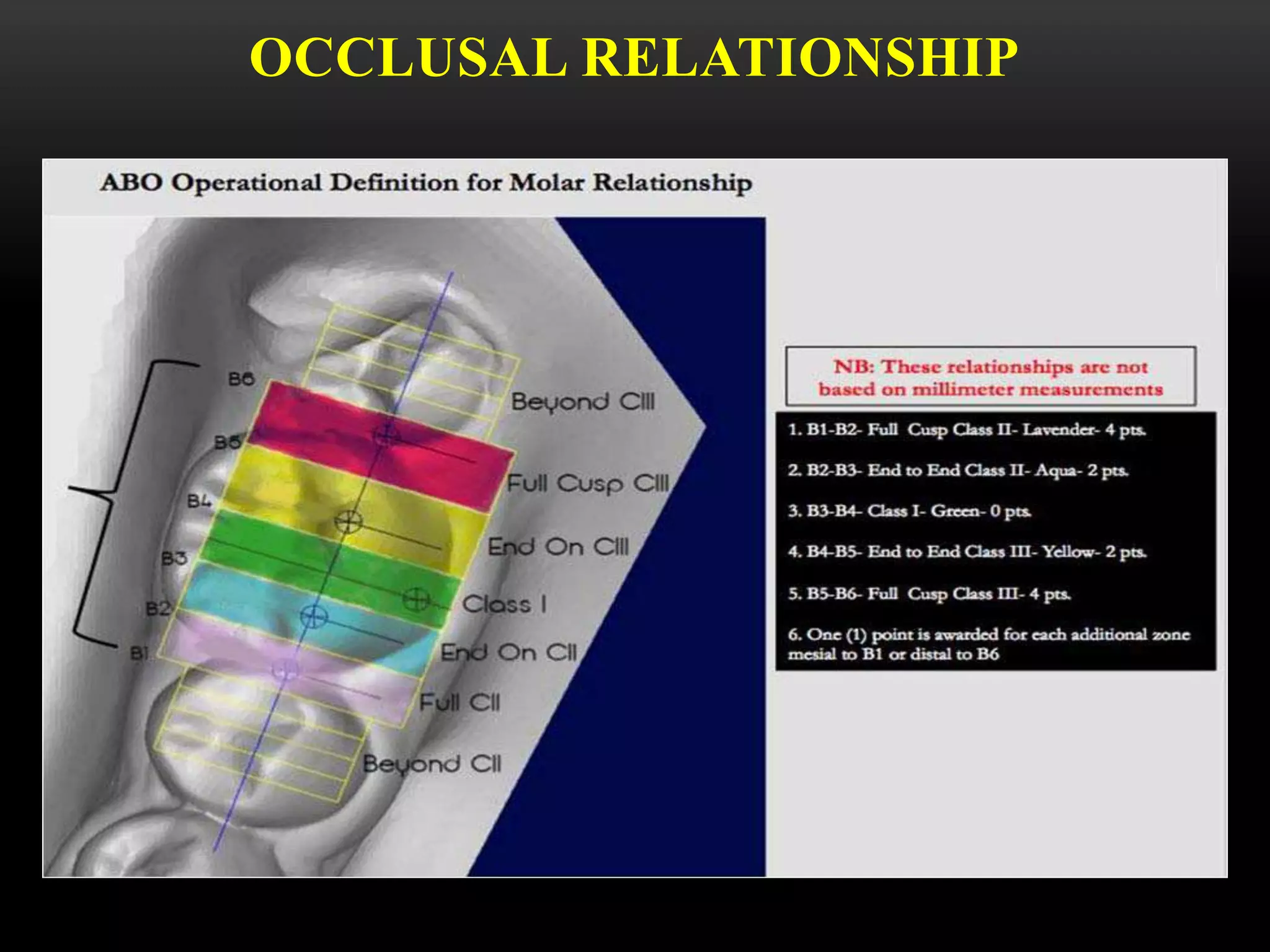
OCCLUSAL RELATIONSHIP
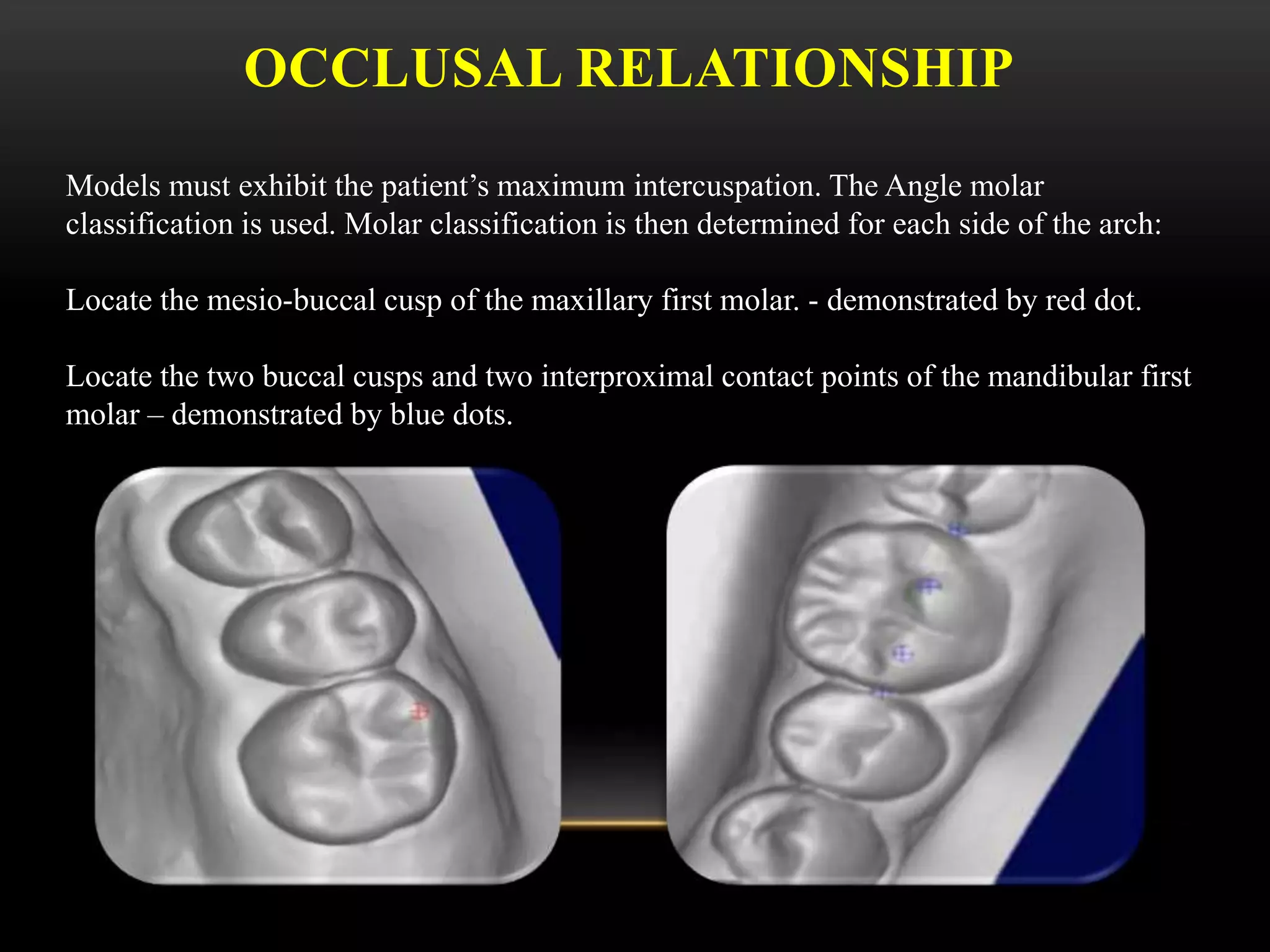
Models must exhibit the patient’s maximum intercuspation. The Angle molar
classification is used. Molar classification is then determined for each side of the arch:
Locate the mesio-buccal cusp of the maxillary first molar. - demonstrated by red dot.
Locate the two buccal cusps and two interproximal contact points of the mandibular first
molar – demonstrated by blue dots.
OCCLUSAL RELATIONSHIP
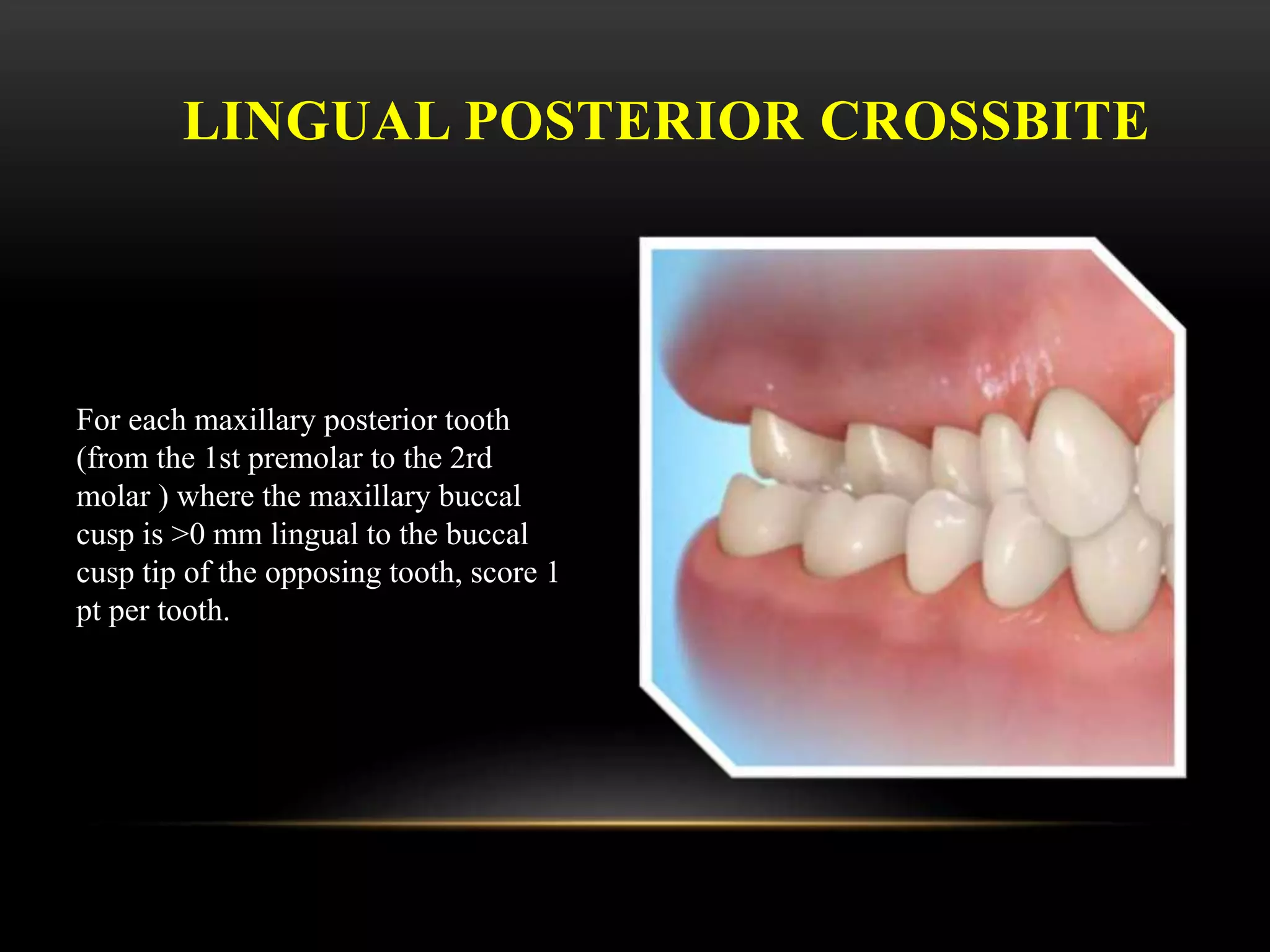
LINGUAL POSTERIOR CROSSBITE
For each maxillary posterior tooth
(from the 1st premolar to the 2rd
molar ) where the maxillary buccal
cusp is >0 mm lingual to the buccal
cusp tip of the opposing tooth, score 1
pt per tooth.
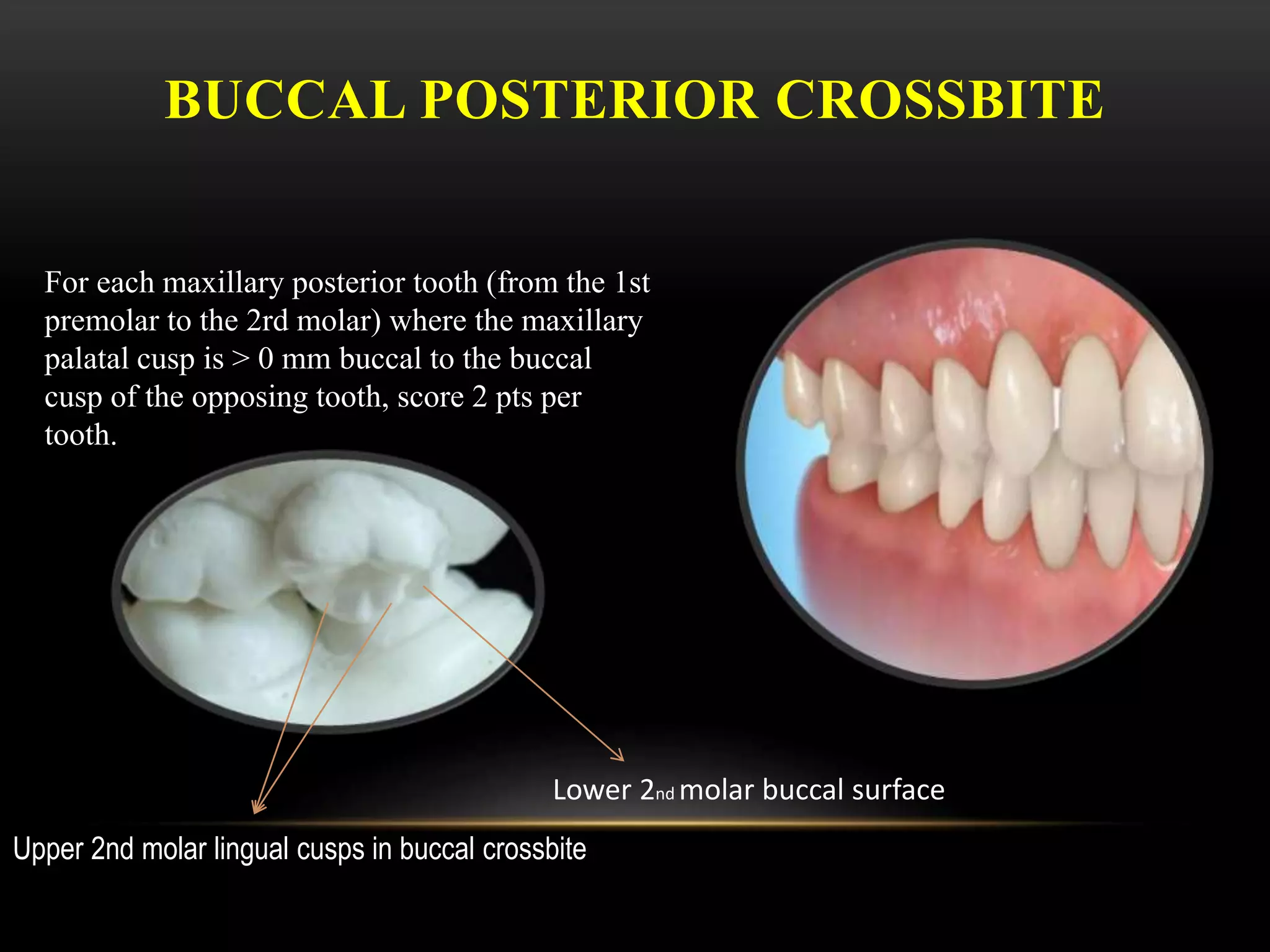
BUCCAL POSTERIOR CROSSBITE
For each maxillary posterior tooth (from the 1st
premolar to the 2rd molar) where the maxillary
palatal cusp is > 0 mm buccal to the buccal
cusp of the opposing tooth, score 2 pts per
tooth.
Lower 2nd molar buccal surface
Upper 2nd molar lingual cusps in buccal crossbite
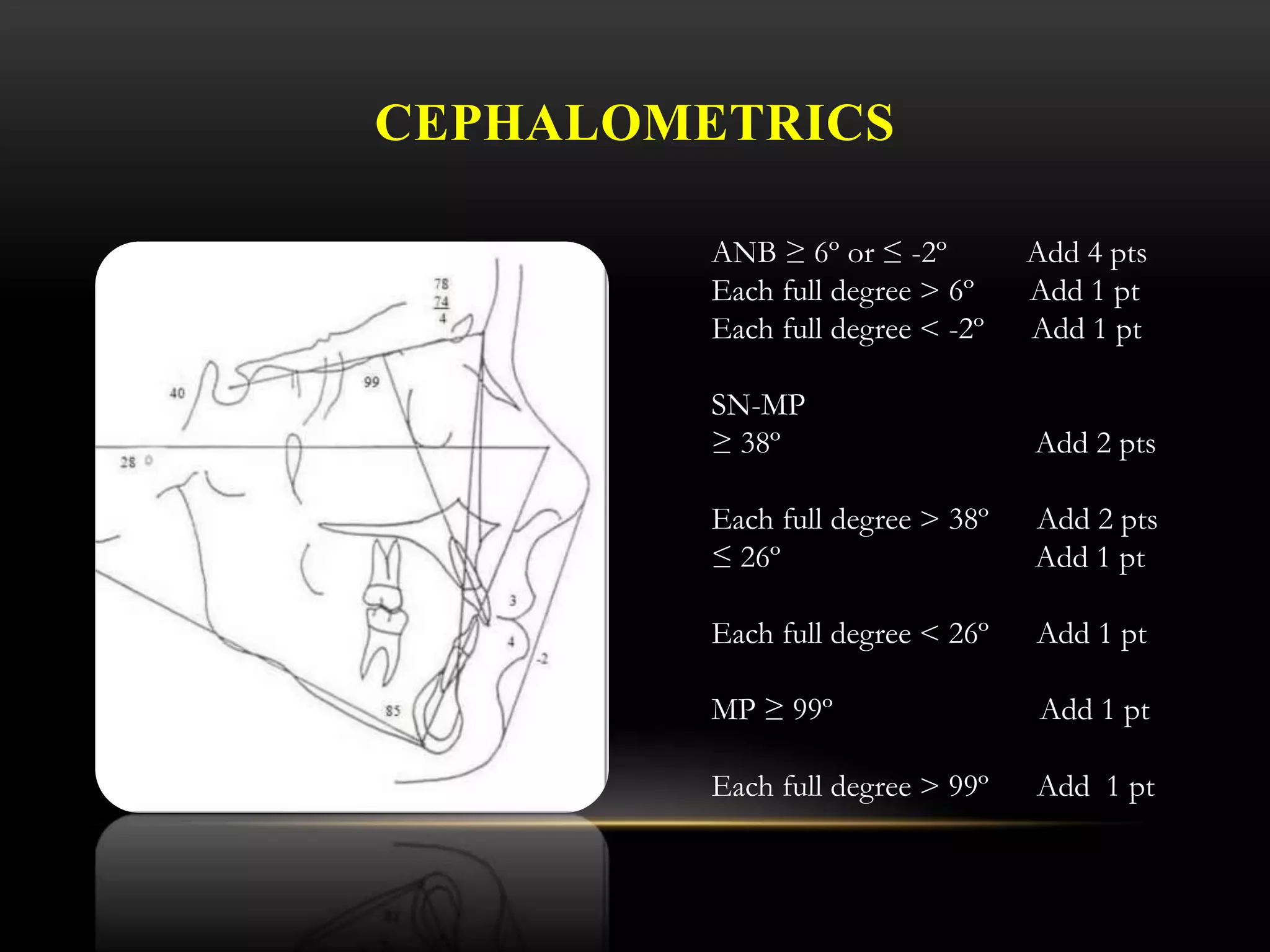
CEPHALOMETRICS
ANB ≥ 6º or ≤ -2º Add 4 pts
Each full degree > 6º Add 1 pt
Each full degree < -2º Add 1 pt
SN-MP
≥ 38º Add 2 pts
Each full degree > 38º Add 2 pts
≤ 26º Add 1 pt
Each full degree < 26º Add 1 pt
MP ≥ 99º Add 1 pt
Each full degree > 99º Add 1 pt
OTHER CLASSIFICATION EXAMPLES
Because it is not possible to include every clinical entity in
an index, the additional category of “Other” is included to
permit scoring of other conditions which may add to
treatment complexity.
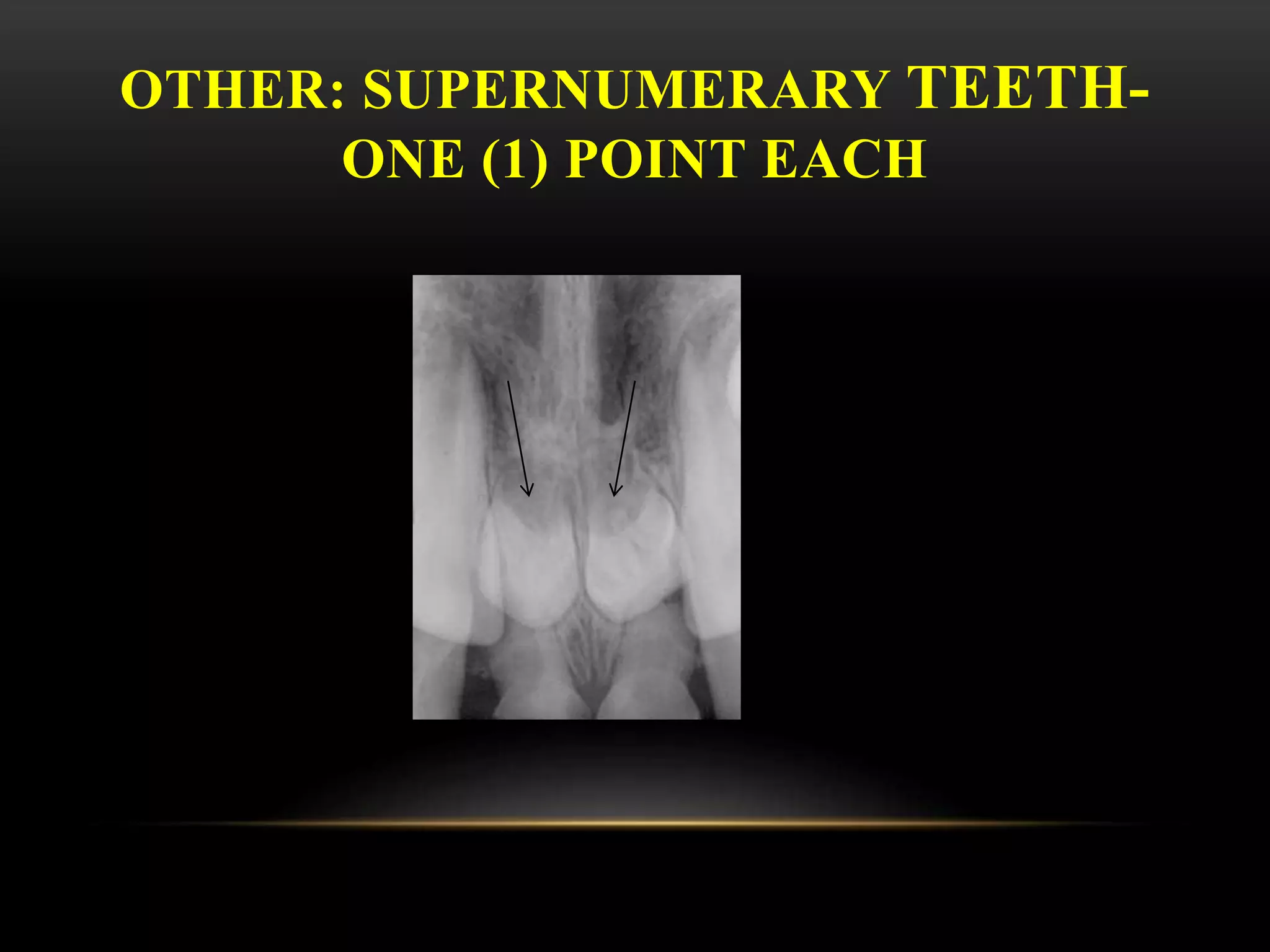
OTHER: SUPERNUMERARY TEETH-
ONE (1) POINT EACH
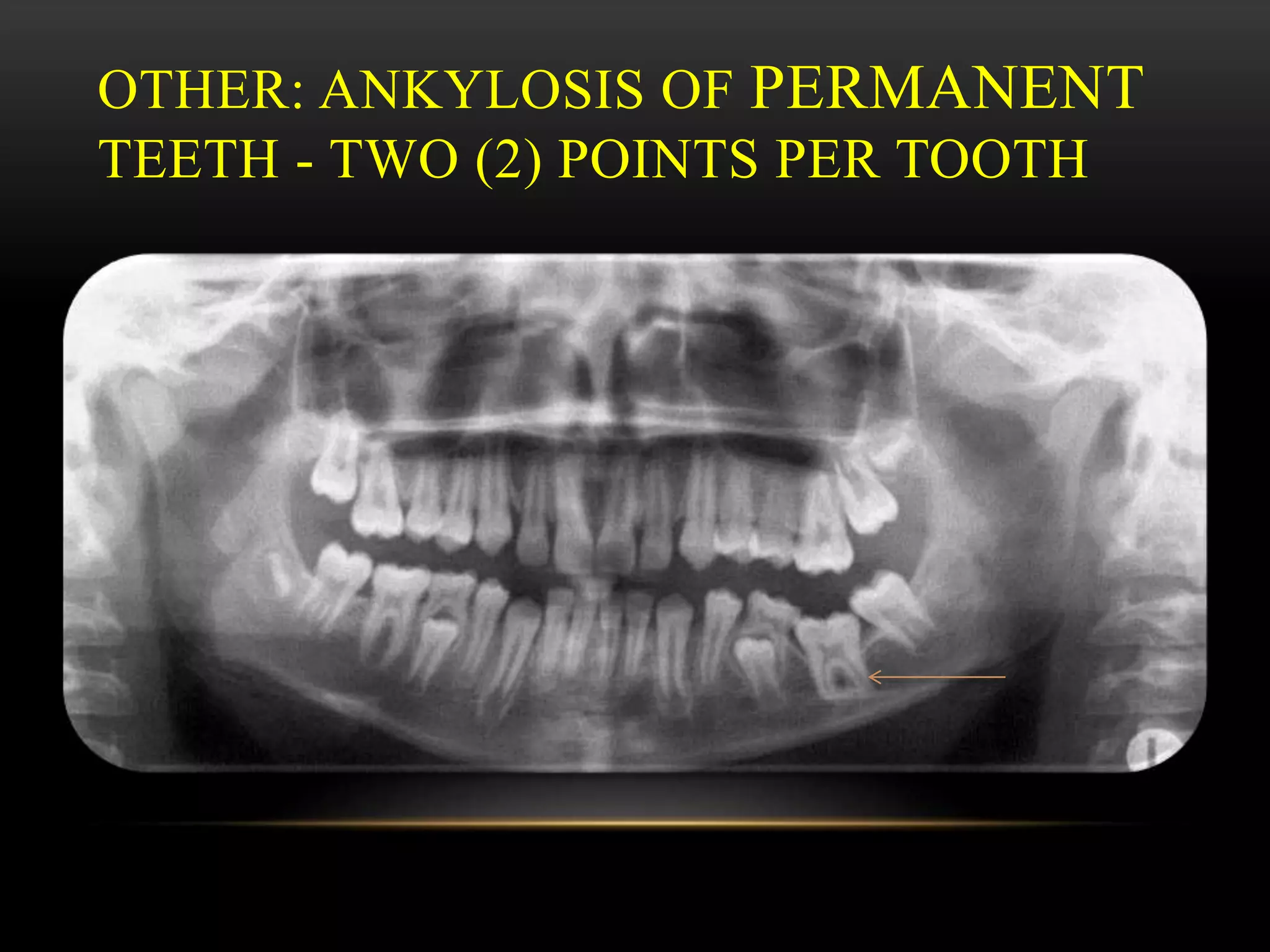
OTHER: ANKYLOSIS OF PERMANENT
TEETH - TWO (2) POINTS PER TOOTH
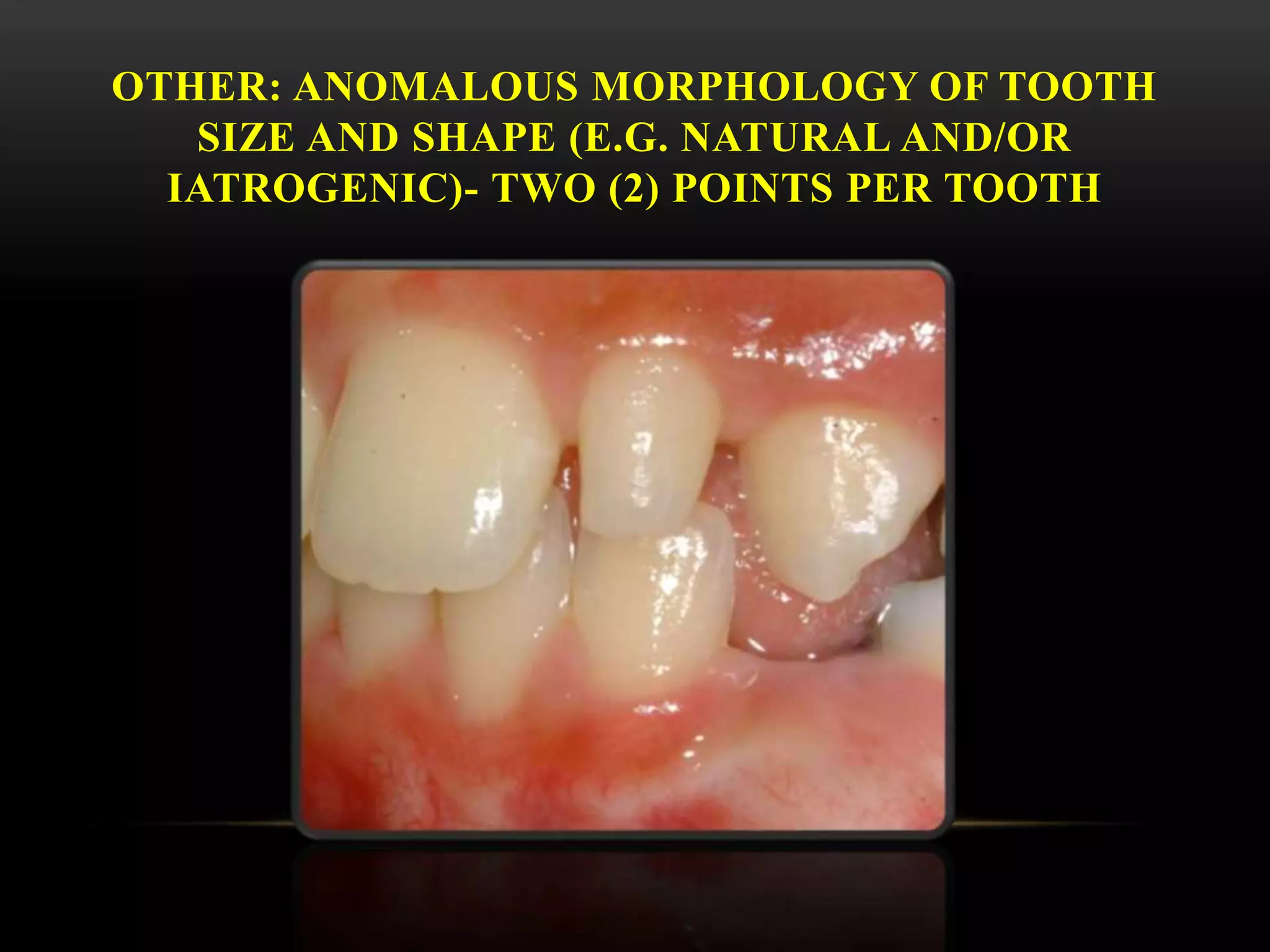
OTHER: ANOMALOUS MORPHOLOGY OF TOOTH
SIZE AND SHAPE (E.G. NATURAL AND/OR
IATROGENIC)- TWO (2) POINTS PER TOOTH
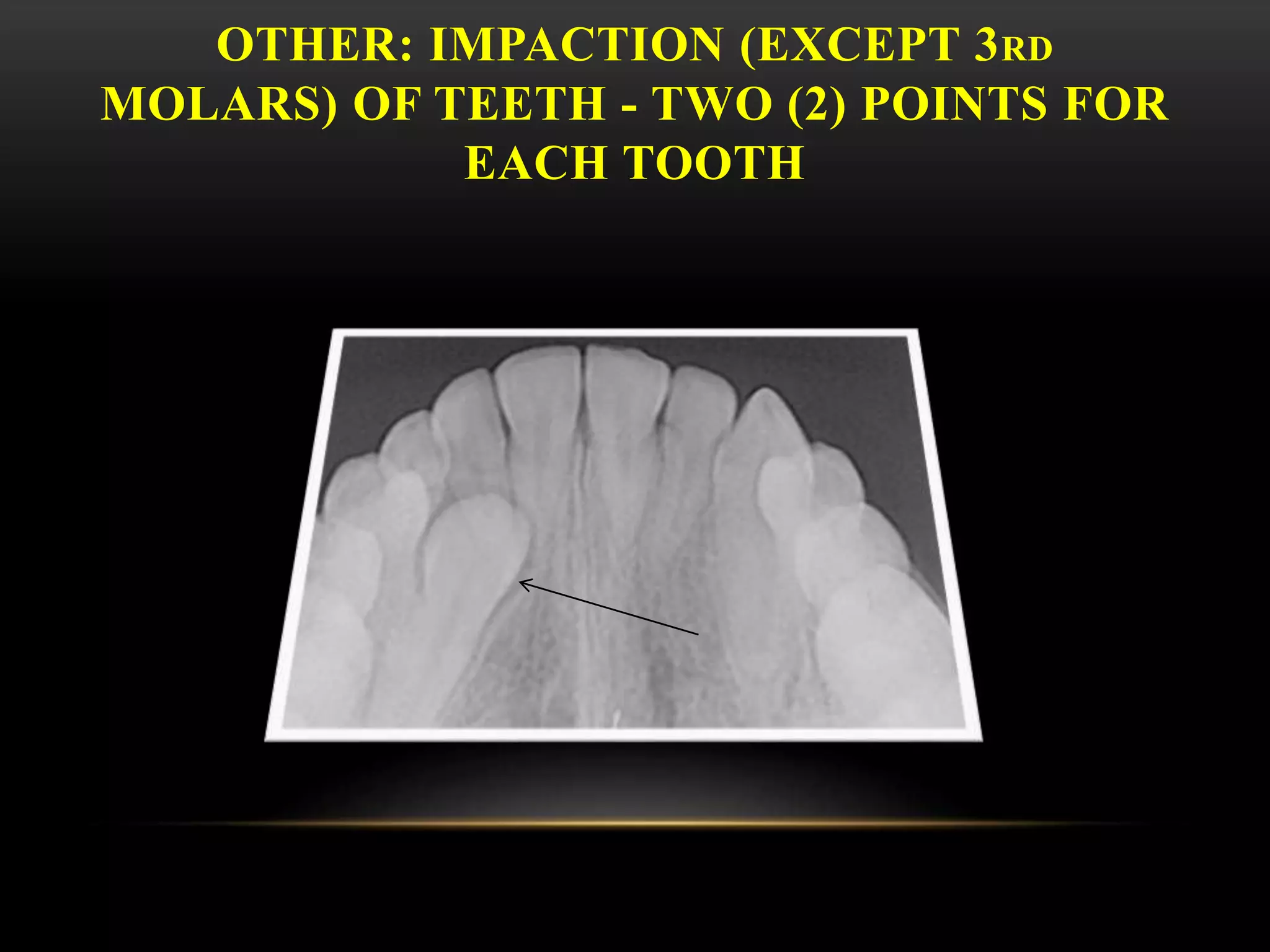
OTHER: IMPACTION (EXCEPT 3RD
MOLARS) OF TEETH - TWO (2) POINTS FOR
EACH TOOTH
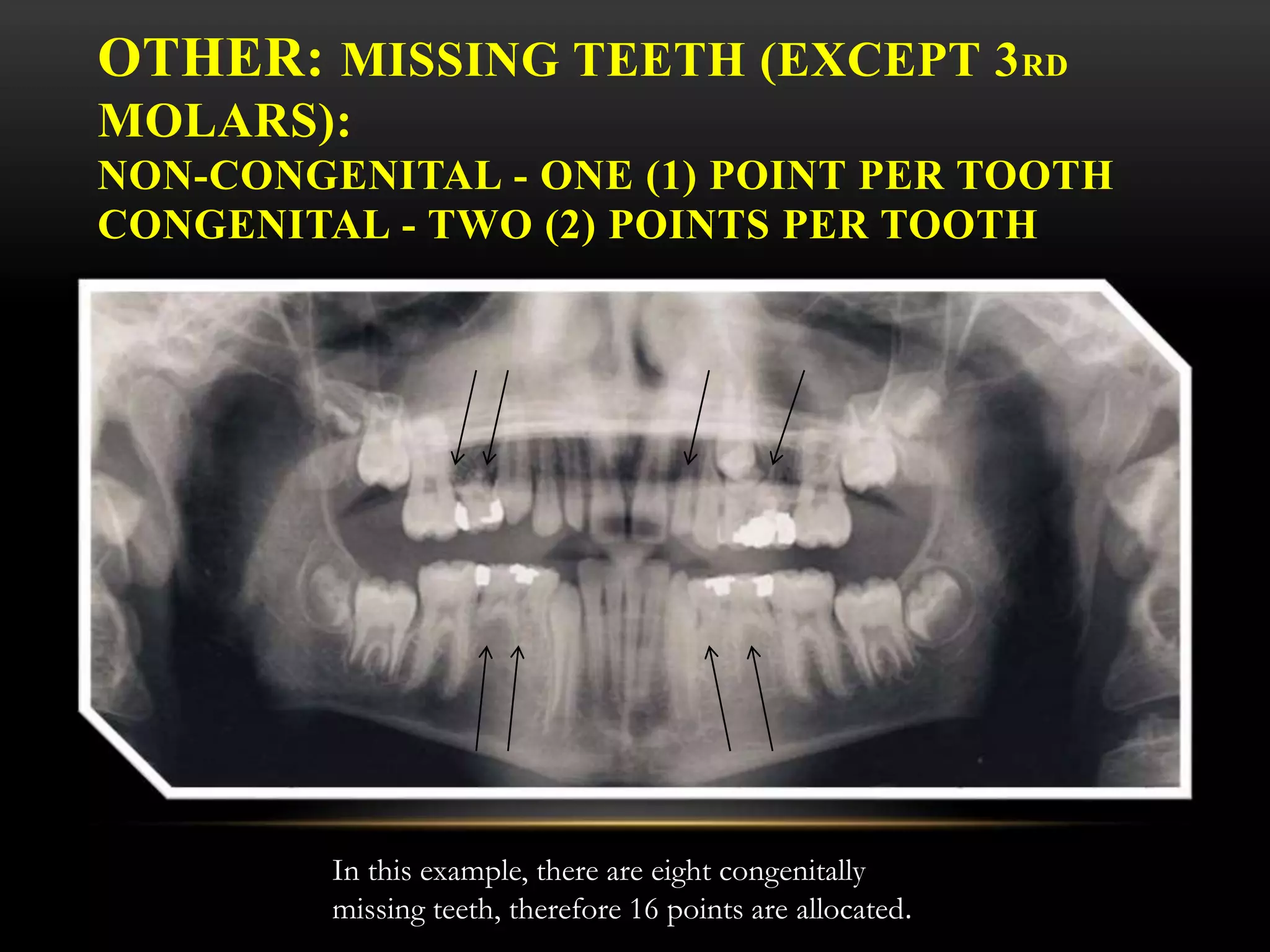
OTHER: MISSING TEETH (EXCEPT 3RD
MOLARS):
NON-CONGENITAL - ONE (1) POINT PER TOOTH
CONGENITAL - TWO (2) POINTS PER TOOTH
In this example, there are eight congenitally
missing teeth, therefore 16 points are allocated.
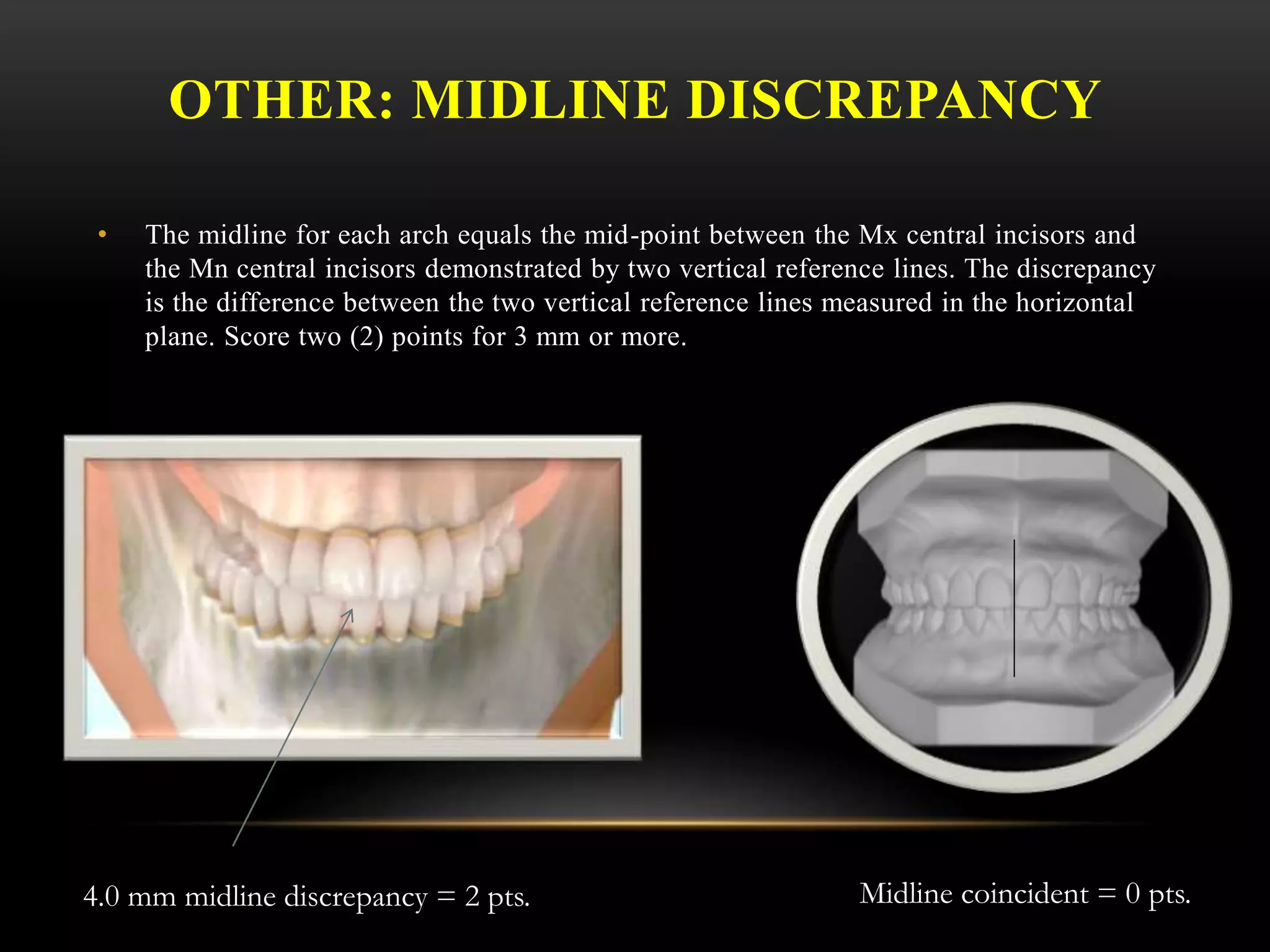
OTHER: MIDLINE DISCREPANCY
• The midline for each arch equals the mid-point between the Mx central incisors and
the Mn central incisors demonstrated by two vertical reference lines. The discrepancy
is the difference between the two vertical reference lines measured in the horizontal
plane. Score two (2) points for 3 mm or more.
4.0 mm midline discrepancy = 2 pts. Midline coincident = 0 pts.
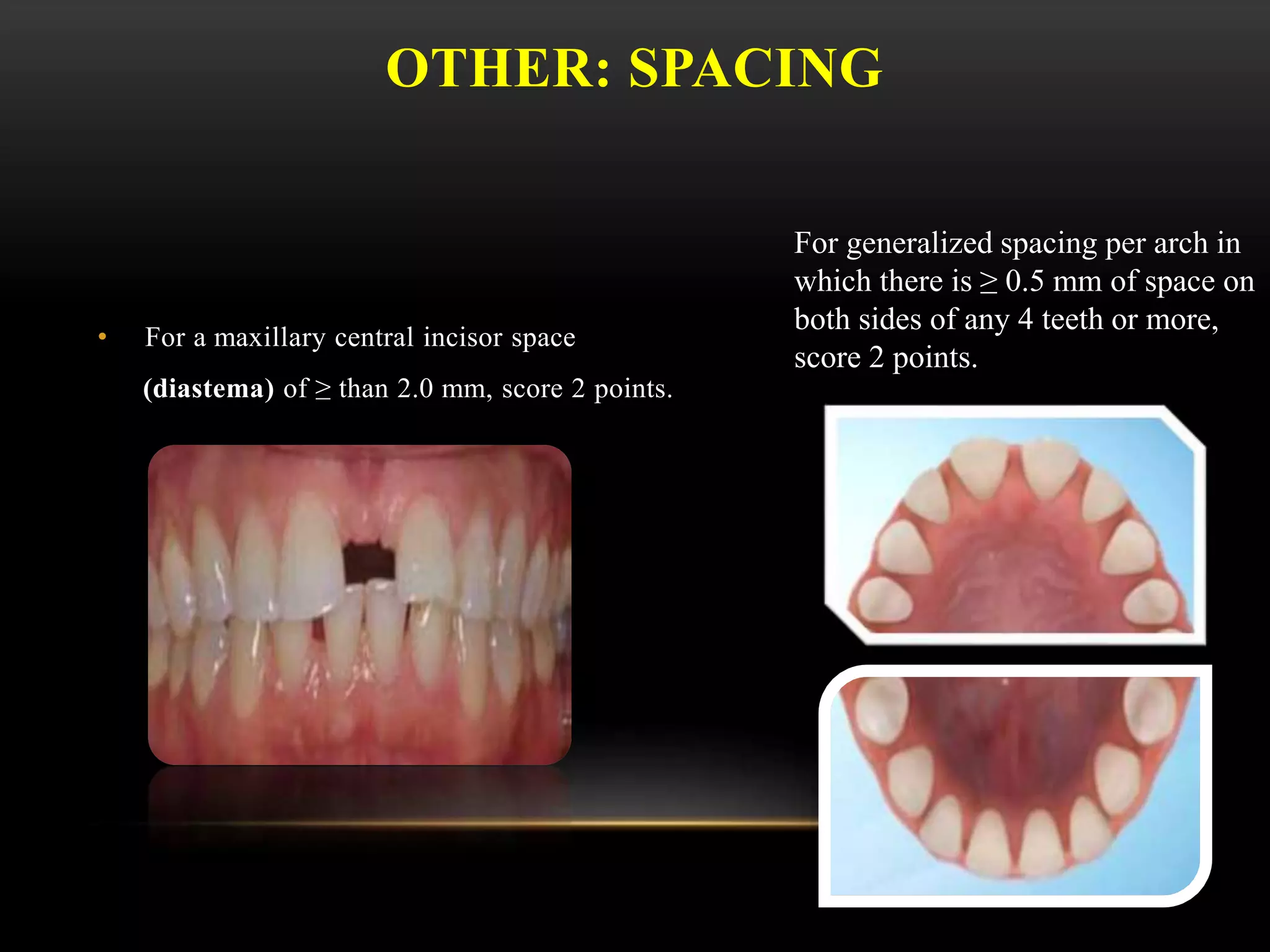
OTHER: SPACING
• For a maxillary central incisor space
(diastema) of ≥ than 2.0 mm, score 2 points.
For generalized spacing per arch in
which there is ≥ 0.5 mm of space on
both sides of any 4 teeth or more,
score 2 points.
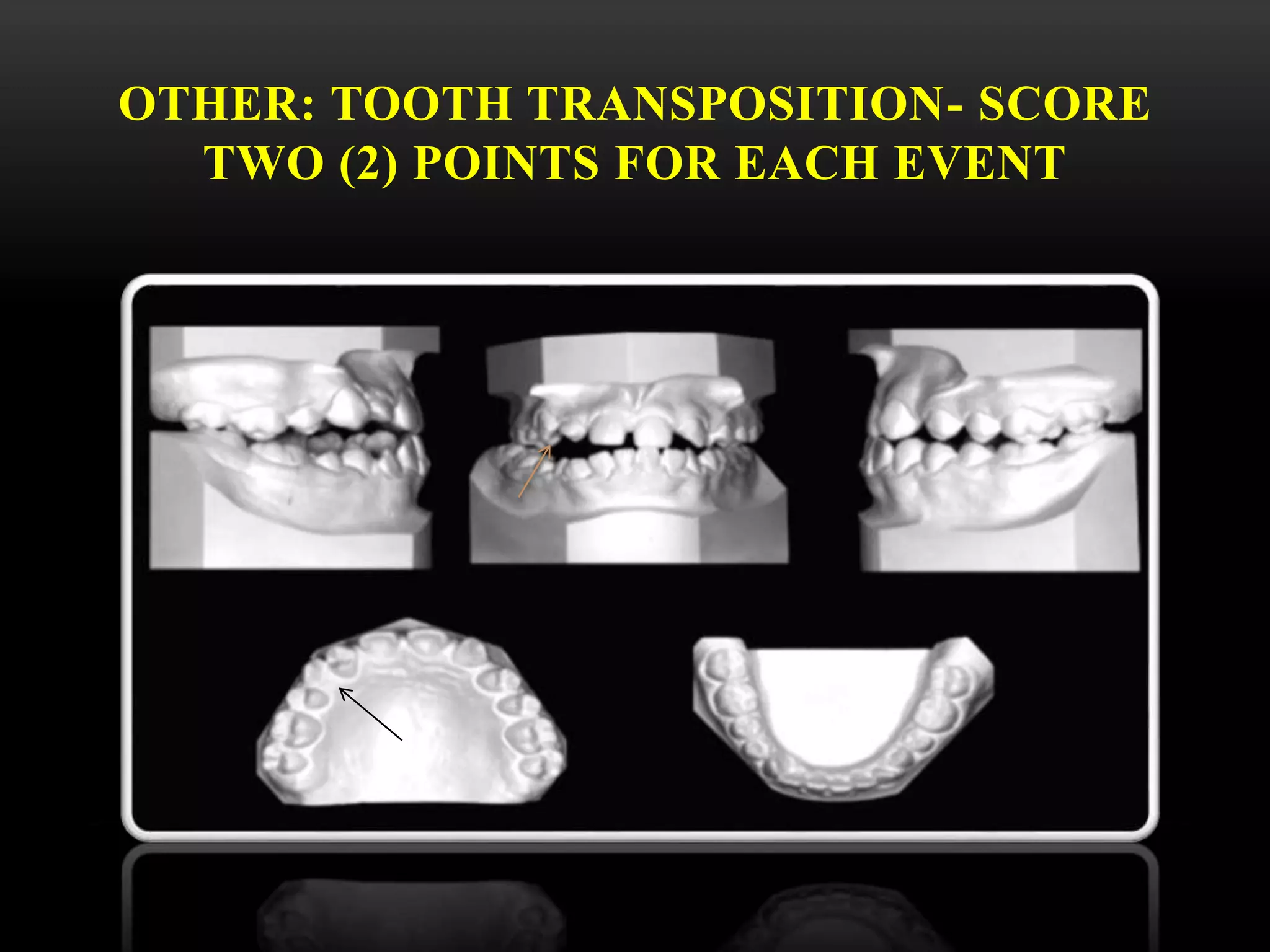
OTHER: TOOTH TRANSPOSITION- SCORE
TWO (2) POINTS FOR EACH EVENT
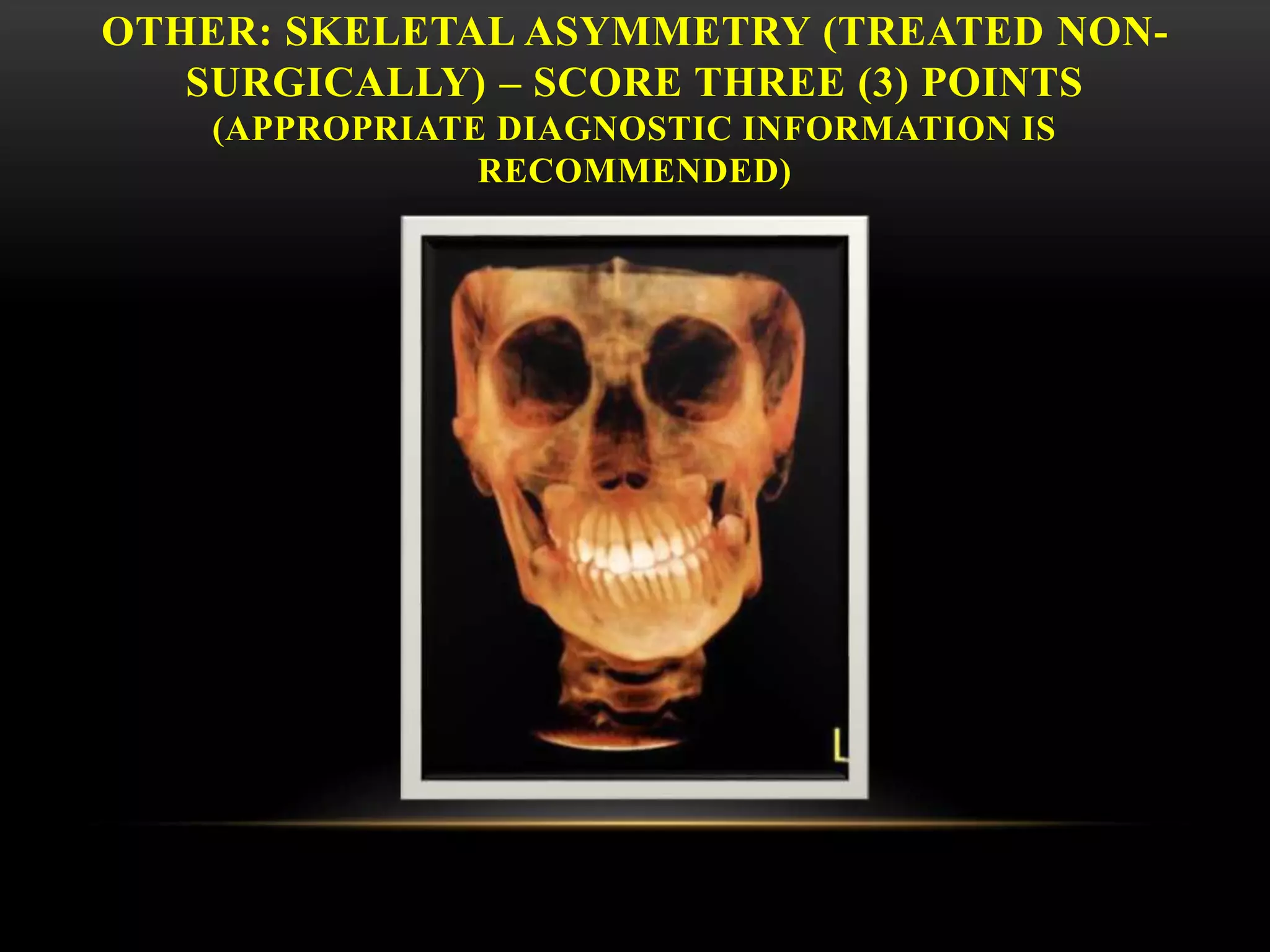
OTHER: SKELETAL ASYMMETRY (TREATED NON-
SURGICALLY) – SCORE THREE (3) POINTS
(APPROPRIATE DIAGNOSTIC INFORMATION IS
RECOMMENDED)
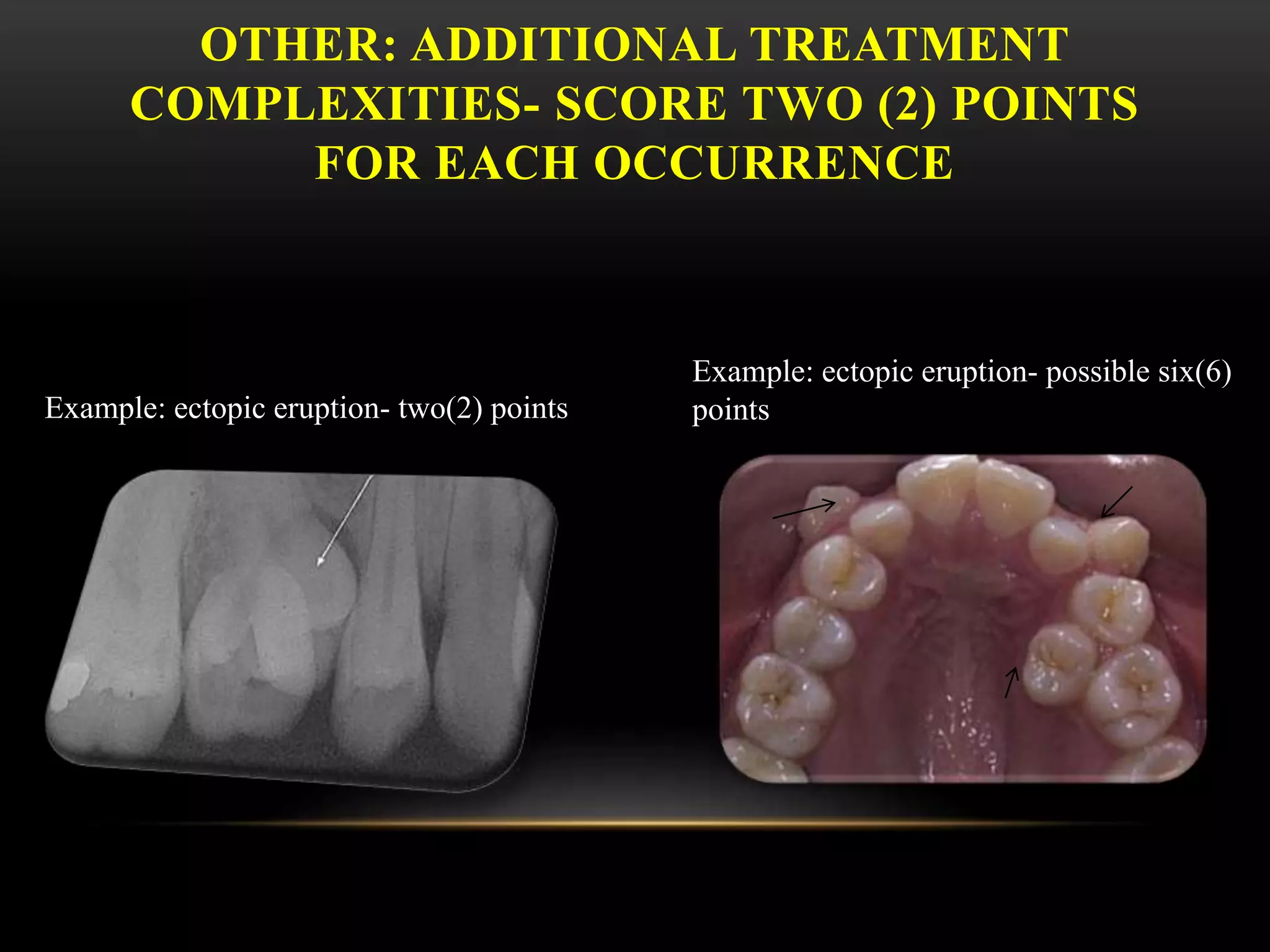
OTHER: ADDITIONAL TREATMENT
COMPLEXITIES- SCORE TWO (2) POINTS
FOR EACH OCCURRENCE
Example: ectopic eruption- two(2) points
Example: ectopic eruption- possible six(6)
points
The abo discrepancy index (di)

The abo discrepancy index (di)

  • 1.
    Prepared by :Dr. ALI WAQAR HASAN FCPS – II Resident ORTHODONTICS UCMD UOL Lahore Supervised by : Dr. SAAD ASAD Associate Professor of Orthodontics UCMD UOL Lahore THE ABO DISCREPANCY INDEX (DI) A MEASURE OF CASE COMPLEXITY
  • 2.
    TARGET DISORDERS FOR DISCREPANCYINDEX • Overjet • Overbite • Anterior Open Bite • Lateral Open Bite • Crowding • Occlusal Relationship • Lingual Posterior Crossbite • Buccal Posterior Crossbite • ANB Angle • SN-MP Angle • Lower Incisor to MP • Other
  • 3.
    OCCLUSAL RELATIONSHIP POSITION OFTHE MODELS Occlusion for plaster models is determined by placing the separated, properly trimmed study casts (Mx/Mn) on a flat surface and then bringing them together into maximum intercuspation. All measurements must be made from this position. For digital models, measurements will be made from a standard 3D orientation that is described in ABO Digital Model Requirements.
  • 4.
    OVERJET (HORIZONTAL OVERLAP) •Overjet Measurements • For ≥0 to <1 mm, score 1 pt (edge- to-edge) • For ≥1 to ≤3 mm, score 0 pts • For >3 to ≤5 mm, score 2 pts • For >5 to ≤7 mm, score 3 pts • For >7 to ≤9 mm, score 4 pts • For >9 mm, score 5 pts Overjet is a measurement between two antagonistic anterior teeth (lateral or central incisors) comprising the greatest overjet and is measured from the facial surface of the most lingual mandibular tooth to the middle of the incisal edge of the more facially positioned maxillary tooth.
  • 5.
    NEGATIVE OVERJET RELATIONSHIP Ifthere are anterior teeth with negative overjet (canine to canine in anterior crossbite > 0 mm), measure from the facial surface of the maxillary tooth to the middle of the incisal edge of the mandibular tooth. Round any fractional remainder to the next full mm, then score 1 pt per mm per anterior tooth in crossbite.
  • 6.
    OVERBITE (VERTICAL OVERLAP) RELATIONSHIP •Overbite is a measurement between two antagonistic teeth (lateral or central incisors) comprising the greatest overbite. • For > 0 to < 3 mm, score 0 pts. • For > 3 to < 5 mm, score 2 pts • For > 5 to < 7mm, score 3 pts • If any of the lower incisors are impinging on the palatal tissues ( < 0.5 mm) or there is 100% overbite ( a complete vertical overlap of antagonistic incisors, score 5 pts.
  • 7.
    ANTERIOR OPEN BITERELATIONSHIP For each anterior tooth in open bite, (> 0 mm), round any fractional remainder to the next full mm, then add 1 pt per mm per tooth in an open bite. No points are scored for any tooth that is blocked-out of the arch due to space deficiency or not fully erupted.
  • 8.
    LATERAL OPEN BITERELATIONSHIP • For each maxillary posterior tooth (from the 1st premolar to the 2rd molar) in an open bite relationship ≥ 0.5 mm from its opposing tooth, measure cusp to cusp. • Round any fractional remainder to the next full mm • Then score 2 pts per mm of open bite for each tooth. • No points are scored for any tooth that is blocked out of the arch due to space deficiency or not fully erupted.
  • 9.
    CROWDING Measure the mostcrowded arch (only one arch) from the mesial contact point of the right first molar to the mesial contact point of the left first molar. If there are conditions such as missing , fractured or decayed teeth, measure crowding consistent with your treatment objectives and be prepared to defend the score at your oral examination.
  • 10.
    ESTIMATED DENTAL CROWDING14 MM Md right lateral incisor = 7.0 mm Md space = 3.0 mm Md right central incisor = 1.0 mm of crowding Md left canine = 9.0 mm 0.0 space available for md left canine Therefore, crowding irrespective of arch form position is estimated at 14.0 mm of dental crowding.
  • 11.
    OCCLUSAL RELATIONSHIP Models mustexhibit the patient’s maximum intercuspation. The Angle molar classification is used. Molar classification is then determined for each side of the arch: Locate the mesio-buccal cusp of the maxillary first molar. - demonstrated by red dot. Locate the two buccal cusps and two interproximal contact points of the mandibular first molar – demonstrated by blue dots.
  • 12.
  • 13.
    LINGUAL POSTERIOR CROSSBITE Foreach maxillary posterior tooth (from the 1st premolar to the 2rd molar ) where the maxillary buccal cusp is >0 mm lingual to the buccal cusp tip of the opposing tooth, score 1 pt per tooth.
  • 14.
    BUCCAL POSTERIOR CROSSBITE Foreach maxillary posterior tooth (from the 1st premolar to the 2rd molar) where the maxillary palatal cusp is > 0 mm buccal to the buccal cusp of the opposing tooth, score 2 pts per tooth. Lower 2nd molar buccal surface Upper 2nd molar lingual cusps in buccal crossbite
  • 15.
    CEPHALOMETRICS ANB ≥ 6ºor ≤ -2º Add 4 pts Each full degree > 6º Add 1 pt Each full degree < -2º Add 1 pt SN-MP ≥ 38º Add 2 pts Each full degree > 38º Add 2 pts ≤ 26º Add 1 pt Each full degree < 26º Add 1 pt MP ≥ 99º Add 1 pt Each full degree > 99º Add 1 pt
  • 16.
    OTHER CLASSIFICATION EXAMPLES Becauseit is not possible to include every clinical entity in an index, the additional category of “Other” is included to permit scoring of other conditions which may add to treatment complexity.
  • 17.
  • 18.
    OTHER: ANKYLOSIS OFPERMANENT TEETH - TWO (2) POINTS PER TOOTH
  • 19.
    OTHER: ANOMALOUS MORPHOLOGYOF TOOTH SIZE AND SHAPE (E.G. NATURAL AND/OR IATROGENIC)- TWO (2) POINTS PER TOOTH
  • 20.
    OTHER: IMPACTION (EXCEPT3RD MOLARS) OF TEETH - TWO (2) POINTS FOR EACH TOOTH
  • 21.
    OTHER: MISSING TEETH(EXCEPT 3RD MOLARS): NON-CONGENITAL - ONE (1) POINT PER TOOTH CONGENITAL - TWO (2) POINTS PER TOOTH In this example, there are eight congenitally missing teeth, therefore 16 points are allocated.
  • 22.
    OTHER: MIDLINE DISCREPANCY •The midline for each arch equals the mid-point between the Mx central incisors and the Mn central incisors demonstrated by two vertical reference lines. The discrepancy is the difference between the two vertical reference lines measured in the horizontal plane. Score two (2) points for 3 mm or more. 4.0 mm midline discrepancy = 2 pts. Midline coincident = 0 pts.
  • 23.
    OTHER: SPACING • Fora maxillary central incisor space (diastema) of ≥ than 2.0 mm, score 2 points. For generalized spacing per arch in which there is ≥ 0.5 mm of space on both sides of any 4 teeth or more, score 2 points.
  • 24.
    OTHER: TOOTH TRANSPOSITION-SCORE TWO (2) POINTS FOR EACH EVENT
  • 25.
    OTHER: SKELETAL ASYMMETRY(TREATED NON- SURGICALLY) – SCORE THREE (3) POINTS (APPROPRIATE DIAGNOSTIC INFORMATION IS RECOMMENDED)
  • 26.
    OTHER: ADDITIONAL TREATMENT COMPLEXITIES-SCORE TWO (2) POINTS FOR EACH OCCURRENCE Example: ectopic eruption- two(2) points Example: ectopic eruption- possible six(6) points