Traumatic brain injury
Dr. Syed Faheem Shams
MD (Part III) student
Dept. of Psychiatry
BSMMU
Objectives
Traumatic brain injury-
What? Epidemiology? Cause and
effect?
Types? When to give attention?
Why we need to know?
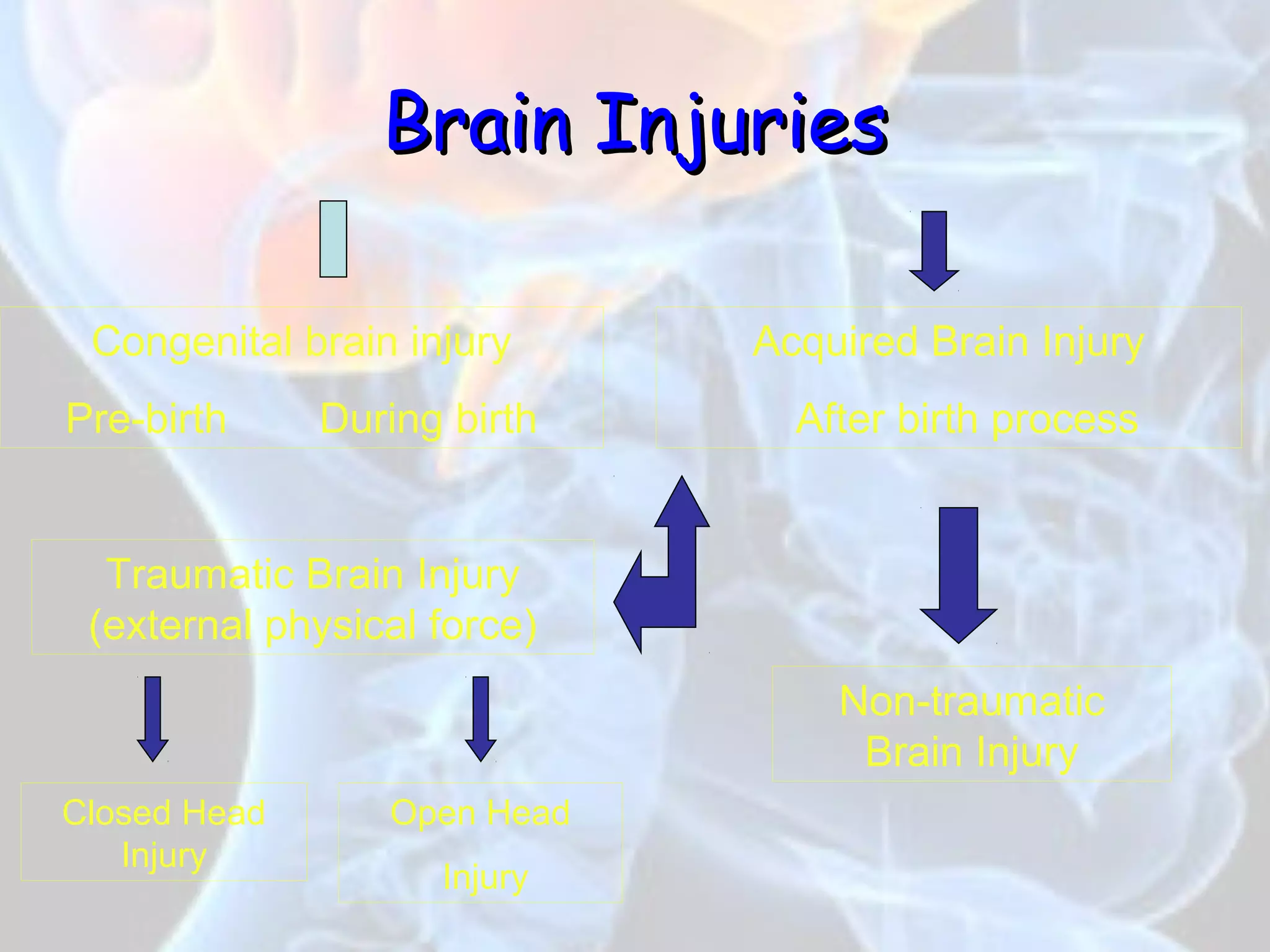
Brain InjuriesBrain Injuries
Congenital brain injury
Pre-birth During birth
Acquired Brain Injury
After birth process
Traumatic Brain Injury
(external physical force)
Non-traumatic
Brain Injury
Closed Head
Injury
Open Head
Injury
What is a TBI?What is a TBI?
Sudden damage to the brain due to anSudden damage to the brain due to an
external forceexternal force
Two types of TBITwo types of TBI
OPEN-HEAD INJURY
(penetrating)
Example:
• Skull fracture that
penetrates the brain
• Gunshot wound
CLOSED-HEAD INJURY
(non penetrating)
when the head forcefullywhen the head forcefully
collides with anothercollides with another
objectobject
Example:
• Coup-Contra Coup
• Diffuse axonal injury
ICD-10 S 06- Intracranial injury
S06.0 Concussion
Commotio cerebri
S06.1 Traumatic cerebral oedema
S06.2 Diffuse brain injury
Cerebral
contusion NOS
laceration NOS
Traumatic compression of brain NOS
S06.3 Focal brain injury
Focal:
cerebral:
contusion
laceration
traumatic intracerebral haemorrhage
S06.4 Epidural haemorrhage
Extradural haemorrhage (traumatic)
S06.5 Traumatic subdural haemorrhage
S06.6 Traumatic subarachnoid haemorrhage
S06.7 Intracranial injury with prolonged coma
S06.8 Other intracranial injuries
Traumatic haemorrhage:
cerebellar
intracranial NOS
S06.9 Intracranial injury, unspecified
Brain injury NOS
Brain Injury Facts
Worldwide
• Brain injury is the leading cause of death
and disability
• Traumatic brain injury is the leading cause
of seizure disorders
• The global incidence rate of TBI is
estimated at 200/100 000 people per year
http://www.internationalbrain.org/?q=brain-injury-facts
http://injuryprevention.bmj.com/content/16/Suppl_1/A17.2.abstract
Brain Injury Facts
(contd.)
United States Europe
01 million hospital
admissions per year
In the south of Europe, the
main cause --traffic
accidents
In the north of Europe, the
major causes- falls,
mainly related to alcohol
use (
Tagliaferri et al 2006)
http://injuryprevention.bmj.com/content/16/Suppl_1/A17.2.abstract
01 million Treated and
released
from hospital
80,000 Some TBI-
related
disability
50,000 die
Males>
females
15-24 years
EpidemiologyEpidemiology
Percentage of Average Annual TBI-related emergency department visits,Percentage of Average Annual TBI-related emergency department visits,
hospitalizations, and deaths, by External Cause, United States, 1995-2001hospitalizations, and deaths, by External Cause, United States, 1995-2001
Falls, 28%
Motor Vehicle-
Traffic, 20%
Struck
By/Against, 19%
Assault, 11%
Unknown,
9%
Other, 7%
Pedal Cycle
(non MV), 3%
Suicide, 1%
Other Transport,
2%
The greatest number of TBIs occur in people aged
15–24
TBI rates are higher in males
Occupational Therapy and Physical Dysfunction: Principles, Skills and Practice.
Edinburgh: Churchill Livingstone. pp. 395–96
TBI in children can beTBI in children can be
especially devastatingespecially devastating
Brain Rates of DevelopmentBrain Rates of Development
P-O
C
T
F-T
P-O
C
F-T P-O
T
C
F-T
5 Distinct
Periods of
Maturation
P - O parietal/
occipital
C central
(limbic &
brainstem)
T temporal
F - T frontal/
temporal
Severity of traumatic brain
injury
GCS PTA LOC
Mild 13-15 <1 day 0-30 min
Moderate 9-12 >1- 14 days >30 min–
6 hrs
Severe 3-8 >14 days >6 hrs
Lishman’s Organic psychiatry, 4th
edition
In severe diffuse traumatic injury:
PTA (weeks) = 0.4 × LOC (days) + 3.6
Katz and Alexander (1994)
Brain ConcussionBrain Concussion
• Impaired function
• No structural damage
• Extreme variance in severity
– LOC
• Diffuse
CONCUSSION vs CONTUSION
CONCUSSION
• Temporary loss of
neurologic function
with no structural
damage lasting for a
few seconds to few
minutes
CONTUSION
• More severe injury in
which the brain is
bruised, with possible
surface hemorrhage
• Unconscious for more
than a few seconds or
minutes
• Picture is somewhat
similar to that of
shock
Coup Contra-Coup InjuryCoup Contra-Coup Injury
Epidural haemorrhage Subdural haemorrhage
Subarachnoid haemorrhage
ManagementManagement
The acute management of severeThe acute management of severe
traumatic brain injury:traumatic brain injury:
– 1. Protect the airway & oxygenation
– 2. Ventilate to normocapnia
– 3. Correct hypovolaemia & hypotension
– 4. CT Scan when appropriate
– 5. Neurosurgery if indicated
– 6. Intensive Care for further monitoring and
management
Significant Head InjuriesSignificant Head Injuries
Signs of increased ICP---Signs of increased ICP---
–Visual difficultiesVisual difficulties
–VomitingVomiting
–DyspneaDyspnea
– BradycardiaBradycardia
How Brain Injuries treated?How Brain Injuries treated?
Interesting findings
The most common areas to have focal
lesions in non-penetrating traumatic brain
injury are the orbitofrontal cortex and the
anterior temporal lobes
"Frontal lobe dysfunction following closed head injury. A review of the literature". Journal of Nervous & Mental
Disorders 178 (5): 282–291. "Deformation of the human brain induced by mild acceleration". Journal of
Neurotrauma 22 (8): 845–856.
"Frontal-subcortical circuits and human behavior".Archives of Neurology 50 (8): 873–880.
"TASIT: A new clinical tool for assessing social perception after traumatic brain injury". Journal of Head Trauma
Rehabilitation 18 (3): 219–238.
Interesting findings (contd.)
• Alexithymia, a deficiency in identifying,
understanding, processing, and describing
emotions occurs in 60.9% of individuals
with TBI
Alexithymia and emotional empathy following traumatic brain injury". J Clin Exp
Neuropsychol 32 (3): 259–67.
Is head injury a risk for
dementia??
β-amyloid protein have been found to
accumulate in about 30% of patients after
TBI and may form plaques
(Roberts et al. 1994; Ikonomovic et al. 2004)
However, some groups have failed to find
elevated Aβ after head injury
(Adle-Biassette et al. 1996; Macfarlane et al. 1999)
PSYCHIATRIC
PROBLEMS
IN
TBI?
Adolf Meyer published comprehensive
case reports about patients who
presented behavior disturbances after
head injuries and proposed a set of
disorders called “traumatic insanities”,
which included consciousness alterations,
psychosis, and neurological symptoms (
Neylan 2000)
Post-traumatic delirium (post-traumatic
confusional state) and post-traumatic
amnesia
Post-traumatic delirium (confusional state)
shows much variation, depending on the
severity of the injury and its complications
Post-traumatic delirium
Apathetic Restless, Irritability Florid delirious states
Withdrawal
Fear, persecutory beliefs, and perplexity are common
Disorientation for time and place is marked at first
Post-traumatic delirium (contd.)
As the confusional state improves,
confabulations come to dominate, almost
always accompanied by lack of insight and
disorientation
Associated with misinterpretation of
surroundings and misidentification of people. It
is not unusual for patients to believe that staff or
other patients on the ward are familiar to them
Hallucinatory experiences may be troublesome;
visual hallucinations are most evident
Post-traumatic agitation
Patient may be abusive, aggressive,
sexually disinhibited
Occurs in about 10% of patients with
severe brain injury (Brooke et al. 1992)
Last a few days
Agitated behavior is associated with
frontotemporal injury and doubles the risk
of later emotional sequelae (van der Naalt et al.
2000).
Post-traumatic amnesia
It ends at the time from which the patient
can later give a clear and consecutive
account of what was happening around
him
Period of unconsciousness + Post-
traumatic delirium
Post-traumatic amnesia (contd.)
A study of orientation during PTA showed
that the usual sequence of recovery was
for person place time (Levin 1990).
Summary of findings for
depression after TBI
Incidence 15.3%–33%
Kim et al 2007 
Prevalence 18.5%–61%
Kim et al 2007 
Abnormalities on CT
Levin et al 2005 
Lower bilateral
hippocampal volume
Jorge et al 2007 
 
 
Volume reduction of the left
prefrontal grey matter
Jorge et al 2004
Unemployment
Seel et al 2003; Dikmen et al 2004; Jorge et al 2004
 
Lower economic status;
aggression; anxiety
Dikmen et al 2004 
Why depression?
Rupture of neural circuits involving the
prefrontal cortex, amygdala,
hippocampus, basal ganglia, and
thalamus may be related to the
development of depression due TBI. (
Jorge and Starkstein 2005)
The hippocampus is an anatomic region
vulnerable to TBI (Campbell and MacQueen 2004)
Treatment of depression in TBI
Citalopram and sertraline (
Turnes-Stokes and MacWalter 2005).
Citalopram (Rapoport et al 2008).
The use of fluoxetine, paroxetine,
venlafaxin, minalcipran, amitryptiline,
desipramine, bupropio presented
generally positive results (Alderfer et al 2005;
Warden et al 2006).
Caution with TCAs
Anticholinergic effects of TCAs can
exacerbate cognitive impairment.
Summary of findings for Mania
after TBI
Incidence 9%
Jorge et al 1999
Prevalence 4.2%
van Reekum et al 2000 
Higher rates for men
van Reekum et al 1996 
Lesions in the temporal basal poles
Jorge et al 1993b; Murai and Fujimoto 2003 
Treatment of Mania in TBI
Valproic acid and lithium, while case
reports pointed out the usefulness of
quetiapine, carbamazepine, clonidine, and
electroconvulsive therapy
(Warden et al 2006; Oster et al 2007)
Summary of findings for
Psychosis after TBI
Incidence 0.1%–9.8%
David and Prince 2007 
Prevalence 0.7%
van Reekum et al 2000  
Damage in frontal and temporal lobes
Achte 1969; Sachdev et al 2001; Fujii and Ahmed 2002a 
Predominance of positive symptoms
Sachdev et al 2001 
Persecutory (56%), reference (22%), control
(22%), and grandiosity (20%).
Fujii and Ahmed (2001)
Treatment of Psychosis in TBI
Typical antipsychotics have
anticholinergic, hypotensive, or sedative
effects, or a strong dopaminergic
antagonism are potentially able to worsen
the already existent deficits for TBI
survivors.
(Feeney et al 1982; Goldstein 1993)
Summary of findings for OCD
after TBI
Prevalence 1.6%–15%
Hibbard et al 1998; Deb et al 1999 
Oribitofrontal cortex, cingulate cortex and caudate
nucleus damage
Berthier et al 2001; Bilgic et al 2004; Ogai et al 2005 
Obsessive slowness; compulsive exercises
practice; aggression
Berthier et al 2001
Summary of findings for PTSD
after TBI
Incidence 11.3%–24%
Bryant and Harvey 1998; Bombardier et al 1999 
Prevalence 3%–27.1%
Bryant et al 2000; Glaesser et al 2004 
Impaired quality of life and social function; chronic
pain
Bryant et al 1999 
Posttraumatic amnesia as a protective factor
Sbordone and Liter 1995; Glaesser et al 2004; Gil et al 2005 
Summary of findings for
Personality change after TBI
Apathy 
Prevalence 34.5% after severe TBI
Pelegrín-Valero et al 2001 
Younger age; more severe TBI
Kant et al 1998 
Affective lability 
Prevalence 5%–32.7%
Zeilig et al 1996; Pelegrín-Valero et al 2001 
Frontal lobe damage; aggression; anxiety
Robinson et al 1993
Aggression 
Prevalence 16.4%–33.7%
Pelegrín-Valero et al 2001; Tateno et al 2003 
Predictors of poor outcome
• “ Poor response to psychiatric medications
• “ Failure in behavioral programs requiring
memory and problem-solving
• “ Social network failure: divorce, separation
• Failure at work
• “Persistence of chronic pain and headache
symptoms
• “Lack of support system
OUTCOME In Severe Brain
injury
Good recovery 25-30%
Moderate disability 15-20%
Sever disability 15%
Vegetative stat 5%
Death 30-35%
Thank you all !!

Traumatic brain injury

  • 1.
    Traumatic brain injury Dr.Syed Faheem Shams MD (Part III) student Dept. of Psychiatry BSMMU
  • 2.
    Objectives Traumatic brain injury- What?Epidemiology? Cause and effect? Types? When to give attention? Why we need to know?
  • 3.
    Brain InjuriesBrain Injuries Congenitalbrain injury Pre-birth During birth Acquired Brain Injury After birth process Traumatic Brain Injury (external physical force) Non-traumatic Brain Injury Closed Head Injury Open Head Injury
  • 4.
    What is aTBI?What is a TBI? Sudden damage to the brain due to anSudden damage to the brain due to an external forceexternal force
  • 5.
    Two types ofTBITwo types of TBI OPEN-HEAD INJURY (penetrating) Example: • Skull fracture that penetrates the brain • Gunshot wound CLOSED-HEAD INJURY (non penetrating) when the head forcefullywhen the head forcefully collides with anothercollides with another objectobject Example: • Coup-Contra Coup • Diffuse axonal injury
  • 6.
    ICD-10 S 06-Intracranial injury S06.0 Concussion Commotio cerebri S06.1 Traumatic cerebral oedema S06.2 Diffuse brain injury Cerebral contusion NOS laceration NOS Traumatic compression of brain NOS S06.3 Focal brain injury Focal: cerebral: contusion laceration traumatic intracerebral haemorrhage S06.4 Epidural haemorrhage Extradural haemorrhage (traumatic) S06.5 Traumatic subdural haemorrhage S06.6 Traumatic subarachnoid haemorrhage S06.7 Intracranial injury with prolonged coma S06.8 Other intracranial injuries Traumatic haemorrhage: cerebellar intracranial NOS S06.9 Intracranial injury, unspecified Brain injury NOS
  • 7.
    Brain Injury Facts Worldwide •Brain injury is the leading cause of death and disability • Traumatic brain injury is the leading cause of seizure disorders • The global incidence rate of TBI is estimated at 200/100 000 people per year http://www.internationalbrain.org/?q=brain-injury-facts http://injuryprevention.bmj.com/content/16/Suppl_1/A17.2.abstract
  • 8.
    Brain Injury Facts (contd.) UnitedStates Europe 01 million hospital admissions per year In the south of Europe, the main cause --traffic accidents In the north of Europe, the major causes- falls, mainly related to alcohol use ( Tagliaferri et al 2006) http://injuryprevention.bmj.com/content/16/Suppl_1/A17.2.abstract 01 million Treated and released from hospital 80,000 Some TBI- related disability 50,000 die Males> females 15-24 years
  • 9.
    EpidemiologyEpidemiology Percentage of AverageAnnual TBI-related emergency department visits,Percentage of Average Annual TBI-related emergency department visits, hospitalizations, and deaths, by External Cause, United States, 1995-2001hospitalizations, and deaths, by External Cause, United States, 1995-2001 Falls, 28% Motor Vehicle- Traffic, 20% Struck By/Against, 19% Assault, 11% Unknown, 9% Other, 7% Pedal Cycle (non MV), 3% Suicide, 1% Other Transport, 2%
  • 10.
    The greatest numberof TBIs occur in people aged 15–24 TBI rates are higher in males Occupational Therapy and Physical Dysfunction: Principles, Skills and Practice. Edinburgh: Churchill Livingstone. pp. 395–96
  • 11.
    TBI in childrencan beTBI in children can be especially devastatingespecially devastating
  • 12.
    Brain Rates ofDevelopmentBrain Rates of Development P-O C T F-T P-O C F-T P-O T C F-T 5 Distinct Periods of Maturation P - O parietal/ occipital C central (limbic & brainstem) T temporal F - T frontal/ temporal
  • 13.
    Severity of traumaticbrain injury GCS PTA LOC Mild 13-15 <1 day 0-30 min Moderate 9-12 >1- 14 days >30 min– 6 hrs Severe 3-8 >14 days >6 hrs Lishman’s Organic psychiatry, 4th edition
  • 14.
    In severe diffusetraumatic injury: PTA (weeks) = 0.4 × LOC (days) + 3.6 Katz and Alexander (1994)
  • 15.
    Brain ConcussionBrain Concussion •Impaired function • No structural damage • Extreme variance in severity – LOC • Diffuse
  • 16.
    CONCUSSION vs CONTUSION CONCUSSION •Temporary loss of neurologic function with no structural damage lasting for a few seconds to few minutes CONTUSION • More severe injury in which the brain is bruised, with possible surface hemorrhage • Unconscious for more than a few seconds or minutes • Picture is somewhat similar to that of shock
  • 17.
    Coup Contra-Coup InjuryCoupContra-Coup Injury
  • 18.
  • 19.
  • 20.
    ManagementManagement The acute managementof severeThe acute management of severe traumatic brain injury:traumatic brain injury: – 1. Protect the airway & oxygenation – 2. Ventilate to normocapnia – 3. Correct hypovolaemia & hypotension – 4. CT Scan when appropriate – 5. Neurosurgery if indicated – 6. Intensive Care for further monitoring and management
  • 21.
    Significant Head InjuriesSignificantHead Injuries Signs of increased ICP---Signs of increased ICP--- –Visual difficultiesVisual difficulties –VomitingVomiting –DyspneaDyspnea – BradycardiaBradycardia
  • 22.
    How Brain Injuriestreated?How Brain Injuries treated?
  • 23.
    Interesting findings The mostcommon areas to have focal lesions in non-penetrating traumatic brain injury are the orbitofrontal cortex and the anterior temporal lobes "Frontal lobe dysfunction following closed head injury. A review of the literature". Journal of Nervous & Mental Disorders 178 (5): 282–291. "Deformation of the human brain induced by mild acceleration". Journal of Neurotrauma 22 (8): 845–856. "Frontal-subcortical circuits and human behavior".Archives of Neurology 50 (8): 873–880. "TASIT: A new clinical tool for assessing social perception after traumatic brain injury". Journal of Head Trauma Rehabilitation 18 (3): 219–238.
  • 24.
    Interesting findings (contd.) •Alexithymia, a deficiency in identifying, understanding, processing, and describing emotions occurs in 60.9% of individuals with TBI Alexithymia and emotional empathy following traumatic brain injury". J Clin Exp Neuropsychol 32 (3): 259–67.
  • 25.
    Is head injurya risk for dementia?? β-amyloid protein have been found to accumulate in about 30% of patients after TBI and may form plaques (Roberts et al. 1994; Ikonomovic et al. 2004) However, some groups have failed to find elevated Aβ after head injury (Adle-Biassette et al. 1996; Macfarlane et al. 1999)
  • 26.
  • 27.
    Adolf Meyer publishedcomprehensive case reports about patients who presented behavior disturbances after head injuries and proposed a set of disorders called “traumatic insanities”, which included consciousness alterations, psychosis, and neurological symptoms ( Neylan 2000)
  • 28.
    Post-traumatic delirium (post-traumatic confusionalstate) and post-traumatic amnesia Post-traumatic delirium (confusional state) shows much variation, depending on the severity of the injury and its complications
  • 29.
    Post-traumatic delirium Apathetic Restless,Irritability Florid delirious states Withdrawal Fear, persecutory beliefs, and perplexity are common Disorientation for time and place is marked at first
  • 30.
    Post-traumatic delirium (contd.) Asthe confusional state improves, confabulations come to dominate, almost always accompanied by lack of insight and disorientation Associated with misinterpretation of surroundings and misidentification of people. It is not unusual for patients to believe that staff or other patients on the ward are familiar to them Hallucinatory experiences may be troublesome; visual hallucinations are most evident
  • 31.
    Post-traumatic agitation Patient maybe abusive, aggressive, sexually disinhibited Occurs in about 10% of patients with severe brain injury (Brooke et al. 1992) Last a few days Agitated behavior is associated with frontotemporal injury and doubles the risk of later emotional sequelae (van der Naalt et al. 2000).
  • 32.
    Post-traumatic amnesia It endsat the time from which the patient can later give a clear and consecutive account of what was happening around him Period of unconsciousness + Post- traumatic delirium
  • 33.
    Post-traumatic amnesia (contd.) Astudy of orientation during PTA showed that the usual sequence of recovery was for person place time (Levin 1990).
  • 34.
    Summary of findingsfor depression after TBI Incidence 15.3%–33% Kim et al 2007  Prevalence 18.5%–61% Kim et al 2007  Abnormalities on CT Levin et al 2005  Lower bilateral hippocampal volume Jorge et al 2007      Volume reduction of the left prefrontal grey matter Jorge et al 2004 Unemployment Seel et al 2003; Dikmen et al 2004; Jorge et al 2004   Lower economic status; aggression; anxiety Dikmen et al 2004 
  • 35.
    Why depression? Rupture ofneural circuits involving the prefrontal cortex, amygdala, hippocampus, basal ganglia, and thalamus may be related to the development of depression due TBI. ( Jorge and Starkstein 2005) The hippocampus is an anatomic region vulnerable to TBI (Campbell and MacQueen 2004)
  • 36.
    Treatment of depressionin TBI Citalopram and sertraline ( Turnes-Stokes and MacWalter 2005). Citalopram (Rapoport et al 2008). The use of fluoxetine, paroxetine, venlafaxin, minalcipran, amitryptiline, desipramine, bupropio presented generally positive results (Alderfer et al 2005; Warden et al 2006).
  • 37.
    Caution with TCAs Anticholinergiceffects of TCAs can exacerbate cognitive impairment.
  • 38.
    Summary of findingsfor Mania after TBI Incidence 9% Jorge et al 1999 Prevalence 4.2% van Reekum et al 2000  Higher rates for men van Reekum et al 1996  Lesions in the temporal basal poles Jorge et al 1993b; Murai and Fujimoto 2003 
  • 39.
    Treatment of Maniain TBI Valproic acid and lithium, while case reports pointed out the usefulness of quetiapine, carbamazepine, clonidine, and electroconvulsive therapy (Warden et al 2006; Oster et al 2007)
  • 40.
    Summary of findingsfor Psychosis after TBI Incidence 0.1%–9.8% David and Prince 2007  Prevalence 0.7% van Reekum et al 2000   Damage in frontal and temporal lobes Achte 1969; Sachdev et al 2001; Fujii and Ahmed 2002a  Predominance of positive symptoms Sachdev et al 2001  Persecutory (56%), reference (22%), control (22%), and grandiosity (20%). Fujii and Ahmed (2001)
  • 41.
    Treatment of Psychosisin TBI Typical antipsychotics have anticholinergic, hypotensive, or sedative effects, or a strong dopaminergic antagonism are potentially able to worsen the already existent deficits for TBI survivors. (Feeney et al 1982; Goldstein 1993)
  • 42.
    Summary of findingsfor OCD after TBI Prevalence 1.6%–15% Hibbard et al 1998; Deb et al 1999  Oribitofrontal cortex, cingulate cortex and caudate nucleus damage Berthier et al 2001; Bilgic et al 2004; Ogai et al 2005  Obsessive slowness; compulsive exercises practice; aggression Berthier et al 2001
  • 43.
    Summary of findingsfor PTSD after TBI Incidence 11.3%–24% Bryant and Harvey 1998; Bombardier et al 1999  Prevalence 3%–27.1% Bryant et al 2000; Glaesser et al 2004  Impaired quality of life and social function; chronic pain Bryant et al 1999  Posttraumatic amnesia as a protective factor Sbordone and Liter 1995; Glaesser et al 2004; Gil et al 2005 
  • 44.
    Summary of findingsfor Personality change after TBI Apathy  Prevalence 34.5% after severe TBI Pelegrín-Valero et al 2001  Younger age; more severe TBI Kant et al 1998  Affective lability  Prevalence 5%–32.7% Zeilig et al 1996; Pelegrín-Valero et al 2001  Frontal lobe damage; aggression; anxiety Robinson et al 1993 Aggression  Prevalence 16.4%–33.7% Pelegrín-Valero et al 2001; Tateno et al 2003 
  • 45.
    Predictors of pooroutcome • “ Poor response to psychiatric medications • “ Failure in behavioral programs requiring memory and problem-solving • “ Social network failure: divorce, separation • Failure at work • “Persistence of chronic pain and headache symptoms • “Lack of support system
  • 46.
    OUTCOME In SevereBrain injury Good recovery 25-30% Moderate disability 15-20% Sever disability 15% Vegetative stat 5% Death 30-35%
  • 48.

Editor's Notes

  • #8 International brain injury association
  • #12 a child’s brain is in an almost constant state of development
  • #14 post-traumatic amnesia (PTA), and loss of consciousness (LOC) Department of Defense and Department of Veterans Affairs 
  • #18 Damage may occur directly under the site of impact, or it may occur on the side opposite the impact (coup and contrecoup injury, respectively). When a moving object impacts the stationary head, coup injuries are typical,while contrecoup injuries are usually produced when the moving head strikes a stationary object
  • #19 Epidural--arterial bleeding,quick onset, less common Subdural-- venous bleeding
  • #22 Pupilary dilatation- serious
  • #24 Areas involved in social behavior, emotion regulation, olfaction, and decision-making, hence the common social/emotional and judgment deficits
  • #25 difficulty identifying feelings and distinguishing between feelings and the bodily sensations of emotional arousal difficulty describing feelings to other people constricted imaginal processes, as evidenced by a scarcity of fantasies
  • #26 The possibility that there may be a statistical link between Alzheimer’s disease and earlier head trauma remains intriguing. This could be explained by increased β-amyloid deposition in the cortex in the wake of trauma (see above). An alternative explanation is that the reduced neuronal reserve brought about by the head injury brings forward the clinical presentation of dementia in those patients who would have developed a dementia anyway, regardless of the head injury.
  • #27 Phineas Gage. his personality changes: from being a responsible and socially well-adapted man, Gage became negligent, irreverent and profane, unable to take responsibility
  • #31 lack of insight into the injury and its effects
  • #32 During the post-traumatic delirium some patients pass through an excitable and overactive phase
  • #36 Low levels of serotonin