Transport across cell
membranes
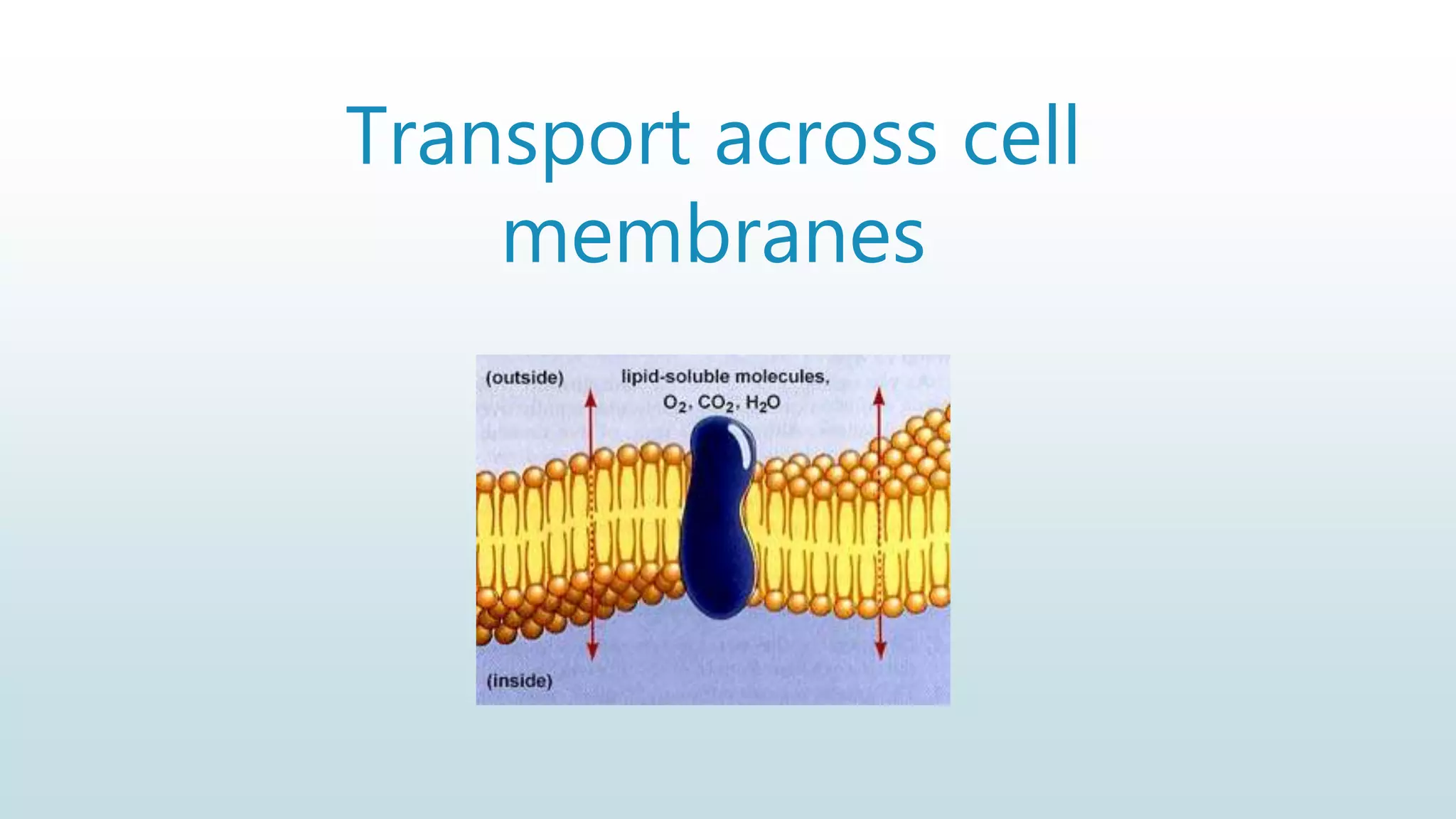
Transport across cell membranes
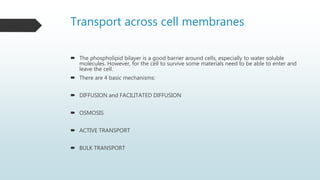
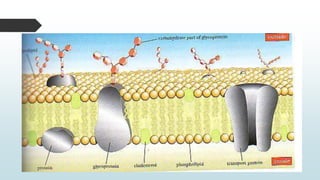
 The phospholipid bilayer is a good barrier around cells, especially to water soluble
molecules. However, for the cell to survive some materials need to be able to enter and
leave the cell.
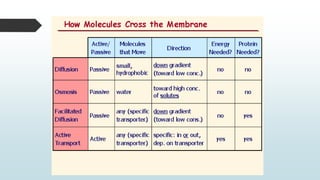
 There are 4 basic mechanisms:
 DIFFUSION and FACILITATED DIFFUSION
 OSMOSIS
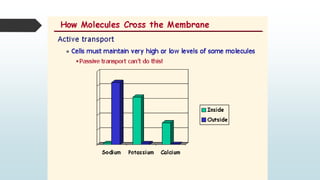
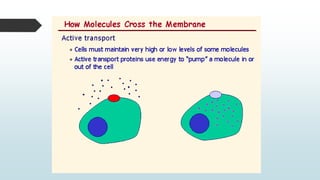
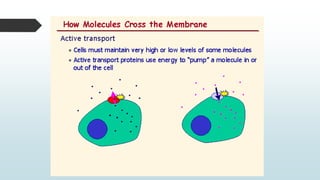
 ACTIVE TRANSPORT
 BULK TRANSPORT
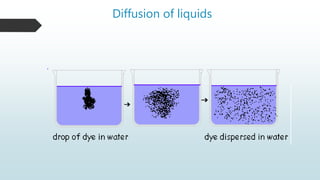
Diffusion of liquids
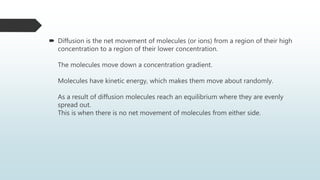
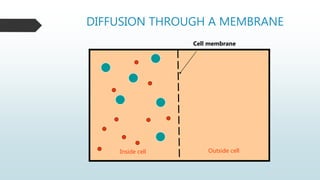
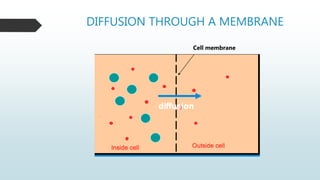
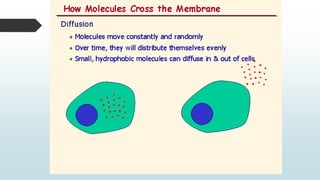
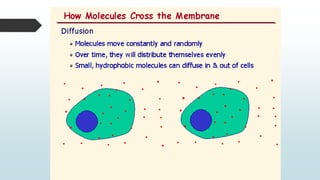
 Diffusion is the net movement of molecules (or ions) from a region of their high
concentration to a region of their lower concentration.
The molecules move down a concentration gradient.
Molecules have kinetic energy, which makes them move about randomly.
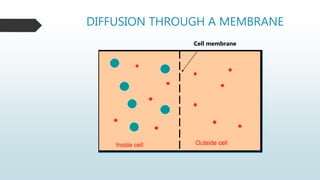
As a result of diffusion molecules reach an equilibrium where they are evenly
spread out.
This is when there is no net movement of molecules from either side.
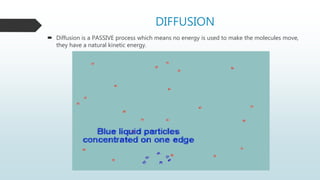
DIFFUSION
 Diffusion is a PASSIVE process which means no energy is used to make the molecules move,
they have a natural kinetic energy.
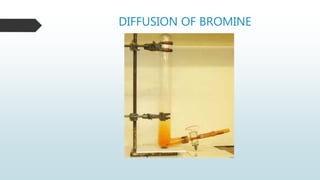
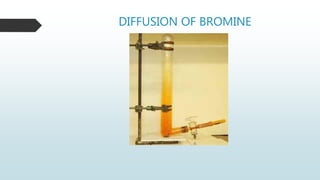
DIFFUSION OF BROMINE
DIFFUSION THROUGH A MEMBRANE
Inside cell Outside cell
Cell membrane
DIFFUSION THROUGH A MEMBRANE
Cell membrane
DIFFUSION THROUGH A MEMBRANE
Cell membrane
What determines the rate of diffusion?
There 4 factors:
 The steepness of the concentration gradient. The bigger the difference between the two sides of
the membrane the quicker the rate of diffusion.
 Temperature. Higher temperatures give molecules or ions more kinetic energy. Molecules move
around faster, so diffusion is faster.
 The surface area. The greater the surface area the faster the diffusion can take place. This is
because the more molecules or ions can cross the membrane at any one moment.
 The type of molecule or ion diffusing. Large molecules need more energy to get them to move so
they tend to diffuse more slowly. Non-polar molecules diffuse more easily than polar molecules
because they are soluble in the non polar phospholipid tails.
Molecules that diffuse through cell
membranes
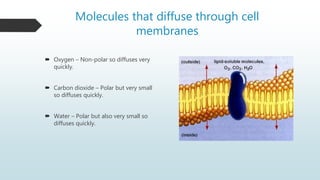
 Oxygen – Non-polar so diffuses very
quickly.
 Carbon dioxide – Polar but very small
so diffuses quickly.
 Water – Polar but also very small so
diffuses quickly.
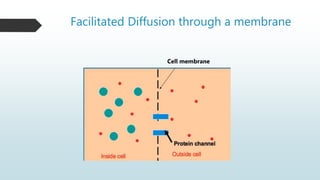
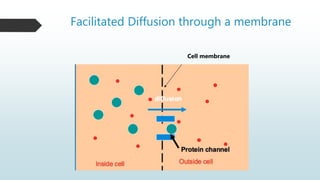
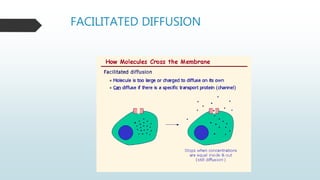
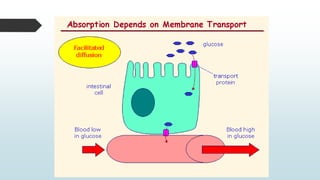
Facilitated diffusion
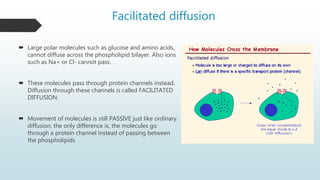
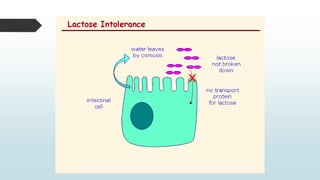
 Large polar molecules such as glucose and amino acids,
cannot diffuse across the phospholipid bilayer. Also ions
such as Na+ or Cl- cannot pass.
 These molecules pass through protein channels instead.
Diffusion through these channels is called FACILITATED
DIFFUSION.
 Movement of molecules is still PASSIVE just like ordinary
diffusion, the only difference is, the molecules go
through a protein channel instead of passing between
the phospholipids
Facilitated Diffusion through a membrane
Cell membrane
Facilitated Diffusion through a membrane
Cell membrane
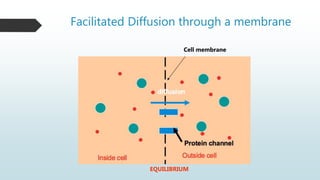
Facilitated Diffusion through a membrane
Cell membrane
EQUILIBRIUM
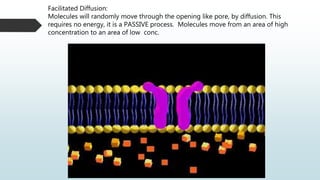
Facilitated Diffusion:
Molecules will randomly move through the opening like pore, by diffusion. This
requires no energy, it is a PASSIVE process. Molecules move from an area of high
concentration to an area of low conc.
FACILITATED DIFFUSION
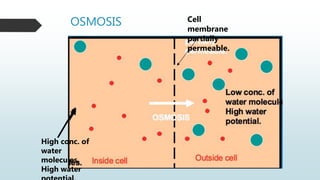
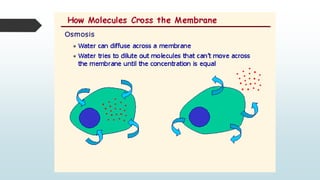
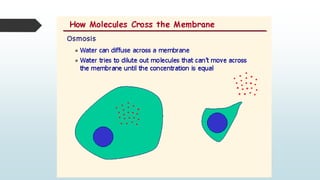
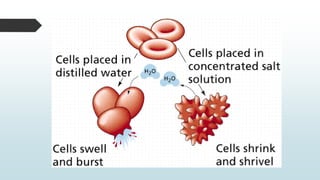
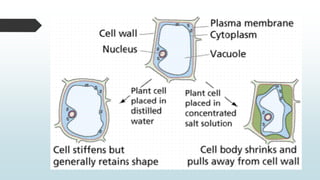
OSMOSIS
‘The diffusion of water from an area of high
concentration of water molecules (high water
potential) to an area of low concentration of water
(low water potential) across a partially permeable
membrane.’
OSMOSIS
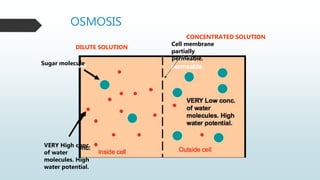
DILUTE SOLUTION
CONCENTRATED SOLUTION
Cell membrane
partially
permeable.
VERY High conc.
of water
molecules. High
water potential.
Sugar molecule
OSMOSIS Cell
membrane
partially
permeable.
High conc. of
water
molecules.
High water
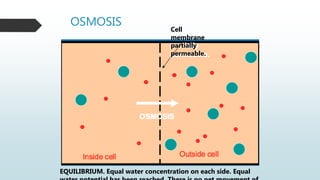
OSMOSIS
Cell
membrane
partially
permeable.
EQUILIBRIUM. Equal water concentration on each side. Equal
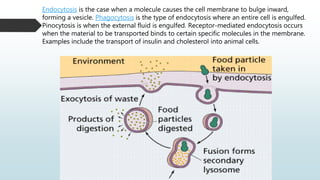
Endocytosis is the case when a molecule causes the cell membrane to bulge inward,
forming a vesicle. Phagocytosis is the type of endocytosis where an entire cell is engulfed.
Pinocytosis is when the external fluid is engulfed. Receptor-mediated endocytosis occurs
when the material to be transported binds to certain specific molecules in the membrane.
Examples include the transport of insulin and cholesterol into animal cells.
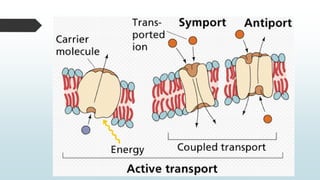
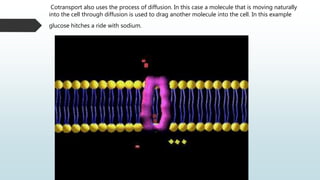
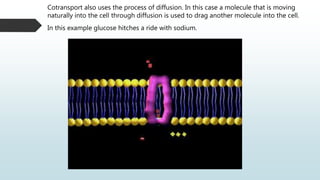
Cotransport also uses the process of diffusion. In this case a molecule that is moving naturally
into the cell through diffusion is used to drag another molecule into the cell. In this example
glucose hitches a ride with sodium.
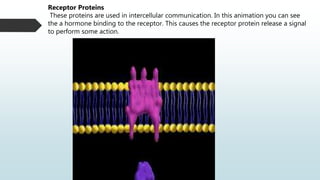
Receptor Proteins
These proteins are used in intercellular communication. In this animation you can see
the a hormone binding to the receptor. This causes the receptor protein release a signal
to perform some action.
Cotransport also uses the process of diffusion. In this case a molecule that is moving
naturally into the cell through diffusion is used to drag another molecule into the cell.
In this example glucose hitches a ride with sodium.
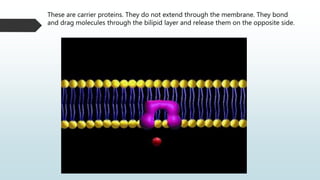
These are carrier proteins. They do not extend through the membrane. They bond
and drag molecules through the bilipid layer and release them on the opposite side.
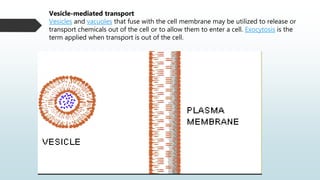
Vesicle-mediated transport
Vesicles and vacuoles that fuse with the cell membrane may be utilized to release or
transport chemicals out of the cell or to allow them to enter a cell. Exocytosis is the
term applied when transport is out of the cell.
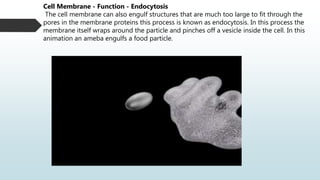
Cell Membrane - Function - Endocytosis
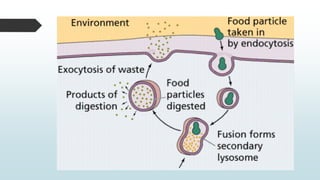
The cell membrane can also engulf structures that are much too large to fit through the
pores in the membrane proteins this process is known as endocytosis. In this process the
membrane itself wraps around the particle and pinches off a vesicle inside the cell. In this
animation an ameba engulfs a food particle.

Transport across cell membrane

  • 1.
  • 2.
    Transport across cellmembranes  The phospholipid bilayer is a good barrier around cells, especially to water soluble molecules. However, for the cell to survive some materials need to be able to enter and leave the cell.  There are 4 basic mechanisms:  DIFFUSION and FACILITATED DIFFUSION  OSMOSIS  ACTIVE TRANSPORT  BULK TRANSPORT
  • 3.
  • 4.
     Diffusion isthe net movement of molecules (or ions) from a region of their high concentration to a region of their lower concentration. The molecules move down a concentration gradient. Molecules have kinetic energy, which makes them move about randomly. As a result of diffusion molecules reach an equilibrium where they are evenly spread out. This is when there is no net movement of molecules from either side.
  • 5.
    DIFFUSION  Diffusion isa PASSIVE process which means no energy is used to make the molecules move, they have a natural kinetic energy.
  • 6.
  • 7.
  • 8.
    DIFFUSION THROUGH AMEMBRANE Inside cell Outside cell Cell membrane
  • 9.
    DIFFUSION THROUGH AMEMBRANE Cell membrane
  • 10.
    DIFFUSION THROUGH AMEMBRANE Cell membrane
  • 13.
    What determines therate of diffusion? There 4 factors:  The steepness of the concentration gradient. The bigger the difference between the two sides of the membrane the quicker the rate of diffusion.  Temperature. Higher temperatures give molecules or ions more kinetic energy. Molecules move around faster, so diffusion is faster.  The surface area. The greater the surface area the faster the diffusion can take place. This is because the more molecules or ions can cross the membrane at any one moment.  The type of molecule or ion diffusing. Large molecules need more energy to get them to move so they tend to diffuse more slowly. Non-polar molecules diffuse more easily than polar molecules because they are soluble in the non polar phospholipid tails.
  • 14.
    Molecules that diffusethrough cell membranes  Oxygen – Non-polar so diffuses very quickly.  Carbon dioxide – Polar but very small so diffuses quickly.  Water – Polar but also very small so diffuses quickly.
  • 15.
    Facilitated diffusion  Largepolar molecules such as glucose and amino acids, cannot diffuse across the phospholipid bilayer. Also ions such as Na+ or Cl- cannot pass.  These molecules pass through protein channels instead. Diffusion through these channels is called FACILITATED DIFFUSION.  Movement of molecules is still PASSIVE just like ordinary diffusion, the only difference is, the molecules go through a protein channel instead of passing between the phospholipids
  • 17.
    Facilitated Diffusion througha membrane Cell membrane
  • 18.
    Facilitated Diffusion througha membrane Cell membrane
  • 19.
    Facilitated Diffusion througha membrane Cell membrane EQUILIBRIUM
  • 20.
    Facilitated Diffusion: Molecules willrandomly move through the opening like pore, by diffusion. This requires no energy, it is a PASSIVE process. Molecules move from an area of high concentration to an area of low conc.
  • 21.
  • 22.
    OSMOSIS ‘The diffusion ofwater from an area of high concentration of water molecules (high water potential) to an area of low concentration of water (low water potential) across a partially permeable membrane.’
  • 23.
    OSMOSIS DILUTE SOLUTION CONCENTRATED SOLUTION Cellmembrane partially permeable. VERY High conc. of water molecules. High water potential. Sugar molecule
  • 24.
  • 25.
  • 37.
    Endocytosis is thecase when a molecule causes the cell membrane to bulge inward, forming a vesicle. Phagocytosis is the type of endocytosis where an entire cell is engulfed. Pinocytosis is when the external fluid is engulfed. Receptor-mediated endocytosis occurs when the material to be transported binds to certain specific molecules in the membrane. Examples include the transport of insulin and cholesterol into animal cells.
  • 39.
    Cotransport also usesthe process of diffusion. In this case a molecule that is moving naturally into the cell through diffusion is used to drag another molecule into the cell. In this example glucose hitches a ride with sodium.
  • 40.
    Receptor Proteins These proteinsare used in intercellular communication. In this animation you can see the a hormone binding to the receptor. This causes the receptor protein release a signal to perform some action.
  • 41.
    Cotransport also usesthe process of diffusion. In this case a molecule that is moving naturally into the cell through diffusion is used to drag another molecule into the cell. In this example glucose hitches a ride with sodium.
  • 42.
    These are carrierproteins. They do not extend through the membrane. They bond and drag molecules through the bilipid layer and release them on the opposite side.
  • 43.
    Vesicle-mediated transport Vesicles andvacuoles that fuse with the cell membrane may be utilized to release or transport chemicals out of the cell or to allow them to enter a cell. Exocytosis is the term applied when transport is out of the cell.
  • 44.
    Cell Membrane -Function - Endocytosis The cell membrane can also engulf structures that are much too large to fit through the pores in the membrane proteins this process is known as endocytosis. In this process the membrane itself wraps around the particle and pinches off a vesicle inside the cell. In this animation an ameba engulfs a food particle.