PRESENTED BY :
HAROON RASHID
MSc Clinical Research
&
RUKAYA AHAD
Bsc Nursing
.
TRANSLATIONAL RESEARCH :
During the 20th century, medical research has observed
enormous advances in basic science discovery.
---We have not witnessed a corresponding success in the
widespread application of these advances into medical
practice
---“It takes an average of 17 years for only 14% of new
scientific discoveries to enter day-to-day clinical practice.”
---Bridging the gap between the discoveries achieved at the
‘bench’ and interventions and therapies at the ‘bedside’
remain a challenge.
.
The National Institutes of Health (NIH) has made
translational research a priority, forming centers of
translational research at its institutes and launching
the Clinical and Translational Science Award (CTSA)
program in 2006. (Roadmap initiative)
By 2012, the NIH expects to fund 60 such centers
with a budget of $500 million per year.
“Effective translation of the new knowledge,
mechanisms, and techniques generated by
advances in basic science research into new
approaches for prevention, diagnosis, and
treatment of disease is essential for improving
health.”
.
‘Translation’ refers to the application of the
results of basic biomedical research to the practice
of medicine.
It is the process of converting discoveries made in
the laboratory into clinical interventions that
provide a direct benefit to human health.
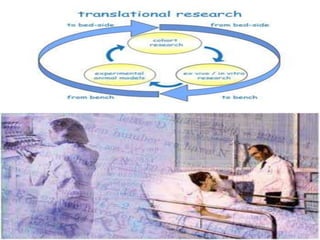
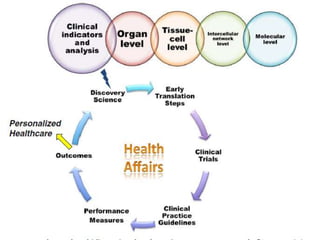
Translation can now occur from bench to bedside
and bedside to bench, often with many journeys in
both directions.
.
The process of new drug discovery involves five
fundamental extrapolations:
1) From physiochemical properties to biology.
2) From in vitro to in vivo (within animals).
3) From animals to healthy human volunteers
(referred to as Phase I)
4) From single doses to multiple doses.
5) From healthy volunteers to patients.
The extrapolation from animals to humans is most
significant and is at the centre of translational
research.
.
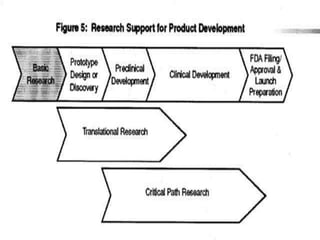
Translational Research is a two-way process to
translate discoveries into clinical application and the
translation of clinical findings into the
understanding of molecular mechanisms.
-- Translates remarkable scientific innovations into
health gains”
-- Accelerates and shortens the process to translate
preclinical knowledge into clinical applications.
-- Plays role in monitoring and managing the
misalignment between the growth in research
spending and the decrease in translational
productivity.
.
TRANSLATIONAL MEDICINE:
Translational Research is the basis for translational
medicine
Translational medicine was initially described as
"the marriage between new discoveries in basic
science and clinical practice"
Translational medicine is the conversion of
promising research outcomes into therapeutic,
diagnostic or preventive agents.
It is the process of turning appropriate biological
discoveries into drugs and medical devices that can
be used in the treatment of patients.
.
Translational medicine has been viewed as a
bidirectional concept, encompassing so-called
bench-to-bedside factors (which aim to increase the
efficiency by which new therapeutic strategies
developed through basic research are tested
clinically) and bedside-to-bench factors (which
provide feedback about the applications of new
treatments and how they could be improved).
The term translational medicine was introduced in
the 1990s but gained wide usage only in the early
2000s to close the gap between “what we know”
and “what we practice.”
.
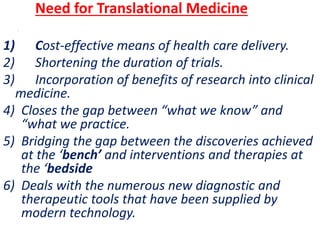
Need for Translational Medicine
1) Cost-effective means of health care delivery.
2) Shortening the duration of trials.
3) Incorporation of benefits of research into clinical
medicine.
4) Closes the gap between “what we know” and
“what we practice.
5) Bridging the gap between the discoveries achieved
at the ‘bench’ and interventions and therapies at
the ‘bedside
6) Deals with the numerous new diagnostic and
therapeutic tools that have been supplied by
modern technology.
.
Clinical Research & Translational Medicine :
Clinical research has been considered as a risky
business with high cost, long timelines to drug
discovery, and complex regulatory components to
assure a safe approach to drug and product
development.
Clinical research is also one of important steps in
Translational Medicine and plays a critical role in
translating discoveries and novel findings into new
and better treatments and putting science to
benefit health care reform.
.
The number of new drugs in drug discovery and
development halved roughly every 9 years since
1950. Toxicity is a common reason for the
frustrating decline in the development of new
therapeutics.
Translational medicine integrates clinical research
with modern methodologies in systems and
computational biology, genomics, proteomics,
metabolomics, pharmacomics, transcriptomics, and
high-throughput image analysis.
Personalized healthcare, treating the right patient
with the right drug at the right dose, becomes more
and more important.
.
How to develop translational Research in medicine?
In industry, better translation as a goal is not
supported by better tools or methods to improve the
translational process -- lack of a scientific backbone.
Those methods and tools to facilitate the
translational process need urgently to be developed.
Key indicators in a translational process, the
biomarkers, which are needed for translational
prediction------ predicting efficacy and safety from
animal to man and could be seen to be accountable
for 80–90% of translational success.
.
Tools of Translational Science in Medicine as
backbone of an emerging science:
• New biomarker development, e.g. imaging or serum
parameters
• Translational toxicology including more powerful
biomarkers
• Biomarker scoring systems to grade their predictive
potency
• Smart, early human study design, including novel
approaches e.g. Micro-dosing and descriptive trials
• Biostatistics development to cope with multiple
read-out problems and small human studies
• Human genetics
.
PHASES OF TRANSLATIONAL MEDICINE:
Phases of translational research include:
• T1 – First phase of translational research, or “Bench to
Bedside,” moves a basic discovery into a clinical
application
• T2 – “Bedside to Practice” research provides evidence of
the value of taking the basic discovery in the clinical
setting
• T3 – Research that moves the evidence-based
guidelines developed in T2 into health practice
• T4 – Research to evaluate the “real world” health
outcomes.
.
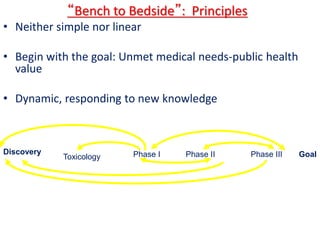
“Bench to Bedside”: Principles
• Neither simple nor linear
• Begin with the goal: Unmet medical needs-public health
value
• Dynamic, responding to new knowledge
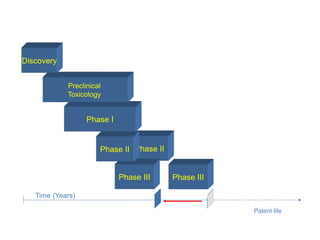
Phase IIIPhase I Phase IIToxicology
Discovery Goal
Phase I
Phase II
Phase III
Preclinical
Toxicology
Patent life
Phase III
Phase II
Phase I
Preclinical
Toxicology
Discovery
Time (Years)
.
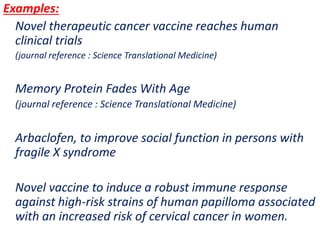
Examples:
Novel therapeutic cancer vaccine reaches human
clinical trials
(journal reference : Science Translational Medicine)
Memory Protein Fades With Age
(journal reference : Science Translational Medicine)
Arbaclofen, to improve social function in persons with
fragile X syndrome
Novel vaccine to induce a robust immune response
against high-risk strains of human papilloma associated
with an increased risk of cervical cancer in women.
.
REFRENCES:
1. Zhou et al. Clinical and Translational Medicine 2012, 1:21
2. Martin Wehling et al. Journal of Translational Medicine
2008, 6:31
3. Steven H. Woolf et al. JAMA, January 9/16, 2008—Vol 299,
No. 2 ; The Meaning of Translational Research and Why It
Matters
4. Khoury et al. ; Genetics IN Medicine October 2007 Vol. 9
No. 10 ; The continuum of translation research in genomic
medicine
5. Gregory Venters et al. Drug Discovery World Spring
2010;The healthcare industry’s evolving role in
translational research
6. Translational Medicine ; An Open Access journal ;
ISSN:2161-1025 ; www.omicsonline.org
7. C. A. Kulikowski, C. W. Kulikowski: Schattauer 2009 ;
Biomedical and Health Informatics in Translational
Medicine
Translational medicine

Translational medicine

  • 1.
    PRESENTED BY : HAROONRASHID MSc Clinical Research & RUKAYA AHAD Bsc Nursing
  • 2.
    . TRANSLATIONAL RESEARCH : Duringthe 20th century, medical research has observed enormous advances in basic science discovery. ---We have not witnessed a corresponding success in the widespread application of these advances into medical practice ---“It takes an average of 17 years for only 14% of new scientific discoveries to enter day-to-day clinical practice.” ---Bridging the gap between the discoveries achieved at the ‘bench’ and interventions and therapies at the ‘bedside’ remain a challenge.
  • 3.
    . The National Institutesof Health (NIH) has made translational research a priority, forming centers of translational research at its institutes and launching the Clinical and Translational Science Award (CTSA) program in 2006. (Roadmap initiative) By 2012, the NIH expects to fund 60 such centers with a budget of $500 million per year. “Effective translation of the new knowledge, mechanisms, and techniques generated by advances in basic science research into new approaches for prevention, diagnosis, and treatment of disease is essential for improving health.”
  • 4.
    . ‘Translation’ refers tothe application of the results of basic biomedical research to the practice of medicine. It is the process of converting discoveries made in the laboratory into clinical interventions that provide a direct benefit to human health. Translation can now occur from bench to bedside and bedside to bench, often with many journeys in both directions.
  • 5.
    . The process ofnew drug discovery involves five fundamental extrapolations: 1) From physiochemical properties to biology. 2) From in vitro to in vivo (within animals). 3) From animals to healthy human volunteers (referred to as Phase I) 4) From single doses to multiple doses. 5) From healthy volunteers to patients. The extrapolation from animals to humans is most significant and is at the centre of translational research.
  • 6.
    . Translational Research isa two-way process to translate discoveries into clinical application and the translation of clinical findings into the understanding of molecular mechanisms. -- Translates remarkable scientific innovations into health gains” -- Accelerates and shortens the process to translate preclinical knowledge into clinical applications. -- Plays role in monitoring and managing the misalignment between the growth in research spending and the decrease in translational productivity.
  • 7.
    . TRANSLATIONAL MEDICINE: Translational Researchis the basis for translational medicine Translational medicine was initially described as "the marriage between new discoveries in basic science and clinical practice" Translational medicine is the conversion of promising research outcomes into therapeutic, diagnostic or preventive agents. It is the process of turning appropriate biological discoveries into drugs and medical devices that can be used in the treatment of patients.
  • 8.
    . Translational medicine hasbeen viewed as a bidirectional concept, encompassing so-called bench-to-bedside factors (which aim to increase the efficiency by which new therapeutic strategies developed through basic research are tested clinically) and bedside-to-bench factors (which provide feedback about the applications of new treatments and how they could be improved). The term translational medicine was introduced in the 1990s but gained wide usage only in the early 2000s to close the gap between “what we know” and “what we practice.”
  • 10.
    . Need for TranslationalMedicine 1) Cost-effective means of health care delivery. 2) Shortening the duration of trials. 3) Incorporation of benefits of research into clinical medicine. 4) Closes the gap between “what we know” and “what we practice. 5) Bridging the gap between the discoveries achieved at the ‘bench’ and interventions and therapies at the ‘bedside 6) Deals with the numerous new diagnostic and therapeutic tools that have been supplied by modern technology.
  • 11.
    . Clinical Research &Translational Medicine : Clinical research has been considered as a risky business with high cost, long timelines to drug discovery, and complex regulatory components to assure a safe approach to drug and product development. Clinical research is also one of important steps in Translational Medicine and plays a critical role in translating discoveries and novel findings into new and better treatments and putting science to benefit health care reform.
  • 12.
    . The number ofnew drugs in drug discovery and development halved roughly every 9 years since 1950. Toxicity is a common reason for the frustrating decline in the development of new therapeutics. Translational medicine integrates clinical research with modern methodologies in systems and computational biology, genomics, proteomics, metabolomics, pharmacomics, transcriptomics, and high-throughput image analysis. Personalized healthcare, treating the right patient with the right drug at the right dose, becomes more and more important.
  • 14.
    . How to developtranslational Research in medicine? In industry, better translation as a goal is not supported by better tools or methods to improve the translational process -- lack of a scientific backbone. Those methods and tools to facilitate the translational process need urgently to be developed. Key indicators in a translational process, the biomarkers, which are needed for translational prediction------ predicting efficacy and safety from animal to man and could be seen to be accountable for 80–90% of translational success.
  • 15.
    . Tools of TranslationalScience in Medicine as backbone of an emerging science: • New biomarker development, e.g. imaging or serum parameters • Translational toxicology including more powerful biomarkers • Biomarker scoring systems to grade their predictive potency • Smart, early human study design, including novel approaches e.g. Micro-dosing and descriptive trials • Biostatistics development to cope with multiple read-out problems and small human studies • Human genetics
  • 16.
    . PHASES OF TRANSLATIONALMEDICINE: Phases of translational research include: • T1 – First phase of translational research, or “Bench to Bedside,” moves a basic discovery into a clinical application • T2 – “Bedside to Practice” research provides evidence of the value of taking the basic discovery in the clinical setting • T3 – Research that moves the evidence-based guidelines developed in T2 into health practice • T4 – Research to evaluate the “real world” health outcomes.
  • 18.
    . “Bench to Bedside”:Principles • Neither simple nor linear • Begin with the goal: Unmet medical needs-public health value • Dynamic, responding to new knowledge Phase IIIPhase I Phase IIToxicology Discovery Goal
  • 19.
    Phase I Phase II PhaseIII Preclinical Toxicology Patent life Phase III Phase II Phase I Preclinical Toxicology Discovery Time (Years)
  • 21.
    . Examples: Novel therapeutic cancervaccine reaches human clinical trials (journal reference : Science Translational Medicine) Memory Protein Fades With Age (journal reference : Science Translational Medicine) Arbaclofen, to improve social function in persons with fragile X syndrome Novel vaccine to induce a robust immune response against high-risk strains of human papilloma associated with an increased risk of cervical cancer in women.
  • 22.
    . REFRENCES: 1. Zhou etal. Clinical and Translational Medicine 2012, 1:21 2. Martin Wehling et al. Journal of Translational Medicine 2008, 6:31 3. Steven H. Woolf et al. JAMA, January 9/16, 2008—Vol 299, No. 2 ; The Meaning of Translational Research and Why It Matters 4. Khoury et al. ; Genetics IN Medicine October 2007 Vol. 9 No. 10 ; The continuum of translation research in genomic medicine 5. Gregory Venters et al. Drug Discovery World Spring 2010;The healthcare industry’s evolving role in translational research 6. Translational Medicine ; An Open Access journal ; ISSN:2161-1025 ; www.omicsonline.org 7. C. A. Kulikowski, C. W. Kulikowski: Schattauer 2009 ; Biomedical and Health Informatics in Translational Medicine